Toward the automatic extraction of knowledge of usable goods
Mei Uemura, Naho Orita, Naoaki Okazaki and Kentaro Inui
Tohoku University, Japan
{mei.uemura, naho, okazaki, inui}@ecei.tohoku.ac.jp
Abstract
Knowledge of usable goods (e.g., tooth-brush is used to clean the teethand tread-mill is used for exercise) is ubiquitous and in constant demand. This study pro-poses semantic labels to capture aspects of knowledge of usable goods and builds a benchmark corpus,Usable Goods Cor-pus, to explore this new semantic labeling
task. Our human annotation experiment shows that human annotators can gener-ally identify pieces of information of usable goods in text. Our first attempt toward the automatic identification of such knowl-edge shows that a model using conditional random fields approaches the human an-notation (F score 73.2%). These results together suggest future directions to build a large-scale corpus and improve the auto-matic identification of knowledge of usable goods.
1 Introduction
A rich body of information extraction techniques focuses on acquiring knowledge from a huge amount of text data (Nickel et al. 2016). This al-lows large-scale knowledge bases to cover a broad range of knowledge. However, an important sub-field of knowledge is not fully addressed: knowl-edge about use of objects such that hand sani-tizer is used to kill bacteria and dental floss is used to remove plaque. Every object that hu-mans create has its own purpose and function. We call these pieces of informationknowledge of usable goods. Knowledge of usable goods is ubiquitous and in constant demand. People use search engines to find information on effect
caused by using a new product, its proper way to use, and so on.
Knowledge sources that contain such informa-tion would also be beneficial for various kinds of natural language processing tasks, such as ques-tion answering systems and textual entailment. However, knowledge of usable goods is not thor-oughly covered by current knowledge bases be-cause these resources focus on entities (e.g. per-son or organization) and their relations (e.g. Is-PresidentOf). Section 4.3 shows the gap be-tween kinds of knowledge available in the cur-rent knowledge bases and the ones that we aim to acquire.
To fill in this gap, this study proposes a set of semantic labels to capture knowledge of us-able goods and builds a benchmark corpus, Us-able Goods Corpus, to explore the automatic
extraction of such knowledge. This work be-gins with focusing on information of health care and household goods such as air freshener, rice cooker, andnasal strip.
We assume that one of the most important aspects of knowledge of usable goods is about effects caused by using/consuming them as in (1). 1
(1) a. Fish-oils ... are known to reduce
inflammation in the body, ... (fish oil)
b. Alcohol-based hand sanitizers are more effective at killing microorganisms than
1Throughout this paper, each typewriter word in a
round bracket (e.g. toothbrush) indicates a name of a usable good that corresponds to the title of Wikipedia article.
Figure 1: Assigned semantic labels for an excerpt from Wikipedia article onfish oil3.
3 Semantic labels for capturing
knowledge of usable goods
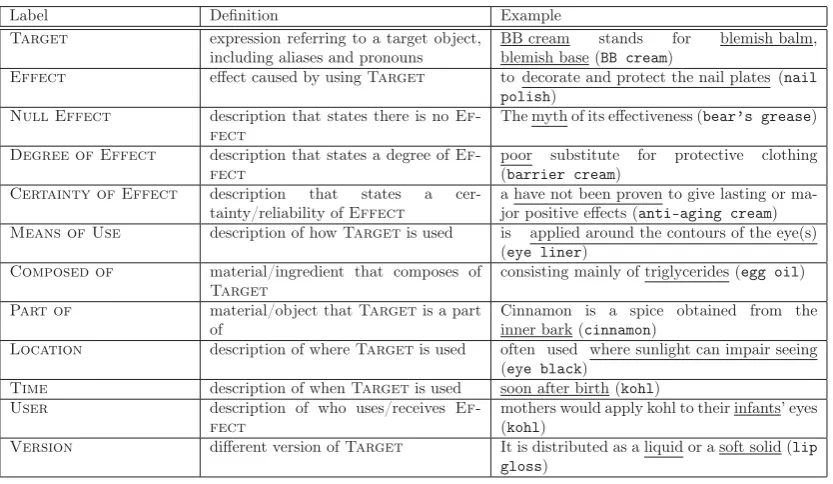
To capture aspects of knowledge of usable goods, we define semantic labels as in Table 1 based on observation of 25 Wikipedia lead sec-tions on health care and household goods. The Wikipedia lead 4 is normally a summary of its most important contents, and therefore it may allow us to get rich information from relatively small amount of data.
As shown in (1), we assume that one of the most important aspects of knowledge of usable goods is about effects caused by the use of goods. We also observe that there are various kinds of information that express degree/certainty of ef-fects and conditions for the occurrence of effects.
3The phraseprecursors of certain eicosanoidsin
Fig-ure 1 is not Composed of for fish oil because this phrase just denotes an explanation of the constituents of fish oil, omega-3 fatty acids eicosapentaenoic acid (EPA)anddocosahexaenoic acid (DHA)are constituents offish oil.
4It is also known as the introduction of a Wikipedia
article, the section before the table of contents and the first heading.
Semantic labels in Table 1 are intended to cap-ture these kinds of information. In addition to these semantic labels, we define a labelTarget
for name and other expressions that refer to a us-able good in the article. Names of usus-able goods essentially correspond to titles of Wikipedia arti-cles, which refer to the topic of the text. Figure 1 shows how these labels are assigned to pieces of information aboutfish oil.
The annotation guidelines are designed to in-crease consistency. We define rules for segmenta-tion in the guidelines, along with definisegmenta-tion and examples of each label. To capture various lin-guistic expressions as illustrated in (1), we do not define a particular syntactic category for each label. All labels can take any type of linguistic constituent, but function words that do not con-tribute to the meaning are not included in each segment to avoid inconsistency. For example, we ask annotators markdefine the eyes inEyeliner is a cosmetic used to define the eyesasEffect
(i.e.,tois not included).
The set of semantic labels in Table 1 proposes a new semantic labeling task. To gauge the com-plexity of this task, we conduct human annota-tion experiment (Secannota-tion 4) and automatic iden-tification experiment (Section 5) as follows.
4 Annotation
We conduct a pilot annotation experiment to measure the complexity of this task. Measures of inter-annotator agreement and distributional analysis of the annotated data provide indi-cations to improve the annotation schema for building a large-scale corpus in the future. This pilot corpus is also used for the automatic iden-tification in Section 5. The following describes our annotation experiment in details.
4.1 Data: snippets from Wikipedia leads
We collect 200 English Wikipedia articles for an-notation. Each article is about a health care or household goods such astoothpaste,tea cosy, and
dishwasher. We choose these items using
Verb phrase transitive 121 (60.8%) ... that can be applied to decorate and protect the nail plates (nail polish) intransitive 14 (7.0%) It generally stays on longer than lipstick (lip stain)
Noun phrase 44 (22.1%) Nail polish is a lacquer (nail polish) Adjective phrase 19 (9.5%) Choline is a water-soluble nutrient (choline)
Sentence 1 (0.5%) ... reports that up to 80% of plaque can be eliminated (dental floss)
Total 199
Table 4: Syntactic distribution ofEffectinstances
ing goods. However, it is possible that exist-ing knowledge bases might have already acquired such knowledge. To examine the coverage of the current knowledge base, we compare Concept-Net (Speer and Havasi 2012) with our corpus.
For comparison, we use 100 usable goods in our corpus such as ice pack, hand sanitizer and
perfume. We then manually select 4 out of 39 pre-defined relations in ConceptNet that could be associated with effect expressions such as
Used For, Capable Of, Causes Desire,
and Causes. Of 100 usable goods, 27 usable
goods have pieces of knowledge that are ex-pressed with the above relations such as hand sanitizer,Causes,clean hand andToothpaste, Capable Of,help remove plaque.
In short, though ConceptNet contains infor-mation of our interest, the coverage is still not sufficient (27/100 usable goods). The automatic extraction of information of usable goods would help populate this kind of knowledge base. The next section shows our initial attempt toward the automatic extraction of knowledge of usable goods.
5 Sequence labeling model for
identifying information of usable goods
This section presents our experiment for au-tomatically identifying information of usable goods. The results provide baseline measures for this new semantic labeling task and suggest potential directions for improvement.
Section 4.3 shows that almost all instances in our corpus occur withTargetin the same
sen-tence. We exploit this distributional property by using Target words as a cue to find
infor-mation of usable goods and pose this task as a sequence labeling problem. We use Conditional
Random Fields (CRFs), a popular approach to solve sequence labeling problems (Lafferty et al. 2001). CRFsuite7 is used as an implementation of CRF for our purpose.
5.1 Experimental Settings
The training and test data consists of 792 sen-tences from 200 Wikipedia snippets (see Section 4.1). We select the four most frequent labels in the corpus, Effect, Means of use, Com-posed ofand Version, for evaluation.
For the data pre-processing, we first parse the raw text and assign a part of speech tag and a named entity tag to each word using Stanford CoreNLP (Manning et al. 2014). Then we add a semantic label to each word with BIO format (Beginning, Inside and Outside).
5.2 Features
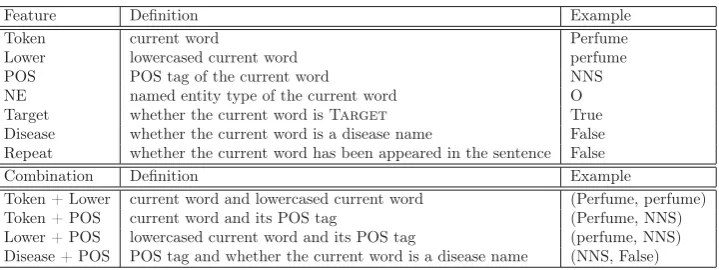
Features shown in Table 5 are used for training. We use these features within a window of ±3 around the current word. Some of these features are used in combination with another feature as shown in Table 5.
In addition to standard features, we add three features to exploit the characteristics of this cor-pus: Target, Disease and Repeat. Target feature is true when the current word is same as the title of Wikipedia article. Disease fea-ture is true when the current word is in a list of disease names that we create using Freebase (Bollacker et al. 2008). This feature is intended to capture effect expressions that include dis-ease names such as provoke allergy and asthma symptoms(air freshener). Repeat feature is true when the current word has already been ap-peared in the sentence. This feature is intended to capture a parallel structure that is often used
Feature Definition Example
Token current word Perfume
Lower lowercased current word perfume
POS POS tag of the current word NNS
NE named entity type of the current word O
Target whether the current word isTarget True
Disease whether the current word is a disease name False Repeat whether the current word has been appeared in the sentence False
Combination Definition Example
Token + Lower current word and lowercased current word (Perfume, perfume) Token + POS current word and its POS tag (Perfume, NNS) Lower + POS lowercased current word and its POS tag (perfume, NNS) Disease + POS POS tag and whether the current word is a disease name (NNS, False)
Table 5: Features
to expressVersionand Composed of.
5.3 Evaluation
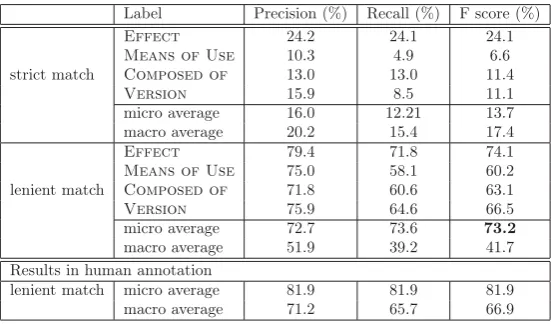
We compute precision, recall and F1 measure using ten fold cross validation. We compute these scores in two ways, lenient match and strict match as in the human annotation experiment (see Section 4.2). Table 6 shows results.
F score in the lenient match (73.2%) ap-proaches the human annotation performance (81.9%). This suggests that the model is able to identify labels to some extent. For exam-ple, the model recognizes typical lexico-syntactic patterns such asbe used toin(wallpaper) is used to cover and decorate the interior walls and be designed to in (rice cooker) is designed to boil or steam rice. Furthermore, the model captures various effect expressions such as an adjective phrase (5a), verb phrase (5b), and gerund (5c).
(5) a. Chandeliers are often ornate, and nor-mally use... (chandelier)
b. A diuretic is any substance that promotes the production of urine. (diuretic)
c. An espresso machine brews coffee by forcing pressurized water near boiling point... (espresso machine)
On the other hand, the segmentation prob-lem as discussed in the human annotation exper-iment influences the F score in the strict match (13.7%).
In sum, though there is the segmentation problem derived from the annotation, the results
in the lenient match suggest that the model can identify information of usable goods to some ex-tent. Improving the annotation schema and in-creasing the size of the corpus would be promis-ing directions for future work.
6 Conclusion
This paper proposes semantic labels to capture aspects of knowledge of usable goods. We de-sign annotation schema and build the bench-mark corpus, Usable Goods Corpus, based
on the proposed semantic labels. Our human an-notation experiment shows that (i) while there is the segmentation mismatch problem, human annotators can generally identify pieces of in-formation of usable goods, and (ii) Wikipedia leads contain a reasonable amount of informa-tion on effects caused by using goods in contrast to the coverage of the current knowledge base. The automatic identification experiment shows that despite of the influence of the segmentation problem in the human annotation, the model can to some extent identify pieces of information of usable goods.
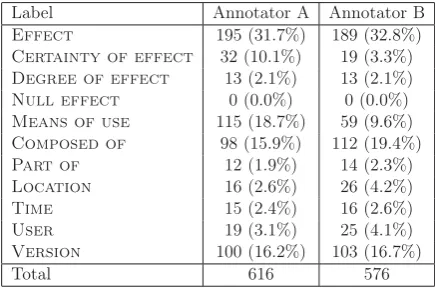
Our next steps are to alleviate the segmenta-tion problem and increase the corpus size. With these goals in mind, we plan to revise the an-notation schema as follows: (a) Some semantic labels do not seem to be important as seen in the statistics in Table 3. Reducing the varia-tion of the semantic labels is a reasonable direc-tion. (b) Defining a syntactic category for each label and giving annotators/models parsed text would increase consistency in the segmentation. (c) These simplifications (a,b) would allow us to
Effect 24.2 24.1 24.1
Means of Use 10.3 4.9 6.6
strict match Composed of 13.0 13.0 11.4
Version 15.9 8.5 11.1
micro average 16.0 12.21 13.7
macro average 20.2 15.4 17.4
Effect 79.4 71.8 74.1
Means of Use 75.0 58.1 60.2
lenient match Composed of 71.8 60.6 63.1
Version 75.9 64.6 66.5
micro average 72.7 73.6 73.2
macro average 51.9 39.2 41.7
Results in human annotation
lenient match micro average 81.9 81.9 81.9
macro average 71.2 65.7 66.9
Table 6: 10-fold cross-validation
try crowdsourcing annotation to increase the size of the corpus.
Acknowledgements
This study is supported by CREST, JST and JSPS KAKENHI Grant Number JP15H05318.
References
Collin F Baker, Charles J Fillmore, and John B Lowe. The Berkeley FrameNet Project. In
Proceedings of the 17th International Confer-ence on Computational Linguistics, pages 86– 90. Association for Computational Linguistics, 1998.
Kurt Bollacker, Colin Evans, Praveen Paritosh, Tim Sturge, and Jamie Taylor. Freebase: A Collaboratively Created Graph Database for Structuring Human Knowledge. In Proceed-ings of ACM Special Interest Group on Man-agement of Data, pages 1247–1250, 2008.
Philipp Cimiano and Johanna Wenderoth. Au-tomatic Acquisition of Ranked Qualia Struc-tures from the Web. InProceedings of the 45th Annual Meeting of the Association for Com-putational Linguistics, pages 888–895, 2007.
Oren Etzioni, Michele Banko, Stephen Soder-land, and Daniel S. Weld. Open information extraction from the web. Communications of the Association for Computing Machinery, 51 (12):68–74, 2008.
Oren Etzioni, Anthony Fader, Janara Chris-tensen, Stephen Soderland, and Mausam.
Open Information Extraction: the Second Generation. In Internartional Joint Confer-ence on Artificial IntelligConfer-ence, pages 3–10, 2011.
Anthony Fader, Stephen Soderland, and Oren Etzioni. Identifying relations for open infor-mation extraction. InProceedings of the Con-ference on Empirical Methods in Natural Lan-guage Processing, pages 1535–1545, 2011.
Harsha Gurulingappa, Abdul Mateen Ra-jput, Angus Roberts, Juliane Fluck, Martin Hofmann-Apitius, and Luca Toldo. Develop-ment of a benchmark corpus to support the automatic extraction of drug-related adverse effects from medical case reports. Journal of biomedical informatics, 45(5):885–892, 2012.
John D. Lafferty, Andrew McCallum, and Fer-nando C. N. Pereira. Conditional Random Fields: Probabilistic Models for Segmenting and Labeling Sequence Data. In Proceedings of the Eighteenth International Conference on Machine Learning, pages 282–289, 2001.
J Richard Landis and Gary G Koch. The Mea-surement of Observer Agreement for Categor-ical Data. Biometrics, 33(1):159–174, 1977.
George A Miller. Wordnet: a lexical database for English. Communications of the Associa-tion for Computing Machinery, 38(11):39–41, 1995.
Maximilian Nickel, Kevin Murphy, Volker Tresp, and Evgeniy Gabrilovich. A Review of Relational Machine Learning for Knowledge Graphs. Proceedings of the Instute of Electri-cal and Electronics Engineers, 104(1):11–33, 2016.
James Pustejovsky. The Generative Lexi-con.Computational linguistics, 17(4):409–441, 1991.
James Pustejovsky, Peter Anick, and Sabine Bergler. Lexical Semantic Techniques for Cor-pus Analysis. Computational Linguistics, 19 (2):331–358, 1993.
Robert Speer and Catherine Havasi. Represent-ing General Relational Knowledge in Concept-Net 5. In Language Resources and Evaluation Conference, pages 3679–3686, 2012.
Pontus Stenetorp, Sampo Pyysalo, Goran Topić, Tomoko Ohta, Sophia Ananiadou, and Jun’ichi Tsujii. BRAT: a Web-based Tool for NLP-Assisted Text Annotation. In Proceed-ings of the Demonstrations at the 13th Euto-pean Chapter of the Association for Computa-tional Linguistics, pages 102–107, 2012.
Ichiro Yamada, Timothy Baldwin, Hideki Sumiyoshi, Masahiro Shibata, and Yagi Nobuyuki. Automatic Acquisition of Qualia Structure from Corpus Data. The Institute of Electronics, Information and Communica-tion Engineers transacCommunica-tions on informaCommunica-tion and systems, 90(10):1534–1541, 2007.