CSEIT17243 | Received : 25 June 2017 | Accepted : 06 July 2017 | July-August-2017 [(2)4: 23-28 ]
International Journal of Scientific Research in Computer Science, Engineering and Information Technology © 2017 IJSRCSEIT | Volume 2 | Issue 4 | ISSN : 2456-3307
23
Direct Sequence Based Comparative Simulation Evaluation of
AODV and OLSR Protocol for 11 Mbps Data Rate Using OPNET
Indu
1, Sandeep Gupta
2, Jonish
3¹M-Tech Department of CSE, HCE, Sonepat, Haryana, India ²Assistant Professor, Department of CSE, HCE, Sonepat, Haryana, India
³Department of CSE, Sonepat, Haryana, India
ABSTRACT
In this paper analysis of the performance of AODV and OLSR routing protocols is done with the use of OPNET simulation tool, we created a 18 mobile nodes networks on data rate 11 Mbps and transmission power 0.005 watts with buffer size 256000 bits the time of simulation was 1500 sec. Routing protocols are compared in terms of FTP Download Response Time (sec), HTTP Page Response Time (sec), WLAN Delay (sec) WLAN Retransmission Attempts (packets) in scenario for the simulation analysis and performances. According to the resulted performance OLSRSPL performed best in cases we considered. The simulation result of the research has practical reference value for further study.
Keywords : AODV, OLSR, MANET, QOS, OPNET
I.
INTRODUCTION
As wireless communication technology is increasing, people are expecting to be able to use their network terminals anywhere and anytime. Examples of such terminals are PDAs and laptops. Wireless connectivity to the network gives users the freedom of movement they desire. These networks consist of mobile nodes and networks which themselves creates the under laying architecture for communication. Because of this, no pre-existing routers are needed. In ad hoc networks, as mentioned above, the nodes are responsible for routing and forwarding of packets themselves.
If the wireless nodes are within range of each other, no routing is necessary. But, on the other hand, if the nodes have moved out of range from each other, and therefore are not able to communicate directly, intermediate nodes are needed to make up the network in which the packets are to be transmitted and the success of communication depends on cooperation of other nodes. Traditional routing protocols are not designed for rapid changing environments such as ad hoc networks. Therefore, customized routing protocols are needed. Examples of such protocols are AODV and OLSR.
Due to the dynamic nature the network topology keep changes randomly. [1]The Optimized Link State Routing (OLSR) is a table-driven, proactive routing protocol which is an optimization of pure link state protocols in that it reduces the size of control packet as well as the number of control packets transmission required.[2] OLSR is well suited to large and dense mobile networks.
Routing protocol is the major issue of performance of MANET. Hence, routing protocol required is to be effective and accurate so as to handle mobility of nodes and to give best utilization to technology. In this paper performance of AODV and OLSR protocols are evaluated by using FTP and HTTP application type of IEEE 802.11a/b/g WLAN Standard Direct Sequence.
II.
RELATED WORK
very limited in resources like CPU capacity, storage capacity, battery lifetime and bandwidth. The routing protocol should minimize the control traffic and calculate route only when they receive request. In this paper they present simulation analysis of the AODV Protocol consider two networks one having smaller nodes and other having larger nodes.
Jonish [2] analyzed the performance of OLSR and TORA routing protocols using OPNET Simulation tool he created a network containing 50 mobile nodes with data rate 1 Mbps and 2 Mbps with transmission power 0.005 watts and buffer size 256000 bits each node moves randomly in the network and simulation time was 1500 sec. TORA and OLSR routing protocols were compared in terms of Traffic Received, Traffic Sent, Network Load, Retransmission Attempts and Throughput. According to the resulted performance OLSR performed better then TORA in both 1 Mbps and 2 Mbps.
Anjali [3] analyzed the performance of AODV, OLSR and GRP routing protocols is evaluated for FTP based application traffic on IEEE 802.11 WLAN Standard and 48 Mbps data rate. The network performance is evaluated by using OPNET simulator based on various quantitative metrics- Network Load, Throughput, Retransmission Attempts and Media Access Delay by varying physical characteristics and number of nodes. A comparative performance analysis of these protocols have been carried out in this paper and in the last conclusion will be presented which demonstrate that performance of routing protocols differs by varying the network and selection of accurate routing protocol according to the network ultimately influences the efficiency of the network in a magnificent way.
III.
ROUTING SECURITY AND SERVICE
Due to the fact that the nodes in a wireless ad hoc network communicate on a shared medium, security becomes an important issue. There are different ways of compromising wireless networks, including: Denial of service: An attacker makes services unavailable by keeping the service provider busy Resource consumption: Battery power of critical nodes is depleted because of unnecessary processing done by an attacker, or the attacker causes buffer overflow which can lead to important data packets being dropped. Host impersonation: As the name suggests, a compromised
node may impersonate a host, and thereby cause wrong route entry tables. Providing quality of service (QoS) in a wireless ad hoc network is a difficult task to overcome. Nodes in such a network act both as clients and service providers, making, contrary to most networks, the boundary between network and host is less clear. Hence, to achieve QoS, a better coordination between the nodes is required. Different applications have different QoS parameter requirements. Whereas multimedia applications require high bandwidth and low delay, availability is the primary requirement for search-and-rescue operation applications. QoS parameters should be considered for route decisions. Throughput, packet loss rate, and reliability are examples of such parameters.
IV.
SIMLATION SETUP
We used software known as OPNET Modeler to work, which is a tool provided by the OPNET Technologies in order to undertake the comparative simulation evaluation; the version named OPNET Modeler 14.5 has been adopted for study [7]. OPNET is one of the most extensively used commercial simulators based on Microsoft Windows platform, which incorporates most of the MANET routing parameters compared to other commercial simulators. It simulates the network graphically and gives the graphical structure of actual networks and network components.
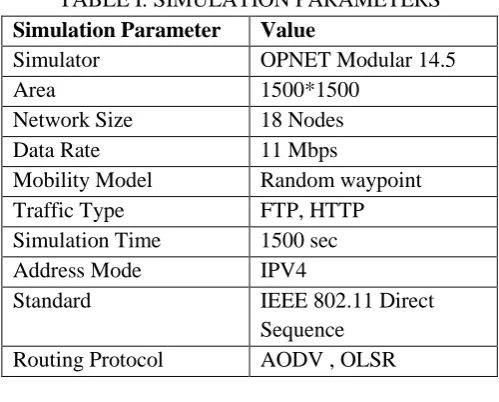
TABLE I: SIMULATION PARAMETERS
Simulation Parameter Value
Simulator OPNET Modular 14.5
Area 1500*1500
Network Size 18 Nodes
Data Rate 11 Mbps
Mobility Model Random waypoint Traffic Type FTP, HTTP Simulation Time 1500 sec Address Mode IPV4
Standard IEEE 802.11 Direct Sequence
Routing Protocol AODV , OLSR
TABLE II: AODV PARAMETERS
Attribute AODV Value AODVSPL Value
Hello Interval(sec)
Allowed Hello
Local Repair Enabled Enabled Addressing
Mode
IPV4 IPV4
TABLE III: OLSR PARAMETERS
Attribute OLSR Value OLSRSPL Value
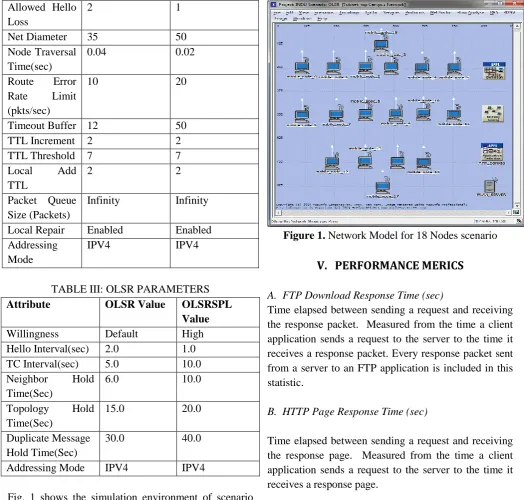
Willingness Default High Hello Interval(sec) 2.0 1.0 containing 18 WLAN mobile nodes, one fixed WLAN Server, Application definition, Profile definition and Mobility config. We configured the nodes in the scenario to work with 11 Mbps data rate.
Figure 1. Network Model for 18 Nodes scenario
V.
PERFORMANCE MERICS
A. FTP Download Response Time (sec)
Time elapsed between sending a request and receiving the response packet. Measured from the time a client application sends a request to the server to the time it receives a response packet. Every response packet sent from a server to an FTP application is included in this statistic.
B. HTTP Page Response Time (sec)
Time elapsed between sending a request and receiving the response page. Measured from the time a client application sends a request to the server to the time it receives a response page.
C. WLAN Delay (sec)
It is the time taken by a packet from the movement it is transmitted on the network by source node to reach the destination node.
D. WLAN Retransmission Attempts (packets)
VI.
SIMULATION RESULTS AND ANALYSIS
Figure 2. Execution Window
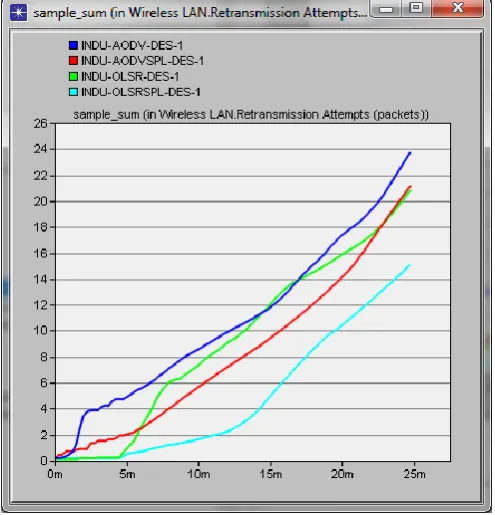
Figure (2 - 6) below shows FTP Download Response Time(sec), HTTP Page Response Time (sec), WLAN Delay (sec) WLAN Retransmission Attempts (packets) in 18 mobile nodes scenario for IEEE 802.11 standard 11 MBPS data rate with OLSR and AODV. The color scheme is showing the protocols behavior in different graphs which gives the average values. From these average values we will conclude the behavior of all these routing protocols.
A. FTP Download Response Time (sec)
Figure 3. Sample Sum for FTP Download Response Time (sec) for AODV and OLSR 11 Mbps
According to simulation, as we can see in Fig. 3, FTP Download Response time OLSRSPL performed best.
B. HTTP Page Response Time (sec)
Figure 4. Sample Sum for HTTP Page Response Time (sec) for AODV and OLSR in 11 Mbps
According to simulation, as we can see in Fig. 4,
HTTP Page Response Time (sec)
OLSRSPL
performed best.
C. WLAN Delay (Sec)
Figure 5. Sample Sum for Wireless LAN Delay for AODV and OLSR in 11 Mbps
According to simulation, as we can see in Fig. 5,
WLAN Delay (Sec) OLSRSPL performed best.
Figure 6. Sample Sum for WLAN Retransmission Attempts (packets) in 11 Mbps for AODV and OLSR
According to simulation, as we can see in Fig. 5, that AODV for 11 Mbps have highest retransmission attempts than all so it performed better of all.
VII.
CONCLUSION
In this paper performance of AODV and OLSR are evaluated for metrics like FTP Download Response Time (sec), HTTP Page Response Time (sec), WLAN Delay (sec) WLAN Retransmission Attempts (packets) by using 18 nodes scenario with IEEE 802.11 Direct Sequence WLAN Standard in 11 Mbps data rate. From the above discussion we find out that below tabled reference value for further study.
VIII.
REFERNCES
[1] Sandeep Kaur, Nitin Bhatia, “Simulation Analysis of AODV Routing Protocol of MANET using OPNET”, IJCST Vol. 2, pp.389-391, Issue 3, September 2011.
[2] Jonish1, Kapil Chawla2,”Frequency Hopping Based Performance Evaluation of TORA and OLSR Routing Protocols Using OPNET”, IJCSMC, Vol. 3, Issue. 11, November 2014, pg.514 – 522
[3] Anjali, Maninder Singh, “Performance Analysis of Proactive, Reactive and Hybrid MANET Routing Protocols on IEEE 802.11 Standard”, International Journal of Computer Applications,pp.1-8,Volume 54-No.12,September 2012.
[4] Anjali, Maninder Singh, “Simulation and Performance Analysis of AODV,OLSR,GRP Routing Protocol by considering IEEE 802.11Standard”,IJARCSSE,Volume2 ,issue 6, pp-171-178,June 2012.
[5] Ravinder Ahuja, “Simulation based Performance Evaluation and Comparison of Reactive, Proactive and Hybrid Routing Protocols based on Random Waypoint Mobility Model”, International Journal of Computer Applications, Vol. 7, No.11, pp. 20-24, Oct. 2010.
[6] Guo, L, and Peng, Y. (2010) “Performance evaluation for on-demand routing protocol based on OPNET modules in wireless mesh network” Computer and Electrical Engineering (Elsevier), vol. 37(2011), pp. 106-114.
International Journal of Distributed and Parallel Systems (IJDPS) Vol.2, No.1, January 2011. [8] Opnet Technologies, Inc. “Opnet Simulator,”
Internet: