CSEIT1723262 | Received : 05 June 2017 | Accepted : 13 June 2017 | May-June-2017 [(2)3: 772-776]
International Journal of Scientific Research in Computer Science, Engineering and Information Technology © 2017 IJSRCSEIT | Volume 2 | Issue 3 | ISSN : 2456-3307
772
Provable Multicopy Dynamic Data Possession in Cloud
Computing
Manasa.B. K, Bhavya B M
MCA Department, P.E.S. College of Engineering, Mandya, Karnataka, India
ABSTRACT
use multi-authority ABE (MA-ABE) to improve the security and avoid key escrow problem. Each attribute authority (AA) in it governs a disjoint subset of user role attributes, while none of them alone is able to control the security of the whole system. We propose mechanisms for key distribution and encryption so that PHR owners can specify personalized fine-grained role-based access policies during file encryption. In the personal domain, owners directly assign access privileges for personal users and encrypt a PHR file under its data attributes. Furthermore, we enhance MA-ABE by putting forward an efficient and on-demand user/attribute revocation scheme, and prove its security under standard security assumptions. In this way, patients have full privacy control over their PHRs. (3) We provide a thorough analysis of the complexity and scalability of our proposed secure PHR sharing solution, in terms of multiple metrics in computation, communication, storage and key management. We also compare our scheme to several previous ones in complexity, scalability and security. Furthermore, we demonstrate the efficiency of our scheme by implementing it on a modern workstation and performing experiments/simulations.
Keywords : PDP, CSP, Dynamic Data, MB-MDDP, MDDP, PHR, MA-ABE
I.
INTRODUCTION
Outsourcing data to a remote cloud service provider (CSP) allows organizations to store more data on the CSP than on private computer systems. Such outsourcing of data storage enables organizations to concentrate on innovations and relieves the burden of constant server updates and other computing issues. Moreover, many authorized users can access the remotely stored data from different geographic locations making it more convenient for them. Once the data has been outsourced to a remote CSP which may not be trustworthy, the data owners lose the direct control over their sensitive data. This lack of control raises new formidable and challenging tasks related to data confidentiality and integrity protection in cloud computing. The confidentiality issue can be handled by encrypting sensitive data before outsourcing to remote servers. As such, it is a crucial demand of customers to have a strong evidence that the cloud servers still possess their data and it is not being tampered with or partially deleted over time. Consequently, many researchers have focused on the problem of provable data possession (PDP) and proposed different schemes to audit the data stored on remote servers. PDP is a technique for validating data integrity over remote servers. In a typical PDP model, the data owner generates some metadata/information for a data file to be used later for verification purposes through a
challenge-response protocol with the remote/cloud
server. The owner sends the file to be stored on a
remote server which may be un trusted, and deletes the local copy of the file. As a proof that the server is still possessing the data file in its original form, it needs to correctly compute a response to a challenge vector sent from a verifier who can be the original data owner or a trusted entity that shares some information with the owner. Researchers have proposed different variations of PDP schemes under different cryptographic assumptions.
One of the core design principles of outsourcing data is to provide dynamic behavior of data for various applications. This means that the remotely stored data can be not only accessed by the authorized users, but also updated and scaled (through block level operations) by the data owner.
PDP schemes presented in focus on only static or warehoused data, where the outsourced data is kept unchanged over remote servers. Examples of PDP constructions that deal with dynamic data. The latter are however for a single copy of the data file. Although PDP schemes have been presented for multiple copies
of static data to the best of our knowledge, this work is
the first PDP scheme directly dealing with multiple
we discuss a slight modification to be applied to the proposed scheme.
II.
METHODS AND MATERIAL
A. Main Contributions
Our contributions can be summarized as follows: We propose a map-based multi-copy dynamic data possession (MB-MDDP) scheme. This scheme provides an adequate guarantee that the CSP stores all copies that are agreed upon in the service contract. Moreover, the scheme supports outsourcing of dynamic data, i.e., it supports block-level operations such as block modification, insertion, deletion, and append. The authorized users, who have the right to access the owner’s file, can seamlessly access the copies received from the CSP. • We give a thorough comparison of MB-MDDP with a reference scheme, which one can obtain by extending existing PDP models for dynamic single-copy data. We also report our implementation and experiments using Amazon cloud platform. We show the security of our scheme against colluding servers, and discuss a slight modification of the proposed scheme to identify corrupted copies. Remark 1: Proof of retrievability (POR) is a complementary approach to PDP, and is stronger than PDP in the sense that the verifier can reconstruct the entire file from responses that are reliably transmitted from the server. This is due to encoding of the data file, for example using erasure codes, before outsourcing to remote servers. Various POR schemes can be found in the literature, which focus on static data. In this work, we do not encode the data to be outsourced for the following reasons. First, we are dealing with dynamic data, and hence if the data file is encoded before outsourcing, modifying a portion of the file requires re-encoding the data file which may not be acceptable in practical applications due to high computation overhead. Second, we are considering economically-motivated CSPs that may attempt to use less storage than required by the service contract through deletion of a few copies of the file. The CSPs have almost no financial benefit by deleting only a small portion of a copy of the file. Third, and more importantly, unlike erasure codes, duplicating data files across multiple servers achieves scalability which is a fundamental customer requirement in CC systems. A file that is duplicated and stored strategically on multiple servers – located at various geographic locations – can help
reduce access time and communication cost for users. Besides, a server’s copy can be reconstructed even from a complete damage using duplicated copies on other servers.
B. Paper Organization
The remainder of the paper is organized as follow. Our system and assumptions are presented in Section II. The proposed scheme is elaborated in Section III. The performance analysis is shown in Section IV. Section V presents the implementation and experimental results using Amazon cloud platform. How to identify the corrupted copies is discussed in Section VI. Concluding remarks are given in Section VII.
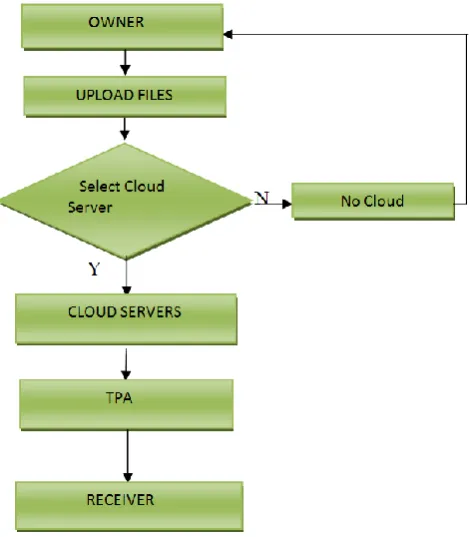
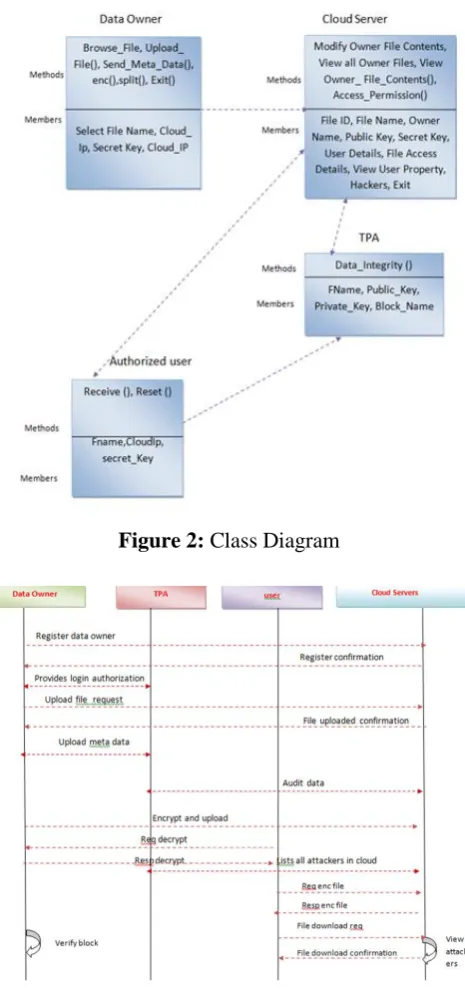
System Design:
Figure 2: Class Diagram
Figure 3: Sequence Diagram
III.
RESULTS AND DISCUSSION
System Analysis
Existing System
Once the data has been outsourced to a remote CSP which may not be trustworthy, the data owners lose the direct control over their sensitive data. This lack of control raises new formidable and challenging tasks related to data confidentiality and integrity protection in cloud computing. The confidentiality issue can be handled by encrypting sensitive data before
outsourcing to remote servers. As such, it is a crucial demand of customers to have a strong evidence that the cloud servers still possess their data and it is not being tampered with or partially deleted over time. Consequently, many researchers have focused on the problem of provable data possession (PDP) and proposed different schemes to audit the data stored on remote servers.
One of the core design principles of outsourcing data is to provide dynamic behavior of data for various applications. This means that the remotely stored data can be not only accessed by the authorized users, but also updated and scaled (through block level operations) by the data owner.
PDP schemes presented focus on only static or warehoused data, where the outsourced data is kept unchanged over remote servers. Examples of PDP constructions that deal with dynamic data. The latter are however for a single copy of the data file.
Proposed System
When verifying multiple data copies, the overall system integrity check fails if there is one or more corrupted copies. To address this issue and recognize which copies have been corrupted, we discuss a slight modification to be applied to the proposed scheme.
We propose a map-based provable multi-copy dynamic data possession (MB-PMDDP) scheme. This scheme provides an adequate guarantee that the CSP stores all copies that are agreed upon in the service contract. Moreover, the scheme supports outsourcing of dynamic data, i.e., it supports block-level operations such as block modification, insertion, deletion, and append. The authorized users, who have the right to access the owner’s file, can seamlessly access the copies received from the CSP.
We give a thorough comparison of MB-PMDDP with a reference scheme, which one can obtain by extending existing PDP models for dynamic single-copy data.
In this work, we do not encode the data to be outsourced for the following reasons. First, we are dealing with dynamic data, and hence if the data file is encoded before outsourcing, modifying a portion of the file requires re-encoding the data file which may not be acceptable in practical applications due to high computation overhead.
Second, we are considering economically-motivated CSPs that may attempt to use less storage than required by the service contract through deletion of a few copies of the file. The CSPs have almost no financial benefit by deleting only a small portion of a copy of the file.
Third, and more importantly, unlike erasure codes, duplicating data files across multiple servers achieves scalability, which is a fundamental customer requirement in CC systems. A file that is duplicated and stored strategically on multiple servers – located at various geographic locations
IV.CONCLUSION
Outsourcing data to remote servers has become a growing trend for many organizations to Alleviate the burden of local data storage and maintenance. In this work we have studied the problem of creating multiple copies of dynamic data file and verifying those copies stored on untrusted cloud servers. We have proposed a new PDP scheme (referred to as MB-MDDP), which supports outsourcing of multi-copy dynamic data, where the data owner is capable of not only archiving and accessing the data copies stored by the CSP, but also updating and scaling these copies on the remote servers. To the best of our knowledge, the proposed scheme is the first to address multiple copies of
dynamic data. The interaction between the authorized
users and the CSP is considered in our scheme, where the authorized users can seamlessly access a data copy received from the CSP using a single secret key shared with the data owner. Moreover, the proposed scheme supports public verifiability, enables arbitrary number of auditing, and allows possession-free verification where the verifier has the ability to verify the data integrity even though he neither possesses nor retrieves the file blocks from the server. Through performance analysis and experimental results, we have demonstrated that the proposed MB-MDDP scheme outperforms the TB-MDDP approach derived from a class of dynamic single-copy PDP models. The
TB-MDDP leads to high storage overhead on the remote servers and high computations on both the CSP and the verifier sides. The MB-MDDP scheme significantly reduces the computation time during the challenge-response phase, which makes it more practical for applications where a large number of verifiers are connected to the CSP causing a huge computation overhead on the servers. Besides, it has lower storage overhead on the CSP, and thus reduces the fees paid by the cloud customers. The dynamic block operations of the map-based approach are done with less integrity," in Proc. 10th Int. Conf. Inf. Commun. Secur. (ICICS), 2008, pp. 419–434.
[3]. Y. Deswarte, J.-J. Quisquater, and A. Saïdane, "Remote integrity checking," in Proc. 6th Working Conf. Integr. Internal Control Inf. Syst. (IICIS), 2003, pp. 1–11.
[4]. D. L. G. Filho and P. S. L. M. Barreto, "Demonstrating data possession and uncheatable data transfer," IACR (International Association for Cryptologic Research) ePrint Archive, Tech. Rep. 2006/150, 2006.
[7]. M. A. Shah, M. Baker, J. C. Mogul, and R. Swaminathan, "Auditing to keep online storage services honest," in Proc. 11th USENIX Workshop Hot Topics Oper. Syst. (HOTOS), Berkeley, CA, USA, 2007, pp. 1–6.
[8]. M. A. Shah, R. Swaminathan, and M. Baker, "Privacy-preserving audit and extraction of digital contents," IACR Cryptology ePrint Archive, Tech. Rep. 2008/186, 2008.
[9]. E. Mykletun, M. Narasimha, and G. Tsudik, "Authentication and integrity in outsourced databases," ACM Trans. Storage, vol. 2, no. 2, pp. 107–138, 2006.