Annotating Arguments: The NOMAD Collaborative Annotation Tool
Georgios Petasis
Software and Knowledge Engineering Laboratory Institute of Informatics and Telecommunications National Centre for Scientific Research (N.C.S.R.) “Demokritos”
GR-153 10, P.O. BOX 60228, Aghia Paraskevi, Athens, Greece [email protected]
Abstract
The huge amount of the available information in the Web creates the need for effective information extraction systems that are able to produce metadata that satisfy user’s information needs. The development of such systems, in the majority of cases, depends on the availability of an appropriately annotated corpus in order to learn or evaluate extraction models. The production of such corpora can be significantly facilitated by annotation tools, which provide user-friendly facilities and enable annotators to annotate documents according to a predefined annotation schema. However, the construction of annotation tools that operate in a distributed environment is a challenging task: the majority of these tools are implemented as Web applications, having to cope with the capabilities offered by browsers. This paper describes the NOMAD collaborative annotation tool, which implements an alternative architecture: it remains a desktop application, fully exploiting the advantages of desktop applications, but provides collaborative annotation through the use of a centralised server for storing both the documents and their metadata, and instance messaging protocols for communicating events among all annotators. The annotation tool is implemented as a component of the Ellogon language engineering platform, exploiting its extensive annotation engine, its cross-platform abilities and its linguistic processing components, if such a need arises. Finally, the NOMAD annotation tool is distributed with an open source license, as part of the Ellogon platform.
Keywords:annotation tools, collaborative annotation, adaptable annotation schemas
1.
Introduction
The development and maintenance of annotated corpora can be significantly facilitated through the use of annota-tion tools, as annotaannota-tion tools can control most aspects of the annotation process, from the presentation of the rele-vant information to the annotators to the validation of an-notated information according to a predefined schema. A plethora of annotation tools has been presented during the last decade (Uren et al., 2006; Fragkou et al., 2008), cov-ering a wide range of annotation tasks and offcov-ering vari-ous levels of support. Annotation solutions can be divided into manual and semi-automatic methods: manual solutions provide the require infrastructure (i.e. storage management, graphical user interface, etc.) for annotators to annotate a corpus with a completely manual approach, where all infor-mation must be manually entered by the annotators. Semi-automatic solutions on the other hand, try to pre-annotate corpora, reducing the role of annotators into validation of existing pre-annotation. However, several of the existing annotation tools are desktop applications, allowing the an-notation of corpora found on a single computer. A more re-cent category of annotation solutions, aredistributedor col-laborativeannotation tools, where several annotators (not necessarily co-located) can annotate the same corpus, and in some cases even the same document. However, the con-struction of annotation tools that operate in a distributed environment is a challenging task, while the majority of these tools are implemented as Web applications (such as WebAnno1 (Yimam et al., 2013) or BRAT2 (Stenetorp et
al., 2012)), having to cope with the capabilities offered by browsers. Annotator tools that operate as Web services are easier to implement, as the corpora are kept on a single
1
http://code.google.com/p/webanno/
2http://brat.nlplab.org/index.html
server and annotation is happening also on the server, trig-gered by actions that happen at the browser of each annota-tor. Despite the fact the almost all collaborative annotation tools follow this approach, there are a few disadvantages in comparison to desktop applications:
• The graphical user interface of Web applications is less capable than a desktop user interface. Usability features like assigning keyboard-shortcuts to buttons, or special actions to mouse buttons, are usually miss-ing.
• It is very difficult to personalise the annotation tool for each annotator. Features like monitoring the actions of a specific annotator, and inducing a set of regular expressions to pre-annotate documents, are quite diffi-cult to be implemented.
• The annotation tool cannot store files or run applica-tion on the computer of the annotator. This suggests that any pre-annotation can only occur at the server, and not on the clients.
• An internet connection to the server is constantly re-quired. An annotator cannot annotate locally, upload-ing the annotation results at a latter time.
This paper describes the NOMAD3 collaborative
annota-tion tool, which implements an alternative architecture: it remains a desktop application, fully exploiting the advan-tages of desktop applications, but provides collaborative annotation through the use of a centralised server for stor-ing both the documents and their metadata, while exploit-ing instance messagexploit-ing protocols for communicatexploit-ing events among all annotators. The annotation tool is implemented
notation to continue locally, if possible. The architecture of
SQL Database (MySQL, PostgreSQL, SQL Server)
Collections/Documents
Local copy of all corpora
Annotation Scheme Annotation
Tool User
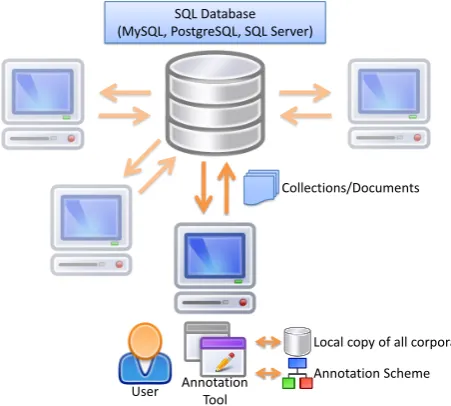
Figure 1: The architecture of the NOMAD annotation tool.
the NOMAD annotation tool is shown in figure 1. The cen-tral component is an SQL database server, where all tools are registering themselves upon start-up and termination. The database server is used to store collections of docu-ments, either annotated or not, along with any other infor-mation required by the annotation tools. Each annotation tool communicates with the database server through SQL queries, and the supported databases are MySQL21, Post-greSQL22, and Microsoft SQL Server23. A single instance of the NOMAD annotation tool can be run in any number of computers. Each instance registers itself with the database server, using the credentials of the user running the applica-tion (taken from the operating system), and synchronises its local copy with the database server. Each annotation tool stores locally all information kept in the server, ensuring that all data can be restored even if the database server gets replaced with a new server, and at the same time providing the ability to annotate off-line.
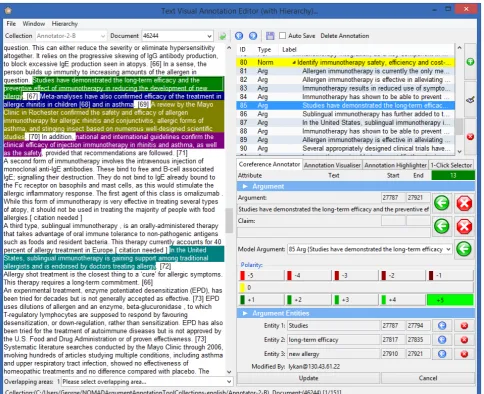
The main window of the annotation tool is shown in fig-ure 2, while the window for annotating documents (with the NOMAD annotation schema loaded) is shown in fig-ure 3. The main window is organised around collection and document management, where any annotator can cre-ate/delete/modify collections by adding or removing docu-ments. The annotation window adapts itself to the selected annotation schema, allowing the user to select segments and annotate them with a set of attributes, according to the an-notation schema. The user has complete control over the way segments are selected (i.e. by configuring mouse but-tons or key combinations to select whole words), and an-notated (i.e. by configuring key combinations for any cat-egory). In addition, the tool monitors the annotation per-formed by the user, and tries to extract regular expressions
21
http://www.mysql.com/
22
http://www.postgresql.org/
23http://www.microsoft.com/sqlserver/en/
us/default.aspx
Figure 2: The main window the NOMAD annotation tool.
from already annotated items. The user is able to revise these expressions (if desired) and apply them to automati-cally annotate the rest of the document, or other documents. The NOMAD tool supports both distributed and collabo-rative annotation. The distributed mode is the most fre-quent and easy to use mode: each annotator locks a whole document for editing, by simply opening this document in its tool, preventing any other annotator to open the same document for annotation. The collaborative mode is more complex, and requires a different configuration of the tool. Withe the help of the open instance messaging protocol XMPP24, also used by Google Talk, actions performed by
annotators are shared among all instances of the tool, ef-fectively sharing annotations among all users that annotate the same document. However, no conflict resolution is per-formed: if two users annotate the same text segment, both annotations are kept into the system, no matter if they are overlapping or contradicting. Finally, the annotation tool currently runs under the Windows (XP, Vista, 7) and Linux (32 and 64 bit) operating systems.
5.
Reusing Ellogon’s Annotation Engine
The Ellogon language engineering platform (Petasis et al., 2002) offers an extensive annotation engine, allowing the construction of a wide range of annotation tools for both plain text and HTML documents. This annotation engine provides a wide range of features, including: a) cross-platform graphical user interface (supporting Windows, Linux and OS X), b) use of standard formats (including stand-off annotation in XML),c) support for user centered design and user friendly interface,d) support of customized annotation schemata, e) support for annotating rendered HTML pages, f) support for performing automatic anno-tation, andg) comparison facilities, to identify mismatches24The Extensible Messaging and Presence Protocol (XMPP):
Figure 3: The annotation window of the NOMAD annotation tool.
among independent annotations of the same document, or calculate inter-annotation agreement. Despite the fact that these features are not unique among the available annota-tion tools (i.e. most of these features are also supported by tools offered by Callisto, Wordfreak, GATE, MMAX2, Knowtator, and AeroSWARM), reusing an annotation en-gine allows for rapid and robust development of a new an-notation tool, through the re-use of tested components.
5.1.
Annotation Schemas
The annotation engine of the Ellogon language engineer-ing platform is configurable through XML files, that de-fine annotation schemas. The tool reads the annotation schema from an XML file, and presents to the annotator a suitable GUI for annotating text segments. The NOMAD tool follows a different approach than other tools, such as GATE Teamware: Instead of implementing floating win-dows which show only a small fragment of the annota-tion schema, the NOMAD tool shows the whole schema, so as not to impose to the user the need to perform exces-sive mouse usage. In addition, the colours are not related to annotation groups (as in GATE Teamware), but on
cat-egory/attribute values. The XML annotation schema lan-guage provides a variety of types that can be annotated. The most important types, along with their visual representation in the GUI, are shown in the following list:
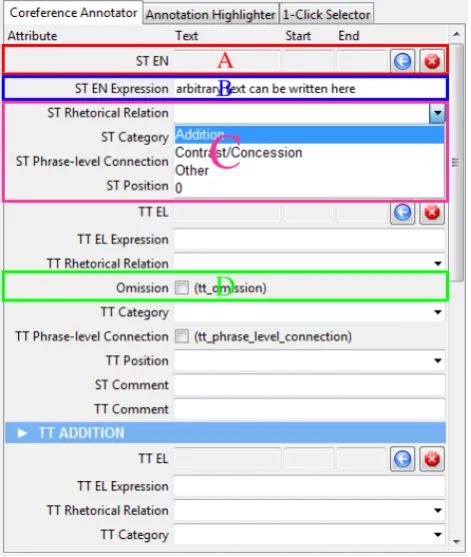
• Acategory(figure 4-A) can be used to assign a spe-cific category to selected segments. It is usually rep-resented by a button widget. Typical usage of this schema type is to annotate POS tags, named-entity types, polarity, etc.
• Adate (figure 4-B) can be used to assign a specific category to selected segments and in addition asso-ciate a date. It is usually represented by a button wid-get along with a date picker, to select the associated date. The date can be formatted according to the for-mat specified in the annotation schema. Typical us-age of this type is when dates in text must be associ-ated/grounded with a normalised date, such as mark-ing the text segment “yesterday”, and ground its date to “21 May 2012” in the linguistic annotation.
in-A
B
C
D
Figure 4: Various types of annotation input.
put type can be used to assign a category and an arbi-trary description (comment) to a selected segment. It is usually represented by a button widget and an entry widget, allowing the entry of arbitrary text. This type can be used when a category may be associated with a note/comment from the annotator.
• Acategorywith adetailand possibly adescription
(figure 4-D). This input type can associate a category to a segment, along with a “detail”, a sub-category of predefined values, along with a description (arbi-trary text). It is usually represented by a button widget and a combo-box widget, allowing the selection of a value among a set of predefined values. In case an op-tional description has been specified in the annotation schema, it is represented by an entry widget, allowing the entry of arbitrary text. Typical usage of this type is when a category has too many values to be repre-sented as buttons, and the values should be selected from a drop-down list. For example, the NOMAD an-notation schema (shown in figure 3) includes a widget for defining “events” in its top-right corner: the anno-tator may identify the events contained in a news item, and define them, with a small description. Each de-fined event gets a unique id. In addition to the event definition, the annotator can mark the segment from where the event was extracted (figure 4-D), and select from the drop-down list the id of the defined event, so as to associate a segment to an event definition, which may be the same across many documents.
In addition, there are some types of annotation input that re-late to grouping several segments and other information in a single annotation, to facilitate annotation of co-reference
or other types of relations:
A
B
C
D
Figure 5: Types of annotation input within groups.
Corcho, O. (2006). Ontology based document annotation: trends and open research problems. Int. J. Metadata Se-mant. Ontologies, 1:47–57, January.
Cunningham, H., Maynard, D., Bontcheva, K., Tablan, V., Aswani, N., Roberts, I., Gorrell, G., Funk, A., Roberts, A., Damljanovic, D., Heitz, T., Greenwood, M. A., Sag-gion, H., Petrak, J., Li, Y., and Peters, W. (2011). Text Processing with GATE (Version 6).
Fragkou, P., Petasis, G., Theodorakos, A., Karkaletsis, V., and Spyropoulos, C. (2008). Boemie ontology-based text annotation tool. In Chair), N. C. C., Choukri, K., Maegaard, B., Mariani, J., Odjik, J., Piperidis, S., and Tapias, D., editors,Proceedings of the Sixth International Language Resources and Evaluation (LREC’08), Marrakech, Morocco, May. European Lan-guage Resources Association (ELRA). http://www.lrec-conf.org/proceedings/lrec2008/.
Goudas, T., Louizos, C., Petasis, G., and Karkaletsis, V. (2014). Argument extraction from news, blogs, and social media. In A. Likas and K. Blekas and D. Kalles (Eds.): SETN 2014, LNCS 8445, pages 287–299. Springer International Publishing Switzerland.
Heflin, J., Hendler, J., and Luke, S. (1999). Shoe: A knowledge representation language for internet applica-tions. Technical report.
Maeda, K. and Strassel, S. (2004). Annotation tools for large-scale corpus development: Using AGTK at the Linguistic Data Consortium. Proceedings of the 4th International Conference on Language Resources and Evaluation (LREC 2004), Lisbon, Portugal.
M¨uller, C. and Strube, M. (2006). Multi-level annotation of linguistic data with MMAX2. In Braun, S., Kohn, K., and Mukherjee, J., editors,Corpus Technology and Lan-guage Pedagogy: New Resources, New Tools, New Meth-ods, pages 197–214. Peter Lang, Frankfurt a.M., Ger-many.
Ogren, P. V. (2006). Knowtator: A prot´eg´e plug-in for an-notated corpus construction. In Moore, R. C., Bilmes, J. A., Chu-Carroll, J., and Sanderson, M., editors, HLT-NAACL. The Association for Computational Linguistics. Petasis, G., Karkaletsis, V., Paliouras, G., Androutsopou-los, I., and SpyropouAndroutsopou-los, C. D. (2002). Ellogon: A New Text Engineering Platform. In Proceedings of the 3rd International Conference on Language Resources and Evaluation (LREC 2002), pages 72–78, Las Palmas, Ca-nary Islands, Spain, May 29–31. European Language Re-sources Association.
Petasis, G. (2012). The SYNC3 Collaborative Annotation Tool. InProceedings of the 8th International Conference on Language Resources and Evaluation, LREC 2012, pages 363–370, Istanbul, Turkey, May. European Lan-guage Resources Association.
Popov, B., Kiryakov, A., Ognyanoff, D., Manov, D., and Kirilov, A. (2004). KIM - a semantic platform for infor-mation extraction and retrieval. Journal of Natural Lan-guage Engineering, 10(3-4):375–392.
Stenetorp, P., Pyysalo, S., Topi´c, G., Ohta, T., Ananiadou, S., and Tsujii, J. (2012). Brat: A web-based tool for nlp-assisted text annotation. In Proceedings of the
Demon-strations at the 13th Conference of the European Chapter of the Association for Computational Linguistics, EACL ’12, pages 102–107, Stroudsburg, PA, USA. Association for Computational Linguistics.
Tsoumari, M. and Petasis, G. (2011). Coreference Annota-tor - A new annotation tool for aligned bilingual corpora. In Proceedings of the Second Workshop on Annotation and Exploitation of Parallel Corpora (AEPC 2), in 8th International Conference on Recent Advances in Natu-ral Language Processing (RANLP 2011), pages 43–52, September 15.
Uren, V., Cimiano, P., Iria, J., Handschuh, S., Vargas-Vera, M., Motta, E., and Ciravegna, F. (2006). Semantic an-notation for knowledge management: Requirements and a survey of the state of the art. Web Semant., 4:14–28, January.