Converting an HPSG-based Treebank into
its Parallel Dependency-based Treebank
Masood Ghayoomi
† ‡Jonas Kuhn
‡†Department of Mathematics and Computer Science, Freie Universität Berlin
‡ Institute for Natural Language Processing, University of Stuttgart
[email protected] [email protected]
Abstract
A treebank is an important language resource for supervised statistical parsers. The parser induces the grammatical properties of a language from this language resource and uses the model to parse unseen data automatically. Since developing such a resource is very time-consuming and tedious, one can take advantage of already extant resources by adapting them to a particular application. This reduces the amount of human effort required to develop a new language resource. In this paper, we introduce an algorithm to convert an HPSG-based treebank into its parallel dependency-based treebank. With this converter, we can automatically create a new language resource from an existing treebank developed based on a grammar formalism. Our proposed algorithm is able to create both projective and non-projective dependency trees.
Keywords:Treebank Conversion, the Persian Language, HPSG-based Treebank, Dependency-based Treebank
1. Introduction
Supervised statistical parsers require a set of annotated data, called a treebank, to learn the grammar of the target language and create a wide coverage grammar model to parse unseen data. Developing such a data source is a tedious and time-consuming task. The diffi-culty of developing this data source is intensified when it is developed from scratch with human intervention. It is possible to develop different treebanks for a language according to a grammar formalism, such as Phrase Structure Grammar (PSG) (Marcus et al., 1993), Head-driven Phrase Structure Grammar (HPSG) (Oepen et al., 2002), Lexical Functional Grammar (LFG) (Cahill et al., 2002), Combinatory Categorial Grammar (CCG) (Hockenamier and Steed-man, 2007), Tree Adjoining Grammar (TAG) (Shen and Joshi, 2004), and Dependency Grammar (DepG) (Rambow et al., 2002) for English.
It is also possible to create a new language resource automatically from the existing treebank based on a grammar formalism, i.e. a new treebank can be cre-ated through the conversion of data developed based on one grammar formalism into another. This method of developing treebanks is less costly than developing one from scratch in terms of both time and expense. In this paper, we propose an algorithm that converts an HPSG-based treebank into its parallel dependency-based treebank automatically. This algorithm is ap-plied on the PerTreeBank, the HPSG-based treebank for Persian.
The structure of the paper is as follows: we describe the background of treebanking via conversion in Sec-tion 2. The properties of the PerTreeBank are de-scribed in Section 3. The algorithm for converting the existing treebank into its parallel dependency-based
treebank is introduced in Section 4. The properties of the available dependency treebanks for Persian and their pros and cons are explained in Section 5. The tools and the experimental setup as well as the ob-tained results are described and discussed in Section 6. The paper is summarized in Section 7.
2. Treebanking via Conversion
The common properties among grammar formalisms make it possible for a monolingual treebank based on one grammar formalism to be converted into another formalism, for instance converting a treebank from Lexicalized TAG into HPSG for English (Tateisi et al., 1998; Yoshinaga and Miyao, 2002), PSG into HPSG for English (Miyao et al., 2005), PSG into HPSG for German (Cramer and Zhang, 2010), PSG into HPSG for Chinese (Yu et al., 2010), DepG into HPSG for Russian (Avgustinova and Zhang, 2010), HPSG into DepG for Bulgarian (Chanev et al., 2006), PSG into CCG for English (Hockenmaier, 2003; Hockenamier and Steedman, 2007), DepG into CCG for Italian (Bos et al., 2009) and Turkish (Çakici, 2005), PSG into TAG for English (Chen et al., 2006), PSG into LFG for English (Cahill et al., 2002; Burke, 2006) and Chi-nese (Guo et al., 2007) and Arabic (Tounsi et al., 2009) and French (Schluter, 2011), and PSG into DepG for French (Candito et al., 2010).
In this paper, we aim at creating a dependency-based treebank for Persian through an automatic conversion of an existing HPSG-based treebank.
3.
The PerTreebank
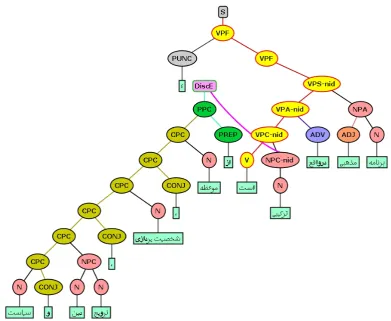
Figure 1: Tree analysis of Example 1 from the PerTreeBank
the HPSG formalism (Pollard and Sag, 1994). The constituent nodes of the phrase structure trees in this treebank contain four basic syntactic relations, which are the simulation of four basic schemas in HPSG to represent the syntactic relations in the constituents, such as the Subject, Complement, Head-Adjunct, and Head-Filler relations. Furthermore, this is a trace-based treebank, i.e. the canonical positions of the extraposed elements are determined in the trees
with the empty nodenid (non-immediate dominance)
to represent traces. Later it is converted into a trace-less treebank such that the trace is removed and the
functional label-nid is used for representing a slashed
element in normal HPSG. Additionally, the provided trees are projective.
Figure 1 represents the tree analysis of Example 1 from the PerTreeBank.
(1) ،یزادﺮﭘ ﺖﯿﺼﺨﺷ ،ﻪﻈﻋﻮﻣ زا ﺖﺳا ـﺒﯿﮐﺮﺗ ﻗاورد ﯽﺒﻫﺬﻣ ﻪﻣﺎﻧﺮﺑ . ﺖﺳﺎﯿﺳ و ﻦﯾد ﺞﯾوﺮﺗ
barnāme-ye program-EZ
mazhabi religious
darvāqeP
in_fact tarkib-i
combination-INDEF ast is
az of
moPeze
homily šaxsiyatpardāzi
characterization
tarvij-e promotion-EZ
din religion
va and siyāsat
politics
‘A religious program is a combination of homily, characterization, promotion of religion, and poli-tics.’
As shown in the figure, the prepositional phrase which
is a complement of the noun ‘ﺐﯿﮐﺮﺗ’ /tarkib/
‘combi-nation’ is extraposed to the post-verbal position. The Head-Filler relation is used to bind the slashed ele-ment.
4. Treebank Conversion Algorithm
To convert the PerTreeBank into its parallel
Algorithm 1Converting a constituency treebank into a dependency treebank
Input: A tree of a sentence from the HPSG-based treebank for Persian, The Head Table (HT),
The modified version of Dependency Relations (DR) based on the Stanford Typed Dependencies (de Marneffe and Manning, 2008)
if Projective option selectedthen repeat
Step1: Traverse the tree to find a pair of sibling leaves Step2: Select the head node of the sibling leaves based on HT
Step3: Detect the DR between the sibling leaves based on the head-daughter dependency relations Step4: Write the corresponding DR according to the CoNLL format
Step5: Remove both of the leaves and transfer the head information to the parent node
untilThe tree root node is met
else if Non-projective option selectedthen repeat
Do Step1
if The parent node has a slashed elementthen
Transfer the information of the leaf along with the slashed element to the parent node as ‘np-head’
else if The parent node has the Head-Filler relationthen
Use the ‘np-head’ of the leaf with a slashed element instead of the head
end if
Do Steps 2 to 5
untilThe tree root node is met
end if
Write the ROOT relation for the head of the tree
Sort the CoNLL format according to the sequence of the words in the input sentence
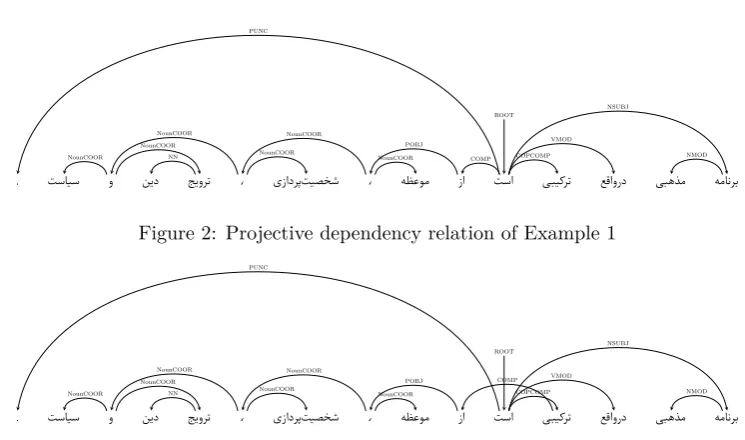
. ﺖﺳﺎﯿﺳ و ﻦﯾد ﺞﯾوﺮﺗ ، یزادﺮﭘ ﺖﯿﺼﺨﺷ ، ﻪﻈﻋﻮﻣ زا ﺖﺳا ـﺒﯿﮐﺮﺗ ﻗاورد ﯽﺒﻫﺬﻣ ﻪﻣﺎﻧﺮﺑ
ROOT
NMOD NSUBJ
VMOD COPCOMP COMP POBJ
NounCOOR NounCOOR
NounCOOR NounCOOR
NounCOOR NN NounCOOR
PUNC
Figure 2: Projective dependency relation of Example 1
. ﺖﺳﺎﯿﺳ و ﻦﯾد ﺞﯾوﺮﺗ ، یزادﺮﭘ ﺖﯿﺼﺨﺷ ، ﻪﻈﻋﻮﻣ زا ﺖﺳا ـﺒﯿﮐﺮﺗ ﻗاورد ﯽﺒﻫﺬﻣ ﻪﻣﺎﻧﺮﺑ
ROOT
NMOD NSUBJ
VMOD COPCOMP COMP POBJ
NounCOOR NounCOOR
NounCOOR NounCOOR
NounCOOR NN NounCOOR
PUNC
Figure 3: Non-projective dependency relations of Example 1
information of the head node is transferred to the par-ent node. The process of removing the leaves in each step results in new leaves which are in fact the old par-ents, and they need to be processed in the next steps. The conversion step continues in a loop to process all nodes of the tree, and it halts when the root of the tree is reached.
Since the positions of the slashed elements are
deter-mined in the trees (displayed by the ‘−nid’ functional
label on trees as represented in Figure 1), it is possible to convert them into non-projective trees as well. In this conversion, after traversing a tree to find a pair of sibling leaves, if a parent node contains a slashed
element, the information of the slashed element in ad-dition to the head node is transferred to the parent node. To draw a non-projective tree, it is important to keep the information of the leaf that has a slashed element. This information, which is related to the head of a non-projective tree, is temporally kept in a vari-able, which we called it ‘np-head’, and the information in the variable is transferred to upper nodes until the Head-Filler relation is met. When the slashed element is bound, the ‘np-head’ information is retrieved, and it is used for defining the dependency relation.
: ﺪﺘﻔﯿﺑ قﺎﻔﺗا ﺪﻧاﻮﺗ ﻣ ﺰﯿﭼ ﻪﻤﻫ نرﻮﺑ یﺎﯿﻧد رد
ROOT
VMOD
POBJ NN
NSUBJ
DEPCOMP AUX
MWE PUNC
Figure 7: Dependency tree of Example 5 from DPTB
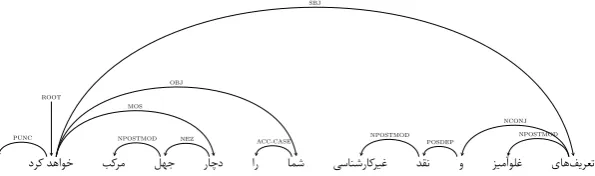
. ﺪﻧز ﻣ رود تﺎﯾدﺎﻣ شﻮﺣ و لﻮﺣ ﺰﯿﭼ ﻪﻤﻫ بﺮﻏ رد
root
prep
pobj nsubj
det dobj
cc conj poss
dobj-lvc punct
Figure 8: Dependency tree of Example 6 from UPDT
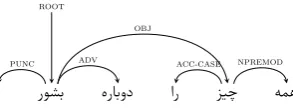
! رﻮﺸﺑ هرﺎﺑود ار ﺰﯿﭼ ﻪﻤﻫ
ROOT
OBJ
ADV ACC-CASE NPREMOD PUNC
Figure 9: Dependency tree of Example 7 from PerDT
DPTB, UPDT, and PerDT using gold POS tags in the evaluations to reduce the impact of tagging on parsing. As can be observed from the results, for all of the tree-banks the Mate parser outperforms the Malt parser. Moreover, the parsers trained with UPDT and PerDT perform better than the parsers train with DPTB. This is not a surprising result, because both UPDT and PerDT contain more data to build more accurate grammar models. PerDT performs the best due to having more annotated data and more coarse-grained dependency labels which result in a higher accuracy rate in predicting the dependency labels. However, the advantage of DPTB, compared with the other two dependency treebanks, is that this language resource is created without any human effort, whereas UPDT and PerDT are developed with human intervention. Addi-tionally, increasing the amount of data in the PerTree-Bank will automatically increase the size of DPTB.
7.
Summary
In this paper, we introduced an algorithm that converts an HPSG-based treebank into its parallel dependency-based treebank. This algorithm was ap-plied on the PerTreeBank, an HPSG-based treebank
for Persian. The main advantage of the converted
dependency-based treebank over the other existing
de-Table 1: Dependency parsing results
Tool Treebank Labeled Unlabeled Label
Attachment Attachment Accuracy
Malt
DPTB 76.63 82.04 81.10
UPDT 79.13 83.71 86.98
PerDT 83.84 87.86 86.19
Mate
DPTB 80.17 84.38 85.64
UPDT 81.36 85.21 90.03
PerDT 90.29 92.69 92.53
pendency treebanks for Persian was that it was created relatively effortlessly and without human intervention. The converted dependency-based treebank could be used for training statistical dependency parsers.
8. Ackowledgement
In this research, Masood Ghayoomi is funded by the German Research Foundation (DFG) via the SFB 732 “Incremental Specification in Context”.
References
Avgustinova, Tania and Zhang, Yi. (2010). Conver-sion of a Russian dependency treebank into HPSG
derivations. In The 9th International Workshop on
Bijankhan, Mahmood. (2004). naqše peykarehāye zabāni dar neveštane dasture zabān: mo‘arrefiye yek narmafzāre rāyāneyi [“The role of corpora in writing
a grammar: Introducing a software”].Journal of
Lin-guistics, 19(2):48–67.
Bohnet, Bernd. (2009). Efficient parsing of
syn-tactic and semantic dependency structures. In
Pro-ceedings of the 13th Conference on Computational Natural Language Learning: Shared Task, pages 67– 72, Stroudsburg, PA, USA. Association for Compu-tational Linguistics.
Bos, Johan, Bosco, Cristina, and Mazzei, Alessan-dro. (2009). Converting a dependency-based tree-bank to a categorial grammar treetree-bank for Italian. In Passarotti, M., Przepiórkowski, Adam, Raynaud,
S., and van Eynde, Frank, editors,Proceedings of the
8th Workshop on Treebanks and Linguistic Theories, pages 27–38.
Burke, Michael. (2006). Automatic Treebank
Anno-tation for the Acquisition of LFG Resources. Ph.D. thesis, Dublin City University.
Cahill, Aoife, Mccarthy, Mairead, Genabith,
Josef Van, and Way, Andy. (2002). Automatic
annotation of the Penn treebank with LFG
f-structure information. In LREC Workshop on
Linguistic Knowledge Acquisition and Representa-tion: Bootstrapping Annotated Language Data, pages 8–15.
Candito, Marie, Crabbé, Benoît, and Denis, Pascal. (2010). Statistical French dependency parsing:
Tree-bank conversion and first results. In Proceedings of
the 7th International Conference on Language Re-sources and Evaluation, pages 1840–1847, La Valletta, Malta. European Language Resources Association.
Çakici, Ruken. (2005). Automatic induction of a
CCG grammar for Turkish. InProceedings of the ACL
Student Research Workshop, pages 73–78.
Chanev, Atanas, Simov, Kiril, Osenova, Petya, and Marinov, Svetoslav. (2006). Dependency conversion
and parsing of the BulTreeBank. In Proceedings of
the LREC workshop Merging and Layering Linguistic Information, pages 16–23.
Chen, John, Bangalore, Srinivas, and Shanker, Vi-jay K. (2006). Automated extraction of tree-adjoining
grammars from treebanks. Natural Language
Engi-neering, 12(3):251–299.
Cramer, Bart and Zhang, Yi. (2010). Constraining robust constructions for broad-coverage parsing with
precision grammars. InProceedings of the 23rd
Inter-national Conference on Computational Linguistics, pages 223–231, Stroudsburg, PA, USA. Association for Computational Linguistics.
de Marneffe, Marie-Catherine and Manning, Christo-pher D. (2008). The Stanford typed dependencies
representation. In Proceedings of the workshop on
Cross-Framework and Cross-Domain Parser
Evalua-tion, pages 1–8, Stroudsburg, PA, USA. Association
for Computational Linguistics.
Ghayoomi, Masood. (2012). Bootstrapping the de-velopment of an HPSG-based treebank for Persian.
Linguistic Issues in Language Technology, 7(1).
Guo, Yuqing, van Genabith, Josef, and Wang, Haifeng. (2007). Treebank-based acquisition of LFG
resources for Chinese. InProceedings of the 12th
In-ternational Lexical Functional Grammar Conference, Stanford, California. CSLI Publications.
Hockenamier, Julia and Steedman, Mark. (2007).
CCGbank: A corpus of CCG derivations and depen-dency structures extracted from the Penn treebank.
Computational Linguistics.
Hockenmaier, Julia. (2003).Data and Models for
Sta-tistical Parsing with Combinatory Categorial
Gram-mar. Ph.D. thesis, School of Informatics, University
of Edinburgh, Edinburgh, Scotland, UK.
Marcus, Mitchell P., Santorini, Beatrice, and
Marcinkiewicz, Mary Ann. (1993). Building a large annotated corpus of English: the Penn treebank.
Computational Linguistics, 19(2).
Miyao, Yusuke, Ninomiya, Takashi, and Tsujii, Jun’ichi. (2005). Corpus-oriented grammar devel-opment for acquiring a head-driven phrase structure
grammar from the Penn Treebank. In Proceedings
of the 1st International Joint Conference on Natural Language Processing, pages 684–693, Berlin, Heidel-berg. Springer-Verlag.
Nivre, Joakim, Hall, Johan, and Nilsson, Jens. (2006). MaltParser: A data-driven parser-generator
for dependency parsing. InProceedings of the 5th
In-ternational Conference on Language Resources and Evaluation, pages 2216–2219.
Oepen, Stephan, Flickinger, Dan, Toutanova,
Pollard, Carl J. and Sag, Ivan A. (1994).Head-driven Phrase Structure Grammar. University of Chicago Press.
Rambow, Owen, Creswell, Cassandre, Szekely,
Rachel, Taber, Harriet, and Walker, Marilyn. (2002).
A dependency treebank for English. In3rd
Interna-tional Conference on Language Resources and Evalu-ation, pages 857–863.
Rasooli, MohammadSadegh, Kouhestani,
Manouchehr, and Moloodi, Amirsaeid. (2013).
Development of a Persian syntactic dependency
treebank. In Proceedings of the Human Language
Technology Conference of the North American Chap-ter of the Association for Computational Linguistics, pages 306–314, Atlanta, Georgia.
Schluter, Natalie. (2011).Treebank-based Deep
Gram-mar Acquisition for French Probabilistic Parsing Re-sources. Ph.D. thesis, Dublin City University.
Seraji, Mojgan, Megyesi, Beata, and Nivre, Joakim.
(2012). Dependency parsers for Persian. In
Proceed-ings of the 10th Workshop on Asian Language Re-sources, pages 35–43.
Shen, Libin and Joshi, Aravind K. (2004). Extracting deeper information from richer resource: EM models
for LTAG treebank induction. InInternational Joint
Conference on Natural Language Processing.
Tateisi, Yuka, Torisawa, Kentaro, Miyao, Yusuke, and Tsujii, Jun’ichi. (1998). Translating the XTAG
English grammar to HPSG. InThe 4th International
Workshop on Tree Adjoining Grammars and Related Formalisms, pages 172–175.
Tounsi, Lamia, Attia, Mohammed, and van Gen-abith, Josef. (2009). Automatic treebank-based ac-quisition of Arabic LFG dependency structures. In
Proceedings of the European Chapter of the Associ-ation for ComputAssoci-ational Linguistics 2009, Workshop on Computational Approaches to Semitic Languages, pages 45–52, Stroudsburg, PA, USA. Association for Computational Linguistics.
Yoshinaga, Naoki and Miyao, Yusuke. (2002).
Gram-mar conversion from ltag to hpsg. In Proceedings of
the Sixth ESSLLI Student Session, pages 309–324.
Yu, Kun, Yusuke, Miyao, Wang, Xiangli, Mat-suzaki, Takuya, and Tsujii, Junichi. (2010). Semi-automatically developing Chinese HPSG grammar from the Penn Chinese treebank for deep parsing. In Proceedings of the International Conference on Computational Linguistics, pages 1417–1425, Beijing, China.
Appendix 1
BOT - bottom ROOT- root DEP- dependent
PUNC - punctuation ARG- argument
COMP - complement
ADJCOMP - adjective complement ADVCOMP - adverb complement AUX - auxiliary
COPCOMP - copula complement COORCOMP - coordination complement CCOMP - clausal complement
DETCOMP - determiner complement INTCOMP- interjection complement NN - nominal complement
POSS - possession complement POSSESSIVE- possessive complement REFLCOMP- reflexive complement OBJ - object
DOBJ - direct object IDOBJ - indirect object POBJ- preposition object XOBJ - dropped object SUBJ - subject
NSUBJ - nominal subject RELSUBJ - relativizer subject XSUBJ - dropped subject MOD- modifier
ADJMOD - adjective modifier CLMOD- clausal modifier DETMOD- determiner modifier MWE- multi-word expression modifier INTMOD- interjection modifier NMOD- noun modifier
NUM - numeric modifier APPOS - appositional modifier REFLMOD- reflexive modifier
NUMBER- element of compound number nu-meric
PREPMOD- preposition modifier PURPCL- purpose clause modifier RCMOD- relative clause modifier RES - residual modifier
VMOD- verb modifier CC - coordination
ADJCOOR- adjective coordination ADVCOOR- adverb coordination CLCOOR- clause coordination DETCOOR- determiner coordination NOUNCOOR- noun coordination NUMCOOR- number coordination PREPCOOR- preposition coordination RESCOOR- residual coordination VERVCOOR- verb coordination MARKER- marker
ACC - accusative marker
COMPM - complementizer marker MARK - clausal marker