International Journal of Research (IJR)
e-ISSN: 2348-6848, p- ISSN: 2348-795X Volume 2, Issue 07, July 2015Available at http://internationaljournalofresearch.org
Available online:http://internationaljournalofresearch.org/ P a g e | 517
Web Based Goal Structuring Notation Tool (E-GSN)
Sidra Anwar
Fatima Jinnah Women University The Mall, Rawalpindi, Pakistan
[email protected]
Khaleeq-un-Nisa
Fatima Jinnah Women University,The Mall, Rawalpindi, Pakistan
[email protected]
Abstract—
Abstract_ Goal Structuring Notation is an argument or logic-based methodology that symbolizes all aspects of a safety argument (requirements, claims, evidence and context etc) in an elegant and logical diagram. In recent years it has been used within the risk-based Safety domain to depict Safety Case structure. It assists with the demonstration or clarification of how the set of evidence items may be combined together and argued to demonstrate the top claim. The use of GSN has arisen in response to poorly written Case documents. All the existing GSN tools are offline. In this paper; Web based Goal structuring notation tool (E-GSN) is presented to support a user to draw a structure of engineering arguments and Data flow while taking technical arguments. The tool has basic GSN shapes. An advance approach of File import , export, re-use, downloading in .png, .jpg, .dmo formats, sharing with public, adding and removing extra users by already registered users, file saving without a user side database connectivity and user’s account settings, is practiced. No memory constraints are there regarding importing/ exporting data.A drawing tool is also presented as a part of paper. It is a tool with basic flow diagram shapes and UML shapes. This tool is providing the services of data flow in technical and critical arguments, and a mature drawing tool. A user's computer system with secure internet connection would be required above than all requirements.
Index Terms—E-GSN, UML, critical arguments.
I. INTRODUCTION
Goal Structuring Notation (GSN) is a graphical notation for presenting the structure of engineering arguments. It has in recent years been used within the risk-based Safety domain to depict Safety Case structure. GSN explicitly represents the individual elements of any safety argument (requirements, claims, evidence and context) and relationships that exist between these elements. It assists with the demonstration or
clarification of how the set of evidence items may be combined together and argued to demonstrate the top claim.
The use of GSN has arisen in response to poorly written Case documents. Such safety documents may easily become lengthy and obtuse for users through poor use of English and it becomes hard to tackle a common weakness in technical and complex arguments where the dependency of a claim on specific evidence lacks clarity. However, it must be recognized that graphical tools in themselves do not prevent such situations; they do however allow the strengths and weaknesses of an argument to be more easily grasped.
I.I.PRINCIPLEELEMENTSOFGSN
Currently available drawing tools as an alternative for creating GSN diagrams for various safety critical industries are offline. Moreover, maintaining database at server side to provide the facility of import, export or re use file is also an issue.
Web based Goal structuring notation tool is developed to support a user to draw a structure in a drawing tool, a structure of Engineering arguments and Data flow while taking technical arguments and dynamic database Updating. It is a drawing tool with GSN Shapes, basic shapes and UML shapes.
II. FEATURES OF E-GSNTOOL
International Journal of Research (IJR)
e-ISSN: 2348-6848, p- ISSN: 2348-795X Volume 2, Issue 07, July 2015Available at http://internationaljournalofresearch.org
Available online:http://internationaljournalofresearch.org/ P a g e | 518 File re-use
Downloading in .png, .jpg and .dmo formats Sharing with public
User’s account settings, Adding and removing
extra users by already registered users File saving without a server side database
connectivity
If drawing is updated, database will be updated automatically
There should be no memory constraint regarding file import/ export.
There should be no insecure internet connection.
III. E-GSN ARCHITECTURE
IV. LITERATURE REVIEW
A lot of research work has been conducted on developing a web based goal structuring notation tool and a drawing tool also. Some of the related work is described below.
A. A Model-driven Safety Certification Method for
Process Compliance (Barbara Gallina; 2014)
In this paper, a model-driven safety certification method is proposed to derive those arguments as goal structures given in Goal Structuring Notation from process models given in compliance with Software Process Engineering Meta-model 2.0. Model-driven Engineering is a model-centric software development methodology aimed at raising the level of abstraction in software specification and increasing automation in software development. For automation purposes, it is represented that a Goal represents a claim about the system; a Strategy represents a method that is used to decompose a goal into sub goals; a Solution represents the evidence that a particular goal has been achieved; a Context represents the domain or scope in which a goal, evidence or strategy is given; Supported by represents an inferential or evidential
relationship. In short in context of represents a contextual relationship. To generate certification artifacts, use of MDE principles is proposed. To reduce cost and time during the certification process, a novel model-driven method called MDSafeCer is presented, which permits users to generate process based arguments from process models.
B. Consistency Checking of Safety Arguments in the Goal Structuring Notation Standard (Adrian Groza; Nicoleta Marc; 2014)
In this study, a tool is proposed that facilitates the construction and automatic assessment of safety cases. The tool supports the Goal Structuring Notation standard for formation of safety arguments. The GSN diagrams are translated in description logic, in order to completely check a variety of properties of the safety case. In the description logic ALC, concepts are built using the set of constructors created by negation, conjunction, disjunction, value restriction, and existential restriction. The tool is consisted of a set of Eclipse plugins and is madeup on layers. The bottom layer consists of the centeral framework of the tool. The second layer consists of several eclipse plug-ins used to execute the tool. The third layer contains the GSN and ARM meta models, plus tool plug-ins through which all tool functionality is provided. The tool was exhibited during developing of a safety critical application for autonomous vehicles.
C.A Design and Implementation of an Assurance Case
Language (Yutaka Matsuno; 2104)
In this paper a proper definition of an assurance case language based on GSN, its pattern and module extensions is presented. The framework of functional programming language is taken as the base for this study. The execution has been done on an EclipseTM based GSN editor. In this study a new formalization of GSN and its extensions is presented. The purpose of the study is to build a simple and general framework which can be implemented easily. To do so, the framework of functional programming languages is subjugated, which is the most basic and ceremonial framework in programming languages. Following are the contributions:
A proper definition and the semantics for GSN and its extensions are provided, and assurance case languages are defined. The language was put into practice on an
open source GSN editor.
The applicability of the language is checked with existing GSN examples.
International Journal of Research (IJR)
e-ISSN: 2348-6848, p- ISSN: 2348-795X Volume 2, Issue 07, July 2015Available at http://internationaljournalofresearch.org
Available online:http://internationaljournalofresearch.org/ P a g e | 519 current design and implementation of the language
has several boundaries such that testing the module and pattern extensions for real systems has not been done.
D. The Use of Goal Structuring Notation as a Method for Ensuring that Human Factors is Represented in a Safety Case (K.J.N.C. Rich; H. Blanchardt; J. McCloskey; 2007)
In this paper the authors use a simple human factors integration build to map human factors arguments onto a standard GSN model. This ensures that equipment-operator relations and risks to people safety are captured. The paper presents an approach for safety managers and human factors professionals to incorporate human factors into system safety design and assurance in a rational, adaptable method. This method has been demonstrated using a case study in UK-MOD defense systems. The argument structure explained makes a narrative three-part division of the system (into equipment, operator and interface elements) to allow human factors claims to be integrated at the suitable level. This structure is adequately flexible to resolve human factors and safety frameworks from any work domain.
E. Deep Drawing Tool for E-learning (Francisco Javier Ramírez; Rosario Domingo and Miguel Angel Sebastián; 2010)
This paper presents a deep drawing tool for e-learning. The tool has been realized for its use in the Master degree because it requires advanced knowledge in manufacturing processes. The instrument has been developed with the objective of the students who can: a) Select input data forget the formability of material to deep drawing; b) Select the process that provides the best solution from a technological perspective; c) Optimize the process for saving the material; d) Know the influence of the punch in the results; e) Consideration of the process cost. The structure of the system has three subsystems: a) Solve, module for data processing and the generation of results; b) Materials, module for management data of the system; and c) Interface, module for user interaction. The tool has been implemented in the software tool programming, developed in Java. The spiral model is suited to create products with different versions, improving with each approach, the current version and adding new functionality. Engineering can be developed through classical life cycle model or prototype construction. This methodology will, in each cycle, review the specifications of objects based on knowledge that is acquired with the operation of the aided system.
F. MOYA-MOYA Drawing (Takanori Komatsu; Hiroki
Terashima; 2012)
In this study, we proposed a drawing tool system named MOYA-MOYA drawing that can utilize user’s
expressed onomatopoeias as a drawing effect. The evaluation experiment proved that mostly users reported that this system succeeded in reflecting their feelings entrenched in their onomatopoeias as certain drawing effects on the target pictures. The system is designed so that it can accept XYXY-type of onomatopoeias that consist of a repetition of two syllables and that this can output two types of effects
“feathering” and “highlighting” on certain target
picture according to any of input onomatopoeias. Specifically, there are three concrete effects of
feathering type; “Gaussian feathering” like a defocusing effect, “Motion blur” like a camera shaking, and “Mosaic feathering” and there are also
three concrete effects of highlighting type;
“Sharpening” like a focusing effect, “Embossing” like
a sterically-enhanced effect and the third is “Edge enhancement” This system was billed by using
Microsoft Visual C++2010 and Open CV 2.2 on Windows XP environment. This system consists of three separated windows; one is for displaying the target picture, the second is a toolbox for selecting specific area on the target picture and the third is a user input dialog box for typing onomatopoeias.
G.Sequence Chart Studio (Martin Bezdˇeka, Ondˇrej
Bouda, L’ubosˇ Korencˇiak, Matu´sˇ Madzin, and Vojteˇch Rˇ eha´k; 2012)
International Journal of Research (IJR)
e-ISSN: 2348-6848, p- ISSN: 2348-795X Volume 2, Issue 07, July 2015Available at http://internationaljournalofresearch.org
Available online:http://internationaljournalofresearch.org/ P a g e | 520
H. A Method for Automatic Generation of Track
Layout Graph Based on Visio Secondary Development (Zhang Yong, Su Yaowei; 2013)
In this paper, to enhance the efficiency of automatic production of track layout graph a computer-aided tool has been developed, which can give the user with an incorporated graphical editing environment and is able to produce Word test sequence files and Xml test scripts automatically. In each and every test sequence file, there is a graph for displaying the track layout of the test line, train path, the test conditions and some rapid boxes for the focus points during a test trip. Prior to the tool, the drawing of the graph is an incredible manual work. In this study, a method for generating the track layout graph based on Visio secondary development is shown, by calling the Visio object model based on COM components under .NET platform. Firstly the data for drawing the track layout, including the DAT files of station and the track database of section is analyzed; secondly corresponding data structures are defined; thirdly, the process of Visio secondary development is briefly introduced; finally the algorithm for generating the track layout are presented in detail. The editable Visio track layout graph generated with this method is automatically inserted into the Word test sequence file, thus greatly sparing manual efforts. Besides, the method for drawing the track layout is universal, which has wide application in the laboratory simulation and testing platform of train control system, such as station interlocking, Radio Block Center, Train Control Center, Simulation Manager
and so on.
I. Parameterized Argument Structure for GSN Patterns
(Matsuno, Y.; Taguchi, K, 2011)
Goal Structuring Notation is used in safety critical system for the system assurance, a graphical notation broadly used to create assurance cases. GSN include parameterized notations to make ease of reuse of existing assurance cases by prototypes and constructs projected in it. As the facility of parameterized
notations is not provided by current GSN so it’s
inflexible to automate the regularity checks. Proposing an idea towards parameterization and its background in GSN is the aim of the paper. Types, scoping rules and type checking mechanism of a new parameterized notation providing protection to misuses of patterns and to type consistency checks will be presented in near future.
J. An Implementation of GSN Community Standard
(Matsuno, Y.; Yamamoto, S., 2013)
To construct assurance cases GSN (Goal Structuring Notation) is a graphical notation widely used, required for the system assurance of safety critical systems specifically in Europe, and now all over the world as the importance of system assurance has been increasing and many safety standard such as ISO 26262 mandate the use of safety case. In GSN Community Standard the syntax and extensions for module and patterns have been defined. Our preliminary implementation partly satisfying the standard is reported in this paper. On D-Case Editor the prototype implementation has been done, an Eclipse based GSN editor. Between syntax defined in
the standard, “goal away” and “module node” as the
basis for the module system is implemented by us, joined with parameters with scope and pattern instantiation function, extensions of our last works [6]. Because of to some misconceptions in the GSN community standard, many design choices may be present. Our design choices are reported by us. Further amore issues for implementing the full syntax of the GSN community standard are also reported.
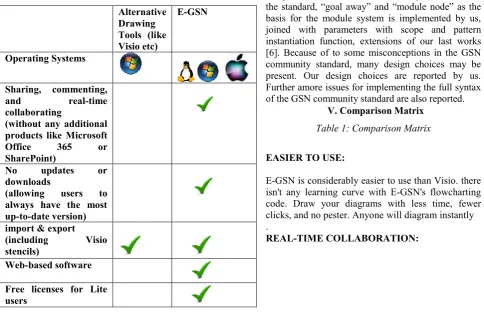
V. Comparison Matrix
Table 1: Comparison Matrix
EASIER TO USE:
E-GSN is considerably easier to use than Visio. there isn't any learning curve with E-GSN's flowcharting code. Draw your diagrams with less time, fewer clicks, and no pester. Anyone will diagram instantly .
REAL-TIME COLLABORATION: Alternative
Drawing Tools (like Visio etc)
E-GSN
Operating Systems
Sharing, commenting,
and real-time
collaborating
(without any additional products like Microsoft
Office 365 or
SharePoint)
No updates or
downloads
(allowing users to always have the most up-to-date version)
import & export (including Visio stencils)
Web-based software
Free licenses for Lite
International Journal of Research (IJR)
e-ISSN: 2348-6848, p- ISSN: 2348-795X Volume 2, Issue 07, July 2015Available at http://internationaljournalofresearch.org
Available online:http://internationaljournalofresearch.org/ P a g e | 521 Work in real time on your diagrams with colleagues and
fellows, and avoid email attachment overload. E-GSN's revision history permits you to revert back to previous versions if you dislike recent changes. WEB-BASED SOFTWARE:
Deployment across your organization is immediate and simple, no transfer or installation is critical. All documents are saved across multiple centers to make it certain that you ne'er lose your valuable work.
COST OF DIAGRAMMING SOFTWARE FOR TEAMS:
0
50000 E-GSN
Alternatives
Team Size
A
nn
ua
l
C
o
st
($
)
VI. MTHOGOLOGY FOR IMPLEMENTATION In order to implement and evaluate the tool, the methodology was based on Software Development Life cycle, generally three main steps, including planning, implementing and analysis. Finally; testing was performed in order to evaluate the tool. Following figure illustrates the overall approach used to develop the tool.
A. Planning
A careful and proper plan was prepared to identify all the information and requirement such as hardware and software.
B. Data collection
Data collection is an important phase in any area of study. At this stage planning about the tool resources and
requirements, literature studies and schedule to get more information in this study was completed. All the related materials are collected from journal, texts book and research papers gathered from libraries and Internet. Within the data collection period I have found the study about windows based GSN tools and the drawing tools with less functionality in the Internet. Firstly; I tried to find out related softwares that have been implemented before and other materials and some of the tools required.
C. Requirements Gathering Software requirements
• Note Pad
• Note Pad ++
• Html 5 editor
• Selenium
Hardware requirements
• System/Pc D. Design
After planning and analyzing the data and requirements the design was prepared. Paper sketch, interface layout and different diagrams were made to construct the system design.
E. Implementation
In implementation phase the design was implemented by using PHP, Html5, and Java script. Html5 is used for layout design while PHP and java script are used to implement the main functionality of GSN tool and also of drawing tool.
F. Maintenance
After implementation the system is executed under different conditions and bugs are identified and maintained. Testing is performed to test the software.
International Journal of Research (IJR)
e-ISSN: 2348-6848, p- ISSN: 2348-795X Volume 2, Issue 07, July 2015Available at http://internationaljournalofresearch.org
Available online:http://internationaljournalofresearch.org/ P a g e | 522 It is concluded that Web based Goal structuring notation
tool is developed to support a user to draw a structure of engineering arguments and data flow. This tool is providing the services of data flow in technical and critical arguments, and a mature drawing tool. An advance approach of File import , export, re-use, downloading in .png, .jpg, .dmo formats, sharing with public, adding and removing extra users by already registered users, file saving without a user side database
connectivity and user’s account settings, is practiced.
Software tool is integrated in a website with a user guide, user friendly front end and online service provider
tool. “Contact Us” option is also provided so that if user
encounter any problem then could contact administrator easily. No memory constraints are there regarding importing/ exporting data. A user's computer system with secure internet connection would be required above
than all requirements. The user’s complete
understanding of using tool and data to be processed would be needed. All the user data will be saved on server side and will be kept safe regarding security issues.
REFERENCES
[1] G. Eason, B. Noble, and I. N. Sneddon, “On certain integrals of Lipschitz-Hankel type involving products of Bessel functions,” Phil. Trans. Roy. Soc. London, vol. A247, pp. 529–551, April 1955.
(references)
[2] J. Clerk Maxwell, A Treatise on Electricity and Magnetism, 3rd ed., vol. 2. Oxford: Clarendon, 1892, pp.68–73.
[3] I. S. Jacobs and C. P. Bean, “Fine particles, thin films and exchange anisotropy,” in Magnetism, vol. III, G. T. Rado and H. Suhl, Eds. New York: Academic, 1963, pp. 271–350.
[4] K. Elissa, “Title of paper if known,” unpublished.
[5] R. Nicole, “Title of paper with only first word capitalized,” J. Name Stand. Abbrev., in press.
[6] Y. Yorozu, M. Hirano, K. Oka, and Y. Tagawa,
“Electron spectroscopy studies on magneto-optical media and plastic substrate interface,” IEEE Transl. J. Magn. Japan, vol. 2, pp. 740–741, August 1987 [Digests 9th Annual Conf. Magnetics Japan, p. 301, 1982].