Increasing the Efficiency of Wireless Network
Using Adaptive Push Systems
Jayakumar. K, S. Rajesh
Dept. of Electronics and Tele-Communication Engineering, Bharath University, Chennai, Tamil Nadu, India
Assistant Professor, Dept. of Electronics and Tele-Communication Engineering, Bharath University, Chennai, Tamil
Nadu, India
ABSTRACT: This paper is fully of automated control for increasing the efficiency of wireless networks using adaptive system of push network. This paper gives a complete idea about how an antenna beam should be adjusted in order to achieve the cent percentage efficiency. This has a master network and a slave network in which master network has full control over the slave which helps to monitor the system performance. This covers whole geographical area and using the learning type of automation, it finds in which area this should ne provided with higher bandwidth so as to improve the performance of the network system. This depends on the number of clients used in a system network so as to completely study the geographical locations of an entire network system.
KEYWORDS:Server broadcasting, adaptive smart antennas, demand population.
I. INTRODUCTION
Wirelesstelecommunications refers to the transfer of information between two or more points that are not physically connected. Distances can be short, such as a few meters for television remote control, or as far as thousands or even millions of kilometers for deep-space radio communications. It encompasses various types of fixed, mobile, and portable applications, including two-way radios, cellular telephones, personal digital assistants (PDAs), and wireless networking. Telecommunicationis the science and practice of transmitting information by electromagnetic means.
Communication is talking to someone or thing not necessarily through technological means. Telecommunication, however, is talking through technology meaning phones, Internet, radio etc...
In earlier times, telecommunications involved the use of visual signals, such as beacons, smoke signals, semaphore telegraphs, signal flags, and optical heliographs, else the audio messages such as coded drumbeats, lung-blown horns, and loud whistles. [4]
In modern times, telecommunications involves the use of electrical devices such as the telegraph, telephone, and tele-printer, as well as the use of radio and microwave communications, as well as fiber optics and their associated electronics, plus the use of the orbiting satellites and the Internet.[1]
Data broadcasting is the broadcasting of data over a wide area via radio waves. It most often refers to supplemental information sent by television stations along with digital television, but May also be applied to digital signals on analog TV or radio. It generally does not apply to data which is inherent to the medium, such as PSIP data which defines virtual channels for DTV or direct broadcast satellite systems; or to things like cable modem or satellite modem, which use a completely separate channel for data. Data broadcasting, which has emerged as an efficient way of information dissemination in wireless networks, can be characterized by locality of client demands.
whose probability distribution vector determines the popularity of each information item among the clients in the service area of the antenna. [3]
However, depending on the actual placement of clients within the coverage area of the system, there can exist cases where the use of directional antennas of fixed beam width limits the amount of performance improvement over single antenna systems. This is because the coverage area of each such antenna is fixed and does not follow the geographical distribution of clients within the coverage area of the system. When this distribution is not uniform, but rather there exist areas with higher density of client groups, there can exist cases where one or more antennas serve a very small, possibly even zero, number of clients, a fact that leads to underutilization of these antennas and consequently to their small contribution to performance improvement. To combat the above problem, this paper proposes to use smart antennas at the BS. The ability of smart antennas to alter their beam width is exploited so that the [2]
coverage of each antenna is adapted according to the current placement of clients within the system. Thus performance will be improved even more compared to the use directional antennas of fixed beam width in cases of non-uniform distribution of the clients within the coverage area of the system. This is due to the fact that each antenna will now have a similar number of clients under its coverage. Moreover, locality of client demands is exploited and thus the broadcast schedule at each antenna is altered, so that it excludes items that are never demanded from clients under its coverage. Simulation results reveal that the proposed approach significantly increases the performance observed by the system clients.
II.MODELANALYSIS
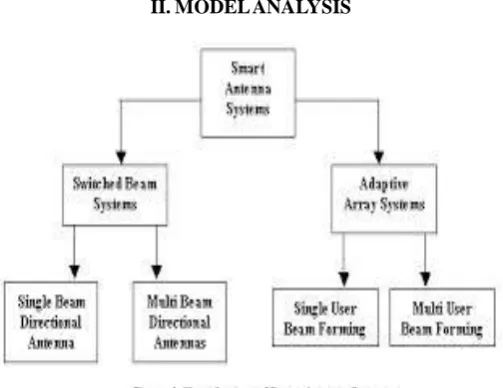
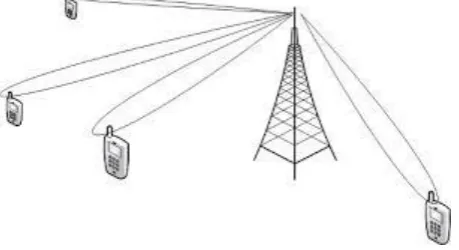
Fig. 1. & 2. Smart Antenna Adaptive Wireless Push System
Due to some disadvantages over the existing system another technique called smart antennas with rescheduling application is used in the proposed system. The use of multiple directional antennas at the Broadcast Server has been shown to increase performance. In many cases however, such broadcasting systems fail to exploit the full potential of the multiple antennas as they do not take into account the geographical distribution of clients within the coverage area of the system.
This proposes an adaptive smart antenna based wireless push system where the beam width of each smart antenna is altered based on the current placement of clients within the system area. Coupled with a modification of the broadcast schedule, this should be done by using learning automaton tool on the broadcasting server side.[6]
purpose. By using this technique the gain of the signal should be gradually increase to the desired range. In the satellite communication the smart antennas are mainly used to monitor their coverage area. It is also used to preset the beam width according to the location of the subscriber.
A. Network Characteristics
The topology of the proposed wireless push system, an example of which is shown in Figure 1, consists of a large number of clients and a BS equipped with a number of smart antennas. The fact that the system is of a push nature means that the system clients do not possess the ability to explicitly submit requests for data items, thus each client will wait for the item it demands to appear in the broadcast program c system. This can be achieved by transmit beam forming , which allows a smart antenna to focus its transmit main beam constructed by the broadcast server.
In the proposed system, the ability of smart antennas to change their beam width is exploited so that the coverage area of each antenna is changed according to the current placement of clients within the direction where the desired client receivers reside and steer nulls in the other directions, so that clients residing in areas other than the desired one do not receive any transmission from this antenna. [5]
It has to be noted that such a requirement is nowadays easy to implement by already proposed smart antenna technology, which has gone even further by supporting Space Division Multiple Access (SDMA), a technique that requires from the smart antenna to form a transmission beam able to follow the movement of a specific mobile.
The proposed system can thus work with any kind of smart antennas that offer the property of alterable beam width, thus with both switched beam smart antennas and adaptive array ones. Switched beam systems employ a number of fixed beam patterns and based on the application requirement determine which beam to access at a given point in time. Adaptive arrays systems are able to steer the antenna beam to any direction of interest while at the same time nulling interfering signals. Each smart antenna is equipped with a Learning Automaton for the estimation of the demand probability of the information items that are broadcast to the clients under its coverage. A LA is an automaton that improves its performance by interacting with the random environment in which it operates. LA have been applied to several problems in the area of wireless networks , including wireless data broadcasting, adaptive mobile ad-hoc networks.
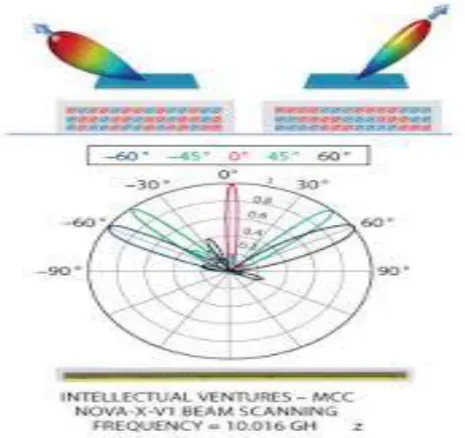
Fig.2 Beam width allocation of Entire System
B. The Server Broadcasting
In this module designing the basic system that consists of one broadcasting server and N number of clients are done. According to the population the clients are divided into several numbers of groups. Broadcasting server uses multiple antennas for transmitting the signals to the clients. According to the number of clients the antennas used on the broadcasting server should be changed. Basic system consists of a broadcasting server and a group of clients. According to the number of clients antennas used at the broadcasting server should be changed. In this system we have to use smart antenna for the transmission of information to the clients. The main use of these kinds of antennas is they accept signal from all direction and also they adjust their beam width according to the client’s location. It should be more advantage over the existing system.
Fig. 3. Types of Antenna Arrays
An another technique called Learning Automaton tool is used. This tool is mainly used to find the client requirement. Because the system used here is push in nature. So the clients want to demand their requirement to the broadcasting server. This should be carried out by using these types of tools at the BS. The server estimates the next transmission by using the cost function present in this system. The cost function mainly used to find the next transmission, by comparing the current transmission with the previous transmission.[7-10]
After the information sent by the broadcasting server it should be accessed by the group of clients, according to their response the broadcasting schedule should be arranged by using the learning automaton tool present in this system. The spacing between the information arranged in the broadcasting schedule should be calculating by using the above equation .
C. Using smart antennas for performance increase
The multiple directional antenna system does not fully exploit the potential of the available directional antennas at the BS. This is attributed to the fixed way that these serve the coverage area due to their lack of ability for beam width alteration.
III.SIMULATIONRESULTS
Consider SA antennas having replicas of the same database of equally-sized items. The antennas are initially unaware of the demand for each item, so initially every item has the same probability estimate. Client demands are a-priori unknown to the server and location dependent. Mean response time is the mean amount of time units that a client has to wait until it receives a desired information item.
Fig. 5 Allocation of Beam Width for different networks
IV. CONCLUSION
In this paper, the performance of different smart antennas using the adaptive network system in order to improve the performance is discussed and the results are analysed using Matlab. This provides the technology of different antenna systems allocating its beam width with respect to the clients variation in a particular system.
REFERENCES
[1] C. Liaskos, S. Petridou, and G. Papadimitriou, “Towards realizable, low cost broadcast systems for dynamic environments,” IEEE Trans. Netw., vol. 19, no. 2, pp. 383–392, Apr. 2011.
[2]Sundarraj, M., "Study of compact ventilator", Middle - East Journal of Scientific Research, ISSN : 1990-9233, 16(12) (2013) pp.1741-1743. [3] P. Nicopolitidis, G. I. Papadimitiou, and A. S. Pomportsis, “Adaptive data broadcasting in underwater wireless networks,” IEEE J. Oceanic Eng., vol. 35, no. 3, pp. 623 634, July 2010.
[4]Thooyamani K.P., Khanaa V., Udayakumar R., "An integrated agent system for e-mail coordination using jade", Indian Journal of Science and Technology, ISSN : 0974-6846, 6(S6) (2013) pp. 4758-4761.
[5]C. Liaskos, S. Petridou, G. I. Papadimitriou, P. Nicopolitidis and A. S. Pomportsis, “On the analytical performance optimization of wireless data broadcasting,” IEEE Trans. Veh. Technol., vol. 59, no. 2, pp. 884– 895, Feb. 2010.
[6]Udayakumar R., Khanaa V., Kaliyamurthie K.P., "High data rate for coherent optical wired communication using DSP", Indian Journal of Science and Technology, ISSN : 0974-6846, 6(S6) (2013) 4772-4776.
[7] P. Nicopolitidis, G. I. Papadimitiou, and A. S. Pomportsis, “Continuous flow wireless data broadcasting for high-speed environments,” IEEE Trans. Broadcast., vol. 55, no. 2, pp. 260–269, June 2009.
[8] Udayakumar R., Khanaa V., Kaliyamurthie K.P., "Optical ring architecture performance evaluation using ordinary receiver", Indian Journal of Science and Technology, ISSN : 0974-6846, 6(S6) (2013) pp. 4742-4747.
[9]C. Liaskos, S. Petridou, G. I. Papadimitriou, P. Nicopolitidis, M. S. Obaidat, and A. S. Pomportsis, “Clustering-driven wireless data broadcasting,” IEEE Wireless Commun. Mag., vol. 16, no. 6, pp. 80–87, Dec. 2009.
10Udayakumar R., Khanaa V., Kaliyamurthie K.P., "Performance analysis of resilient ftth architecture with protection mechanism", Indian Journal of Science and Technology, ISSN : 0974-6846, 6(S6) (2013) pp. 4737-4741
[12] A. B. Waluyo, W. Rahayu, D. Taniar, and B. Scrinivasan, “A novel structure and access mechanism for mobile data broadcast in digital ecosystems,” IEEE Trans. Industrial Electron., vol. 58, no. 6, pp. 2173– 2182, June 2011.
[13] Y. De-Nian and C. Ming-Syan, “Data broadcast with adaptive network coding in heterogeneous wireless networks,” IEEE Trans. Mobile Com- put., vol. 8, no. 1, pp. 109–125, Jan. 2009.
[14] I. Stojanovic, W. Zeyu, M. Sharif, and D. Starobinski, “Data dissemination in wireless broadcast channels: network coding versus cooperation,” IEEE Trans. Wireless Commun., vol. 8, no. 4, pp. 1726–1732, Apr. 2009.
[15] TVUK Kumar, B Karthik, EB Kumaran, Visual Secret Sharing Scheme for JPEG Compressed Images, Middle-East Journal of Scientific Research 12 (12), PP 1873-1880, 2012.
[16] B Karthik, TVUK Kumar, EMI Developed Test Methodologies for Short Duration Noises, Indian Journal of Science and Technology 6 (5S), PP 4615-4619, 2013.
[17] Mr.B.Karthik, Dr.T.V.U. Kiran Kumar, N. Gomathi, Immobilizer Implementation using Mutual Authentication with enhanced security using 802.15.4 protocol,International Journal of Advanced Research in Electrical, Electronics and Instrumentation Engineering ,ISSN 2278 - 8875, pp 142-151, Vol. 1, Issue 3, September 2012.
[18] M.Jasmin,Bus Matrix Synthesis Based On Steiner Graphs For Power Efficient System On Chip Communications ,International Journal of Advanced Research in Electrical, Electronics and Instrumentation Engineering, ISSN 2278 - 8875 , pp 98-104,Vol. 1, Issue 2, August 2012. [19] M. Jasmin, A Low Power Pipelined FFT/IFFT Processor for OFDM Applications,International Journal of Advanced Research in Electrical, Electronics and Instrumentation Engineering,ISSN (Print) : 2320 – 3765, pp 4712-4721, Vol. 2, Issue 10, October 2013.
[20] M Jasmin, Low Power Design of the Processer Based on Architecture Modifications,International Journal of Advanced Research in Electrical, Electronics and Instrumentation Engineering,ISSN: 2278 – 8875, pp 2922-2927, Vol. 2, Issue 7, July 2013.