On The Determination of a Low Cost
K-Connected Network
Latha .S
1,Sridhar Raja .D
2Professor & Head, Dept. of ECE, Bharath University, Chennai, Tamil Nadu, India1 Assistant Professor, Dept. of ECE, Bharath University, Chennai, Tamil Nadu, India2
ABSTRACT: The goal of the topological design of a computer network is to achieve a specified performance at a minimal cost. Unfortunately, the problem is completely intractable. A reasonable approach is to generate a potential network topology. One heuristic for generating a potential network topology is due to Steiglitz, Weiner and Kleitman and is called the link deficit algorithm. This paper presents a modified version of the above heuristic which results in a lower cost starting network. In addition, a novel and simple algorithm has been presented for designing a 3-connected starting network when the number of nodes in the network exceeds four.
KEYWORDS: Topological Design, Computer Networks, Link Deficit Algorithm, Minimal Weight Spanning Tree, K-Connected Network, Starting Network.
1. INTRODUCTION
The terms 'K-connected network’, ‘starting network’, ‘link deficit algorithm’,’ topological design’,’ minimal spanning tree' have the usual meanings{1,2,3].
The goal of the topological design of a computer communication network is to achieve a specified performance at a minimal cost. Unfortunately, the problem can be solved only by using exponential algorithms and as such the problem is completely intractable [2].The fastest available super computers cannot optimize a 25 node network, let alone a 100 node network. Thus, a reasonable approach is to generate a potential network topology (called a starting network) and see if it satisfies connectivity and delay constraints. If not, the starting network is subjected to small modification (called perturbation) to yield a slightly different network, which is now checked to see if it is better. If a better network is found, it is used as the base for more perturbations. If the network resulting from perturbation is not better, the original network is perturbed in some other way. This process is repeated till the computer budget is used up [4, 5].
One of the many heuristics for a generating a starting network is the link deficit algorithm [6]. We now present a modified version of the link deficit algorithm which results in a lower cost starting network.
II. MODIFIED LINK DEFICIT ALGORITHM
III.ILLUSTRATIVE EXAMPLE
The geographical positions of five nodes labeled 1 through 5 are shown in fig 1.
Fig 1
The cost of establishing a link between any nodes i to any node j is given by the following cost matrix C
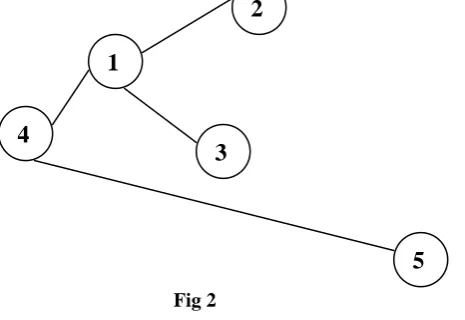
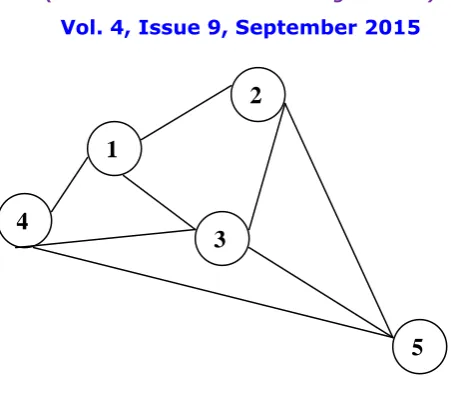
The minimal spanning tree can be determined as usual [2, 4] and is shown in fig 2.Let us suppose that we want to set up a 3-connected network. In fig 2, the deficits of the nodes1 through 5 are 0,2,2,1 and 2 respectively. Application of the link deficit algorithm to what is shown in fig 2 results in the starting network shown in fig 3.
(1)
This modified link deficit algorithm can be used to set up any k-connected network wherein K is greater than 1 [3].We now present a simple algorithm. Wherein the minimal spanning tree algorithm is applied twice [5].
1
2
4
3
1
2
4
5
3
3
1 2 3 4 5
1 – 2 2 1 8
2 2 – 4 10 5
C
= 3 2 4 - 4 6
4 1 10 4 - 2
Fig 3
IV. ALGORITHM FOR A 3-CONNECTED NETWORK
Given the geographical positions of the nodes of a network and a cost matrix giving the cost of establishing a link between any node i and any node j, we proceed as follows. The minimal spanning tree T1 is determined. The costs of the link presented in T1 are made infinite in the cost matrix and the minimal spanning treeT2 is again determined [6,7]. A low cost 3-connected starting network results when the edges of T1 and T2 are superimposed. We now illustrate this novel approach by working out the previous example.
V. ILLUSTRATIVE EXAMPLE
The geographical positions of the nodes of a network are shown in fig 1. The cost matrix is given by equation 1. The minimal spanning tree is determined as usual and is shown in fig 2.In the cost matrix given in equation 1.the costs of the edges present in fig 1 are made infinite and the modified cost matrix C’ is shown below [8-10].
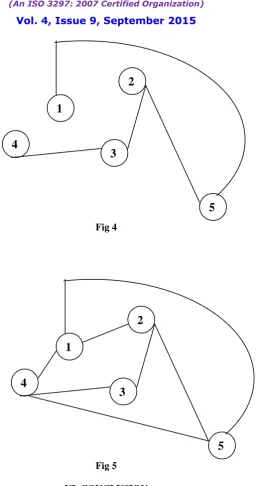
For the cost matrix C’ given in equation 2, we find the minimal spanning tree as shown in fig 4 [11, 12].When the edges shown in fig 2 and fig 4 are superimposed, we get a low cost 3 connected starting network as shown in fig 5.
1
2
4
5
3
3
1 2 3 4 5
1 __
8
2
__ 4 10 5
Fig 4
Fig 5
VI. CONCLUSION
This paper presents a modified version of the link deficit algorithm which results in a lower cost starting network, when we desire to set up a k-connected network. In particular when k=3, a novel algorithm which utilizes the minimal spanning tree algorithm twice has been presented.
1
2
4
5
3
3
1
2
4
5
3
6. Thomas J., Ragavi B.S., Raneesha P.K., Ahmed N.A., Cynthia S., Manoharan D., Manoharan R., "Hallermann-Streiff syndrome", Indian Journal of Dermatology, ISSN : 0019-5154, 58(5) (2013) pp.383-384.
7. Gerla, H.Frank and J.Eckl, A cut saturation algorithm for topological design of packet switched communication networks, Proc NTC, 1974, pp 1074-1085.
8. Subha Palaneeswari M., Ganesh M., Karthikeyan T., Manjula Devi A.J., Mythili S.V., "Hepcidin-minireview", Journal of Clinical and Diagnostic Research, ISSN : 0973 - 709X, 7(8) (2013) pp.1767-1771.
9. A. Lavia and E.G. Manning, ‘Perturbation Techniques for topological optimization of computer networks, Proc Fourth Data Comm. Symp, 1975, pp 4.16-4.23.
10. Laljee R.P., Muddaiah S., Salagundi B., Cariappa P.M., Indra A.S., Sanjay V., Ramanathan A., "Interferon stimulated gene - ISG15 is a potential diagnostic biomarker in oral squamous cell carcinomas", Asian Pacific Journal of Cancer Prevention, ISSN : 1513-7368, 14(2) (2013) pp.1147-1150.
11. K. Steiglitz, P.Weiner and D.J.Kleitman, The design of minimum cost survivable networks, IEEE Trans. Circuit theory (1969), pp455-460. 12. Pandimadevi V., Kujambal A., Sudhakar S., Ramaiah B., Gupta S., Srinivasan K.S.V., "Upgrading low-grade grain leather using high
performance polymeric dispersions by a transfer coating system", Journal of the American Leather Chemists Association, ISSN : 0002-9726, 96(5) (2001) pp.157-161.
13. T.Nalini ,A.Gayathri,HVS Based Enhanced Medical Image Fusion ,International Journal of Innovative Research in Computer and Communication Engineering,ISSN (Print) : 2320 – 9798 , pp 170-173, Vol. 1, Issue 2, April 2013.
14. S.Thirunavukkarasu, r.K.P.Kaliyamurthie ,EFFICIENT ALLOCATION OF DYNAMICRESOURCES IN A CLOUD,International Journal of Innovative Research in Computer and Communication Engineering, ISSN: 2249-2651, pp 24-29,Volume1 Issue3 Number2–Dec2011. 15. K.G.S. VENKATESAN,Planning in FARS by dynamic multipath Reconfiguration system failure recovery in Wireless Mesh
Network,International Journal of Innovative Research in Computer and Communication Engineering,ISSN(Online): 2320-9801,pp 5304-5312,Vol. 2, Issue 8, August 2014.
16. G.Michael, An Empirical Approach – Distributed Mobility Management for Target Tracking in MANETs ,International Journal of Innovative Research in Computer and Communication Engineering , ISSN (Print) : 2320 – 9798 , pp 789-794 , Vol. 1, Issue 4, June 2013.