International Journal of Research (IJR)
e-ISSN: 2348-6848, p- ISSN: 2348-795X Volume 2, Issue 10, October 2015Available at http://internationaljournalofresearch.org
Analysis of the Benefits and Adoption Approach for CCTLD in
Developing Countries
1
Amadi E.C. ;
2Oluigbo I.V. ;
3Roland J. O. &
4Ujunwa A.L.
1-4
Department of Information Management Technology, Federal University of Technology Owerri.
[email protected], [email protected], [email protected],
[email protected] ABSTRACT
The importance of Domain Name Service (DNS) and Windows Internet Naming Service (WINS) cannot be overemphasized; at it is an internet service that works transparently in the background, translating human readable Fully Qualified Domain Name into a network understandable IP address. With that in mind, it is imperative that we properly structure our domain names such that it weighs more on the international community. For a long time, domain names bearing only the Top Level Domain was most popular in the domain market, but overtime, things are changing as individuals, organisations and countries are identifying the benefits of using a Country Code Top Level Domain (ccTLD) as an entity within the Top Level Domain. This research identifies the numerous benefits of ccTLD in a developing country, and analyses the best approach towards adoption and using this ccTLDs.
Keywords: CCTLD; TLD; Developing Countries; DNS; Naming system; gTLD
1.0 INTRODUCTION
Since the invention of Domain Names in the early 1980’s, the number of registered domain names in the internet space currently has growing very fast, with an alarming rate of 93 Million registered domain names in April 2006 [1].
At the end of 1985, there were a whopping total of six domain names registered in the world. That number has expanded to 265 million names registered globally [2]. On March 15, 1985, Symbolics Inc., a computer manufacturer in Massachusetts, registered the domain name Symbolics.com, making it the first appropriately registered .com domain in the world. Symbolics.com remained under the same ownership until 25 years later, in 2009, when it was purchased for an undisclosed sum by XF.com Investments. As it stands today, Symbolics.com is a strange hybrid: part-online museum, part-advertising space. At inception, domain name registration was free of charge; a strategy aimed at encouraging high integration and acceptance of the use of domain name. In
1995, Domain prices began at $100 for a two-year registration [2].
International Journal of Research (IJR)
e-ISSN: 2348-6848, p- ISSN: 2348-795X Volume 2, Issue 10, October 2015Available at http://internationaljournalofresearch.org
“.com”, “.edu”, “.gov”, “.net”, “.mil”, “.biz”, “.info”, “.info” e.t.c.
The next level of the domain name is the Second-level Domain name (SLD). The SLD identifies an entity within a TLD, and it usually includes the TLD. SLDs can be subdivided into further domain levels known as “Subdomains”. For example, a domain name used by a registered company is “cresponet.net”, “cresponet” is the Second-Level Domain name while “.net” is the TLD. A subdomain “portal.cresponet.net” can be further created, which is an entity within the SLD.
Basically Top Level Domains consists of two parts; the generic Top-Level Domains (gTLDs) (e.g. “.com” or “.org”) and the country code Top-Level Domains (ccTLDs). A country code top- level domain (ccTLD) is a top-level domain used and reserved for a country or an independent territory, expressed in two-letter country codes mostly based on the ISO 3166-1 standard e.g. “.ng” for Nigeria or “.fr” for France [3]. The country’s top-level domain represents the national or territorial interests of a domain, and is often viewed as the flagship of a country’s Internet participation and as a strategic asset with symbolic, socio-economic and/or Internet stability and security implications.
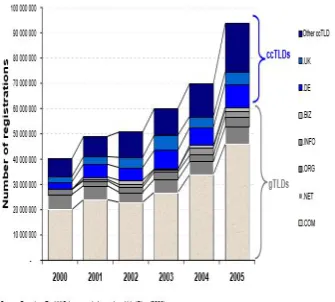
The number of domain name registrations under major gTLDs and the ccTLDs has increased rapidly over recent years. The major gTLDs more than doubled from 28 million in 2000 to 60 million in 2005, while the number of registrations in the ccTLDs nearly tripled from 12 million in 2000 to 33 million in 2005 [1]. Whereas gTLDs do not generally have geographic or country designations and are governed by rules set up by the Internet Corporation for Assigned Names and Numbers (ICANN), ccTLDs, for their part, are under national jurisdiction for the definition of their policies and legal responsibilities [4].
With respect to Domain Name Service, there are three subsidiaries to ccTLD:
1. ccTLD Registries: A body that administers and operates a ccTLD in compliance with local and international laws and regulations
2. Registry-Accredited Registrars (also called Domain Name Retailers): They purchase domain names from ccTLD registries on behalf of registrants and in accordance with the specific ccTLD policies as specified in registrar accreditation agreements, and provide services to registrants.
3. Registrants (also called domain name holders): These are individuals or reseller customers of the registrar or of the registry.
1.1 EVOLUTIONS OF ccTLD
The implementation of ccTLDs was started by Internet Assigned Numbers Authority (IANA). The delegation and creation of ccTLDs is presented within RFC 1951. In order to determine whether new ccTLDs should be added or not, the IANA follows the provisions of ISO 3166 - Maintenance Agency [5]. In 2010, IANA began implementing internationalized country code TLDs – a two-letter top-level domain, consisting of language-native characters when displayed in an end-user application.
International Journal of Research (IJR)
e-ISSN: 2348-6848, p- ISSN: 2348-795X Volume 2, Issue 10, October 2015Available at http://internationaljournalofresearch.org
Figure 1: Number of registered gTLDs and
ccTLDs, 2000-2005 (33 Million)
Much of the growth in ccTLD registrations is coming from developing nations, from ccTLD registries that are liberalising their policies, and from specific promotional campaigns. For example, the number of domain names using China's .cn more than doubled in 2005 [6]. The reasons for this include higher growth in Internet usage, a major lowering of the price of registration, and implementation of character domain name registrations at the second level.
Figure 2. Registrations of ccTLDs,
2008-2014 (105 Million) [18]
The vast majority of ccTLD registrations are attributable to a relatively small number of ccTLD registries. Out of the 245 ccTLDs, the top ten account for 70% of all ccTLD registrations and nearly all of the top ten ccTLDs experienced growth from mid 2005to April 2006. While the top-ten ccTLDs represent a large proportion of the total number of ccTLD registrations, this percentage has been slowly declining since early 2004 when the top ten represented 75% of all ccTLDs.
In terms of ccTLD registrations, 4.3 million domain names were added in the first quarter of 2012, representing a 16.2% increase from the same period a year ago.
Based on the average year over year growth in ccTLDs from the first quarter of 2008 to the corresponding quarter of 2012, [18] predicted that by early 2013, there will be 105 million ccTLD registrations
Figure 3: Contributions to the overall net balance by segment (2010 - 2014)
2.0 HIGHLIGHTS OF ccTLD
International Journal of Research (IJR)
e-ISSN: 2348-6848, p- ISSN: 2348-795X Volume 2, Issue 10, October 2015Available at http://internationaljournalofresearch.org
1. ccTLD’s Policies: There are quite a number of policies surrounding ccTLD implementation in developing countries; these policies can be economic, legal, socio-cultural and historical. ccTLD have a wide number of naming structures, from flat to multi-layered, some having several levels of hierarchy and elaborate structures; forexample .co.ng. TLDs are the top level of naming hierarchy.
Most ccTLD registries have their own policies with regards to eligibility for registrations, local presence requirements, naming structure of the second-level domains, public access to ccTLD registration information (Whois), and trademark policy, that are both heavily influenced by, as well as subject to, local or regional legislation. Many feel that such variety is in the interest of registrants as it allows each registry to reflect local requirements, and that the variety of approaches is a strength of the ccTLD community, facilitating the identification of best practice and cultural diversity [1]. 2. ccTLD Domain Name Market
Expansion: There has been a high growth and integration of ccTLD among developing countries. Overall, countries have become more aware of the importance of the Internet and of Internet identifiers, and many ccTLD registries strive to enhance their national Internet identity by promoting registrations under their ccTLD. Reduced restrictions on registration requirements, commercialisation and greater automation of registry provisioning have accelerated adoption of ccTLD names. Yearly growth in registrations under ccTLD averaged 36% in 2005. Some of the higher growth rates are found in countries that have liberalised their registration requirements.
3. ccTLD Registries as Non-Profit Organisation: A large number of ccTLD managers are local
organisations that are not-for-profit organisations with a public service inclination. They tend to emphasise an active commitment to the needs of their local Internet communities (LIC), in compliance with local and/or regional legislation, while forming part of and taking into account a global inter-dependent system. The composition of given “local Internet communities” varies from one country to another, and might include Internet service providers, Internet users – both individual and business –, as well as governments. Therefore the form, characteristics and influence of the LIC on domain allocation vary significantly. 4. Government Interests in ccTLD: Government interest and involvement in the management of their national ccTLD has increased, though not necessarily to increase control. Governments have legitimate interests in the management of their respective ccTLD, which should be respected. Many parties have acknowledged that ccTLDs are managed in the interest of the local community and in compliance with local and/or regional legislation. Yet a question often raised is whether or how to implement authority of governments over their ccTLDs within current frameworks in a way that is suitably dynamic in serving the interests of national and international registrants and to that question, there is no “one size fits all” solution.
3.0 ccTLD Review in Nigeria
International Journal of Research (IJR)
e-ISSN: 2348-6848, p- ISSN: 2348-795X Volume 2, Issue 10, October 2015Available at http://internationaljournalofresearch.org
In 1995, the University of Southern California's Information Sciences Institute (which then performed the IANA functions) approved a request for establishment of the .ng ccTLD. At that time and today, that two-letter code was and is set forth on the ISO 3166-1 list maintained by the ISO 3166 Maintenance Agency (ISO 3166/MA) as the approved alpha-2 code for Nigeria.
There are certain unique features for adopting and using the,ng ccTLD [7];
The hierarchical structure of the .ng Registry and the restrictions to characters and figures afford certain advantages.
The possibility of introducing new second level domains to serve specific trades or interest groups.
With a TLD as .ng, Nigeria’s country code assumes a global significance for many words by coupling of the TLD with any of the vowels of the English language. i.e. Fishi.ng, Samsu.ng
The uniqueness of the .ng ccTLD has seen firms like Google, Microsoft Domain Developers Fund taking up googli.ng; bi.ng; et cetera since the Second Level was opened up.
Irrespective of the unique features the .ng ccTLD possesses, it has one major drawback. According to [8] and [9], the .ng ccTLD is the most expensive in the world; and it is regarded as the most “dangerous” ccTLD. As outlined in [8], it costs about 40,000 dollars per year to register a Nigeria domain extension (.ng); that’s about 400 times the cost of registering a Moroccan country code extension (.ma) and over 2300 times the cost of registering a United States country code extension (.us). This high cost is attributed to the demands of Nigerian registry (NIRA), thereby making the NIRA accredited registrars demand for more just to make profit.
The high cost of the .ng ccTLD has significantly lowered the demand for it. In other to compensate for this, NiRA participated
and hosted many awareness programmes/ events geared at public awareness of .ng domain names and .ng ccTLD in 2014 [10]. In addition to this, The Nigeria Internet Registration Association, the body that manages the .ng country code TLD, has gave out 100,000 free domain names to Nigerians in 2014. The initiative is in celebration of Nigeria’s centenary and hopes to promote the use of .ng domains among its citizens; this is geared at increased the number of registered .ng domain by 250 percent.
4.0 ccTLD ADOPTION APPROACH FOR DEVELOPING COUNTRIES
As the proportion of ccTLD domain name registrations continues to grow -- recently reaching 38% of all domain names worldwide -- the question of the role of national governments within the administration of national domain names has moved to the forefront.
The appropriate governmental role in the management and oversight of the domain name system is an increasingly contentious issue. At the global level, the domain name system is administered by ICANN, a California non-profit corporation. While ICANN enjoys support from the United States government as well as the governments of several other developed countries, many developing countries worldwide have begun to voice the view that all governments should share in the administration of the domain name system [1].
International Journal of Research (IJR)
e-ISSN: 2348-6848, p- ISSN: 2348-795X Volume 2, Issue 10, October 2015Available at http://internationaljournalofresearch.org
have entered into operational contracts with their national ccTLD manager in which they assert their ultimate authority over the ccTLD, but grant their approval to a non-governmental ccTLD manager.
A further thirty percent of survey respondents indicated that they had taken specific steps, including drafting legislation or creating a commission to consider legislation, toward asserting ultimate authority over their national ccTLD. An additional nineteen percent of respondents indicated that they were considering formalizing their relationship with their ccTLD and expected that relationship to change in the future. In fact, only seven percent of respondents indicated no formal governmental role in their ccTLD with no plans to alter the present situation.
Figure 4: Government’s role in ccTLD
adoption
The following approaches are required priorities for the efficient adoption of ccTLD in developing countries [1]:
1. Efficiency of the domain name system
The Domain Name System maintains the domain namespace and provides translation services between the domain name hierarchy and the IP address
system. DNS cache improve the efficiency of the DNS by reducing DNS traffic across the Internet, and by reducing load on authoritative name-servers, particularly root name-servers. Because they can answer questions more quickly, they also increase the performance of end-user applications that use the DNS [12]
2. Preservation of the public interest in ccTLD
By protecting and preserving the stability, integrity and utility of the DNS and the authoritative root that is being manage, ICANN can be assured of the public’s continual interest in DNS and CCTLD
3. Ease of ccTLD registration
For easy adoption and use of the ccTLD, individuals and business organizations must be exposed to proper awareness on each domain and enlightened about the restrictions on each domain. While some developing countries have opened up their ccTLD registration to people from other nations, other countries have decided to maintain their domain name within their territory. For example, a small island country, Kiribati, wants to keep its domains (.ki) primarily for use within their own community and discourage foreigners from using the domain.
4. Transparency and accountability in ccTLD management
International Journal of Research (IJR)
e-ISSN: 2348-6848, p- ISSN: 2348-795X Volume 2, Issue 10, October 2015Available at http://internationaljournalofresearch.org
country. The Accountability Framework program provides two mechanisms by which ccTLD managers can formalize their relationship with ICANN. The first is an Accountability Framework document that sets out the obligations of a ccTLD manager and ICANN. It also covers dispute resolution and termination and is designed for ccTLD managers requiring a formal document with ICANN. The second mechanism is an exchange of letters between ICANN and the ccTLD manager designed for those for whom a simple statement of commitment is more appropriate.
5. Protection of Intellectual Property Rights (IPR)
Intellectual property (IP) is a term referring to creations of the intellect for which a monopoly is assigned to designated owners by law. Every developing country should be able to protect the copyrights, designs, name, symbols and images of its customers. Almost every country has its own IPR law, and a person desiring a protection in a particular country must make an application for IPR protection in that country, in accordance with the requirements of that country. By striking the right balance between the interests of innovators and the wider public interest, the IPR system aims to foster an environment in which creativity and innovation can flourish [14]
6. Low cost of registration
Country Code Top Level Domain is usually very expensive to purchase and register, unlike Generic TLD [15]. For this reason, individuals and corporate organisations would rather stick with a cheap gTLD for their web hosting, as against a ccTLD purchased sometimes 40 times more than the cost of a gTLD. If developing countries such as Nigeria will reduce the high cost of purchasing the .ng ccTLD from over 200 dollars to
an affordable price, there will be widespread adoption and use of the ccTLD. The golden rule is not to rush to purchase the ccTLD directly; instead prices should be compared with several online domain registrars such asNameCheap, or it is wise to consult your local registrar for a possibly cheaper deal, especially when a domain name that represents a country wants to be purchased.
7. Alignment with the government's general telecommunication policy or other policies
In April 2003, [16] launched a survey of all 189 ITU member states on the role of national governments within their domestic top-level domain. The survey featured questions on the current legal role of ccTLD administrators, ccTLD policies, and governmental involvement in national and international Internet governance issues. The findings of the survey show that Governments are deeply involved in domain name administration and plays a major role in ccTLD adoption at the national level. Contrary to most expectations, virtually every government that responded to the survey either manages, retains direct control, or is contemplating a formalized relationship with their national ccTLD.
8. The local Internet community's cooperation in the ccTLD management
International Journal of Research (IJR)
e-ISSN: 2348-6848, p- ISSN: 2348-795X Volume 2, Issue 10, October 2015Available at http://internationaljournalofresearch.org
to collect the necessary information to ensure that the Registrant can be authoritatively identified. Specifically, the registration of domain names should be based on objective criteria that are transparent and non-discriminatory. Policies and procedures may vary from country to country due to local customs, cultural values, local policies and objectives, law and regulations. The definition must be documented, available for public inspection, and transparent to the Local Internet Community [17].
4.1 Steps towards registering a ccTLD
Every country has its own registration body that manages controls, directs and coordinates a country’s ccTLD. Most of these registration bodies operate a registry/registrar system; it therefore does not register domains directly to individuals and corporate organisation that might need it. This task is left to Registrars who serve as the interface between registration body and the Registrant.All registration, renewals and transfer of the ccTLD domains are handled by the registration body’s accredited Registrars.
Before registering a domain, it is wise for a registrant to first visit the website of the country’s registration body to view the list of accredited registrars. The registrant can thereafter proceed by clicking on any Registrar of his/her choice, and would be taken to the Registrar’s website for further information on their respective procedure.
To register a domain name, the registrant shouldselect a name that wants to be registered and check the rules that apply to each suffix for the domain (e.g. .com.ng, biz.ng, .info.ng) by reading the Domain Names Policy.
5.0 BENEFITS OF ccTLD ADOPTION IN DEVELOPING COUNTRIES
One potential benefit is for a higher Search Engine Optimization (SEO) value for
country-based search results. This is the greatest benefit of adopting ccTLD as the domain name for a country [15]. Google has already stated that their search engine perceive ccTLD as a strong sign that your site is targeted to a certain country, thus it will rank higherin Google’s country-based result, or the country’s local search engine.
ccTLD is good for credibility and it raises the confidence of the users visiting your site, especially when they come from the country of your implemented ccTLD. It might be tricky to understand but in certain countries like China, the locals there have the tendency to visit a .cn brand site. This may be because the preference for the language, the locality ensures that webmaster is reachable, and issues like expensive import duty or permanent ban do not often exist
ccTLD also improves branding. With .com domain name, all you can do for branding is get a decent name, but with smart tricks applied on ccTLD branded sites, you could express your creativity, explain your site purpose and even encourage users to act upon the brand. The URL is also significantly shorter so it helps users to memorize it quickly.
Specifically, stated below are the benefits of ccTLD adoption in a developing country;
1. The ccTLD for a country is the official ICANN approved ccTLD for that country. It is wise to maintain this identity in the internet space.
2. Availability of Names is better on the ccTLD than on the gTLDs. A domain name that is lost to another individual or organisation can be recovered using the ccTLD. For example, a person can register a www.mymarket.com.ng or
www.mymarket.co.za domain name,
even though a www.mymarket.com
domain name had already been registered previously.
International Journal of Research (IJR)
e-ISSN: 2348-6848, p- ISSN: 2348-795X Volume 2, Issue 10, October 2015Available at http://internationaljournalofresearch.org
4. Security – the primary DNS servers are secured and locally managed with multiple Anycast servers located around the world.
In addition to this, registering a ccTLD domain can significantly help reduce fraudulent activities; this can be achieved if only domain names with a country’s ccTLD are considered legitimate. Internet users will be mindful of visiting any website that does not have the ccTLD domain name. 5. It supports the country’s economy and
provide jobs for local IT professionals
References
[1] Karine P. &Dimitri Y. (2006) Evolution In The Management Of Country Code Top-Level Domain Names (CCTLDs), Directorate For Science,
Technology And Industry Committee For
Information, Computer And Communications Policy,
http://Www.Oecd.Org/Sti/Ieconomy/37730629.Pdf
[2] The Domain Name Industry Brief;
http://www.verisigninc.com/assets/infographic-dnib-Q32013.pdf
[3] The list of ccTLDs is available at http://www.iana.org/cctld/cctld-whois.htm. Further information on its history is available at
http://www.iana.org/cctld/cctld-establishment-procedures-19mar03.htm
[4] The GAC Principles and Guidelines for the delegation and administration of ccTLDs of April2005(http://gac.icann.org/web/home/ccTLD_P rinciples.rtf) update the previousprinciples of 23 February 2000
[5] http://icannwiki.com/CcTLD
[6] Data compiled and growth rate compiled by
ZookNIC in 2006 (www.zooknic.com).
[7] http://www.nira.org.ng/index.php/join-us/register-ng-domain
[8] https://www.quora.com/Why-does-it-cost-40-000-yr-to-register-a-Nigerian-domain-extension-ng
[9] https://www.namepros.com/threads/ng-is-the- most-dangerous-cctld-of-all-cctlds-also-the-most-expensive-cctld.814733/
[10] Lilian M. (2014) “Nigeria sees 18,870 domains
registered in 2014”
http://www.cio.co.ke/news/top- stories/nigeria-sees-18,870-domains-registered-in-2014
[11] Nicole Henderson (2014) “Nigeria Internet Registration Association Offers Free ccTLDs to
Encourage .ng Domain Adoption”
http://www.thewhir.com/web-hosting-news/nigeria- internet-registration-association-offers-free-cctlds-encourage-ng-domain-adoption
[12] https://en.wikipedia.org/wiki/Name_server
[13] ICANN (2012) “ICANN Signs Accountability Framework with ccTLD Manager for Curacao (.CW)”https://www.icann.org/news/announcement-2012-03-13-en
[14] World Intellectual Property Organisation – WIPO (2015) “What is Intellectual Property?” http://www.wipo.int/about-ip/en/
[15] Alvaris F. (2012) “Ultimate Guide to Owning
Code Top Level Domains (CCTLD)”
http://www.hongkiat.com/blog/country-code-top-level-domains/
[16] Michael G. (2004) “Governments and Country-Code Top Level Domains: A Global
Survey” Telecommunication Standardization
Bureau/ITU, Place des Nations, CH-1211 Geneva 20 (Switzerland)
[17] ICANN (2001) “CENTR Best Practice
Guidelines for ccTLD Managers”
https://archive.icann.org/en/cctlds/centr-2nd-best-practices-20may01.htm
[18] Robin W. (2012) “Review of ccTLD
registrations leading to 2013”