Study of SC-FDMA MIMO Systems Using
Block Coding Schemes and Their PAPR and
BER Performance
Lakshmi Priya Nair
1, Prof.M.Mathurakani
2PG Student [Wireless Technology], Dept. of ECE, Toc H Institute of Science and Technology, Kochi, India1 Professor, Dept. of ECE, Toc H Institute of Science and Technology, Kochi, India2
ABSTRACT: The 3GPP Long term evolution uses single carrier frequency division multiple access for uplink and orthogonal frequency division multiple access for downlink communication. SCFDMA is a recent technique which has advantage of low PAPR compared to OFDMA system so that the power amplifiers will be battery efficient. Coding over the space, time, and frequency domains provided by MIMO-OFDM system will enable a much more reliable and robust communication over the harsh wireless environment. This article presents an overview of Space time, space frequency and quasi orthogonal space frequency coded MIMO-OFDM systems and employing multiple antennas. Also the Bit Error Rate and PAPR values of the systems will be compared.
KEYWORDS: 3GPP,LTE,SC-FDMA,OFDMA,SC-STBC,PAPR,BER,SC-SFBC,SC-QOSFBC.
I.INTRODUCTION
Communication systems have advanced so beyond that, there is no way of communication today that is totally wired. Every telecommunication system today must have a wireless path to get connected between different users. Different generations of communication evolved and latest 4G technology includes higher releases of following two standards: Wireless Interoperability Microwave Access (WiMAX) and Long Term Evolution (LTE). LTE uses Orthogonal Frequency Division Multiplexing (OFDM) as downlink access scheme and Single Carrier Frequency Division Multiple Access (SC-FDMA) as uplink access scheme. To improve diversity it uses multi antenna techniques called Multiple Input Multiple Output (MIMO) antenna systems.
Future generations of wireless communications will need to cope with ever increasing demands in quality and performance. These systems should meet stringent requirements such as high data rates over dispersive channels, coexistence of different services, robustness to interference, good coverage, high flexibility and high performance. These requirements turn the design of such a system into a real challenge, especially for the uplink, where low-cost and low-complexity mobile terminals are demanded. OFDM is a multicarrier transmission scheme that has become the technology of choice for next generation wireless and wire line digital communication systems because of its high speed data rates, high spectral efficiency, high quality service and robustness against narrowband interference and frequency selective fading. Due to its favorable features, OFDM has been adopted as a major data transmission technique by many wireless communication standards, such as IEEE 802.11a, IEEE 802.16a and terrestrial digital video broadcasting (DVB-T) systems.
rate through spatial multiplexing, and/or reduce interference from the other users. With two transmit antennas, Alamouti scheme gives a very simple and elegant orthogonal design which does not increase the throughput but provides full diversity. A space-time (ST) code is a bandwidth-efficient method that can improve the reliability of data transmission in MIMO systems. This involves restrictions on the frame duration and increase in PAPR. Also in STBC data burst should contain even number of symbols. Combination of space-frequency coding with SC-FDMA could be used, with neither restriction on the frame format, nor increase of the PAPR. This scheme is called SC-SFBC (SC Space- Frequency Block Code) which was extended to a SC quasi-orthogonal (QO) SFBC.
II.RELATED WORKS
In [3], the author presented an overview of ST coding, SF coding and STF coding for 4G MIMO-OFDM broadband wireless systems. It was shown that orthogonal ST-coded OFDM has a simple implementation that can provide a minimal decoding complexity, but cannot achieve multipath diversity nor high rate. On the other hand, it was also shown that SF-coded OFDM with signal space diversity technique can achieve the maximum diversity and full rate over multipath fading channels, at the expense of a high decoding complexity. As one of the promising multiple access techniques in future 4G wireless communications, OFDMA has been shown to provide much flexibility in resource allocation and robustness to multipath fading.
In [12], the performance of Single Carrier Space Frequency Block Coding (SC-SFBC), a new diversity technique compatible with SC-FDMA. SC-FDMA has been adopted as a possible air interface for future wireless networks as it combines the advantages of Orthogonal Frequency Division Multiple Access (OFDMA) and the constant envelope properties of single carrier (SC) transmission. Existing transmit antenna diversity techniques as STBC and SFBC are incompatible either with the system constraints or with the low envelope variations of SCFDMA. A new proposed SC-SFBC precoding technique has good performance both in terms of PAPR and BER.
In [1] A new transmit diversity scheme has been presented. This was the first paper on Alamouti coding. Here, using two transmit antennas and one receive antenna, the new scheme provides the same diversity order as MRRC with one transmit and two receive antennas. It is further shown that the scheme may easily be generalized to two transmit antennas and M receive antennas to provide a diversity order of 2M .
In [2], the impact of different types of open loop transmit diversity techniques on the performance of SC-FDMA when four transmit antennas and radio-frequency chains are available at the MS transmitter are discussed. Drawbacks of existent antenna precoding techniques (namely QOSTBC, QOSFBC) are shown and have proposed a new single-carrier quasi-orthogonal SFBC (SCQOSFBC) that is compatible with SC-FDMA and that has the flexibility and robustness of classical QOSFBC. This scheme was shown to have only a slight performance degradation compared to QOSTBC and QOSFBC. The strict framing constraints imposed by QOSTBC can be therefore relaxed at the price of a small performance degradation. Compared to classical QOSFBC, the proposed SC-QOSFBC has significantly better performance in the presence of power amplifier nonlinearity.
II. SC-FDMA STBC SYSTEM MODEL
Figure shows the block diagram of space time block coded SC-FDMA system employing two transmitting and two receiving antennas.
Fig 2 MIMO system
ALAMOUTI SCHEME FOR 2*2 MIMO: Let s1 and s2 be two random data block.
time
Fig 3 Alamouti scheme
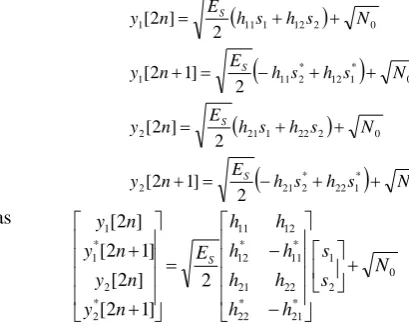
At the first time instant (2n) , s1 ans s2 will be transmitted. And at the next time instant (2n+1), si* and –s2* will be transmitted. This coded data get convolved with the transfer functions of the channel. Convolution becomes multiplication in frequency domain after DFT precoding. The received signal will be as follows at two time slots 2n and 2n+1,
This can also be written as
The SC-FDMA receiver block diagram of this system employing two transmit and receive antennas are as follows.:
Fig .4 –SC-FDMA Reciever
The streams could be alamouti decoded using the equation:
0Which can be written as:
Where z1 and z2 are the two output streams.
III. SC-FDMA SFBC SYSTEM:
Block diagram is similar to STBC system. In SFBC alamouti coding is done for two different frequencies instead of different time instants. S1 and s2 will be transmitted at first frequency and s1* and –s2* will be transmitted at a different frequency.
Frequency
In STBC, s1 and s2 are two different data blocks of equals length. But in SFBC s1 and s2 are from the same data block.Suppose a0 ,a1, a2, a3 are the first four data symbols of the data block, then the corresponding transmitting from different antennas will be as followes.
The schemes discussed above are for two antennas at the transmitter and receiver side. For multiple transmit antennas extended alamouti scheme could be used, Jafarkhani-type coding. The equivalent H matrix for four transmit antennas can be written as:
Each row of the matrix corresponds to different frequencies or sub carriers. The first subscript represent the receive antenna and second subscript represent the transmit antenna. Hence if there are two receive antennas the H parameter matrix could be extended for the second antenna.If R represents the received signal vector, H represent the H matrix and S represents the data stream, R=HS. Taking hermitan on both side of the above equation and solving for S matrix, we deduce an equation to find S from the received signals and H parameter values.
S=[HHH]HHR.
0 2
1 2
2 1
||
||
2
||
||
h
N
s
s
E
h
z
z
S
III. SC-FDMA QO-SFBC SYSTEM WITH MULTIPLE ANTENNAS
To preserve framing flexibility of SF type coding without causing any PAPR degradation we extend to QO-SFBC coding using four transmit antennas. By trying to extend alamouti based SC-SFBC from two to four transmit antennas, Jafarkhani like quasi orthogonal code is used. The PAPR is conserved in this method. The data must me coded in groups of twelve instead of four, as in case of SFBC; with 12 different frequencies.
Fig 5 SC-QOSFBC
IV.SIMULATION RESULTS
1. Simulated a basic SC-FDMA system and BER values for different SNR are plotted. Simulation result showed that BER value decreases as SNR increases. LFDMA shows better performance when compared with IFDMA. And hence it is widely used in LTE uplink systems.
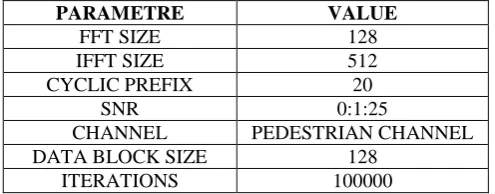
PARAMETRE VALUE
FFT SIZE 128
IFFT SIZE 512
CYCLIC PREFIX 20
SNR 0:1:25
CHANNEL PEDESTRIAN CHANNEL
DATA BLOCK SIZE 128
ITERATIONS 100000
3. Now the input data streams to be transmitted will be Alamouti coded and sent through Rayleigh channel through two transmit antennas at two different time slots. And these will be received by two antennas and the alamouti decoding will be performed. This is space time block coding for two transmit and two receive antennas.
BER and PAPR plot for the two Alamouti streams are plotted. Streams have similar performance charecteristics.
4. With two different mapping scheme:
5. SFBC with four transmit and two receive antennas gives the BER and PAPR plots as follows.
In STBC the streams have almost the same charecteristics but in SFBC the streams have different PAPR charecteristics because of the the presence of the spectral components.Here the plot is given for four transmitted antennas and two receive antennas.Four colours represent the PAPR plot of signal transmitted from four different antennas.
6. QO-SFBC using SC-FDMA using four transmit and two receive antennas
V.CONCLUSION
SC-FDMA is a new single carrier multiple access technique which has similar structure and performance to OFDMA, currently adopted for uplink multiple access scheme for 3GPP LTE. Two types of subcarrier mapping, distributed and localized, give system design flexibility to accommodate either frequency diversity or frequency selective gain. A salient advantage of SC-FDMA over OFDM/OFDMA is low PAPR. Combining MIMO techniques with SC-FDMA in order to improve uplink performance turns out to be a real design challenge. But most of the classical MIMO techniques result either in PAPR degradation or in strong constraints when applied to SC-FDMA. An innovative mapping that allows Alamouti-based SFBC-type precoding without degrading the PAPR properties of SC-FDMA. This scheme, coined SC-SFBC, shows good performance in realistic simulation scenarios: It is more flexible than STBC, and it has better PAPR than classical SFBC for almost equivalent performance. Also we extended the SC-SFBC codes in a quasi-orthogonal manner which resulted in robust performance.
REFERENCES
[1] S.M. Alamouti ,”A Simple Transmit Diversity Technique For Wireless Communications “IEEE Journal On Select Areas In Communications, Vol. 16, No. 8, October 1998.
[2] [C Ciochina,D Castelain, D Mottier And H Sari,” A Novel Quasi-Orthogonal Space-Frequency Block Code For Single-Carrier FDMA” ©2008 IEEE
[3] Wei Zhang, Hong Kong ,Xiang-Gen Xia, “Space-Time/Frequency Coding For Mimo-Ofdm In Next Generation Broadband Wireless Systems” IEEE Wireless Communications “,June 2007
[4] H. Myung, J. Lim, And D. Goodman, “Single Carrier Fdma For Uplink Wireless Transmission," IEEE Veh. Tech. Mag., Vol.1, Pp. 30-38, Sep.2006
[5] Yong Soo Cho,Jaekwon Kim,Won Young Yang,Chung G. Kang ,”MIMO-OFDM Wireless Communications With Matlab”,@Copyright 2010 [6] R Rani ,G Saini,A Kumar, “Peak-To-Average Power Ratio Analysis Of SCFDMA Signal By Hybrid Technique “ , International Journal Of
Computer Applications (0975 – 8887) Volume 69– No.15, May 2013 [7] R Surgiewicz ,Ahmed,Yun Ai ,” LTE Uplink Transmission Scheme”
[8] M A. Aboul-Dahab, Esam A. A. A. Hagras, And A A. Elhaseeb;” PAPR Reduction Based On DFT Precoding For OFDM Signals”, International Journal Of Future Computer And Communication, Vol2, No. 4, August 2013.
[9] C. Ciochina*, David Mottier And Damien Castelain;” Low PAPR Space Frequency Block Coding For Multiuser MIMO SC-FDMA Systems: Specific Issues For Users With Different Spectral Allocations”; Ciochina Et Al. EURASIP Journal On Advances In Signal Processing 2011, 2011:54.
[10] L. A. Dalton;” A Full-Rate, Full-Diversity Four-Antenna Quasi-Orthogonal Space-Time Block Code”; Ieee Transactions On Wireless Communications, Vol. 4, No. 2, March 2005.
[11] Cristina Ciochina And Hikmet Sari;” A Review Of OFDMA And Single-Carrier FDMA And Some Recent Results”; ADVANCES In Electronics And Telecommunications, Vol. 1, No.1, April 2010