ISSN 2286-4822 www.euacademic.org
Impact Factor: 3.4546 (UIF) DRJI Value: 5.9 (B+)
The Effects of Nozzle Shape on the Flow
Characteristics - A Review
REEM AHMED ABDEL BANAT
Department of Mechanical Engineering Elgeraf sharg Technical College, Sudan
ALI MOHAMMED HAMDAN ADAM
Department of Mechanical Engineering Sudan University of Science and Technology, Sudan
OBAI YOUNIS
Department of Mechanical Engineering College of Engineering at Wadi Addwaser Prince Sattam Bin Abdul-Aziz University, KSA Department of Mechanical Engineering, Faculty of Engineering
University of Khartoum, Sudan
DANIA ELSIR
Department of Mechanical Engineering, Faculty of Engineering University of Khartoum, Sudan
Abstract
This paper reviews the investigations fluid flow through different nozzle geometry, and aimed to understand the effects of nozzle shapes on the flow characteristics. This work divided in two parts, experimental method and numerical method and both focused on flow of the nozzles. The experimental discus mainly on the influence of nozzle geometry and to compare their results with different techniques, while numerical method is focused on flow of nozzle shapes using CFD analysis with different turbulent models.
1. INTRODUCTION
Nozzles have a large engineering implementations major to generate jest and sprays, it can be described as a convergent or divergent nozzles, and convergent-divergent nozzles have a convergent section flowered by divergent section and also called De-Laval Nozzle. Nozzles come in a variety of shapes and sizes depending on applications, which can be employment either as a single device or as a part of device. There are many studies of the nozzle shapes and geometry effects on the flow characteristics with different methods of analyzed.
2. METHOD OF ANALYSIS
There are two ways to study the nozzle shape effect on the flow characteristics, firstly experimental method and secondly numerical method which discus in the following.
2.1 Experimental methods
In diesel engine there are many experimental on the influence of nozzle geometry, (Hespel, C. et al., 2010) made an experimental to find the spray structure and particle size distribution close to the nozzle exit and they found that the cavitation plays a role of most importance on the atomization process and on the interaction between the liquid spray and the surrounding gas. (Payri, R et al., 2009) noticed that nozzle geometry and cavitation strongly effected to evaporation and atomization process of fuel, also (Payri, R., et al., 2005) checked the influence of nozzle geometry on combustion process under real engine condition using CH- and OH chemiluminescence techniques.
computational results. (Theerayut, K.S.M.W.H. and Nuntadusit, L.C., 2012) investigated using flow visualizations technique for the flow characteristics of the jet expansion pipe nozzles and the experiment was conducted for the free jet from round pipe with installing collar at jet exit, and they showed that the jet spreading rate of pipe nozzle with collar is not different from the conventional jet (pipe nozzle without collar), but the fluctuation of jet from pipe nozzle with collar is larger than conventional jet. Also (Ghassemieh, E., et al., 2006) made investigations by using visualization technique of small water jet for nozzle with cross-section and small diameter ranged between 120-170 µm, and they concluded that manufacturing tolerances and surface roughness effects become critically important factors in determining flow characteristics of very small nozzles. (Hu, G., et al., 2012) produced the prototype and made some experimental studies and they have seen the optimum throw lengthen of water with the maximum inlet pressure and compared their result, also (Yuan, B., et al., 2012) made proto type to compared their result for investigation in convergent nozzle of high pressure.
2.2 Numerical Methods
Numerous nozzle simulations are interested with the effect of nozzle shape and geometry on flow with different fluid and different type off nozzles. There are several studies done to investigated flow in various nozzles, (Brusiani, F., et al., 2014) compromise of the fluid dynamic performance of three different injector hole shapes diesel nozzle cylindrical, KS hole and k hole and they studied the nozzle layouts using 3D - CFD fully transient multiphase approach.
they found that the helical nozzle causes to from higher swish velocity in the vortex's chamber than the straight nozzle.
(Tamaki, H., et al., 2007) studied numerically the flow field in variable area nozzle for radial turbine using CFD and investigated for two throat areas, and they found that the effect on leakage flow on the flow field downstream of the nozzle vane was very weak with the largest opening.
(Babu, P.C. and Mahesh, K., 2004) investigated the effect of entrainment near the inflow nozzle on spatially evolving round jets for laminar and turbulent jet using Direct numerical simulation (DNS) and found that the importance allowing for in flow entrapment in simulation of turbulent jest.
One of the first efforts at connecting nozzle geometry and flow characteristics, (Matsuo, S., et al., 2007) investigated numerically the effect of nozzles geometry on the flow characteristics in spiral nozzle using unified platform for aerospace computational simulation and Spalart-Allmaras as turbulence model. Also (Theerayut, K.S.M.W.H. and Nuntadusit, L.C., 2012) illustrated the flow characteristics of jet from expansion pipe nozzle by using 3-D numerical simulation and the model of numerical simulation is same the experimental model with standard k-ε turbulent model, and they found that there is reverse flow of ambient fluid into the chamber for the pipe nozzle with the collar.
(Yii, R.S.C. el al., 2014) have studied numerically nozzle geometry of the premix injector and they determined the effect of nozzle shape on flow characteristics using CFD to improve combustion performance and pollutant products, and they showed that the premix injector nozzle hole shape gives impact flow characteristics and indirectly affects the emission of the burner system.
Reynolds-averaged Navier-Stokes equations, and showed that the nozzle geometry had clearly effect on discharge coefficient.
Many numerical work concentrated on flow in convergent-divergent nozzles, (Belega, B.A. and Nguyen, T.D., 2015) analyzed the flow through the convergent-divagated nozzle and viewed the behavior of fluid using CFD. Also (Rao, G.R. et al., 2013) analyzed the flow in convergent-divagated nozzle using CFD with different Mach number and different nozzle ratio. (Satyanarayana, G., et al., 2013) made CFD analysis of flow in convergent-divagated nozzle for different cross-section shape to investigated the suitable nozzle which gives high exit velocity among different cross-section, and they found that fluid properties are grandly dependent on the shape of the nozzle which affects the flow within the nozzle and the extent of flow expansion. Also (Mohamed, S., et al., 2017) have numerical simulation of the compressible flow in convergent-divergent nozzle to study the pressure influence on the flow characteristics and they used Reynolds averaged Navier-Stoks equations and two transport equations to model the turbulence. There have studies for gas and natural gas (Jassim, E.I. and Awad, M.M., 2013) made numerical investigation for different shape of nozzle to illustrate the position of chock wave for varies pressure ratio and they showed that nozzle geometry influences the flow structures including location of shock wave. (Pandey, K.M. and Singh, A.P., 2010) have been studying gas flow in a conical nozzle with various degree of angle and the flow is simulated using CFD 2-D axi-symmetric models.
There are many studies focused numerically for water jet including (Yuan, B., et al., 2012) have studied of the interior flow in water jets using CFD and they chose converged nozzle with different type of turbulent model and they found that k.ε verifiable turbulent model for using in water jet flow.
convergence angle) on the nozzle water jet flow field and they concluded that hydraulic cutting has the better comprehensive effect at the optimal nozzle parameters. (Baisheng, N.I.E., et al., 2011) made numerical investigates of the flow field inside and outside high-pressure abrasive water jet nozzle using CFD analysis to investigate the effect of different nozzle geometry with applying different inlet pressure and shock pressure and they chose k-ε equation turbulence model for all analysis. Additionally, (Kasare, P.K., et al., 2016) studied the effects of geometry on the turbulent jet in convergent ducts using computational tool for suitable nozzle contraction design optimization and the study suggested that SST-kx model is used where on for large change in turbulence intensities. (Hu, G., et al., 2012) made analysis of jet characteristics and structure optimization of a liquamatic fire water monitor, they simulated the internal flow performance of the fire monitor using CFD analysis with two equation RNG and k-ε turbulence model to investigated the effect of the diameter of the monitor body, cross-section shape and inlet pressure to found the best case for jet characteristics of fire water monitor. (Fang, Z.L., et al., 2014) numerically simulated the flow field of organ pipe nozzle and investigated cavity effect for different inlet pressure using CFD analysis based on k-ε equation turbulence model and showed that working pressure, cavity length and cavity diameter had influence on the characteristics of organ pipe nozzle and it exited optimum parameters.
3. NOZZLE GEOMETRY CONFIGURATIONS
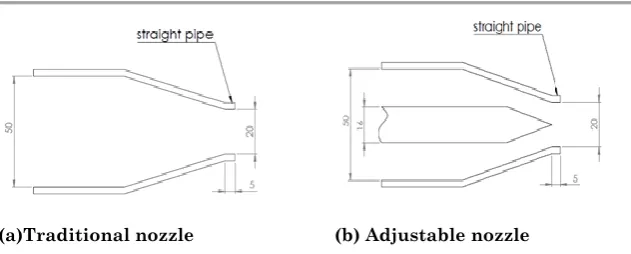
(a)Traditional nozzle (b) Adjustable nozzle
Fig. 1 Axisymmetric conical nozzles, (Zhang, S. B., et al., 2013) Flow inside the nozzle investigated numerically (Ahmet Çağrı Bilir, et al., 2016) using CFD analysis based on finite volume method for different nozzle geometries. In their study they designed five different nozzles with the same inlet and outlet diameters and length to make a good comparison, (Fig. 2) (a) Pelton-1 nozzle, (b) Conical-1 nozzle, (c) Conical-2 nozzle, (d) Reverse Pelton nozzle, and (e) Pelton-2 nozzle with applying two equation k-ε turbulence method and determined minimum reaction force and maximum mass flow rate.
(a) Pelton-1 nozzle (b) Conical-1 nozzle
e. Pelton-2 nozzle
Fig. 2 Five different nozzles with the same inlet and outlet diameters (Ahmet Çağrı Bilir, et al., 2016)
(Y. Yu, et al., 2012) Investigated the effect of nozzle geometry for different nozzle type (Fig. 3), (a) ring nozzle, (b) baseline nozzle, (c) extended nozzle and (d) grooved nozzle by using CDF analysis and the flow in those nozzle simulated using various turbulence method and they found that the increases of the turbulences intensity and mean velocity in the ring nozzle at the exit with high pressure to move flow flowed throng it.
(b) Baseline nozzle
(a) Ringed nozzle
(c) Extended nozzle (d) grooved nozzle
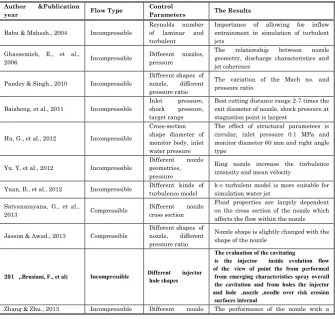
Table (1) illustrates summary of different studies of the nozzle shapes and geometry effects on the flow characteristics with various methods of analysis as blow which contents of the author of the paper, year of publication, flow type, control parameters and the important results. Flow type have done either compressible or incompressible in the nozzles, the most control parameters have been focused on the nozzle shapes, geometries and the cross section of the nozzle. Finally, the paper (CFD study of effects of geometry variations on flow in a nozzle) presents the best results which ring nozzle increase the turbulence intensity and mean velocity.
Table 1 Summary of different studies of the nozzle shapes and geometry effects on the flow characteristics with different methods of analysis.
Author &Publication
year Flow Type
Control
Parameters The Results
Babu & Mahesh., 2004 Incompressible
Reynolds number of laminar and turbulent
Importance of allowing for inflow entrainment in simulation of turbulent jets
Ghassemieh, E., et al.,
2006 Incompressible
Different nozzles, pressure
The relationship between nozzle geometry, discharge characteristics and jet coherence
Pandey & Singh., 2010 Incompressible
Different shapes of nozzle, different pressure ratio
The variation of the Mach no. and pressure ratio
Baisheng, et al., 2011 Incompressible
Inlet pressure, shock pressure, target range
Best cutting distance range 2-7 times the exit diameter of nozzle, shock pressure at stagnation point is largest
Hu, G., et al., 2012 Incompressible
Cross-section shape diameter of monitor body, inlet water pressure
The effect of structural parameters is circular, inlet pressure 0.1 MPa and monitor diameter 60 mm and right angle type
Yu. Y, et al., 2012 Incompressible
Different nozzle geometries, pressure
Ring nozzle increase the turbulence intensity and mean velocity
Yuan, B., et al., 2012 Incompressible Different kinds of turbulence model k-ε turbulent model is more suitable for simulation water jet
Satyanarayana, G., et al.,
2013 Compressible
Different nozzle cross section
Fluid properties are largely dependent on the cross section of the nozzle which affects the flow within the nozzle
Jassim & Awad., 2013 Compressible
Different shapes of nozzle, different pressure ratio
Nozzle shape is slightly changed with the shape of the nozzle
( la t.r,.n ,in is rB ni
201 e,bissaitt.cBi .ttiai,s .,eibsia
iBi t rsit
g i ilrB rs.i, it s i brl.srs.,T tBif iliB s.i, .,t.ni s i .,eibsia .t siatiasin tais s i si.,s it l.if it s i
iliarBB tsars b rarbsia.ts.bt isiaT.,T
tais
s i .,eibsia iBit
r,n tais s i brl.srs.i,
iait.i, a.tr ilia ,iinBi n ,izzBi n r,n iBi
.,sia,rB t atrbit
with different contraction angle
straight pipe is better than that of the nozzle without a straight pipe.
Yii, R.S.C. el al., 2014 Incompressible, compressible Different shapes nozzle
That the premix injector nozzle hole shape gives impact to the flow characteristics and indirectly affects the emission of the burner system
Belega & Nguyen., 2015 Compressible
Different nozzle pressure ratio, different Mach number
Mass flow rate decrease with Mach no. static pressure increase with Mach no
Ahmet Çağrı Bilir, et al.,
2016 Incompressible
Different nozzle geometry, pressures
Conical nozzle is the best nozzle geometry
Alam, M.M.A., et al., 2016 Compressible Different inlet geometry nozzle
The nozzle geometry has pronounced effect on the sonic lines and discharge coefficients
Liao & Deng., 2017 Incompressible
Convergence angle, nozzle outlet diameter, cylindrical section length
Under optimal nozzle parameters hydraulic cutting has the best comprehensive effect in an optimal design.
Mohamed, S., et al., 2017 Compressible Pressure Appearance of the delamination
4. CONCLUSIONS
This review paper purpose is to review and understand different methods of analysis concerned on the flow of nozzles which cannot covered, there has been many experimental studies and more numerical method done to gain better results. In general, numerical method has demonstrated best solution rather than experimental which it need complex nozzle geometriesi
REFERENCES
1. Alam, M.M.A., Setoguchi, T., Matsuo, S. and Kim, H.D., (2016). Nozzle geometry variations on the discharge coefficient. Propulsion and Power Research, 5(1), pp.22-33i 2. Babu, P.C. and Mahesh, K., (2004). Upstream entrainment
in numerical simulations of spatially evolving round jets. Physics of Fluids, 16(10), pp.3699-3705i
W.A.N.G. and Hailong, L., (2011). Numerical investigation of the flow field inside and outside high-pressure abrasive waterjet nozzle. Procedia Engineering, 26, pp.48-55i
4. Belega, B.A. and Nguyen, T.D., (2015). Analysis of flow in convergent-divergent rocket engine nozzle using computational fluid dynamics. In Proceedings of International Conference of Scientific Paper AFASES. Brasov, Romaniai
5. Bilir, A.Ç., Doğrul, A., Coşgun, T., Yurtseven, A. and Vardar, N., 2016. A numerical Investigation of the Flow in
Water Jet Nozules. JOURNAL OF THERMAL
ENGINEERING, 2(5), pp.907-912i
6. Brusiani, F., Falfari, S. and Pelloni, P., (2014). Influence of the Diesel injector hole geometry on the flow conditions emerging from the nozzle. Energy Procedia, 45, pp.749-758.e Series: Materials Science and Engineering, 2013. 52(7): p. 072014i
7. Fang, Z.L., Kang, Y., Wang, X.C., Li, D., Hu, Y., Huang, M. and Wang, X.Y., (2014). Numerical and experimental investigation on flow field characteristics of organ pipe nozzle. In IOP Conference Series: Earth and Environmental Science (Vol. 22, No. 5, p. 052020). IOP Publishingi
8. Ghassemieh, E., Versteeg, H.K. and Acar, M., (2006). The effect of nozzle geometry on the flow characteristics of small water jets. Proceedings of the Institution of Mechanical Engineers, Part C: Journal of Mechanical Engineering Science, 220(12), pp.1739-1753i
9. Hespel, C., Blaisot, J.B., Margot, X., Patouna, S., Cessou, A. and Lecordier, B., (2010), September. Influence of nozzle geometry on spray shape, particle size, spray velocity and air entrainment of high pressure diesel spray. In THIESEL 2010-Conference on Thermo-and Fluid Dynamic Processes in Diesel Engines (pp. 383-394)i
fire water monitor with self-swinging mechanism. The International Journal of Advanced Manufacturing Technology, 59(5-8), pp.805-813i
11.Jassim, E.I. and Awad, M.M., (2013). Numerical investigation of nozzle shape effect on shock wave in natural gas processing. World Academy of Science, Engineering and Technology, 7i
12.Kasare, P.K., Mishra, P. and Patle, V., (2016). Effect of Geometry on the Turbulent Jet in Convergent Ducts Using Computational Tooli
13.Liao, W.T. and Deng, X.Y., (2017), August. Study on Flow Field Characteristics of Nozzle Water Jet in Hydraulic cutting. In IOP Conference Series: Earth and Environmental Science (Vol. 81, No. 1, p. 012167). IOP Publishing
14.Matsuo, S., Kim, T.H., Setoguchi, T., Kim, H.D. and Lee, Y.W., (2007). Effect of nozzle geometry on the flow characteristics of spiral flow generated through an annular slit. Journal of Thermal Science, 16(2), pp.149-154i
15.Mohamed, S., Mokhtar, A. and Chatti, T.B., (2017). Numerical simulation of the compressible flow in convergent-divergent nozzle. International Journal of Heat and Technology, 35(1), pp.673-677i
16.Pandey, K.M. and Singh, A.P., (2010). CFD analysis of conical nozzle for Mach 3 at various angles of divergence with fluent software. International Journal of Chemical Engineering and Applications, 1(2), p.179i
17.Payri, R., Garcia, J.M., Salvador, F.J. and Gimeno, J., (2005). Using spray momentum flux measurements to understand the influence of diesel nozzle geometry on spray characteristics. Fuel, 84(5), pp.551-561i
19.Pourmahmoud, N., Zadeh, H.A., Moutaby, O. and Bramo, A., (2012). CFD analysis of helical nozzles effects on the energy separation in a vortex tube. Thermal science, 16(1), pp.151-166i
20.Rao, G.R., Ramakanth, U.S. and Lakshman, A., (2013). Flow analysis in a convergent-divergent nozzle using CFD. International Journal of Research in Mechanical Engineering, 1(2), pp.136-144i
21.Satyanarayana, G., Varun, C. and Naidu, S.S., (2013). CFD analysis of convergent-divergent nozzle. Acta Technical Corviniensis-Bulletin of Engineering, 6(3), p.139i
22.Tamaki, H., Unno, M., Iwakami, A. and Ishii, S., (2007). Study on flow fields in variable area nozzles for radial turbines. IHI Engineering review, 40(2), pp.89-97.nc
23.Theerayut, K.S.M.W.H. and Nuntadusit, L.C., (2012). Effect of nozzle geometry on flow characteristic of jet from expansion pipe nozzlei
24.Yii, R.S.C., Amirnordin, S.H. and Khalid, A., (2014). Effects of nozzle shape on the flow characteristics of premix injector using computational fluid dynamics (CFD)i
25.Yu, Y., Shademan, M., Barron, R.M. and Balachandar, R., (2012). CFD study of effects of geometry variations on flow in a nozzle. Engineering Applications of Computational Fluid Mechanics, 6(3), pp.412-425i
26.Yuan, B., Kang, Y., Yang, X.F., Fang, Z.L. and Li, D., (2012). Numerical investigation on high-pressure convergent nozzle by comparative and statistical analysis method. In IOP Conference Series: Earth and Environmental Science (Vol. 15, No. 7, p. 072033). IOP Publishingi