ISSN 2286-4822 www.euacademic.org
Impact Factor: 3.1 (UIF) DRJI Value: 5.9 (B+)
Contribution of nitrogen and methods of weeding
on the yield components and yield of hybrid boro
rice (HEERA 4)
SHIMUL CHANDRA SARKER1
Department of Agronomy Sher -e-Bangla Agricultural University, Dhaka Bangladesh MD. HAZRAT ALI Department of Agronomy Sher -e-Bangla Agricultural University, Dhaka Bangladesh PARIMAL KANTI BISWAS Department of Agronomy Sher -e-Bangla Agricultural University, Dhaka Bangladesh RAJESH CHAKRABORTY Department of Agronomy Sher -e-Bangla Agricultural University, Dhaka Bangladesh RUHUL AMIN Department of Entomology Sher -e-Bangla Agricultural University, Dhaka Bangladesh SANJIDA KHANDKER Department of Agricultural Extension and Information system
Sher -e-Bangla Agricultural University, Dhaka Bangladesh
Abstract:
Experiment was carried out at the Agronomy Field of Sher-e-Bangla Agricultural University, Dhaka during the period from December, 2012 to May, 2013 to investigate the response of different levels of nitrogen and methods of weeding on the yield of hybrid boro rice (Heera 4). The treatments consisted of four nitrogen levels viz., No
weeding on the yield components and yield of hybrid boro rice (HEERA 4)
= 0 kg N ha-1, N1 = Urea super granules (2.7 g) @ 75 kg N ha-1, N2 =
140 kg N ha-1, N3 = 180 kg N ha-1 and five different weed control
methods viz., W0 =No weeding (Control), W1= One weeding (30 days
after transplanting), W2= Two weeding (30 DAT & 50 DAT), W3=
Sunrice 50WG at recommended dose (100g ha-1), W4=Topstar 80WG at
the recommended dose (@80g ha-1). The experiment was laid out in a
split plot design with three replications having nitrogen doses in the main plots, weed control in the sub plots. Nitrogen and weed control had significant response on yield and yield components of hybrid rice viz., effective tillers hill-1 (No.), panicle length (cm), number of filled
grains panicle-1, number of unfilled grains panicle-1, total grain
panicle-1, weight of 1000-grain, grain yield, straw yield, biological
yield and harvest index (%). From the economic point of view, significant highest (9.48 t ha-1) grain yield was found from the
combination of USG with Sunrice 150.
Key words: Nitrogen Levels, Methods of Weeding, Yield Components and Hybrid Boro Rice
Introduction
Among cereal crops Rice (Oryza sativaL.) is one of the most important in the world. The area and production of hybrid rice in boro season were about 0.658 hectares and 33.01 lac metric tons, respectively (AIS, 2013). The population of Bangladesh is still growing by two million every year and may increase by another 30 million over the next 20 years. Thus, Bangladesh will require about 27.26 million tons of rice for the year 2020. But the average yield of rice is poor (4.34 t ha-1) in Bangladesh
(BRRI, 2011). Whereas the average rice yield in China is about 6.30 t ha-1, Japan is 6.60 t ha-1 and Korea is 6.30 t ha-1 (FAO,
weeding on the yield components and yield of hybrid boro rice (HEERA 4)
production cost. Inadequate and improper applications of N are now considered one of the major reasons for low yield of rice in Bangladesh. Weeds pose a major threat for increasing rice productivity. Uncontrolled weed growth caused significant loss of grain yield of rice (Hasanuzzaman et al., 2007). Any delay in weeding will lead to increased weed biomass as a result drastic reduction in yield. Mamun (1990) reported that weed growth reduced the grain yield by 68-100% for direct seeded aus rice, 16-48% for transplanted aman rice and 22.36 % for modern boro rice. The principle objectives under present research work is to evaluate the response of nitrogen and weed control methods on the yield components and yield of hybrid boro rice (HEERA 4) along with judicial application of all the treatments.
Materials and methods
Experiment was carried out at the Agronomy field ( 23074/N
latitude and 90035/E longitude with an elevation of 8.2 meter
from sea level under Madhupur Tract-AEZ 28), Sher-e-Bangla Agricultural University, Dhaka, Bangladesh during the period from December, 2011 to May, 2012. The planting crop was rice variety (hybrid heera-4). The experiment consisted of two factors, namely factor A: Nitrogen (level 4) viz., No = 0 kg N ha-1,
N1 = Urea super granules (2.7 g) @ 75 kg N ha-1, N2 = 140 kg N
ha-1 and N3 = 180 kg N ha-1 and factor B: weed control method
(level 5) viz., W0 =No weeding (Control), W1= One weeding (30
Days after transplanting), W2= Two weeding (30 DAT and 50
DAT), W3= Sunrice 150 WG at recommended dose (100g ha-1)
and W4 =Topstar80WG at the recommended dose (80g ha-1).
Thirty days old seedlings were uprooted and transplanted on well puddled plots. The experiment was laid out in a split plot design with three replications. The experimental plots were fertilized with P, K, Zn and S @ 140,134.7, 7.5, 60 kg ha-1 in the
weeding on the yield components and yield of hybrid boro rice (HEERA 4)
2010) as basal. The USG weighing 2.7 g each were placed at 5-10 cm soil depth at 5-10 DAT in the center of four hills in alternate rows @ 1 granule in one spot to supply 75 kg N ha-1.
Nitrogen in the form of USG and prilled urea (PU) was given following treatment levels. Split application of nitrogen was done only for PU at 10, 35 and 55 DAT. Gap filling, weeding, application of irrigation water and plant protection measures were taken properly as per when needed. From the present study data on effective tillers hill-1 (No.), panicle length (cm),
number of filled grains panicle-1, number of unfilled grains
panicle-1, total grain panicle-1, weight of 1000-grain, grain yield,
straw yield, biological yield and harvest index (%) were collected. Data were compiled and analyzed statistically by using a computer package program MSTAT-C and the mean differences were compared by Duncan’s Multiple Range Test (DMRT).
Results and discussion
Table 1: Response of nitrogen and weed control methods and their interaction on yield contributing characters of hybrid boro rice (HEERA 4)
Treatment combinations
Effective tillers hill-1
Panicle length (cm) Filled grains panicle-1 Unfilled grains panicle-1
Total grain panicle-1
1000 grain weight (g) Nitrogen
N0 9.82b 23.01c 130.00c 18.67a 148.67c 28.22a
N1 13.40a 24.17a 176.50a 11.17c 187.67a 29.20a
N2 12.84a 23.58b 156.50b 15.11b 171.61b 28.73a
N3 12.67a 24.10ab 169.10a 13.38b 182.48ab 28.66a
SE 0.42 0.19 4.27 0.66 4.24 0.29
CV(%) 16.84 3.21 10.47 17.63 9.53 3.85
Weed control methods
W0 9.14b 22.55b 137.70c 18.63a 156.33c 27.67b
W1 9.44b 23.81a 151.60b 15.10b 166.7bc 28.46b
W2 10.58ab 23.74a 161.20ab 13.10bc 173.68ab 29.48a
W3 11.61a 24.29a 173.00a 12.48c 185.48a 30.36a
W4 9.84b 24.19a 166.70a 13.62bc 180.32ab 30.03a
SE 0.49 0.22 4.78 0.74 4.74 0.32
weeding on the yield components and yield of hybrid boro rice (HEERA 4)
Note: No = 0 kg N ha-1, N1 = Urea super granules (2.7 g) @ 75 kgN ha-1 , N2 =
140 kg N ha-1 , N3 = 180 kg N ha-1 ,W0 =No weeding (Control methods) ,W1=
One weeding (30 Days after transplanting),W2= Two weedings (30 DAT and
50 DAT),W3= Sunrice 150 WG at recommended dose (100g ha-1),W4=Topstar
80WG at the reco mmended dose(80g ha-1 )
Effective tillers hill-1: The number of effective tillers hill-1 was
significantly influenced by nitrogen (Table 1). The highest number of effective tiller hill-1 (13.40) was observed from N1
(Urea super granules @ 75 kg N ha-1) that similar to N2 and N3
and the lowest (9.82) from N0 (control methods) treatment. It
was in agreement with Rama et a1. (1989), who reported that USG produced higher numbers of panicle m-2 than splits
application of urea. Weed control methods by Sunrice (W3) gave
the highest effective tiller (11.61) that similar to two weedings (10.58) (Table 1) and lowest (9.14) from no weeding (W0).The
results was supported by Raju et al. (2003) who stated that use of weedicide (Ronstar 25 EC, Safener and Butachlor) gave the highest effective tiller. The effect of interaction between N levels and weed control methods was found to be significant in respect of number of effective tillers hill-1 (Table). The highest
Interaction effect of nitrogen and Weed control methods
N0W0 6.33d 21.73f 108.80h 28.47a 137.27h 26.70h
N0W1 6.89d 22.53d-f 126.30gh 21.07b 147.37e-h 28.03e-h
N0W2 8.22cd 23.23c-e 130.30f-h 14.37c-g 144.67f-h 28.80d-h
N0W3 10.78a-c 23.97a-e 149.30d-g 17.30b-e 166.60c-h 28.50d-h
N0W4 8.56b-d 23.60b-e 135.00e-h 12.17e-h 147.17e-h 29.07c-g
N1W0 8.89b-d 23.07c-f 159.30c-f 11.50f-h 170.80b-g 29.77c-e
N1W1 10.89a-c 23.73b-e 183.70a-c 10.60gh 194.3a-c 29.50c-f
N1W2 11.89ab 24.13a-c 181.70a-c 11.80f-h 193.50a-c 30.07bc
N1W3 12.67a 25.23a 205.70a 8.93h 214.63a 31.77a
N1W4 10.89a-c 24.33a-c 191.70ab 11.27f-h 202.97ab 30.90b
N2W0 10.89a-c 22.53ef 125.70gh 16.87b-e 142.57gh 27.30f-h
N2W1 8.89b-d 23.73b-e 136.30e-h 12.67d-h 148.97d-h 28.00e-h
N2W2 12.67a 23.70b-e 154.30c-g 14.40c-g 168.70c-g 29.00c-g
N2W3 8.56b-d 24.03a-d 166.00b-f 15.47c-g 176.7b-e 28.97c-g
N2W4 11.89ab 23.90a-e 160.30b-f 16.17c-f 176.17b-e 30.37b-d
N3W0 10.45a-c 22.87c-f 156.70c-g 17.67bc 174.37b-f 26.93gh
N3W1 11.11a-c 25.20a 160.00b-f 16.07c-f 176.07b-e 28.30d-h
N3 W2 11.89ab 23.90a-e 178.30a-d 9.36h 187.60bc 29.07c-g
N3W3 11.11a-c 24.83ab 171.00b-d 10.7.gh 179.93b-d 30.20b-e
N3W4 8.01cd 24.03a-d 179.70a-d 14.87c-g 194.57a-c 28.80d-h
SE 0.98 0.44 9.55 1.48 9.49 0.65
weeding on the yield components and yield of hybrid boro rice (HEERA 4)
number of effective tiller hill-1 (12.67) was found from
N1W3(Urea super granules (2.7 g) @75 kgN ha-1)with Sunrice
150 WG at recommended dose) (100g ha-1) followed by N2W2
(12.67), N1W2 (11.89), N2W4 (11.89) and the lowest(6.33) from
N0W0 (control treatment combination).
Panicle length: Panicle length was statistically significant by forms of nitrogen (Table 1).The longest (24.17 cm) panicle was produced due to application of USG @ 75 kg N ha-1 and the
shortest (23.01 cm) was produced in control methods. Sen and Pandey (1990) also found similar panicle length by applying 38.32 kg N ha-1 either in the form of USG or prilled urea. The
panicle length varied significantly due to weed control methods shown in (Table 1). It was observed that the longest panicle (24.29 cm) was observed from the treatment W3 (Sunrice
150WG), which was statistically similar with W1, W2 and W4
and the shortest (22.55 cm) from control methods (W0). Results
confirmed by Khan and Tarique (2011) who observed that panicle length was varied due to different weed control methods treatments. Panicle length was statistically influenced by the interaction of nitrogen fertilizer and weed control methods (Table 1). The highest panicle length (25.23 cm) was observed from N1W3 (Urea super granules (2.7 g) @ 75 kgN ha-1 with
Sunrice 150 WG at recommended dose (100g ha-1) and the
lowest (21.73 cm) panicle length was produced form N0W0
treatment.
Number of filled grains panicle-1: There was a statistical variation in number of filled grains panicle-1 due to N fertilizer
(Table 1). Results showed that the highest number of filled grains panicle-1(176.50) was obtained with USG @ 75 kg N ha -1that similar to N3 and the lowest (130.00) from control
methods (W0). Rama et al. (1989) found significantly higher
filled grains panicle-1 with 40, 80 or 120 kg N ha-1 applied as
weeding on the yield components and yield of hybrid boro rice (HEERA 4)
results. Significant variation was found in filled grains panicle-1
due to the effect of weed control methods (Table1). The highest filled grains (173.00) were obtained from the effect of Sunrice 150WG (W3) followed by Topstar 80 WG (W4) and W2 (Two
weedings) and the lowest (137.70) from no weeding treated plot (W0). Results supported by Salam et al. (2010) who showed that
application of herbicide contributed mainly increasing the number of grains panicle-1. Interaction effect of N fertilizer and
weed control methods was found significant on filled grains panicle-1 (Table 1). Results observed that the highest (205.70)
filled grains panicle-1was found from the combination of Urea
super granules (2.7 g) @ 75 kgN ha-1 with Sunrice 150 WG
(N1W3) and the lowest (108.80) from combination of control
treatment (N0W0).
Number of unfilled grains panicle-1: Number of unfilled grains panicle-1 was statistically influenced from the N fertilizer
(Table 1). The lowest (11.17) unfilled grains panicle-1 was
obtained from the application of USG (N1) and the highest
(18.67) from control methods (N0). Hasan et al. (2002) also
observed that unfilled grains panicle-1 was differed by the
application of USG and PU. Effect of weeding showed significant variation in unfilled grains (Table 1). No weeding (W0) gave the highest unfilled grain (18.63) and the lowest
(12.48) from Sunrice 150WG (W3). Interaction of nitrogen
fertilizer and weed control methods showed significant response on unfilled grainspanicle-1 (Table 1). The lowest (8.93) unfilled
grains panicle-1 was observed from N1W3treatment and the
highest (28.47) from N0W0 treatment.
Total grains panicle-1: The total grain panicle-1was
significantly affected by the source of N (Table 1).The highest total grains panicle-1 (187.67) was observed from N1 treatment
that similar to N3 and the lowest (148.67) from N0 treatment.
weeding on the yield components and yield of hybrid boro rice (HEERA 4)
to different weed control methods (Table 1). Among the weed control methods treatments, the highest total grains panicle -1(185.48) was recorded from Sunrice 150WG (W3) and the
lowest (156.33) from from no weeding (W0) treatment.
Significant effect was observed in total grain panicle-1 from the
interaction of N fertilizer and weed control methods (Table 1). The highest total grains panicle-1 (214.63) was obtained by the
interaction of Urea super granules with Sunrice 150 WG and the lowest (137.27) from the control (N0W0) treatment.
1000-grain weight: There was significant variation in 1000-grain weight due to different forms of N fertilizer (Table 1). The highest 1000-grain weight (29.20g) was obtained from N1
treatment and the lowest (28.22 g) from N0 treatment. Hasan et
al. (2002) also reported that the effect of application method of USG and PU was not significant in respect of 1000-grain weight. Effect of weeding showed significant variation in 1000 grain weight (Table 1). Sunrice 150WG (W3) gave the highest
1000 grain weight (30.36 g) followed by Topstar 80WG (W4) and
two hand weeding (W2) and the lowest (27.67 g) from no
weeding (W0). Results supported by Raju et al. (2003) who
showed that weeding regime had significant effect on 1000 grain weight. Interaction of different forms of N fertilizer and weed control methods was showed significant variation on grain weight of rice (Table 1). The highest (31.77) 1000-grain weight was observed from N1W3 treatment and the lowest
weeding on the yield components and yield of hybrid boro rice (HEERA 4)
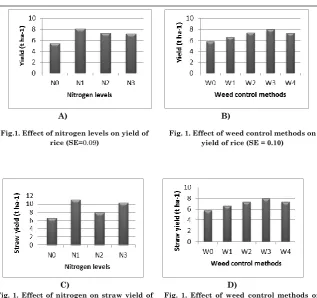
A) B)
Fig.1. Effect of nitrogen levels on yield of rice (SE=0.09)
Fig. 1. Effect of weed control methods on yield of rice (SE = 0.10)
C) D)
Fig. 1. Effect of nitrogen on straw yield of rice (SE=0.29)
Fig. 1. Effect of weed control methods on straw yield of rice (SE = 0.32)
E) F)
Fig. 1. Effect of nitrogen on biological yield of rice (SE=0.33)
Fig. 1. Effect of weed control methods on biological yield of rice (SE = 0.37)
weeding on the yield components and yield of hybrid boro rice (HEERA 4)
G) H)
Fig. 1. Effect of nitrogen on harvest index of rice (SE=0.75)
Fig. 1. Effect of weed control methods on harvest index of rice (SE = 0.84)
Fig. 1(A-H): Effect of nitrogen and weed control methods on yield of hybrid boro rice (HEERA 4)
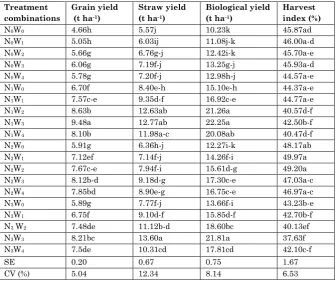
Table 2: Interaction effect of nitrogen and weed control methods on grain yield, straw yield, biological yield and harvest index of hybrid boro rice (HEERA 4)
Treatment combinations
Grain yield (t ha-1)
Straw yield (t ha-1)
Biological yield (t ha-1)
Harvest index (%)
N0W0 4.66h 5.57j 10.23k 45.87ad
N0W1 5.05h 6.03ij 11.08j-k 46.00a-d
N0W2 5.66g 6.76g-j 12.42i-k 45.70a-e
N0W3 6.06g 7.19f-j 13.25g-j 45.93a-d
N0W4 5.78g 7.20f-j 12.98h-j 44.57a-e
N1W0 6.70f 8.40e-h 15.10e-h 44.37a-e
N1W1 7.57c-e 9.35d-f 16.92c-e 44.77a-e
N1W2 8.63b 12.63ab 21.26a 40.57d-f
N1W3 9.48a 12.77ab 22.25a 42.50b-f
N1W4 8.10b 11.98a-c 20.08ab 40.47d-f
N2W0 5.91g 6.36h-j 12.27i-k 48.17ab
N2W1 7.12ef 7.14f-j 14.26f-i 49.97a
N2W2 7.67c-e 7.94f-i 15.61d-g 49.20a
N2W3 8.12b-d 9.18d-g 17.30c-e 47.03a-c
N2W4 7.85bd 8.90e-g 16.75c-e 46.97a-c
N3W0 5.89g 7.77f-j 13.66f-i 43.23b-e
N3W1 6.75f 9.10d-f 15.85d-f 42.70b-f
N3 W2 7.48de 11.12b-d 18.60bc 40.13ef
N3W3 8.21bc 13.60a 21.81a 37.63f
N3W4 7.5de 10.31cd 17.81cd 42.10c-f
SE 0.20 0.67 0.75 1.67
weeding on the yield components and yield of hybrid boro rice (HEERA 4)
Note: No = 0 kg N ha-1, N1 = Urea super granules (2.7 g) @ 75 kgN ha-1 , N2 =
140 kg N ha-1 , N3 = 180 kg N ha-1 ,W0 =No weeding (Control methods) ,W1=
One weeding (30 Days after transplanting),W2= Two weedings (30 DAT and
50 DAT),W3= Sunrice® 150 WG at recommended dose (100g ha-1),W4=Topstar
80WG at the recommended dose(80g ha-1 )
Grain yield: Grain yield affected significantly due to the forms of N-fertilizer (Fig 1 A). The highest grain yield (8.10 tha-1) was
obtained from Urea super granules (N1) which was 32.84%
higher than control plot having the lowest grain. Placement of nitrogen fertilizer in the form of Urea super granules (2.7 g) @ 75 kgN ha-1in the present experiment produced the highest
number of effective tillers hill-1, filled grains panicle-1which
ultimately gave higher grain yield than split application of urea. This result was supported with those of BRRI (2000) where USG gave 18% yield increase over the recommended prilled urea. Significant variation was observed for grain yield due to different weed control methods (Fig.1 B). The highest yield (7.97 t ha-1) was recorded from Sunrice 150WG (W3) which
was 27.35% higher than control plot having the lowest grain. Similar findings were reported by Al-Mamun et al. (2011) who observed that application of chemical herbicides significantly increases grain yield of rice. Interaction of N fertilizer and weed control methods significantly affected the grain yield (Table 2). Significantly the highest (9.48 t ha-1) grain yield was found
from the combination of USG with Sunrice 150 WG (N1W3) and
the lowest (4.66 t ha-1) from combination of control (N0W0).
Straw yield: From (Fig.1 C), it was revealed that straw yield was significantly affected due to the application of nitrogen. The highest straw yield of 11.03 t ha-1 was obtained from N1
(USG @ 75 kg N ha-1) and the lowest (6.55 t ha-1) from N0 (0 kg
N ha-1). Hasanuzzaman et al. (2009) reported application of 200
kg N ha-1 and USG @ 75 kg N ha-1 gave the highest straw yield.
weeding on the yield components and yield of hybrid boro rice (HEERA 4)
recorded from Sunrice 150WG (W3) and the lowest (7.03 t ha-1)
from no weeding (W0) treatment. Results supported by Salam et
al. (2010), who revealed that weeding had significant variation on straw yield of rice. Interaction effect of nitrogen and weed control methods was observed significant on straw yield (Table 2). The highest (13.60 t ha-1) straw yield was found from the
combination of N3W3 (180 kg N ha-1and Sunrice 150 WG), which
was statistically similar with N3W3 and the lowest straw yield
(5.57 t ha-1) was found with the combination of N0W0.
Biological yield: The biological yield was significantly affected by the nitrogen (Fig.1 E). The highest (19.13 t ha-1) biological
yield was measured from the N1 (USG @) 75 kg N ha-1) treated
plots and the lowest (11.95 t ha-1) from N0 (0 kg N ha-1). The
result agreed with the findings of Ahmed et al. (2005) who observed the effect of nitrogen dose on biological yield (t ha-1) of
rice. The biological yield varied significantly due to different weed control methods treatments shown in (Fig. 1 F). Weeds control methods led by Sunrice 150WG (W3) gave the highest
biological yield (18.55 t ha-1) and no weeding (W0) treatment
gave the lowest biological yield (12.85 t ha-1). Interaction effect
of nitrogen and weed control methods was found significant on biological yield (Table 2). The highest biological yield (22.25 t ha-1) was found from the combination of N1W3 (USG @ 75 kg N
ha-1 and Sunrice 150WG) which was statistically similar with
N1W2 and N3W3 and more than two times of control (N0W0)
recorded 10.23 t ha-1.
Harvest index: Effect of nitrogen doses exerted significant variation on harvest index (Fig. 1 G). Harvest index was the highest (48.27%) in N2 (140 kg N ha-1) and the lowest (41.16%)
was observed in N3 (180 kg N ha-1). Awan et al. (2011) reported
that highest harvest index was found with 156 kg N ha-1.
weeding on the yield components and yield of hybrid boro rice (HEERA 4)
was found due to the effect of one weeding (W3). Sunrice 150
WG (W0) gave the lowest harvest index (43.28%). The
interaction effect of nitrogen and weed control methods had significant effect on harvest index on hybrid boro rice (Table 2). Among the treatment combinations N2W1 produced the highest
harvest index (49.97%) and the lowest harvest index was obtained from the treatment combinations of N3W3(37.63%).
Conclusion
From the economic point of view, production of hybrid boro rice (HEERA 4) under present study it may be concluded that, by applying the nitrogen and weed control methods it is possible to enhance the yield of rice. Significant highest (9.48 t ha-1) grain
yield was found from the combination of USG with Sunrice 150.
Acknowledgement
The authors are very much thankful to Ministry of Education, The People’s Republic of Bangladesh to provide the financial support for this study.
BIBLIOGRAPHY
Ahmed, M., Islam, M. and Paul, S.K. (2005). Effect of nitrogen on yield and other plant characters of local T. Aman rice,
Var. Jatai. Res. J. Agric. Biol. Sci.1(2): 158- 161.
AIS (Agricultural Information Service). (2013). Krishi Diary (In Bangla). Agril. Inform. Ser. Khamarbari, Farmgate, Dhaka, Bangladesh. p.16.
weeding on the yield components and yield of hybrid boro rice (HEERA 4)
Awan, T.H., Ali, R.I., Manzoor, Z., Ahmed, M. and Akhtar, M. (2011). Effect of different nitrogen levels and row spacing on the performance of newly evolted medium grain rice variety, KSK-133. J. Animal Plant Sci. 21(2): 231-234.
BRRI (Bangladesh Rice Research Institute). (2011). Adhunik Dhaner Chash (in bengali). Bangladesh Rice Research Institute, Joydebpur, Gazipur. p. 5.
BRRI (Bangladesh Rice Research Institute). (2010). Adhunik Dhaner Chash (In Bangla) Bangladesh Rice Research Institute, Joydebpur, Gazipur.
BRRI (Bangladesh Rice Research Institute). (2000). Annual Report for 1999-2000. Bangladesh Rice Research Institute, Joydebpur, Gazipur. P. 138.
FAO. (2008). FAO Production Yearbook, Food and Agriculture Organization, Rome, Italy. 59-78.
Hasan, M. S., Hossain, S. M. A., Salim, M., Anwar, M. P. and Azad, A. K. M. (2002). Response of hybrid and inbred rice varieties to the application methods of urea supergranules and prilled urea. Pakistan J. Bio. Sci. 5(7): 746-748.
Hasanuzzaman, M. Nahar, K. Alam, M.M., Hossain, M.Z. and Islam, M.R. (2009). Response of transplanted rice to different application methods of urea fertilizer. Intl. J.
Sustain. Agric.1(1):1-5.
Hasanuzzaman, M., Nahar, K. and Karim, M. R. (2007). Effectiveness of different weed control methods on the performance of transplanted rice. Pak. J. Weed Sci. Res. 13(1-2):17-25.
weeding on the yield components and yield of hybrid boro rice (HEERA 4)
Mamun, A. A. (1990). Weeds and their control: A Review of Weed Research in Bangladesh. JSARD, Japan Intl. Co-operation Agency. Dhaka, Bangladesh. pp. 45-72.
Raju, A., Pandian, B. J., Thukkaiyannan, P. and Thavaprakash, N. (2003). Effect of weed management practices on the yield attributes and yield of wet seeded rice. Acta. Agron. Hungarica. 51(4):461-464.
Rama, S., Reddy, G. and Reddy, K. (1989). Effect of levels and sources of nitrogen on rice. Indian J. Agron. 34(3): 364-366.
Salam, M. A., Islam, M. M., Islam, M. S. and Rahman, M. H. (2010). Effects of herbicides on weed control and yield performance of Binadhan-5 grown in boro season.
Bangladesh J. Weed Sci.1(1):15-22.