ISSN (Print) : 2320 – 3765 ISSN (Online): 2278 – 8875
I
nternational
J
ournal of
A
dvanced
R
esearch in
E
lectrical,
E
lectronics and
I
nstrumentation
E
ngineering
(An ISO 3297: 2007 Certified Organization)
Vol. 5, Issue 7, July 2016
Automatic Intelligent Traffic Control System
Linganagouda R1, Pyinti Raju2, Anusuya Patil3
Assistant Professor, Dept. of EEE, RYM Engineering College, Ballari, Karnataka, India1
Assistant Professor, Dept. of EEE, RYM Engineering College, Ballari, Karnataka, India2
Associate Professor, Dept. of EEE, RYM Engineering College, Ballari, Karnataka, India3
ABSTRACT: Traffic congestion is the biggest problem faced by densely populated countries like India, China etc. So, our project focuses on three areas-Ambulance, Priority vehicles (like VIP cars, police jeeps) and Traffic density control. The project is a replica of a four way lane crossing of real time scenario. In the first part, concentrated on problems faced by Ambulances, RFID concept is used to make the Ambulance’s lane Green and thus providing a stoppage free way for the Ambulance. In the second part, concentrated on problems faced by Priority vehicles, IR transmitter and receiver are used to make the vehicles’ lane Green and thus preventing traffic congestion. In the third part, concentrated on Traffic density control, IR transmitter and receiver are used to provide dynamic traffic control and thus increasing the duration of the Green light of the lane in which traffic density is high and hence, regulating traffic.
KEYWORDS: Traffic density control, RFID, IR transmitter and receiver, dynamic traffic control.
I.INTRODUCTION
Traffic congestion is a severe problem in many major cities across the world and it has become a nightmare for the commuters in these cities. The Traffic congestion can also be caused by large Red light delays, etc. The delay of respective light is hard coded in the traffic light and it is not dependent on traffic. Therefore for simulating and optimizing traffic control to better accommodate this increasing demand is arises .One of the major problems faced by heavy traffic is by Ambulances. As we all know that Ambulances are the most important medical means of transport in any country as they carry patients to the nearby hospitals. But due to heavy traffic, one can often see the Ambulances stuck in traffic for long durations thus causing danger to patient’s life. So, our project aims to solve this problem of Ambulances. When an Ambulance arrives, its corresponding lane traffic light becomes green and all the others become red, thus paving traffic less way for the Ambulance and thus helping it to reach the hospital swiftly. This is possible by the use of RF transmitters and Receivers. In the second use of our project, we aim at controlling traffic density using microcontroller. In this the system contains IR transmitter and IR receiver which are mounted on the either sides of roads respectively. The IR system gets activated whenever any vehicle passes on road between IR transmitter and IR receiver. Microcontroller controls the IR system and counts number of vehicles passing on road. Microcontroller also store vehicles count in its memory. Based on different vehicles count, the microcontroller takes decision and updates the traffic light delays as a result. The traffic light is situated at a certain distance from the IR system. Thus based on vehicle count, microcontroller defines different ranges for traffic light delays and updates those accordingly. Finally, using the concept of IR we are providing passage to vehicles of extreme priority (VIP and Police cars), here we have installed IR transmitter in one such vehicles, the moment it comes within the line of sight of the corresponding IR receiver installed at a distance from the traffic light, it will send a signal to microcontroller and the respective lane’s light goes green.
II. LITERATURE SURVEY
ISSN (Print) : 2320 – 3765 ISSN (Online): 2278 – 8875
I
nternational
J
ournal of
A
dvanced
R
esearch in
E
lectrical,
E
lectronics and
I
nstrumentation
E
ngineering
(An ISO 3297: 2007 Certified Organization)
Vol. 5, Issue 7, July 2016
implement various traffic Signal control Algorithms [1].Intelligent traffic system for VANET suggest that creation for smart city framework for VANET consisting of Intelligent Traffic Lights which transmit warning messages and traffic statistic. In That System Various Routing Protocol Has Been Discus And Compare. They suggest that AODB is best suited for Intelligent Traffic Light [2]. Author suggest in reference [3] the data forecasting model for transmitting data from one to other. This article studied about the dynamic traffic control system and based on radio propagation model for predicting path loss &link. The author suggests in reference [7] Intelligence road Traffic signaling System. In that system OBUs used. OBUs used destination information for calculating load traffic on road for reducing the conjunction on road. The general belief is that it is more difficult to estimate and predict traffic density than traffic flow .In Intelligent Traffic Light and Density Control using IR Sensors and Microcontroller [4] the author propose that the delay of Signal not depend on traffic density. TheAuthor optimize the traffic using microcontroller this system reduce traffic jams problem cause by traffic light to extent. Thesystem contains IR Transmitter and IR Receiver. IR count the vehicles on the road Microcontroller generates the result. [8]Priority Based Traffic Lights Controller Using Wireless Sensor Network the author implements Adaptive Traffic control System based on (WSN) wireless sensor Network. In that System Time manipulation Used for controlling Traffic Light. This System Control Traffic over Multiple intersections.
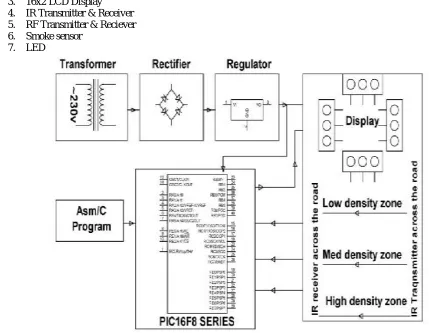
III. BLOCK DIAGRAM OF THE PROPOSED MODEL
The block diagram of Detecting vital signs with wearable wireless sensors consists of following blocks:
1. PIC Micro Controller(16F877A) 2. Regulated Power Supply 3. 16x2 LCD Display 4. IR Transmitter & Receiver 5. RF Transmitter & Reciever 6. Smoke sensor
ISSN (Print) : 2320 – 3765 ISSN (Online): 2278 – 8875
I
nternational
J
ournal of
A
dvanced
R
esearch in
E
lectrical,
E
lectronics and
I
nstrumentation
E
ngineering
(An ISO 3297: 2007 Certified Organization)
Vol. 5, Issue 7, July 2016
The sensors used in this system are listed below:
SMOKE SENSOR
Structure and configuration of MQ-2 gas sensor is sensor composed by micro AL2O3 ceramic tube, Tin Dioxide (SnO2) sensitive layer, measuring electrode and heater are fixed into a crust made by plastic and stainless steel net. The heater provides necessary work conditions for work of sensitive components. The enveloped MQ-2 have 6 pin,4 of them are used to fetch signals, and other 2 are used for providing heating current
INFRARED SENSOR:
In this we have an IR detector and transmitter circuit, the IC 444 timer is working under monostable mode. The pin 4 i.e. reset pin is when grounded via IR receiver the pin 3 output is low. As soon as the IR light beam transmitted is obstructed, a momentary pulse actuates the relay output (or LED). The IR transmitter is simple series connected resistor network from battery. The timing capacitor connected to pin 2 and ground can varied as per requirement.
RADIO FREQUENCY SENSOR:
Radio-frequency identification (RFID) is the use of a wireless non-contact system that uses radiofrequency electromagnetic fields to transfer data from a RF transmitter attached to a vehicle (ambulance), for the purposes of automatic identification and tracking. These devices use a power source (9V) and emit radio waves (electromagnetic radiation at radio frequencies). The transmitter sends signal to the receiver which can receive from several meters (yards) away. Unlike IR devices, the RF transmitter does not need to be within line of sight of the receiver.
Unlike IR devices, the RF transmitter does not need to be within line of sight of the receiver.
DESCRIPTION OF THE MODEL:
ISSN (Print) : 2320 – 3765 ISSN (Online): 2278 – 8875
I
nternational
J
ournal of
A
dvanced
R
esearch in
E
lectrical,
E
lectronics and
I
nstrumentation
E
ngineering
(An ISO 3297: 2007 Certified Organization)
Vol. 5, Issue 7, July 2016
IV.EXPERIMENTAL RESULTS AND SETUP
Fig: 2 Photograph of proposed model
PIC16F877A is used to control traffic density by using IR sensors, way for special vehicles like VIP cars and Ambulance is provided by using RF sensor. Smoke sensor is used tp measure the amount of pollution over that cross section.
V.ADVANTAGES Advantages of Smart Ambulance System:
1. Ambulance service will no longer be affected by traffic jams. 2. Use of radio frequency signal (not blocked by objects, fast). 3. Over a wide range applicability.
4. One time investment cost. 5. Life of people can be saved.
Advantages of Traffic Density Control System:
1. A modernized way of controlling traffic.
2. Number of road accidents can be reduced to a large extent. 3. Easy traffic regulation in busy cities such as Delhi, Mumbai etc.. 4. Help the traffic police in easy control of traffic
VI. CONCLUSION
ISSN (Print) : 2320 – 3765 ISSN (Online): 2278 – 8875
I
nternational
J
ournal of
A
dvanced
R
esearch in
E
lectrical,
E
lectronics and
I
nstrumentation
E
ngineering
(An ISO 3297: 2007 Certified Organization)
Vol. 5, Issue 7, July 2016
data continuously over a fiber optic link or through an internet digital radio. The received data can be stored in separate memory and be processed by a microcontroller.
VII. FUTURE SCOPE
This project can be enhanced in such away as to control automatically the signals depending on the traffic density on the roads using sensors like IR detector/receiver module extended with automatic turn off when no vehicles are running on any side of the road which helps in power consumption saving.
No. of passing vehicle in the fixed time slot on the road decide the density range of traffics and on the basis of vehicle count microcontroller decide the traffic light delays for next recording interval. In future this system can be used to inform people about different places traffic condition. This can be done through RADIO. Data transfer between the microcontroller and computer can also be done through telephone network, data call activated SIM This technique allows the operator to gather the recorded data from a far end to his home computer without going there
Traffic lights can be increased to N number and traffic light control can be done for whole city by sitting on a single place.
In ambulance system, the data of the patient in the ambulance can be sent to the Hospitals via GSM technology. Thus, it can provide early and fast treatment of the patient.
REFERENCES
[1]. Legon-Okponglo, “Design and development of microcontroller based traffic system using image processing techniques”. University of Ghana, published in ICAST, 2012 IEEE 4th International Conference.
[2]. Amrita Rai and Govind Singh Patel Multiple Traffic Control Using Wireless Sensor and Density Measuring Camera. Sensors & Transducers Journal Vol. 94, Issue 7, July 2008, pp. 126-132.
[3]. Muhammad Ridwan. “Development of a Low Cost Smart Traffic Controller System”. Department of Mechanical and Materials Engineering Faculty of Engineering and Built Environment University Kebangsaan Malaysia, 43600 Bangi Selangor, Malaysia.
[4]. “Highway traffic model-based density estimation”-IEEE paper by Morarescu, Nancy Univ., France, published in American Control Conference(ACC), 2011.
[5]. W. Wen & C.L. Yang. “A dynamic and automatic traffic light control system for solving the road congestion problem”.
[6]. “Iterative learning based Freeway density control”-IEEE paper by Jianye Li, Wuyi Univ.,China, published in Information Engineering and Computer Science(IECS),2nd International Conference
[7].http://www.edgefxkits.in/embedded/pic/density-based-traffic-signal-system-using-picmicrocontroller. [8].http://www.ijater.com/Files/IJATsER_03_06.pdf
[9] Muhammad Ridwan. “Development of a Low Cost Smart Traffic Controller System”. Department of Mechanical and Materials Engineering Faculty of Engineering and Built Environment University Kebangsaan Malaysia, 43600 Bangi Selangor, Malaysia.
[10] Marco Wiering. “Intelligent Traffic Light Control”. Institute of information and computing sciences, Utrecht University.
[11] “Automatic Traffic Control System”. SMEU Astana Solutions Automatic Traffic Control System.htmKarmakar, N. , Handbook of Smart Antennas for RFID Systems ,Wiley-IEEE Press, Pages: 13 -56 .