i
ONLINE MODULES:
NOVEL MODEL IN SERIAL-BASED METHOD OF SOFTWARE COPY PROTECTION
AHMAD GHADIRI HAKIMI
A project submitted in partial fulfillment of the requirements for the award of the degree of
Master of Science (Computer Science)
Faculty of Computer Science & Information Systems Universiti Teknologi Malaysia
iii
iv
ACKNOWLEDGEMENT
In the name of Allah, Most Gracious and Most Merciful.
I take this opportunity to express my profound gratitude and deep regards to my guide Dr. Imran Ghani, my supervisor for his exemplary guidance, monitoring and constant encouragement throughout the course of this thesis. The blessing, help and guidance given by him time to time shall carry me a long way in the journey of life on which I am about to embark.
v
ABSTRACT
vi
ABSTRAK
vii
TABLE OF CONTENTS
CHAPTER TITLE PAGE
DECLARATION ii
DEDICATION iv
ACKNOWLEDGEMENT iv
ABSTRACT v
ABSTRAK vi
TABLE OF CONTENTS vii
LIST OF TABLES x
LIST OF FIGURES xi
1 INTRODUCTION 1
1.1 Introduction 1
1.2 Problem Background 1
1.3 Problem Statement 2
1.4 Project Goal 3
1.5 Project Objectives 3
1.6 Project Scope 3
1.7 Significance of Study 4
1.8 Project Organization 4
2 LITERATURE REVIEW 5
2.1 Introduction 5
2.2 Type of Software Licensing 5
2.3 Copy Protection Methods 7
viii
2.3.2 Hardware Tokens (Dongles) for Copy Protection 12 2.3.3 Online Software 14
2.4 Security Issues about Software-Based Copy Protection 15
2.5 Dongle-Based Protection Security 16
2.6 Cryptography 17
2.6.1 Public-key vs. Private-Key Cryptography 18 2.6.2 One-Way Cryptographic Functions 18
2.7 Summary 21
3 RESEARCH METHODOLOGY 22
3.1 Introduction 22
3.2 Research Framework 22
3.2.1 Phase 1: Initial Planning 24 3.2.2 Phase 2: Research 24 3.2.3 Phase 3: Design Methodology 25 3.2.4 Phase 4: Implement the Algorithm 25 3.2.5 Phase 5: Report Writing 26
3.3 Requirements 26
3.4 Summary 26
4 ANALYSIS AND DESIGN 27
4.1 Introduction 27
4.2 The Layered Architecture 28
4.2.1 The Client Layered Architecture 28 4.2.2 The Server Layered Architecture 31
4.3 The Scenario 32
4.4 Frequency Password 34
4.5 Summary 35
5 IMPLEMENTATION AND TEST 36
5.1 Introduction 36
5.2 Use Case Diagram 36
5.3 Sequence Diagram 38
ix
5.5 The Application Interface 45
5.6 Performance Result 50
5.7 Security Testing 52
5.8 Questionnaire 53
5.9 Comparison 56
5.10 Summary 57
6 DISCUSSION, CONCLUSIONS AND FUTURE WORK 58
6.1 Introduction 58
6.2 Discussion 58
6.3 Achievement 59
6.4 Limitation 59
6.5 Future Work 60
6.6 Conclusion 60
REFERENCES 61
x
LIST OF TABLES
TABLE NO TITLE PAGE
2.1 Comparison Copy Protection Methods ... 20
5.1 The system specification ... 45
5.2 The Data Size and Bandwidth Used ... 50
5.3 The Time performance Result ... 51
xi
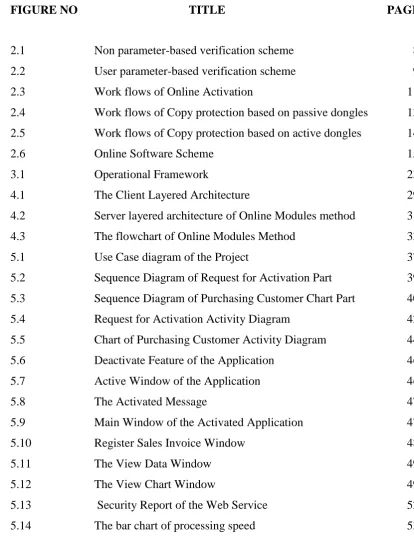
LIST OF FIGURES
FIGURE NO TITLE PAGE
2.1 Non parameter-based verification scheme 8 2.2 User parameter-based verification scheme 9 2.3 Work flows of Online Activation 11 2.4 Work flows of Copy protection based on passive dongles 13 2.5 Work flows of Copy protection based on active dongles 14
2.6 Online Software Scheme 15
3.1 Operational Framework 23
4.1 The Client Layered Architecture 29 4.2 Server layered architecture of Online Modules method 31 4.3 The flowchart of Online Modules Method 33 5.1 Use Case diagram of the Project 37 5.2 Sequence Diagram of Request for Activation Part 39 5.3 Sequence Diagram of Purchasing Customer Chart Part 40 5.4 Request for Activation Activity Diagram 42 5.5 Chart of Purchasing Customer Activity Diagram 44 5.6 Deactivate Feature of the Application 46 5.7 Active Window of the Application 46
5.8 The Activated Message 47
5.9 Main Window of the Activated Application 47 5.10 Register Sales Invoice Window 48
5.11 The View Data Window 49
5.12 The View Chart Window 49
xii
xiii
1
CHAPTER
1
INTRODUCTION
1.1 Introduction
Protection of software against cracking is one branch of software security. Usually, developer software use complex codes for enhancing security in order to crackers have problems to cracks the software. But they can do it just with spend more time. In this paper reviewed the popular and strong algorithm about crackproofing and bring up an idea for enhance crackproofing. (Cerven, 2002)
1.2 Problem Background
Nowadays, the people life involved to the technology as continue life without technology is so unbelievable. Also, technology caused people have a more time for do their works and it can avoided of duplication work and day by day people more need to new technology. One of the most important parts of technology is software that it can useful for people to all fields such as business, education, entertainment, health, communication and daily routine.
2 money. Because of this they should spend more money, time and use expert groups of software engineering for preparing the software. Unfortunately, when the software enters to markets for selling, crackers start to crack the software in order to other users allow use it without pay money. Some users buy it but other users use illegal software by the crack. It makes a great loss to the software developer because of this the developers do not have enough motivation for create a costly software. At first the developers estimate that how many of license will sell with what price, after that they spend money and time for creating the software. Imagine, the users cannot use cracked software, what happens? It’s clear; the developers can more sell of their software so they can spend more money for preparing software and every day we will see powerful applications come to markets that they can more useful for us. (Djekic , et al., 2007)
1.3 Problem Statement
3
1.4 Project Goal
The main goal of this project is to propose the new model which is capable to improve the weakness of software copy protection models. The model doesn’t allow to crackers to have all the machine code of software. Another goal of this study is to research on some models’ trends of software copy protections and to understand the vulnerabilities of their methods.
1.5 Project Objectives
This project follow the below objectives:
1. To study software copy protection methods for problem analysis
2. To propose and implement a novel model in serial-based method of software copy protection that called “Online Modules” model.
3. To test software copy protection in Sales Invoice software.
4. To compare Online Modules model with Online Activation model
1.6 Project Scope
4
1.7 Significance of Study
This subject helps to investors that they can get more benefit of invest in software which cause software industry grow up faster and more powerful than past.
1.8 Project Organization
This study consists of four chapters. The chapters are organized according to different works that involved in this study. The detailed organization of this report is described in following paragraphs. This section presents how this report is organize in different chapters.
Chapter 1 of this report consists of overview of the study, problem background, problem statement, objectives, scope and significance of this study.
Chapter 2 is about a review of the literature related to the research area. It discusses some methods and models in serial-based of software copy protection.
Chapter 3 consists of the research methodology that it used in this project.
Chapter 4 is about the analysis and design of the project.
Chapter 5 is about implement the project and analyzes its performance. Also this model compares with Online Activation
61
REFERENCES
Bobba, J. et al., 2009. StealthTest: Low Overhead Online Software Testing using Transactional Memory. Appears in the Conf on Parallel Architectures and
Compilation Techniques (PACT), september.
Djekic, P. & Loebbecke, C., 2007. Preventing application software piracy: An empirical investigation of technical copy protections. Journal of Strategic
Information Systems 16, 12 july, p. 173–186.
Madou, M., Anckaert, B., Sutter, B. D. & Bosschere, K. D., 2004. Hybrid Static-Dynamic Attacks against Software Protection Mechanisms. Ghent University. Ankit, J., Kuo, J., Jordan Soet, J. & Tse, B., 2007. Software Cracking.
Cerven, P., 2002. Crackproof Your Software. In: San Francisco: William Pollock, pp. 3-6.
Corporation, A., 2012. Home Page. [Online] Available at: http://www.acunetix.com/ [Accessed 23 December 2012].
Eberhardt, G. & Nagy, Z., 2006. Copy protection through software watermarking and obfuscation. Department of Measurement and Information Systems Budapest
University of Technology and Economics Budapes.
Genov, E., 2008. Designing Robust Copy Protection for Software Products.
International Conference on Computer Systems and Technologies.
Ionescu, A., 2004. Introduction to NT Internals, Part 1: Processes, Threads, Fibers and Jobs, Relsoft Technologies.
Joye, M., 2008. On White-Box Cryptography. Security of Information and
Networks,, pp. 7-12.
Linn, C. & Debray, S., 2003. Obfuscation of Executable Code to
ImprovenResistance to Static Disassembly. Department of Computer Science
62 Li, S., 2004. A Survey on Tools for Binary Code Analysis. Stony Brook University,
pp. 37-52.
Merckx, G., 2006. Software Security thirough Targetted Diversification, s.l.: Katholieke University IT Leuven.
Nigurrath, S., 2005. Cracking with loaders: theory, general approach and a framework. ARTeam.
Nützel, J. . & Beyer, A., 2006. Towards Trust in Digital Rights Management Systems. ACM workshop on Digital rights.
Razeen, M., Ali, A. & Sheikh, N. M., 2003. Software protection: The Last Line of Defense against Piracy.
Schneier, B., 1996. Applied Cryptography. In: s.l.:John Wiley & Sons, pp. 39-44. Shi, W., Lu, C. & Zhang, T., 2004. Attacks and Risk Analysis for Hardware
Supported Software Copy Protection Systems. College of Computingy School of
Electrical and Computer Engineeringz Georgia Institute of Technology Atlanta.
Stallman, R., 2003. Stallman and the GCC Developer Community. Using the GNU
Compiler Collection, GNU Press.
Sutter, D., Bus, D., Bosschere, D. & Demoen, K., 2000. On the Static Analysis of Indirect Control Transfers in Binaries. Ghent University and Katholieke
Universiteit Leuven.
Tanenbaum, A. S., 2002. Computer Networks. In: 4th ed. s.l.:Prentice Hall, pp. 156-165.
techtarget.com, 2009. digital signature (electronic signature). [Online]
Available at: http://searchsecurity.techtarget.com/definition/digital-signature [Accessed 22 December 2012].
Usama, M. & Sobh, M., 2011. Software Copy Protection and Licensing based. IEEE, pp. 856-861.
Zhao, J. & Yao, N., 2009. A New Method to Protect Software from Cracking. World