78:2 (2016) 7–14 | www.jurnalteknologi.utm.my | eISSN 2180–3722 |
Jurnal
Teknologi
Full Paper
I
MPROVING
Q
UALITY OF
S
ERVICE THROUGH
R
OAD SIDE
B
ACK
-
BONE
N
ETWORK IN
VANET
Kashif Naseer Qureshi
a*, Abdul Hanan Abdullah
a, Saleem Iqbal
a,
zia Muhammad
ba
Faculty of Computing, Universiti Teknologi Malaysia, Johor Bahru,
Malaysia
b
im|Sciences Peshawar, Pakistan
Article history
Received 31 March 2015 Received in revised form
21 August 2015 Accepted 15 January 2016
*
Corresponding author
[email protected]
Graphical abstract
Abstract
The vehicular ad hoc Networks (VANETs) are expected to support a large spectrum of traffic alert, dynamic route planning, file sharing, safety and infotainment applications to improve traffic management. User satisfaction plus in time delivery of real-time messages is the most significant quality evaluation criterion for vehicular applications. High mobility and rapidly changing topologies always lead to intermittent quality of services, higher delay and packet dropping issues in network. To improve the quality of services for multi-hop and dynamic environment, different types of solutions have been proposed. The article introduces multi-protocol label switching based on roadside backbone network to provide widespread, scalable, high-speed, robust quality of services and improve network efficiency. The simulation results showed that proposed model improves data transmission and routing performance in terms of data delivery, throughput, end-to-end delay and achieve adequate utilization of resources.
Keywords: Quality of service (QoS), Vehicular ad hoc Networks, Mobility, Multiprotocol Label Switching MPLS
© 2016 Penerbit UTM Press. All rights reserved
1.0 INTRODUCTION
The vehicular ad hoc networks (VANETs) have emerged as persuasive technology for providing safety and infotainment services to the passengers in the vehicles. Different projects and applications have gained a lot of popularity in this area in order to achieve productivity and traffic management. Different types of wireless and communication technologies have been implemented to support data communication in vehicular networks such as Wi-Fi, WiMAX, 3/4/5 G, cellular, and satellite systems. The VANETs have different communication modes such as vehicle-to-road side (V2R), vehicle-to-vehicle (V2V), and hybrid communication. In vehicle to roadside communication, IEEE 802.11(Wi-Fi) [1], dedicated short range communication (DSRC) [2] and IEEE 802.16 worldwide interoperability for microwave access
78:2 (2016) 7–14 | www.jurnalteknologi.utm.my | eISSN 2180–3722 | including collision avoidance, lane changing
assistance with low transfer latency. However, some applications in VANETs require high bandwidth for data delivery that need high quality of services (QoSs) such as voice over IP (VoIP)[5], video conferencing (VC) [6], multimedia services and video Security. In time delivery of messages is always considered as a main objective in safety applications. Vehicular networks have been suffered from infrastructure, applications, security, and services challenges. High-speed and dynamically changing topologies always lead to inadequate end-to-end delivery, path loss and dis-connectivity issues in network. The QoSs over VANETs remain a challenge due to these characteristics and presence of different obstacles in the network. Therefore, there is a need to develop an adaptive QoS model that can easily be adoptable and efficiently tackle the performance parameters. Different types of solutions have been proposed to deal with the challenges related to routing, frameworks, and new infrastructure models. Most of
the solutions belong to vehicle–to-vehicle
communication and enhance the routing and MAC protocols performance. On the other hand, some infrastructure solutions have been proposed to add sensor network technologies to improve the network performance [7]. However, these solutions need more investment on infrastructure that suffered from maintenance plus energy consumption issues. To take these factors into account, we focus on existing infrastructure and proposed a solution which is multi-protocol label switching (MPLS) based backbone network in order to improve network performance in terms of QoSs.
In this paper, we propose a MPLS based backbone network for improving and increasing the QOSs in VANET. The proposed model will solve the end-to-end delay and jitter issues in VANET.
The rest of this paper is organized as follows: Section 2 discusses the QOSs challenges in the vehicular network. Section 3 presents related literature. Section 4 illustrates the proposed model in detail. In last section 5, the performance evaluation of proposed model is elaborated and check the performance of proposed model with state of the art models in terms of packet delivery ratio (PDR), throughput and end-to-end delay.
2.0 QUALITY OF SERVICES CHALLENGES IN
VANET
In VANET the applications are categorized into three main classes: safety, traffic management, and comfort or entertainment applications. The safety applications are notifying about any dangerous situation on roads such as warning about weather conditions, accident warning and collision warnings. The main concern of these applications is to finding low latency and efficient methods for data
broadcasting between vehicles. To deal with high mobility and dynamically changing topologies, various data dissemination approaches have been proposed [8]. Some solutions are suggested that infrastructure less and independent pure ad hoc
communication is feasible for vehicular
communication [9]. However, in time delivery of messages is still under consideration. The second class traffic applications are working with traffic information systems in order to provide road information to vehicles in urban areas about road density plus street or junctions capacity such as self-organizing traffic information system [10] and traffic view [11]. The third class belongs to comfort applications, where the real time or non-real time multimedia streaming communication services are working such as gaming, video conferencing, data transfer, web browsing, weather information, advertisements about hotels and presence of gas stations. Multimedia applications are utilizing high bandwidth and need more strong backbone network, which is attached with roadside units. It provides high compression and user-friendly services to the network. Multimedia applications have been suffered with various QoSs challenges in network such as video coding (quantization, frame dropping, bitrates, decoding) and adjust these parameters by transmit multiple compressed programs over wireless network. Limited bandwidth and co-channel interference disturbed the network quality in terms delay. There is a need to design an efficient network model in order to provide satisfactory resources with maximum bandwidth, real-time streaming and improve QoSs requirements in network.
3.0 RELATED WORK
78:2 (2016) 7–14 | www.jurnalteknologi.utm.my | eISSN 2180–3722 | Another Multi-layer model with wireless backbone
infrastructure was proposed in [14], for VANET with multi-layer functions. The wireless backbone model is based on wide local area network (WLAN) and WiMAX enable vehicle nodes in order to provide seamless services on highways. In addition, the model addressed the gap between the bandwidth of WWAN (Wi-MAX 802.16e) and WLAN technologies. The main idea in this model is using mesh network as a
backbone infrastructure with the multi-layer
functionalities. Additionally, this model has capabilities to work as an independent solution and adaptable for further development. It supports real-time data streaming for efficient backbone structure. However, the wireless based backbone network suffered due to different obstacles in network and cause of interference issues for radio transmission.
To deal with high mobility and dynamic changing topologies in VANET, network needs a feasible,
cost-effective and scalable solution as a backbone network in order to improve the QoSs with better data delivery in the network.
4.0 PROPOSED SOLUTION FOR ROADSIDE
BACKBONE NETWORK
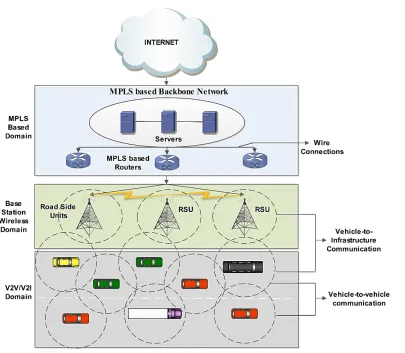
The proposed integrated backbone network is based on IP and MPLS network connected with cables to enhance security with quality services. The model has three sub domains: MPLS based domain, Base station wireless domain and V2V/V2R domain. The VANET applications requirements are using maximum bandwidth e.g. 1.5 Mb/s to 6 Mb/s per user for video streaming services with low packet loss and jitter rate [15]. Figure 1 shows the proposed backbone model including three subdomains.
78:2 (2016) 7–14 | www.jurnalteknologi.utm.my | eISSN 2180–3722 | The MPLS-based domain refers to make a connection
between roadside units and internet domain. The servers in this domain plays a central role to establish the connection between the both. MPLS-based servers are responsible for dynamic addressing, mobility management, intelligent routing and load balancing. The base station wireless domain equipped with WLAN and WiMAX technologies to access the network and mobile vehicles. The third domain provides communication by RSUs or V2V communication. In next section, we discusses these three domains in detail.
4.1 MPLS Domain
The MPLS-based backbone network provides high bandwidth facilities and services to vehicles. It is wire based domain with enhanced reliability and protection mechanisms. The domain uses IEEE 802.11 standard [16], where roadside units are connected with backbone network through digital subscriber line and local area network connections [17]. These types of IP-based wired infrastructures are usually deployed in urban areas, towns and on highways for traffic management [18]. In traditional systems, the central devices plus terminals are used to connect with dedicated interfaces. Afterward, IP-based systems are replaced with integrated interfaces, which are used for advanced composite services. Some researchers suggested the fiber optical cables for dedicated interfaces due to its fastest data flow with at least 1 Gb/s bandwidth [18]. However, these solutions are most expensive and do not suitable for complex infrastructure environment. Furthermore, these solutions are still suffered with weather conditions especially with humidity and moisture [19].
A. Multiprotocol Label Switching
The MPLS technology was introduced in late 90's for improving QoSs and designed for high-speed backbone networks [20]. Almost all IT companies are looking for an effective and appropriate solution for their wide area networks. Most of the companies are adopted frame relay or asynchronous transfer mode leased lines [21]. The virtual private network [22] is another layer 2 tunnel based technology for data routing over the Internet with maximum security. Although, VPN is not scalable to deal with new IT technologies and security challenges in network [23, 24]. The MPLS provides scalability plus efficient security due to its layer 2 (data link) and layer 3 (network) capabilities and known as 2.5 technology [25]. Furthermore, MPLS offers an efficient and effective packet forwarding services across the network with contents of labels, which are attached with IP packets [26]. The MPLS technology looks like a virtual circuit concepts, where ATM (Asynchronous Transfer Mode) is used to find the next hop in the routing tables. The ATM based systems suffer with time consumption
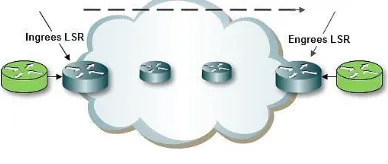
issues. On the other hand, MPLS uses label packets for data forwarding in the network, where the attached labels are routing like layer 3 and perform separately like layer 2 switching. The MPLS does not determine the best route and shortest path in the network in order to prepare service requirements. Recently, MPLS provides a better high processing power and considered as an essential ingredient for the wireless domain. The MPLS technology particularly takes extraordinary measures for quick processing at layer 2, TCP/IP protocol stack header in order to improve end-to-end delay. Figure 2 shows the MPLS model.
Figure 2 MPLS based model
In MPLS-based domain, various QoSs metrics use to improve the vehicular network performance such as it reduce round trip delay, decrease packet loss with fault tolerant paths, and provide structural management services. To deal with high mobility, MPLS implementation on V2V communication may not have a positive effect on the network, so we adopted MPLS in backbone network. The vehicles send their data to the base stations and then data move to MPLS based infrastructure for further analysis. The MPLS based backbone domain better in QoSs metrics and gain higher results compared with traditional systems [27].
B. Road Side Units Domain
In this domain, the RSUs are based on different
communication technologies in order to
communicate with vehicle nodes such as IEEE 802.11p (WAVE) [28], 802.20 and 802.16e WiMAX [29]. The basic function of these RSUs is providing preloaded contents requested by the vehicles with load balancing and content transmission scheduling. Further, it also provides in time important information to the upper domain for further analysis.
C. Vehicle-to-vehicle and Vehicle-to-infrastructure domains
In this domain, vehicles are communicating with each other and disseminate the information in ad hoc manner through roadside units. Vehicles are
equipped with on-board units for wireless
78:2 (2016) 7–14 | www.jurnalteknologi.utm.my | eISSN 2180–3722 | as WAVE. The 802.11p/1609 standard family aims to
provide a set of specifications to allow interoperability between OBUs and RSUs.
After the brief discussion about proposed MPLS backbone model, we analyze the performance of model through simulation.
5.0 SIMULATION SETUP
First we set the mobility model, to test proposed backbone network. In VANET, the mobility models are
divided into two types: microscopic and
macroscopic. The vehicle movements and behavior belong to microscopic whereas, roads, street, crossroads, traffic lights, distribution of vehicles, generation of vehicular traffic density and flow fall in the macroscopic model. The various types of mobility models are proposed to generate the mobility, some of them are shown in Table 1.
Table 1 Different types of mobility models and their usage
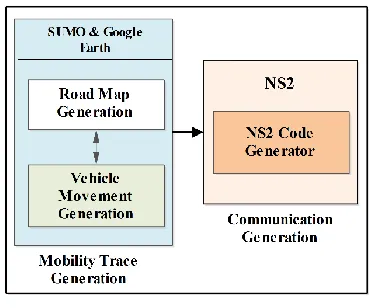
The second and important step in VANET environment is mobility generation, different tools are available for mobility generation such as VISIM, MOVE, SUMO, and VanetMobiSim [30]. These tools are designed to provide simulation scenarios at the micro and macro scale levels. Afterward, the NS-2 selects [31] to test the proposed model performance. NS2 is an event-driven tool and compatible with MOVE to generate realistic mobility and built on top of an open source micro-traffic simulator (SUMO) [32]. Vehicles allow to move along the grid of vertical and horizontal streets in the map. We set a map in the simulation with multiple roads, traffic lights, and intersections. Vehicles are divided into four groups and each group has four vehicles. The simulation parameters are listed in Table 2 and Figure 3 shows the simulation model and parameters.
Figure 3 Simulation model
Table 2 Simulation Parameters
Parameters Values
Network Area 500 * 600 M Radio Range 150 m Channel Wireless Traffic type CBR Routing Protocol AODV Number of Vehicles 16 Base stations 10 Speed of vehicles node 30 km/h Packet size 800 byte Transport protocol UDP
5.1 Data Communication
Different types of routing protocols have been implemented in vehicular environment such as topology based, position based and cluster based [33, 34]. We set topology based protocol to test the performance due to its shortest path finding mechanism [35]. Topology based protocols are divided into reactive and proactive types, in proactive type, every node keeps information of all connected nodes in the routing table and cause high network overhead. On the other hand, in reactive protocols, the routes are discovered and maintained on demand. The ad-hoc on demand distance (AODV) protocol is an example of reactive routing protocol [36]. AODV addresses various issues of proactive protocols by supporting a large networks with various nodes and reduces the message flooding issues in the network.
With MPLS technology, the network performance is greater in terms of QoSs, where the vehicle nodes connect with RSUs and further connect with MPLS domain through wire network. The vehicle nodes communicate with RSUs and with each other in order to forward the data to MPLS backbone network. Each RSU has its own 3 level addressing domain. The proposed model will improve the QoSs with fast and
S/No Mobility Models Usage
1 Manhattan Mobility Model (MHM)
For vehicle node movement
2 Freeway Mobility Model (FWM)
For freeway motion behavior
3 Random Waypoint Model (RWM)
78:2 (2016) 7–14 | www.jurnalteknologi.utm.my | eISSN 2180–3722 | reliable communication compared to previous
traditional mechanisms.
6.0 RESULTS
After the simulation setting, we compared MPLS-based network with two previous models: MI-VANET [12] and Multi-layer model model based on wireless backbone infrastructure [14].
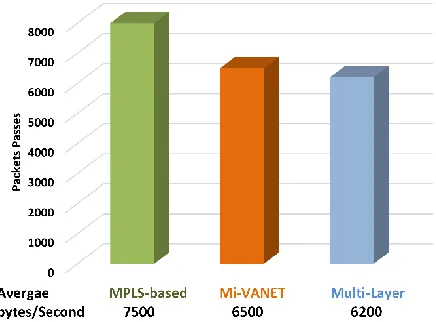
The simulation is running for several times to check the network performance. After determined the results the Figure 3 shows the throughput of all technologies. It is noted from the graph that total 7500 packets are passed through MPLS-based model which results in the average throughput of 25 packets/sec while the total number of packets are 8000. On the other hand, the total packets passes through MI-VANET are around 6500 out of 8000, which results 39 packets /sec. The Multi-Layer model performance is less with 6200 packets as compared to the state of the art models. The throughput of three technologies show the correct choice for network for data traffic and that is MPLS-based model. The results show the better performance of proposed MPLS-based backbone model
Figure 3 Throughput (MPLS, MI-VANET and Multi-Layer)
The vehicular environment has unique
characteristics such as high mobility, dynamic nature of topologies and different obstacles. Because of these characteristics the network still suffered from data loss and dis-connectivity issues. Figure 4 shows the average packets loss of three models. The average number of packet loss in the MPLS-based environment is 1800, while in MI-VANET the packet loss ratio is 2200 and multi-layer model is 2500 packets. The overall performance of MPLS model is better compared to the state of the art models. The results clearly shows that MPLS-based model overcome the ratio of packet loss compared to other two models.
Figure 4 Packet Loss
Figure 5 shows the average delay of three models. The graph clearly shows the different pattern of delay that affect the performance of traffic in terms of end-to-end delay. The graph shows the MPLS-based model delay is small at the start of communication while that is increasing when the number of nodes are increasing in the network. This is because of broadcasting the packets in the network to inform other vehicles about each other positions. Still the average delay rate of MPLS model is better compared to MI-VANET and Multi-layer models.
Figure 5 End-to-end Delay
78:2 (2016) 7–14 | www.jurnalteknologi.utm.my | eISSN 2180–3722 |
7.0 CONCLUSION
Due to high mobility and dynamic nature of topologies, the VANET suffered from packets loss and packet delay issues in the network. In this paper, we overcome these issues with the help of MPLS-based backbone model in order to improve network QoSs performance. In MPLS based proposed model, the vehicles are communicating via roadside units. RSUs are further connected with MPLS network and with the internet. Through simulation results, we proved that MPLS based model performance is superior in terms of PDR, network throughput and end-to-end delay. The proposed model is an efficient model considers as a low-cost solution for vehicular networks.
Acknowledgement
The research is supported by Ministry of Education Malaysia (MOE) and conducted in collaboration with Research Management Center (RMC) at Universiti Teknologi Malaysia (UTM) under VOT NUMBER: QJ130000.2528.06H00.
References
[1] M. Wellens, B. Westphal, and P. Mahonen. 2007
Performance Evaluation of IEEE 802.11-based WLANs in
Vehicular Scenarios. In Vehicular Technology Conference,
2007. VTC2007-Spring. IEEE 65th. 1167-1171.
[2] D. Jiang and L. Delgrossi. 2008. IEEE 802.11 p: Towards an
International Standard for Wireless Access in Vehicular
Environments. In Vehicular Technology Conference. VTC
Spring. IEEE. 2036-2040.
[3] M. WiMAX-Part, I: 2006. A Technical Overview and
Performance Evaluation. In WiMAX Forum. 9-24.
[4] K. N. Qureshi and A. H. Abdullah. 2013. A Survey on
Intelligent Transportation Systems. Middle-East Journal of
Scientific Research. 15: 629-642.
[5] H. Holma, J. Kallio, M. Kuusela, P. Lundén, E. Malkamäki, J.
Ojala, et al. 2009. Voice over IP (VoIP). LTE for UMTS:
Evolution to LTE-Advanced. Second Edition. 351-374.
[6] C. Egido. 1988. Video Conferencing as a Technology to
Support Group Work: A Review of Its Failures. In Proceedings
of the 1988 ACM conference on Computer-supported cooperative work. 13-24.
[7] K. N. Qureshi and A. H. Abdullah. 2014. Wireless Sensor
Based Hybrid Architecture for Vehicular Ad hoc Networks.
TELKOMNIKA Telecommunication, Computing, Electronics and Control. 12.
[8] J. Zhao, Y. Zhang, and G. Cao. 2007. Data Pouring and
Buffering on the Road: A New Data Dissemination
Paradigm for Vehicular Ad Hoc Networks. Vehicular
Technology, IEEE Transactions on. 56: 3266-3277.
[9] K. S. Kaveh Shafiee and V. C. L. Victor CM Leung. 2009. A
Reliable Robust Fully Ad Hoc Data Dissemination
Mechanism for Vehicular Networks. International Journal of
Advanced Science and Technology. 2: 53-62.
[10] L. Wischoff, A. Ebner, H. Rohling, M. Lott, and R. Halfmann.
2003. SOTIS-A Self-Organizing Traffic Information System. In
Vehicular Technology Conference. VTC. The 57th IEEE Semiannual. 2442-2446.
[11] T. Nadeem, S. Dashtinezhad, C. Liao, and L. Iftode. 2004. TrafficView: Traffic Data Dissemination Using Car-to-Car
Communication. ACM SIGMOBILE Mobile Computing and
Communications Review. 8: 6-19.
[12] J. Luo, X. Gu, T. Zhao, and W. Yan. 2010. MI-VANET: a new Mobile Infrastructure Based VANET Architecture for Urban
Environment. In Vehicular Technology Conference Fall
(VTC 2010-Fall). IEEE 72nd. 1-5.
[13] J. Coffee, K. Marvin, T. Gin, and D. Anderson.2013. Method and System for Efficient Extended Data Communications
using GPRS. ed: Google Patents.
[14] M. Krohn, R. Daher, M. Arndt, and D. Tavangarian. 2009.
Aspects of Roadside Backbone Networks. In Wireless
Communication, Vehicular Technology, Information Theory and Aerospace & Electronic Systems Technology, Wireless
VITAE 2009. 1st International Conference on.788-792. [15] C. J. Sreenan, J.-C. Chen, P. Agrawal, and B. Narendran.
2000. Delay Reduction Techniques for Playout Buffering.
Multimedia, IEEE Transactions on. 2: 88-100.
[16] B. J. Chang, Y. H. Liang, and J. T. Lai. 2015. Performance Analyses of Minimising Emergency Message Collisions and Maximising Network throughput in IEEE 802.11 p VANET
Network. International Journal of Ad Hoc and Ubiquitous
Computing. 18: 205-221.
[17] W. Franz, H. Hartenstein, and M. Mauve. 2005. Inter-vehicle Communications Based on Ad Hoc Networking Principles:
the FleetNet project: Univ.-Verlag Karlsruhe.
[18] S. Okanishi, M. Kon, S. Chiku, M. Sugiyama, and H. Sakurai.
2008. Traffic Network System. NEC Technical Journal. 3:
16-20.
[19] B. J. Blazer, A. S. Dodd, D. E. Kundis, and S. Olszewski. 2014.
Fiber Optic Drop Cable. ed: Google Patents.
[20] R. Zheng and W. Yang. 2014. H-MPLS: A Lightweight
NFV-based MPLS Solution in Access Network. In Consumer
Communications and Networking Conference (CCNC),
2014 IEEE 11th. 887-892.
[21] R. O. Onvural, 1995. Asynchronous Transfer Mode Networks: Performance Issues. Artech House, Inc.
[22] E. your BEARID. VPN–Virtual Private Network.
[23] D. Ooms, B. Sales, W. Livens, A. Acharya, F. Griffoul, and F. Ansari.2002. Overview of IP Multicast in a Multi-Protocol
Label Switching (MPLS) Environment. Informational Request
for Comments. 3353.
[24] M. Mohamed, M. Abou-El-Seoud, and A. El-Feki. 2014. A
Survey of VPN Security Issues. International Journal of
Computer Science Issues (IJCSI). 11: 106.
[25] B. Daugherty and C. Metz. 2005. Multiprotocol Label
Switching and IP. Part I. MPLS VPNs over IP Tunnels. Internet
Computing, IEEE. 9: 68-72.
[26] V. Alwayn, 2001. Advanced MPLS Design and
Implementation. Cisco Press.
[27] S. GholamalitabarFirouzjaee, M. Fathy, and K. Raahemifar.
2012. Utilizing Mobile IP, MPLS to Improve QoS in VANET. In
International Conference on Advances in Signal Processing and Communication-SPC2012, Amsterdam, Netherlands (Accepted).
[28] C. Campolo, A. Vinel, A. Molinaro, and Y. Koucheryavy. 2011. Modeling Broadcasting in IEEE 802.11 p/WAVE
Vehicular Networks. Communications Letters, IEEE. 15:
199-2011.
[29] P. Borkar, 2012. Comparative Study of IEEE 802.11, 802.15,
802.16, 802.20 Standards for Distributed VANET. In
ICEEE-2012.
[30] F. K. Karnadi, Z. H. Mo, and K.-c. Lan. 2007. Rapid
Generation of Realistic Mobility Models for VANET. In
Wireless Communications and Networking Conference, 2007. WCNC 2007. IEEE. 2506-2511.
[31] T. Issariyakul and E. Hossain. 2011. Introduction to Network Simulator NS2: Springer Science & Business Media. [32] SUMO. Simulation of Urban MObility.
78:2 (2016) 7–14 | www.jurnalteknologi.utm.my | eISSN 2180–3722 |
Applicability in Typical Road Situation. Life Science Journal.
10.
[34] K. N. QURESHI and H. ABDULLAH. 2013. TOPOLOGY BASED
ROUTING PROTOCOLS FOR VANET AND THEIR
COMPARISON WITH MANET. Journal of Theoretical and
Applied Information Technology. 58.
[35] J. Luo, X. Gu, T. Zhao, and W. Yan. 2010. A Mobile Infrastructure based VANET Routing Protocol in the Urban
Environment. In Communications and Mobile Computing
(CMC), 2010 International Conference on. 432-437. [36] A. Shastri, R. Dadhich, and R. C. Poonia. 2011. Performance
Analysis of On-Demand Routing Protocols for Vehicular
Ad-Hoc Networks. International Journal of Wireless & Mobile