AN AUTOMATIC FINGERPRINT CLASSIFICATION TECHNIQUE BASED ON SINGULAR POINTS AND STRUCTURE SHAPE OF ORIENTATION FIELDS
SAPARUDIN
A thesis submitted in fulfilment of the requirements for the award of degree of Doctor of Philosophy (Computer Science)
Faculty of Computer Science and Information System Universiti Teknologi Malaysia
To my God, Allah ‘azza wa jalla
ACKNOWLEDGEMENTS
Thanks to Allah SWT for everything I was able to achieve and for everything I tried but I was not able to achieve.
I am grateful for several people for making this thesis possible. I would like to begin by expressing my deep appreciation to my supervisor, Professor Dr. Ghazali bin Sulong for his guidance and encouragement. Despite the busy schedule, he has provided me with valuable ideas, advice and comments. I am very fortunate to have him as my adviser. I would like to thank Dr. Darmawijoyo and Dr. Yusuf Hartono for personal support.
ABSTRACT
ABSTRAK
TABLE OF CONTENTS
CHAPTER TITLE PAGE
DECLARATION ii
DEDICATION iii
ACKNOWLEDGEMENTS iv
ABSTRACT v
ABSTRAK vi
TABLE OF CONTENTS vii
LIST OF TABLES x
LIST OF FIGURES xi
LIST OF ABBREVIATIONS xvi
LIST OF SYMBOLS xvii
LIST OF APPENDICES xix
1 INTRODUCTION 1
1.1 Introduction 1
1.2 Background of Research 2
1.3 Problem Statements 10
1.4 Research Goal 11
1.5 Objectives of Study 11
1.6 Scope of the Study 12
1.7 List of Research Contributions 13 1.8 Significance of the Study 14
1.9 Research Framework 15
1.10 Thesis Outline 16
2 LITERATURE REVIEW 18
2.2 Fingerprint Segmentation 19 2.2.1 Grey-scale Statistical Features 21 2.2.2 Local Directionality Features 22
2.2.3 Coherence Features 24
2.3 Fingerprint Enhancement 26
2.3.1 Normalization 28
2.3.2 Gaussian Filter 29
2.3.3 Directional Filter 31
2.4 Orientation Field Estimation 34 2.4.1 Orientation Field Estimation Using Gradient 35 2.4.2 Model-based Approach for Orientation Field
Estimation 38
2.5 Singular Point Detection 40
2.5.1 Poincaré Index Methods 40 2.5.2 Partitioning-based Methods 43 2.5.3 Methods Based on Local Characteristics
of the Orientation Field 44
2.6 Fingerprint Classification 46
2.6.1 Rule-based Approaches 47
2.6.2 Structure-based Approaches 50
3 METHODOLOGY 53
3.1 Introduction 53
3.2 Foreground Extraction 56
3.2.1 Grey-scale Normalization 56 3.2.2 Proposed Foreground Extraction Method 59 3.2.3 Noise Areas Identification and Marking
Using Gradient Coherence 65
3.3 Enhancement of Grey-level 68
3.4 Fingerprint Orientation Field 73 3.5 Orientation Field Enhancement 75 3.6 Region of Singular Point Detection 78
3.7 Singular Point Detection 82
3.8.2 Structure Shape Analysis of Orientation Fields 86 3.8.2.1 Examine True Cores 87 3.8.2.2 Examine True Deltas 92
3.9 Summary 95
4 EXPERIMENTAL RESULT AND DISCUSSION 97
4.1 Introduction 97
4.2 Dataset 97
4.3 Experimental Set-up 102
4.4 Experimental Results 104
4.4.1 Performance Measure of Fingerprint
Segmentation 104
4.4.2 Performance Measure of Noise Removal and Ridge Pattern Enhancement for
Orientation Field Estimation 119 4.4.3 Performance Measurement of Singular
Point Detection 131
4.4.4 Performance Measurement of Fingerprint
Classification 143
4.5 Summary 155
5 CONCLUSION 157
5.1 Introduction 157
5.2 Contribution 160
5.3 Future Work 162
REFERENCES 164
LIST OF TABLES
TABLE NO. TITLE PAGE
2.1 Classification based on singularities 46 2.2 Summary of the fingerprint classification literature
review 52 4.1 Classes of fingerprint NIST Special Database 14
(f000001 to f027000 filenames) 100
4.2 Scan type and sex of fingerprints NIST Special
Database 14 (f000001 to f027000 filenames) 101
4.3 Performance measures 103
4.4 Performance results of various fingerprint
segmentation methods from singular points detections
points of view 114
4.5 Comparison results of singular points detection 143 4.6 A confusion matrix of the experimental results of
the proposed fingerprint classification 145 4.7 Ambiguous fingerprints off the misclassified prints 145 4.8 Accuracy rates of the Cappelli and Maltoni’s
classification methods using 27,000 fingerprints (f0000001 to f0027000) of DB14 (Source:
LIST OF FIGURES
FIGURE NO. TITLE PAGE
1.1 Example of five classes 3
1.2 Sample of ambiguous prints 4
1.3 Rejected prints 5
1.4 Dry, wet, and tainted prints 6
1.5 (a) Three fingerprints of the same class that have very different characteristic (large-intra-class variability).
(Source: NIST Special Database 14) 7 (b) Three fingerprints belonging to different classes that have similar appearance (small-inter-class variability).
(Source: NIST Special Database 14) 7 1.6 Ridges and valleys structure (Right-loop class) 8 1.7 Core and delta on a fingerprint image 9
1.8 Research framework flowchart 17
2.1 A sample of fingerprint segmentation results; (a) Fingerprint image, (b) background regions,
foreground regions, and noise patches of the fingerprint
image 20
2.2 Quality of fingerprint image; (a) good, (b) broken/cut,
(c) low contrast, (d) dry, (e) wet, and (f) stain 28 2.3 Convolution masks; (a) 3×3 Gaussian smooth filter,
in the centre and four overlapping neighbourhood
(Wang et al. 2005) 34
4 3 2
1 ,D ,D ,D D
2.7 Ridge flow direction at pixel (i,j) and angle θxy(i,j) indicating the direction of flow with respect to the
horizontal axis 35
2.8 The labelling of neighbourhood pixels used to explain
the Sobel operator 36
2.9 Orientation image partitioning with the MASK approach (Cappelli et al., 1999). The intersections between region border lines denote fingerprint
singularities 43
2.10 The mask for capturing the centre point
(Hsieh et al. (2005)) 44
2.11 The candidate regions for singular points
(Park et al., 2006) 45
2.12 Samples after flow-like tracing (Left-loop, Right-loop
and Tented-arch) (Wang and Xie, 2004) 51 3.1 On Automatic Fingerprint Classification Scheme
(AFCS): Proposed AFCS complements generic AFCS (Note: The dashed rectangle denotes the proposed
AFCS) 55
3.2 The fingerprint segmentation scheme 56
3.3 Grey-scale normalization process 57
3.4 Normalization process. (a) Input fingerprint image (NIST DB 14: f0000023), (b) normalized fingerprint
image 59 3.5 Flowchart of foreground extraction 60
3.6 (a) Horizontal Sobel mask operator Sx(p,q),
(b) Vertical Sobel mask operator Sy(p,q) 62 3.7 Result of the foreground extraction process using the
proposed segmentation method. (Note: the input image
3.8 Noise areas of the foreground are identified and labelled. The white coloured blocks indicate the noise areas. (Note: the input image is referred to the extracted
foreground image in Figure 3.7 above) 67 3.9 CCB gradient magnitude of size 5×5 70 3.10 Result of the enhancement process in the noise areas
(circles highlight the noise areas), (a) Orientation image before enhancement, (b) orientation image after the enhancement. (Note: the input is the foreground image
in Figure 3.8) 72
3.11 Result of orientation field estimations in the fingerprint
image 75
3.12 A 3×3 CCB of orientation field 76
3.13 Orientation fields of fingerprint after enhancement
using minimum variance of orientation fields. 77 3.14 Set of four pre-defined block of arches. 78
3.15 The mechanics of BoI 80
3.16 Results of CRSP using the proposed method. (Source image: NIST Database 14, f0000023). Note: Blue
squares indicate CRSP 82
3.17 Core and delta detections using the proposed methods (NIST DB 14: F0000023). Note: White and yellow
squares indicate the core and delta, respectively 84 3.18 Types of the core point (a) Upper-core, (b) lower-core,
(c) right-core, and (d) left-core 88
3.19 Omni-directional orientation fields neighbouring the core points: (a) Upper-core, (b) lower-core, (c)
right-core, and (d) left- core 90
3.20 Omni-directional orientation fields neighbouring a
delta. (a) Right-delta, and (b) left-delta 93 4.1 Tagged comment in WSQ compressed file 99
4.3 Fingerprint with a cross-referenced classification or
ambiguous fingerprint 101
4.4 Fingerprint with extraneous objects: (a) Like
handwritten characters and (b) other artefacts common
to inked fingerprints 102
4.5 (a) - (e): Results of the segmentation process of good
quality fingerprints 106
4.6 (a) - (e): Results of the segmentation process of dry
fingerprints 107
4.7 (a) - (e): Results of the segmentation process of wet
fingerprints 109
4.8 (a) - (e): Results of the segmentation process of low
contrast fingerprints 111
4.9 (a) - (e): Results of the segmentation process of fingerprints which contain ink stains and handwritten
characters 112
4.10 On segmentation results: Local mean versus the
proposed method. (a) Original fingerprint; (a1) outcome
of local mean method; (a2) outcome of proposed method 116 4.11 On segmentation results: Zang and Yan versus the
proposed method. (b) Original fingerprint; (b1) outcome of Zang and Yan method; (b2) outcome of proposed
method 117
4.12 On segmentation results: Local variance of gradient magnitude method Vs the proposed method. (c) Original fingerprint; (c1) outcome of local variance of gradient
magnitude method; (c2) outcome of the proposed method 118 4.13 On segmentation results: Outcome of the proposed
segmentation method. (d) Original fingerprint;
(d1) outcome of the proposed method 118 4.14 (a) - (e): Some results of the enhancement process for
good quality fingerprints 121
4.15 (a) - (e): Some results of the enhancement process for
wet fingerprints 124 4.17 (a) - (e): Some results of the enhancement process for
cuts fingerprints 126
4.18 (a) - (e): Some results of the enhancement process for
bruises fingerprints 127
4.19 (a) - (e): Some results of the enhancement process for
Low contrast fingerprints 129
4.20 Artificial singular point regions 130 4.21 Mean square error results of both Wang and the proposed
methods 131
4.22 (a) - (e): Results of the singular points detection for good
fingerprints 133
4.23 (a) - (e): Results of the singular points detection for dry
fingerprints 135
4.24 (a) - (e): Results of the singular points detection for wet
fingerprints 137
4.25 (a) - (e): Results of the singular points detection for cuts
fingerprints 138
4.26 (a) - (e): Results of the singular points detection for bruises
fingerprints 140
4.27 (a) - (e): Results of the singular points detection for low
contrast fingerprints 142
4.28 Some examples of correctly classified prints of various qualities viz. good, dry, wet, cut, bruise, low contrast,
and stain 148
4.29 Fake core (file name: f0002084) 149
4.30 (a) - (c): Fingerprints classes with one missing delta. 150 4.31 A sample of large-intra-class variation prints 152
4.32 Small-inter-class variations 154
LIST OF ABBREVIATIONS
FBI - Federal Bureau Investigation
AFIS - Automatic Fingerprint Identification System AFCS - Automatic Fingerprint Classification System NIST - National Institute of Standards and Technology
NN - Neural Network
HMM - Hidden Markov Model
2D - Two dimensional
DMF - Directional Median Filter DB14 - NIST Special Database 14
SVM - Support Vector Machine
FVC2002 - Second International Competition for Fingerprint
Verification Algorithm
CCB - Cross Centre Block BoI - Block of Interest
CB - Convergence Block
CRSP - Candidate Region Singular Point GoB - Group of Block
CoB - Combination of Block
NCIC - National Crime Information Centre WSQ - Wavelet Scalar Quantisation MC - Miss Rate of Cores
LIST OF SYMBOLS
) , (m n
I - Intensity value of the pixel at the m-th row and n-th column in the fingerprint image
H
W× - Size of fingerprint image
Mg - Global mean value of fingerprint image Vg - Global variance value of fingerprint image
) , (m n
N - Intensity value of the pixel at the m-th row and n-th column in the normalized fingerprint image
0
Mg - Desired mean value for determine normalization 0
Vg - Desired variance value for determine normalization Mn - Global mean value of normalized fingerprint image
B
B× - Size of block in the fingerprint image )
, (i j
Mb - Local mean value of block(i,j) )
, (m n
Gx - Gradient of pixel in horizontal direction (m,n) )
, (m n
Gy - Gradient of pixel in vertical direction (m,n) x
S - Horizontal Sobel mask operator y
S - Vertical Sobel mask operator
) , (m n
Gr - Gradient magnitude of pixel (m,n) th
G - Threshold value for gradient c - Threshold factor for gradient
) , (i j
Mgr - Local mean value of gradient magnitude of block(i,j) )
, (i j
Vgr - Local variance value of gradient magnitude of block(i,j) )
, (i j
Coh - Coherence value of block (i,j) )
, (i j
Vx - Vector gradient x-direction of block (i,j) )
, (i j
) , (i j
Vz - Vector gradient resultant direction of block (i,j) D - Set of gradient magnitude in CCB
i
D - Subset i-th of gradient magnitude in CCB i
D
Mgm - Mean value of subset i-th of gradient magnitude in CCB i
D
Vgm - Variance value of subset i-th of gradient magnitude in CCB P - Set of normalized fingerprint image in CCB
i
P - Subset i-th of normalized fingerprint image in CCB i
P
Mi - Mean value of subset i-th of normalized fingerprint image in CCB Q - Set of gradient angle in CCB
i
Q - Subset i-th of gradient angle in CCB i
Q
Ma - Mean value of subset i-th of gradient angle in CCB i
Q
Va - Variance value of subset i-th of gradient angle in CCB )
, (p q
Gs - Gaussian filtering mask )
, (i j
θ - Gradient angle of orientation field )
(k
δ - Closed-curve angle
PI - Poincaré index in continuous vector )
, (i j
P - Poincaré index in discrete vector Nc - Number of cores
LIST OF APPENDICES
APPENDIX TITLE PAGE
A Scars Fingerprint Image 172
B Results of Fingerprint Segmentation using Local
Mean Method 183
C Results of Fingerprint Segmentation using a
Combination of Local Mean and Coherence 195 D Results of Fingerprint Segmentation using Local
Variance of Gradient Magnitude 207
E Results of Fingerprint Segmentation using
Proposed Method 219
F Results of Singular Points Detection using Poincaré
Index Method 231
CHAPTER 1
INTRODUCTION
1.1 Introduction
Biometric is automatic recognition of a person that is based on physiological measurements or behavioural traits. Fingerprint as a kind of human biometric features has been used for over a century and the most widely used for personal recognition in civil, forensic, and commercial areas because of its uniqueness, immutability, reliability, and low cost. For example, the total number of fingerprint cards where each card contains one impression for each of the 10 fingers of a person in the FBI fingerprint database stands well over 200 million from its original number of 810,000 and is growing continuously (Maltoni et al., 2009). The uniqueness of fingerprint has been studied and it is well established that the probability of two fingerprints matching is vanishingly small (Jain et al., 2000; Pankanti et al., 2002). The immutability of fingerprint is persistent with age and can not be easily disguised (Yager and Amin, 2004).
data of the large fingerprint databases seriously compromises the efficiency of the identification task, although the fastest matching algorithms take only a few milliseconds per matching.
To perform fingerprint identification, both matching accuracy and processing time are critical performance issues. In order to achieve an efficient identification of a fingerprint, fingerprints in the database are organized into a number of mutually exclusive classes that share certain similar properties. This process is called fingerprint classification. Therefore, although all automatic fingerprint identification system require the fingerprint classification stage before the matching stage, it is very difficult to design an automatic system able to perform such classification with high accuracy (Karu and Jain, 1996).
1.2 Background of Research
Fingerprint classification is an important stage in automatic fingerprint identification system (AFIS) because it significantly reduces the processing time to search and retrieve in a large-scale fingerprint database (Cappelli et al., 1999). When a class of a query fingerprint is known, matching the fingerprint only requires the comparison to be done within the class similar to the query fingerprint.
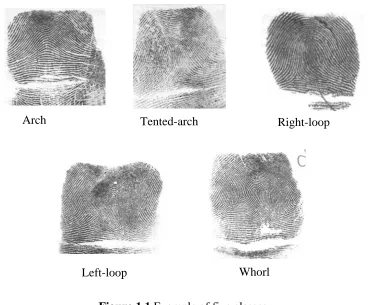
Several years later Henry (1990) continued Galton’s work on fingerprint classification. Henry subdivided the three main classes into more specific subclasses, namely, Arch, Tented-arch, Left-loop, Right-loop and Whorl as shown in Figure 1.1. He also introduced the concept of fingerprint ‘‘core’’ and ‘‘delta’’ points and used them as aids for fingerprint classification. Henry’s classification scheme constitutes the basis for most modern classification schemes.
Tented-arch
Arch Right-loop
Whorl Left-loop
Figure 1.1 Example of five classes
performance of their proposed classification methods is also implausible (Maltoni et al., 2009). In relation to that, NIST Special Database 14 was created and becomes de facto standard dataset for developing and testing of automatic fingerprint classification systems (Watson, 1993; Maltoni et al., 2009).
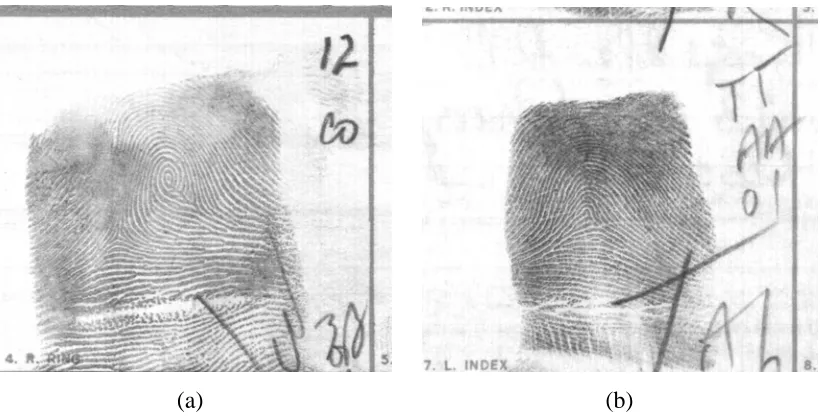
Naturally, there are some fingerprints that are ambiguous and can not be classified even by a human expert because in some cases, the fingerprints have properties more than one classes (see Figure 1.2). There is about 3.39% of the 27,000 images in the NIST Special Database 14 have two different ground truth labels (Cappelli and Maltoni, 2009). In these cases it is unclear which fingerprint classes the ambiguous prints should be matched against.
(a) (b) Figure 1.2 Samples of ambiguous prints
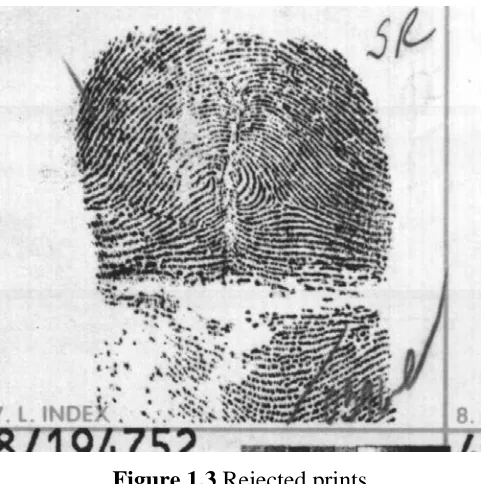
Figure 1.3 Rejected prints
(a) Dry print (b) Wet print
(c) Bruises print (d) Tainted print Figure 1.4 Dry, wet, bruises and tainted prints
Figure 1.5(a) Three fingerprints of the same class that have very different characteristic (large-intra-class variability). (Source: NIST Special Database 14)
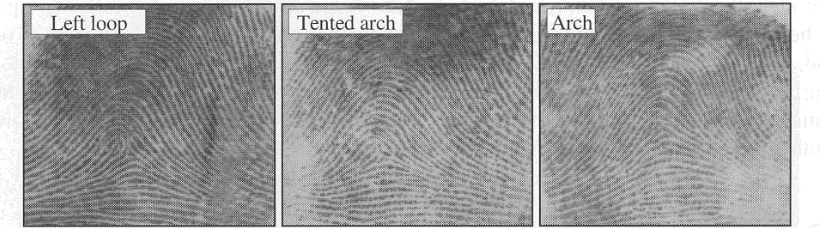
Figure 1.5(b) Three fingerprints belonging to different classes that have similar appearance (small-inter-class variability). (Source: NIST Special Database 14)
correction are expected to be proposed and investigated (Zhu et al., 2006).
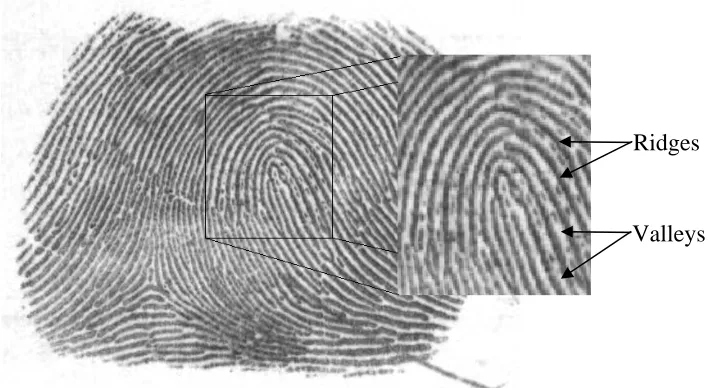
Valleys Ridges
Figure 1.6 Ridges and valleys structure (Right-loop class)
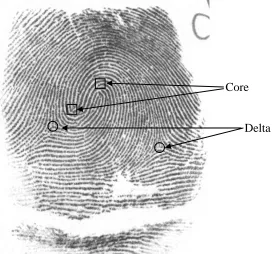
Another feature that is often used for distinguishing fingerprint classes is the existence and location of singular points. The singular points are classified into core and delta as depicted by Figure 1.7. The difficulties faced by singularities-based are: the singular points may not appear in the image, especially if the image is small; the noise in the fingerprint images makes the singular points extraction unreliable, including missing or wrong detection. There are several methods have been proposed to locate the singular points. However, the most common and widely used is the Poincaré index (Li et al., 2007), but this method is very sensitive to noise, low contrast and quality of fingerprint images.
(2004) employ structure shape of orientation fields around the cores when the delta located near the border are failed to be detected.
In relation to that, many techniques have been proposed to locate the singular points; their performances are far from satisfactory, let alone a full automation. Therefore, it is vital to come out with an efficient technique that capable of detecting precisely genuine singular points without to undergo both cropping and realignment pre-processes.
Delta Core
Figure 1.7 Core and delta on a fingerprint image
The above mentioned remaining issues provide a window of research opportunities in this area. In relation to that, the corresponding interrelated research questions that need to be resolved are arranged according to their order of preference: 1. How to automatically segment fingerprint image into background and
foreground?
2. How to identify, locate and remove the noises from the foreground? 3. How to accurately estimate the orientation fields?
Base on the problem background and research questions, the remaining issues can be stated as follows:
1. Generally, fingerprint images of NIST Special Database 14 always vary in terms of shape, size and orientation. Thus, previous studies applied manual cropping to separate foreground from background. Later the foreground is manually realigned and rescaled to obtain appropriate orientation and work area. These non-automatic pre-processes involve human intervention, and therefore should be avoided. Thus, a robust method should be invariant to scaling and rotation.
2. Naturally, many noises exist in fingerprints especially inked prints due excessive or insufficiently used of inks. To accurately identify, locate and remove the noises require a novel approach so that it does not damage the ridges structure and break their flows.
3. Accurate orientation fields are paramount importance prior to singular points detection. Most previous studies employed pre-define angles (for instance, 0, 45, 90, 135, 180 degrees) to represent the ridges’ orientations (Ratha et al., 1995; Wang and Xie, 2004; Hsieh et al., 2005; Zhang and Yan, 2007). However, these rigid pre-set angles do not truly reflect the actual ridges orientations. In fact, it resulted in many fake singular points. In addition, to identify and eliminate these artificial singular points are time consuming and tedious and therefore require a special tool to undertake the job.
5. There is a wide variety of orientation fields-based classification methods that have been proposed by previous researches including geometric-based, structure-geometric-based, rule-geometric-based, learning-geometric-based, statistical-geometric-based, and hybrid (Jain et al., 1999; Maltoni et al., 2009). However, most of the techniques are considered rigid and involved human intervention during pre-processing stage. Moreover, most of their experiments were based on unreliable dataset such as NIST database 4 which contains 2000 pre-segmented and pre-cropped prints (Cappelli and Maltoni, 2009). This limited number of pre-processed prints is considered small and unnatural, and therefore, is not reliable to be an appropriate testing platform for the fingerprint classification. In addition, some studies have also employed standard dataset but with unreliable sample size (i.e. insufficient and biased), except for Cappelli and Maltoni (2009). Hence, their experimental results and as well as the proposed methods are disputable.
1.4 Research Goal
To develop an automatic ridges orientation structure-based fingerprint classification method that covers foreground segmentation, noise removal, enhancement, orientation field estimation, singular point detection, and classification.
1.5 Objectives of Study
In order to fulfil the above goal, the following objectives are to be targeted: 1. To propose a new automatic fingerprint classification scheme.
should be able to improve the foreground image quality.
3. To propose a new orientation field’ estimation approach that utilizes true angle of the orientation fields in accordance to natural gradient of the ridge’s structure of the prints.
4. To propose a new singular point detection technique using a filtering mechanism. This mechanism is functioned to filter singular points in order to minimize of both fake core and delta.
5. To propose a new rule-based classification method using singular points and structure shape of orientation fields.
1.6 Scope of the Study
This thesis involves a complete process of automatic fingerprint classification including fingerprint segmentation, fingerprint enhancement, orientation field estimation, singular point detection, and finally fingerprint classification.
1.7 List of Research Contributions
The contributions of this study can be grouped into six findings namely, new scheme of fingerprint classification, segmentation, enhancement, orientation fields estimation, singular points detection, and classification.
• New scheme of fingerprint classification
A new scheme of fully automatic fingerprint classification system is proposed. This scheme is free of cropping and realignment processes, and can be considered as a significant progress compared to the previous methods. Besides, it also introduced a novel filtering mechanism to filter singular points. The scheme has successfully been tested on de facto standard dataset NIST Special Database 14 using 27000 prints. The experimental results have revealed that the scheme outperformed the most recent Cappelli and Maltoni’s work (2009) who are been considered as the most respected researchers in this area.
• Segmentation
A new segmentation method is proposed using a combined local mean and local variance of gradient magnitudes approach. This technique has successfully extracted the foreground from background of fingerprint image without human intervention.
• Enhancement
Once the foreground is extracted, enhancement process is followed. For this purpose, a new enhancement technique is proposed. In this approach, the noisy areas are identified, enhanced and labelled, and subsequently the noises are removed. The strong point of this technique is that the focal point of the enhancement is only on the noisy areas, while clean areas of the fingerprint are left unchanged. Therefore, it is not only improved the speed, is also does not encroach on the rest of the clean areas. Once the noise removal is completed, then a 3×3 Gaussian filter is applied on the entire image to further refine the foreground.
• Orientation fields estimation
considered an edge over the previous studies which use pre-set angles to estimate the orientation fields.
• Singular point detection
A novel filtering mechanism is proposed using orientation fields structure. This mechanism has successfully indentified and precisely determined potential candidate regions that most likely contain singular points. This novel approach acts like a filter in which candidate regions of singular point are first searched. Then, for each candidate region, the Poincarè index is applied to seek for genuine singular point (i.e. core or delta). This process has significantly reduced number of fake singular points. In fact, in most cases, not even a single false singular point is found.
• Classification
A novel orientation fields-based classification method is proposed using rule-based approach that utilizes both singular points and orientation fields’ structure. This technique is considered non-rigid since it utilized true angles of the orientation fields. Therefore, it is considered robust and invariant to scaling and rotation.
1.8 Significance of the Study
Against a backdrop of the above highlighted issues, this research is vital to resolve all the drawbacks including automating all the processes and using de facto standard dataset with sufficient and unbiased sample. Nonetheless, the significance of this study is not only limited to knowledge enrichment, it also can be applied to real life applications, for instance, multipurpose national identity cards, Automated Teller Machine cards, and cross-border-access immigration project.
1.9 Research Framework
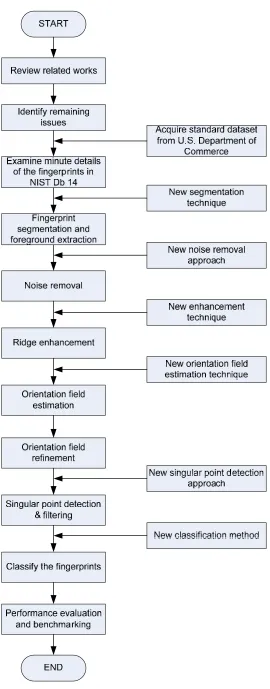
This is an experimental-based study as depicted in Figure 1.8 below. It begins with literature reviews to find the remaining issues and shortcomings of the existing methods and also to learn past experiences. Then, it’s followed by analysing the fingerprints of the NIST Special Database 14. In this case, minute details of the prints are studied in order to devise a suitable approach that can be applied to solve the problems that associated with the fingerprints’ quality. Amongst the many issues are low contrast, wet prints, dry prints, noises, handwritten annotations, and artefacts.
Next, recent segmentation approaches are also studied to find their strengths and weaknesses. Subsequently, a new segmentation technique is introduced to extract the foreground and as well as to discard all unrelated foreign objects such as handwritten annotations and artefacts.
Once an alien-free foreground is extracted from its background through the segmentation process, the noises are then removed by using a novel noise removal technique. Then, orientation fields’ estimation of the foreground is performed. Subsequently, a refinement process is done on the orientation fields by focusing on the noises’ areas of the foreground. Later, a singular point detection technique is applied to seek for a genuine core and delta. This technique is coupled with a filtering mechanism to filter the singular points.
delta in terms of their numbers and positions. Concurrently, all orientation fields which are considered as neighbours of the singular point are also analysed with regard to their patterns or shapes. The technique is then evaluated by using the standard error rate performance measure of the fingerprints sample used. Finally, the results are benchmarked with the latest work of Cappelli and Maltoni (2009).
1.10 Thesis Outline
This thesis consists of five chapters namely, Introduction, Literature Review, Methodology, Experimental Results and Discussions, and finally Conclusion. This introduction chapter is followed by the second chapter which discusses about related works by the previous authors. Among the topics reviewed are segmentation, enhancement, orientation field estimation, singular point detection, and classification of fingerprints.
The third chapter proposes a new fully automatic fingerprint classification method including new scheme of fingerprint classification approach, foreground extraction, noise areas detection and removal, orientation fields’ enhancement and estimation, singular points’ filtering mechanism, singular points detection, and rule-based classification approach.
Fourth chapter begins with introduction, and followed by dataset used, experimental setting, performance evaluations, and discussions of the results of the implementations including segmentation, enhancement, orientation field estimation, singular point detection and classification of fingerprints.
REFERENCES
Arora K. and Garg P. (2011). A Quantitative Survey of Various Fingerprint Enhancement Techniques. Int. Journal of Computer Applications (0975-8887), vol. 28, no. 5.
Bazen A.M. and Gerez S.H. (2000). Directional Field Computation for Fingerprint Based on the Principal Component Analysis of Local Gradients. ProRISC 2000 Workshop on Circuits, Systems and Signal Processing, Veldhoven, the Netherlands.
Bazen A.M. and Gerez S.H. (2001). Segmentation of Fingerprint Images. ProRISC 2001 Workshop on Circuits, Systems and Signal Processing, Veldhoven, the Netherlands.
Bazen A.M. and Gerez S.H. (2002). Systematic Methods for the Computation of the Directional Fields and Singular Points of Fingerprints. IEEE Transactions on Pattern Analysis and Machine Intelligence, vol. 24, no. 7, pp. 905-919.
Bo J., Ping T.H., Lan X.M. (2008). Fingerprint Singular Point Detection Algorithm by Poincaré Index. WSEAS Transactions on Systems, issue 12, vol. 7, pp. 1453-1462.
Candela G.T., Grother P.J., Watson C.I., Wilkinson R.A., and Wilson C.L. (1995). PCASYS-A Pattern-level Classification Automation System for Fingerprints. NIST Technical Report NISTIR 5647.
Cappelli R., Lumini A., Maio D., and Maltoni D. (1999). Fingerprint Classification by Directional Image Partitioning. IEEE Transactions on Pattern Analysis and Machine Intelligence, vol. 21, no. 5, pp. 402-421.
Cappelli R. and Maio D. (2004). State-of-The-Art in Fingerprint Classification. Automatic Fingerprint Recognition System. N. Ratha and R Bolle (Eds), Springer, New York, pp. 183-205.
Cappelli R. and Maltoni D. (2009). On the Spatial Distribution of Fingerprint Singularities. IEEE Transactions on Pattern Analysis and Machine Intelligence, vol. 31, no. 4.
Chen X., Tian J., Cheng J., and Yang X. (2004). Segmentation of Fingerprint Images using Linear Classifier. EURASIP Journal on Applied Signal Processing, vol. 2004, no. 4, pp. 480-494.
Cheng J. and Tian J. (2004). Fingerprint Enhancement with Dyadic Scale-space. Pattern Recognition Letters, vol. 25, no. 11, pp. 1273-1284.
Chikkerur S., Charwright A.N., and Govindaraju V. (2007). Fingerprint Enhancement using STFT Analysis. Pattern Recognition, vol. 40, pp.198-211.
Cho B. H., Kim J. S., Bae J. H., Bae I. G., and Yoo K. Y. (2000). Core-Based Fingerprint Image Classification. Proc. Int. Conf. on Pattern Recognition (15th), vol. 2, pp. 863-866.
Chong M., Ngee T., Jun L., and Gay R. (1997). Geometric Framework for Fingerprint Image Classification. Pattern Recognition, vol. 30, no. 9, pp. 1475–1488.
Conti V., Militello C., Sorbello F., and Vitabile S. (2010). Introducing Pseudo-Singularity Points for Efficient Fingerprints Classification and Recognition. IEEE Proc. Int. Conf. on Complex, Intelligent and Software Intensive Systems, pp. 368-375.
Conti V., Pilato G., Vitabile S., and Sorbello F. (2002). Verification of Ink-on-paper Fingerprints by Using Image Processing Techniques and a New Matching Operator. Proc. of VIII Convegno AI*IA.
Feng W., Xiuyou W., and Lin X. (2009). An Improved Fingerprint Segmentation Algorithm based on Mean and Variance. Intelligent System and Applications (ISA). IEEE International Workshop, 23-24 May 2009.
Galton F. (1892). Finger Prints. Macmillan and Co, London.
Sons.
Hong L., Wan Y., and Jain A.K. (1998). Fingerprint Image Enhancement: Algorithm and Performance Evaluation. IEEE Transactions on Pattern Analysis and Machine Intelligence, vol. 20, no. 8, pp. 777-789.
Hong L., and Jain A.K. (1999). Classification of Fingerprint Images. 11th Scandinavian Conference on Image Analysis, June 7-11, Kangerlussuaq, Greenland.
Hsieh C.T., Shyu S.R., and Hu C.S. (2005). An Effective Method of Fingerprint Classification Combined with AFIS. IFIP International Federation for Information Processing, EUC 2005, LNCS 3824, pp. 1107-1122.
Huang C.Y., Liu L.M., and Hung D.C. (2007). Fingerprint Analysis and Singular Point Detection. Pattern Recognition Letters, 28 (2007), pp. 1937-1945. Hung D.C.D., and Huang C. (1996). A Model for Detecting Singular Points of a
Fingerprint. Proc. Florida Artificial Intelligence Research Symposium (9th), pp. 444-448.
Jain A.K. and Minut S. (2002), Hierarchical Kernel Fitting for Fingerprint Classification and Alignment. Proc. Int. Conf. on Pattern Recognition (16th). Jain A.K., Prabhakar S., Hong L., and Pankanti S. (2000). Filterbank-based
Fingerprint Matching. IEEE Transactions on Image Processing, vol. 9, pp. 846-859.
Jain A. K., Prabhakar S., and Hong L. (1999) A Multichannel Approach to Fingerprint Classification. Pattern Recognition, vol. 21, no. 4, pp. 348–359. Ji L. and Yi Z. (2008). Fingerprint Orientation Field Estimation Using Ridge
Projection. Pattern Recognition, 41 (2008), pp. 1491-1503.
Karu K. and Jain A.K. (1996). Fingerprint Classification. Pattern Recognition, vol. 29, no. 3, pp. 389-404.
Kass M. and Witkin A. (1987). Analyzing Oriented Patterns. Computer Vision, Graph and Image Processing, vol. 37, no. 3, pp. 362-385.
Kawagoe M. and Tojo A. (1984). Fingerprint Pattern Classification. Pattern Recognition, vol. 17, no. 3, pp. 295-303.
Peak-Signal to Noise Ratio. Int. Journal on Computer Science and Engineering (IJCSE), vol. 3, no. 1, pp. 266–270.
Kim B.G., Kim H.J., and Park D.J. (2002). New Enhancement Algorithm for Fingerprint Images. Proc. Int. Conf. on Pattern Recognition (16th), vol. 3, pp. 879–882.
Klein S., Bazen A., and Veldhuis R. (2002). Fingerprint Image Segmentation based on Hidden Markov Models. Proceedings of 13th Annual Workshop on Circuits, Systems, and Signal Processing, vol. 2002, pp. 310–318.
Lee S., Lee C., and Kim J. (2006). Model-based Quality Estimation of Fingerprint images. Proc. of the international conference on biometrics (Springer LNCS 3832), pp. 229-235.
Li J., Yau W.Y., and Wang H. (2006). Constrained Non Linear Models of Fingerprint Orientations with Prediction. Pattern Recognition, vol. 39, no. 1, pp. 102-114.
Li J., Yau W.Y., and Wang H. (2007). Combining Singular Points and Orientation Image Information for Fingerprint Classification. Pattern Recognition, vol. 41, no. 1, pp. 353-366.
Liu L. and Dai T.S. (2006). Ridge Orientation Estimation and Verification Algorithm for Fingerprint Enhancement. Journal of Universal Computer Science, vol. 12, no. 10, pp 1426-1438.
Liu M., Jiang X., and Kot A. C. (2005). Fingerprint Reference-Point Detection. EURASIP Journal on Applied Signal Processing, vol. 4, pp. 498-509.
Ma J., Jing X., Zhang Y., Sun S., and Huang H. (2010). Simple Effective Fingerprint Segmentation Algorithm for low Quality Images. Proceeding of International conference-Broadband Network and Multimedia Technology (IC-BNMT), 3rd IEEE International Conference, pp. 855-859.
Maio D. and Maltoni D. (1996). A Structural Approach to Fingerprint Classification. Proc. Int. Conf. on Pattern Recognition (13th), pp. 578-585.
Maio D. and Maltoni D. (1997). Direct Gray-Scale Minutiae Detection in Fingerprints. IEEE Transactions on Pattern Analysis and Machine Intelligence, vol. 19, no. 1.
Method. IEEE Proc. 3rd Int. Joint Conf. on Computational Science and Optimization, pp. 222-226.
Mehtre B.M., Murthy N.N., Kapoor S., and Chatterjee B. (1987). Segmentation of Fingerprint Images Using the Directional Images. Pattern Recognition, vol. 20, no. 4, pp. 429-435.
Mehtre B.M. and Chatterjee B. (1989). Segmentation of Fingerprint Images a Composite Method. Pattern Recognition, vol. 22, no. 4, pp. 381-385.
Neuhaus M. and Bunke H. (2005). A Graph Matching Based Approach to Fingerprint Classification Using Directional Variance. Proc. Int. Conf. on Audio and Video Based Biometric Person Authentication (5th), pp. 191-200. Qi J. and Xie M. (2008). Segmentation of Fingerprint Images Using the Gradient
Vector Field. Cybernetics and Intelligent System. IEEE Conference, pages: 543-545.
Pankanti S., Prabhakar S., and Jain A.K. (2002). On the Individuality of Fingerprints. IEEE Transaction Pattern Analysis and Machine Intelligence, vol. 24, no. 8, pp. 1010–1025.
Park C.H., Lee J.J, Smith M.J.T. and Park K.H. (2006). Singular Point Detection by Shape Analysis of Directional Fields in Fingerprints. Pattern Recognition, vol. 39, no. 5, pp. 839–855.
Qi J. and Xie M. (2008). Segmentation of Fingerprint Images using the Gradient Vector Field. IEEE, CIS 2008.
Ramo P., Tico M., Onnia V., and Saarinen J. (2001). Optimized Singular Point Detection Algorithm for Fingerprint Images. Proc. Int. Conf on Image Processing.
Ratha N.K., Chen S., and Jain, A.K. (1995). Adaptive Flow Orientation Based Feature Extraction in Fingerprint Images, Pattern Recognition, vol. 28, no. 11, pp. 1657-1672.
Sherlock B.G., Monro D.M. (1993). A Model for Interpreting Fingerprint Topology. Pattern Recognition, vol. 26, no. 7, pp. 1047-1055.
Teixeira R.F.S and Leite N.J. (2011). Unsupervised Fingerprint Segmentation Based on Multiscale Directional Information. CIARP 2011, LNCS 7042, pp. 38-46. Springer-Verlag Berlin Heidelberg.
Thompson D.E. (1999). Design Analysis: Mathematical Modeling of Nonlinear Systems. Cambridge University Press.
Vïzcaya P.R. and Gerhardt L.A. (1996). A Nonlinear Orientation Model for Global Description of Fingerprints. Pattern Recognition, vol. 29, no. 7, pp. 1221-1231.
Wang L. and Dai M. (2007). Application of a new type of singular points in fingerprint classification. Pattern Recognition Letters, vol. 28, no. 13, pp. 1640-1650.
Wang S. and Wang Y. (2004). Fingerprint Enhancement in the Singular Point Area. IEEE Signal Processing Letters, vol. 11, no. 1.
Wang X. and Xie M. (2004). Fingerprint Classification: An Approach Based on Singularities and Analysis of Fingerprint Structure. Proc. International Conference on Biometric Authentication (1st), LNCS 3072. pp. 324-329. Wang Y., Hu J., Han F. (2007). Enhanced Gradient-based Algorithm for the
Estimation of Fingerprint Orientation Fields. Applied Mathematics and Computation, 185(2): pp. 823-833.
Wang Y., Hu J., Schroder H. (2005). A Gradient Based Weighted Averaging Method for Estimation of Fingerprint Orientation Fields. IEEE Proceedings of the digital imaging computing: Techniques and applications (DICTA 2005), pp. 195-202, Cairns, Australia.
Watson C. I. (1993). NIST Special Database 14 Mated Fingerprint Cards Pairs 2 version 2. U.S. National Institute of Standards and Technology.
Watson C. I. and Wilson C.L. (1992). NIST Special Database 4, Fingerprint Database. U.S. National Institute of Standards and Technology.
Wilson C., Candela G., and Watson C. (1993). Neural Network Fingerprint Classification. Journal Art Neural Network, vol. 1, no. 2, pp. 203–228.
Fingerprint Segmentation Algorithm. ICB 2007, LNCS 4642, pp. 1095-1103. Springer-Verlag Berlin Heidelberg.
Yager N. and Amin A. (2004) Fingerprint Classification: a review. Pattern Analysis Application, vol. 7, pp. 77-93.
Yang J., Liu L., Jiang T., and Fan Y. (2003). A Modified Gabor Filter Design Method for Fingerprint Image Enhancement. Pattern Recognition Letter, vol. 24, no. 12, pp. 1805-1817.
Yin J.P., Zhu E., Yang X.J., Zhang G.M., and Hu C.F. (2007). Two Steps for Fingerprint Segmentation. Journal Image and Vision Computing, vol. 25, no. 9, pp. 1391–1403.
Young I. T., Gerbrands J. J., and van Vliet L. J. (1995). Fundamentals of Image Processing. Version 2.2. Printed in The Netherlands at the Delft University of Technology.
Yu C., Xie M., and Qi J. (2008). An Effective Algorithm for Low Quality Fingerprint Segmentation. IEEE Proc. of 3rd Int. Conf. on Intelligent System and Knowledge Engineering.
Zhang Q. and Yan H. (2004). Fingerprint Classification Based on Extraction and Analysis of Singularities and Pseudo ridges. Pattern Recognition, vol. 37, no. 11, pp. 2233-2243.
Zhang Q. and Yan H. (2007). Fingerprint Orientation Field Interpolation based on The Constrained Delaunay Triangulation. International Journal of Information and Systems Sciences, vol. 3, no 3, pp. 438-452.
Zheng X, Wang Y., and Zhao X. (2006). A Detection Algorithm of Singular Points in Fingerprint Images Combining Curvature and Orientation Field. ICIC 2006, LNCIS 345, pp. 593-599.
Zhixin S. and Govindaraju V. (2006). Fingerprint Image Enhancement Based on Skin Profile Approximation. Proc. Int. Conf. on Pattern Recognition (18th), vol. 3, pp. 714-717.
Zhu E., Yin J., Hu C., and Zhang G. (2006). A Systematic Method for Fingerprint Ridge Orientation Estimation and Image Segmentation. Pattern Recognition, vol. 39, pp. 1452-1472.