Dy
Gracicla
Gon7.a.lC'~-Farias and David A. DickeyInsti tute of Statistics
Mimm
Serics
#~ ~:l"'.~
Jannary, 1992
~
~"'S
NAME
LIKELIHOOD TEST FOR A UNITI
ROOT
DATE
I
I
l
The
Library of
th
N
e
Department
of
Star r
....
..
AN UNCONDITIONAL MAXIMUM LIKELIHOOD TEST FOR A UNIT ROOT
Graciela Gonzalez-Farias and David A. Dickey
North Carolina State University Raleigh, North Carolina
Key Words: Time Series, Nonstationary
Abstract
We investigate a test for unit roots in autoregressive time series based on maximization of the
unconditional likelihood. This is the likelihood function appropriate for stationary time series. While
this function is the true likelihood only under the stationary alternative, it can nevertheless be
maximized for any data including data from a unit root process. It thus gives a way to test for unit
roots, provided percentiles can be calculated. For models with estimated means, the power of the new
test is better than that of some currently popular tests.
1. INTRODUCTION
Time series modeling often involves the selection and fitting of an ARIMA (autoregressive
integrated moving average) model. The order of integration is defined as the degree of differencing
required to make the series stationary where stationarity implies constant mean and variance over time
and a covariance which depends only on the time separating two observations. The fitting of a series
traditionally involves differencing the data if necessary, until they appear stationary then fitting
autoregressive and moving average parameters to the, possibly differenced, data. We investigate
statistical ways to check whether differencing is necessary.
Appropriate differencing renders a series stationary and thus makes the resulting estimation theory
easier to work out. The results tend to be classical in nature, for example normal limit distributions of
estimators. Classic methods of estimation, such as least squares and maximum likelihood are not
necessarily poor estimation methods for the parameters of nonstationary series, however the
distributions are not standard even in the limit. Ifpercentiles of the distributions can be obtained,
For ARIMA models, stationarity can be characterized by a condition on the roots of a polynomial
involving the autoregressive coefficients, called the characteristic polynomial. Ifall the roots are larger
than 1 in magnitude, the series is stationary. Therefore we can base a test for stationarity on the
coefficients or roots of the characteristic polynomial. These in turn must be estimated in some way.
Such tests are often called unit root tests (unit roots being the null hypothesis) but could arguably also
be called tests for stationarity when that is taken as the alternative. The most important motivation
for developing a test for stationarity is that certain economic hypotheses are mathematically equivalent
to stating that there are unit roots in the corresponding data series.
Tests based on least squares estimation are reasonably well known. Least squares maximizes the
likelihood conditional on the initial observation(s). This is in contrast to the unconditional likelihood
function for a stationary model that is used by computer programs written to do maximum likelihood
analysis. This unconditional likelihood function can be maximized regardless of the true nature of the
data and thus might be thought of as an objective function rather than a likelihood. Under the
alternative hypothesis of stationarity, such an estimator should do well. However, it is not clear how
well it would perform under the null hypothesis of a unit root nor is it clear what the distribution of
the unconditional maximum likelihood estimator would be in this case.
We show that the distribution in question is nonstandard and differs, even in the limit, from that
of the least squares estimator. Further, this new estimator has superior power in some instances of
practical interest.
2. TEST CRITERIA, MEAN KNOWN (/1
=
0)While the case of a known mean is of little practical value, the algebra is simple and the ideas of
the proof carryover to the more practical cases. In what follows, we outline the main steps of the
..
details.
Hasza (1980) and Anderson (1971, pg. 354) study the AR(1) case with known mean using the
stationary likelihood function. They show that the maximum likelihood estimator of p in the model
Yt
=
pYt-1+
et, et ,....,N(O,17
2) can be written as the solutionp
to the cubic equation g(p)=
0where_ (n - 1 n-l 2) 3 (n _ 2 n-2 ) 2 (n-l 2 1 n 2) ( n )
g(p) - - n - E Yt p - -n- E YtYt-1 p - EYt
+
ii EYt p+ EYtYt-1t=2 t=2 t=2 t=l t=2
Using the formula for the roots of a cubic equation, a closed form solution can be given (see Hasza,
1980).
Although this gives a neat solution in the first order case, we want to look at higher order
1n-l
processes. Let X
=
n(p - 1) and divide g(p) by n -; E Y~. The result isn t=2
where
p
=(
~y~)-l(
t
YtYt-1) which is almost exactly the ordinary least squares estimator andt=2 t=2
15
=
[~(Yi
+
Y~)
+
~ y~Jl
[t
YtYt-1] which is the symmetric estimator as defined in Dickey,2\
t=2 t=2Hasza, and Fuller (1984). Both n(p -1) and n(p-1) are Op (1). Since the leading coefficient in qn(X)
is l/n, we see that the probability limit of the polynomial qn(X) over any closed X interval is the same
as the probability limit of the quadratic
Q(X)
=
2X2- 2[n(p - 1)] X+
2[n(p - 1)]. (2.1 )13ecause of the Op (1) order of the random coefficients and the fact that n(p -1) is strictly negative, we
can find a closed X interval such that with arbitrarily high probability for a given {y
>
0, the roots ofqn(X) are real, the largest two are within the closed X interval, and these two are within {y of the roots
as the maximum likelihood estimator.
Using the notation of Dickey and Fuller (1979) we define
• 2 n 2 -1 n
(r,()
=
hm (n EWt_1, n EWt_1Zt)n-+oo t=2 t=2
where W t is the random walk defined by Wt
=
W t_1+
Zt and Zt ... N(O,1).
Alternatively, Chan and Wei define(r, ()
as(J
5
W2(t)dt, !(W2(1) -1))
where Wet) is Brownian Motion. The limit ofexpression (2.1) in terms of
(r, ()
becomes(2.2)
Techniques described in Dickey (1976) can be used to simulate the random vector
(r, ()
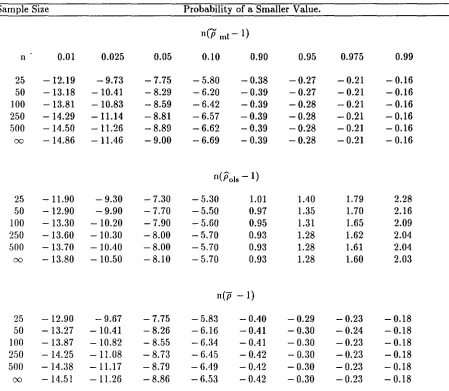
from whichthe roots of(2.2) can be found, and percentiles tabulated. Table 2.1 contains percentiles of the
unconditional maximum likelihood estimator's distribution for finite samples and the limit. These are
labelled n(ffml - 1). Also listed for comparison are the least squares estimate n(pols - 1) as in Fuller
(1976) and the symmetric estimator n(p -1) as in Dickey, Hasza, and Fuller (1984). Gonzalez-Farias
Table 2.1. Empirical cumulative distribution of the estimators ofp, p=1.
Sample Size Probability of a Smaller Value.
n(Pml- 1)
n 0.01 0.025 0.05 0.10 0.90 0.95 0.975 0.99
25 -12.19 -9.73 -7.75 -5.80 -0.38 -0.27 -0.21 -0.16
50 -13.18 -10041 -8.29 -6.20 -0.39 -0.27 -0.21 -0.16
100 -13.81 -10.83 -8.59 - 6042 -0.39 -0.28 -0.21 - 0.16
250 -14.29 -11.14 -8.81 -6.57 -0.39 -0.28 -0.21 -0.16
500 - 14.50 - 11.26 -8.89 -6.62 -0.39 -0.28 -0.21 -0.16
00 -14.86 - 11.46 -9.00 -6.69 -0.39 -0.28 -0.21 -0.16
n(pois - 1)
25 - 11.90 -9.30 -7.30 -5.30 1.01
lAO
1.79 2.2850 -12.90 -9.90 -7.70 -5.50 0.97 1.35 1.70 2.16
100 - 13.30 - 10.20 -7.90 -5.60 0.95 1.31 1.65 2.09
250 -13.60 -10.30 -8.00 -5.70 0.93 1.28 1.62 2.04
500 -13.70 - 10040 -8.00 -5.70 0.93 1.28 1.61 2.04
00 -13.80 -10.50 -8.10 - 5.70 0.93 1.28 1.60 2.03
n(p -1)
25 -12.90 - 9.67 -7.75 -5.83 - 0040 -0.29 - 0.23 - 0.18
50 -13.27 - 10.41 -8.26 -6.16 - 0.41 -0.30 -0.24 - 0.18
100 -13.87 -10.82 -8.55 -6.34 - 0.41 -0.30 -0.23 -0.18
2.50 - 14.25 - 11.08 -8.73 - 6.45 - 0.42 - 0.30 -0.23 -0.18
500 -14.38 -11.17 -8.79 - 6.49 - 0.42 -0.30 -0.23 -0.18
The limit distribution does not change if additional lags are included in the model. This will also
be true in the case where the mean is estimated. To illustrate this result, consider a second order,
AR(2), model. The AR(2) model with mean 0can be written as
Yt = (ml + m 2) Yt-l - mlm2 Yt-2 + et
and the logarithm of the stationary likelihood for et normal is
where the sum of squares SSQ is
SSQ = f:(Yt-(ml +m2)Yt-1+mlm2yt_2)2 t=3
SlIppose the true value of (ml , m2) is (1, 0') with 10'1
<
1. Now let X = n(ml -1) and S = Jll(m2 - 0')and consider the function En(L) for (X, S) in an arbitrary closed rectangular region R. Let;:;2 denote
the maximum likelihood estimator ofu2for any given (X, S) and note that for (X, S) in R we have
since, in R, ml = 1 + O(I/n) and m2 = 0' + 00/ Jll). Substituting;:;2 into En(L) we have the
concentrated likelihood
€n(L) = - (n/2)€n(;:;2) + (1/2)€n( - X/n) - (n/2)€n(2II)
+ (1/2)€n[0 + mt)(1 -
m~)(1
- mtm 2)2] - (n/2)Only the first two terms affect the limit distribution. In fact the X=n(ml - 1) and S=Jll(m2 - 0')
which maximize €n(L) are asymptotically the same as the (X, S) which maximize
Fn(X, S) = [ - (n/2)€n((SSQ)/n)] + (1/2)€n( - X) + C (2.3)
where C is constant with respect to X and S. See Gonzalez-Farias (1992 appendix B). For (X, S) in R
we have
SSQ = f:[et - X (Yt- l - O'Yt _2)/n - S(Yt _1 - Yt - 2 )/Jll + XS(Yt _2/n3/2
)f
3
Notice that XS in SSQ is multiplied by n-2 Yt-2, a term whose sum of squares converges toO.
Furthermore l{(Yt -t -
aY
t_2)/n
(Yt -t -Y
t-2)1
yn]
converges to 0. In the limit, then, the log likelihoodis the sum of two functions, one involving only S and one involving only X. Specifically, SSQlu2
-n
L:
e~I
u2 is a polynomial in (X, S) and converges uniformly in Rtot=3
[ - 2X(
+
x
2r]
+
[S2/(1 - ( 2) -
2 SV] (2.4)whereV '" N(O, (1 - a2rt). The derivatives ofSSQlu2also converge to the derivatives of(2.4). This
result follows from the well known rates of convergence of sums of squares and cross products for
st,ationary and unit root processes. Taking the derivative, with respect to X, of Fn(X, S), we see that
the limit maximum likelihood estimator satisfies
or
2X2- 2((/r)X
+
2(
2f)
=°
which is the same as (2.2). Note also that taking the derivative of Fn(X, S) with respect to S gives the
same limit normal distribution for
yn(m
2 - a) that would be obtained from applying least squares ormaximum likelihood to the model
Since the region R can be any closed rectangular region with (X, S)=(O, 0) an interior point, the orders
of sums of squares and cross products in
(2.3)
imply that, given any 8>
0, the (X, S) which maximizesFn is eventually within this region with probability at least (1 - 8). Over R, the function
en(i) - Fn(X, S) converges uniformly to 0, so the normalized maximum likelihood estimates of mt and
m2 converge to the maximizing (X, S).
We have outlined the case of the known mean since the algebra is relatively easy to follow and
involves only a few terms. In the next section, we look at the more practical case in which the mean p
is estimated. The main ideas are similar to the case just presented, but the algebra is more tedious
3. TEST CRITERIA, MEAN ESTIMATED
Consider the model for Yl' ..., Yn
Yt = J.l(1- p)+pYt-1+et , t=2, 3, ... ;Ipl
<
1where et is a sequence of iid N(O, 0-2) random variables. We will study the model (3.1) under two scenarios, namely, Y1being fixed and
3.1. Case 1: Y1fixed.
When Y1is considered fixed, the estimator ofp is obtained by maximizing the log likelihood
function conditioned on Y1, namely
(3.1)
1
20-2
(3.2)
This is commonly called the conditional maximum likelihood estimator. IfJ.l is estimated, the
conditional maximum likelihood estimator is also asymptotically equivalent to the ordinary least
sqlJares estimator
P"
ols ofp, obtained by regressing Yt on 1 and Yt-1. Asymptotic properties ofPolsr' IJ,
when p
=
1 have been very well established in the literature, see for example, Dickey and Fuller (1979).The estimator's distribution does not depend on the value of Jl in (3.1).
Dickey and Fuller (1979) show that the pivotal statistic
2 1 n -2 - _ 1 n
where S
=- -
2:
et and Y(-1) - n _ 12:
Yt-1and T" can be expressed as a function of standardnormal variates. Again this statistic does not depend on the true value ofJ-l in (3.1). In fact, adding a
constant c to every observation has no effect on either
P
/-l,oIsor T/-l' Table 8.5.2 of Fuller (1976) givesthe percentiles of the TJ-l distribution.
3.2. Case 2: Y1 '" N(J-l' (72 / (1 _
p2)) .
Consider n observations Yl' " ' , Yn from the model (2.1). Then, the log likelihood function is
given by
\vhere i *(J-l' p, (72)
= -
~
log 211 -~
log (72+
!
log (1-p)For any given p and (72, both i and L* are maximized at
(3.3)
n-l
Y1
+
Yn - (p - 1)L:
Ytjl(p)
=
2-(n-2)(p-l) (3.4)- 1
where Y1
=
n _ 2Notice that jl(p) is a weighted average of the data so that any statistic defined as a function of
YI- iJ(p) will be unchanged by the addition of a constant c to every observation. This shows that
such a statistic is independent of the value ofJ-lin (3.1).
Let iJ,~, P~ and (7~2be the values ofJ-l, p and (72 that maximize L*. Itis shown in
Gonzalez-Farias (1992) that the asymptotic distribution of(jl* ,m p* , 0'*2)m m is the same as (iiml'
P
ffi,rnI' (72ID,IDI) the maximum likelihood estimator of(J-l, p, (72), so it is sufficient to use L*as the objective to maximize.THEOREM. Suppose Yt
=
Yt -1+
et where et is a sequence of iid (0, (7~) random variables withthat maximize L*(Il, P, (T2). Then
and
(n(jJ~
n-~
jl:U)
-
1)1
(H
A
:)
0-*2
=
1~
e2+
0 (1)m n t~2 t p n
(3.5)
where H* = H + T - 2H and A* is the unique negative solution to 2-A*
(3.6)
The a/s are funetionals of a standard Brownian motion W(t). Following Dickey and Fuller (1979),
and Chan and Wei (1988), (f, H, T)
=(J~W2(t)db, J~W(t)dt,
W(I)).Let fIl = f - H2, (=!(T2-1), and (,. = ( - TH. Then
a4
=
2fp' a3= -
2((1l+
H 2) - 8f,.,
a2
=
8f1l+8((fJ+
H2)-1 ,a1
= -
8((fJ+ H2) + 2(T - 2H)2 + 4, aD = - 4.Proof: We present here a sketch of a proof. A detailed proof appears in Gonzalez-Farias (1992).
Taking partial derivatives ofL* with respect toIl, and (T2 and setting them equal to zero we get
jl~
=
!i(jJ:U)
and
iJ:u
is a solution toa* f3-*4+ a * iJ*3+ a * f3-*2+ a *
jj*
+a* = 04m m 3m m 2m m 1m m Om
(3.7)
(3.8)
a~,n
= -
4+
oi)n)'
r
-
1n,I' - n2
and
The coefficients a:"I,n in (3.9) converge jointly in distribution to the coefficients aj in (3.6).
By Theorem 13.8 of Breiman (1968), we can change to a new probability space on which
{ai,n'
i=
0, " ' , 4}.E{aj,
i=
0, " ' , 4}.The limit polynomial given in (3.6) can be factored giving
and hence, we can show that it has a unique root X=A
*
in ( - 00, 0).Also, since a:"l,n= Op(I), i=O, ... , 4 and a4*tn and a4 are positive random variables, it is possible to
show that with a very high probability the polynomial in (3.9) has a solution,
p:n
in the interval( - n, 0).
Then, using the Implicit Function Theorem we get that with high probability, there exists a
unicJlle
P;n
that satisfies (3.9) and is a continuous function of ai,n,i=0, .. ·,4 and henceP:U
.1A*.Note that, the partial derivative of1.(/J,p,0"2) is
~~
=2(I~P)
+
81.*(JJa;,
0"2))After some algebra we get that the maximum likelihood estimator ofp, or equivalently
~~l=
n(p:U,
ml - 1) is a solution to a fifth degree polynomial,5 _.
2:
a· j31=
0. l,n m 1=0
Note that the polynomial in (3.10) behaves similarly to the fourth degree polynomial we obtained
for 1.,*and hence the asymptotic distribution for the maximum likelihood estimator is the same as that
of(iI.*rm' p'*m' iT*2).m
4. Remarks
1. The maximum likelihood estimators may also be obtained iteratively. For a given
Pj
- 1 and iT?-1'h
may be obtained from (3.4). For a givenP'i'
we then obtainPj
and iT? by maximizing L(jti' p, (72).It, can be shown that
p.
is a solution to a cubic equation where the observations are centered at ji,. andI I
a closed form expression is given in Hasza (1980).
2. When we assume that 1"=0in the model (3.1) then the MLE ofp that maximizes 1.,(0, p, (72) is
obt.ained by solving (2.2), namely
• GJ _
If (
(2
21/2}
n(Pml - 1) -+ A -
21.
r - {
r2
+
r}
.
An empirical study that. compares the powers ofPolsand Pmlindicates that there are essentially no
differences in the power among these test criteria in the1"=0 case.
~. A Wald type pivotal t-statistic can be constructed for testing p=l,
(p -1)
JV(p)
where V(p) is determined from the negative matrix of the second derivatives of the corresponding objective function.
tl. For the higher order processes, we consider the model
(3.11)
where Zt is a stationary AR(p -1) model, 1
>
P~ max Imjl and mj' i=
2, . ", p are the roots of thecharacteristic equation of the Zt process. Using methods similar to those in section 2, Gonzalez-Farias
model (3.11), is the same as that of
n(P
m,ml)
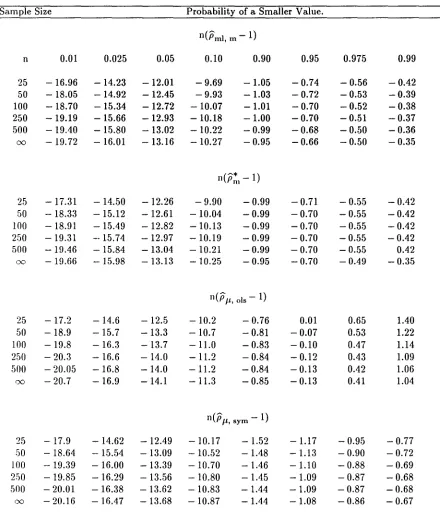
derived for the AR(1) case.Tables of percentiles for the different estimators mentioned above are given in Table 4.1 4.2.
The top panel of each table is the maximizer ofL(j.l, p, 0-2)and the second the maximizer of
L*(j.l, p, 0-2) as in (3.3). The last two panels are the least squares and symmetric estimators as in
Table 4.1 Empirical distribution of the normalized bias estimators.
Sample Size Probability of a Smaller Value.
n(Pml, m - 1)
n 0.01 0.025 0.05 0.10 0.90 0.95 0.975 0.99
25 -16.96 -14.23 -12.01 -9.69 -1.05 -0.74 - 0.56 - 0.42
50 -18.05 -14.92 -12.45 -9.93 -1.03 - 0.72 -0.53 -0.39
100 -18.70 -15.34 - 12.72 -10.07 -1.01 -0.70 -0.52 -0.38
250 -19.19 -15.66 -12.93 - 10.18 -1.00 -0.70 -0.51 -0.37
500 - 19.40 -15.80 -13.02 -10.22 -0.99 -0.68 -0.50 - 0.36
00 - 19.72 - 16.01 - 13.16 -10.27 -0.95 -0.66 -0.50 - 0.35
n(p~l-l)
25 - 17.31 -14.50 -12.26 - 9.90 -0.99 -0.71 - 0.55 - 0.42
50 - 18.33 - 15.12 -12.61 -10.04 -0.99 -0.70 - 0.55 -0.42
100 - 18.91 -15.49 - 12.82 -10.13 -0.99 -0.70 -0.55 -0.42
2.50 - 19.31 --15.74 -12.97 -10.19 - 0.99 -0.70 -0.55 - 0.42
500 - 19.46 - 15.84 -13.04 -10.21 -0.99 -0.70 -0.55 0.42
00 - 19.66 -15.98 - 13.13 -10.25 -0.95 -0.70 - 0,49 -0.35
n(pj.L,ols-l)
25 -17.2 -14.6 -12.5 -10.2 - 0.76 0.01 0.65 1.40
50 -18.9 -15.7 -13.3 -10.7 - 0.81 -0.07 0.53 1.22
100 -19.8 -16.3 -13.7 -11.0 -0.83 - 0.10 0.47 1.14
250 - 20.3 -16.6 -14.0 -11.2 - 0.84 - 0.12 0.43 1.09
500 - 20.05 -16.8 -14.0 -11.2 -0.84 - 0.13 0.42 1.06
00 - 20.7 -16.9 -14.1 -11.3 -0.85 -0.13 0,41 1.04
n(pj.L,sym -1)
25 -17.9 - 14.62 - 12.49 -10.17 -1.52 -1.17 - 0.95 - 0.77
50 - 18.64 - 15.54 -13.09 -10.52 -1.48 -1.13 - 0.90 - 0.72
100 - 19.39 - 16.00 -13.39 - 10.70 -1.46 -1.10 - 0.88 -0.69
2.50 - 19.85 -16.29 -13.56 -10.80 -1.45 -1.09 - 0.87 -0.68
500 - 20.01 - 16.38 -13.62 -10.83 -1.44 -1.09 -0.87 -0.68
Table 4.2 Empirical distribution of pivotal statistics
Sample Size Probability of a Smaller Value.
t
ml,mn 0.01 0.025 0.05 0.10 0.90 0.95 0.975 0.99
25 - 3.49 -3.08 - 2.76 -2.42 - 0.90 - 0.83 -0.79 -0.76
50 -3.31 -2.96 -2.68 -2.38 -0.91 -0.83 -0.79 -0.76
100 - 3.24 -2.92 -2.66 -2.36 -0.91 -0.83 -0.79 -0.76
250 -3.21 -2.90 -2.65 - 2.36 -0.91 -0.83 -0.79 -0.76
500 -3.20 -2.90 -2.64 -2.36 -0.91 -0.83 -0.79 -0.76
00 -3.20 -2.90 -2.64 -2.36 - 0.91 -0.83 -0.79 -0.76
t*
m25 - 3.53 - 3.10 - 2.78 -2.44 - 0.88 - 0.81 -0.78 -0.75
50 -3.35 - 2.99 - 2.70 -2.39 -0.90 - 0.83 -0.79 -0.76
100 - 3.36 -2.94 - 2.68 -2.37 - 0.90 - 0.83 -0.80 -0.77
250 - 3.21 -2.91 - 2.65 -2.36 -0.91 - 0.84 - 0.80 -0.77
500 - 3.21 -2.90 - 2.64 -2.36 -0.91 - 0.84 -0.81 -0.78
'Xl - 3.20 - 2.90 - 2.64 -2.35 -0.91 -0.84 -0.81 -0.78
T{I
25 -3.75 -3.33 -3.00 - 2.63 -0.37 0.00 0.34 0.72
50 -3.58 - 3.22 -2.93 -2.60 - 0.40 -0.03 0.29 0.66
100 - 3.51 - 3.17 -2.89 -2.58 - 0.42 - 0.05 0.26 0.63
2.50 -3.46 - 3.14 -2.88 -2.57 - 0.43 - 0.07 0.24 0.62
500 -3.44 - 3.13 - 2.87 -2.57 - 0.44 -0.07 0.24 0.61
00 -3.43 - 3.12 -2.86 - 2.57 - 0.44 -0.07 0.23 0.60
T{I,sym.
25 - 3.40 -3.02 - 2.71 -2.37 - 0.83 -0.73 -0.65 -0.59
50 -3.28 - 2.94 - 2.66 -2.35 -0.84 - 0.73 -0.65 -0.58
100 - 3.23 - 2.90 - 2.64 -2.34 - 0.84 - 0.73 -0.65 -0.58
250 - 3.20 - 2.88 - 2.62 -2.34 -0.85 - 0.73 -0.66 -0.58
500 - 3.19 - 2.88 - 2.62 -2.33 - 0.85 - 0.73 -0.66 -0.58
5. Power Study
We generate 50 observations from the model
Yt
=
p(1 - p)+pYt-1+
etwith Yo
=
0, and et "" NID (0, I), We consider the values p=Oand p=,98, .95, .90, .85, ,80, and .70.For each parameter combination 5,000 data sets were generated and the percentage of runs for which
the test criteria reject the unit root null hypothesis were recorded.
In Fig. 1, we give the empirical powers of the test criteria of the form n(p - 1), often called normalized bias, We have
P",OLS: ordinary least squares estimator obtained by regressing Yt on 1 and Yt -1' This
is t.he solid line.
PI',sym:
symmetric estimator obtained by regressingYt on 1, Yt -1 and on 1 and Yt+1 as in Dickey, Hasza, and Fuller (1984). This is the middle dashed line.P
IU,lnI: maximum likelihood estimator obtained as a solution to the fifth degreepolynomial (3.10). This is one of the top, nearly coincident, dashed lines.
P~l: approximate maximum likelihood estimator obtained as a solution to the fourth
degree polynomial (3.9). This is the other dashed line at the top.
Figure 2, shows the empirical powers of the corresponding pivotal statistics, T1" TI',sym'
t
m , mI' andt~n' for testing p
=
1.We observe that:
1. The test criteria based on
Pm,
ml and its approximationP:'n
have much higher power than thecrit.el·ia based on the O1,S estimate.
2. The test criteria based on the pivotal statistics have marginally higher power than the criteria based
on the corresponding normalized bias statistics. Also, for some pvalues, the empirical power of
t
m,mIis almost twice that of Dickey and Fuller (1979) statisticT1"
3. The test criteria based on the symmetric estimator have powers between that of the O1,S and
P
m,ml'A more extensive study may be found in Chapter 4 in G-F (1992).
4. It. is not surprising to see the best power associated with the statistic whose 5th percentile, under the
null hypothesis, is closest to O. After all, under the stationary alternative, the estimators in each table
•
o
:.."
o
o :.." C1Io
ex,
o
o
<0o
....
(:)o
/ .7.
.,
/
.; • J/ . 1
;'
./
;'
.; , .1 / .1;'
;'
J / .1;'
./
.
.; / J / .7 ,."
/ of , J / .J • .Y /.,
, J / J , .7 /."
, of / .) / .7•
,;Y
/.
,.,
/.,
, .)'/ '1,'I
/
.) , .) / .l" ,."
/
.,
• J/
."
.
.,
/
.; • J / .7;'
./
.
.; / J • ,1/ /
/ J • .1/
.'
.
.,
/J • J1.7
.
.,
I.;
'JI)
1'.1
.
.,
I
J • JV'
• f ; J J f: I
I
I
. I : I
i
•
:T
o
o Coo
o<0
oo
<0
C1l...
o
o
.I
./
/,
• J.I
I /;'
• J / I / I • ,I.I
'
//
.I
;'
/ I • J / I • .f /,
/./
/ .f.
/
/ J.I
./
//
•/ . fJ
/
./
/ J J /.'
//'
• J/ . f
/
./
• J / J/
./
• J / .1 ; .f.
/
I
J • .I / .fi /
• .II
I • fI
I • JI
.I • fI ;
• JI
Ji/
• III
i'
• lI'
• III
.//"
./ ~J/
I: I
I
I
• I •
: I
I
•
REFERENCES
(1) Breiman, L. (1968). Probability, Addison-Wesley, Reading, Mass.
(2) Chan, N. H. and Wei, C. Z. (1988). Limiting distribution of least squares estimates of unstable
autoregressive processes. The Annals of Statistics, 16, 367-40l.
(3) Dickey, D. A. (1976). Estimation and Hypothesis Testing in Nonstationary Time Series, PhD
thesis, Iowa State University.
(3) Dickey, D. A. and Fuller, W. A. (1979). Distribution of the estimators for autoregressive time
series with a unit root. Journal of the American Statistical Association, 74, 427-43l.
(4) Dickey, D. A., Hasza, D. P., and Fuller, W. A. (1984). Testing for Unit Roots in Seasonal Time
Series. Journal of the American Statistical Association, 79, 355-367.
(5) Fuller, W. A. (1976). Introduction to Statistical Time Series. Wiley, New York.
(6) Gonzalez-Farias, G. (1992). A new unit root test for autoregressive time series. Unpublished
Dissertation, North Carolina State University, Raleigh, N. C.
(7) Hasza, D. P. (1980). A note or maximum likelihood estimation for the first-order autoregressive