AC 2012-2957: ENGINEERING STUDENTS’ PERCEPTION ON
LEARN-ING THROUGH COOPERATIVE PROBLEM-BASED LEARNLEARN-ING (CPBL)
FOR THE FIRST TIME
Dr. Fatin Aliah Phang, Universiti Teknologi Malaysia
Cooperative problem-based learning (CPBL) has been proven to be a powerful technique in engaging and developing students in learning, as well as a multitude of professional skills. Nevertheless, academic staff in engineering who are new to conducting CPBL may face difficulties because students who are new to this inquiry based technique will normally be ”traumatized” because of the drastic change in the learning environment and requirements. As part of a larger study on training and supporting academic staff in implementing CPBL, a phenomenological study was conducted on the categories of variations in students’ perceptions towards learning as they go through a course that fully utilized CPBL in a whole semester. The main purpose is to identify students’ perception towards CPBL in two aspects: the student perceptions and acceptance/rejection, and the benefits and improvements that students gained along the learning process. The paper illustrates the extent of acceptance and effectiveness of CPBL method for an engineering class taught by a lecturer who had undergone a series of training on cooperative learning and problem based learning, but is new to implementing CPBL. Through classroom observations, students’ self-reflection notes and interviews with students for one whole semester, the results are reported in three stages: beginning of the semester, in the middle the semester; and at the end of the semester. Four types of initial-to-final students’ perspectives were found. The analysis of the interviews reveal that, first and foremost, it is essential for academic staff to understand and embrace the philosophy behind CPBL, which will enable them to providing students with appropriate support especially in developing team working, time management, learning and thinking skills. In addition, proper explanation and justification behind each step in the CPBL cycle, as well as the overall planning through the different problems, are also necessary to avoid confusion and cutting corners in learning among students. Most of all, the analysis reveal the importance of emotional support in the form of motivation and encouragement, as students go through various emotions that form into perception, which in turn affect their performance.
Dr. Khairiyah Mohd-Yusof, Universiti Teknologi Malaysia
Khairiyah Mohd-Yusof is currently the Director of the Regional Centre for Engineering Education (RCEE), Universiti Teknologi Malaysia. Previously, she had held posts as a Deputy Director at the Centre for Teaching and Learning and Head of the Chemical Engineering Department. As the Director of RCEE, she oversees the Ph.D. in engineering education program in UTM. Her main research areas are pro-cess modeling, simulation and control, and engineering education. She has been implementing PBL in her courses since 2002 and is also involved in training engineering instructors in teaching and learning throughout Malaysia.
Dr. Syed Helmi Syed Hassan, Universiti Teknologi Malaysia
Syed Helmi Syed Hassan is as Senior Lecturer in the faculty of mechanical engineering, Universiti Teknologi Malaysia, and is affiliated to the Regional Centre for Engineering Education, Universiti Teknologi Malaysia. He is among the first cohort of graduates of the Ph.D. in engineering education program from Universiti Teknologi Malaysia.
Dr. Mimi H. Hassim, Universiti Teknologi Malaysia
Mimi Haryani Hassim is a Senior Lecturer with the Department of Chemical Engineering, Universiti Teknologi Malaysia. She obtained her Ph.D. in chemical engineering from Aalto University School of Science and Technology, Finland, in 2010. She is also a Chartered Member of the Institution of Chemical Engineers (IChemE). She has been working in the area of inherent occupational health studies for more than 10 years. Her research studies also include inherent safety, multi-criteria decision making, and industrial hygiene.
c
American Society for Engineering Education, 2012
P
Engineering Students' Perception on Learning through Cooperative Problem-Based Learning (CPBL) for the First Time
ABSTRACT - Cooperative problem-based learning (CPBL) has been proven to be a powerful
technique in engaging and developing students in learning, as well as a multitude of professional
skills. Nevertheless, academic staff in engineering who are new to conducting CPBL may face
difficulties because students who are also new to this inquiry based technique will normally be
"traumatized" because of the drastic change in the learning environment and requirements. As
part of a larger study on training and supporting academic staff in implementing CPBL, a
phenomenological study was conducted on the categories of variations in students' perceptions
towards learning as they go through a course that fully utilized CPBL in a whole semester. The
main purpose is to identify students’ perception towards CPBL in two aspects: (1) perception and
acceptance/rejection; and (2) the benefits and improvements gained along the learning process.
The paper illustrates the extent of acceptance and effectiveness of CPBL for an engineering
course taught by a lecturer who had undergone a series of training on cooperative learning and
problem based learning, but is new to implementing CPBL. Through classroom observations,
students’ self-reflection notes and interviews with students for one whole semester, the results
are reported in three stages: (1) beginning of the semester; (2) in the middle the semester; and (3)
at the end of the semester. Four types of initial-to-final students’ perspectives were found. The
analysis of the interviews reveal that, first and foremost, it is essential for academic staff to
understand and embrace the philosophy behind CPBL, which will enable them to provide
students with appropriate support especially in developing team working, time management,
learning and thinking skills. In addition, proper explanation and justification behind each step in
the CPBL cycle, as well as the overall planning through the different problems, are also
necessary to avoid confusion and cutting corners in learning among students. Most of all, the
analysis reveal the importance of emotional support in the form of motivation and
encouragement, as students go through various emotions that form into perception, which in turn
affect their performance.
Keywords: Cooperative Problem-Based Learning, Teaching and Learning, Student Perceptions
P
I. INTRODUCTION
Cooperative Problem-Based Learning (CPBL) is an inductive learning method that
incorporates the five principles of Cooperative Learning (CL) into the Problem-Based Learning
(PBL) cycle. CPBL is suitable for medium-sized classes of up 60 students sitting in small
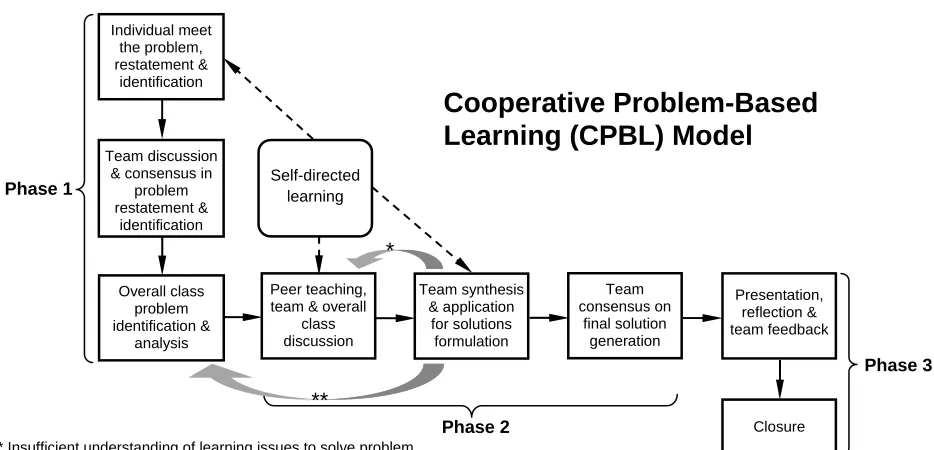
groups consisting of three to five students for one floating academic staff or facilitator1,2. A detailed description of the CPBL model can be seen in Figure 11,4.
Designed based on constructive alignment, the CPBL framework, shown in Figure 1, is a
scaffolding for students to visualize the whole cycle, and go through the process in a systematic
manner. Previous studies had shown CPBL to enhance students’ problem solving abilities and
team working skills3. It is also shown to motivate students to learn, as well as develop skills to
learn and think critically. This is very much in line with the outcomes of PBL. As such, the
CPBL model allows PBL to be executed in a typical classroom while attaining the desired
outcomes normally possible only with small group implementation. A detailed description of
CPBL can be seen in Khairiyah et al. (2011a)1.
Figure 1: Cooperative Problem-Based Learning (CPBL) Model
Self-directed learning
Phase 3 Peer teaching,
team & overall class discussion Team synthesis & application for solutions formulation Team consensus on final solution generation Presentation, reflection & team feedback Closure Phase 2 * **
Cooperative Problem-Based
Learning (CPBL) Model
* Insufficient understanding of learning issues to solve problem **Incomplete or misunderstanding of problem requirements
Individual meet the problem, restatement &
identification
Team discussion & consensus in
Nevertheless, implementing and facilitating CPBL can be rather complicated, especially
if the course where it is implemented is the only one using the technique among all others that
use a more traditional lecture-based method. Students who face CPBL for the first time will
typically feel shocked over such a drastic change in the teaching and learning method. In fact,
Woods (1994)5 stated that many will go through emotions associated with someone who had
faced typical trauma. Students initially feel shocked, which then turn to denial, followed by
strong emotion, and after that, resistance. Finally, they resigned themselves to acceptance, start
to struggle, which in turn help them to attain better understanding, before finally attaining
integration at a higher performance level than when they initially started. Therefore, part of the
role of the facilitator is to provide support so that students will be able to overcome their initial
frustrations in the shortest time possible. It is important for the facilitator to address these issues
before they started to abandon the learning strategy12.
However, this is not an easy task for the facilitator, especially when faced with many
students in various stages of "trauma" in a class. While most students are able to go through and
overcome this difficulty, there may be a few who continue to resist or feel negative towards
CPBL until the end of the semester. Therefore, it is essential to identify their source of
dissatisfaction to design proper support or scaffolding that can minimize students' frustration
while guiding them in developing the necessary skills to learn and solve the given problem.
This paper describes a study which investigates the perception of third year students in a
class while learning in a difficult, mathematically intensive engineering course. Although the
lecturer for the class had gone through a series of pedagogical training on active, cooperative and
problem-based learning, this is the first time the lecturer implemented CPBL. This study is
actually part of a larger research on training and supporting academic staff in implementing
CPBL.
III. STUDY DESIGN
This study was conducted in a three-credit course called "Process Control and
Dynamics", which is required for third year chemical engineering students. The course was
notorious for its difficult content because students need to be able to decipher and extract the
P
meaning behind mathematical representations of dynamic chemical process behaviors to select
suitable controller settings or design appropriate control systems. To appreciate the course,
students need to have a strong background in mathematics as well as the knowledge of chemical
processes, which they had learned in courses taken in previous semesters. When lectures were
used as the primary mode of instruction, thirty to forty percent of the class would fail, with an
average passing grade of a C- to D+. Nevertheless, up to 90% of the course content is now
covered using CPBL through four problems given throughout the semester. A detailed
description of the implementation of CPBL in the course can be seen in Khairiyah et al.1 and
Khairiyah et al.4
This study involves 35 students in one of the three sections offered for the Process
Control course. The main purpose is to identify student perceptions towards CPBL, conducted by
a new lecturer in its implementation, in two aspects: (1) the students' perceptions and
acceptance/rejection; and (2) the benefits and improvements that students gained along the
learning process. This is part of a larger research to determine appropriate support and training
for academic staff in implementing CPBL.
To study students' perceptions, a phenomenological research design was carried out
through non-participant observations, unstructured interviews and students’ written
self-reflections which were collected at the end of every problem (there were four problems in this
class). Students in the class were divided into nine groups (about four students in a group).
During and after each problem, the students, selected based on convenient sampling, were
interviewed on the following aspects:
a) Students' perceptions in the conduct of CPBL by the lecturer
b) Their experience and involvement during the CPBL learning process
c) Their acceptance of the CPBL as a teaching method for the course
During and after each problem, the students were asked with a set of questions centered
on students' initial thought as they approach the CPBL system in earlier stage. The questions
were to investigate the student's expectations on CPBL after attending classes in the first few
weeks of the semester, what are the differences compared to their usual teaching and learning
experience, and what concerns they had. At the mid-semester stage, the focus of the interview
shifted towards their emotional aspect as students were showing frustration in struggling to adapt
P
to the CPBL cycles. The questions geared towards reflections of their learning issues and self
development. At the final stage, they were asked about the CPBL as a whole, strengths and
weaknesses, as well as their reflection of self improvement.
After one semester of exploration with almost all the students through interviews and
observation by two researchers, it was found that the pattern of student perceptions can be
categorized into four, which will be explained at the end of this paper. Further exploration on
these categories was made to understand the change of their perceptions in order to identify the
reasons for such a pattern. This is to inform the lecturers who are new in using CPBL to carry out
the appropriate steps in CPBL that will ensure positive perceptions among students and avoid
steps that might result in negative perceptions among the students. The overall perceptions of the
students were presented in this paper drawing from the interview, observation and self-reflection
data. The interviews were carried out after the classes every week either at the school building or
at the students' residential colleges. Later, four students, one from each of the categories of the
four patterns of student perceptions categorized, were selected to illustrate the results and further
discussions.
IV. RESULTS AND DISCUSSIONS
A. Student Perceptions on at the Beginning of the Semester
In the first few weeks of the semester, the students were trying to review the overall
CPBL framework, understand the CPBL cycle and deal with the work-load required by the
CPBL process. During the initial cycle of CPBL, where for the first time, the students had to
identify and understand the learning issues before they could solve a realistic and unstructured
problem, many students felt obligated to make a lot of reading (something that they are not used
to doing), to develop peer-teaching notes that they have to turn in and use during peer-teaching
sessions with their team mates and with all their classmates during the overall class peer teaching
session. Reading up on the assigned learning issues and making the notes made some of them
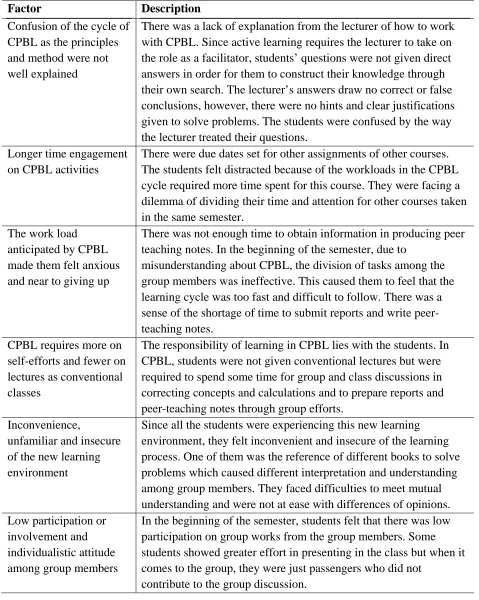
felt burdened. Table 1 summarizes their early responses which actually show higher degree of
dissatisfaction among the students. This conform to the initial part of the "trauma cycle"5, which
stipulate that students would feel shocked, denial, strong emotion, and resistance.
P
Table 1: Students’ Responses towards CPBL at the Beginning of the Semester
Factor Description
Confusion of the cycle of CPBL as the principles and method were not well explained
There was a lack of explanation from the lecturer of how to work with CPBL. Since active learning requires the lecturer to take on the role as a facilitator, students’ questions were not given direct answers in order for them to construct their knowledge through their own search. The lecturer’s answers draw no correct or false conclusions, however, there were no hints and clear justifications given to solve problems. The students were confused by the way the lecturer treated their questions.
Longer time engagement on CPBL activities
There were due dates set for other assignments of other courses. The students felt distracted because of the workloads in the CPBL cycle required more time spent for this course. They were facing a dilemma of dividing their time and attention for other courses taken in the same semester.
The work load anticipated by CPBL made them felt anxious and near to giving up
There was not enough time to obtain information in producing peer teaching notes. In the beginning of the semester, due to
misunderstanding about CPBL, the division of tasks among the group members was ineffective. This caused them to feel that the learning cycle was too fast and difficult to follow. There was a sense of the shortage of time to submit reports and write peer-teaching notes.
CPBL requires more on self-efforts and fewer on lectures as conventional classes
The responsibility of learning in CPBL lies with the students. In CPBL, students were not given conventional lectures but were required to spend some time for group and class discussions in correcting concepts and calculations and to prepare reports and peer-teaching notes through group efforts.
Inconvenience,
unfamiliar and insecure of the new learning environment
Since all the students were experiencing this new learning environment, they felt inconvenient and insecure of the learning process. One of them was the reference of different books to solve problems which caused different interpretation and understanding among group members. They faced difficulties to meet mutual understanding and were not at ease with differences of opinions. Low participation or
involvement and individualistic attitude among group members
In the beginning of the semester, students felt that there was low participation on group works from the group members. Some students showed greater effort in presenting in the class but when it comes to the group, they were just passengers who did not
These dissatisfactory responses on the CPBL implementation have been identified due to
several following factors:
a) Confusion of the cycle of CPBL as the principles and method were not well explained
b) Longer time engagement on CPBL activities
c) The work load anticipated by CPBL made them felt anxious and near to giving up
d) CPBL requires more on self-efforts and fewer on lecture notes as conventional classes
e) Inconvenience, unfamiliar and unsecure of the new learning environment
f) Low participation or involvement and individualistic attitude among group members
After the completion of the first problem, the students' perceptions began to show some
changes. While some of them were still resisting, others were showing positive attitude towards
CPBL. For example, the following self-reflection shows positive attitude after the end of the first
problem, which is labeled as Case Study 1 (CS1):
RefCS1 - Respondent 03:
"After undergo CS1, I learned that CPBL had given me new a experience on learning. We
were exposed to a situation that might occur in real life. I learned how to make a proper
problem identification involving a table identifying - what we know, what we need to
know and the learning issues. This is totally different from lecture-based teaching".
Note that all the reflections shown in this paper were corrected for grammatical errors, while
preserving the original meaning.
This group of students realized the benefits of what CPBL can offer them especially
when they enter the work place in the future. Some other students showed mixed perceptions of
CPBL because this is just the first problem they had experienced. One of them said:
RefCS1 - Respondent 02:
"Initially, I am very curious on the subject as it seem so challenging and difficult to learn.
I am also curious on the topics and the awkward learning system that is different than
usual. But, after series of discussions with group members, I began to understand the
P
flow of the learning system. But, it tends to make us confused and requires our own
efforts to read the suggested textbooks".
This group of students could feel the benefits of CPBL, but were not willing to put their
efforts into it. They were also still at a state of confusion because of the different technique of
learning and the various opinions and approaches in trying to find an answer for the problem.
This shows that the students still did not fully understand how CPBL works, and why they have
to learn according to the steps outlined in the framework, as shown in Figure 1.
There is another group of students who could not accept CPBL as a learning method
because of the demands CPBL requires. One of them said:
RefCS1 - Respondent 01:
"I can feel difficulties for this semester. I have registered a subject that is very tough
which is PC subject that are using CPBL method, with complicated cycle, needs full
attention and commitment in order to find the solution"
The first problem, which is the simplest of the four problems given in this course, is an
introduction for the students to CPBL. It aims to provide the students of the appropriate method
in defining problems and solutions. It also helps to prepare them for the upcoming problems that
had more technically challenging content with more complex and real problems.
It is not difficult to anticipate such problems among students in CPBL because CPBL is a
blend of cooperative learning and problem-based learning, which is highly grounded in the
constructivist theoretical framework where the role of the lecturer is to facilitate the knowledge
construction of the students and students must be prepared to take on the responsibility and
ownership of their learning. CPBL is very remote to the students who are used to the
conventional spoon-feeding teaching style and more individualistic learning approach. For this,
the lecturers must be equipped with the right facilitating skills, understanding the philosophies
and principles underlying CPBL and the ability to understand students’ emotions and
P
psychological state in order to motivate them, especially in the beginning of the implementation
of CPBL. This is to give them the sense of security of their learning progression in CPBL and to
show them the benefits and learning that they are gaining through the cycles of CPBL.
However, in this class, the students' perception on the lack of explanation from the
lecturer on how CPBL works, especially at the beginning of the semester, has caused confusion,
frustration and dissatisfaction among the majority of the students. Some of them even thought
that the lecturer was incompetent for not providing lecture notes and answering their questions
directly.
B. Student Perceptions on CPBL as a Means for Self-Improvement
As the students experience the subsequent problems at the middle of the semester, they
gradually shifted their perceptions to a more positive attitude towards the end of semester. They
realized that the CPBL learning process has slowly optimized their learning skills. However, it is
undeniable that the process has created higher workloads and extra learning hours. Some group
members showed dissatisfaction towards irresponsible group members and became upset during
the group discussions.
The change of student perceptions towards a positive attitude was because of:
a) the deeper understanding and higher skills in problem solving
b) the realization of the benefits CPBL can offer
c) the increase of self-confidence to achieve better result
Therefore, majority of the students confirmed that CPBL has contributed for:
a) self-independent and group work engagement
b) improvement of their reading and learning skills
c) optimizing their efforts in learning
d) offering better understanding of their mistakes through open class discussions
e) learning new approached in problem solving for future career
f) improvement of interpersonal skills and communication among friends
P
Table 2 shows the interview quotes of the students regarding self-improvement that they
have achieved through CPBL. These responses were obtained at the end of the semester.
Table 2: Student Perceptions of Self-Improvement
a. Self-independent and group work engagement
Q6-A1.3. “…I love this class! I love the self-making notes, group activities and
open-minded class discussions. All these hardworking efforts make me appreciate myself
more...”
b. Improvement of reading and learning skills
Q6-A2.1. “…the presented notes are results from reviews on peer-teaching notes from
friends. I have reviewed others’ models several times and study the differences and
similarities in textbooks. It causes me do lots of reading, rewriting and rereading,
something that I have never done before…”
c. Optimizing own efforts in learning
Q6-A3.1. “It very different! This learning style is not dependent on lecture and lecture
notes, requires students to talk and discuss among each other. It mostly about
self-learning…”
d. Better understanding of own mistakes
Q6-A4.1. “It is truly different! If we have misconceptions, these concepts will be
thoroughly discussed together again and again in the classroom. It differs from previous
learning method, where it’s only on the paper, nobody care to ask and most students just
pretend to understand…”
e. Approach towards future industry problems and applications
Q6-A5.2. “Since study using CPBL approach, my understandings on specific problems
are better. Compared to previous classes, students only describe the theoretical
situations and concepts in industry. But, through CPBL the problems are more
practical, based on what may happen and how to solve the problems.”
f. Improve self-interpersonal skills and interactions
Q6-A6.1. “Before this, I am passive, shy to interact with friends and to come forward.
But now, I feel relaxed, better communications and close to my friends. Now I can even
freely tell my jokes!”
P
Most of the students claimed that they could now enjoy the learning process, became
used to the challenging group discussions and felt the excitement to compete with each other to
find the best solution. The students agreed that CPBL learning process had:
a) contributed to longer retention of the knowledge learned
b) made the time needed for examination preparation shorter
c) made them become more hardworking
d) increased the level of understanding, capabilities and self-performance
e) increased the level of confidence
f) increased their passion and interest in discussion and learning
g) improved their time management skills
The majority of the students agreed that the biggest improvement that students benefited
from this CPBL learning process is critical thinking, team-working and communication, and
interpersonal skills.
C. Students’ Acceptance of CPBL
In terms of students’ acceptances of CPBL, they can be categorized into three groups:
positively accepting, moderately accepting and rejecting as shown in Table 3. Those who
resisted CPBL claimed that the problems and cycles were wasting their time. Those who
accepted CPBL found CPBL to be an interesting learning approach which offers advantages in
all of the problems given.
Table 3: Students’ Acceptance of CPBL Acceptance Reasons
Positively
accepting
• Increase self- capability in time management
• Increase reading skills
• Increases personal efforts & patience
Moderately
accepting
• Less time engagement in discussion
• If the number of CPBL cycles can be reduced
Rejecting • Wasting quality time
• Uncertain results and increase worries
• Difficulties in learning due to lack of notes, explanations and
guidance
D. Overall Changes on Students' Perceptions after One Semester
The students' perceptions of their overall learning process depend on how the students
interpreted difficulties in learning in either to transform into:
a) benefits or self-improvement – which later develops a positive perception; or
b) difficulties and threat – that constructs into negative perception
Analyzing the qualitative data obtained from students in the class, four types of changes
on student perceptions can be seen as students undergo the CPBL learning process:
a) those that held positive perception about CPBL from the beginning until the end
b) those that held negative perception from the beginning until the end
c) those that changed from positive perception in the beginning to negative perception at the
end
d) those that changed from negative perception in the beginning to positive perception at the
end
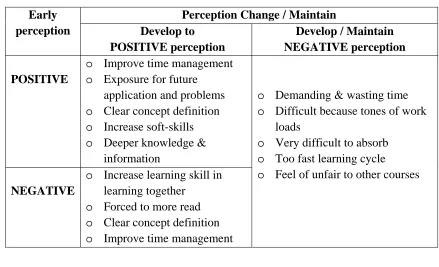
Based on the analysis of interviews with one student from each category, factors that
affect the change of student perceptions from the beginning until the end of the semester were
extracted and summarized in Table 4. The main factors that can sustain the positive perception
are:
a) the students felt that CPBL has improved their time management
b) CPBL has exposed them to the future application of knowledge they have learnt for
workplace problem solving
c) the students are clear of the concept definitions
d) CPBL helps to increase students’ soft skills
P
e) the students gained deeper knowledge and understanding
Table 4: Factors for the Change of Student Perceptions from the Beginning until the End of the Semester
Early perception
Perception Change / Maintain Develop to
POSITIVE perception
Develop / Maintain NEGATIVE perception
POSITIVE
o Improve time management
o Exposure for future application and problems o Clear concept definition
o Increase soft-skills
o Deeper knowledge & information
o Demanding & wasting time
o Difficult because tones of work loads
o Very difficult to absorb
o Too fast learning cycle
o Feel of unfair to other courses
NEGATIVE
o Increase learning skill in learning together
o Forced to more read
o Clear concept definition o Improve time management
Referring to Table 4, the factors that sustain negative perception among students are:
a) CPBL demands higher workload and time (students felt it was a waste of time)
b) some students who did not do enough preparation and group discussion felt the difficulty
to absorb the learning
c) poor time management made the students felt that the learning cycle went too fast
d) the students felt they neglected other courses taken in the same semester because of the
attention towards CPBL was higher than others
Factors that can change students' perceptions from negative towards positive are:
a) the students could see the benefit of studying together and felt that they cannot study
alone in the setting of CPBL, and hence they felt an increase in their learning skills
b) CPBL made the students feel obligated to do more self-reading, which led students to
master the concepts and knowledge
c) CPBL encourages students to reflect and plan their time properly and discipline
themselves to fulfill the due dates of each problem
P
Comparing the factors that hold positive versus negative perceptions of CPBL, the same
element tend to appear in both. For example, in terms of time, those who have positive
perceptions at the end (both the initially positive and negative categories) tend to say that
learning through CPBL trained them to manage time and handle their workload properly. On the
other hand, those who have negative perceptions at the end tend to say that they were unable to
manage their time because the learning cycle was too fast, causing them to neglect other courses.
In terms of learning, those who have positive perceptions at the end managed to read more and
learn deeper, as well as develop learning and professional skills. They appreciate learning with
their team and classmates, and value learning in the context of their future work setting.
However, those with negative perception at the end felt that learning with their team and
classmates were a waste of time, because they were not able to learn (difficult to absorb). They
obviously do not appreciate the opportunity to learn and develop themselves through CPBL,
which is why they find it demanding and the workload too much. The issue of workload is in
direct contrast to students with positive perception, who appreciate the inculcation of the reading
and discussing culture in learning.
From the interview results, students with positive perception gained tremendously in
terms of knowledge and professional skills. On the other hand, students with negative perception
found it difficult to participate in the CPBL process, causing them to lose out in the learning and
understanding the content, as well as professional skills development, which would also
compromise their final grade in the course. Therefore, it is important for facilitators to identify
students with negative perception to provide additional support and scaffolding, especially in
terms of learning and thinking skills. In addition, looking at their reasons for dissatisfaction,
correct understanding of the overall process, as well as the function of each step of the CPBL
process need to be given to students, and reinforced throughout the semester. The students also
need to be motivated and properly facilitated throughout the CPBL cycle. Regular assessment
on the team functioning, as required in cooperative learning, is also necessary to promote
accountability, as well as continuous improvement of team working.
The insights gained from the analysis of the findings shows the gaps that need to be
addressed in training and supporting academic staff to implement CPBL successfully. Before
P
lecturers can guide students in CPBL, they need to fully understand not only the CPBL process,
but also the underlying philosophy that forms the basis of the design of framework. This will
enable them to provide proper support, design scaffolding and facilitate students through the
myriad of emotion that they go through to finally allow them to develop positive perception so
that they may gain from the numerous benefits of CPBL.
V. CONCLUSION
The phenomenological study on CPBL learning process for Chemical Engineering
students has defined types of changes on student perceptions and their level of acceptances
towards the learning of CPBL by a lecturer who is new to this method. Although studies have
shown that problem-based learning enhance positive attitude among students6,7, the key of these
changes is on how the lecturer shapes the learning environment, understanding the students’
emotion and learning issues, motivate and facilitate them towards the right direction by not just
being a constructivist facilitator but also by providing the necessary support to develop the
required skills8,9 needed to work in a team, solve problems and manage time. Therefore, the
lecturer actually plays a very important role in shaping students' perceptions of the learning
approach that in turn will deeply impact their learning10. As Woods11 stated that it may not be the
fault of the teaching method but the way it is introduced to the students which causes students to
develop the negative perception.
ACKNOWLEDGEMENT
The project is funded by the Centre for Teaching and Learning (CTL), Universiti Teknologi
Malaysia under the Instructional Development Grant (IDG).
REFERENCES
1. Khairiyah Mohd-Yusof, Syed Helmi Syed Hassan, Mohammad-Zamry J. and Nor-Farida H. (2011a). “Cooperative Problem-Based Learning (CPBL): A Practical PBL Model for a Typical Course”, International
Journal of Emerging Technologies in Learning, Vol. 6, Issue 3, Sept 2011, pp 12-20. P
2. Ariffin A. H., Khairiyah Mohd-Yusof, Mohd. Kamaruddin A. H., Mimi Haryani H., Azila A. A., and S Syed Helmi Syed Hassan (2004). A review and survey of Problem-Based Learning Application in Engineering Education, accepted for Conference on Engineering Education, Kuala Lumpur, 14-15 Dis. 2004.
3. Syed Helmi Syed Hassan, Khairiyah Mohd-Yusof, Mohd Salleh Abu, Shahrin Mohammad (2011), An instrument to assess students’ engineering problem solving ability in cooperative problem-based learning (CPBL), paper AC 2011-2720, ASEE Annual Conference, Vancouver, Canada, June 2011.
4. Khairiyah Mohd-Yusof, Syed Helmi Syed Hassan, Mohammad-Zamry Jamaluddin, Nor-Farida Harun (2011b), Motivation and engagement of learning in cooperative problem-based learning (CPBL) framework, paper AC 2011-2721, ASEE Annual Conference, Vancouver, Canada, June 2011.
5. Woods, D. R. (1994). Problem-based Learning: How to Gain the Most from PBL, Waterdown, Ontario, Canada.
6. Polanco, R., Calderon, P., and Delgado, F. (2001). “Problem-based learning in engineering students: Its effects on academic and attitudinal outcomes.” in The Power of Problem-based Learning. P. Little and P. Kandlbinder Eds., 2001, pp 111 – 125.
7. Khairiyah Mohd-Yusof, Mimi H.H., and Azila N.M.A. (2004). “A first attempt at problem based learning in process dynamics and control course for chemical engineering undergraduates at Universiti Teknologi Malaysia”, 5th Asia Pacific Conference on Problem-based Learning, Kuala Lumpur, Mar 2004.
8. Strobel, J. and van Barneveld, A. (2009). “When is PBL more effective? A meta-synthesis of meta-analyses comparing PBL to conventional classrooms”, The Interdisciplinary Journal of Problem-based Learning, Vol. 3, no. 1, pp44-58.
9. Woods, D. R., Felder, R. M., Rugarcia, A., and Stice, J. M. (2000). “The Future of Engineering Education: III. Developing Critical Skills”, Chemical Engineering Education, 34(2), pp 108-117.
10. Amador, J. A., Miles, L., and Peters, C. B. (2006). The Practice of Problem-Based Learning: A Guide to
Implementing PBL in the College Classroom. Bolton: Anker Publishing.
11. Woods, D. R. (1996). “Problem-Based Learning for Large Classes in Chemical Engineering”. In Bringing
Problem-Based Learning to Higher Education: Theory and Practice. L. Wilkerson and W. H. Gijselaers Eds.,
1996, pp.91-100.
12. Savin-Baden, M., and Major, C. H. (2004). Foundations of Problem-based Learning. Berkshire: Open University Press.
P