P-wave Diffusion in Fluid-Saturated Medium
1
C. C. Dennis Ling,2S. Y. Faisal, and3A. A. Zainal
1,3Department of Mathematics, Faculty Science, Universiti Teknologi Malaysia
81310 UTM Johor Bahru, Malaysia. 2
Department Mathematics, University of Kordofan, Sudan e-mail:1
Abstract This paper considers the propagating P-waves in the fluid-saturated ums that are categorized to fall into two distinct groups: insoluble and soluble medi-ums. P-waves are introduced with slowness in accordance to Snell Law and are shown to relate to the medium displacement and wave diffusion. Consequently, the results bear out that the propagating P-waves in the soluble medium share similar diffusive characteristic as of insoluble medium. Nonetheless, our study on fluid density in the mediums show that high density fluid promotes diffusive characteristic whiles low den-sity fluid endorses non-diffusive P-wave.
Keywords P-wave; fluid-saturated mediums; medium displacement; wave diffusion.
1
Introduction
P-waves are referred to the primary waves when the phenomenon of an earthquake is being discussed. Engineers have studied widely and estimated the wet-rock P-wave velocity from the dry-rock P-wave velocity (refer e.g. Kahraman [1]). The dependence of P- and S-wave attenuation on strain amplitude and frequency had also been studied experimentally in dry and water-saturated sandstone samples under a confining pressure (e.g. Mashinkii [2]).
The protection of underground structures against dynamic loadings has long been a topic of great interest in defense engineering. Hence, the P-wave propagation and attenuation in rock shelter layer with an inclusion or filled medium had been studied in relation to such engineering interest (e.g. Wang et al. [3]). Furthermore, the problem of diffraction of waves due to plane harmonic P-wave incident normally on a line crack situated in an infinite micro-polar elastic medium was studied as well in Midya et al. [4]. Nevertheless, Weihua et al. [12] has recently obtained an analytical solution is obtained for two-dimensional scattering and diffraction of plane P-waves by circular-arc alluvial valleys with shallow saturated soil deposits. We were taken aback that similar research is taken place in medical cardiology (e.g. Materazzo [13]) where P-waves are used to monitor the risk assessment of the patient after undergoing surgery.
We organized this paper as such that section 1 is our brief review of current situa-tion, section 2 is the problem formulation and mathematical formulations, section 3 is our analytical discussions on our results and finally section 4 posted our concluding remarks.
2
Problem Formulation
The governing equations for the displacement is given by
µ∇2u+ (λ+µ)∇(∇u) +ρF =ρ∂ 2
u
∂t2. (1)
Boundary conditions forz= 0 and the stresses are
σz≡(λ+µ)
∂uz
∂z +λ ∂ux ∂x + ∂uy ∂y
= 0,
τxz≡µ
∂u x ∂z + ∂uz ∂x
= 0,
τyz ≡µ
∂uy ∂z + ∂uz ∂y
= 0.
Initial conditions fort= 0 are
u(x, y, z) = 0,
∂ux
∂t = ∂uy
∂t = ∂uz
∂t = 0.
In linear elasticity for isotropic medium,λandµdenote the Lame parameters for the stress
σz,τxz,τyz and the displacementsux,uy anduzare continuous everywhere. F is the body force in the direction ofx,y, zrespectively andρis the density.
Provided that ω is the angular velocity or frequency, k is the wavenumber, c is the wave velocity along with the dispersion relationω =ck,the group velocity of a wave is the velocity with the overall shape of the wave’s amplitudes which is also known as envelope of the waves. Several waves add together to form a single wave shape (called the envelope). In other words, the phase velocity is the average velocity of the components, given by
VP =ω/k. The group velocity is velocity of the envelope, given byVg=dω/dk[9]. When this is applied to the problem of P-wave’s propagation in fluid saturated medium, the group velocity reflects the apparent velocity of the surface displacement or the overall shape of the P- wave’s amplitude at the boundary of the medium. The envelope is formed by the grouping of P-waves.
In this research, the apparent velocityVappor surface displacement velocity is measured along the boundary of the similar density medium in accordance to Snell law:
Vapp sinf =
c
sine, (2)
where e is the incident angle and f is the refraction angle made by the P- and S-waves. However, this research aims to study P-waves only. For the case of fluid-saturated medium, there exists variation in density within medium [7, 8]. There exists slowness for fluid-saturated medium [5, 6] i.e. the apparent velocity of the displacement at the boundary is slower than phase velocity of the wave in the medium,
In this paper, the elastic wave equation will be solved by extracting P-wave’s displacements in the different types of medium that satisfied (2) and (3). By using the divergence operator,
∇2
u=∇(∇u)− ∇ ×(∇ ×u),
equation (1) is reduced to
α2∇(∇ ·u)−β2∇ × ∇ ×u+F = ∂
2 u
∂t2, (4)
where αandβ are given asα=qλ+2µ ρ , β=
qµ
ρ.Here, αandβ are the velocities for the P-wave and S-wave and equation (4) is the elastic wave equation [10]. Hence, this modeling is only valid for elastic medium and it is necessary to reduce the right hand side (RHS) of (4) by letting
u= exp [i(kx−ct)]. (5) Inserting second order derivative of (5) into the right hand side of (4), the equation reads
α2∇(∇ ·u)−β2∇ × ∇ ×u+F =−ω2u. (6)
Since elastic wave consists of irrotational P-wave and solenoidal by S-wave [10], the dis-placement can be written as
u=uP+uS. (7)
For irrotational P-waves, the vorticity ∇ ×uP = 0. Thus, the relation (7) reads
∇uP 6= 0,∇ ×uP = 0,∇uS= 0,∇ ×uS 6= 0. (8)
Inserting (7) and (8) into (6), the equation yields
α2 ∇2uP+kP2uP+β2 ∇2uS+kS2uS= 0, ωP =
α kP
, ωS =
β kS
, F = 0.
The Helmholtz equations for P- and S-waves [11] are respectively
∇2uP +kP2uP = 0, ∇2uS+kS2uS = 0.
Here, the Helmholtz equations are solved by utilizing Hansen vector [10] that gives
uP =A(lax+naz) exp
iω
t−lx+nz
α
, (9)
uSV =B(−nax+laz) exp
iω
t−lx+nz
β
, (10)
uSH =Cayexp
iω
t−lx+nz
β
, (11)
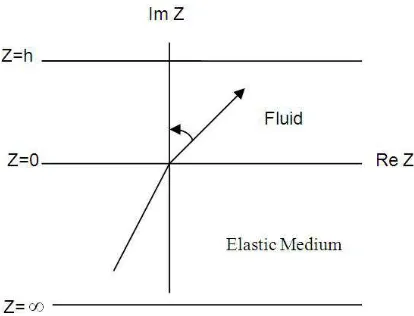
where ax, ay, andaz are the unit vectors while l and nare the vector components. Only equation (9) will be considered in this paper since the aim is to study the P-wave only. P-wave vanishes when the depth go infinity as illustrated in figure 1. Thus, the amended equation (9) or P-wave on which the amplitude reduces with depth is
uP =A(ax+ηαaz) exp [ik(ct−x−ηαz)], ηα=
r c2
α2 −1. (12)
Figure 1: The P-wave’s incidence and the fluid saturated medium
3
Analytical Discussions
For the displacement parallel to the propagation direction, by means of quantity ηα and amplitude A, equation (12) for x-direction of displacements with amplitude reduces with depth z gives
uP = [A(ax+ηαaz) exp (−ikηαz)] exp [ik(ct−x)], ω1=ηαk. (13)
Here, the quantityηαrefers to the refracted wave velocities that givesω1=ηαk. From wave terminology, the term exp (−ikηαz) exp [ik(ct−x)] in equation (13) potrays the harmonic waves such as diffusive with depth z ifω1= −ηαk is in complex [9]. The diffusive waves are associated with attenuation of the amplitudes with the time due to certain dissipation mechanisms present in the system.
Equation (13) should be polarized to give the real quantities (frequency) equation that reads [10],
uP = [Aηαexp (−ikηαz)] exp [ik(ct−x)]. (14)
Next, the roles of ηα will be shown. For the fluid-saturated medium, there comes the slowness induced by refraction [5, 6]. The envelope velocity at medium surface is different from the wave velocity in the medium after the slowness orVapp6=c. For certain particular cases, the P-wave velocity in the medium is greater than the envelope’s velocity that yields
c > α, α=Vapp, (15)
Here, we propose the relation for another two types of medium conditions such that
c=α, α=Vapp, (16)
c < α, α=Vapp. (17)
explain the soluble medium such that the fluid mixes well with the medium to give similar velocity. Yang and Tadanobu [14] and Kahraman [1] show that the high density medium promotes high wave’s velocity. Hence, relation (15) will only be present when the low density fluid is saturated in the insoluble medium; the low density fluid will reshuffle the ray velocity or reduce the P-wave velocity. Eventually, relation (17) is meant for the high density fluid saturated in the insoluble medium.
The detail explanations about the tie between medium’s solubility and the fluid’s density will be discussed next for showing the vital roles played by the relations (15), (16) and (17) especially the displacement’s characteristic.
When condition (17) is applied to the quantityηα in equation (12), a complex solution will be obtained forηαthat reads
ηα→iηα. (18)
This indicates an amendment is required for equation (14) to give (19). Hence, the P-wave’s displacements for three types of mediums are
uP = [Aiηαexp (kηαz)] exp [ik(ct−x)] for c < α, (19)
uP = [Aηαexp (−ikηαz)] exp [ik(ct−x)] for c=α, (20)
uP = [Aηαexp (−ikηαz)] exp [ik(ct−x)] for c > α. (21)
Equations (19), (20) and (21) show that the P-waves propagation inx-direction while the diffusion is inz-direction. For a soluble medium withc=α, equation (20) gives
uP = [Aηα] exp [ik(ct−x)] for ηα= 0. (22)
Indeed, the displacement does not exist for equation (20) if ηα = 0. Consequently, the relation (22) implies that there is no diffraction to be done.
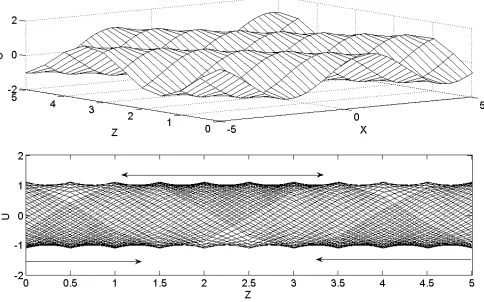
An insoluble medium with displacement (19) is diffusive given that the termω1=kηα is complex [9]. Figure 2 is plotted for the diffusive P-waves with c < α, −5 ≤ x ≤ 5,
k= 1,α= 4,c= 2. High density fluid promotes the diffusive characteristic for propagating P-waves in fluid saturated medium.
An insoluble medium with displacement (21) is non-diffusive given that the termω1= kηα is real [9]. Figure 3 is plotted for the non-diffusive P-waves withc > α, −5 ≤x≤5,
k = 1, α = 2, c = 4. Low density fluid promotes the non-diffusive characteristic for propagating P-waves in fluid saturated medium. However it is shown in Figure 3 that the compression exists when the polarized P-waves propagate in x−z direction. The compression is related to shock wave which is formed by the wave diffraction [15].
4
Conclusion
Figure 2: The diffusive characteristic by P waves propagate in the medium saturated with high density fluid. c < α,−5≤x≤5,k= 1,α= 4,c= 2
Acknowledgement
DLCC is indebted to MOSTI for NSF. Faisal is thankful to the Sudanese government for financial support. This research is partially funded by MOHE FRGS Vote no 78485.
References
[1] S. Kahraman,The correlations between the saturated and dry P-wave velocity of rocks, Ultrasonics, 46 (2007) 341-348, doi:10.1016/j.ultras.2007.05.003.
[2] E.I. Mashinskii,Strain amplitude-dependent attenuation of P and S waves in dry and water-saturated sandstone under confining pressure, Russ. Geol. Geophys., 50 (2009) 734-738, doi:10.1016/j.rgg.2008.12.013.
[3] Z.L. Wang, H.Konietzky, R.F.Shen, Analytical and numerical study of P-wave attenuation in rock shelter layer, Soil Dyn. Earthq. Eng., 30 (2010) 1-7, doi:10.1016/j.soildyn.2009.05.004.
[4] G.K. Midya, G.C. Layek, T.K. De,A note on diffraction of normally incident P-wave by a line crack in micro-polar elastic medium, Int. J. Solids Struct. , 45 (2008) 2706-2722, doi:10.1016/j.ijsolstr.2007.12.020.
[5] C.M. Keith, S. Crampin, Seismic body wave in anisotropic media: reflection and refraction at a plane interface, Geophys. J. R. Astr. Soc., 49 (1977) 181-208, doi:10.1111/j.1365-246x.1977.tb03708.x.
[6] M.D. Sharma, Effect of initial stress on reflection at the free
sur-face of anisotropic medium, J. Earth Syst. Sci., 116 (2007) 537-551,
http://www.springer.com/content/u48511327r02893x/fulltext.pdf.
[7] J.T. Wang, C.H. Zhang, F. Jin,Analytical solutions for dynamic pressure of coupling fluid-porous medium-solid due to SV-wave incidence, Int. J. Numer. Anal. Methods Geomech., 33 (2009) 1467-1484, doi:10.1002/nag.
[8] M.D. Sharma,3-D wave propagation in a general anisotropic poroelastic medium: re-flection and refraction at an interface with fluid, Geophys. J. Int., 157 (2004) 947-958, doi:10.1111/j1365-246x.2004.02226.x.
[9] P.L. Bhatnagar, Nonlinear Waves in One-dimensional Dispersive System, India: Thomson Press, 1977, pp:4-20, ISBN:0-19-853531-7.
[10] J.A. Pujol,Elastic Wave Propagation and Generation in Seismology, United Kingdom: Cambridge University Press, 2003, pp: 124-125, ISBN:0-521-52046-1.
[11] B. Gang, G.W. Wei, Z.Shan,Numerical solution of the Helmholtz equations with wave numbers, Int. J. Numer. Meth. Engng., 59 (2004) 389-408, doi:10.1002/nme.883.
[13] C. Materazzo, P. Piotti, C. Mantovani, R. Miceli, F. Villani, Atrial fibrillation after non-cardiac surgery: P-wave characteristics and Holter monitoring in risk assessment, Eur. J. Cardio-Thorac. Surg., 31 (2007) 812-816, doi:10.1016/j.ejcts.2007.02.007.
[14] J. Yang and S. Tadanobu, Influence of water saturation on horizontal and vertical motion at porous soil interface induced by incident SV-wave. Soil Dyn. Earthquake Eng., 19(2000) 339-346, doi: 10.1016/S0267-7261(00)00023-3.