MODELING DYNAMIC ROUTING FOR 3D
SHORTEST PATH ANALYSIS
1
Ivin Amri Musliman
1Alias Abdul Rahman
2Volker Coors
1
Department of Geoinformatics,
Faculty of Geoinformation Science and Engineering,
Universiti Teknologi Malaysia, 81310 UTM Skudai, Johor, Malaysia.
2Department Photogrammetry and Geoinformatics,
Stuttgart University of Applied Science, Schellingstr. 24 70023 Stuttgart, Germany.
ABSTRACT
problem is its ability to handle “multiple heterogeneous modifications”: between updates, the input graph is allowed to be restructured by an arbitrary mixture of edge insertions, edge deletions, and edge-length changes.The chapter is organized in three general parts. The first part discusses the 3D navigation model, dynamic weight and its functional requirements. The second part presents the 3D dynamic network model and elaborates on the possible solution using SSSP routing algorithm and its implementation. Final discussion on recommendations for future research concludes the chapter.
Keywords: Shortest path, dynamic weight, 3D navigation, 3D-GIS.
1.0 INTRODUCTION
necessary at each junction etc... A slope road with no junction still can be modeled with two nodes and one arc for routing purposes even if it is long and has a lot of serpentines as usual in the mountains but this is the geometry part of the network.
Before continuing, let us describe some notations and define the basic shortest path problem. A network is a graph, G = (V, E) consisting of set of nodes (vertex) V, with the collection of network nodes g = |V|; g = |V1, V2, V3,...Vn| and a spanning set of directed edges E with h = |E|; h = |(V1, V2), (V2, V3), ..., (Vn, Vn)|. Each edge is represented as a pair of nodes, from node i to node j, denoted as (i, j). Each edge (i, j) has a weight, associated with a numerical value, Wij, which represents the distance or cost of the edge (i.e. Wij : 5). In this chapter, we assume that two-directional travel between a pair of nodes i and j is represented by two different directed edges (i, j) and (j, i). Given a network G = (V, E) with known edge weight (distance) Wij for each edge (i, j) subset to E, the shortest path problem is to find the shortest distance path from a source node s to a specific node in the node set V. This is a simple way of finding shortest path in a network, with a static node(s). There are some cases where behavior (i.e. location, weight & related surrounding attributes) of one or more nodes are dynamically change due to unforeseen events in the future, either along or surround the route to the destination.
Currently, research efforts have been initiated by researchers to introduce concepts for routing in 3D-GIS (Ivin et al., 2006 and Zhu et al., 2006) and even for evacuation strategies (Shi and Zlatanova 2005) with several types of developments and approaches. Most of the discussed researches were based on transportation data model (Zhu et al., 2006; Liu et al., 2005; Fischer, 2004) and others are focusing on disaster and emergency management (Shi and Zlatanova, 2005; Zlatanova et al., 2005; Zlatanova and Holweg, 2004). What is missing is the mapping of the real world or a 3D model to the weights or costs of an edge in a network graph.
2.0 3D NAVIGATION DATA MODEL
(NavTech), GIS-T Enterprise (Dueker and Butler, 1997), and lane-based data model (Fohl et al., 1996).
To improve current data models and construct new data models/standards, studying the concept and logic model is the base. GDF, which became an ISO standard in early 2004, is more a common concept and logic model of road networks and road related information for navigation service. And its physical model can act as exchangeable format for navigation data. However, SDAL are more physical data models. The concept and logic data model study based on GDF is meaningful.
Graph data structure allows an edge to connect to other edges only at its end points. Fohl et al. (1996) suggested a way to adapt the lane-based network to work with the existing routing algorithms by representing a lane segment with a series of small edges so that lane changing can be made to adjacent lanes at any vertex along the series.
2.1 Concept of Dynamic Weight
In vehicle routing problem, destination node is fixed, whereas the start node would be dynamically located anywhere on the map. For example, call for a taxi; a person calls a taxi company and gives his/her location to the operator. Then the operator will searched and dispatched the nearest taxi to the given location and informed the caller the estimated time of arrival of the taxi. With a dynamic factor such as road traffic taking into account, the assigned taxi might not be able to arrive at the specific location in time. Other available taxi (second nearest) will then be notified, and the process goes on until a taxi reached the caller. Algorithm that will be used for this type of problem will have one-to-many type Therefore this type of case is much easier than the following problem.
While in rescue operation planning, the model of a building can either be an abstraction of a building is represented with polygons in 3D space (Zlatanova et. al 2004) which is likely geometry or topology model, or a logical model, which represents the connections between the rooms. The rooms and important crossings are represented with nodes; the paths are represented as links between nodes. Therefore scenario such as “would the model be able to assign each rescuer to survivor(s) in a rescue operation and evacuation process with known or unknown number of survivor in case of a fire situation?” can be solved.
Detailed discussion about the efficiency analysis of shortest path algorithms can be found in Zhan and Noon’s (1998) research.
Navigating indoors and outdoors virtually need to have 'seamless' continuation between them. By using simulation (Jafari et. al 2003), it may improve the dynamic understanding of navigation. Some information will be temporarily unavailable in some special situation such as poor weather or technical problem, therefore the use of simulation information will provide continuous and dynamic support. Simulation of environment scenarios under different assumptions may minimize the costs and threats with a predicted manner.
3.0 3D DYNAMIC NETWORK MODEL
In short, the overall process of building a 3D dynamic network can be shown briefly in three steps. Firstly, from planar and non-planar networks to 3D networks, the ambiguous situation of under/overpass and network overlay in the 2D graph can be clarified. It improves the abilities of visualization and effective and comprehensive data integration. Secondly, by moving from a static network to a dynamic network, real-time information about the vehicle and other events can be directly integrated into the routing process. Lastly, after optimization, the unnecessary vertices are eliminated and the total number of vertices is greatly reduced, thus improve the ability of rapid response.
3.1 Anticipated Routing Algorithm Implementation
As mentioned before the routing graph might change over time due to specific events. As we will see, the two most important changes are increasing and decreasing the costs of an edge and inserting a new edge into the graph. Other events can be modelled based on these two operations. Inserting a new edge e=(v,w) to a graph can be considered as decreasing the costs c(e) from to a value c. Deleting an edge e=(v,w) is similar to increase the costs of an edge to . Deleting a vertex v can be done by deleting all edges that are incident to v. Inserting a vertex is trivial as long as no edge is connecting it with the rest of the graph. These connecting edges will be inserted using the inserting edge algorithm. Table 1 below described when it is required to delete, insert or modifying an edge or vertex.
Table 1: Description of dynamic events for routing algorithm.
Task Example (Dynamic Events)
Deleting an edge
An edge might be blocked due to a disaster (ceiling collapse in buildings or road accidents) and can not be used any more.
Inserting an edge
In case of fire, more time is taken when rescuer uses ladder to rescue people from first floor, etc...
Modifying costs of an edge
More difficult to take this way out (due to smoke, etc.) or more easy to take this way out due to rescue team appearance.
In order to find the shortest way out of a building in case of an emergency from a given location or in traffic jams, the Single-Sink Shortest Path problem (SSSP) has to be solved for the dynamic graph G. Under the assumption that every edge e=(v,w) in the graph has positive costs c(e)>0, the problem can be solved by Dijkstra algorithm. If the structure of the graph changes due to some event, the whole algorithm has to be run again even if the changes do not have any effect on the result. The Dijkstra algorithm can be considered as batch processing on a given input graph G and sink Vertex s. If the data input is changed, the algorithm as to be run again. In this chapter we propose an incremental approach to deal with the changes of the graph structure. Changes in the graph structure are usually local changes. Once the SSSP problem is solved for the given input (G, v), only a small part of the solution has be recalculated due to the event. This incremental approach is usually much more efficient. For a detailed analysis of complexity of this kind of incremental algorithms can be found in Ramalingam and Reps’s (1996) research.
3.2 Incremental SSSP Algorithm
The input of the SSSP problem is a graph G (V, E), a cost function c: E Æ R+ and a sink vertex v. The shortest distance dist (w) from v for every vertex w V should be computed. Dijkstra algorithm will solve the problem. However, G changes over time as discussed before. We are interest in an incremental algorithm that handles these changes without solving the SSSP problem for the whole graph again.
a vertex could be reached on two different paths with the same costs. In this case, the resulting shortest paths do not build a spanning tree any more but a directed acyclic graph (DAG).
SSSP sink : 0
Vertex 0 1 2 3 4 5 6 7 8
Distance to vertex 0
-- 1000 200 700 1250 2100 950 1050 1850
0
1 2
3
4 6 7
8
5
1000 m 200 m
950 m
850 m 800 m
400 m 350 m
250 m
250 m 500 m
Resulting shortest paths:
3.2.1 Deleting / increasing costs of an edge
Increasing costs c(e) of an edge e=(t,u) or deleting this edge only has an effect to the solution of the SSSP problem if the edge e is part of an existing shortest path, thus e ST. In that case, all nodes that use the modified edge in their shortest path might be affected by this event. These nodes are the successors of node t in ST. Other nodes can not be affected because the costs for e are increasing. To recalculate the shortest paths form the sink to the affected vertices we simplify the graph as follows. All vertices that are not affected by the event will be treated as a single vertex. Each edge e=(x,y) of the affected vertices x
to one vertex y that is not affected will get a new weight: cs’(e)= c(e) + dist(y). The SSSP problem is solved again with this simplified graph. For example;
Delete Edge e=( v0,v1) Affected vertices: v1,v4,v5.
Not affected vertices: v0,v2,v3,v6,v7,v8.
5
0
1 2
3
4 6 7
8
1000 m
950 m
850 m
800 m
250 m
0
1 2
3
4 6 7
8
5
1000 200
950
850 800
400 350
250
250 500
500 Resulting graph:
Simplified graph to be solved:
1 a
4 5
950 m
400 m + dist (v6) = 1350 m
250 m
3.2.2 Inserting / decreasing costs of an edge
Decreasing costs c(e) of an edge e=(t,u) or inserting a new edge. A vertex w is affected by this event if the new edge e enables a shorter path from v to w with distnew(w) < distold(w). The new edge e has to be part of this new shortest path. The length of the new shortest path is given by distnew (w) = dist(t) + c(e) + dist(u,w) where dist(u,w) is the length of the shortest path between u and w.
The algorithm works similar to Dijkstra algorithm. In a batch implementation of Dijkstra algorithm all adjacent vertices vi of a vertexx are adjusted if dist(x) + c(x, vi) < dist(vi) where dist(vi) is the shortest distance so far. In the incremental version of the algorithm if edge e=(t,u) is inserted into G or the costs of the (already existing) edge is decreased, it has to be checked if dist(t) + c(t,u) < dist(u) or dist(u) + c(t,u) < dist(t). If this is the case, the algorithm continues with the affected vertex similar to the batch implementation of Dijkstra algorithm. Otherwise, the inserted edge does not change the shortest paths.
3.3 Implementation of the Incremental SSSP
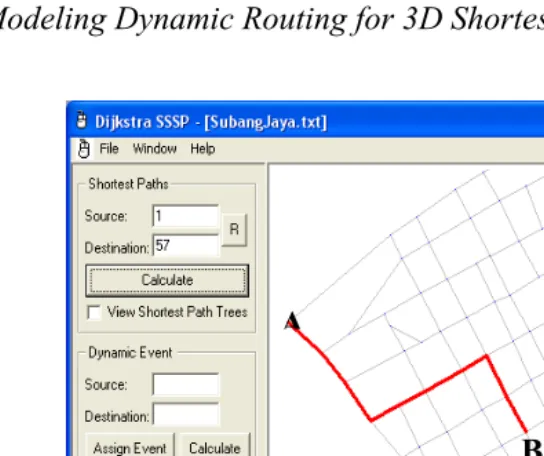
Fig. 2: Shortest path from location A (vertex 1) to B (vertex 57) using the standard Dijkstra algorithm.
A
B
Fig. 3: Shortest path from location A (vertex 1) to B (vertex 57) using Incremental SSSP Dijkstra algorithm after
assigning a dynamic event at vertex 18 (source) A
B
1
4.0 CONCLUSIONS
This chapter suggested a new concept of calculating shortest path routes that supports dynamic changes information. The initial results are shown in section 3.3. Based on the concepts given in this chapter, implementation of the dynamic indoor evacuation and shortest path route calculation algorithm for vehicle will be carried out. Also, in simulating environment scenarios under different assumptions, further works need to be looked at and addressed from 2D to 3D.
REFERENCES
Dueker, K. J., & Butler, J. A. 1997. GIS-T Enterprise Data Model with Suggested Implementation Choices. [Electronic Version] from http://www.upa.pdx.edu/CUS/publications/docs/PR101.pdf
Fischer, M. M. 2004. GIS and Network Analysis. [Electronic Version] from http://www.ersa.org/ersaconfs/ersa03/cdrom/papers/433.pdf Fohl, P., Curtin, K. M., Goodchild, M. F. and Church, R. L., 1996. A
non-planar, lane-based navigable data model for ITS. In M.J. Kraak and M. Molenaar (eds.) Proceedings, Seventh International Symposium on Spatial Data Handling, Delft, August 12-16, pp. 7B.17-7B.29
GDF4.0 Manual. Available at
http://www.ertico.com/en/links/links/gdf_-_geographic_data_files.htm or http://www.4d-technologies.com/writegdf/GDF4_Specs.zip
Goodchild, M.F., 1998. Geographic information systems and disaggregate transportation modeling. Geographical Systems 5(1– 2):19–44
Ivin Amri Musliman, Alias Abdul Rahman and Volker Coors, 2006. 3D Navigation for 3D-GIS – Initial Requirements. Innovations in 3D Geo Information Systems, Springer: pp. 125-134
Jafari, M., Bakhadyrov, I., & Maher, A. 2003. Technological Advances in Evacuation Planning and Emergency Management: Current State of the Art [Electronic Version] from http://www.cait.rutgers.edu/finalreports/EVAC-RU4474.pdf
Liu Yuefeng, Zheng Jianghua, Yan Lei, Xu Yiqin, 2005. Study on the real time navigation data model for dynamic navigation. IGARSS '05 Proceedings. Geoscience and Remote Sensing Symposium,
2005. [Electronic Version] from http://ieeexplore.ieee.org/iel5/10226/32596/01525224.pdf
NavTech. Available at http://www.navteq.com/sdalformat/
Shi Pu and Sisi Zlatanova, 2005. Evacuation Route Calculation of Inner Buildings. Geo-information for Disaster Management, Springer: pp. 1143-1161
Zhan, F. B., & Noon, C. E. 1998. Shortest Path Algorithms: An Evaluation using Real Road Networks. Transportation Science 32(1): 65-73
Zhu Qing, Li Yuan and Tor Yam Khoon, 2006. 3D Dynamic Emergency Routing. GIM-International June 2006, Volume 20, Issue 6. [Electronic Version] from http://www.gim-
international.com/issues/articles/id674-D_Dynamic_Emergency_Routing.html
Zlatanova S., Holweg D., Coors V., 2004. Geometrical and Topological Models for Real-time GIS. Proceedings of UDMS 2004, 27-29 October, Chioggia, Italy.