ABSTRACT
MASON, CHERYL LARAY. An Analysis of Patterns of Computer Mediated Communication Within the Social Studies Student Teaching Experience. (Under the direction of Dr. Peter H. Martorella.)
The purpose of this research has been to examine the computer mediated communication (CMC) among a cohort of middle school social studies student teachers and their university supervisors. CMC was facilitated by desktop videoconferencing and web-based groupware. Desktop videoconference sessions were held weekly using CU-SeeMe software, while, web-based groupware
BIOGRAPHY
Cheryl LaRay Mason was born in Richmond, Virginia. She attended Chesterfield County (Virginia) Public Schools. Ms. Mason earned a
ACKNOWLEDGEMENTS
I extend deepest appreciation to the many people who have inspired, encouraged, and advised me in the preparation of this study. Their support and tremendous cooperation have been invaluable.
Special acknowledgement is given to my committee members -- Dr. John Arnold, Dr. Barbara Parramore, Dr. Hiller Spires, and Dr. Pamela Tyler. Thank each one of you for acting as my teacher, mentor, and friend during my study at North Carolina State University. I hope to show my appreciation by giving to others what each of you have so unselfishly given to me.
A very special word of thanks to Dr. Peter Martorella, chair of my committee. Some years ago, you saw a spark in me and charged me to Òwake the sleeping giant.Ó I have grown from your challenges and learned from your expertise.
Finally, my deepest gratitude to my parents, Charlie and LaRay
Mason, your unconditional love and support has made me who I am today. Thank you.
TABLE OF CONTENTS
Page
LIST OF FIGURES ...vi
1. INTRODUCTION ...1
2. REVIEW OF THE LITERATURE ...13
Teacher Education...13
Theoretical Frameworks...13
Field Experience...14
Reflective Teacher...16
Computer Mediated Communication (CMC) ...19
Telecommunications ...19
Media Richness Model...22
CMC and Teacher Education ...26
3. THE PILOT STUDY ...30
The Virtual Seminar ...31
Pilot Study Design ...32
Results...33
Discussion ...38
Conclusions ...40
4. RESEARCH DESIGN ...41
Description of the Study ...42
Participants ...43
Role of Researcher ...47
Data Collection ...49
Data Sources ... 49
Data Analysis ... 51
Validity ... 54
Criteria ... 54
Ethical Electronic Qualitative Research ... 55
5. REPORT OF THE STUDY ...58
Context of the Cohort ...59
Emerging Themes in Communication ...61
School Environment ...62
Need for Support ... 65
Questions About the Future ... 71
Personal Concerns ... 74
Evidence of Reflection ... 76
Use of Technology ... 79
Integrating the Curriculum... 80
Characteristics of Hardware and Software ... 87
6. DISCUSSION, CONCLUSIONS, AND RECOMMENDATIONS ...96
Discussion ... 96
Conclusions...111
Limitations ... 112
Recommendations ... 113
7. LIST OF REFERENCES ...115
8. APPENDICES ... 128
Appendix 1 Software UsersÕ Guides ... 129
List of Figures
CHAPTER I
INTRODUCTION
Background to the Study
Thomas Jefferson introduced his ÒBill for the More General
Diffusion of KnowledgeÓ to the Virginia legislature in 1779. This
legislation declared that the state had the responsibility to inspire an
educated and literate citizenry. ÒIf a nation expects to be ignorant and free,
in a state of civilization, it expects what never was and will never will beÓ
(Ornstein & Levine, 1984, p.155), Jefferson said.
JeffersonÕs plan called for the development and support of public
schools to educate AmericaÕs citizens. The notion of public schools
assumes that our nation will take all steps necessary to develop and sustain
the most effective education system for all citizens. For generations,
Americans have attempted to heed JeffersonÕs clarion call to provide its
children with the education they deserve.
Over two centuries later, the desire of Jefferson, a forefather of public
education, has gone unheeded. In 1983, A Nation at Risk rung a fire bell
in the night. The frightening proclamation: American schools were
drowning in a Òrising tide of mediocrity.Ó American schools were not
providing its students with the education they needed or deserved.
Countless proposals for educational reform followed the publication of this
report. School reform initiatives focused attention on new resources such
as textbooks, curriculum packages, testing, and television (Goodlad, 1991).
But the proposals fell short. They ignored improving the education
teacher education reform because the school reform movement and the
teacher education reform movement have not been connected. Decades
ago, Sarason (1962) labeled teacher education reform as the Òunstudied
problemÓ, an assertion appropriate to today.
To address teacher education, an essential ingredient of school
reform, the National Commission on Teaching and AmericaÕs Future
(1996) developed a strategy for school reform centered around the
classroom teacher. Emphasizing the key role the teacher plays in school
reform, the CommissionÕs blueprint for change is based on three basic
tenets:
1. What teachers know and can do is the most important influence
on what students learn.
2. Recruiting, preparing, and retaining good teachers is the central
strategy for improving our schools.
3. School reform cannot succeed unless it focuses on creating the
conditions in which teachers can teach, and teach well (p. 6).
Recognizing these principles will help our nation meet the overall
goal of this initiative: to provide all Òstudents what should be their
educational birthright: access to competent, caring, and qualified teachersÓ
(p. vi). This is the education that Thomas Jefferson envisioned in 1779. To
effectively pursue this goal, colleges of education must challenge their
traditional teacher education programs and ÒreinventÓ them.
The National Commission recommended that teacher education
programs structure their curricula around standards. Specific standards to
with colleagues and parents, (b) technological skills for supporting student
learning and professional learning in the Information Age, and (c) strong
emphasis on reflection and inquiry as means to continually evaluate and
improve teaching (p. 76).
This study was designed to examine these three specific standards
through the voices and actions of a six-member middle-school preservice
teacher cohort during the student teaching experiences. Two modes of
computer mediated communication (CMC) were used, desktop
videoconferencing and web-based groupware. CMC provided the
opportunities for the participants to collaborate and develop reflective
teaching skills.
This chapter provides an overview of some of the relevant issues
concerning preservice field experiences and CMC used to generate the
guiding questions for this study. Definitions of terms, a discussion of the
purpose of the study, the research questions that guided the study, and an
outline of the organization of the dissertation follow.
Definition of Terms
Since many of the terms used in this study may be new to the reader,
the definition of terms are placed early in Chapter I.
CU-SeeMe - software that supports the exchange of real time text, audio,
and video over the Internet
Cohort - a group of students that progress through the teacher education
curriculum together
Cooperating Teacher - a classroom teacher who is responsible for the
Desktop Videoconferencing - synchronous communication between
personal computer users over the Internet
Electronic Mail (email) - text that is sent from one computer user to
another over various types of networks
Field Experience - time period that a preservice teacher spends in the
public school classroom either observing or teaching
Ethernet - a local area network which supports connections to the Internet
Internet - the sum of all global connected networks
Modem - a device used to connect a computer to the Internet over the
telephone line
NetForum - software that allows users to read and post text on the World
Wide Web
Preservice Teacher - an individual who is in the process of earning a
teacher licensure
Online - the act of a computer user being connected to a network or
computer system
Supervisor - a university official who observes and evaluates preservice
teachersÕ professional teaching skills over an extended period
Telecommunications - the exchange of information over the Internet;
sometimes referred to as electronic exchanges
Videoconference - Synchronous exchange of audio and video using
telecommunications links
World Wide Web - the sum of thousands of high-powered servers
Teacher Education
For many preservice teachers, student teaching is the culminating
and paramount component in their preparation to teach (Clift, Meng, &
Eggerding, 1994; Schlagal, Trathen, & Blanton, 1994). The goal of the field
experience is to foster within preservice teachers an inquiry orientation
which empowers them to become Òautonomous and analytical
professionals rather than techniciansÓ (Cohn & Gellman, 1988, p.8). The
experience offers the preservice teacher the opportunity to apply theory and
learn practical concepts. Student teachers are Òintegrating the theoretical
frameworks with classroom realities and . . . negotiating between the
differing norms of the university and the school siteÓ (Grossman, 1990, p.
133).
Nonetheless, the time that a preservice teacher is placed in the field
is often a period of disequilibrium and isolation (Fuller, 1969; Goodlad,
1984; Scott & Smith, 1990). There is a well-documented gap between
university-based methods courses and the ability to teach (Cochran-Smith,
1991; Lanier & Little, 1986). A number of researchers have discussed the
inadequacies of the traditional student teaching models (Feiman-Nemser
& Buchman, 1987; Goodlad, 1991; Schlagal, Trathen, & Blanton, 1996;
Zeichner, 1980). They question the weak link between the university and
the school, and encourage colleges of education to rethink their traditional
teacher education programs.
Preservice teachersÕ first experiences in the classroom are often
characterized by stress and self-doubt (Katz & Raths, 1992; Odell, 1986).
teaching experience (Onosko, 1991). The isolation contributes to the gap
between their university methods courses and classroom teaching
experiences. This gap is a barrier which restricts the preservice teacher
from engaging in the kind of discourse among professors, teachers, and
students that is vital to the development of reflective, inquiry-oriented
teachers (Blanton, Thompson, & Zimmerman, 1994).
The conflict between theory and practice leads to the omission of two
of the National CommissionÕs declared standards for teacher education.
The two omitted standards are: (a) preparation for collaboration with
colleagues and parents, (b) a strong emphasis on reflection and inquiry as
means to continually evaluate and improve teaching. KickbuschÕs (1987)
study revealed social studies teachers during their field experience
emphasize the transmission of factual knowledge, rather than critical
thinking skills. The weak links between social studies content and
pedagogical skills are evident, as the student teachers in his study did not
incorporate social issues or multiple perspective-taking of topics into their
teaching.
In 1904, John Dewey (1965) declared that the ultimate intent of
teacher education programs should be to prepare teachers to reflect upon
the relationship between theory and practice. He cautioned against a
technocratic approach to teacher preparation and encouraged reflection
upon the theoretical issues and their practical implications. Dewey (1933)
defined reflection as Òthe active, persistent, and careful consideration of
any belief or supposed form of knowledge in light of the grounds that
of his definition to colleges of education redefines the role of the university
in teacher preparation.
If we accordingly conceive of the education of teachers not simply as
the training of individual classroom performers, but as the development of
a class of intellectuals vital to a free society, we can see more clearly the role
of educational scholarship and theoretical analysis in the process. Building
on this belief, Zeichner (1980, 1983) called for the development of a
reflective teacher. The reflective teacher analyzes classroom situations and
develops as a professional in his or her decision making. The
development of critical reflection in teachers is Òcharacterized by wide
ranging skepticism as well as grounding in logical argument and empirical
data. It entails probing beneath surface appearances and questioning
claims, evidence and proposalsÓ (Cornbleth, 1987, p. 516). Colleges of
education preparing their students in this vein positively shape the lens
through which preservice teachers construct their own teaching methods.
Zeichner (1983) calls for an enculturation process through which
Òcandidates transcend their self-oriented student preoccupations to become
more other-orientedÓ (p.288). To meet this urgent need, Goodlad (1991)
recommends the development and nurturing of cohort groups for teacher
education students.
A cohort group is a cluster of preservice teachers who stay together
throughout the duration of their preservice teaching experience. Knowles,
Cole, and Presswood (1994) have identified three key benefits of cohort
collaboration during the preservice teaching experience: (a) serving as
sense of classroom participation, and (c) creating a safety net as new
methods are tried. Cohort groups that are structured to provide
intellectual guidance and support hold the potential of developing teachers
who are active agents in the learning of others, rather than being passive
learners (Goodlad, 1991).
To best prepare social studies educators for todayÕs children,
Armento (1996) declared that social studies teacher education programs
have a responsibility to Òbuild ongoing and stimulating collaborative
linkages among social studies educatorsÓ (p.497). Intellectual cohort groups
may serve as a step in the right direction for teacher education reform.
Time and geographical obstacles, however, restrict the group membersÕ
interactions once they are in the field. Developments in
telecommunications offer the potential of reducing the impact of these
barriers. Telecommunications allows individuals to communicate with
others in geographically disparate locations.
Computer Mediated Communication (CMC)
Telecommunications are revolutionizing the way we teach and
learn. No longer are we limited by our geography in accessing resources or
individuals. Martorella (1996) declares that the advent of
telecommunications is spawning a significant restructuring of our society:
Our society has undergone fundamental changes in its character and
composition, and social, economic, and political forces already in
motion portend continuing dramatic changes. These ultimately will
affect everything from how we worship to how we conduct our
emerging technologies and they have profound implications for the
nature of schooling and teacher education in the next century (p.35).
New technologies have found their way into many of our schools.
Schrum (1991) argues that telecommunications hold the potential of
restructuring preservice and staff development. CMC can be used to
optimize preservice education by Òenhancing meaningful preservice
experiences and giving teachers knowledge and confidence about using
these tools in their classroomsÓ (p. 42). However, Brooks and Kopp (1990)
report that integration of technology into teacher education programs lags
behind other fields of education. The use of CMC in teacher education
programs is relatively new (Merseth, 1991; Schlagal, Trathen, Blanton,
1996). A majority of these studies focus on the effects of email on the
preservice teacher/university supervisor relationship (Merseth, 1991).
Researchers have discovered that CMC is used primarily as a conduit for
social and emotional support, rather than reflective inquiry (Schlagal,
Trathen, & Blanton, 1996). A review of the literature reveals the most
widely used mode of CMC being used by teacher education programs is
email.
Casey (1997) has found the major benefits of using email during the
student teaching experience to be increased:
(a) reflectivity;
(b) feeling of rapport and support from university supervisor, access
to to their supervisors and university personnel;
(c) team support; and
support through email messages.
Thomas, Clift, and SugimotoÕs (1996) research, however, revealed
that student teachers in the field found email discussions to be a Òcool,
impersonal medium.Ó The student teachers in this study missed the social
presence found in face-to-face interactions and the rapid response they
received from either face-to-face or telephone conversations. According to
the media richness model, new technologies such as video conferencing
may enhance electronic communication. The media richness model (Daft
& Lengel, 1986; Trevino, Daft, & Lengel, 1990) implies that communication
media differ in their ability to facilitate understanding and reduce
ambiguity.
Face-to-face is considered the richest way to communicate (Daft &
Lengel, 1986). It allows timely mutual feedback and the simultaneous
communication of non-verbal gestures. Desk-top video conferencing is less
powerful than face-to-face communications, but has greater information
than the telephone. It supports both verbal and nonverbal language,
feedback is rapid, and natural language is used (Daft & Lengel, 1986).
Fetterman (1996) agrees that these benefits are highly desirable:
Electronic communication is a little more personal and a lot more
effective when you hear the nuances of tone and see nonverbal
language such as gestures and expressions, cues you normally
depend on in face-to-face interactions (p. 23).
Videoconferencing systems, however, are often restricted to those
who can afford elaborate expensive software and infrastructure. The
educators to view them as futuristic. The advent of desk-top
videoconferencing is changing this. Desktop videoconferencing now
permits faculty, students, and practitioners to participate in online
dialogue, enhanced by audio and video (Fetterman, 1996). With relatively
inexpensive software and hardware, they can do this from an
Internet-connected computer in their office, classroom, or home.
Purpose of the Study
The purpose of this study was to examine the online dialogue of a
cohort of six preservice teachers during their field experience. Desktop
videoconferencing and web-based discussion software programs were used
to maximize the electronic dialogue among the participants. A qualitative
design was used for this study in order to gather descriptive data of the
CMC and to conduct an analysis of the participantsÕ patterns of
communication. An interpretation of the dialogues may generate valuable
guidelines for teacher educators as they attempt to meet the standards set
forth by the National Commission on Teaching and AmericaÕs Future.
Research Questions
The following questions were used to guide this study:
1. What were the patterns of CMC among the cohort members?
2. To what extent did CMC facilitate reflective discourse among the
cohort members?
3. What were the patterns of CMC between the members of the
cohort and its supervisor?
4. To what extent did the student teachers use the different forms of
5. To what extent did the intervention of CMC affect the student
teachersÕ perceptions of classroom instruction?
Overview of the Study
This dissertation has been organized according to the format
described below:
Chapter I, Introduction: provides a background to the study,
definition of terms, an overview of the study, the purpose of the study, and
the research questions.
Chapter II, Review of Literature: reports the most relevant research
in the areas of CMC and teacher education.
Chapter III, Pilot Study: describes the pilot study and reports its
findings.
Chapter IV, Research Design: describes the research methodology
and procedures of this study.
Chapter V, Report of the Study: reports the themes/patterns that
emerged from an analysis of the data.
Chapter VI, Discussion and Conclusions: discusses the findings as
they relate to the literature, summarizes the research findings and gives
CHAPTER II
REVIEW OF THE LITERATURE
This review of literature includes relevant and current theory and
research in the fields of teacher education and computer mediated
communication (CMC). The teacher education literature includes a
selected review of the following areas: 1) theoretical frameworks, 2) field
experience, and 3) characteristics of the reflective teacher. The CMC
literature includes a selected review of the following areas: 1)
telecommunications, 2) media richness, and 3) CMC and teacher
education.
Teacher Education
Theoretical Frameworks
Zeichner (1983) has identified four paradigms of teacher education:
behavioristic, personalistic, traditional-craft, and inquiry-oriented. Each of
these approaches seem to share basic ideals. Fundamental differences,
however, exist between each model. The most widely practiced approach
to teacher education is the behavioristic paradigm. The primary concern in
this model is Òfostering the development of skill in an actual performance
of a predetermined taskÓ (Zeichner, 1983, p. 4). Underlying the
behavioristic model is a metaphor of the assembly line. Teachers are
produced by colleges of education with little interest in individual
differences.
The second most influential paradigm is personalistic teacher
education. Psychological maturity is the objective in this model (Fuller,
rather than on teaching others how to grow and develop. ÒSuccess within
the personalistic orientation is measured primarily in terms of effects upon
individuals and not in terms of effects upon social systemsÓ (Zeichner,
1983, p. 5).
The traditional-craft model of teacher education creates novice and
expert roles for the preservice teacher and the teacher educator. This
paradigm has been identified as the ÒmodalÓ approach to teacher education
today because of the traditional student teaching model (Zeichner, 1980).
Novices learn from the experts, much like the apprentices learn from
tradesmen.
Inquiry-oriented teacher education emphasizes the teacher as an
active learner (Zeichner & Teitelbaum, 1982), who can Òhelp initiate and
sustain a process of critical inquiryÓ (Berlak & Berlak, 1981, p. 252).
Zeichner (1983) promotes this paradigm of teacher education, arguing that
Òthe fundamental task of teacher education from this point is to develop
prospective teachersÕ capacities for reflective action and to help examine
the moral, ethical and political issues, as well as the instrumental issues,
that are embedded in their everyday thinking and practiceÓ (p. 7).
Field Experience
The student teaching experience is often cited by new and
experienced teachers as the paramount component of their teacher
education program (Cruikshank & Armaline, 1986; Rust, 1983). The beliefs
about education that student teachers develop during their field experience
are the beliefs that will undergird and shape their actions as teachers
some education reformers to call for added field experiences in teacher
education programs, emphasizing their significance (Berliner, 1985).
Current research, however, prompts us to be cautious. The
transition for many student teachers from the university to the school is
often disjointed and difficult (Applegate, 1986). Two weeks into the field
experience, a majority of preservice teachers abandon the pedagogy studied
at the university and adopt the practices of their cooperating teacher
(Richardson-Koehler, 1988). This may be attributed to the discovery that
classroom realities often differ from those imagined prior to the field
experience ( Clift, Meng, & Eggerding, 1994). It may also be a result of the
isolation they experience. The field experience places preservice teachers in
an unfamiliar environment without the support of their university
supervisor or peers. They are left with limited opportunities to discuss and
reflect on their experiences with someone (Schlagal, Trathen, & Blanton,
1996).
This disconnection restricts discourse that is essential to the
development of reflective teachers (Blanton, Thompson, & Zimmerman,
1994). Mehan (1981) argues that student teachers are denied the
opportunities to participate in reflective practices and professional circles.
Alone, they develop an isolated construction of meaning, which may lead
to professional growth in an idiosyncratic and uncritical manner
(Goldenberg, 1992).
Increasing the quantity of field experiences does not necessarily
increase their quality (McIntyre, Byrd, & Foxx, 1996). Teacher educators,
These experiences should be strange or problematic in order to prompt
reflection and analysis among preservice teachers (OÕLoughlin, 1992). To
insure that these experiences are effective, they should embrace an
inquiry-oriented framework. An inquiry-inquiry-oriented framework, much like
contructivism, respects the individual learnerÕs prior experiences and
encourages the development of reflective thinking (McIntyre, Byrd, &
Foxx, 1996). Further reinforcing the call for meaningful experiences, Exum
(1977) concluded in his research that the time invested in an experience
does not equal a better quality of the experience. Rather, he concluded that
guided reflection did enhance the quality of the experience.
Reflective Teacher
Ginsberg and Clift (1977) define reflection as Òthe systematic and
concerted synthesis of theory and practice - praxisÓ (p. 454 ). Joyce and
Showers (1995, p. 164) believe it to be the crux of educational reform, Òno
change is more needed than the development of social arrangements that
enable educators to work supportively together, help one another reflect on
teaching, and help one another make sensible changes.Ó
Sprinthall and Thies-Sprinthall (1983) argue that too often teacher
education programs do not support the development of reflective teachers:
Apparently the general educational enterprise rarely teaches anyone
how to reflect upon real experience...If preservice or in-service
teachers are asked to keep a journal, the results are usually meager
at best. As a stimulus to growth, teaching how to ask questions, how
to examine experience from a variety of views, and so forth, seem
Cruikshank and MetcalfÕs (1990) research revealed that reflection
produces higher order thinking about teaching. Teacher education
programs which foster reflective thinking provide the novice with
opportunities to use personal experiences as a framework for assessing and
revising existing actions to construct more effective strategies (Schon, 1983).
These programs should integrate Òpersonal knowledge, craft knowledge of
skilled practitioners, and propositional knowledge from classroom research
from the social and behavioral sciencesÓ (Doyle, 1983 , p. 6).
Investigating the links between theory and practice are the crux of
the reflective approach. Rudney and Guillaume (1990) argue that requiring
preservice teachers to participate in reflective activities will lead to their
development as a reflective teacher. It is essential, then, to consider Van
ManenÕs hierarchy of reflectivity in teacher education programs.
Van ManenÕs (1977) first level of reflectivity is concerned with the
technical issues of classroom teaching. The second level calls upon
teachers to compare and contrast their education principles with their
practice. Finally, critical reflection encourages teachers to consider the
moral and social implications of their practice. Gore and Zeichner (1991)
argue that these levels should not be viewed as independent stages.
Teacher education programs should not try to ÒmoveÓ students from one
level to the next. Rather, the methods and technical issues should be
embedded in the critical reflection.
Seminars or discussion groups designed for student teachers during
their field experience have been found to contribute to critical reflective
students can interact in an informal environment conducive to creative
problem solving, relate educational theory to practice, develop insights
into themselves and their student teaching experiencesÓ (Goodman, 1984,
p.9). Thies-Sprinthall and Gerler (1990) found that participation in such a
group void of assessment contributed to the professional development of
teachers. Schunk (1991) argues that self-efficacy is encouraged through peer
support.
Vygotsky (1978) describes dialogue within a community of peers as
essential for the internalization of thought and action. Plato (1961)
declared that discourse was the ultimate mode of teaching. Piaget (1970)
believes the importance of peer discourse to be the cognitive conflict which
emerges. The phenomenon which binds members of a shared discourse
together has been called ÒheteroglossiaÓ (Bakhtin, 1981).
The National Commission on Teaching and AmericaÕs Future (1996,
p. 15) reported that schools are currently structured for failure because
Òteachers are isolated from one another so they cannot share knowledge or
be responsible for overall student learning.Ó Hence, it is critical that
teacher education programs seek measures to build a community of
teachers in which a shared language is spoken, and reflective activities are
practiced.
In summary, teacher education has been found lacking in promoting
reflective practice on the part of novice teachers. However, research
studies about ways to encourage this exists in the computer mediated
Computer Mediated Communication (CMC)
Telecommunications
Schrum and Berenfeld (1997) define telecommunications as the
Òtransfer of information or messages at a distance, using electricity and
electromagnetism.Ó The primary goal of telecommunications is
communication. Electronic communication is a two-way exchange of
information which can be accomplished in a variety of ways. The most
popular modes of telecommunications include: email, world wide web,
and videoconferencing (Schrum & Berenfeld, 1997).
Telecommunications enables learners to access a wide array of
resources and people. Electronic networks have made it possible for
individuals to collaborate locally and globally with experts, teachers, and
students. Traditional methods of teaching and learning are being altered,
additional materials are integrated into our classrooms, and teachers accept
the shift in working relationships. The essential goal of
telecommunications, according to Dede (1991), is Òto widen the bandwidth
of communicationÓ among individuals despite their location.
Over two million global citizens are telecommunications users; and
at least a hundred thousand more log-on for the first time each month
(Stoll, 1996). Jones (1995) draws parallels between the current growth of
the information highway and the 1950Õs development of the interstate
highway system. Both of these projects connect individuals and create a
new sense of community. Jones (1995) contends that ÒCMC, it seems, will
do by way of electronic pathways what cement roads were unable to do,
vehicle and yet not detach us from the rest of the worldÓ (p. 11). We will be
linked in ways that will collapse the walls of school buildings, globally
connecting teachers and students with the world at large. Rheingold (1993)
compares online communities to other forms of community:
ItÕs a bit like a neighborhood pub or coffee shop. ItÕs a little like a
salon, where I can participate in a hundred ongoing conversations
with people who donÕt care what I look like or sound like, but do
care how I think and communicate. (p. 66)
Virtual communities might be real communities, they might be
pseudocommunities, or they might be something entirely new
in the realm of social contracts, but I believe they are in part a
response to the hunger for the community that has followed the
disintegration of traditional communities around the world. (p. 62)
As computers are used less and less for ÒcomputingÓ and more and
more for communicating, we are being called upon to develop new literacy
skills (Fontana, 1997). Weiser (1991) has identified different psychological
functions for CMC and for face-to-face communication. Among these
differences is the void of context and explanation in CMC. As he points
out -- a walk in the woods is not overloading, despite there is more
available information than in any computer system. The void of social
context cues fosters online learning communities.
The collaborative learning that may take place electronically
prompts the development of online learning communities. Online
learning communities may be defined as Òa body of individuals who use
theme or topic to support the ongoing learning experiences of all the
membersÓ (Fontana, 1997). These electronic networks are connecting
students and teachers in a highly interactive fashion. Levin and Thurston
(1996) report the most meaningful result of online learning communities
may be the ÒflowÓ of information between society and our schools.
One of the examples cited by Levin and Thurston with respect to
online communication (1996) is a project that engaged students in
California, Illinois, Japan, Israel, and Mexico to study a local water problem.
Each group of students studied their communityÕs dilemma and tapped
local and global resources to help address it. They shared their problems
with one another and pooled together their resources. The collective effort
helped each group of students to resolve their communityÕs dilemma. In
each case, the students shared information, analyzed it, and specified steps
that local officials had not discovered.
Online learning communities have been found to entrust
participants with greater control and responsibility toward their learning
(Rohfeld & Hiemstra, 1994). Shrum (1993) argues that Òthe world of
electronic communication assumes and demands that people take
initiative for their own learning and growth (p. 193).
Several research studies have looked at the reported increased sense
of responsibility. Rohfeld and Hiemstra (1994) concluded from their
research that participants in an online learning community found the
demands for reflection to be greater as compared to the traditional class
setting. Barrett (1994) argues that communication among participants in
device -- it encourages student to assess their own work firstÓ (p. 120).
Information exchanged via CMC has been found to emphasize the
message content rather than the social or personal characteristics of the
messenger (Dubrovsky, Kiesler, & Sethna, 1991). This communication
shift dubbed the Òequalization phenomenonÓ has been found to promote
collaboration and flatten hierarchies.
To illustrate the differences between conventional face-to-face
conversation with the Òpanoramic open spaces of computer conferencingÓ
Blantern (1993) cites a poem by Philip Larkin:
To put one brick upon another, Add a third, and then a fourth, Leaves no time to wonder whether What one does has any worth.
But to sit with bricks around you While the winds of heaven bawl Weighing what you should or can do Leaves no doubt of it at all. (p. 233)
Media Richness Model
Members of online learning communities may choose from an array
of tools to engage in CMC. These tools include: email, videoconferencing,
and groupware. Selecting which mode of CMC to use should be based on
different factors. One of these factors is media richness.
Media richness is Òthe extent to which media are able to bridge
different frames of reference, make issues less ambiguous, or provide
opportunities for learning in a given time intervalÓ (Daft & Lengel, 1986).
The media richness model (Daft & Lengel, 1986; Daft, Lengel, & Trevino,
understanding and minimize uncertainties. These differences are a
function of a mediumÕs richness. ÒIn a sense, richness pertains to the
learning capacity of a communication (Daft & Lengel, 1986, p. 560).Ó The
richer the media, the more efficient individuals can process equivocal
messages.
Daft and LengelÕs (1986) media richness model is based on four
standards: (1) feedback, (2) multiple cues, (3) language variety, and (4)
personal focus. Feedback is the spontaneous response that encourages
interaction. Multiplicity of cues suggests cues such as voice inflection,
non-verbal language, graphic symbols, and physical presence are significant to
communication. Language variety involves communicating with
language symbols, such as numbers. Personal focus is the perceptions and
sentiment that are essential to effective communication (Daft & Lengel,
1987).
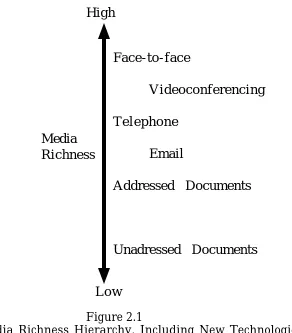
Face-to-face interaction is considered the richest mode of
communication because it permits timely mutual feedback and the
simultaneous communication of non-verbal gestures. Face-to-face allows
one to observe and process smiles, eye-contact, hand gestures, head nods,
and other non-verbal gestures. It also supports high variety natural
language. The telephone is placed second on the media richness
continuum because it does not allow for the communication of non-verbal
behavior. It does, however, support personal communication, feedback is
synchronous, and natural language is used. Addressed documents are
third on the scale in which interaction is limited to written information;
documents are fourth on the scale. They do not permit feedback and
non-verbal language, and do not provide for personal information or natural
language (Daft & Lengel, 1987).
Daft and LengelÕs (1986) media richness scale was developed prior to
the wise-use of telecommunications. The advent of telecommunications
requires us to adjust the media richness model to include new
technologies. For example, email would be placed in between the
telephone and addressed documents because it allows for prompt feedback,
but not for non-verbal gestures (Schmitz & Fulk, 1991). Email is
asynchronous, meaning that information is exchanged over the network
by participants who are not online at the same time. Videoconferencing
would be placed in between face-to-face and telephone. Although some
nonverbal gestures would be restricted, it has the capacity for rapid
feedback, and natural language (Valacich, Paranka, George, & Nunamker,
1975). Figure 2.1 illustrates my interpretation the adjusted media richness
Media Richness
High
Low
Face-to-face
Videoconferencing
Telephone
Addressed Documents
Unadressed Documents
Figure 2.1
Desktop videoconferencing. Videoconferencing involves the
exchange of audio, video, and text over a computer network or the
Internet. That is, one may communicate across a private network or across
the world wide web. Desktop videoconferencing has the advantage that it
may take place from a personal computer connected to a network. This
feature eliminates the need for expensive infrastructure and equipment
required by traditional videoconferencing systems.
CU-SeeMe is one of the many desktop videoconferencing software
products available, and prices vary. For example, a camera/digitizer
package is available from a number of retailers for under $100. One of the
advantages of CU-SeeMe is that it runs over a TCP/IP connection (Sattler,
1995). This is the same type of connection used by most email and world
wide web prgrams. It has the further advantage that it is free software that
may be downloaded from Cornell UniversityÕs web page. Software
versions are available for both Macintosh and Windows computers.
CMC and Teacher Education
The integration of telecommunications into teacher education
programs is in its early stages (Merseth, 1991; Schlagal, Trathen, &
Blanton, 1996). White (1997) cites a U. S. Congress report, stating that only
one in ten recent recent graduates of teacher education programs felt that
they could use CMC for collaborative learning. This is ironic, in that
electronic networks seem to hold the potential of addressing a number of
identified weaknesses of many existing teacher education programs. Lack
of time and support to develop reflective thinking because of student
via different methods of telecommunications.
The National Council for Accreditation of Teacher Education
(NCATE) reports a need for two million new teachers over the next decade
for our public school classrooms (1997). These two million new teachers
will be teaching in classrooms profoundly affected by technology.
Computer to student ratios have declined from 50:1 in 1985 to 20:1 in 1990
to an estimated 9:1 in 1997 (NCATE, 1997). Teachers must have an
understanding of the impact technology is having on classroom
instruction. The NCATE Task force on Technology and Teacher Education
(1997) has declared:
Technology will transform the role of the teacher as thoroughly as
did the introduction of printed textbooks. More than in the past,
teachers must become advisors to student inquirers, helping them
to frame questions for productive investigation, directing them
toward information and interpretive sources, helping them to judge
the quality of the information they obtain, and coaching them in
ways to present their findings effectively to others (p. 5).
LeBaron and Bragg (1994) argue that the gap between teacher
education programs and public school classrooms will become even wider
if preservice teachers are not prepared to use emerging technologies:
The failure of teacher preparation institutions to reform their
curricula in response to an anticipation of changes occurring in
schools may render them irrelevant to the educational
transformations predicted for the coming decade. (p. 5)
education connect preservice teachers in the field with their university
supervisor (Merseth, 1991). In these situations, researchers have
discovered that CMC is used primarily as a conduit for social and
emotional support rather than for professional discussions (Schlagal,
Trethen, and Blanton, 1996). An exception, Schlagal et al. (1996) used email
to link preservice teachers with their university supervisors. The dialogue
was intentionally structured to facilitate the development of joint
construction of meaning. An analysis of the email conversations revealed
an increase in the quality and quantity of contacts between the supervisors
and students.
Teacher education programs are beginning to extend the applications
of CMC. Once limited to online dialogues between student teacher and
university supervisor, links are now evolving to create professional
electronic communities. Member of professional electronic communities
may include, but are not restricted to preservice teachers, supervisors,
cooperating teachers, students, classroom teachers, university faculty
members. TurnerÕs (1993) research conlcuded that students who
conscientiously used email to communicate with faculty and fellow
students develop a greater conceptual understanding of the content.
Listservs sponsored by the National Council for the Social Studies
and National Council of Teachers of English, which connect teachers and
preservice teachers via email, are an example of professional electronic
communities. A listserv is an automatic email program that distributes
email to a list of subscribers. Open UniversityÕs (Leach, 1996) experiment
electronic community of learners. This program, FirstClass, replaced
university-based meetings with electronic conferencing. From the
studentsÕ evaluations of FirstClass, benefits of CMC in teacher education
include:
(1) Support within the course itself: ÔI use FirstClass because itÕs
something related to the course which I can accomplish in 3 -20 minutes
(not normally a useful block of study time).Ó
(2) Study support: ÔI have drawn some relief from finding that
others are in the same boat with regard to overload.Õ
(3) Personal relationships: ÔI like private chat for meeting peers.
Sometimes it is hard to have a strong sense of accomplishment or humor
when youÕre working alone.Õ
(4) Direct teaching: ÔI find direct contact with people like the course
team is very helpful. They have been very supportive.Õ (p. 70).
This review of the literature identified issues related to teacher
education and CMC. In addition, the literature and research support the
need for the integration of CMC into teacher education. The following
pilot study and dissertation study drew from the selected review of the
CHAPTER III
THE PILOT STUDY
Researchers have examined the effects of computer mediated
communication (CMC) and the preservice teacher. The majority of these
studies examine the use of email by student teachers and their supervisors
(Anderson & Lee, 1995; Merseth, 1991; Schlagal, Trathen, & Blanton, 1996;
Schrum & Berenfeld, 1997; Thomas, Clift, and Sugimoto, 1996) . Most
researchers of CMC and the preservice teacher have looked at the type of
electronic messages being exchanged. In these studies, the high volumes of
individual email messages are time consuming to organize and respond to.
The pilot study for this dissertation was an attempt to use the
groupware, NetForum, instead of email as a tool for CMC among
preservice teachers. Groupware is telecommunications software that
supports and encourages collaboration among individuals in
geographically disparate locations. Research on the uses of groupware by
teacher educators is in an Òembryonic stageÓ (Schrum, 1997). The central
focus of this study was to examine the efficiency of NetForumÕs interface in
the facilitation of reflective discourse among preservice teachers.
The pilot study for this dissertation was conducted during the Spring
1997 semester. Twenty-seven students and one instructor participated in
this study . Pseudonyms have been assigned to each of the participants.
The research methodology and the findings from from the pilot study are
presented in this section. They are presented in this section because the
research experiences gained from collection and analysis of the data
The Virtual Seminar
Participants in this study were both undergraduate and graduate
middle school preservice teachers enrolled in a required course, Reading in
the Middle School. There were two sections of the course; both were
taught by the same instructor. Within each section of the course, there
were students in language arts education, social studies education, math
education, and science education. The class met twice a week, for the
duration of the semester. Two class meetings out of the semester were
held in the computer lab to explore methods of integrating
telecommunications in the middle school classroom.
During one of these class meetings, the students and the instructor
were introduced to NetForum. This groupware is world wide web-based
and accessible from any computer with an Internet connection. The
interface of the Web Forum allows participants to view an unlimited
number of topics and replies. The participants were given a guide to using
the groupware and allowed class time to practice posting topics and replies.
The topics and replies were entered by the instructor, the students, and
invited guests. The communication was asynchronous, in that students
did not have to be online at the same time to engage in the CMC.
NetForum has an option to either allow anyone on the Internet to
access the page or to restrict access by requiring a password. This option was
presented to the students and they discussed the consequences of both
options. The students unanimously decided to allow free access to their
page. They wanted the liberty to invite classroom teachers or other
opening themselves to the world and uninvited guests may read their
reflections or enter inappropriate messages. This consequence was worth
the freedom to the students. They believed if they did encounter an
unwelcome guest it would allow them the opportunity to Òpractice what
might really happen in a classroom when middle school students access an
inappropriate web page.Ó
After using the groupware, NetForum, the class members named it
the ÒVirtual Seminar.Ó They chose this nickname because to them, the
NetForum was much like the Paideia seminars they had learned about in
class and experienced. The Virtual Seminar became their Òplace to have a
virtual conversation with one another about issues related to the middle
school and reading.Ó
The instructor discussed with the students how best to evaluate
their participation in the seminar. Together, through online dialogue, the
classes decided that their participation in the virtual seminar should be
included in class points designated for class participation. The instructor
assessed each studentÕs participation in the seminar by the substance and
number of entries posted.
Pilot Study Design
Data for the pilot study consisted of the archived electronic messages,
available to the researcher, transcriptions of classroom discussions, and
individual interviews with participants. The data were examined for
evidence of reflection, peer support, and comprehensive dialogue. The
following criteria guided the analysis: postings had to address a specific
Among the categories of uses were for a student to: ask for advice from
their peers, share an idea, express their concerns , discuss issues related to
their class time, to reflect upon what they experienced during their time in
the field, and to support one another.
Four primary strands emerged from the analysis. Technology talk
included dialogue about studentsÕ uses of the computer and their
reflections on computers and education. Pedagogy talk encompassed
student reflections on specific teaching methods and materials.
Socioemotional talk included studentsÕ personal reflections on their
excitement and fear of becoming a classroom teacher. Housekeeping talk
included queries and comments about studentsÕ class assignments and
responsibilities.
Results
In the early stages of the semester, technology talk dominated the
electronic dialogue. Participants frequently discussed ways that technology
could be integrated into the curriculum. These discussions ranged from
students who were just learning to explore the world wide web and had a
fear of the unknown, ÒThis is my first time using the web and I do not feel
very comfortable yet.Ó Immediately, another student responded, ÒI
understand how you feel. I am still working on getting used to the
computers at school. If you need help, write me here or at my email
address.Ó
The technology talk also included numerous dialogues that served
as information sharers. Students shared web pages that they found helpful,
HyperStudio. If anyone is familiar with HyperStudio, please leave a
message.Ó
As the semester progressed, the virtual seminar served as an
electronic forum for a variety of topics and purposes. Students initiated
new topics on issues such as mainstreaming, classroom management, ESL
students, and Òfinding our place among experienced teachers.Ó In the
following message, Melanie seeks pedagogical advice from her peers,
ÒCurrently IÕm tutoring several ESL students with very limited English
ability. I donÕt know how to communicate with these children. IÕm
interested in hearing your ideas, strategies, etc. and the implications you
think this has on the teaching profession.Ó
Following this message, a number of her peers responded by sharing
their own ideas and experiences. David, an Internet user for just three
weeks, shares:
Hi Melanie: Teaching ESL students can be very rewarding, but fun.
Here is a website that might help:
http://members.aol.com/Jakajk/ESLLessons.html - IÕve had a
chance to browse this site and it looks interesting. I hope itÕs also
helpful. Take Care - David.Ó
Another student posts a message with pedagogical help and peer
support:
Melanie, I kind of know what you might be going through. Last
semester, I had an assignment to be a teacherÕs assistant. I didnÕt
know until my first day that it was an ESL classroom. I have to
suggestion I have is that you have to learn to communicate through
pictures. I found myself doing that a lot. You have to find
something that they like and use pictures to get through to them. I
even asked the Korean student to write my name for me. This
showed her (i guess) that she could teach me something as well.
Another thing that I noticed was that whenever they do have a
problem, they are reluctant to raise their hand. You have to look for
facial expressions . . . Melanie, I know that this is kind of long but I
have so much else to say. I guess IÕll save it for another message. I
hope this is helpful.
Virginia, the class instructor, responded to Melanie later that week:
Did you see the article in the N&O this week? I cut it out but
havenÕt brought it to class yet. Like other students with special
needs, you (as a teacher) will need to adjust your assignments and
expectations for ESL students. LetÕs discuss this. As a tutor, I would
find out what mainstream classes the students are in. Ask them to
bring their homework assignments . . . Good resources to have when
tutoring: anything with lots of pictures, even those funny Bernstein
Bears childrenÕs books . . . Do lots of talking, pointing, identifying.
Ask lots of questions. You could ask to be taught some of their
primary language in return too. Good luck! You are perfect for this
hard job, Melanie. Please keep me updated.
The socioemotional talk weaved its way throughout many of the
messages. The students found strength and encouragement in one another
these strands was sparked by a poem posted by Carl. He recited a piece that
had significance to him as a preservice teacher, The Cold Within by James
Patrick Kinney. Immediately, a number of fellow students identified with
Carl:
Thank you for sharing that beautiful poem with us. ItÕs funny how
something so brief and simple can have such an impact and
promote so much soul-searching and thought. I can honestly say
that after reading the poem I had to think for a minute and examine
myself and my biases . . . it was an excellent choice and a very
appropriate piece to share with prospective educators.
Self-knowledge is something we should constantly strive to increase; and
I canÕt think of a better tool than the poem I just read.
Throughout the semester, the participants found NetForum to be an
effective way to enter housekeeping queries. The instructor began one of
these threads by posting ÒAn Advance Look at the Rubric for the Project.Ó
Her entry listed potential requirements for the class project and asked for
student feedback. The students appreciated not only the clear expectations
for their class project, but felt valued by the solicitation of their opinions.
ÒThank you for getting the rubric to us so soon . . . it sounds so
overwhelming . . . I like AnnÕs idea of working in groups or giving a
specific number of bibliographies.Ó
The online dialogue continued throughout the semester, and the
topics varied from the instructor asking for feedback on the class project
rubric to students sharing quotations about teaching. The participants
and offered support and advice to one another. Issues were viewed from
several perspectives, and a variety of solutions proposed.
The Virtual Seminar appears to have been a valuable experience for
preservice teachers. One indication is the studentsÕ interest in continuing
the dialogue after the initial introduction to the NetForum. Another
indication is the instructorÕs desire to use the NetForum with future classes
of preservice teachers. An analysis of the discourse suggests that the most
important advantage of the CMC may be the peer support. The preservice
teachers found that the ability to Òreach out and touchÓ someone in a
similar situation to be comforting and informative. The comments of two
participants observe the value of CMC:
The Virtual Seminar allows learning and colleague
interaction to continue outside of the regular classroom. One of the
major benefits I would see here, is the essence of continued learning
from and with one another . . . we have decided to take ownership of
our Òcontinued learningÓ. I think thatÕs awesome!
I was wondering if perhaps the website may be continued,
once class is over, especially when some of us may be teaching in
the near future. I think an open NetForum would be useful to
beginning teachers, so they can express concerns get encouragement
and support from people they know. A web forum would be useful
also, because many teachers feel isolated from other adults in the
classroom, and if they had a way of communicating outside of
school, they would feel like they had a support group, if there was
Discussion
Using NetForum as an integral component of this teacher education
course appeared to contribute to the participantsÕ development as reflective
future teachers. The professional exchanges among the students created an
effective online learning community. Students were provided the
opportunity to engage in dialogue with colleagues outside of their course
section, which widened their professional network. They were free to
discuss and debate a wide range of topics that were not addressed during
class time, expanding their opportunities for discourse.
Telecommunications allowed for an increase in quality and quantity of
professional dialogue which is believed to be essential in the development
of reflective teachers. While at the same time, it provided the students
with the opportunity to experience an effective integration of technology
into the classroom that may be helpful to their professional development.
Although participation of all students was encouraged by the
instructor, it was difficult for some students to access the NetForum. All
students had access to the Internet from the campus computer labs;
however, not all students had access to the Internet from home.
Participants who either had an Internet connection at home or who had
time in their schedules to regularly visit the campus computer lab were
more involved with the virtual seminar than other classmates. Students
also found it difficult to access a computer with an Internet connection
from their field placements. Some of the students reported that in their
another teacherÕs classroom or it often was being used by other teachers and
their classes. Others reported there was not an Internet connection from
their school. Yet, others were able to easily access the Internet from their
classroom.
Another challenge of using NetForum was the amount of time the
instructor devoted to each message. At the beginning, she responded to
each and every electronic posting. This was critical in the success of using
NetForum, as it helped to jump start the conversations. The instructor
carefully responded to each message with care and expertise, while also
trying to connect student comments with other studentsÕ messages or
posing a question to entice active dialogue. As the students assumed more
responsibility for interaction and responded to one another in a colleagial
manner, the instructor gradually weaned the students from her responses.
Her participation still required an extensive amount of time as she read
and assessed each entry.
The results of this pilot study demonstrate that NetForum is a more
timely mode of telecommunications than email for this sort of discourse.
Listservs or distribution lists of this nature often require the users to
exhaust an excessive amount of time opening and responding to
numerous single email messages. NetForum threads topics and their
replies, along with the times and dates they were entered. This
organization feature of the software allows the user to more easily follow a
thread of conversation or to join a conversation at a timely point. This
attribute not only conserves the time of all participants, but also helps to
Conclusions
The investigation reported here demonstrates a potentially effective
use of technology in preservice teacher education. According to the
students, their participation in the virtual seminar not only enriched their
preservice experience, but also gave them a new confidence about
integrating technology into the classroom. NetForum provided a
friendly interface for the participants. The participants classified it as
user-friendly because it was easy to navigate through the threads of
conversations and easy to read and post messages. The contribution of
CMC in teacher education is only beginning to be considered as teacher
educators take advantage of the unlimited opportunities available through
advances in telecommunications.
This pilot study addressed issues related to CMC and the preservice
teachersÕ field experience. In addition, it underscored the importance and
complexity of utilizing emerging technologies to develop inquiry-oriented
teachers. Therefore, an investigation of their online dialogues seems
merited. The next chapter describes the research design for this
CHAPTER IV
RESEARCH DESIGN
This qualitative case study examined a large collection of data to
tell the story of six student teachers interacting with each other and their
university supervisor through the Internet. Desktop video conferencing
and group-based world wide web software was used to facilitate the
computer mediated communications (CMC). Through their words and
gestures, their story is told. As the storyteller, I designed this study as
Meredith Cherland (1994) framed her book, Private Practices:
I am the person who has chosen the events that comprise the
story. I have arranged them and shadowed them with my
meanings . . . In this way, I have done what every researcher and
storyteller does: I have seen people and events in the light of my
own belief systems, experiences, and discourse, and I have told what
I hope is a compelling and authentic story that is consistent with
what I believe about the world. (p. 2)
Saveyne and Robinson (1996) define qualitative research as Òresearch
devoted to developing an understanding of human systemsÓ (p. 1172). The
aim of this descriptive study was to capture a variety of online interactions
among the participants. Sherry Turkle (1988) argues that it is essential to
conduct descriptive research to best understand the ways in which Òthe
computer can be a partner in a great diversity of relationshipsÓ (p. 57). The
intent of this report is to show that the student teachersÕ stories reveal rich
and descriptive dialogue that is trustworthy and generalizable.
studies: historical, organizational, and life history. This study involved
two of these categories. It is historical because it includes data for the
duration of the preservice teachersÕ entire field experience. It is
organizational because I have studied and interpreted the preservice
teachersÕ patterns of computer mediated communication (CMC).
A miscellany of purposes and audiences propel educational research.
We can classify the research into one of two types: basic or applied
(Bogdan & Biklin, 1992). Basic researchÕs intent is to extend our general
knowledge base. The purpose of applied research is to generate practical
implications from investigations in the real world. This study assumes the
purpose of applied research, in a pedagogical sense. Bogdan and Biklin
(1992) characterize the pedagogical researcher as one who may use research
to be a more effective practitioner. This person uses qualitative research to
document immediate changes in an existing program. The beneficiaries of
change are the immediate participants. In this study, the cohort of middle
school preservice teachers were the beneficiaries. The analysis of their
stories hold the potential of translating results into practical changes for
teacher education.
Description of the Study
The informants in this study, a cohort of middle grades social
studies preservice teachers, enrolled in a Òprofessional semesterÓ during
which they participated in a methods course followed by the school
placement. The student teachers engaged in online dialogue periodically
throughout their eight week student teaching experience with the intent of