The Integration Of Multimedia Elements In Classroom Teaching Among TESL Teacher-Trainees
Fatimah Puteh & Siti Shuhaida Shukor Fakulti Pendidikan,
Universiti Teknologi Malaysia
Abstract : The integration of multimedia in classroom teaching has brought education into one step higher from the traditional technique or better known as “chalk and talk” teaching method to a more interactive and interesting teaching and learning process. The aim of this study is to investigate the extent to which multimedia is incorporated in classroom teaching among TESL teacher-trainees during the practical teaching. A total of 50 respondents consisting of third and fourth year TESL teacher-trainees from Universiti Teknologi Malaysia participated. This study also aims to find out whether or not the TESL teacher-trainees integrate multimedia in classroom teaching and if they do, the study aims to identify the multimedia elements they frequently use and if not, the study wants to find out the reasons for not integrating multimedia in their classroom teaching. Based on the result, it was reported that even among those who integrate multimedia, there are limitations to incorporate it in classroom teaching and this study has identified these limitations. Besides that, the benefits resulting from the integration of multimedia have also been identified. The result of the data analysis revealed four major findings namely the forms of multimedia incorporated in classroom teaching by TESL teacher-trainees, the benefits of the integrating multimedia in the classroom, the limitations, as well as the reasons for not integrating multimedia in classroom teaching during the practical teaching. Based on the findings, several conclusions and recommendations are drawn in order to improve the incorporation of multimedia in classroom teaching.
Keywords : integration of multimedia elements, teacher-trainees
Introduction
In the 21st century, it is not an easy task to implement the use of technology in education as an additional tool to further enhance language learning and competency as well as to equip students with a critical skill. In addition, the preparation for globalization, information and communication revolution in developing country is also another example of challenge faced by the society and government in our education system. High technology gadgets such as computer and multimedia have been the example of beneficial instruments in education system all over the world. However, in Malaysia, the use of computers and multimedia is still in its infancy stage in the education system due to the limited infrastructure as well as the high cost of access. Malaysia lags far behind businesses in using tools like computers and the Internet in their daily work. The schools have long operated with fairly impoverished learning materials. The primary source of information during that time is only textbooks, and the teacher’s knowledge of the subject matter. Textbooks play an important role during that time albeit it often provides outdated information. Moreover, teacher is considered as the only source who can impart the content of the knowledge to students. This shows that our country is left far behind from other developing country.
before possible. Multimedia technologies as well as the Internet come together in the World Wide Web. These technologies provide easy access almost to everything. For instance, the assistive technologies empower students with disabilities, allowing them to contribute in ways never before possible. This clearly shows that students can benefit when the technology is used intelligently to provide meaningful content and powerful tools for learning.
Statement of Problems
Teachers today are spoilt for choice in terms of the tools either conventionally or unconventionally that can be integrated easily into the classroom. They have been pampered so much with the traditional teaching tools such as books, paper, and pencils until they are reluctant to put their effort in order to make use of the more current and affective technology particularly multimedia into their classroom teaching. As the expansion of the technology advances, it is supposedly more feasible to integrate multimedia directly into the classroom teaching.
Theoretically, there is no reason for teachers not to incorporate multimedia into their teaching. However, there are some problems that arise which lead to the inability to integrate the multimedia into the classroom. Regardless of the variety of the tools available, teacher trainees prefer to use the traditional method in their classroom teaching instead of using multimedia resources. Albeit they have been taught the computer knowledge and skills, due to certain problems such as time consuming, they are less enthusiastic to integrate multimedia into their classroom. Most of them are not aware of the importance of integrating multimedia into their classroom teaching as they are contented with just using the conventional ways of teaching.
Objectives of the Research
Objectives of this research are:-
i. To investigate the form(s) of multimedia incorporated in classroom teaching by TESL teacher-trainees.
ii. To determine the benefit(s) of integrating multimedia in classroom teaching. iii. To identify the limitation(s) of integrating multimedia in classroom teaching. iv. To identify the reason(s) of not integrating multimedia in classroom teaching.
Significance of this Study
There are some significant elements of this research due to the integration of multimedia into classroom teaching. Firstly, this research will be able to contribute to the teaching world because TESL teacher-trainees have to accept the fact that teaching is no longer confined to the four walls of their classrooms or even the resource centres such as the library and media rooms. They are facing the reality that the education field has gone beyond their imagination whereby they can get the information only at their finger tips. Malaysian education system has only just begun to explore the potential of information and communication technologies. Thus, this machine that has changed the world is needed in our education system so that the technology will allow limitless learning.
incorporating multimedia into the classroom, it will be able to fulfil students’ learning styles and needs simultaneously.
Through the result of the study, the government can use the data to improve the teacher training programme so that more emphasis can be put on equipping the teacher trainees with the right knowledge of technology, specifically multimedia so that classroom learning will be an interesting and challenging experience for the students.
Research design
This research utilised a quantitative research methodology. The instrument used to collect the data was a questionnaire. A set of questionnaire was developed specifically for this purpose in the questionnaire containing forty-one questions was divided into six sections which are centred on the research questions stated in Chapter 1. Different question-types such as likert-scale and open-ended were used in the questionnaire. The different sections of the questionnaire were: A) Demographic, B) The form(s) of multimedia integrated in classroom teaching, C) The advantage(s) of using multimedia in classroom teaching, D) The limitation(s) of integrating multimedia in classroom teaching, E) Suggestion(s) for better incorporation of multimedia in classroom teaching and F) Reason(s) for not integrating multimedia in classroom teaching. The questionnaire was piloted to a group of 5 students in order to assess its validity before distributing it to the respondents.
Respondents of the Study
The respondents for this study were 50 TESL teacher-trainees from Universiti Teknologi Malaysia, Skudai consisting of 25 respondents from the third year students and another 25 from the fourth year students. These respondents were chosen randomly. They were chosen because they have undergone 13 weeks of practical teaching in schools and have IT as their minor in the university.
Research Instrument
The instrument used in this research was a set of questionnaire. Nunan (1992) says that through questionnaire, it is able to “yield responses which can readily be quantified and analysed”. Questionnaire is very cost effective when compared with other methods namely interviews, telephone or face to face surveys and observation. Questionnaire reduces bias whereby respondents will not be influenced by the researcher’s own opinion in answering questions in a certain manner. This is because there are no verbal or visual clues to influence the respondent.
Pilot Study
difficulties in interpreting and completing the questionnaire with ease. In addition, by doing this it reduced the possibility of not getting back the 5 questionnaires.
Data Analysis
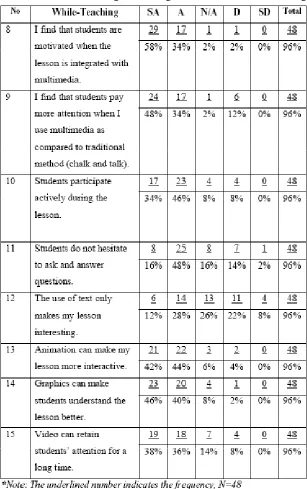
Table 4.3.2: The advantages of using multimedia: while-teaching phase.
to learn motivation and decrease the number of “need” to learn motivation simultaneously. This might be because some of the concepts are difficult to explain and MM can do the job well. Moreover, each student has different level of learning ability. Thus, when teachers use traditional means of teaching, this might contribute to students’ lack of motivation to learn as they have been exposed to similar approach all the time. Hence, the respondents find this problem can be reduced by incorporating multimedia in classroom teaching.
Secondly, 86 percent of the respondents find that the integration of animation can make their lesson more interactive whilst question fourteen also yields similar result whereby the use of graphic can make students understand the lesson better. This might be because animation and graphic are visually appealing. Students’ attention is attracted to these displays and they are more likely to study them for longer periods of time. In addition, by using these two elements too it can also make complex information easier to comprehend. Particularly, the usage of animation and graphic can make complex information visually obvious. Therefore, it requires less cognitive effort in order to understand the lesson instead of using text-based description only.
Thirdly, 82 percent of the respondents agree that students pay more attention when they use multimedia as compared to traditional method of chalk and talk. This is likely because the usage of traditional method is dull and boring as compared to multimedia. In traditional method, a teacher might be the only one who does the talking and explaining the concept to the students. Basically, the teacher controls the instructional process, the content is delivered to the entire class and the teacher tends to emphasise factual knowledge. The students need to listen whereby the learning mode tends to be passive because they play little part in the learning process. The advent of technology of multimedia has rapidly changed the scenario by providing a stimulating environment for learning and retaining the information delivered.
Fourthly, 80 percent of the respondents agree that the students participate in the lesson actively when the teacher integrates multimedia element in classroom teaching. This might be because when the lesson becomes more interesting, the students will pay attention more. Therefore, when the teacher asks students to participate in the activities conducted, they are willing to take part in the discussion by giving response to the teacher’s lesson.
Next, 74 percent of the respondents also agree that video can retain students’ attention for a long time. As mentioned before, the usage of interactive materials in teaching will attract students’ attention successfully. This is probably because, when students watch a video for instance, their curiosity level will increase. They tend to know what is played in the video, hence the students are more likely to pay their attention until the end of the lesson.
Other than that, 64 percent of the respondents agree that students did not hesitate to ask and answer the questions given by the teacher. This might be because when they have fun in learning, their anxiety level will reduce. Thus, the feelings of anxiety or afraid to ask questions will be reduced because of the distraction created through the incorporation of multimedia in the classroom. This is likely because they feel relax and enjoy learning the lesson without worrying about other things.
In sum, most of the respondents have very positive response to the incorporation of multimedia during the while-teaching phase.
Discussion
From the findings, it can be seen that there are many advantages of integrating multimedia in classroom teaching. Firstly, the respondents found that the students are motivated to learn when they incorporate multimedia in the lesson. In addition, through the integration of multimedia elements such as video, animation, graphic, text and audio can make the lesson become more interactive and appealing to the students. This indirectly attracts students’ attention and at the same time aids their comprehension of the lesson. Moreover, students are able to retain the information present because the integration of multimedia will activate and stimulate the memory process. Besides, the respondents also found that the students participated actively in the classroom as the multimedia activities reduce the anxiety level among them. Besides, students also were able to answer the exercises given easily. This proves that the integration of multimedia in classroom teaching aids understanding of a lesson.
Based on the findings, there are some obvious hindrances that held back the TESL teacher-trainees from fully integrating multimedia in their classroom teaching. Firstly, most of the schools where they did the teaching practice did not have computer in the classroom. Therefore, they need to use the multimedia room or language lab in order to integrate multimedia in the lesson. However, although some schools have language lab or multimedia room, sometimes it is insufficient for the use of TESL teacher-trainees. The use of the multimedia room or the language lab is limited due to the reason of both infrastructures were sometimes occupied by the senior teachers.
References
Ahmad, K.,Corbett. G., Rogers, M. & Sussex, R. (1985). Computers, language learning and language teaching. Cambridge University Press.
Ellis, R. (1998). Discourse control and the acquisition-rich classroom. Learners and Language Learning.
Froke, M. (1994). A vision and promise: Distance education at Penn State, Part1-Toward and experience-based definition.
Jamalludin Harun & Zaidatun Tasir (2000). Teknologi Multimedia. Skudai, Johor:Jabatan Multimedia Pendidikan.
Kenning M-M. & Kenning M. J. (1990) Computers and language learning: current theory and practice, New York: Ellis Horwood.
Kleen, B. A., & Shell, L. W. (1994). Multimedia management issues in higher education. Proceedings of the Annual Conference of the IACIS, 107-113.
Lockard, J., Abrams, P.D. & Many, W.A. (1993). Microcomputers for twenty first century educators. 3rd Ed. New York: HarperCollins Publishers Inc.
Nunan, D. (1993). Introducing discourse analysis. London: Penguin.
Panagiotakopoulos, C., & Ioannidis, G. (2002). Assessing children’s understanding of basic time concepts through multimedia software. Computers & Education, 38, 331-349.
Stevens V. (ed.) (1989) "A direction for CALL: from behavioristic to humanistic courseware". Taylor M. & Perez L. (1989) Something to do on Monday, La Jolla, CA: Athelstan.