Approximation Algorithms
for
Open Queueing Networks
with
Blocking
Harry G. Perros
Center for Communications and Signal Processing
Department of Electrical and Computer Engineering
North Carolina State University
September 1989
APPROXIMAnON ALGORITHMS FOR OPEN QlJEUEING NETWORKS WITH BLOCKING}
HarryG. Perros2 Computer.ScienceDepartment
and
Center for Communications andSignalProcessing North CarolinaState University
Raleigh, NC 27658-8206
Networks of queues with blocking have proved usefulinmodelling computer systems, distributed systems, telecommunication systems, and flexible manufacturing systems. A queueing networkwith blocking is a set of arbitrarily linked finite capacity nodes. Blocking arises because ofthelimitations imposed on the size of these nodes. Thatis,the flow ofunits through one node maybemomentarily stoppedifa destination nodehasreached its capacity. Queueing networkswithblocking are,ingeneral, difficult to treat Some exact closed-form results have been reportedintheliterature. However, closed-form solutions are not generally available. Most of the techniques, therefore, that havebeenemployed to analyze queueing networkswithblocking havebeen basedon approximations, numerical techniques, and simulation.Inthis paper, we survey approximation solution techniques for the analysis of open queueing networkswith blocking which consist of morethanNlO nodes.Inparticular, we concentrate on tandem and arbitrary configurations of open queueing networks withblocking. The paper canbe
seen as complementingthetwo surveys by Perms [64] andOnvural[61].
TABLE OF CONTENTS
1. Introduction
1.1 Some basicconcepts 2. Blocking mechanisms
3.Tandemconfigurations: exponential service times 3.1 The Hillierand Boling algorithm
3.2ThePerrosand Altiokalgorithm
3.3 The BrandwajnandJowalgorithm ~3.4TheCa.seau andPujollealgcx'ithm
3.5Otbclrefereoces
4. TandemcoafiguratiODS:CQIlSWltservice times
4.1 NOD-syDChroaiz.edservers 4.1.1 Savmwithoutfailures 4.1.2 Serverswithfailures 4.2 SyDChroaiz.edserverswith failmes
S. TandemCODfiguratiODS: general service times 5.1 The JunaDdPermsalgorithm
S.2TheGUn andMakowskialgorithm S.3 Otherreferences
6. Arbitrarycoafigurations
6.1 Feed-forNUdcoafigurations 6.1.1 Matrix-geometric solution 6.1.2 The PetrosandSnyderalgorithm 6.2 Arbitraryconfigurations
6.2.1 The Jon and Perros algorithm 6.2.2 The Kouvusos and Xeniosalgorithm
6.3 Otherreferences 7. Future researchdirections Rderences
lSupponedin pan byNational ScienceFoundationunder
grantsDCR-85-02540 and CCR-87-02258.
2This paper was written while the author was on a
sabbaticalleaveofabsencefirstatBell NcnhemResearch, ReseIJ'Ch Trianglepart.,NorthCarolina, USA,andthen at the Laboratoire MASI, University of Paris 6, Paris, France.
H. G. Perras received the B.Sc.degreeinMathematics in1970fromAthensUniversity, Greece,theM.Sc.degree
in Operational Researchwith Computing from Leeds University,Englan~ in 1971. and the Ph.D. degreein Operations Research from Trinity College Dublin,Ireland, in1975. From 1976to1982 be was an Assistant Professor intheDepartment of Quantitative Methods, University of
Dlinois at Chicago.In 1979 hespent a sabbaticaltermat INRlA, Reequencourt, France. In 1982 be joined the Department of Computer Science, North Carolina State University,as anAssociateProfessor,andsince1988beis
a Professor.During the academic:year 1988189. he was on a sabbaticalleaveof absence
rust
at DNR.. Research TrianglePark, Nonh Carolina, and subsequently at me1. INTRODUCTION
Networks of queues with blocking haveprovedusefulin modelling computer systems, distributed systems, telecommunication systems, and flexible manufacturing systems. A queueingnetworkwithblockingisaset of arbitrarilylinkedfinite capacitynodes.Blocking arises because of the limitations imposed on the size of these nodes. That is, the flow of units through one node maybemomentarilystoppedifadestination nodebas reached its capacity. Thistypeof blocking is notrelatedtothe notion of blocking in teletraffic, where an arrivingunit isblocked, i.e.lost,ifthe nodeis full.
Queueing networkswithblockingare,in general.difficulttotreat.Someexact closed-form results have been reponed in the literature. However, closed-form solutions are not generally available. Most ofthetechniques, therefore,that areemployedtoanalyze such queueing networks are based on analytic approximations, numerical analysis, and simulation.
In Perros [64] a survey of results was given for two-node queueing networks with blocking. This is the simplest configuration of queueing networks with blocking, and it consists of two nodes linkedin tandem, where the second node is always finite. The first node mayor may not befinite. Thismodelhas been studied under a multiplicity of different assumptions regarding service time distributions, feedbacks, and blocking mechanisms. A systematic presentation of the literature related to closed queueing networks withblocking which consist of two or more nodes is giveninOnvural[61] elsewhereinthisbook.
In this paper, we survey approximation solution techniques for the analysis of open queueing networkswithblocking, which consist of more than two nodes.Inparticular, we concentrate on tandem and arbitrary configurations of open "queueing networks with blocking. The paper can be seen as complementing the two surveys by Perros [64] and Onvural [61] mentioned above. We notethatdue to space limitations, it is impossible to survey all the approximation algorithms that have been proposed, and the presentation of the material has been influenced to some extent by the author's research interests.
underlying Markov Chain of the queueing network under study. We note that, to the best knowledge of the author, no formal comparison between these algorithms has as yet been reponed in the literature. Also, the convergenceanderror analysis of thesealgorithmshave not as yet been formally carried out, Due to space limitations, we do not give specific numerical examples in order to demonstrate the
accuracy
of these approximation algorithms. However, wheneverpossiblewecomment ontheiraccuracy.The paper is organized as follows. Inthe followingsection,we review the most commonly used blocking mechanisms and we discuss some well-known equivalencies between these blocking mechanisms. In section 3t we examine tandem configurations of open queueing networks with blocking assuming exponential service times. In section 4, we examine tandem configurations of open queueing networks with blocking assumingconstantservice times. The case of tandem configurations with general service timesistakenupinsection 5. The analysis of arbitrary configurations is discussed in section 6. Fmally,insection 'l, we remark on possible future research directionsin the area of queueing networks with blocking.
Before we proceedwith the paper, we review some basic concepts thatwillbeusedin the paper.
1.1 Some basic concepts
We define a node to consist of a queue served by a single server.(Ifa node consists of more than oneserver, then itwill bespecificallymentioned.) Wewillmostly deal with finite capacitynodes. We indicate sucha nodebythefamiliar figure shown below, where the circle indicatestheserver,
m
and the rectangular with the finite numberof positions indicates the finite capacityqueue. It
isassumed that there is a positioninfront of the serverthatisoccupied by theunitCUITently
rase.The rate of arrivals observed at pointBwillbereferredtoastheeffective an-ivai rate.
This rate is,of course, the rate of units who succeedinentering the finite node. Finally, because of blocking, the time a unit spends in front of the servermay belonger than its service time. This total time willbereferred to as the
effective service time.
That is, the effective service time of a unit at a node consists of its service plus an additional delay the unitmay suffer due to blocking.One of thedis.tribu~on~ tha~will~usedinthispaperisthe Coxian distribution. Below, we show a Coxian distribution With n phases. Each phase represents an exponential distribution. Aunit first receives anexponential service with mean 1/JJ.l, andthen with probability I-a} it departs or with probability at itproceedstothe second phase where it receives anexponential service with mean 1/J.l2.Then.withprobabilityl-a2 itdepartsor
withprobabilitya2it proceeds to the third phase. The unit proceedsthroughthe phasesin this fashion. A unit that completes thelast phase departs with probability 1. Such a distribution is notated as Cn.In this paper, we will make useof the two-phased Coxian distribution, i.e. C2.This is obtained from the above distributionbesetting n=2. It should benoted that a C2has acoefficient of variation greater than 0.5, andit can beused to approximate distributions with a rational Laplace transform. In general, in a C n
distribution, the unit visits the phasesin a sequential fashion. It is possibly to allow the unitto follow different paths through the phases.Inthis case, the resultingdistribution is commonly referred to asphase-type distribution andit is notated as PHn,where n is the
number of phases.
2. BLOCKING l\IECHANISMS
Various blocking mechanisms have been considered in the literature so far. These mechanisms arose out of different studies of real-life systems. They are distinct types of
Blockinl-after-service: A unit upon service completion at node i attempts to join destinationnodej. Ifnodej atthat momentisfull, theunitisforcedto waitinnodei,in front of serveri, until it enters destination nodej. The server remains blocked for this periodof time and it cannot serveanyother units waiting in the node · This blocking mechanism has been usedtomodel systems such asdisk
110
configurations and production systems (cf. Altiok[2], Petros [62]). Intheliterature,this blocking mechanismisknown bythe names:type 1blocking, transfer blocking. production blocking, and non-immediate blocking.Blocklng-before-servlce: A unitin nodei declares its destination (say nodej) priorto starting service.Ifnodej isfull, the server of nodeibecomes blocked, Le,itcannot serve anyunits. When a departure occurs from destination node
i,
the server of nodeibecomes unblockedandthe unit begins receiving service.This blocking mechanismhasbeen usedto model production systemsandtelecommunicationsystems(cf. Gershwin[23], Brandwajn [15]). Itisknowninthe literaturebythe names: type 2blocking,communicationblocking, immediate blocking, and service blocking.Depending upon whether the blocked unitisallowedtooccupythe positioninfront of the server or nor, one can distinguish two cases.Inthefirstcase, the position infront of the server canbeoccupied by the blocked unit when the server is blocked, whereasin the second case it cannot Let us consider, for instance, two nodesintandem with capacities ml and m2.In thefirst case, when there are m2unitsin the second node (i.e, the second node is full), there canbe at mostMtunitsin thefirst node, whereasinthe second case, there can be at most mj-I unitsinit This distinction maybemeaningful in certain real-life systems.We notethatmost authors typically consider thefirst case.In view of this, unless otherwise specified, in the remaining of this paper we shall assume that in the blocking-before-service mechanism, the blocked unit is allowed to occupy the position in front of the server.
Repetitive-service: A unit upon service completionat nodei attempts to join nodej. If the nodej is full, the unit receives another serviceat node i. This is repeated until the unit completes a service at node iat a moment when nodej is notfulL Thistypeof blocking is knownintheliteraturebythe names:type3 blocking,and rejection blocking.
a service itattempts to enter the same destination node.In the second case, each time the unit completes a service, a destination nodeischosen independently of the destination node chosen the previous time. The fixed destination case has been used in modelling telecommunication systems (cf.Caseauand Pujolle[17]).Therandomdestination case has been usedto model flexible manufacturingsystems(ct.Yao and Buzacott [75]).
To understand how these blocking mechanismswork,let
us
considera
queueing network with blocking consisting of a node (node0)linkedtoM parallel nodes (numbered1toM). Let m;bethe finite capacity of node I, i=O,I,...,M. Units arrive from outside and they join nodeO. Aunit, upon service completion atnode0joins one oftheMdownstream nodes withprobability POi,i=l,2, ...,M,and after service completion it departs from the network. This tree-like configuration, hereafterreferredtoassplit configuration,is shownin figure 2.1. (Note that this split configuration is not relatedtothe forkfJOintypeof configurations). Inthe case of blocking-after-service, a unitinnode 0, upon service completionwillchoose a destination nodej, ISj~. Ifnodej is full, node 0 will get blocked and the unit willremaininfront of the server until the moment when a departure occurs from nodej. Then, the unitwilljoin nodejand the server at node 0will become unblocked. Inthe case of
2.1. A split configuration
blocking-before-service, a unit will rust choose a destination node j, lSj~, and if this node is not full it will begin service.Ifnodej is full, the server at node 0 will become blocked. It will remain blocked until a departure occurs from node j. If the blocking mechanism is repetitive-service, then the unitin node 0will choose a destination nodej,
unit will repeatedly receive service at nodeO. but each time it completes service it will choose a new destination node independently of the destination node chosenlasttime. Finally. we need to clarify further the mechanisms alter-service and blocking-before-service when there are several nodes which have the same destination node.In particular. consider the tree-like configuration, hereafter referred to as a merge configuradon, shown in figure 2.2. This configuration consists of M nodes in parallel (numbered 1 to M) all linked to the same node (node0).Let IDibethe finitecapacity of node it i=O.l...M. There are M independent arrival streams, one for each of the M nodes. A unit in node
it
j=l,2,...,M. upon completion of its service joins node 0 with probability 1, and after it receives service, it departs from the network. (We note that this merge configuration is not relatedtoforkljointype of queues.)Inthe caseofFigure 2.2: A mergeconfiguration
blocking-after-service, when a unit completes its service at theithnode, lSiSJ.'A, at a time that node 0 is full, the unit becomes blocked. At that instance, there maybeother units (from the other M-I nodes) also blocked. Blocked units enter node 0 on sfirst-btocked-first-enter basis. Unblocking of the server at nodeioccurs when the blocked unit finally enters node O. Now, let us consider the case of blocking-before-service. In this case, when node 0 becomes full, all upstream services currentlyin progress are interrupted. These blocked services are resumed when a departure occurs from node O. That is, a unit at node i, lSiSM, may become blocked at any time duringitsserviceifnode 0 becomes full (due to arrivals from the other M-l nodes). During a blocking period, a unit that arrives at an idle node it 1<i<M,cannot get served.
Mechanisms Abbreviation
1. Blocking-after-service bas
2. Blocking-before-service
- positioninfront of blockedservermay beoccupied bbs-po
- positioninfront of blockedservermay notbeoccupied bbs-pno 3.Repetitive-service
- fixed destination rs-fd
- randomdestination rs-rd
Inthe above three blocking mechanisms, aserverbecomesunblockedwhenthe numberof unitsinthe destination nodedropsbelow its maximumcapacity.LaroucheandNeuts[46] considered other extensions whereby unblocking occurs when the number of units in the destination node drops below a pre-defined level, not necessarilyequalto itsmaximum capacity (see also Lavenberg [47] and Altiok and Ranjan [8]). Also, there is a host of different blocking mechanisms associated with product-form solutions (cf. Hordijk and
Van Dijk [29], Yao and Buzacott [75], andLeNy[49~O]).
Comparisons between these three blocking mechanisms have been carried out to a limited
extent by Caseau and Pujolle [17], Altiok and Stidham [3], and Bocharov and Albores
[11]. More recently, Onvural and Perras [59] made extensive comparisons for tandem,
split, and merge configurations assuming exponentially distributed service times. The
objective of these comparisons was to obtain an equivalency between a queueing network
(call it A) with one blocking mechanism and another queueing network (call it B)with a
different blocking mechanism. Queueing network B maybe identical to A, or it may be obtained from A by simply changing the capacity of some or all of the nodes of A. The two
queueing networks are said to be equivalentifthey have the same transition rate matrix. A
summary of the equivalencies obtained by Onvural and Perros [59] for tandem
configurations is giveninthe tables below without proof.
Configuration Finite first node Infinite first node
Tanderr bas
=
bbs-pno bas=bbs-pnobbs-po--rs-fd=rs-rd bbs-po=rs-fd=rs-rd
In general, the notation i=j means that the particular queueing network with blocking mechanismiis equivalent to the same queueing networkwith blocking mechanismj. For tandem configurations,allthe above equivalencies are valid without any adjustments to the buffer capacity of the nodes, except the equivalency bas=bbs-pno.In this case, a tandem configurationwith blocking-alter-service
is
equivalenttoan
identical configurationwith blocking-before-service (and assuming thatthepositioninfront of a blocked server cannotbeoccupied),ifthe buffer capacity of each intermediate node(i.e.eachnodeexceptthefirst one)isincreasedbyone. The same adjustment holds for the equivalencies bas=bbs-po, bas
=n-fd, andbas=rs-rd reported in the case of two-node tandem configurations with infinite first node .
For split configurations we have the following equivalencies valid without any adjustments tothe buffer capacity of the nodes.
Confi tion S lit
Node 0finite bbs- =n-fd
Finally, for merge configurations we have the following equivalencies valid without any adjustments to the buffer capacityof the nodes.
Configuration Nodes 1 to M finite Node 1 to M infinite Mere:e bbs-po=rs-fd=rs-rd bbs-po=bbs-pno=rs-fd=rs-rd
3. TANDEM CONFIGURATIONS: EXPONENTIAL SERVICE TIMES In this section, we examine tandem configurations of queueing networks with blocking withexponentially distributedservice times.
Let us consider a tandem configuration of M nodes as shown in figure 3.1. For presentation purposes the nodes are numbered from 1 to M starting from the leftmost node. AU nodes are assumed tobefinite except thefirst one whichmaybeinfinite. LetJ.li andmi
Units arrive at the first node in a Poisson fashion at the rate A.. Let us assume for the
momentthatthefirstnode isfinite. A unit enters thisqueueifit arrives at atimethat the
Figure 3.1:Anopentandem queueingnetwcxk with blocking
nodeisnot full Otherwise, it gets lost.Let Pi(nubetheprobability thatthereareDiunits in the ith node. Then, the effective arrival rate at thefirstnode is
1.=
A.[l-Pl(mt)].Below, we review four different approximation algorithmsproposedfor the analysis of the
above open tandemconfigurations with blocking, namely the algorithms by Hillier and Boling [28], Perms and Altiok [63], Brandwajn andlow [14,15], and Caseau and Pujolle [17].
3.1 The Hillier and Boling algoritbm
Hillier and Boling [28] were probably thefIrStto report on an approximation algorithm for
tandem configurations. The first node was assumed to bealways saturated (i.e, never empty). Blocking-after-service was assumed. That is, when a unit completes its service at
the ith node, it proceeds to the (i+ l)st node ifthere is space available. However, ifthe (i+1)st node is full at that time, the unit is forced to waitin front of the ith node until a
departure occurs from the (i+l)st node. During this time, the ith server remains blocked
and it cannot give service to any other units that might bewaiting in the node. The algorithm is in the form of an iterative scheme, and it was usedbythe authors to obtain the throughput T of the system.
The approximation algorithm decomposes the system into individual nodes withmodified capacity, service process and arrival process. Each node is then analyzedinisolation. Each
I. The totalarrival rate~at nodei,i=2,3 ....,M,is
A;
={JJ.i-t(l-Pi-l(O» ifniSmi (3.1)I 0 ifDi=mi+1
Obviously, seeing that theflrSt node isnever empty, we have that Pl(O)=O. and therefore. A.2=J.Ll. The arrival process at each
queue
i, i=2,3,...,M, is assumed to bePoisson.b. The mean effective servicerate
Pi
ofthe
ith node, i-l,2r-",M,is~)
where Tis the system's throughput For,i=~ -Ie have P.M =JJ.M, and~ ,-1-PM(O)]=T. The effective service timeateach node isassumed tobeexponentially distributed.
c. The capacity of each node is augmentedby one in order to accommodate the blocked unit, This is necessary due to the nature of the blocking-after-service
mechanism; the(i-l )st server acts as an additional space for the ith node during the
time period that it is blockedbythis node. Therefore, the blocked unit, although it waits in front of the(i-l)st server, isineffectpanof the ith node.
Therefore, each nodei,i=I,2,...)A,is analyzed as anMlM/l/ml+l, i.e,
where
Pi
=Ai/J1i.
Using (3.1) and (3.2) wehave)li-}[l-Pi-l(0)] Pi
=
T/[ I-Pi(O)] ·(3.3)
(3.4)
Using (3.4) into (3.3), we can solve forPi(O)as a fixed-point problem,ifpi-l(O) and T are
LetT(O)beaninitialvalue of the system's throughput Seeing thatPl(O)=O, wecansolve the fixed-point problem involving equations (3.3) and (3.4) in order to obtain P2(O). Proceeding inthisfashion,we cansolveforP3(O), ...,andfinallyforPM(O).UsingPM(O) we can computea new valuefor T,callitT(1). If
m
O) •lit)1<~we stop. Otherwise,we set T(0) • T(l)andrepeattheabovealgorithm.3.2 The Perros and Altiok algorithm
Perms and Altiok[63] proposed an approximation algorithm for the analysis of the queueing network showninfigure 3.1. Thefirstnode maybefiniteorinfinite. Blocking-after-service was assumed. Thealgorithmisbasedon an earlieralgorithm by Altiok[2]. The approximation proceduredecomposes the queueing network intoindividualnodeswith revisedarrivalprocess, service process, and augmented buffer capacity. Theseindividual nodesare then analyzedinisolationstarting fromnodeM and working backwards. Each nodeismodified as follows.
a. Thearrivalprocess at each node is assumedtobePoisson.
b. The service mechanism of each serveri,thatis liable to getting blocked,isenhanced
byappropriatelyaddingexponential phases. Theresultingservice mechanism is, in general, of the phase-type andit represents the regular service aunitreceives plus any possible delays it might undergo due to blocking.
c. The capacity of each node (except node 1) is augmented by one in order to accommodate the blocked unit
Themainresult that canbeobtained using this approximation algorithmis the queue-length probability distribution of each node. The procedure can beused when thefirst node is infiniteorfinite.
Let us assume for a moment that thefirstnode is inflnite. Then, given that thefirstnode is stable, the effectivearrivalrate ~at theithnode,~,is A.Therefore, thearrival process at each node i,~, isassumed tobePoisson with parameter
Ai
such that the effectivearrival rateto this node is equal to ~.Thatis1i
=).[1-Pi(mi+1)].Now, the Mth servercannot getblocked.Therefore,it can be analyzed in isolation as an
fixed-point problem ~M =AJ[l-PM(mM+l)]. The (M-l)st node can get blocked, and therefore, it canbeanalyzed as an M/C2l1/mM-l+1 node with an arrival rateAM-Iobtained as above. TheC2distribution shown below reflects the effective servicetime a unit
receives at the (M-l)st server.Inparticular, a unit starting its service receives first an
exponentially distributed servicewithmeanl~M.l.Thisisequivalentto the unit receiving its service at the (M-I)st server. Upon completion of this service, the unit receives a second exponentially distributed service with mean l~M with probability1M-1.M' This reflects the event that a unit upon completionalit! (M-l)st service finds the Mth node full and therefore, it is forced towaituntil a departure occurs from the Mth server. Obviously,
aM-l.M +aM-I,O= 1. The quantity aM-l.Mis calculated approximately using information relatedtothe queue-lengthdistribution of the Mth node(already analyzed).
Now, let us consider the (M-2)nd node. This can bemodelled as anM/PH3Il/mM-2+1 node,with a service mechanism as shown below.
a~·2,M
blocked (by the Mth node).Hitisblocked, then the unit willremain blocked for aperiod of timeequaltothe residual service time of the Mth server. Obviously, thisperiodof time is exponentially distributed with a mean time of l/J.1M. This is reflected in the phase-type server by allowing the blocking unittojoin thelastphase.Now,ifthe (M-l)st server is busy serving, then the unit willremain blocked until a departure occurs from the (M-I)st server. Thisis reflected in thephase-type serverby allowing the unittojoin the second phase. Inthiscase, theperiodof timeduringwhich the unit will remain blocked is equal to the residual service time at the (M-I)st server (whichhasa mean of l/J.1M-l) plus a possible delay the (M-I)st server might suffer due to the Mth queue being full at the moment of service completionatthe (M-I)st server.
Thus, proceeding in this fashion, the effective service time of each server i can be
characterized. The branching probabilities aij for the ith server are calculated approximately using information related to the queue-length distribution of the(i+l)st queue, whichhas alreadybeen analyzed approximately.Inparticular. let Xibethe steady-state conditional probability that upon service completion at the (i-I)s! node, the ith node is full, i.e. it contains mi units. Let WiG)bethe steady-state probability that the ith serveris in the jth phase of its phase-type effective service time, given that the ith nodeis full. Then, the branching probabilities aij can be approximated by lij=1ti+lWi+lG). where j=i+l,...,M, and
~l. The quantities 1ti+l and Wi+l(j) are obtained using the queue-length probability distribution of the(i+1)st node.
Each queue i is analyzed numerically as an M/PHM-i+l/1/mi+1 queue using the matrix-geometric procedure (see Neuts [56]). It should be mentioned that in ordertoanalyze each
queue i,~2,one needs to know in advance the total input rate
Ai,
rather than the effective arrivalrate~i, where ~i =A. This quantity canbecomputed numerically using the fixed-point expression A.i=
)j(l-Pi(mi+ I)]. That is, assuming a value forA.iwe solve numerically toobtain the queue-length distribution of the ith node. From this. we calculate a new value forAt
and we iterate inthisfashion until the successive values ofAi'Sconverge.particular. let i~O) bean initial estimate. Using the approximation algorithm, the queue-length distribution of thefirstnode
can
becalculated.from whichasecond
value~l)
can
be obtained. We stop.if11F·l~l)1
<
e,
else we setif>.
>:fl)
and we repeat the above procedure.3.3 Tbe Brandwajn and Jaw a110rithm
Brandwajn and Jow [14,15] developed an approximation algorithm for tandem queueing networks assumingblocking-after-serviceex-blocking-before-se!Vice. Thearrival rateatthe first node (assumedtobefinite) is state-dependant, The servicerate at nodei is also state-dependent, The approximation algorithm gives thejointqueue-length disttibution for pain of neighbouringnodes.In thissection, we discuss the approximation algorithm assuming blocking-after-service.
The algorithm is an iterative scheme,in which the nodes of thequeueing networkare considered two bytwo. Theinformationobtainedfrom thesolutionof the pair of nodesi
andi+l isusedforthe pairsi+l, i+2 and i-I, LInparticular,let(ni,
su
be the state ofnodei, where niisthenumber of units in nodeiandSiisthe statusoftheithserver. si=bifthe ith server is blocked, andSi=aotherwise. Letp(ni,sj,Di+l,Si+l)be the joint steady-state probability distributionofthe numberof units innode iand i+ I.Thisjoint distributioncan
beobtained numerically. However,inorder tosetup the rate matrix associated with these two nodes, we need to know how nodei interactswithnodei-I, and node i+l with node i+2.Inparticular, we need toknowthefollowing transition rates:
a. (ni,si,ni+l,si+l)=> (ni,Sitni+l-l,a),the rate atwhich jobsdepart from node i+l. b. (ni,Si,ni+l,a)=>(nitsj,Di+l,b), therate at whichserver i+l completes a jobandthe
jobisblockedbynode i+2.
c. (mi,a,ni+l,si+l) => (mi- 1,a,ni+l+I,Si+l). the rate at which server i completes a service and doesnot trigger an instantaneous arrival to node i(i.e. node iis not blocking server i-I).
d. (mj.a.n.,1.s.;1)=> (mi,a,Di+ 1+1,Si+1), the rate at whichserver i completes a service and triggers an instantaneous arrival to node i (i,e. node i was blocking server i-l).
g. (mitb•mi+l,Si+l) => "(mi,a,mi+l,a), the rate at which a job leaves node i+l and
triggersaninstantaneous arrival tonodei(i.e.nodeiandi-l were blocked).
These transition ratesareapproximatedusingthe conditional probabilities p(ni-l,si-l 'nhs
J
and p(ni+2,si+2'ni+l,Si+l). The first conditional probability p(ni-l,Si-t1ni,Si) means that given we know the state of the ith node, whatisthe state of the (i-l)st node; the second conditional probability p(ni+2,si+2Ini+I,Si+l)means that given we know the state of the (i+ l)st node, what is the stateo~the (i+2)ndnode.These conditional probabilitiesarenot known, but they are approximated by successive iterations. The steps of the iterative procedure are as follows:Step 1: (Initialization). Select aninitialapproximation fer the conditional probabilities p(O)(ni-l,Si-l
'n
its
U
and p(O)(ni+2,Si+2Ini+1.Si+ I), i=2,3,... ,M-l.Step2: (Iteration j). Solve M-l pairs of neighbouring nodes i,i+l for i=l,2,...,M-l. For eachpairi.i+l use p(j-l>(ni-I,Si-llnitSJ andpU-1)(ni+2,Si+2Ini+l,Si+l) and solve the system numerically to obtain p(j)(nitSi,ni+l,si+l). From this compute
p(j)(ni,Si1ni+l,Si+l) and p(j)(ni+l,si+llnitsU and anyother performance measures of interest.
Step3: Ifthe maximum absolute value between two iterates for each node is less than a given value. then convergence has been attained. Otherwise, setjto j+1and return to step 2.
3.4 The Caseau and Pujolle algoritbm
Caseau and Pujolle [17] reponedon an algorithm for obtaining the maximum throughput of the system, assuming that the first node is infinite. Repetitive-service blocking was
assumed. As was mentioned in section 2, in the repetitive-service blocking, one can distinguish two cases depending upon whether the destination remains fixed or not In a
tandem configuration. these two casesareidentical due to the fact that each queue has only one destination.
The algorithm decomposes the queueing network into individual nodeswithrevised arrival and service processes. Each node is then studied in isolation. The arrival and service
a. The arrival processis
assumed
tobePoisson with an effective rate Aor a total input rate AI[I-Pi(mU].b. The service time is assumedto be exponentially distributed with parameterJJ.i[ 1-Pi+l(mi+l»). This parameter was obtained as follows. A unit in node i, upon completion ofits service,attempts toenternodei+1.Ifnodei+1isfull at thattime, the unitwillrepeatitsservice, The probabilitythatthe unit will repeatitsservice is approximated by Pi+l(~i+l), Le, the probability thal node i+l isfull. Therefore, the probability that the unit will repeat its service k times is [1-Pi+l(mi+l)][Pi+l(mi+l)]k-l.Then, the probabilitydensityfmction of the effective servicetimeatnodeiis
00
L
Ek[I-Pi+l(mi+l)][Pi+l (mi+l)]t-l , k=lwhereEkis an Erlang distribution with k phases, each with mean 1/~.The above distribution is equivalent to an exponential distribution with parameter JJ.i[ 1-Pi+l(mi+l)].
GivenA.(the arrival rate at the first node) we can apply the above approximation procedure starting from the last node and working backwards. Each nodei, i=2,...,M, is studied as an rvtIMIl/mit and node 1 as an
MIMII.
Using this algorithm the maximum throughput can beapproximated as corresponding to an input value).*for which ).-=-~1[1-P2(m2)].The above four approximation algorithms are based on the notion of decomposition. In particular, the algorithms by Hillier and Boling, Perros andAltiok,and Caseau and Pujolle aresingle-node decomposition algorithms. This is because the queueing network under study is decomposed into single nodes. The algorithm by Brandwajn and Jow is a
two-node decomposition algorithm seeing that the queueing network is broken-up into
two-node subsystems. In general, the two-two-node decomposition algorithm requires much more cputime,but it has better accuracy (seealsoTakahashi[72]).
3.5 Other references
distributionat each node of the system. The algorithm utilizes arguments similar to those used in the Perros and Altiok [62] algorithm. Mitra and Mitrani [54] introduced atandem configuration motivatedby akanban scheme. The first node was assumedto be saturated. The blocking mechanismisas follows. Servericontinuestoserveunitsduring thetime that node i+l isfull.The servedunitsremaininnodei.Serverigets blocked when the ith node is full and all units have been served. The authors analyzed approximately the queueing network using a single node decomposition, and then combining the isolated nodes through a set of fixed-point equations.
Massey [S3] obtained the exact jointdistribution for a tandem configuration with no intermediate buffers, and no queue in front of the fint server (i.e,mi=l, i=l,2,...,M). Each serverhasthe same servicerate,whichisequaltotherateof arrivalsatthefirstnode. Blocking-before-service was assumed. Bocharov and Rokhas [12] studied a tandem configurationwithno intermediate-buffers, where thefirstnodewasassumedtobeinfinite. The authors obtained the maximum throughput using the faet that theratediagram of the system has a block tri-diagonal rate structure. Also, Bocharov and Spesivov [13] considered a tandem configuration with nointermediate buffers, where thefirstnode has a finite capacity. The distribution of the inter-arrivaltime andthe servicetimeatthefirst node were assumedtobephase-type. The servicetime atthe remainingnodeswasassumedtobe
exponentially distributed. External Poisson arrivals occur at eachintermediatenode. Aunit, upon completion of its service atnodeI,i=2,3,...,M-l,may eitherproceedtonode i+l or it maybefed back to nodei. Ifaunitattemptstoenternodei+l at atime when the nodeis full(i.e, busy), the unit is lost. A recursive algorithm is given with which one can obtain various measures such as the probability the queueing network is empty, and the probability thefirstqueueisempty. Makino[S2]andHunt [30] studied a queueing network consisting of three serverswith no intermediate buffers, assuming that the first node is saturated. They obtained the mean effective service time of the first server. Also, Makino obtained the output disaibution of this queueing network. Finally, a critique of three approximation algorithms was given by Bell [10].
4. TANDEM CONFIGURATIONS: CONSTANT SERVICE TIMES
server provides a constant service time, whose lengthmaybenode-dependentIn the latter case,thequeueing network is synchronized so thatall servers beginand end service at the same time. The duration of the serviceis constant Variation in the service time is introduced by allowing each server to break down with some probability. This type of queueing network arose from
studies
of synchronized assembly productionsystems,
and isa very popular modelinthe area ofproductioa.4.1 Non-syncbronized servers
In this section, we consider the following two cases: a) servers without failures, and b)
servers
withfailores.
4.1.1 Servers without failures
Avi-Itzhak[9] analyzed an open tandemconfigurationwithblocking-alter-service assuming constant service times, i.e. server i provides a constant service time of length Sit i=I,2,...,M. It was also assumed that the servers neverbreakdown. Units arrive at the first node, which is assumed to have an infinite capacity, accordingtoanarbitraryarrival process. Each node is served by a single server, and units are servedin a FIFO manner. Avi-Itzhak establishedthe following two results:
a) The time spent in the systembyany unit is independent oftheorder oftheservers and itisalso independent of mit the finite capacity of nodei(i_I).
b) The total time a unit spendsinthe whole network equals the sum ofall services plus the total time the unit spends waitingin the various queues of the network. This total waiting time is equal to the time the same unit would spend waitingina single server queue witha constant service time equal to the largest constant service time of the tandem configuration (assuming the same arrival processinbothsystems).
4.1.2 Servers with failures
De Koster [40,41,42] consideredatandem configuration, in which unitsarenot modelled separately, butratherthe flowofunitsismodelledas acontinuousvariable.This enables the modelling of the configurationatan aggregate levelA serveriseither operational or broken down. Both operationalandbrokendownperiodsare assumedtobe exponentially distributed,During the operationalperiod,deterministicserviceisprovided.Ifthe server's buffer becomes empty, the server adjustsits speed tothe speed of the upstream server.If
the upstream server is down, then the serverisforcedtostop.Ifthe downstreambuffer is full, the server either adjustsits speedto the downstreamserver'sspeed,oritstops. The tandem configuration is decomposedinto subsystems, each consisting of two successive servers and the intermediate buffer. Each subsystem is analyzed using differential equations. Wesfreid [76] also used differential equations to analyze a similar tandem configuration consisting ofthree nodes. A continuousflow model
was
analyzedby Dallery, David, and Xie [20]. Also,in the same paper, the interested readermay find a good introduction on this model. Finally, we note that this model was first analyzed by Sevast'yanov [67].4.2 Synchronized servers with failures
Let us consider a tandem configuration assumingthat thefirst nodeissaturated, that is, there is always at least one unit waiting tobeserved. Each server provides a constant service time. This time is the same for all servers, and it is taken as the unit time. All servers are synchronized, that is theyallbegin and end service at the same time. Thus,if
we assume for a moment that the servers never break down, then therewill beno units waitinginqueues 2 throughM. Variabilityinthe service is introduced by allowing a server to break down. In particular, server it i=l,2,...,M, breaks down during a unit time with probabilityPi.The timeto failisthus distributed geometticallywitha mean timetofail of
I/pi. Server i ~.} repaired during a unit time with probability Ii. The time to repair is therefore also geomeaically distributedwitha mean time to repair of 1/ri. Blocking-before-service is assumed. That is,ifthe node i is full, serveri-t gets blocked.
only break down during the time it is busyserving.Anidle or blocked server never fails. A unit in service is not lostifduring its service theserver breaksdown. By convention,
repairs andfailuresoccurat the beginningofaunit time, andadeparture (or anarrival) from (to) a node takes place at theend of a unit time. Each server is completely characterizedbyitsbreakdown and repairprobabilities.
The approximation algorithm decomposes the queueing network into subsystems, each consisting of two successive servers and the queue in-between. Thus, subsystem i, i=2,3,...,M,comprises of queue i and servers i-landi,as showninfigure 4.1. The
Figure 4.1: A two-server subsystem
characteristics of each of these two servers (i.e. the breakdown and repair probabilities) are modified, so that the first server reflects the behaviour of the upstream part of the queueing network
and
the second server reflects the behaviour of the downstreampanof the queueing network. Thus, subsystemicanbeusedto approximate the behaviour of node i. The first and second server of the ith subsystem, are characterized using information from the (i-l)st and (i+l)st subsystem respectively. Each subsystem is solved exactly using results from Gershwin and Schick [22]. The approximation algorithm is an iterative procedure consisting ofthreeloops: Each loop is characterized by the solution of a single non-linear equationinone unknown, and it is solved using the Newton-Raphson method. The algorithm yields the throughputof the network and the mean number of units that wait for service in each queue i, i=2,3,...,M. Dallery, David, and Xie [19] found examples where the algorithm fails to converge. They proposed an alternative way to solve the equations obtained from the decomposition algorithm. The proposed method is computationally efficient, and it was foundexperimentally that it always converged.processed is scrapped with some probability or itiscompleted when the server becomes operational again. Ohmi [58] obtained approximately the throughput of a transfer line assuming a) only one servermaybebroken downatanytime, b) if a serverbreaksdown, the contents of the bufferinfront of itisassumed to beequalto the mean number ofunits in the buffer. Finally, the problem of allocating buffers so as to maximize a performance measure has been studied by Soyster and Toof [69], Soyster, Schmidt, and Rohrer [70], Sbeskin [68], andJafari and Shanthikumar[32].
s.
TANDEM CONFIGURATIONS: GENERAL SERVICE TIMESInthis section, we discuss two approximation algorithms (or tandem configurationswith general service times, namely. the algorithms by Jun and Perros [34], and GilD and Makowski [26].
5.1 The Jun and Perros algorithm
Jun and Perros[34] analyzed an open tandem configurationwithblocking-alter-service, as shown in figure 5.1, where each serverhas a C2 service. All
nodes.
except thefirst one, are assumed tobefinite, The first node maybefinite or infinite. Let mi be the capacity of the ith node, i=1,2,...,M. Also, let (Sit!' Si,2. 9i)bethe parameters of the C2 service distribution of the ith node. where Sij is the service rate at thejth phase of the C2 distribution, j=1,2, and9iis the probability that upon service completion at the first phase the unit will move to the second phase service. The arrival process at the first node is Poisson. The algorithmisbasedon the earlier algorithm by PermsandAltiok [63]\..---v---" ml
... -+
---v---mM
describedabove. That is, the system is decomposed into individual nodes with revised arrival process, service process and augmented capacity. Each node is then analyzed in isolation. Inparticular, the capacity of each decomposed nodeisaugmented by one, the service process is revised to include the additional blocking delays, and the arrival process
isdescribed by aC2disaibution (rather than a Poisson distribution). The algorithm yields the steady-statequeue-length disttibutionof eacb node.Let usassumefor a momentthat the first nodeisinfinite. The algorithm consists of the followingthreesteps.
Step 1: Thisis identical to the algorithm proposedbyPerros and Altiok [63]andAltiok
[2,~" The non-Poissonarrivalprocessateach decomposed nodeI,i22,is approximatedby aF on distribution with parameter
Ai
such that the effective arrivalrate atthis nodeiseq~ ~A..the system's throughput. The algorithm begins with the analysis of theMthnoc!~
anc .roceedsbackwardstoqueueI.Unlikethepredecessonofthisalgorithm,theeffect service time at each node is collapsedtoaC2disttibution. For instance, let us consider ...e (M-l)st node. Upon service completion at node M-I, the unitwill enter node M without getting blocked with probability 1-1tM-l. Otherwise, with probability 1tM.l it willget blocked. The time it spends being blocked is, of course, the remaining servicetimeatnode M at the instant of blocking. When the (M-l)st node gets blocked, the Mth serverisbusy serving a unit and it is either in phase I or phase 2 with probability wM.l and WM.2 respectively.Ifit isinphase 1, the distribution of the remaining service timeisthe service time, i.e, aC2 distribution with parameter(SM.ltS~ew. Ifitisin phase2, the remaining service time is distributed exponentially with l/SM,2. Hence, the effective service timeof the (M-l)st node is described by the phase-typedistribution shown in figure5.2 The
'M-l,l
Figure5.2: The effective service time of~ \1-1)stserver
PM(mwis theprobability that the
node
is full. The probabilityJtM-l is calculated using Linle's relation on the fictitious (I11M+l)stposinoe, Le,The quantity in the square brackets in the above expression approximates the residual service time of the Mth server when the (M-l)st server gets blocked. Now, using the
method of moments, this phase-type distribution isapproximated by a C2 distribution, This simplifies the effective servicetime (without compromising the algorithm'saccuracy, see Perros and Snyder [65]). Node M-I can nowbeanalyzedas anM/C2l1/mM-l+1queue using the matrix-geometric procedure.Inorderto do this, we needtoknowinadvance the overall arrival rate AM-l ratherthanthe effective arrivalrate).. Asinthepredecessorsof this
algorithm, A.M-l canbefound by solving the fixed-point problem AM-l= )J[l-PM-t(I11M-1+1)].
Working backwards we can analyze each node i in isolation as an M/C2l1/mi+l.except node 1whichisanalyzed as anM/C2Ilnode.
Step 2:This step deals with approximating the arrival process of each decomposed node by a C2 distribution, while keeping the effective service process as modifiedinstep 1. As
before, the capacity of each node is augmented by one. The analysis of the network proceeds from node 1to node M, and each node is analyzedisisolation.
Let usfirst consider node 2.Inordertocharacterizeitsarrival process, one needs to know the pdf of the inter-departure time from node 1. This, in general, is difficult to obtain.
•
Instead, the Laplace transform 01(s) of the inter-departure time from node 1 is obtained
assuming that successive effective services are independent of each other. When a unit
departs from node1,either another unit is availableinthe node ready to begin service, or
the node isempty. In the f11'5t case, the time until the next departure from node 1 is
distributed exactly as the effective service time. Inthe second case, the time until the next
departure is the sum of two intervals, the first being the time until the next unit arrives and
where B~(5)istheLaplace transformofthepdfof the effectiveservice timeatnode 1. The above Laplacetransformissetequalto the Laplace tranSform ofthe pdf of the effective inter-arrival time at node2.c;(5).As before,inorderto analyze thisnode, one needsto know the overall arrival process ratherthan the effective arrival process. The Laplace transform0;(5) of the inter-arrival time of the overall anival
process
is given by the following expression:wheref2isthe probability thatan arriving unit finds node 2fulland it islost. Thisisthe probability, thatanarrival seeslIl2+1unitsinthe node. It can be easily expressedinterms of thetimeaverage probabilitiesP2(Q2). Fromthe aboveexpression, thefirst threemoments of the overall arrival processVo~l.Vo2,2. vo2J canbeobtained. Thus, theoverall arrival process can beapproximated by a C2 distribution. Node 2 can now be analyzed as a CJ1C211/m2+1 queue. We note, however, that f2isstill undetermined.Thiscan be obtained asinthe predecessoralgorithmsby solving the fixed-point problem l/vo2,l=).(l-fV- This
guarantees that the throughputisequalto ).
The algorithm proceedsforward, analyzing each nodein the same fashion, until the Mth nc zis analyzed. The expression of the Laplace transform of thepdfof the inter-departure time of node it~2, is slightly more complicated than the one given above, because the arrival process at nodei is a C2 rather than Poisson. Each node is analyzed using an iterative procedure by YaoandBuzacott [74].
The approximation algorithm involves using steps I, 2, and 3, and then testing for convergence. In particular. let p~2)(ni} and p~3)(nu, ni=O,l,....m], bethe queue-length distribution of the ith node obtained in step 2 and 3 respectively. Then, if
I
(2) (3)I
.
~ Pi (nJ -Pi (nJ
<
e,stop. Else, repeat steps 2and3and test for convergence again.The case where the first node is finite istreatedinasimilarway asinthe Perms and Altiok algorithm describedinsection3~Convergence of the effective arrival rate at the first node is testedafterstep 1 and subsequently after step 3.
In general, the approximation algorithm gives results which aresignificantly betterthan those obtained using step 1, i.e. under the assumption that the anival process to each decomposed node is Poisson. The average relative error of the approximation algorithm was observed to be about 5%, whereas the average relative error of step 1 was observedto
beabout 13%. The algorithm was also used to analyze tandem configurations with exponential service times. No significant improvementaver the results obtained using step 1 was observed, when all the service rates were approximatelyequal(balanced services). For,in this case, the coefficient of variation of each effective servicetimewas closeto 1, thus justifying the Poisson assumption. Some improvements, however. were observed for unbalanced cases.
5.2 The
Gun
and Makowski algorithmsubsystems are sufficiently close to each other. The algorithm yields the queue-length distributionateach node.
We now proceed to discuss how the service times of a two-server subsystem are characterized. Consider the ith subsystemconsistingof the(i-l)stserver, the ith server,and the in-between buffer.Inordertobe abletoanalyzethissubsysteminisolation, we needto know whether the ith serverwillgetblockeduponservicecompletion,andhow loogit will remain blocked. This information is obtained from the(i+1)51 subsystem. The servicetime
attheith server is constructed following the same argumeDts u inAltiok [5] (or
IUD
and Perros [34]). For instance, let usconsideratandem configuration where each node is served by a C2 distribution, asintheIUDand Perms algorithmdescribedabove. Then, the ithserver of the ith subsystem has a structure identicaltothe effectiveservicetimeof the ith server inthe Iun and Perros algorithm. The branching probabilities are calculated using information from the (i+l)st subsystem.Now, let us consider the (i-I )stserverof theithsubsystem. Following aservicecompletion at this server, we need to know whether the serverwillbecome idle or not andhowlong it
willstay idle. This informationisobtained from the (i-l)st subsystem.Inparticular, from this subsystem, we can calculate the probabilitythat upondeparturefrom the subsystem, the (i-l)st buffer willbeempty. Furthermore,thisprobability canbe conditioned on the phase of thearrival process, i.e. the phase the (i-2)nd server is when a departure takes place that leaves the (i-l)st buffer empty. Thus, we can construct a phase-type distribution whichwilldepict the time it takes for the next departuretooccur given that the previous departure left the subsystem empty. This phase distribution is used to augment the service of the (i-l )st server in the ith subsystem. We note thatboththe servers of theithsubsystem may becharacterizedby a large phase-type distribution.
5.3 Otber references
Choong and Gershwin [18] proposed an approximation algorithm foranalyzing tandem configurationswithunreliable servers. The methodissimilartothe onebyGershwin [23] for synchronized tandem configurations.For each server,the service time, the timetofail, and the repair time are assumedto beexponentially distributed. The same problem was more recently tackled by Gershwin[25] using the algorithmby Dallery,David, and Xie [19]. Altiok[5]proposed an approximatice algorithm for analyzing tandem configurations
~th phase-type services. The algorithmis similarto the oneby Perms and Altiok[63]. Hildebrand [27] considered a tandem configurationwith saturated first queue, general service times, and blocking-after-service. The author showed formally that the system's throughputisthe reciprocal of the effective servicetimeat the first node. He obtained an expression for itinsome cases. Knot[39]obtained an approximation for the throughput of atandem configuration withsaturated first queue,underavarietyofdifferentservice time distributions. Jassim[33] analyzedapproximately a tandemlikeconfigurationmotivatedby an opendouble loop fault tolerantringnetworkwithfinitestoragecapacities.
Muth [55] considered atandem configurationwith saturated first queue, general service time distributions, and blocking-alter-service. He showed that the throughput of this system remains invariant under reversal of. the queueing network, i.e. when units pass through the networkinthe reverse order beginningwiththe Mth server and ending with server 1.Thiswas shown by treating each positionina queue as a serverwith zero service. Similar results were also obtained by Dattatreya [21]. Also, of interest is the paper by Yamazaki, Kawashima, and Sakasegawa [73].
6. ARBITRARY CONFIGURATIONS
Inthis section, we discuss approximation algorithms developed for the analysis ofarbitrary configurationsofqueueing networkswithblocking.
Takahashi, MiyaharaandHasegawa [71]aDdLabetoulleandPujolle[44]wereprobably the firsttopropose approximation algorithms for queueing networks with blocking, where the
nodesarelinked inanarbitraryfashion..
Takahashi. Miyahara and Hasegawa [71] consideredthecase where each nodeisserved by a singleexponential server.andexternalarrivals occurtoeach nodeina Poisson fashion. Blocking-after-servicewas assumed. Theproblemof deadlockthat may ariseinthis case, as it willbefurther discussedin section 6.2, was not takeninto account explicitly.The approximation algorithmissimilartothe single node decomposition algorithms discussed in the previous sections.Inparticular, for nodei. letUjbe the setofitsupstream nodes. Then, the effectivearrival rate intonodeiis
A.
=L
rji~Jl·Pj(O»
jeUi
where rji ,je Vi, is the probability that a unit upon completion ofitsserviceatnodej will join node i, ~j is the effective service time at the upstream node j, and Pj(O) is the probability that nodej is empty. The totalarrival rate Aiinto node i is calculated using the expression A.i=~[l-Pi(mi)], wherePi(mi) is the probability nodei is full. The effective service time of theithnodel/~i isobtained as follows:
•
-+
=
_1
+L
rikPk(mk)[1
+L
Pjrjk-f=L-]
~
~i ~l
keDi jeUk~j+~i
j;eiinthissecond summationtermis the traffic intensity of the jth node. These equations can be written down for each node. The solutionto the queueing network is obtained by solving the set of equations obtained from all nodes. The algorithm yields for each node the blocking probability and its throughput
Labetoulle and Pujolle [44]analyzedanarbitraryconfiguration with repetitive-service fixed-destination blocking. That is, the unit upon service completion at nodeiattemptstojoin nodej.Ifnodej isfull, the unit receivesanotherserviceatnode i.Thisisrepeateduntil the unit completes a service at nodei at a time when the destination node
i
isnotfull.The authors developed a single node decomposition type of approximation algorithm for exponentially distributed service times. They then extended the algorithmto the case of general distributions.Below, we describe approximation algorithms which are more complex than the above two algorithms, but they have better accuracy. In particular, in the following section, we discuss feed-forward configurations, and in section 6.2, we discuss arbitrary configurations. Funher references are givenin section 6.3.
6.1 Feed-forward configurations
sub-matrices willnotbefinite.The diagonalelements of
Q
aresaietlynegative,andthc off-diagonal elements are non-negative. The stationaryprobabilityvector, ifit exists,is the solution to thesystem xQ=O,xe=1,wherethecolumn vector ehas allelementsequalto one. Let thevector xbepartitioned as followsZ=(y.sl~2,.")' whereyis anNt-vector, and Xlti=1,2,..., are N2-vectors.Also, let A-AO+Al+A2 bethe infinitesimal generator for a finitecontinuousparameter Markovprocess,assumedtobeirreducible. Itsstationary probability vector is denoted by ~t where ~A=O, ~e=l. Then, the following holds (seeNeuts[S6]):The above Markov process is positive recurrent if and only if ~A2e
=
~Aoe. Ifthe Markov process is positive recurrent, then there exists a Don-negative matrix R with spectral radiuslessthanone, such thatXi
=
Xl Ri-l .i >1.The vectors yandXl are uniquelydeterminedby yBt+xIB2 =0 yC+ XI(Al+RA2)
=
0ye+Xl(I-R)-le
=
1.Thematrix Ris theunique non-negative solution, with spectralradius less thanone, of the matrix-quadratic equation
The matrixRcanbe numerically determined as thelimitof the monotonically increasing sequence of maaices {Rn,n>O}
(6.1)
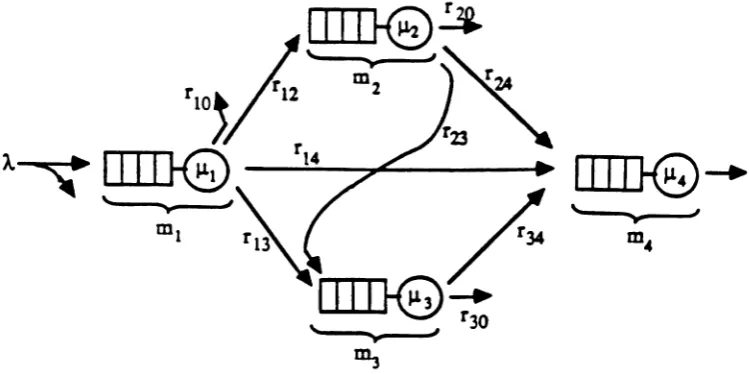
The numerical investigation of a queueing model involves the following three stages:a) generation of the states,b) generation of theratematrix, and c) solving for the stationary probabilityvector. As anexample letus considerthe three-node queuing networkobtained from figure6.1 by removing node 4. The state ofthisnetwork can befully describedby
Figure 6.1: The four-node configuration
6.1.1 Matrix-geometric solution
Let us consider an open feed-forward queueing network with blocking-alter-service, as shown in figure 6.1. All service timesareassumed tobeexponentially distributed and external arrivalsareassumedtooccurinaPoisson fashion. Units in each nodeare served inaFIFOmanner. Externalarrivalsoccuronlytothefirstnode, whose capacityisassumed to be infinite, The capacity ofall the other nodesisfinite. The state vector of thistypeof network keeps track of the number of units at each node and the status of the server (i.e, blocked or serving). Theresultingcontinuous time irreducible Markovprocess has an infinitesimal generator of the following form, after the states are ordered lexicographically.
81
C
82 Al AO
Q
=
A2 Al AOA2 Al AO
procedure has been used to efficiently calculate the exact steady-state probability distribution ofanetworkupto four nodes.
6.1.2 The Perros and Snyder algorithm
Perros and Snyder[65]reported on acomputationallyefficient approximation algorithm for feed-forward open exponential queueing networks with blocking-after-service. The algorithm is based on an earlier procedure due to Alaok and Perros [4]. The class of queueing networks with blocking that can beanalyzed consists of single server queues linked so asto form a feed-forward configuration.
Figure
6.1 shows such a queueing network consisting of four nodes. All service times areassumed to be exponentially distributed and external arrivalsare assumedtooccurinaPoisson fashion. Unitsineach nodeareservedinaFIFO manner.Thecapacityofa nodetowhich external arrivalsoccur canbefinite or infinite. The capacity of all other nodesisfinite. External arrivalsmayoccur to morethanone node, though for simplicity it has been assumedthattheyalloccur
toone particular node. A finite nodemaynot accept both external arrivals and input from other(upstream)nodes.
The algorithm isanextension of the Perros and Altiok algorithm describedinsection3.It decomposes the queueing network into individual nodes, each with a revised arrival process, service process,andcapacity, sothat each nodecanbestudiedinisolation. The parameters of each nodearerevised as follows: a) thearrival process at each nodeis approximated by a Poisson distribution; b) the original service mechanism ofanynode that may become blockedisaugmented by a phase-type distribution which represents the blocking delay aunit may experience, and c) the capacity of eachfinite node is augmented by asmany positions as the number of upstream nodesdirectly linkedto it The phase-type structure representingallblocking delaysaunitmayexperience upon service completionat a node has a very simple structure. It is concise and consistent from node to node, thus making implementation easy.
finite or infinite. The random· variable nit i=l,2,3, indicates the number of unitsinnode
i.
which may varyfrom0tomi.Ifmlisinfinite,thenDtmay take any non-negative integer number. The additional values associated with random variables 02 and n3 are used to
describethevarious blocking states.Inparticular,D2=1J12+ 1 denotes that node 1isblocked bynode2, n3=m3+ 1 denotes that node 1 is blockedbynode 3, n3=D13+2 denotes that node
2is blockedbynode3.n3=m3+3 denotes that nodes 1and2 are blockedbynode 3inthat order, n3=m3+4 denotesthatnodes 2 and 1 are blockedbynode 3 in thatorder. The states canbeeasily generatedinalexicographical orderusing thefollowingsimplealgorithm:
for i
=
0to mldo forj=0tom2+1 dofor k = 0toM3+4do if(iJ.k)is feasible then
begin
states(ind)=(iJ~)
ind=ind+1 end;
The generation of the rate matrix can beaccomplished easilybygoing throughthe list of states and for each state generate all feasible transitions. Infact due to the structure of the rate matrix, it suffices to generate sub-matrices Bl' B2.
C,
AO, At, and A2.The state space andrate matrixfor more thanthree nodes network canbeobtained in asimilarfashion. Ingeneral, however, their calculation is more complex than the one described above. This is mainly due to the increasednumberof nodes and the increased number of
combinationsinwhichnodes can get blocked.
Once the necessarysub-matriceshave been set up,the stationary vectorcanbeobtainedby solving recursively for R using (6.1). Empirically, it was observed (see Onvural, Perros
and Altiok [60]) that the computation of the steady-state probabilities is the major
contributorto the time complexity of this numerical procedure. That is, the solution for R, y andXiti=O,l,... , require much more time than the generation of the states and the rate matrix. Furthermore, the computation of R is the most time consuming. The convergence
of R depends on the number of nodes. the topology of the network, the buffer sizes, and
the traffic congestion level in the network. The first three factors basically determine the
order ofR As the order of R increases, the time it takes R to converge increases as well.A
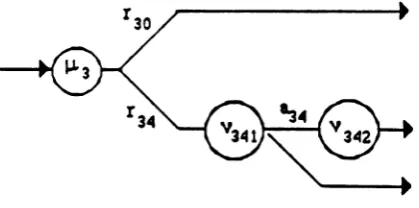
threemoments and then fittin'g a Coxian-2 distribution, with parametersvi41, Vi42, andaj4, i
=
1.2,3.Figure 6.2: A phase-typerepresentation ofthe blocking delayatnode 4.
The thirdnodeis now consideredinisolation. Thecapacity ofnode3is increasedbytwo unitssincebothnodes 1and2 maybeblocked bynode3. The arrival process at node3is assumedtobePoissonwith parameter).3t where13 is determined from the fixed point
problem~3
=
A3[I-p3(m3+2)],with P3(m3+2)a function of A.3,andr3=
).1 (rl3 +r12 r23). The service mechanism at queue3isaugmented. as shown in figure 6.3,bythe Coxian-2 representation of the blocking delay at node4which is experiencedbya unitcompleting service at node 3.has a finite capacity are similartothose mentionedin the Perros and Altiok algorithmin section3.)
Asbefore, let Pi(nubethe probability that there areDiunits (including the oneinservice)at node i, under equilibrium condltionsandlet Jtij(nj} be the conditional probability that upon service completion at
server
i,there are
Djunits innodej.Thealgorithmbeginswiththe analysis of node 4. Because of the network topology, node 4 cannotbecomeblocked. Since nodes 1, 2and3 may sendunits tonode4, the capacity of node 4 isincreasedby 3unitsand node 4 canbeanalyzedas an MJMIl/D14+3 node. The equilibrium queue length distributioncanbeobtained from the classicalMJMIlIN formulae once the overall arrival rate
4,
is known. Assumingthatnode1isstable, therateatwhich units enter node 4 is 4=Al(r14 +r12~+r12rnl14 +r13114). The quantity4 can be obtained by the fixed-point expression 4[1-p4(D14+3)]=4, where P4(ID4+3)is afunction of4.
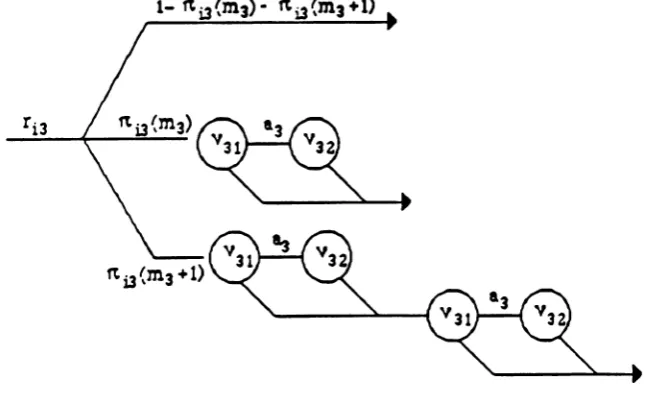
and also delays due to blocking by node 4. Thisdistribution is then used to construct a representation of the delay experienced by units at nodes 1 and 2 because node3 isat capacity. This blocking delayis represented in the form of a phase-type distributionas shown in figure6.4.The conditional throughputs,7ti3(.),i =1,2,areobtainedin thesame
way as in Altiok and Perms [4]. This phase-type distributioniscollapsed toa two-phase
Coxian distribution with parametenVi3I,V-132, 1i3,i-l.2,using the method of moments. Now, following similar arguments we can analyze node2. Inparticular, its service time is augmented so that in additiontoitsregularservice,it comprises oftwoCoxian-2delays, withparametersV231t V232, a23,'and Y2AI, Y242,124,reflectingtheblockingdelay at node 3 and4respectively. Node 1isanalyzedlikewise.
6.2 Arbitrary configurations
Inthis section, we examine two approximation algorithms for analyzing configurations of arbitrarily linked nodes, namely the algorithmsbyIUDand Perros [35] and Kouvatsos and Xenios [43].
6.2.1 The Jun and Perros algoritbm
Jun and Perros [35] analyzed approximately an open queueing network consisting of arbitrarily linked finite single server queues. External arrivals may occur at each node. All service times and inter-arrival times are assumedtobeexponentially distributed. Blocking-after-service was assumed. A unit arriving to a node from outside is lost if the node is found full. Due to the arbitrary interconnection of the nodes, deadlock may occur. For example, suppose that nodeiisblocked by nodej. Now, itispossible that a unit in nodej
A three-phase server of this
type
has a transition rate matrix with departure rate blocks havingrank1. Thisproperty allows the equilibrium queue-length distribution to bewritten immediatelyinterms of the queue parameters (see Neuts [56]).P3(1)T~).3P3(O)[10 0]R
~3(n)T:a ~3 ~3(n-l)TR
with
and P3(n)=P3(n)Te3,where e3isa columnvectorof ones.
-
-
-In the analysis of node 3, our method requires the construction of two Coxian-2 representadons.Tbis is done so that the solutionof each node in isolationisboth simple and consistentfromnode to node, First, the representation of the augmentedservice mechanism at queue 3, shown infigure 6.3, is condensed to a two-phase Coxian distribution with parametersV31, V32,a3. This Coxian-2distribution incorporates the service delay at node 3
of finite nodes arbitrarily linked. There is an external arrival process to each node. All service times andinter-arrival times are assumedto have a generalized exponential distribution (hereafter referred toas GE).Ina GE distribution, a unitwithprobability 9 receives an exponential distribution, or with probability 1-8itreceives zero service time. This means that a GE distributionisequivalenttoa Poissonian bulk arrival process, where the bulk is geometrically distributed.Inview of this, a queueing network withGE inter-arrival and service distributionscanbeseen
u
having bulk arrivals andbulkservice times. The approximation algorithm decomposes the queueing network into individual nodes with revised arrival and service disaibution. Each nodeisthen analyzedin isolation using the principle of the maximum entropy.Inparticular, let us consider a GE'JGFJl/mqueue, i.e. a single server queuewithcapacity m and GE inter-arrival and service distribution. Units that arrive at the queue when the queueisfull.are IOSLWefirst note thatthis queue can be analyzed by setting up the steady-state equations and subsequently using z-transforms. Alternatively, it canbeanalyzed using the maximum entropy principle as follows. Let p(n) bethe steady-state probability that there are n units in the node, n=O,l,...,m. Then, the form ofthisprobability canbecompletely specifiedbymaximjzingthe entropy functionm
H(p)
=-
I
p(n)logp(n)n=<>
subjectto the following constraints: m
1. Normalization, i.e.
I
pen) = 1.n=O
m
2. The percent of time the node is utilized is equal to p,i.e, I, p(n)=p, or written
n=1 m
outina more convenient form
I
h(n)pen)= p, where hen)=min(I, n=Omax(O,n)}.
m
3. The mean number of unitsin the nodeisequaltoL,i.e, I,np(o)
=
L. n=O4. Theprobabilitythenode isfullis" i.e.p(m)=~, ormore conveniently m
j. Inview ofthis, the blocked unit fromnode k entersnodej flrStwhile node i still remains blockedbynodej.Thus, the tirst-blocked-tirst-enterruleisviolated.
The algorithm developed for the analysis ofthistype of networkisbasedon the previous algorithms by Altiok and Perros [4] and Perros and Snyder [65]. It decomposes the queueing network to individual nodes, each with augmented buffer capacity and with revised arrival and service process. The arrivalprocessisassumed to be Poisson. The capacity of the node isincreasedbyasmanypositions asthenumberoftheupstream nodes directly linked to the node under study. The serviceprocessisrevisedtoinclude a phase-type distribution, whose parameters reflect all the possible blocking delays and deadlocks. This phase-type distribution is rather complicated dueto the deadlock and its resolution mechanism. After it is constructed, itisthen simplified by collapsingpans of it to C2 distributions using thethreemoment approximation.Inparticular, eachpanof the phase-type distribution that represents the blockingdelay due a particularqueue is collapsed into a C2 distribution. Thus, the resulting effective mechanism becomes very simple, and the node under study canbeanalyzed numerically.
The approximation algorithmisan iterative scheme and itissimilarinspirittothe isolation method of Labetoulle and Pujolle [45].Inparticular, each nodeisanalyzedseparately as described above. An iteration is completed when every nodein the queueing network has been analyzed. Following a convergence test, the algorithm stops or another iteration is carried out. Ifthe nodes are fully interconnected. then the order in which each node is analyzedin not important, Furthermore, within each iteration, in order to analyze a node, one needs certain values from the other nodes. For the nodes thatalreadyhave been visited during this iteration, the new updated values are used For those nodes that have not been visited yet, the values obtained from the previous iteration are used.
6.2.2 The Kouvatsos and Xenios algorithm
Thealgorithm iterates in a fashion similartotheisolation method of Labetoulle and Pujolle [45] orthe Junand PeITOS method described above. The algorithm yields the marginal queue-length distribution.
6.3 Other references
Feed-forward configurations of thetype analyzedabove werealso considered byLeeand Pollock [48]. The queueing networkanalyzedisthe
same as
the one considered by Altiok and Perras [4] and Perms and Snyder[65], with the additional assumptionthat external arrivals can occur at each node. The algorithm yields the queue-length disaibution for each node. It is a single node decomposition algorithm anditconsists of a forward pass and a backward pass. Inthe forwardpass, therateofarrival intoeach node iisupdated using information from its upstream nodes, which have already been visited.Inthebackward pass, the effective service time of each nodei is updated,using information from all its downstream nodes which have alreadybeenvisited.Theeffective service timeateach node isassumed tobeexponentiallydistributed.Takahashi[72] analyzed a feed-forward queueing networkwithblocking-before-service, assuming exponential services and Poisson distributedarrivals,Each queue was served by two servers. The configuration is similar to the one shown in figure 6.1. The rate matrix of this systemhas a special structure, which is exploited by the approximation algorithm. Takahashi analyzed this queueing network using single node decomposition, two node decomposition, andthreenode decomposition.
Kerbache and MacGregor Smith[38] proposed an approximation methodfor analyzing queueing networks undertype 3.1 blocking. Service times and external inter-arrival times were assumed to have a general distribution. The authors applied their method to small size tandem, split, and merge configurations. Finally, Akyildiz [1] obtained a product-form solution for open, closed, and mixed queueing networks assuming repetitive-service blockingwithrandom destination and multipleclasses.