Cross-lingual Conversion of Lexical Semantic Relations: Building
Parallel Wordnets
Chu-Ren Huang1 , I-Li Su1, Jia-Fei Hong1, Xiang-Bing Li2
1. Institute of Linguistics
2. Institute of Information Science
Academia Sinica,
No.128 Academic Sinica Road, SEC.2 Nankang,
Taipei 115, Taiwan
1.{ churen, isu, jiafei }@gate.sinica.edu.tw
Abstract
Parallel wordnets built upon
correspondences between different
languages can play a crucial role in multilingual knowledge processing. Since there is no homomorphism between pairs of monolingual wordnets, we must rely on lexical semantic relation (LSR) mappings to ensure conceptual cohesion. In this paper, we propose and implement a model for bootstrapping parallel wordnets based on one monolingual wordnet and a set of cross-lingual lexical semantic relations. In particular, we propose a set of inference rules to predict Chinese wordnet structure
based on English wordnet and
English-Chinese translation relations. We show that this model of parallel wordnet building is effective and achieves higher precision in LSR prediction.
1 Introduction
A knowledgebase which systemizes lexical and conceptual information of human knowledge is a basic infrastructure for Natural Language Processing (NLP) applications. Wordnets, pioneered by the Princeton WordNet (WN, Fellbaum 1998), and greatly enriched by EuroWordnet (EWN, Vossen 1998), have become the standard for a lexical knowledgebase enriched with lexical semantic relations. In addition to the multilingual architecture of EWN, there are
some proposals to construct the expansion for monolingual wordnets to parallel wordnet systems, such as Pianta and Girardi (2002). However, the construction of multilingual wordnets eventually faces the challenge of low-density languages, which is dealt with in Huang, et al. (2002). Low-density languages, as opposed to high-density languages, usually refer to languages that are not spoken by a large number of people. However, there is neither a direct correspondence between language population and language technology, nor an objective population number that defines density level. In this work, we use the availability of language resources instead to define language density. That is, low-density languages are languages that do not have enough language resources to support fully automated language processing, such as machine translation. In our current line of work, we (Huang et al. 2002) refer to low-density languages as those which do not have enough existing resources for semi-automatic construction of monolingual wordnet.
Figure1.Two Approaches to Building Bilingual Wordnets
Approach I maps and pairs Language A synsets with Language B synsets and annotates cross-lingual LSR’s. The result is a fully annotated parallel wordnet. Approach II maps language A synsets to language B through translation equivalents. After language B synsets are thus established, language B LSR’s are predicted based on corresponding LSR’s in language A. A new set of monolingual LSR’s is bootstrapped and predicted basing on inference rules governed by translation LSR’s (T-LSR’s). In general, approach I applies to high-density languages while approach II applies to low-density languages. In this paper, we will focus on the application of approach II to build a Chinese Wordnet with conceptual cohesion.
The current model was first explored in Huang et al. (2003). This previous study covered 210 lemmas, consisted of the top ranked lemmas in each part-of-speech (POS). The translation LSR’s discussed in
the previous model were antonymy,
hypernymy and hyponymy. In this current work, we expand our study to all possible LSR’s as well as to all the bilingual lexical pairs in our English-Chinese translation equivalents databases. Moreover, the LSR’s in Princeton WordNet are again used as the basis for bootstrapping. In addition, we establish a set of evaluation for the results. The approach will be evaluated in term of both the precision of prediction and the confidence of prediction. We aim to show that T-LSR’s bootstrapped approach does
provide an effective model for building parallel wordnets for low-density languages. After the introduction, the main part of this paper consists of the following sections: in section 2, we briefly introduce the existing resources required for this work.
We discuss methodology of T-LSR
bootstrapping step by step in section 3. A series of LSR-predicting inference rules are also given in this section. In section 4, we plan to evaluate the results of our experiment and demonstrate the feasibility of maintaining conceptual cohesion in cross-lingual LSR mapping.
2 Required Resources: ECTED and
WN
As we mentioned above, the T-LSR approach to parallel wordnet requires two language resources: a fully annotated monolingual wordnet and a set of translation LSR’s to map the wordnet information to the target language. In our current study, we use the English WN as the source of synset and LSR information. The semantic relation between an English synset and its Chinese translation is based on The English-Chinese Translation Equivalents Database (ECTED, Huang et al. 2002).
2.1 The English-Chinese Translation Equivalents Databases (ECTED)
The basic idea of ECTED is to provide the Chinese translation equivalents for each APPROACHI
Given fully annotated WN
of language A; and
bilingual translation
equivalents annotated
with LSR
Map LSR-annotated
synsets in Language A to
Language B through
translation LSRs (T-LSR’s)
Grow LSR links among
Language B synsets by
using language A LSR
and cross-lingual LSR
inference rules Map and pair Language A and
Language B synsets with
WN English synset. Our ECTED was bootstrapped with a combined lexical knowledgebase integrating at least four
English-Chinese or Chinese-English
bilingual resources. Based on this combined LKB, a group of translators chose (or created) up to three best translation equivalents for each WN synset. In addition, for each English-Chinese translation equivalent, a lexical semantic relation is annotated. In addition to synonym, the semantic relations marked including antonym, hypernym, hyponym, holonym, meronym, and near-synonym. We use all semantic relations, with the exception of antonymy, in this study.
2.2 Wordnet (WN)
The Cognitive Science Laboratory of Princeton University created WN, a lexical knowledgebase for English, in 1990 (Fellbaum, 1998). Synsets (a group of form-meaning pairs sharing same sense) are the main units used in WN to organize the lexicon conceptually. Each sense can be expanded either by gloss or context. It is easy for users to distinguish each sense by simply checking the synonyms, the example sentences or explanation. Nouns, verbs, adjectives and adverbs are the main lexical categories to classify all the lexicons. Such classification of lexicons is based on the principles in psycholinguistics. Besides, the semantic relations of each sense in WN are
also expressed like a Word-network. In other words, WN resembles an ontology system and links all the semantic relations of words. Therefore, English WN is not just a lexical knowledgebase but also an ontological system that expresses the semantic relations and the concepts of words.
The current version of WN is Wordnet 2.0, but Wordnet 1.6 is more widely used by the most applications in NLP and linguistic research. Therefore, after considering the compatibility with other applications, we connected the ECTED with Wordnet 1.6. However, we are still working on keeping updating our systems by using the content in the new version of WN. We believe this will keep the information updated and shorten the gap caused by the different versions of WN.
3 Inferring Lexical Semantic
Relations for WN and ECTED
As we mentioned above, WN does not only express the knowledge of lexicons but also cover the semantic relations of lexicons. Therefore, in order to present such semantic relations clearly and logically, Huang (2002) proposed to use cross-lingual Lexical Semantic Relations (LSRs) to predict the semantic relations in the target language. The proposed framework is shown in Diagram 1.
Diagram 1. Translation-mediated LSR (the complete model)
In Diagram1, EW1 and EW2 are head words for two different English synsets. CW1 and CW2 are translation equivalents in ECTED for these two head words. LSR i and ii are the T-LSRs stipulating the
semantic relations between the head words and their Chinese TEs. In WN, each synset is linked to a network of their synsets through a number of LSR’s. Hence, we use LSR x to represent the semantic relation
between EW1 and EW2. The four LSR’s form a closed network that includes three know LSR’s: two T-LSRs, i and ii, and one English LSR, x, from WN. The only unknown LSR is y, the semantic relation between CW1 and CW2. Huang et al (2002) claimed that LSR y can be inferred as a functional combination of the three LSRs - i, x and ii.
Language translation does not only involve the semantic correspondences but also the human decision in choosing translation equivalents that are affected by the social and cultural factors. Our main
priority in this paper is to infer the lexical semantic information across different language rather than the translational idiosyncrasies, so the elements regarding translational idiosyncrasies are excluded here. In order to simplify the complexity of LSR combination and get a better prediction of LSR, here, we only take account of the situations when LSR ii is exactly equivalent, EW2=CW2 or ii=0. Therefore, we have a reduced model of the translation-mediated LSR Prediction as shown in diagram 2.
Diagram 2. Translation-mediated LSR (the reduced model)
Synonym, hypernym, hyponym,
holonym, meronym and near-synonym are the main semantic relations that we will discuss in the following sections. First of all, we would like to discuss the foundational situation of LSR prediction, synonym, as
shown in diagram 3. When translation LSR i is exactly equivalent, i.e. CW1=EW1, and LSR ii is also exactly equivalent, i.e. EW2=CW2, the LSR combination, LSR y, is directly inherited the semantic relation of LSR x.
Diagram 3. Translation-mediated LSR (When TEs are synonymous)
CW1 EW1(Synset number)
EW2(Synset number)=CW2 (ii=0)
y
i
x
The unknown LSR y= i + x
CW1 EW1(Synset number)
EW2(Synset number)=CW2 (ii=0)
y
CW1=EW1(i=0)
x
Diagram 4. Examples of the LSR (When TEs are synonymous)
As shown in diagram 4 above, according to the ECTED, the English head word ‘thin’ is exactly equivalent with ‘shou4’ in Chinese. The LSR x between EW1 and EW2 in WN is marked ‘ANT’ which means ‘fat’ is the antonym of ‘thin.’ Therefore, according to the prediction in diagram 3, we can infer that the CW2 (fei2pang4de5) is the antonym of CW1 (shou4). The above inference can also be applied to another example in diagram 4. The LSR prediction in WN plays a very crucial role in determining the unknown LSR y. Even an English head word may have more than one sense, it is still very clear to infer the LSR between the TEs. However, there is a potential problem within
this inference. If a head word has more than one Chinese TEs which can all correspond to the head word, there might be a problem to consider whether those TEs are really synonyms.
However, the situation is not always that ideal as above. When the Chinese translation equivalents and the corresponded English synset have a non-identical
semantic relation, CW1EW1, the
prediction of LSR y needs to be considered further and carefully.
fei2pang4d fat (00934421A) chubby(00935062A) = feng1man3de5
y =NSYN
CW1=EW1(i=0)
x = NSYN shou4 thin (00936334A)
fat(00934421A) = fei2pang4de5
y = ANT
CW1=EW1(i=0)
Diagram 5. Predicting LSR (Hypernym) and its example
Diagram 6. Predicting LSR(Hyponym) and its example
Logically, hypernym and hyponym are symmetric semantic relations. For instance, if A is a hypernym of B, B is a hyponym of A. For instance, as shown in diagram 5, the English word ‘nick’ is the hypernym of the Chinese term ‘shang1kou3’ and ‘cut’ is the hypernym of ‘nick’ in WN and the exact translation equivalent of ‘cut’ in Chinese is ‘jian3kai1.’ According to the logicality,
‘jian3kai1’ is the hypernym of
‘shang1kou3.’ The example of hyponym is shown in diagram 6. Due to the varied semantic relations in WN, the inferences of LSRs , the unknown LSR y = i + x ,for
hypernym, hyponym, near-synonym,
holonym, and mernoym are listed as below:
Hypernym(HYP) (a) IF x=ANT
LSR y =HYP +ANT =ANT (CW2 is the antonym of CW1.)
(b) IF x=HYP
LSR y = HYP+HYP =HYP (CW2 is the hypernym of CW1.)
(c) IF x= NSYN
LSR y = HYP+NSYN =HYP (CW2 is the hypernym of CW1.)
(d) IF x = HOL
LSR y = HYP+HOL =HOL (CW2 is the holonym of CW1.)
(e) IF x = all other LSR
LSR y = HYP +all other LSRs = ? (Undecided)
Hyponym(HPO) (a) IF x=ANT
LSR y =HPO +ANT =ANT (CW2 is the antonym of CW1.)
(b) IF x=HPO
LSR y = HPO+HPO =HPO (CW2 is the hyponym of CW1.)
(c) IF x= NSYN
LSR y = HPO+NSYN =HPO (CW2 is the hyponym of CW1.)
(d) IF x = MER
LSR y = HPO+MER =MER (CW2 is the meronym of CW1.)
(e) IF x = all other LSR
LSR y = HPO +all other LSRs = ? (Undecided)
gao1dian3 pastry(05670938N)
baklava(05674827N)=guo3ren2mi4tang2qian1ceng2bing3
y
i= HPO
x= HPO
The unknown LSR y
= i + x
=HPO +HPO =HPO
(‘guo3ren2mi4tang2qian1ceng2bing3’ is the
hyponym of ‘gao1dian3’)
shang1kou3 nick(00248910N) cut(00248688N)=jian3kai1
y
i= HYP (‘nick’ is the hypernym of ‘shang1kou3’ )
x= HYP(‘cut’ is the hypernym of ‘nick’)
The unknown LSR y
= i + x
=HYP +HYP =HYP
Near-Synonym(NSYN) the near-synonym of CW1.)
(e) IF x = MER
4 Implementation and Evaluation
WN 1.6 contains 99,642 English English synsets in average.
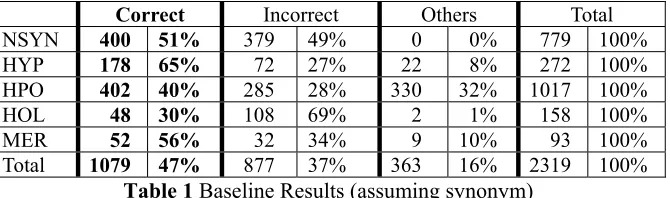
In comparing the two approaches to parallel wordnet building, we treat at baseline the cases where the translation LSR is synonymy. In others words, these are the cases where both approach I and approach II will make highly accurate predictions (e.g. Huang, et al. 2003). However, if the T-LSR is other than synonymy, we expect the prediction based on source language LSR will be much lower.
In our study, there are in total 372,927 lexical semantic relations that can potentially be bootstrapped when the T-LSR is one of the five semantic relations in study. These are expanded from the following types of translations equivalence relations: 11,396 translation near-synonyms, 2,782 translation hypernyms, 2,106 translation hyponyms, 252 translation meronyms and 145 translations holonyms. For evaluation, due to constraints on resources, we exhaustively check the types with less than 300 lemmas, while randomly checked close to 300 lemmas for the other types.
Correct Incorrect Others Total
NSYN 400 51% 379 49% 0 0% 779 100%
HYP 178 65% 72 27% 22 8% 272 100%
HPO 402 40% 285 28% 330 32% 1017 100%
HOL 48 30% 108 69% 2 1% 158 100%
MER 52 56% 32 34% 9 10% 93 100%
Total 1079 47% 877 37% 363 16% 2319 100%
Table 1 Baseline Results (assuming synonym)
Table 2 shows the comparison between the T-LSR model and the baseline. It shows that there is improvement of 17.8% in
average and that there is gain in precision for each LSR type. The improvement varies from just below 2% to 39%.
Baseline T-LSR Difference Improvement
NSYN 400 51% 556 71% 156 20 % 156/400 39 %
HYP 178 65% 184 66% 6 2.2% 6/178 3.4%
HPO 402 40% 409 40% 7 0.7% 7/402 1.7%
HOL 48 30% 64 41% 16 10.1% 16/48 33.3%
MER 52 56% 58 62% 6 6.5% 6/52 11.5%
Total 1079 47% 1271 55% 191 8.2% 191/1080 17.7%
Table 2 Precision of using the LSR inferences
5 Conclusion
It is interesting to note that the classes with least improvements are hypernymy and hyponymy. Since these are the classical IS-A relations, we hypothesize that their predictions are similar to the baseline relation of synonym. If we take these two relations out, the T-LSR model with inference rules has a precision difference of
17.3% (178/1030), as well as an
improvement of 35.6% (178/500). These are substantial improvements over the baseline model. The result will be reinforced when the evaluation is completed. We will also analyze the prediction based on each T-LSR to give a more explanatory account as well a measure confidence or prediction. The result offers strong support for T-LSR as a model for bootstrapping parallel wordnets with a low-density target language.
References
Fellbaum, C. (ed.) 1998. Wordent: An Electronic
Lexical Database. Cambridge, MA: MIT Press.
Huang, Chu-Ren, D.B. Tsai, J.Lin, S. Tseng, K.J. Chen and Y. Chuang. 2001 Definition and Test
for Lexical Semantic Relation in Chinese. [in
Chinese] Paper presented at the Second Chinese Lexical Semantics Workshop. May 2001,
Beijing, China.
Huang, Chu-Ren, I-Ju E. Tseng, Dylan B.S. Tsai. 2002. Translating Lexical Semantic Relations: The first step towards Multilingual Wordnets. Proceedings of the COLONG2002 Workshop “SemaNet:Building and Using Semantic Networks”, ed. By Grace Ngai, Pascale Fung, and Kenneth W. Church, 2-8.
Huang, Chu-Ren, Elanna I. J. Tseng, Dylan B.S. Tsai, Brian Murphy. 2003 Cross-lingual Portability of Semantic Relations: Bootstrapping
Chinese WordNet with English WordNet
Relations. pp.509-531.
Pianta, Emanuel, L. Benitivogli, C. Girardi. 2002 MultiWordnet: Developing an aligned
nultilingual database. Proceedings of the 1st
International WordNet Conference, Maysore, Inda, pp.293-302.
Tsai, D.B.S., Chu-Ren Huang, J.Lin, K.J. Chen and Y. Chuang. 2002. Definition and Test for
Lexical Semantic Relation in Chinese. [ύЎຒ
ကᜢ߯ޑۓကᆶղۓচ!
߾] Journal of Chinese Information Processing
[ύЎߞ৲Ꮲൔ]. 16.4.21-31.
Vossen P. (ed.). 1998. EuroWordNet: A multilingual database with lexical semantic
networks. Norwell, MA: Kluwer Academic