Fast Tweet Retrieval with Compact Binary Codes
Weiwei Guo∗ Wei Liu† Mona Diab‡
∗Computer Science Department, Columbia University, New York, NY, USA †IBM T. J. Watson Research Center, Yorktown Heights, NY, USA
‡Department of Computer Science, George Washington University, Washington, D.C., USA [email protected] [email protected] [email protected]
Abstract
The most widely used similarity measure in the field of natural language processing may be co-sine similarity. However, in the context of Twitter, the large scale of massive tweet data inevitably makes it expensive to perform cosine similarity computations among tremendous data samples. In this paper, we exploit binary coding to tackle the scalability issue, which compresses each data sample into a compact binary code and hence enables highly efficient similarity computations via Hamming distances between the generated codes. In order to yield semantics sensitive binary codes for tweet data, we design a binarized matrix factorization model and further improve it in two aspects. First, we force the projection directions employed by the model nearly orthogonal to reduce the redundant information in their resulting binary bits. Second, we leverage the tweets’ neighborhood information to encourage similar tweets to have adjacent binary codes. Evaluated on a tweet dataset using hashtags to create gold labels in an information retrieval scenario, our proposed model shows significant performance gains over competing methods.
1 Introduction
Twitter is rapidly gaining worldwide popularity, with 500 million active users generating more than
340 million tweets daily1. Massive-scale tweet data which is freely available on the Web contains rich
linguistic phenomena and valuable information, therefore making it one of most favorite data sources used by a variety of Natural Language Processing (NLP) applications. Successful examples include first story detection (Petrovic et al., 2010), local event detection (Agarwal et al., 2012), Twitter event discovery (Benson et al., 2011) and summarization (Chakrabarti and Punera, 2011), etc.
In these NLP applications, one of core technical components is tweet similarity computing to search for the desired tweets with respect to some sample tweets. For example, in first story detection (Petrovic et al., 2010), the purpose is to find an incoming tweet that is expected to report a novel event not revealed
by the previous tweets. This is done by measuring cosinesimilarity between the incoming tweet and
each previous tweet.
One obvious issue is that cosine similarity computations among tweet data will become very slow once the scale of tweet data grows drastically. In this paper, we investigate the problem of searching for most similar tweets given a query tweet. Specifically, we propose a binary coding approach to render com-putationally efficient tweet comparisons that should benefit practical NLP applications, especially in the face of massive data scenarios. Using the proposed approach, each tweet is compressed into short-length
binary bits (i.e., acompact binary code), so that tweet comparisons can be performed substantially faster
through measuring Hamming distances between the generated compact codes. Crucially, Hamming distance computation only involves very cheap NOR and popcount operations instead of floating-point operations needed by cosine similarity computation.
Compared to other genres of data, similarity search in tweet data is very challenging due to the short nature of Twitter messages, that is, a tweet contains too little information for traditional models to extract
This work is licenced under a Creative Commons Attribution 4.0 International License. Page numbers and proceedings footer are added by the organizers. License details:http://creativecommons.org/licenses/by/4.0/
1http://en.wikipedia.org/wiki/Twitter
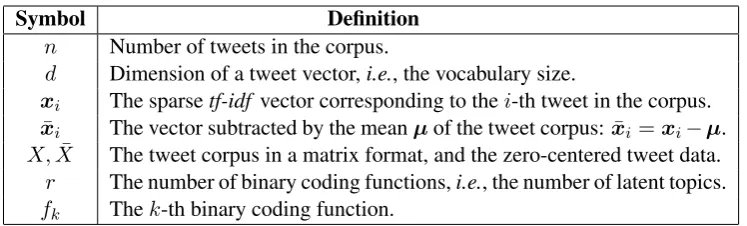
Symbol Definition
n Number of tweets in the corpus.
d Dimension of a tweet vector,i.e., the vocabulary size.
xi The sparsetf-idf vector corresponding to thei-th tweet in the corpus.
¯
xi The vector subtracted by the meanµof the tweet corpus:x¯i =xi−µ.
X,X¯ The tweet corpus in a matrix format, and the zero-centered tweet data.
r The number of binary coding functions,i.e., the number of latent topics.
[image:2.595.113.487.60.173.2]fk Thek-th binary coding function.
Table 1: Symbols used in binary coding.
latent topical semantics. For instance, in our collected dataset, there exist only11words per tweet on
average. We address the sparsity issue pertaining to tweet data by converting our previously proposed
topic modelWeighted Textual Matrix Factorization(WTMF) (Guo and Diab, 2012) to a binarized version.
WTMF maps a tweet to a low-dimensional semantic vector which can easily be transformed to a binary code by virtue of a sign function. We consider WTMF a good baseline for the task of tweet retrieval, as it has achieved state-of-the-art performance among unsupervised systems on two benchmark short-text datasets released by Li et al. (2006) and Agirre et al. (2012).
In this paper, we improve WTMF in two aspects. The first drawback of the WTMF model is that it focuses on exhaustively encoding the local context, and hence introduces some overlapping information that is reflected in its associated projections. In order to remove the redundant information and meanwhile discover more distinct topics, we employ a gradient descent method to make the projection directions nearly orthogonal.
The second aspect is to enrich each tweet by its neighbors. Because of the short context, most tweets do not contain sufficient information of an event, as noticed by previous work (Agarwal et al., 2012; Guo et al., 2013). Ideally, we would like to learn a model such that the tweets related to the same event are mapped to adjacent binary codes. We fulfill this purpose by augmenting each tweet in a given training dataset with its neighboring tweets within a temporal window, and assuming that these neighboring
(or similar) tweets are triggered by the same event. We name the improved modelOrthogonal Matrix
Factorization with Neighbors(OrMFN).
In our experiments, we use Twitter hashtags to create the gold (i.e., groundtruth) labels, where tweets
with the same hashtag are considered semantically related, hence relevant. We collect a tweet dataset which consists of 1.35 million tweets over 3 months where each tweet has exactly one hashtag. The experimental results show that our proposed model OrMFN significantly outperforms competing binary coding methods.
2 Background and Related Work
2.1 Preliminaries
We first introduce some notations used in this paper to formulate our problem. Suppose that we are
given a dataset ofntweets and the size of the vocabulary isd. A tweet is represented by all the words it
contains. We use notationx∈Rdto denote a sparsed-dimensionaltf-idfvector corresponding to a tweet,
where each word stands for a dimension. For ease of notation, we represent allntweets in a matrixX =
[x1,x2,· · ·,xn]∈Rd×n. For binary coding, we seekrbinarization functionsfk:Rd→ {1,−1} rk=1
so that a tweetxi is encoded into anr-bit binary code (i.e., a string ofrbinary bits). Table 1 illustrates
the symbols used in this paper for notation.
Hamming Ranking:In the paper we evaluate the quality of binary codes in terms of Hamming ranking.
op-erations for cosine similarity computation. Since logic opop-erations are much faster than floating-point
operations, Hamming distance computation is typically much faster than cosine similarity computation2
2.2 Binary Coding
Early explorations of binary coding focused on using random permutations or random projections to ob-tain binary coding functions (aka, hash functions), such as Min-wise Hashing (MinHash) (Broder et al., 1998) and Locality-Sensitive Hashing (LSH) (Indyk and Motwani, 1998). MinHash and LSH are
gen-erally considereddata-independentapproaches, as their coding functions are generated in a randomized
fashion. In the context of Twitter, the simple LSH scheme proposed in (Charikar, 2002) is of particular interest. Charikar proved that the probability of two data points colliding is proportional to the angle
between them, and then employed a random projectionw∈Rdto construct a binary coding function:
f(x) =sgn w>x= 1, ifw>x>0,
−1, otherwise. (1)
The current held view is thatdata-dependentbinary coding can lead to better performance. A
data-dependent coding scheme typically includes two steps: 1) learning a series of binary coding functions with a small amount of training data; 2) applying the learned functions to larger scale data to produce binary codes.
In the context of tweet data, Latent Semantic Analysis (LSA) (Landauer and Dumais, 1997) can
di-rectly be used for data-dependent binary coding. LSA reduces the dimensionality of the data inX by
performing singular value decomposition (SVD) overX:X=UΣV>. LetX¯ be the zero-centered data
matrix, where each tweet vectorxiis subtracted by the mean vectorµ, resulting inx¯i=xi−µ. Ther
coding functions are then constructed by using thereigenvectorsu1,u2,· · ·,urassociated with ther
largest eigenvalues, that is,fk(x) =sgn u>kx¯
=sgn u>
k(x−µ)
(k= 1,· · · , r). The goal of using
zero-centered dataX¯ is to balance1bits and−1bits.
Iterative Quantization (ITQ) (Gong and Lazebnik, 2011) is another popular unsupervised binary
cod-ing approach. ITQ attempts to find an orthogonal rotation matrixR ∈ Rr×r to minimize the squared
quantization error:kB−RVk2
F, whereB ∈ {1,−1}r×ncontains the binary codes of all data,V ∈Rr×n
contains the LSA-projected and zero-centered vectors, andk · kF denotes Frobenius norm. After Ris
optimized, the binary codes are simply obtained byB=sgn(RV).
Much recent work learns nonlinear binary coding functions, including Spectral Hashing (Weiss et al., 2008), Anchor Graph Hashing (Liu et al., 2011), Bilinear Hashing (Liu et al., 2012b), Kernelized LSH (Kulis and Grauman, 2012), etc. Concurrently, supervised information defined among training data samples was incorporated into coding function learning such as Minimal Loss Hashing (Norouzi and Fleet, 2011) and Kernel-Based Supervised Hashing (Liu et al., 2012a). Our proposed method falls into
the category ofunsupervised, linear, data-dependentbinary coding.
2.3 Applications in NLP
The NLP community has successfully applied LSH in several tasks such as first story detection (Petrovic et al., 2010), and paraphrase retrieval for relation extraction (Bhagat and Ravichandran, 2008), etc. This paper shows that our proposed data-dependent binary coding approach is superior to data-independent LSH in terms of the quality of generated binary codes.
Subercaze et al. (2013) proposed a binary coding approach to encode user profiles for recommenda-tions. Compared to (Subercaze et al., 2013) in which a data unit is a whole user profile consisting of all his/her Twitter posts, we tackle a more challenging problem, since our data units are extremely short – namely, a single tweet.
2We recognize that different hardware exploiting techniques such as GPU or parallelization accelerate cosine similarity.
X P Q T
≈
×
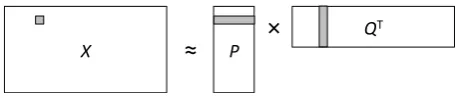
Figure 1: Weighted Textual Matrix Factorization. Thed×nmatrixXis approximated by the product
of ad×rmatrixP and ann×rmatrixQ. Note in the figure we used the transpose of theQmatrix.
3 Weighted Textual Matrix Factorization
The WTMF model proposed by Guo and Diab (2012) is designed to extract latent semantic vectors for short textual data. The low-dimensional semantic vectors can be used to represent the tweets in the original high-dimensional space. WTMF achieved state-of-the-art unsupervised performance on two short text similarity datasets, which can be attributed to the fact that WTMF carefully handles missing
words (the missing words of a text are the words with 0 values in a data vectorx).
Assume that there are r latent dimensions/topics in the data, the matrix X is approximated by the
product of ad×rmatrixP and ann×rmatrixQ, as in Figure 1. Accordingly, a tweetxjis represented
by anr-dimensional vectorQj,·; similarly, a wordwiis generalized by ther-dimensional vectorPi,·(the
ith row in matrixP). The matrix factorization scheme has an intuitive explanation: the inner-product
of a word profile vector Pi,· and a tweet profile vector Qj,· is to approximate the TF-IDF value Xij:
Pi,·>Qj,·≈Xij (as illustrated by the shaded parts in Figure 1).
Intuitively, Xij = 0 suggests that the latent topics of the text xj are not relevant to the wordwi.
Note that99%of the cells inX are 0 because of the short contexts, which significantly diminishes the
contribution of the observed words to the searching of optimalP andQ. To reduce the impact of missing
words, a small weightwmis assigned to each 0 cell ofXin the objective function:
X
i X
j
Wij
Pi,·>Qj,·−Xij 2
+λ||P||2
2+λ||Q||22,
Wi,j=
1, ifXij 6= 0,
wm, ifXij = 0.
(2)
whereλis the regularization parameter. Alternating Least Squares (Srebro and Jaakkola, 2003) is used
to iteratively compute the latent semantic vectors inP andQ:
Pi,·=
Q>W˜(i)Q+λI−1Q>W˜(i)X>
i,·, Qj,·=
P>W˜(j)P +λI−1P>W˜(j)X·,j
(3)
whereW˜(i) = diag(W
i,·)is a n×ndiagonal matrix containing thei-th row of the weight matrixW.
Similarly,W˜(j)=diag(W
·,j)is ad×ddiagonal matrix containing thej-th column ofW.
As in Algorithm 1 line 6-9,PandQare computed iteratively, i.e., in a iteration eachPi,·(i= 1,· · ·, d)
is calculated based onQ, then eachQj,·(j= 1,· · · , n)is calculated based onP. This can be computed
efficiently since: (1) allPi,·share the sameQ>Q; similarly allQj,·share the sameP>P; (2)Xis very
sparse. More details can be found in (Steck, 2010).
Adapting WTMF to binary coding is straightforward. Following LSA, we use the matrixP to linearly
project tweets into low-dimensional vectors, and then apply the sign function. The k-th binarization
function uses thek-th column of theP matrix (P·,k) as follows
fk(x) =sgn(P·,kx¯) =
1, ifP·,kx¯>0,
−1, otherwise. (4)
4 Removing Redundant Information
It is worth noting that there are two explanations of thed×rmatrixP. The rows ofP, denoted byPi,·,
Algorithm 1:OrMF
1 ProcedureP =OrMF(X, W, λ, n itr, α)
2 n words, n docs←size(X); 3 randomly initializeP, Q;
4 itr←1;
5 whileitr < n itrdo 6 forj←1ton docsdo
7 Qj,·=
P>W˜(j)P+λI−1P>W˜(j)X·,j
8 fori←1ton wordsdo
9 Pi,·=
Q>W˜(i)Q+λI−1Q>W˜(i)X>
i,·
10 c=mean(diag(P>P));
11 P ←P−αP(P>P−cI);
12 itr←itr+ 1;
in the WTMF model. Meanwhile, columns of P are projection vectors, denoted by P·,k, which are
similar to eigenvectorsU obtained by LSA. The projection vectorP·,kis employed to multiply to a zero
centered data vectorx¯to generate a binary string: sgn(P·,k>x¯). In this section, we focus on the property
of theP matrix columns.
As in equation 3, each row in matrices P and Q is iteratively optimized to approximate the data:
Pi,·>Qj,·≈Xij. While it does a good job at preserving the existence/relevance of each word in a short
text, it might encode repetitive information by means of the dimensionality reduction or the projection
vectorsP·,k (the columns ofP). For example, the first dimensionP·,1 may be90%about thepolitics
topic and10%about theeconomicstopic, and the second dimensionP·,2is95%oneconomicsand5%
ontechnologytopics, respectively.
Ideally we would like the dimensions to be uncorrelated, so that more distinct topics of data could
be captured. One way to ensure the uncorrelatedness is to forceP to be orthogonal, i.e.,P>P = I. It
impliesP·,j>P·,k = 0ifk6=j.
4.1 Implementation of Orthogonal Projections
To produce nearly orthogonal projections in the current framework, we could add a regularizerβ(P>P−
I)2with the weightβ in the objective function of the WTMF model (equation 6). However, in practice
this method does not lead to the convergence ofP. This is mainly caused by the phenomenon that any
word profilePi,·becomes dependent of all other word profiles after an iteration.
Therefore, we adopt a simpler method, gradient descent, in whichP is updated by taking a small step
in the direction of the negative gradient of(P>P−I)2. It is also worth noting that(P>P−I)2requires
each projectionP·,k to be a unit vector because ofP·,k>P·,k = 1, which is infeasible when the nonzero
values inXare large. Therefore, we multiply the matrixI by a coefficientc, which is calculated from
the mean of the diagonal ofP>P in the current iteration. The following two lines are added at the end
of an iteration:
c←mean(diag(P>P)),
P ←P −αP(P>P −cI). (5)
This procedure is presented in Algorithm 1. Accordingly, the magnitude ofP is not affected. The step
sizeαis fixed to0.0001. We refer to this model as Orthogonal Matrix Factorization (OrMF).
5 Exploiting Nearest Neighbors for Tweets
aspect of an event (Agarwal et al., 2012; Guo et al., 2013). Our objective is to find the relevant tweets given a tweet, and then learn a model that assigns similar binary bits to these relevant tweets.
5.1 Modeling Neighboring Tweets
Given a tweet, we treat its nearest neighbors in a temporal window as its most relevant tweets. We assume that the other aspects of an event can be found in its nearest neighbors. Accordingly, we extract
tneighbors for a tweet from 10,000 most chronologically close tweets. In this current implementation,
we sett= 5.
Under the weighted matrix factorization framework, we extend each tweet by itstnearest neighbors.
Specifically, for each tweet, we incorporate additional words from its neighboring tweets. The values of the new words are averaged. Moreover, these new words are treated differently by assigning a new
weightwnto them, since we believe that the new words are not as informative as the original words in
the tweet.
We present an illustrative example of how to use neighbors to extend the tweets. Let x1 be a tweet
with the following words (the numbers after the colon are TF-IDF values):
x1={obama:5.5, medicare:8.3, website:3.8}
which has two nearest neighbors:
x27={obama:5.5, medicare:8.3, website:3.8, down:5.4}
x356={obama:5.5, medicare:8.3, website:3.8, problem:7.0}
Then there are two additional words added inx1whose values are averaged. The new data vectorx01is:
x0
1={obama:5.5, medicare:8.3, website:3.8, down:2.7, problem:3.5}
Therefore, the algorithm is run on the new neighbor-augmented data matrix, denoted byX0, and the
weight matrixW becomes
Wi,j =
1, ifX0
ij 6= 0 &jis an original word,
wn, ifXij0 6= 0, &jis from neighbor tweets,
wm, ifXij0 = 0.
(6)
This model is referred to as Orthogonal Matrix Factorization with Neighbors (OrMFN). 5.2 Binary coding without Neighbors
It is important to point out that the data used by OrMFN,X0, could be a very small subset of the whole
dataset. Therefore we only need to find neighbors for a small portion of the data. After the P matrix
is learned, the neighborhood information is implicitly encoded in the matrixP, and we still apply the
same binarization function sgn(P·,k>x¯) on the whole dataset (in large scale) without neighborhood
information. We randomly sample 200,000 tweets for OrMFN to learnP; neighbors are extracted only
for these 200,000 tweets (note that the neighbors are from the 200,000 tweets as well), and then we use
the learnedP to generate binary codes for the whole dataset 1.35 million tweetswithoutsearching for
their nearest neighbors.3
Our scheme has a clear advantage: the binary coding remains very efficient. During binarization for any data, there is no need to compare 10,000 most recent tweets to find nearest neighbors, which could
be time-consuming. An opposite example is the method presented in (Guo et al., 2013), wheretmost
nearest neighbor tweets were extracted, and a tweet profileQj,·was explicitly forced to be similar to its
neighbors’ profiles. However, for each new data, the approach proposed in (Guo et al., 2013) requires computing its nearest neighbors.
6 Experiments
6.1 Tweet Data
We crawled English tweets spanning three months from October 5th 2013 to January 5th 2014 using the
Twitter API.4 We cleaned the data such that each hashtag appears at least 100 times in the corpus, and
each word appears at least 10 times. This data collection consists of 1,350,159 tweets, 15 million word tokens, 30,608 unique words, and 3,214 unique hashtags.
One of main reasons to use hashtags is to enhance accessing topically similar tweets (Efron, 2010). In a large-scale data setting, it is impossible to manually identify relevant tweets. Therefore, we use Twitter hashtags to create groundtruth labels, which means that tweets marked by the same hashtag as the query tweet are considered relevant. Accordingly, in our experiments all hashtags are removed from the original data corpus. We chose a subset of hashtags from the most frequent hashtags to create groundtruth labels: we manually removed some tags from the subset that are not topic-related (e.g.,
#truth,#lol) or are ambiguous; we also removed all the tags that are referring to TV series (the relevant
tweets can be trivially obtained by named entity matching). The resulting subset contains 18 hashtags.5
100 tweets are randomly selected as queries (test data) for each of the 18 hashtags. The median number of relevant tweets per query is 5,621. The small size of gold standard makes the task relatively
challenging. We need to identify 5,621 (0.42%of the whole dataset) tweets out of 1.35 million tweets.
200,000 tweets are randomly selected (not including the 1,800 queries) as training data for the data
dependent models to learn binarization functions.6 The functions are subsequently applied on all the
1.35 million tweets, including the 1,800 query tweets. 6.2 Evaluation
We evaluate a model by the search quality: given a tweet as query, we would like to rank the relevant tweets as high as possible. Following previous work (Weiss et al., 2008; Liu et al., 2011), we use mean precision among top 1000 returned list (MP@1000) to measure the ranking quality. Let pre@k be the
precision among topkreturn data, then MP@1000 is the average value of pre@1, [email protected]@1000.
Obviously MP gives more reward on the systems that can rank relevant data in the top places, e.g., if the highest ranked tweet is a relevant tweet, then all the precision values (pre@2, pre@3, pre@4...) are
increased. We also calculate the precision and recall curve at varying values of topkreturned list.
6.3 Methods
We evaluate the proposed unsupervised binary coding models OrMF and OrMFN, whose performance is compared against 5 other unsupervised methods, LSH, SH, LSA, ITQ, and WTMF. All the binary coding functions except LSH are learned on the 200,000 tweet set. All the methods have the same form of binary coding functions: sgn(P·,k>x¯), where they differ only in the projection vectorP·,k. The retrieved tweets
are ranked according to their Hamming distance to the query, where Hamming distance is the number of different bit positions between the binary codes of a tweet and the query.
For ITQ and SH, we use the code provided by the authors. Note that the dense matrix X¯X¯> is
impossible to compute due the large vocabulary, therefore we replace it by sparse matrixXX>. For the
three matrix factorization based methods (WTMF, OrMF, OrMFN) we run 10 iterations. The regularizer
λin equation 6 is fixed at20as in (Guo and Diab, 2012). A small set of 500 tweets is selected from
the training set as tuning set to choose the missing word weightwmin the baseline WTMF, and then its
value is fixed for OrMF and OrMFN. The same 500 tweets tuning set is used to choose the neighbor word
weightwn. In fact these models are very stable, consistently outperforming the baselines regardless of
different values ofwmandwn, as later shown in Figure 4 and 5.
We also present the results of cosine similarity on the original word space (COSINE) as an upper bound of the binary coding methods. We implemented an efficient algorithm for COSINE, which is the algorithm 1 in (Petrovic et al., 2010). It firstly normalizes each data to a unit vector, then cosine similarity is calculated by traversing only once the tweets via inverted word index.
6.4 Results
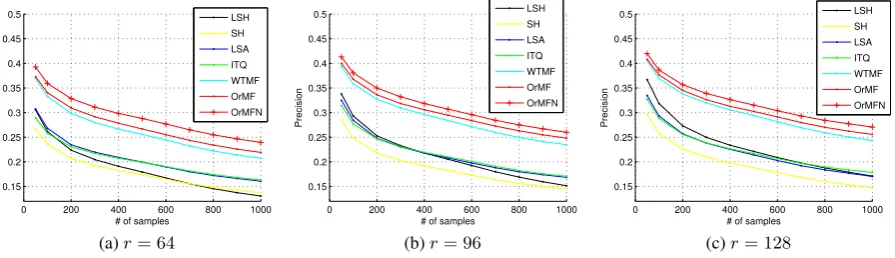
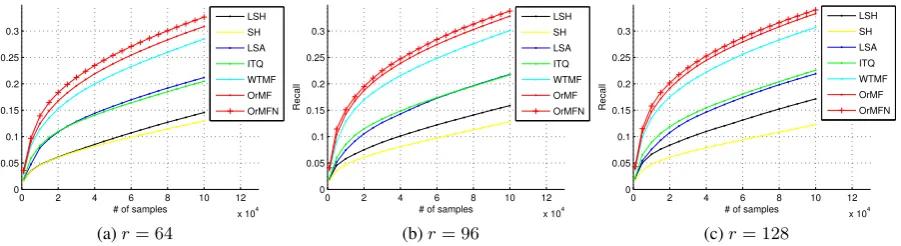
Table 2 summarizes the ranking performance measured by MP@1000 (the mean precision at top 1000 returned list). Figures 2 and 3 illustrate the corresponding precision and recall curve for the Hamming
5The tweet dataset and their associated list of hashtags will be available upon request.
6Although we use the word “training”, the hashtags are never seen by the models. The training data is used for the models
Models Parameters r=64 r=96 r=128
LSH – 19.21% 21.84% 23.75%
SH – 18.29% 19.32% 19.95%
LSA – 21.04% 22.07% 22.67%
ITQ – 20.8% 22.06% 22.86%
WTMF wm = 0.1 26.64% 29.39% 30.38%
OrMF wm = 0.1 27.7% 30.48% 31.26%
OrMFN wm= 0.1, wn= 0.5 29.73% 31.73% 32.55%
[image:8.595.147.453.62.193.2]COSINE – 33.68%
Table 2: Mean precision among top 1000 returned list
0 200 400 600 800 1000 0.15 0.2 0.25 0.3 0.35 0.4 0.45 0.5 Precision
# of samples
LSH SH LSA ITQ WTMF OrMF OrMFN
(a)r= 64
0 200 400 600 800 1000 0.15 0.2 0.25 0.3 0.35 0.4 0.45 0.5 Precision
# of samples
LSH SH LSA ITQ WTMF OrMF OrMFN
(b)r= 96
0 200 400 600 800 1000 0.15 0.2 0.25 0.3 0.35 0.4 0.45 0.5 Precision
# of samples
LSH SH LSA ITQ WTMF OrMF OrMFN
(c)r= 128
Figure 2: Hamming ranking: precision curve under top 1000 returned list
distance ranking. The number ofrbinary coding functions corresponds to the number of dimensions in
the 6 data-dependent models LSA, SH, ITQ, WTMF, OrMF and OrMFN. The missing words weightwm
is fixed as0.1based on the tuning set in the three weighted matrix factorization based models WTMF,
OrMF and OrMFN. The neighbor word weightwnis chosen as0.5for OrMFN. Later in Section 6.4.1
we show that the performance is robust using varying values ofwmandwn.
As the number of bits increases, all binary coding models yield better results. This is understandable since the binary bits really record very tiny bits of information from each tweet, and more bits, the more they are able to capture more semantic information.
SH has the worst MP@1000 performance. The reason might be it is designed for vision data where the data vector is relatively dense. ITQ yields comparable results to LSA in terms of MP@1000, yet the recall curve in Figure 3b,c clearly shows the superiority of ITQ over LSA.
WTMF outperforms LSA by a large margin (around5%to7%) through properly modeling missing
words, which is also observed in (Guo and Diab, 2012). Although WTMF already reaches a very high
MP@1000 performance level, OrMF can still achieve around1%improvement over WTMF, which can
be attributed to orthogonal projections that captures more distinct topics. At last, leveraging
neighbor-hood information, OrMFN is the best performing model (around1% improvement over OrMF). The
trend holds consistently across all conditions. The precision and recall curves in Figures 2 and 3 confirm the trend observed in Table 2 as well.
[image:8.595.80.528.242.371.2]0 2 4 6 8 10 12 x 104 0 0.05 0.1 0.15 0.2 0.25 0.3 Recall
# of samples
LSH SH LSA ITQ WTMF OrMF OrMFN
(a)r= 64
0 2 4 6 8 10 12
x 104 0 0.05 0.1 0.15 0.2 0.25 0.3 Recall
# of samples
LSH SH LSA ITQ WTMF OrMF OrMFN
(b)r= 96
0 2 4 6 8 10 12
x 104 0 0.05 0.1 0.15 0.2 0.25 0.3 Recall
# of samples
LSH SH LSA ITQ WTMF OrMF OrMFN
[image:9.595.81.532.79.202.2](c)r= 128
Figure 3: Hamming ranking: recall curve under top 100,000 returned list
0.05 0.08 0.1 0.15 0.2
0.25 0.26 0.27 0.28 0.29 0.3 0.31 0.32 0.33 0.34 MP@1000 wm WTMF OrMF OrMFN
(a)r= 64
0.05 0.08 0.1 0.15 0.2
0.25 0.26 0.27 0.28 0.29 0.3 0.31 0.32 0.33 0.34 MP@1000 wm WTMF OrMF OrMFN
(b)r= 96
0.05 0.08 0.1 0.15 0.2
0.25 0.26 0.27 0.28 0.29 0.3 0.31 0.32 0.33 0.34 MP@1000 wm WTMF OrMF OrMFN
[image:9.595.96.498.253.366.2](c)r= 128
Figure 4: Weighted matrix factorization based models: MP@1000 vs. missing word weightwm
6.4.1 Analysis
We are interested in whether other values ofwm andwn can generate good results – in other words,
whether the performance is robust to the two parameter values. Accordingly, we present their
im-pact on MP@1000 in Figure 4 and 5. In Figure 4, the missing word weight wm is chosen from
{0.05,0.08,0.1,0.15,0.2}, where in OrMFN the neighbor weightwn is fixed as 0.5. The figure
in-dicates we can achieve even better MP@1000 around 33.2%when selecting the optimalwm = 0.05.
In general, the curves for all the code length are very smooth; the chosen value ofwmdoes not have a
negative impact, e.g., the gain from OrMF over WTMF is always positive.
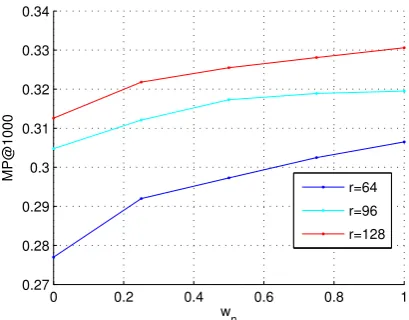
Figure 5 demonstrates the impact of varying the values of neighbor word weight wn from
{0,0.25,0.5,0.75,1}on OrMFN tested in different r conditions. Note that whenwn = 0 indicating
that no neighbor information is exploited, the OrMFN model is simply reduced to the OrMF model. Based on the Figure illustration we can conclude that integrating neighboring word information always
yields a positive effect, since any value of wn > 0 yields a performance gain overwn = 0 which is
OrMF.
6.5 Computation Cost
The data-dependent models involve 2 steps: 1) learning coding functions from a small dataset, and 2)
binary coding for the large scale whole dataset.7 In real-time scenarios, the time is only spent on the
2nd step that involves no matrix factorization. The computation cost of binary coding for all models
(LSH, ITQ, LSA, WTMF, OrMF and OrMFN) are roughly the same: sgn(P·,k>x¯). Note thatP·,k>x¯ =
P·,k>x−P·,k>µwherexis a very sparse vector (with 11 non-zeros values on average) andP·,k>µcan
be precomputed. On the other hand, calculating Hamming distance on binary codes is also very fast using the logic operations.
7Learning the binarization functions can be always done on a small dataset, for example in this paper all the data dependent
0 0.2 0.4 0.6 0.8 1 0.27
0.28 0.29 0.3 0.31 0.32 0.33 0.34
MP@1000
w
n
[image:10.595.188.393.70.230.2]r=64 r=96 r=128
Figure 5: OrMFN model: MP@1000 vs. neighbor word weightwn
7 Conclusion
In this paper, we proposed a novel unsupervised binary coding model which provides efficient similarity search in massive tweet data. The proposed model, OrMFN, improves an existing matrix factorization model through learning nearly orthogonal projection directions and leveraging the neighborhood infor-mation hidden in tweet data. We collected a dataset whose groundtruth labels are created from Twitter hashtags. Our experiments conducted on this dataset showed significant performance gains of OrMFN over the competing methods.
Acknowledgements
We thank Boyi Xie and three anonymous reviewers for their valuable comments. This project is sup-ported by the DARPA DEFT Program.
References
Puneet Agarwal, Rajgopal Vaithiyanathan, Saurabh Sharma, and Gautam Shroff. 2012. Catching the long-tail: Ex-tracting local news events from twitter. InProceedings of the Sixth International AAAI Conference on Weblogs and Social Media.
Eneko Agirre, Daniel Cer, Mona Diab, and Aitor Gonzalez-Agirre. 2012. Semeval-2012 task 6: A pilot on semantic textual similarity. InFirst Joint Conference on Lexical and Computational Semantics (*SEM).
Edward Benson, Aria Haghighi, and Regina Barzilay. 2011. Event discovery in social media feeds. InProceedings
of the 49th Annual Meeting of the Association for Computational Linguistics: Human Language Technologies. Rahul Bhagat and Deepak Ravichandran. 2008. Large scale acquisition of paraphrases for learning surface
pat-terns. InProceedings of ACL-08: HLT.
Andrei Z Broder, Moses Charikar, Alan M Frieze, and Michael Mitzenmacher. 1998. Min-wise independent
permutations. InProceedings of the Thirtieth Annual ACM Symposium on Theory of Computing.
Deepayan Chakrabarti and Kunal Punera. 2011. Event summarization using tweets. InProceedings of the Fifth
International AAAI Conference on Weblogs and Social Media.
Moses S. Charikar. 2002. Similarity estimation techniques from rounding algorithms. InProceedings of the
Thiry-fourth Annual ACM Symposium on Theory of Computing.
Miles Efron. 2010. Information search and retrieval in microblogs. In Journal of the American Society for
Information Science and Technology.
Yunchao Gong and Svetlana Lazebnik. 2011. Iterative quantization: A procrustean approach to learning binary
Weiwei Guo and Mona Diab. 2012. Modeling sentences in the latent space. InProceedings of the 50th Annual Meeting of the Association for Computational Linguistics.
Weiwei Guo, Hao Li, Heng Ji, and Mona Diab. 2013. Linking tweets to news: A framework to enrich online short text data in social media. InProceedings of the 51th Annual Meeting of the Association for Computational Linguistics.
Piotr Indyk and Rajeev Motwani. 1998. Approximate nearest neighbors: towards removing the curse of dimen-sionality. InProceedings of the thirtieth annual ACM symposium on Theory of computing.
Brian Kulis and Kristen Grauman. 2012. Kernelized locality-sensitive hashing. IEEE Transactions On Pattern
Analysis and Machine Intelligence, 34(6):1092–1104.
Thomas K. Landauer and Susan T. Dumais. 1997. A solution to plato’s problem: The latent semantic analysis theory of acquisition, induction and representation of knowledge. InPsychological review.
Yuhua Li, David McLean, Zuhair A. Bandar, James D. O’Shea, and Keeley Crockett. 2006. Sentence similarity
based on semantic nets and corpus statistics. IEEE Transaction on Knowledge and Data Engineering, 18.
Wei Liu, Jun Wang, Sanjiv Kumar, and Shih-Fu Chang. 2011. Hashing with graphs. InProceedings of the 28th
International Conference on Machine Learning.
Wei Liu, Jun Wang, Rongrong Ji, Yu-Gang Jiang, and Shih-Fu Chang. 2012a. Supervised hashing with kernels. InProceedings of IEEE Conference on Computer Vision and Pattern Recognition.
Wei Liu, Jun Wang, Yadong Mu, Sanjiv Kumar, and Shih-Fu Chang. 2012b. Compact hyperplane hashing with bilinear functions. InProceedings of the 29th International Conference on Machine Learning.
Mohammad Norouzi and David J. Fleet. 2011. Minimal loss hashing for compact binary codes. InProceedings
of the 28th International Conference on Machine Learning.
Sasa Petrovic, Miles Osborne, and Victor Lavrenko. 2010. Streaming first story detection with application to
twitter. InHuman Language Technologies: The 2010 Annual Conference of the North American Chapter of the
Association for Computational Linguistics.
Nathan Srebro and Tommi Jaakkola. 2003. Weighted low-rank approximations. InProceedings of the Twentieth
International Conference on Machine Learning.
Harald Steck. 2010. Training and testing of recommender systems on data missing not at random. InProceedings
of the 16th ACM SIGKDD International Conference on Knowledge Discovery and Data Mining.
Julien Subercaze, Christophe Gravier, and Frederique Laforest. 2013. Towards an expressive and scalable twitter’s
users profiles. InIEEE/WIC/ACM International Joint Conferences on Web Intelligence and Intelligent Agent
Technologies.
Yair Weiss, Antonio Torralba, and Rob Fergus. 2008. Spectral hashing. In Advances in Neural Information