A Comparative Evaluation of Data-driven Models in Translation
Selection of Machine Translation
◦Yu-Seop Kim ? Jeong-Ho Chang ?Byoung-Tak Zhang ◦ Ewha Institute of Science and Technology, Ewha Woman’s Univ.
Seoul 120-750 Korea, [email protected]∗
? Schools of Computer Science and Engineering, Seoul National Univ. Seoul 151-742 Korea,{jhchang, btzhang}@bi.snu.ac.kr†
Abstract
We present a comparative evaluation of two data-driven models used in translation selec-tion of English-Korean machine translaselec-tion. La-tent semantic analysis(LSA) and probabilistic latent semantic analysis (PLSA) are applied for the purpose of implementation of data-driven models in particular. These models are able to represent complex semantic structures of given contexts, like text passages. Grammatical rela-tionships, stored in dictionaries, are utilized in translation selection essentially. We have used
k-nearest neighbor (k-NN) learning to select an appropriate translation of the unseen instances in the dictionary. The distance of instances in
k-NN is computed by estimating the similar-ity measured by LSA and PLSA. For experi-ments, we used TREC data(AP news in 1988) for constructing latent semantic spaces of two models and Wall Street Journal corpus for eval-uating the translation accuracy in each model. PLSA selected relatively more accurate transla-tions than LSA in the experiment, irrespective of the value of k and the types of grammatical relationship.
1 Introduction
Construction of language associated resources like thesaurus, annotated corpora, machine-readable dictionary and etc. requires high de-gree of cost, since they need much of human-effort, which is also dependent heavily upon hu-man intuition. A data-driven model, however, does not demand any of human-knowledge, knowledge bases, semantic thesaurus, syntac-tic parser or the like. This model represents
∗ He is supported by Brain Korea 21 project performed by Ewha Institute of Science and Technology.
† They are supported by Brain Tech. project controlled by Korean Ministry of Science and Technology.
latent semantic structure of contexts like text passages. Latent semantic analysis (LSA) (Lan-dauer et al., 1998) and probabilistic latent se-mantic analysis (PLSA) (Hofmann, 2001) fall under the model.
LSA is a theory and method for extracting and representing the contextual-usage meaning of words. This method has been mainly used for indexing and relevance estimation in infor-mation retrieval area (Deerwester et al., 1990). And LSA could be utilized to measure the co-herence of texts (Foltz et al., 1998). By applying the basic concept, a vector representation and a cosine computation, to estimate relevance of a word and/or a text and coherence of texts, we could also estimate the semantic similarity between words. It is claimed that LSA repre-sents words of similar meaning in similar ways (Landauer et al., 1998).
Probabilistic LSA (PLSA) is based on proba-bilistic mixture decomposition while LSA is on a linear algebra and singular value decomposition (SVD) (Hofmann, 1999b). In contrast to LSA, PLSA’s probabilistic variant has a sound statis-tical foundation and defines a proper generative model of the data. Both two techniques have a same idea which is to map high-dimensional vectors representing text documents, to a lower dimensional representation, called a latent se-mantic space (Hofmann, 1999a).
Dagan (Dagan et al., 1999) performed a com-parative analysis of several similarity measures, which based mainly on conditional probability distribution. And the only elements in the dis-tribution are words, which appeared in texts. However, LSA and PLSA expressed the latent semantic structures, called a topic of the con-text.
selection of English-Korean machine transla-tion. First, we built a dictionary storing tu-ples representing the grammatical relationship of two words, like subject-verb,object-verb, and
modifier-modified. Second, with an input tuple, in which an input word would be translated and the other would be used as an argument word, translation is performed by searching the dic-tionary with the argument word. Third, if the argument word is not listed in the dictionary, we used k-nearest neighbor learning method to determine which class of translation is appro-priate for the translation of an input word. The distance used in discovering the nearest neigh-bors was computed by estimating the similarity measured on above latent semantic spaces.
In the experiment, we used 1988 AP news corpus from TREC-7 data (Voorhees and Har-man, 1998) for building latent semantic spaces and Wall Street Journal (WSJ) corpus for con-structing a dictionary and test sets. We ob-tained 11-20% accuracy improvement, compar-ing to a simple dictionary search method. And PLSA has shown that its ability to select an ap-propriate translation is superior to LSA as an extent of up to 3%, without regard to the value of kand grammatical relationship.
In section 2, we discuss two of data-driven models, LSA and PLSA. Section 3 describes ways of translation with a grammatical rela-tion dicrela-tionary andk-nearest neighbor learning method. Experiment is explained in Section 4 and concluding remarks are presented in Section 5.
2 Data-Driven Model
For the data-driven model which does not re-quire additional human-knowledge in acquiring information, Latent Semantic Analysis (LSA) and Probabilistic LSA (PLSA) are applied to es-timate semantic similarity among words. Next two subsections will explain how LSA and PLSA are to be adopted to measuring semantic simi-larity.
2.1 Latent Semantic Analysis
The basic idea of LSA is that the aggregate of all the word contexts in which a given word does and does not appear provides a set of mutual constraints that largely determines the similar-ity of meaning of words and sets of words to each other (Landauer et al., 1998)(Gotoh and Renals,
1997). LSA also extracts and infers relations of expected contextual usage of words in passages of discourse. It uses no human-made dictionar-ies, knowledge bases, semantic thesaurus, syn-tactic parser or the like. Only raw text parsed into unique character strings is needed for its input data.
The first step is to represent the text as a matrix in which each row stands for a unique word and each column stands for a text passage or other context. Each cell contains the occur-rence frequency of a word in the text passage.
Next, LSA applies singular value decomposi-tion (SVD) to the matrix. SVD is a form of factor analysis and is defined as
A=UΣVT (1)
,where Σ is a diagonal matrix composed of nonzero eigen values of AAT or ATA, and U
and V are the orthogonal eigenvectors associ-ated with thernonzero eigenvalues ofAAT and
ATA, respectively. One component matrix (U)
describes the original row entities as vectors of derived orthogonal factor value, another (V) de-scribes the original column entities in the same way, and the third (Σ) is a diagonal matrix con-taining scaling values when the three compo-nents are matrix-multiplied, the original matrix is reconstructed.
The singular vectors corresponding to the
k(k ≤ r) largest singular values are then used to definek-dimensional document space. Using these vectors,m×kandn×kmatricesUkandVk
may be redefined along withk×ksingular value matrixP
k. It is known thatAk =UkΣkVkT is
the closest matrix of rankk to the original ma-trix.
LSA can represent words of similar meaning in similar ways. This can be claimed by the fact that one compares words with similar vectors as derived from large text corpora. The term-to-term similarity is based on the inner products between two row vectors ofA,AAT =UΣ2UT.
One might think of the rows ofUΣ as defining coordinates for terms in the latent space. To calculate the similarity of coordinates, V1 and
V2, cosine computation is used:
cosφ= V1·V2
2.2 Probabilistic Latent Semantic Analysis
Probabilistic latent semantic analysis (PLSA) is a statistical technique for the analysis of two-mode and co-occurrence data, and has produced some meaningful results in such applications as language modelling (Gildea and Hofmann, 1999) and document indexing in information re-trieval (Hofmann, 1999b). PLSA is based on
aspect model where each observation of the co-occurrence data is associated with a latent class variable z ∈ Z = {z1, z2, . . . , zK} (Hofmann, 1999a). For text documents, the observation is an occurrence of a word w∈W in a document
d ∈ D, and each possible state z of the latent class represents one semantic topic.
A word-document co-occurrence event, (d, w), is modelled in a probabilistic way where it is parameterized as in
P(d, w) = X
z
P(z)P(d, w|z)
= X
z
P(z)P(w|z)P(d|z). (3)
Here, w and d are assumed to be condition-ally independent given a specificz. P(w|z) and
P(d|z) are topic-specific word distribution and document distribution, respectively. The three-way decomposition for the co-occurrence data is similar to that of SVD in LSA. But the ob-jective function of PLSA, unlike that of LSA, is the likelihood function of multinomial sam-pling. And the parameters P(z), P(w|z), and
P(d|z) are estimated by maximization of the log-likelihood function
L= X
d∈D
X
w∈W
n(d, w) logP(d, w), (4)
and this maximization is performed using the EM algorithm as for most latent variable mod-els. Details on the parameter estimation are referred to (Hofmann, 1999a). To compute the similarity of w1 and w2, P(zk|w1)P(zk|w2)
should be approximately computed with being derived from
P(zk|w) = P P(zk)P(w|zk)
zk∈ZP(zk)P(w|zk)
(5)
And we can evaluate similarities with the low-dimensional representation in the semantic topic space P(zk|w1) and P(zk|w2).
3 Translation with Grammatical Relationship
3.1 Grammatical Relationship
We used grammatical relations stored in the form of a dictionary for translation of words. The structure of the dictionary is as follows (Kim and Kim, 1998):
T(Si) =
T1 if Cooc(Si, S1)
T2 if Cooc(Si, S2)
. . .
Tn otherwise,
(6)
where Cooc(Si, Sj) denotes grammatical
co-occurrence of source wordsSiandSj, which one
means an input word to be translated and the other means an argument word to be used in translation, and Tj is the translation result of
the source word. T(·) denotes the translation process.
Table 1 shows a grammatical relationship dic-tionary for an English verb Si =‘build’ and its
object nouns as an input word and an argument word, respectively. The dictionary shows that the word‘build’ is translated into five different translated words in Korean, depending on the context. For example,‘build’ is translated into ‘geon-seol-ha-da’ (‘construct’) when its object noun is a noun ‘plant’ (=‘factory’), into ‘che-chak-ha-da’ (‘produce’) when co-occurring with the object noun ‘car’, and into ‘seol-lip-ha-da’ (‘establish’) in the context of object noun ‘com-pany’ (Table 2).
One of the fundamental difficulties in co-occurrence-based approaches to word sense dis-ambiguation (translation selection in this case) is the problem of data sparseness or unseen words. For example, for an unregistered object noun like ‘vehicle’ in the dictionary, the correct translation of the verb cannot be selected us-ing the dictionary described above. In the next subsection, we will present k-nearest neighbor method that resolves this problem.
3.2 k-Nearest Neighbor Learning for Translation Selection
Table 1: Examples of co-occurrence word lists for a verb‘build’in the dictionary Meaning of‘build’ in Korean (Tj) Collocated Object Noun (Sj)
‘geon-seol-ha-da’ (= ‘construct’) plant facility network . . . ‘geon-chook-ha-da’ (= ‘design’) house center housing . . . ‘che-chak-ha-da’ (= ‘produce’) car ship model . . . ‘seol-lip-ha-da’ (= ‘establish’) company market empire . . . ‘koo-chook-ha-da’ (= ‘develop’) system stake relationship . . .
Table 2: Examples of translation of ‘build’
source words translated words (in Korean) sense of the verb ‘buildaplant’ ⇒ ‘gong-jang-eulgeon-seol-ha-da’ ‘construct’
‘buildacar’ ⇒ ‘ja-dong-cha-reulche-chak-ha-da’ ‘produce’
‘buildacompany’ ⇒ ‘hoi-sa-reulseol-lip-ha-da’ ‘establish’
The k-nearest neighbor learning algorithm (Cover and Hart, 1967)(Aha et al., 1991) as-sumes all instances correspond to points in the
n-dimensional space Rn. We mapped the n -dimensional space into then-dimensional vector of a word for an instance. The nearest neigh-bors of an instance are defined in terms of the standard Euclidean distance.
Then the distance between two instances xi
and xj,D(xi, xj), is defined to be
D(xi, xj) =
q
(a(xi)−a(xj))2 (7)
and a(xi) denotes the value of instancexi,
sim-ilarly to cosine computation between two vec-tors. Let us consider learning discrete-valued target functions of the form f : Rn → V, where V is the finite set {v1, . . . , vs}. The k -nearest neighbor algorithm for approximating a discrete-valued target function is given in Table 3.
The value ˆf(xq) returned by this algorithm
as its estimate of f(xq) is just the most
com-mon value of f among thek training examples nearest toxq.
4 Experiment and Evaluation
4.1 Data for Latent Space and Dictionary
In the experiment, we used two kinds of cor-pus data, one for constructing LSA and PLSA spaces and the other for building a dictionary containing grammatical relations and a test set. 79,919 texts in 1988 AP news corpus from TREC-7 data was indexed with a stemming tool and 19,286 words with the frequency of above 20
Table 3: The k-nearest neighbor learning algo-rithm.
• Training
– For each training example hx, f(x)i, add the example to the list
training examples.
• Classification
– Given a query instance xq to be
clas-sified,
∗ Let x1, . . . , xk denote the k
in-stances from training examples
that are nearest toxq. ∗ Return
ˆ
f(xq)←arg maxv∈V k
X
i=1
δ(v, f(xi)) ,
where δ(a, b) = 1 if a = b and
δ(a, b) = 0 otherwise.
sin-Figure 1: The accuracy ration ofverb-object
gle vector lanczos algorithm derived from SVD-PACK when constructing LSA space. (Berry et al., 1993). We generated both of LSA and PLSA spaces, with each word having a vector of 200 and 128 dimensions, respectively. The similarity of any two words could be estimated by performing cosine computation between two vectors representing coordinates of the words in the spaces.
Table 4 shows 5 most similar words of ran-domly selected words from 3,443 examples. We extracted 3,443 example sentences containing grammatical relations, like verb-object, subject-verbandadjective-noun, from Wall Street Jour-nal corpus of 220,047 sentences and other newspapers corpus of 41,750 sentences, totally 261,797 sentences. We evaluated the accu-racy performance of each grammatical rela-tion. 2,437, 188, and 818 examples were uti-lized forverb-object,subject-verb, and adjective-noun, respectively. The selection accuracy was measured using 5-fold cross validation for each grammatical relation. Sample sentences of each grammatical relation were divided into five dis-joint samples and each sample became a test sample once in the experiment and the remain-ing four samples were combined to make up a collocation dictionary.
4.2 Experimental Result
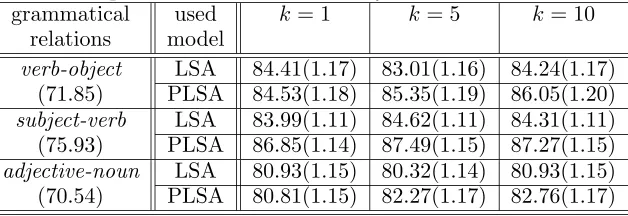
[image:5.595.76.296.73.240.2]Table 5 and figure 1-3 show the results of translation selection with respect to the applied model and to the value ofk. As shown in Table 5, similarity based on data-driven model could improve the selection accuracy up to 20% as
[image:5.595.323.540.78.241.2]Figure 2: The accuracy ration ofsubject-verb
Figure 3: The accuracy ration ofadjective-noun
contrasted with the direct matching method. We could obtain the result that PLSA could improve the accuracy more than LSA in almost all cases. The amount of improvement is varied from -0.12% to 2.96%.
[image:5.595.322.542.289.447.2]re-Table 4: Lists of 5 most semantically similar words for randomly selected words generated from LSA, and PLSA. The words are stems of original words. The first row of each selected word stands for the most similar words in LSA semantic space and the second row stands for those in the PLSA space.
selected words most similar words
plant westinghous isocyan shutdown zinc manur radioact hanford irradi tritium biodegrad car buick oldsmobil chevrolet sedan corolla
highwai volkswagen sedan vehicular vehicle home parapleg broccoli coconut liverpool jamal
memori baxter hanlei corwin headston business entrepreneur corpor custom ventur firm
digit compat softwar blackston zayr ship vessel sail seamen sank sailor
[image:6.595.83.466.130.272.2]destroy frogmen maritim skipper vessel
Table 5: Translation accuracy in various case. The first column stands for each grammatical relation and the second column stands for the used models, LSA or PLSA. And other three columns stand for the accuracy ratio (rm) with respect to the value ofk. The numbers in parenthesis of the first
column show the translation accuracy ratio of simple dictionary search method (rs). And numbers
in the other parenthesis were obtained by rm÷rs.
grammatical used k= 1 k= 5 k= 10 relations model
verb-object LSA 84.41(1.17) 83.01(1.16) 84.24(1.17) (71.85) PLSA 84.53(1.18) 85.35(1.19) 86.05(1.20)
subject-verb LSA 83.99(1.11) 84.62(1.11) 84.31(1.11) (75.93) PLSA 86.85(1.14) 87.49(1.15) 87.27(1.15)
adjective-noun LSA 80.93(1.15) 80.32(1.14) 80.93(1.15) (70.54) PLSA 80.81(1.15) 82.27(1.17) 82.76(1.17)
lations, subj-verb, showed an exceptional case, which seemed to be caused by the small size of examples, 188.
Selection errors taking place in LSA and PLSA models were caused mainly by the fol-lowing reasons. First of all, the size of vocab-ulary should be limited by computation com-plexity. In this experiment, we acquired below 20,000 words for the vocabulary, which could not cover a section of corpus data. Second, the stemming algorithm was not robust for an in-dexing. For example, ‘house’ and ‘housing’are regarded as a same word as ‘hous’. This fact brought about hardness in reflecting the seman-tic structure more precisely. And finally, the meaning of similar word is somewhat varied in the machine translation field and the informa-tion retrieval field. The selecinforma-tional restricinforma-tion tends to depend a little more upon semantic
type like human-being, place and etc., than on the context in a document.
5 Conclusion
[image:6.595.77.391.351.459.2]the grammatically-related class for the majority of the k words is selected as the translation of an input word.
We evaluated the accuracy ratio of LSA and PLSA comparatively and classified the exper-iments with criteria of the values of k and the grammatical relations. We acquired up to 20% accuracy improvement, compared to direct matching to a collocation dictionary. PLSA showed the ability to select translation better than LSA, up to 3%. The value ofkis strongly related with PLSA in translation accuracy, not too with LSA. That means the latent semantic space of PLSA has more sound distribution of latent semantics than that of LSA. Even though longer learning time than LSA, PLSA is benefi-cial in translation accuracy and distributional soundness. A distributional soundness is ex-pected to have better performance as the size of examples is growing.
However, we should resolve several problems raised during the experiment. First, a robust stemming tool should be exploited for more ac-curate morphology analysis. Second, the opti-mal value ofkshould be obtained, according to the size of examples. Finally, we should discover more specific contextual information suited to this type of problem. While simple text could be used properly in IR, MT should require an-other type of information.
The data-driven models could be applied to other sub-fields related with semantics in ma-chine translation. For example, to-infinitive phrase and preposition phrase attachment dis-ambiguation problem can also apply these els. And syntactic parser could apply the mod-els for improvement of accurate analysis by us-ing semantic information generated by the mod-els.
References
D. Aha, D. Kibler, and M. Albert. 1991. Instance-based learning algorithms. Machine Learning, 6:37–66.
M. Berry, T. Do, G. O’Brien, V. Krishna, and S. Varadhan. 1993. Svdpackc: Version 1.0 user’s guide. Technical Report CS–93–194, University of Tennessee, Knoxville, TN. T. Cover and P. Hart. 1967. Nearest neighbor
pattern classification. IEEE Transactions on Information Theory, 13:21–27.
I. Dagan, L. Lee, and F. Fereira. 1999. Similarity-based models of word cooccurrence probabilities. Machine Learning, 34:43–69. S. Deerwester, S. Dumais, G. Furnas, T.
Lan-dauer, and R. Harshman. 1990. Indexing by latent semantic analysis. Journal of the American Society for Information Science, 41:391–407.
P. Foltz, W. Kintsch, and T. Landauer. 1998. The mesurement of textual coherence with la-tent semantic analysis. Discourse Processes, 25:285–307.
D. Gildea and T. Hofmann. 1999. Topic based language models using em. In Proceedings of the 6th European Conference on Speech Com-munication and Technology (Eurospeech99). D. Gotoh and S. Renals. 1997. Document
space models using latent semantic analysis. InProceedings of Eurospeech-97, pages 1443– 1446.
T. Hofmann. 1999a. Probabilistic latent se-mantic analysis. In Proceedings of the Fif-teenth Conference on Uncertainty in Artifi-cial Intelligence (UAI’99).
T. Hofmann. 1999b. Probabilistic latent se-mantic indexing. In Proceedings of the 22th Annual International ACM SIGIR conference on Research and Developement in Informa-tion Retrieval (SIGIR99), pages 50–57. T. Hofmann. 2001. Unsupervised learning by
probabilistic latent semantic analysis. Ma-chine Learning Journal, 42(1):177–196. Y. Kim and Y. Kim. 1998. Semantic
implemen-tation based on extended idiom for english to korean machine translation. The Asia-Pacific Association for Machine Translation Journal, 21:23–39.
T. K. Landauer, P. W. Foltz, and D. Laham. 1998. An introduction to latent semantic analysis. Discourse Processes, 25:259–284. E. Voorhees and D. Harman. 1998. Overview of