SriShell Primo: A Predictive Sinhala Text Input System
Sandeva Goonetilleke† Yoshihiko Hayashi‡ Yuichi Itoh† Fumio Kishino‡
sandeva.goonetilleke hayashi@lang. itoh@ist. kishino@ist.
@ist.osaka-u.ac.jp osaka-u.ac.jp osaka-u.ac.jp osaka-u.ac.jp
†Graduate School of Information Science and Technology, Osaka University ‡Graduate School of Language and Culture, Osaka University
Yamada oka, Suita, Osaka, Japan.
Abstract
Sinhala, spoken in Sri Lanka as an official language, is one of the less privileged lan-guages; still there are no established text in-put methods. As with many of the Asian lan-guages, Sinhala also has a large set of char-acters, forcing us to develop an input method that involves a conversion process from a key sequence to a character/word. This paper proposes a novel word-based predic-tive text input system named SriShell Primo. This system allows the user to input a Sin-hala word with a key sequence that highly matches his/her intuition from its pronuncia-tion. A key to this scenario is a pre-compiled table that lists conceivable roman character sequences utilized by a wide range of users for representing a consonant, a consonant sign, and a vowel. By referring to this ta-ble, as the user enters a key, the system gen-erates possible character strings as candidate Sinhala words. Thanks to a TRIE structured word dictionary and a fast search algorithm, the system successively and efficiently nar-rows down the candidates to possible Sin-hala words. The experimental results show that the system greatly improves the user-friendliness compared to former character-based input systems while maintaining high efficiency.
1 Introduction
The mother tongue of 14.6 million (74% of the total Sri Lankan population of 19.7 million) Sri Lankans
is Sinhala (U S Department Of State, 2007). While computing has become almost ubiquitous in the US and Europe, Sinhala is inadequately supported on computers. Sinhala is a less privileged language that does not have even an efficient and highly user-friendly text input system. This is a major bottleneck in handling Sinhala text on computers in order to de-velop any natural language processing tools. Even though various kinds of Sinhala fonts and input ap-plications have been proposed, the language is still not well supported by computer systems. Hundreds of Sinhala fonts have been developed, but most of them have their own weaknesses. For example some rare Sinhala characters (such as , ) are miss-ing in most of the fonts. Furthermore, the major problems of the current input systems are the lack of user-friendliness and efficiency.
The objective of this research is to propose an effi-cient and highly user-friendly predictive Sinhala in-put method, and to evaluate the efficiency and the user-friendliness compared with other input meth-ods. Here, efficiency is quantified by the aver-age typing cost per Sinhala character, and user-friendliness is quantified by ease of remembering. The average edit distance between a user-intuitive character sequence and the input sequences of each input method is taken as a measurement of the dif-ficulty of remembering. Our results have proved that SriShell Primo has maximum user-friendliness while maintaining high efficiency.
The rest of the paper is organized as follows. In Section 2 we discuss various Sinhala input methods proposed up to now, and their main features. The main features of the proposed input method SriShell
Primo are explained in Section 3. The evaluations are reported in Section 4. Section 5 concludes and outlines future work.
2 Character-based Input Systems
This section reviews the representative Sinhala input systems proposed so far.
These input methods are character-based, forcing the users to memorize key assignments for each and every Sinhala character. This is not an easy task be-cause Sinhala has hundreds of combined characters.
2.1 Direct Input Method
Sinhala fonts assign vowel characters, consonant characters and vowel signs to the ASCII character code. For example, Sinhala (=a) was assigned to 0x61 (=ASCII ‘a’) in most of the fonts. In the di-rect input method, users have to input the character codes as assigned in a specific Sinhala font. A typ-ical example of this kind of font is the “kaputadot-com” font.1 Most of the online Sinhala sites includ-ing news sites use these kinds of fonts.
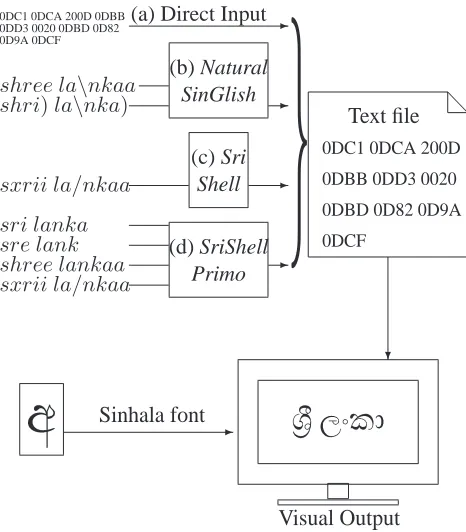
Sinhala Unicode characters can also be input di-rectly by entering the hexadecimal code. The arrow (a) in Figure 1 shows an example of this method of input.
2.2 Conversion Systems
The direct input method assigns a key for each Sin-hala character or a part of a character that may or may not be phonetically associated. For this reason, the key assignments are far from intuitive.
Natural SinGlish
To resolve this problem the Natural SinGlish (Natural Singlish, 2004) typing application was in-troduced by A. D. R. Sasanka. This application converts the input sequence that is more natural for users into character codes as shown in (b) of Fig-ure 1. English spellings and the English pronuncia-tions are the basis of this system. For example shree la\nkaa→27 H (=Sri Lanka). However, Sinhala has many more characters than English. To avoid ambiguity, this system has introduced several tech-niques, such as:
1http://www.info.lk/slword/news.htm
Input Sequences
0DC1 0DCA 200D 0DBB 0DD3 0020 0DBD 0D82 0D9A 0DCF
shree la\nkaa shri)la\nka)
sxrii la/nkaa
sri lanka sre lank shree lankaa sxrii la/nkaa
(a) Direct Input
-(b) Natural
SinGlish
-(c) Sri
Shell
-(d) SriShell
Primo
-}
Text file @ ? 0DC1 0DCA 200D0DBB 0DD3 0020
0DBD 0D82 0D9A
0DCF
27 H
Visual Output
Sinhala font-Figure 1: Sinhala character input systems (taking27 H (´sr¯i lam.k¯a : Sri Lanka) as an example)
• Capitals
a → (=a) ta → (=t.a)
A → (=æ) Ta → (=t.ha)
• Key combinations
ea → (=¯e) KNa → (=˜na)
oe → (=¯o) Sha → 8(=s.a)
• Dead keys: “\” is used as a dead key \n → (=N)
\h → (=h)
This system is simply based on English spellings, making the system quite complex. The characters that have phonetic similarities cannot be typed in a similar manner.
ka → H(=ka) and kha → P(=kha)
ta → (=t.a) but tha 6→ (=t.ha)
da → (=da) and nnda → h(=ˇnd.a)
ba → è(=ba) but nnba 6→ p(= ˇmba)
Sri Shell
Goonetilleke et al. have proposed a Sinhala typ-ing system called Sri Shell (Goonetilleke et al., 2007). Sri Shell assigns a key combination to each Sinhala character ((c) of Figure 1). The basis of this system is the phonetic notation of Sinhala charac-ters.
Unlike the Natural SinGlish, Sri Shell has been implemented as an independent module, which al-lows the input of Sinhala text into any application program. Principles of the Sri Shell system are as follows.
• It is based on phonetic notation of the charac-ters:
– All aspirated consonants can be produced by adding an “h” to the unaspirated con-sonants.
– Nasals can be produced by voiceless vowel preceded by “/”.
– Nasal+voiced can be produced by voiced vowel preceded by “/”.
• It is consistent:
– All long-vowels can be produced by dou-bling the last character of a short-vowel.
– If two Sinhala characters map to the same roman character, then these Sinhala char-acters are differentiated by adding an “x.” The “x” is added to the one that has a lower occurrence rate.
• It is complete:
Most of the Sinhala input systems introduced up to now have several missing characters. Es-pecially rare characters such as , , , are missing in most systems. Sri Shell supports all the characters even though some of them cannot be displayed with most of the fonts.
2.3 Problems on Input Systems
Goonetilleke et al. have introduced average edit dis-tance (per Sinhala character) as a measurement of user-friendliness. Even though they have succeeded in limiting the average edit distance to 0.35 keys per sinhala character, still the Sri Shell input sequence is quite far from users’ natural intuition.
da
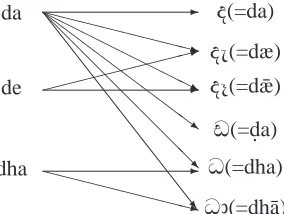
Figure 2: Some many-to-many relationships in test subjects’ proposals
Our experiments have proven that users expect to get different Sinhala characters by typing the same key sequence. A few examples of these kinds of sit-uations are shown in Figure 2.
Unfortunately, all the Sinhala input methods pro-posed up to now have a one-to-one (or many-to-one) relationship between the input sequence and output characters. For this reason users have to memorize how to type each Sinhala character.
To overcome this problem a many-to-many pre-dictive character conversion algorithm is required.
3 Proposal: Word-based Input System
Here we propose a Sinhala input system called Sr-iShell Primo. SrSr-iShell Primo is a word-based predic-tive converter. A number of predicpredic-tive input meth-ods have been proposed so far especially for hand-held devices and mobile phones (MacKenzie et al., 2007). Among them, eZiText(R)2supports some
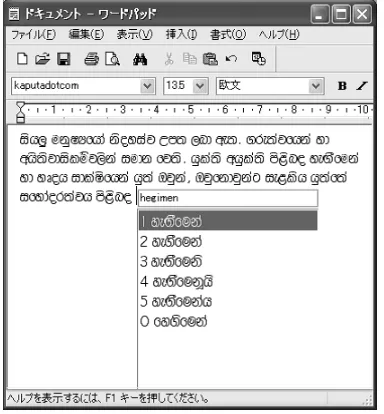
In-dic scripts such as Hindi, Tamil, Malayalam etc. The SriShell Primo users can input a Sinhala word by typing it in the roman character sequence they think is most appropriate. Even though the roman charac-ter sequence for a specific Sinhala word may differ from person to person, the SriShell Primo system is still capable of guessing the Sinhala word intended by the users. The user can select the intended word from the candidate list. A screen shot of the system is shown in Figure 3.
3.1 Main Features
SriShell Primo has three main features.
Figure 3: Screen Shot of SriShell Primo
1. Covers all possible input sequences
The roman character sequence used to represent each Sinhala word depends on the user. For exam-ple:
− desei, dase, dese, daasee, desee, dasee, daesei, dasay, deesee, desee, dhasay, dhese → E (=d ¯æs¯e:in eyes)
On the other hand the input sequences can be am-biguous. For example:
− bata → ð(=bhata:soldier), è(bæta:hurt),
è(=bata:bamboo or pipe), è (=b¯at¯a:a trade name)
The SriShell Primo is capable of converting all these possible sequences into the user-intended word.
2. Predicts possible words
SriShell Primo not only gives the Sinhala words that could be completely represented by the input roman character sequence, but the predicted Sinhala words are also added into the menu dynamically.
3. Allows word combinations
Normally Sinhala words are separated by a space, but we have found out in our preliminary experi-ments that sometimes some users omit the space, es-pecially in the case of frequently co-occurring word pairs. SriShell Primo allows up to one space omis-sion. Thus SriShell Primo gives word pairs also at
the end of the menu, if the number of word candi-dates from the above methods is very small.
(a) (b)
(c) (d)
Figure 4: Text Entering Example è(Õ(¯ayub¯ovan:Welcome)
Figure 4 demonstrates how the menu changes dynamically as user enters the keys, taking
è(Õ (¯ayub¯ovan:Welcome) as an example.
When the user starts typing with “a” SriShell Primo gives a list of candidates in the menu that starts with , ,, etc. as shown in Figure 4(a). When the user types up to “ayub” the intended word è(Õ appears for the first time in the menu as the second choice (Figure 4(b)). Then
è (Õ rises to the first choice of the menu
3.2 The Algorithm
Input Sequences
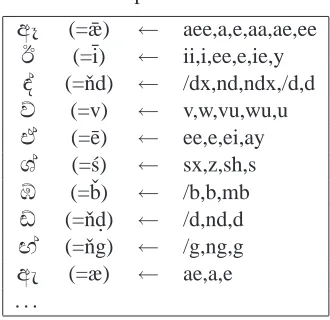
Goonetilleke et al. have carried out an experiment to find out how the most frequent Sinhala characters are romanized by Sinhala speakers. We have fur-ther divided the roman character sequence for each Sinhala character into the consonant part, consonant sign part and vowel part. Thus we got a table that shows how each consonant, consonant sign or vowel is romanized by various users, as shown in Table 1.
Table 1: Input variation table
(= ¯æ) ← aee,a,e,aa,ae,ee (=¯i) ← ii,i,ee,e,ie,y » (=ˇnd) ← /dx,nd,ndx,/d,d (=v) ← v,w,vu,wu,u (=¯e) ← ee,e,ei,ay 5 (=´s) ← sx,z,sh,s u (=ˇb) ← /b,b,mb m (=ˇnd.) ← /d,nd,d ] (=ˇng) ← /g,ng,g (=æ) ← ae,a,e . . .
Dictionary (TRIE structure)
We have used the Divaina online Sinhala news-paper3 from January 2005 to May 2006 (about 50 MB of kaputadotcom font text) to create the dictio-nary. This dictionary contains about 240,000 words with their occurrence frequencies. To improve the search speed, the words are stored in a TRIE struc-ture, where each branch of the TRIE structure repre-sents a consonant part, vowel part or consonant sign part of a Sinhala character. Thus any single Sin-hala character can be retrieved up to three hops. To reduce the amount of memory required, at the be-ginning this data structure is stored in the disk, and when the user starts to type words, the required part of the data structure is copied into the memory.
Procedure
When the user enters the text, SriShell Primo cre-ates a list of all possible Sinhala character sequences that can be represented by the user’s character se-quence using the Input variation table. SriShell
3http://www.divaina.com/
Primo travels along the TRIE structure in order to find out whether the Sinhala character sequences in the list are real words or not. As a result a candi-date list is created and sorted in descending occur-rence frequency order. For example in Figure 4(a) the candidates from 1 to 5 are created at this point.
Then SriShell Primo searches the Sinhala char-acter sequence list to find out whether there is any sequence that matches the beginning of a Sinhala word. Those predicted words are also added at the end of the candidate list. The candidates from 6 on-ward in Figure 4(a) are added at this point.
If SriShell Primo was unable to find any candi-dates up to this point, it searches for word pairs that can be matched with the input character sequence, assuming that the user could have omitted a space in between.
Finally the SriShell (Goonetilleke et al., 2007) conversion of the character sequence is also added at the end of the candidate list, in order to allow typing a new word that is not included in the dic-tionary. The candidate number 0 in Figure 4(a) is added at this point. This candidate list is displayed as a menu, where the user can select the word that he/she intended by using a mouse or up/down arrow keys.
This process is repeated on each keystroke of the user. The user can enter the selected item to his/her document by striking the space key or any punctua-tion key.
4 Evaluation
This section describes the evaluation of the pro-posed input method. Following (Goonetilleke et al., 2007), we have also evaluated the proposed method in terms of efficiency and user friendliness.
4.1 Experiment
specific Sinhala word. SriShell Primo keeps a log of typed keys, menu items selected, and time lapses in between. This experiment was carried out on a group of 6 subjects (2 female and 4 male, age 20-29 years).
4.2 Efficiency
The most general way to calculate efficiency is to ex-perimentally compute the maximum typing speeds for each input method. Masui (Masui, 1998) has also used this measure to evaluate his character in-put method. However, the inin-put sequences of the ex-isting input methods are quite far from the average Sinhala computer users’ intuition, and it is not easy to train people for typing Sinhala using those input methods, in order to carry out an experiment to mea-sure their efficiencies. Hence, instead of the actual typing speed, Goonetilleke et al. have introduced av-erage typing cost per Sinhala character, which rep-resents the normalized typing speed, as a measure for efficiency. They have defined the average typing cost by Equation 1. There the weight of a normal key is set to 1, andwshif tandwrepeatare determined by
applying the least square method as shown in Equa-tions 4 and 5.
typing cost = 1
#Sinhala characters × (normal keys
+ wshif t×shif ts
+ wrepeat×repeats) (1)
wshif t = txY +tXy
txy
−2 (2)
wrepeat =
txx
txy (3)
where,
txy= average time lapse
between two alpha key strokes txx= average time lapse
to repeat an alpha key stroke txY= average time lapse
between an alpha key and a shifted alpha key tXy= average time lapse
between a shifted alpha key and an alpha key wrepeat = 0.87−0.73txy(|r|= 85%) (4)
wshif t = 2.50−2.92txy(|r|= 69%) (5)
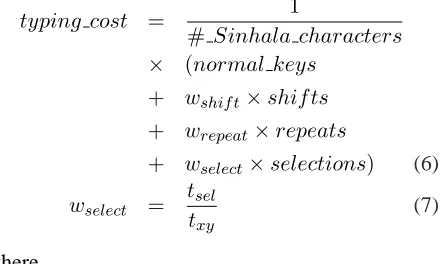
Accordingly we define average typing cost per Sinhala character for SriShell Primo by adding the menu selecting time factor as shown in Equation 6.
typing cost = 1
#Sinhala characters × (normal keys
+ wshif t×shif ts + wrepeat×repeats
+ wselect×selections) (6)
wselect = tsel
txy (7)
where,
tsel= average time taken to select an item from the menu
Results
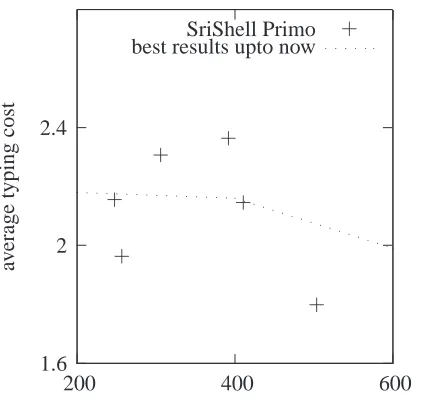
We have calculated the typing cost per Sinhala character from our experiment. The results are shown in Figure 5. The X-axis showstxy, the
aver-age time lapse between two alpha key strokes, while the Y-axis shows the average typing cost per Sinhala character. For comparison purposes we have plot-ted the best result obtained by Goonetilleke et al. as shown in Table 2.
Table 2: Average typing cost by Goonetilleke et al. txy best results Input Method
200 2.18 Sri Shell
400 2.16 Sri Shell
600 1.99 kaputadotcom
2.4
2
1.6
600 400
200
av
erage
typing
cost
average typing speed of subjects [milliseconds] SriShell Primo
+
+
+ +
+
+ + best results upto now
Figure 5: Average typing cost
say that the efficiency of SriShell Primo is not worse than Sri Shell and kaputadotcom because 4 out of 6 subjects who participated in our experiment were able to type Sinhala text more efficiently compared to the best efficiencies obtained by Goonetilleke’s experiments.
4.3 User-friendliness
User-friendliness is strongly associated with how easy it is to remember the predefined input sequence for each Sinhala character. Goonetilleke et al. have taken the difference between the input character se-quences of each input method and user intuitive character sequence as a measure of how difficult it is to remember the input sequence for each Sinhala character. They have measured the difference be-tween the input key sequence of each input method and the proposed romanized sequence by several Sinhala speakers on several words by the edit dis-tance between the two strings as shown in Equation 8.
avg edit dist= (8)
1
# Sinhala Chars×edit dist( user intuitive character sequence,
input sequence of specif ic input method)
Table 3: Average edit distances Input Method Average edit distance
kaputadotcom 1.42
Sri Shell 0.44
Natural SinGlish 0.35
SriShell Primo ≤0.04
Edit Distance
The Levenshtein distance or edit distance be-tween two strings is given by the minimum number of operations needed to transform one string into the other, where an operation is an insertion, deletion, or substitution of a single character (Wagner et al., 1974).
The user-friendliness of SriShell Primo is com-pletely dependent on the input variation table (Ta-ble 1). By adjusting this ta(Ta-ble it is possi(Ta-ble to make SriShell Primo accept all user intuitive input se-quences. As we have included all the conversions derived from Goonetilleke’s experiment, we can ex-pect a very high level of user-friendliness.
However, if there is any lack of user-friendliness in SriShell Primo, when the user tries to input a Sin-hala word by entering the character sequence that he/she thinks most appropriate to represent a specific Sinhala word, he/she will not get that Sinhala word as a candidate in the SriShell Primo menu. At that point the user will have to correct the input character sequence in order to get the correct Sinhala word. As there may be other reasons for not having the user-intended Sinhala word in the menu due to mistyp-ings etc., we can say the edit distance between the user intuitive input sequence and the input sequence of SriShell Primo is absolutely less than or equal to the edit dist between input sequence with errors and input sequence without errors as shown in Equation 9.
edit dist(user intuitive input sequence, input sequence of SriShell P rimo)
Results
As a measure of the user-friendliness, we have calculated the average edit distance per Sinhala char-acter, which should be less than or equal to typing errors per Sinhala character. The results are shown in Table 3 with Goonetilleke’s experiment results for comparison.
The results show that there is a big difference be-tween the user intuitive character sequence and the input sequence proposed by kaputadotcom. Even though Natural SinGlish and Sri Shell were able to reduce this significantly, they were not good enough for a novice user because they require the user to memorize how to enter each Sinhala character. We can say that SriShell Primo was able to remove this barrier completely because anybody can enter Sin-hala text correctly without acquiring any additional knowledge. Our experiment shows that the users av-erage error rate is 4%, which means that the users were able to correctly type 96% of the Sinhala char-acters in the text, given the current input variation table.
At the same time SriShell Primo was able to keep the efficiency to an average of 2.1 key strokes per Sinhala character, and some users were able to re-duce it to as few as 1.8 key strokes per Sinhala char-acter. This reduction was achieved by the system’s capability for predicting possible words while allow-ing shorter key sequences.
5 Conclusions and Future Work
This paper experimentally proved that the proposed predictive Sinhala input method has maximum user-friendliness, while maintaining high efficiency. This method can also be well applied to other languages with many characters but that lack well known 1-to-1 correspondences between the written characters and roman key sequences; these include Indic lan-guages such as Sanskrit and Hindi.
Our future work has two main thrusts: to broaden the applicability and to improve the prediction.
We need to have a dictionary with better cov-erage to ensure better applicability. To do this, we will develop a systematic and automatic way to generate morpho-syntactically related derivational word forms, and store them efficiently in the dictio-nary. For example, our dictionary currently includes
{X@(=gasa : tree), XE(=gas : trees), X@(=gasat.a : to tree),XE(=gas¯e : in tree), X@½(=gasat : tree also), XC½(=gasut : trees also), X@Õ(=gasen : from tree), . . .} etc. However, we would like to generate these derivational forms from the root
X@(=gasa : tree).
On the other hand, to improve the accuracy of prediction, we will explore two dimensions: adapta-tion to an individual user and evaluaadapta-tion of linguistic contexts (Hasselgren et al., 2003). We see that the first dimension would enable a prompt improvement and will seek a means to adjust the candidate order-ing in the input variation table by lookorder-ing at a user’s natural preferences in the inputs.
Acknowledgement
This research was supported in part by “Global COE (Centers of Excellence) Program” of the Ministry of Education, Culture, Sports, Science and Technol-ogy, Japan.
References
A. D. R. Sasanka 2004. Natural Singlish, http://
www.geocities.com/naturalsinglish/.
Robert A. Wagner and Michael J. Fischer 1974. The String-to-String Correction Problem. Journal of the
ACM, Volume 21(1), 168–173.
Toshiyuki Masui 1998. An efficient text input method for pen-based computers. Proceedings of the SIGCHI
Conference on Human Factors in Computing Systems,
328 – 335.
U S Department Of State 2007. Background Note: Sri
Lanka. http://www.state.gov/r/pa/ei/
bgn/5249.htm.
Sandeva Goonetilleke, Yoshihiko Hayashi, Yuichi Itoh, Fumio Kishino 2007. An Efficient and User-friendly Sinhala Input Method Based on Phonetic Transcrip-tion. Journal of Natural Language Processing, Vol-ume 14, Number 5, 147 – 166.
I. Scott MacKenzie, Kumiko Tanaka-Ishii 2007. Text
Entry Systems: Mobility, Accessibility, Universality.
Morgan Kauffman, 344 pages.
Jon Hasselgren, Erik Montnemery, Pierre Nugues, Markus Svensson 2003. HMS: A Predictive Text En-try Method Using Bigrams. Proceedings of the