An Improved Hierarchical Bayesian Model of Language
for Document Classification
Ben Allison
Department of Computer Science University of Sheffield
UK
Abstract
This paper addresses the fundamental problem of document classification, and we focus attention on classification prob-lems where the classes are mutually exclu-sive. In the course of the paper we advo-cate an approximate sampling distribution for word counts in documents, and demon-strate the model’s capacity to outperform both the simple multinomial and more re-cently proposed extensions on the classifi-cation task. We also compare the classi-fiers to a linear SVM, and show that pro-vided certain conditions are met, the new model allows performance which exceeds that of the SVM and attains amongst the very best published results on the News-groups classification task.
1 Introduction
Document classification is one of the key technolo-gies in the emerging digital world: as the amount of textual information existing in electronic form increases exponentially, reliable automatic meth-ods to sift through the haystack and pluck out the occasional needle are almost a necessity.
Previous comparative studies of different classi-fiers (for example, (Yang and Liu, 1999; Joachims, 1998; Rennie et al., 2003; Dumais et al., 1998)) have consistently shown linear Support Vector
Ma-chines to be the most appropriate method.
Gen-erative probabilistic classifiers, often represented
by the multinomial classifier, have in these same
© 2008. Licensed under the Creative Commons Attribution-Noncommercial-Share Alike 3.0 Unported li-cense (http://creativecommons.org/licenses/by-nc-sa/3.0/). Some rights reserved.
studies performed poorly, and this empirical evi-dence has been bolstered by theoretical arguments (Lasserre et al., 2006).
In this paper we revisit the theme of genera-tive classifiers for mutually exclusive classification problems, but consider classifiers employing more complex models of language; as a starting point we consider recent work (Madsen et al., 2005) which relaxes some of the multinomial assump-tions. We continue and expand upon the theme of that work, but identify some weaknesses both in its theoretical motivations and practical applica-tions. We demonstrate a new approximate model which overcomes some of these concerns, and demonstrate substantial improvements that such a model achieves on four classification tasks, three of which are standard and one of which is a newly created task. We also show the new model to be highly competitive to an SVM where the previous models are not.
§2 of the paper describes previous work which has sought a probabilistic model of language and its application to document classification. §3 de-scribes the models we consider in this paper, and gives details of parameter estimation. §4 describes our evaluation of the models, and §5 presents the results of this evaluation. §6 explores reasons for the observed results, and finally §7 ends with some concluding remarks.
2 Related Work
The problem of finding an appropriate and tractable model for language is one which has been studied in many different areas. In many cases, the first (and often only) model is one in which counts of words are modelled as binomial– or Poisson– distributed random variables. However, the use of such distributions entails an implicit assumption
that the occurrence of words is the result of a fixed number of independent trials—draws from a ”bag of words”—where on each trial the probability of success is constant.
Several authors, among them (Church and Gale, 1995; Katz, 1996), observe empirically such mod-els are not always accurate predictors of actual word behaviour. This moves them to suggest dis-tributions for word counts where the underlying probability varies between documents; thus the ex-pected behaviour of a word in a new document is a combination of predictions for all possible prob-abilities. Other authors (Jansche, 2003; Eyhera-mendy et al., 2003; Lowe, 1999) use these same ideas to classify documents on the basis of subsets of vocabulary, in the first and third cases with en-couraging results using small subsets (in the sec-ond case, the performance of the model is shown to be poor compared to the multinomial).
When one moves to consider counts of all words in some vocabulary, the proper distribution of the whole vector of word counts is multinomial. (Madsen et al., 2005) apply the same idea as for the single word (binomial) case to the multino-mial, using the most convenient form of distribu-tion to represent the way the vector of multino-mial probabilities varies between documents, and report encouraging results compared to the simple multinomial. However, we show that the use of the most mathematically convenient distribution to describe the way the vector of probabilities varies entails some unwarranted and undesirable tions. This paper will first describe those assump-tions, and then describe an approximate technique for overcoming the assumptions. We show that, combined with some alterations to estimation, the models lead to a classifier able to outperform both the multinomial classifier and a linear SVM.
3 Probabilistic Models of Language for Document Classification
In this section, we briefly describe the use of a gen-erative model of language as applied to the prob-lem of document classification, and also how we estimate all relevant parameters for the work which follows.
In terms of notation, we usec˜to represent a
ran-dom variable andc to represent an outcome. We
use roman letters for observed or observable quan-tities and greek letters for unobservables (i.e.
pa-rameters). We writec˜∼ ϕ(c)to mean that ˜chas
probability density (discrete or continuous) ϕ(c),
and writep(c)as shorthand forp(˜c= c). Finally,
we make no explicit distinction in notation be-tween univariate and multivariate quantities;
how-ever, we useθj to refer to thej-th component of
the vectorθ.
We consider documents to be represented as vectors of count–valued random variables such
that d = {d1...dv}. For classification, interest
centres on the conditional distribution of the class variable, given such a document. Where docu-ments are to be assigned to one class only (as in the case of this paper), this class is judged to be the most probable class. For generative classifiers such as those considered here, the posterior bution of interest is modelled from the joint
distri-bution of class and document; thus ifc˜is a variable
representing class andd˜is a vector of word counts,
then:
p(c|d)∝p(c)·p(d|c) (1) For the purposes of this work we also assume a
uniform prior on˜c, meaning the ultimate decision
is on the basis of the document alone.
Multinomial Sampling Model
A natural way to model the distribution of
counts is to letp(d|c)be distributed multinomially,
as proposed in (Guthrie et al., 1994; McCallum and Nigam, 1998) amongst others. The multino-mial model assumes that documents are the result of repeated trials, where on each trial a word is se-lected at random, and the probability of selecting
thej-th word from classcisθcj. However, in
gen-eral we will not use the subscriptc– we estimate
one set of parameters for each possible class.
Using multinomial sampling, the term p(d|c)
has distribution:
pmultinomial(d|θ) = P
jdj
!
Q j(dj!)
Y
j θdj
j (2)
A simple Bayes estimator forθcan be obtained
by taking the prior forθas a Dirichlet distribution,
in which case the posterior is also Dirichlet. De-note the total training data for the class in
ques-tion as D = {(d11...d1v)...(dk1...dkv)} (that is,
counts of each ofvwords inkdocuments). Then
ifp(θ)∼Dirichlet(α1...αv), the mean ofp(θ|D)
for thej-th component ofθ(which is the estimate
ˆ
θj = E[θj|D] = Pαj+nj
jαj+n• (3)
where thenj are the sufficient statisticsPinij,
andn•isPjnj. We follow common practice and
use the standard reference Dirichlet prior, which is
uniform onθ, such thatαj = 1for allj.
3.1 Hierarchical Sampling Models
In contrast to the model above, a hierarchical
sam-pling model assumes thatθ˜varies between
docu-ments, and has distribution which depends upon
parameters η. This allows for a more realistic
model, letting the probabilities of using words vary between documents subject only to some general trend.
For example, consider documents about politics: some will discuss the current British Prime Minis-ter, Gordon Brown. In these documents, the
proba-bility of using the wordbrown(assuming case
nor-malisation) may be relatively high. Other politics articles may discuss US politics, for example, or the UN, French elections, and so on, and these ar-ticles may have a much lower probability of using
the wordbrown: perhaps just the occasional
refer-ence to the Prime Minister. A hierarchical model attempts to model the way this probability varies between documents in the politics class.
Starting with the joint distributionp(θ, d|η)and
averaging over all possible values thatθmay take
in the new document gives:
p(d|η) =
ˆ
p(θ|η)p(d|θ)dθ (4)
where integration is understood to be over the
entire range of possible θ. Intuitively, this allows
˜
θto vary between documents subject to the
restric-tion thatθ˜∼p(θ|η), and the probability of
observ-ing a document is the average of its probability for
all possibleθ, weighted byp(θ|η). The sampling
process is 1) θ is first sampled from p(θ|η) and
then 2) dis sampled from p(d|θ), leading to the
hierarchical name for such models.
Dirichlet Compound Multinomial Sampling Model
(Madsen et al., 2005) suggest a form of (4)
where p(θ|η) is Dirichlet-distributed, leading to
aDirichlet–Compound–Multinomialsampling
dis-tribution. The main benefit of this assumption is that the integral of (4) can be obtained in closed
form. Thusp(d|α)(using the standardα notation
for Dirichlet parameters) has distribution:
pDCM(d|α) = P
jdj
!
Q
j(dj!) ×
ΓPjαj
ΓPjdj+αj
×Y
j
Γ(αj +dj)
Γ(αj) (5)
Maximum likelihood estimates for theαare
dif-ficult to obtain, since the likelihood forαis a
func-tion which must be maximised for all components simultaneously, leading some authors to use ap-proximate distributions to improve the tractability of maximum likelihood estimation (Elkan, 2006). In contrast, we reparameterise the Dirichlet com-pound multinomial, and estimate some of the pa-rameters in closed form.
We reparameterise the model in terms ofµand
λ – µ is a vector of length v, and λ is a
con-stant which reflects the variance ofθ. Under this
parametrisation,αj = λµj. The estimate we use
forµjis simply:
ˆ
µj = nnj
• (6)
wherenjandn•are defined above. This simply
matches the first moment about the mean of the distribution with the first moment about the mean of the sample. Once again letting:
D={d1...dk}={(d11...d1v)...(dk1...dkv)}
denote the training data such that thediare
indi-vidual document vectors anddij are counts of the
j-th word in the i-th document, the likelihood for
λis:
L(λ) =Y
i
Γ(Pjλµj)
Γ(Pjdij +λµj) Y
j
Γ(λµj +dij)
Γ(λµj)
(7) This is a one–dimensional function, and as such is much more simple to maximise using standard optimisation techniques, for example as in (Minka, 2000).
As before, however, simple maximum likeli-hood estimates alone are not sufficient: if a word
fails to appear at all in D, the corresponding µj
to incorporate a prior on either α or (under our
parameterisation) µ; however, this would lead to
high computational cost as the resulting posterior would be complicated to work with. (Madsen et
al., 2005) instead set eachαˆjas the maximum
like-lihood estimate plus some , in some ways
echo-ing the estimation ofθfor the multinomial model.
Unfortunately, unlike a prior this strategy has the same effect regardless of the amount of training data available, whereas any true prior would have diminishing effect as the amount of training data increased. Instead, we supplement actual training data with a pseudo–document in which every word occurs once (note this is quite different to setting
= 1); this echoes the effect of a true prior onµ,
but without the computational burden.
A Joint Beta-Binomial Sampling Model
Despite its apparent convenience and theoretical well–foundedness, the Dirichlet compound multi-nomial model has one serious drawback, which is emphasised by the reparameterisation. Under the Dirichlet, there is a functional dependence
be-tween the expected value ofθj,µjand its variance,
where the relationship is regulated by the constant
λ. Thus two words whoseµjare the same will also
have the same variance in theθj. This is of concern
since different words have different patterns of use – to use a popular turn of phrase, some words are more “bursty” than others (see (Church and Gale, 1995) for examples). In practice, we may hope to model different words as having the same ex-pected value, but drastically different variances – unfortunately, this is not possible using the Dirich-let model.
The difficulty with switching to a different model is the evaluation of the integral in (4). The integral is in fact in many thousands of dimensions, and even if it were possible to evaluate such an integral numerically, the process would be excep-tionally slow.
We overcome this problem by decomposing the
term p(d|η) into a product of independent terms
of the form p(dj|ηj). A natural way for each of
these terms to be distributed is to let the probability
p(dj|θj) be binomial and to letp(θj|ηj)be beta–
distributed. The probabilityp(dj|ηj)(whereηj =
{αj, βj}, the parameters of the beta distribution) is
then:
pbb(dj|αj, βj) =
n dj
B(dj+αj, n−dj+βj)
B(αj, βj)
(8)
where B(•) is the Beta function. The term
p(d|η)is then simply:
pbeta−binomial(d|η) = Y
j
p(dj|ηj) (9)
This allows means and variances for each of the
θj to be specified separately, but this comes at a
price: while the Dirichlet ensures thatPjθj = 1
for all possibleθ, the model above does not. Thus
the model is only an approximation to a true model
where components of θ have independent means
and variances, and the requirements of the multi-nomial are fulfilled. However, given the inflexibil-ity of the Dirichlet multinomial model, we argue that such a sacrifice is justified.
In order to estimate parameters of the Beta– Binomial model, we take a slight departure from both (Lowe, 1999) and (Jansche, 2003) who have both used a similar model previously for individual words. (Lowe, 1999) uses numerical techniques
to find maximum likelihood estimates of the αj
andβj, which was feasible in that case because of
the highly restricted vocabulary and two-classes. (Jansche, 2003) argues exactly this point, and uses moment–matched estimates; our estimation is sim-ilar to that, in that we use moment–matching, but different in other regards.
Conventional parameter estimates are affected (in some way or other) by the likelihood function for a parameter, and the likelihood function is such that longer documents exert a greater influence on the overall likelihood for a parameter. That is, we
note that if the true binomial parameterθij for the
j-th word in thei-th document were known, then
the most sensible expected value for the
distribu-tion overθjwould be:
E [θj] = k1 × k X
i=1
θij (10)
Whereas the expected value of conventional method–of–moments estimate is:
E [θj] = k X
i=1
p(θij)×θˆij (11)
That is, a weighted mean of the maximum
given byp(θij), i.e. the length of the i-th
docu-ment. Similar effects would be observed by max-imising the likelihood function numerically. This is to our minds undesireable, since we do note be-lieve that longer documents are necessarily more representative of the population of all documents than are shorter ones (indeed, extremely long doc-uments are likeliy to be an oddity), and in any case the goal is to capture variation in the parameters.
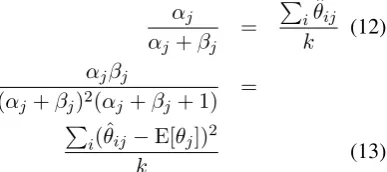
This leads us to suggest estimates for parameters such that the expected value of the distribution is
as in 10 but with theθij (which are unknown)
re-placed with their maximum likelihood estimates,
ˆ
θij. We then use these estimates to specify the
de-sired variance, leading to the simultaneous equa-tions:
αj αj+βj =
P iθˆij k (12) αjβj
(αj +βj)2(αj+βj+ 1) = P
i(ˆθij −E[θj])2
k (13)
As before, we supplement actual training doc-uments with a pseudo-document in which every
word occurs once to prevent anyαjbeing zero.
4 Evaluating the Models
This section describes evaluation of the models above on four text classification problems.
The Newsgroups task is to classify postings into one of twenty categories, and uses data originally collected in (Lang, 1995). The task involves a rel-atively large number of documents (approximately 20,000) with roughly even distribution of mes-sages, giving a very low baseline of approximately 5%.
For the second task, we use a task derived from the Enron mail corpus (Klimt and Yang, 2004), de-scribed in (Allison and Guthrie, 2008). Corpus is a nine–way email authorship attribution problem, with 4071 emails (between 174 and 706 emails per
author)1. The mean length of messages in the
cor-pus is 75 words.
WebKB is a web–page classification task, where the goal is to determine the webpage type of the unseen document. We follow the setup of (McCal-lum and Nigam, 1998) and many thereafter, and
1The corpus is available for download from www.dcs.shef.ac.uk/˜ben.
use the four biggest categories, namelystudent,
faculty,courseandproject. The resulting corpus consists of approximately 4,200 webpages. The SpamAssassin corpus is made available for public use as part of the open-source Apache
Spa-mAssassin Project2. It consists of email divided
into three categories: Easy Ham, which is email
unambiguously ham (i.e. not spam), Hard Ham
which is not spam but shares many traits with
spam, and finallySpam. The task is to apply these
labels to unseen emails. We use the latest ver-sion of all datasets, and combine the easy ham and easy ham 2 as well as spam and spam 2 sets to form a corpus of just over 6,000 messages.
In all cases, we use 10–fold cross validation to make maximal use of the data, where folds are chosen by random assignment. We define “words” to be contiguous whitespace–delimited alpha–numeric strings, and perform no stemming or stoplisting.
For the purposes of comparison, we also present results using a linear SVM (Joachims, 1999), which we convert to multi–class problems using a one–versus–all strategy shown to be amongst the best performing strategies (Rennie and Rifkin, 2001). We normalise documents to be vectors of unit length, and resolve decision ambiguities by sole means of distance to the hyperplane. We also note that experimentation with non–linear kernels showed no consistent trends, and made very little difference to performance.
[image:5.595.98.292.311.397.2]5 Results
Table 1 displays results for the three models over the four datasets. We use the simplest measure of classifier performance, accuracy, which is simply the total number of correct decisions over the ten folds, divided by the size of the corpus. In response to a growing unease over the use of significance tests (because they have a tendency to overstate significance, as well as obscure effects of sample size) we provide 95% intervals for accuracy as well as the metric itself. To calculate these, we view ac-curacy as an (unknown) parameter to a binomial distribution such that the number of correctly clas-sified documents is a binomially distributed ran-dom variable. We then calculate the Bayesian in-terval for the parameter, as described in (Brown et al., 2001), which allows immediate quantification
of uncertainty in the true accuracy after a limited sample.
As can be seen from the performance figures, no one classifier is totally dominant, although there are obvious and substantial gains in using the Beta-Binomial model on the Newsgroups and Enron tasks when compared to all other models. The Spa-mAssassin corpus shows the beta–binomial model and the SVM to be considerably better than the other two models, but there is little to choose be-tween them. The WebKB task, however, shows extremely unusual results: the SVM is head and shoulders above other methods, and of the genera-tive approaches the multinomial is clearly superior. In all cases, the Dirichlet model actually performs worse than the multinomial model, in contrast to the observations of (Madsen et al., 2005).
In terms of comparison with other work, we note that the performance of our multinomial model agrees with that in other work, including for exam-ple (Rennie et al., 2003; Eyheramendy et al., 2003; Madsen et al., 2005; Jansche, 2003). Our Dirichlet model performs worse than that in (Madsen et al., 2005) (85% here compared to 89% in that work), which we attribute to their experimentation with
alternate smoothing as described in §3.1. We
note however that the Beta-Binomial model here still outperforms that work by some considerable margin. Finally, we note that our beta–binomial model outperforms that in (Jansche, 2003), which we attribute mainly to the altered estimate, but also to the partial vocabulary used in that work. In fact, (Jansche, 2003) shows there to be little to sepa-rate the beta-binomial and multinomial models for larger vocabularies, in stark contrast to the work here, and this is doubtless due to the parameter es-timation.
6 Analysis
One might expect performance of a hierarchical sampling model to eclipse that of the SVM because of the nature of the decision boundary, provided certain conditions are met: the SVM estimates a linear decision boundary, and the multinomial classifier does the same. However, the decision boundaries for the hierarchical classifiers are non– linear, and can represent more complex word be-haviour, provided that sufficient data exist to pre-dict it. However, unlike generic non–linear SVMs (which made little difference compared to a lin-ear SVM) the non–linlin-ear decision boundary here
arises naturally from a model of word behaviour. For the hierarchical models, performance rests on the ability to estimate both the rate of word
oc-currence θj and also the way that this rate varies
between documents. To reliably estimate variance (and arguably rate as well) would require words to occur a sufficient number of times. However, this section will demonstrate that two of the datasets have many words which do not occur with suf-ficient frequency to estimate parameters, and in those two the linear SVM’s performance is more comparable.
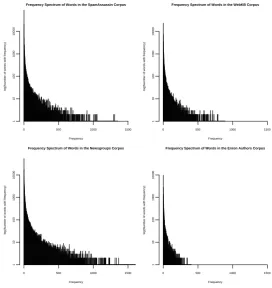
We present two quantifications of word reuse to support our conclusions. The first are frequency spectra for each of the four corpora, shown in Fig-ure 1. The two more problematic datasets appear in the top of the figure. To generate the charts, we pool all documents from all classes in a each prob-lem, and count the number of words that appear
once, twice, and so on. The x axis is the
num-ber of times a word occurs, and theyaxis the total
number of words which have that count.
The WebKB corpus has the large majority of words occurring very few times (the mass of the distribution is concentrated towards the left of the chart), while the SpamAssassin corpus is more rea-sonable and the Newsgroups corpus has by far the most words which occur with substantial fre-quency (this correlates perfectly with the relative performances of the classifiers on these datasets). For the Enron corpus, it is somewhat harder to tell, since its size means no words occur with substan-tial frequency.
We also consider the proportion of all word pairs in a corpus in which the first word is the same as
the second word. If a corpus has n• words total
with total countsn1...nv then the statistic is:
r= (n 1
•(n•−1))/2 X
i
(ni(ni−1))/2. (14)
To measure differing tendencies to reuse words,
we calculate therstatistic once for each class, and
Newsgroups Enron Authors WebKB SpamAssassin Multinomial 85.66 ± 0.5 74.55 ± 1.34 85.69 ± 1.06 95.96 ± 0.5
DCM 85.03 ± 0.51 74.43 ± 1.34 82.69 ± 1.15 91.47 ± 0.7
Beta-Bin 91.65± 0.4∗+ 83.54± 1.14∗+ 84.81 ± 1.08 97.35 ± 0.4∗
[image:7.595.83.512.73.146.2]SVM 88.8 ± 0.45∗ 80 ± 1.23∗ 92.68± 0.79∗ 97.65± 0.38∗
Table 1: Performance of four classifiers on four tasks. Error is 95% interval for accuracy. Bold denotes
best performance on a task. ∗ denotes performance superior to multinomial which exceeds posterior
uncertainty (i.e. observed performance outside 95% interval). +denotes the same for the SVM
Frequency Spectrum of Words in the SpamAssassin Corpus
Frequency
log(Number of words with frequency)
1
10
100
1000
10000
0 500 1000 1500
Frequency Spectrum of Words in the WebKB Corpus
Frequency
log(Number of words with frequency)
1
10
100
1000
10000
0 500 1000 1500
Frequency Spectrum of Words in the Newsgroups Corpus
Frequency
log(Number of words with frequency)
1
10
100
1000
10000
0 500 1000 1500
Frequency Spectrum of Words in the Enron Authors Corpus
Frequency
log(Number of words with frequency)
1
10
100
1000
10000
0 500 1000 1500
Figure 1: Frequency spectra for the four datasets. yaxis is on a logarithmic scale
not look promising for the hierarchical model by either measure.
7 Conclusion
In this paper, we have advocated the use of a joint beta–binomial distribution for word counts in documents for the purposes of classification. We have shown that this model outperforms classifiers based upon both multinomial and Dirichlet Com-pound Multinomial distributions for word counts.
We have further made the case that, where cor-pora are sufficiently large as to warrant it, a gener-ative classifier employing a hierarchical sampling model outperforms a discriminative linear SVM. We attribute this to the capacity of the proposed model to capture aspects of word behaviour
be-yond a simpler model. However, in cases where the data contain many infrequent words and the tendency to reuse words is relatively low, default-ing to a linear classifier (either the multinomial for a generative classifier, or preferably the lin-ear SVM) increases performance relative to a more complex model, which cannot be fit with sufficient precision.
References
Allison, Ben and Louise Guthrie. 2008. Authorship at-tribution of e-mail: Comparing classifiers over a new corpus for evaluation. InProceedings of LREC’08. Brown, Lawrence D., Tony Cai, and Anirban
[image:7.595.159.432.212.501.2]Newsgroups Enron Authors WebKB SpamAssassin
[image:8.595.93.504.73.104.2]Meanr 0.0090 0.0083 0.0047 0.0037
Table 2: Meanrstatistic for the four problems
Church, K. and W. Gale. 1995. Poisson mixtures. Nat-ural Language Engineering, 1(2):163–190.
Dumais, Susan, John Platt, David Heckerman, and Mehran Sahami. 1998. Inductive learning algo-rithms and representations for text categorization. In
CIKM ’98, pages 148–155.
Elkan, Charles. 2006. Clustering documents with an exponential-family approximation of the dirich-let compound multinomial distribution. In Proceed-ings of the Twenty-Third International Conference on Machine Learning.
Eyheramendy, S., D. Lewis, and D. Madigan. 2003. The naive bayes model for text categorization. Arti-ficial Intelligence and Statistics.
Guthrie, Louise, Elbert Walker, and Joe Guthrie. 1994. Document classification by machine: theory and practice. InProceedings COLING ’94, pages 1059– 1063.
Jansche, Martin. 2003. Parametric models of linguistic count data. InACL ’03, pages 288–295.
Joachims, Thorsten. 1998. Text categorization with support vector machines: learning with many rele-vant features. In N´edellec, Claire and C´eline Rou-veirol, editors,Proceedings of ECML-98, 10th Euro-pean Conference on Machine Learning, pages 137– 142.
Joachims, Thorsten. 1999. Making large-scale svm learning practical. Advances in Kernel Methods -Support Vector Learning.
Katz, Slava M. 1996. Distribution of content words and phrases in text and language modelling. Nat. Lang. Eng., 2(1):15–59.
Klimt, Bryan and Yiming Yang. 2004. The enron cor-pus: A new dataset for email classification research. InProceedings of ECML 2004, pages 217–226. Lang, Ken. 1995. NewsWeeder: learning to filter
net-news. InProceedings of the 12th International Con-ference on Machine Learning, pages 331–339. Lasserre, Julia A., Christopher M. Bishop, and
Thomas P. Minka. 2006. Principled hybrids of gen-erative and discriminative models. In CVPR ’06: Proceedings of the 2006 IEEE Computer Society Conference on Computer Vision and Pattern Recog-nition, pages 87–94.
Lowe, S. 1999. The beta-binomial mixture model and its application to tdt tracking and detection. In Pro-ceedings of the DARPA Broadcast News Workshop.
Madsen, Rasmus E., David Kauchak, and Charles Elkan. 2005. Modeling word burstiness using the Dirichlet distribution. InICML ’05, pages 545–552. McCallum, A. and K. Nigam. 1998. A comparison
of event models for na¨ıve bayes text classification. InProceedings AAAI-98 Workshop on Learning for Text Categorization.
Minka, Tom. 2000. Estimating a dirichlet distribution. Technical report, Microsoft Research.
Rennie, Jason D. M. and Ryan Rifkin. 2001. Improv-ing multiclass text classification with the Support Vector Machine. Technical report, Massachusetts In-sititute of Technology, Artificial Intelligence Labora-tory.
Rennie, J., L. Shih, J. Teevan, and D. Karger. 2003. Tackling the poor assumptions of naive bayes text classifiers.