Support or Oppose?
Classifying Positions in Online Debates
from Reply Activities and Opinion Expressions
Akiko Murakami1,2 Rudy Raymond1
1 IBM Research - Tokyo
2Graduate School of Interdisciplinary Information Studies, The University of Tokyo
{akikom,raymond}@jp.ibm.com
Abstract
We propose a method for the task of iden-tifying the general positions of users in online debates, i.e., support or oppose the main topic of an online debate, by ex-ploiting local information in their remarks within the debate. An online debate is a forum where each user post an opin-ion on a particular topic while other users state their positions by posting their re-marks within the debate. The supporting or opposing remarks are made by directly replying to the opinion, or indirectly to other remarks (to express local agreement or disagreement), which makes the task of identifying users’ general positions diffi-cult. A prior study has shown that a link-based method, which completely ignores the content of the remarks, can achieve higher accuracy for the identification task than methods based solely on the contents of the remarks. In this paper, we show that utilizing the textual content of the remarks into the link-based method can yield higher accuracy in the identification task.
1 Introduction
Social computing tools, such as a SNS (So-cial Network Service) or an online discussion board have become very powerful communication tools for discussing topics with people around the world. Many companies use these kinds of social computing tools to understand their customers’ re-quirements and their marketing activities. Social
computing tools are very useful not only for ag-gregating customers’ opinions outside the com-panies, but also for aggregating their employees’ ideas. For example, IBM has held Jam1sessions, which are short-term online discussions to agggate ideas from employees and customers. The re-sults of Jam sessions help management decisions, for instance the technology areas to invest.
Not just enterprises, but some nations are try-ing to aggregate their citizens’ ideas in the Internet and provide systems for discussions at the people-to-people levels as part of the movement for open government. The United States government has the Idea Factory2 website for collecting ideas to enhance activities of Department of Homeland Security (DHS) and the Open For Questions3 to collect requests for the US government.
The motivation for creating these kinds of on-line discussions is not limited to collecting ideas but also to help understand the trends of opinions about the ideas or topics. This means that getting a quick overview of opinions about ideas is a key point for the success of online discussions.
In this paper we propose a method to show quick overview of participants’ positions, “Sup-port” or “Oppose” for the main idea or topic in online debates. It is difficult to identify each per-son’s position for a topic directly, since most of opinionative expressions are made not for main topic but for adjacent remarks. This causes a dif-ficulty in building answer sets for classifier. The following example shows opinion expressions for a main topic focused on an adjacent remark in a
1
https://www.collaborationjam.com 2
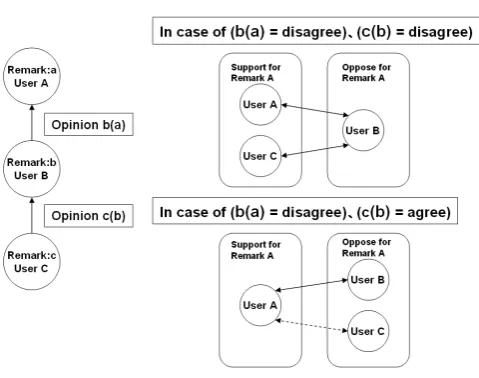
Figure 1: Identifying users’ positions from their opinions about previous remarks
debate. In this example, The main topic is “Travel and F2F (face-to-face) meeting is fundamental to business”.
Remark A Travel isn’t necessary
be-cause besides the high cost of trav-els around the world, today we have a lot of communication tools, for instance web conference, video chat that can easily contribute to join leaders around the world in a cheaper way.
Remark B I disagree. Without travel
and F2F meetings global integra-tion does not work as well or as quickly. It doesn’t mean that ev-erybody has to travel all the time, but at least some meetings are key to success.
The author of Remark A mentions that travel is not necessary to business. This opinion opposed to the main topic, so that the position for the main topic is “Oppose”. In contrast, the opinion expres-sion in Remark B is not an opinion about the main topic, but relates to the previous opinion in Re-mark A. This opinion expression indicates that the author of Remark B disagrees with the opinion of Remark A, and indirectly implies agreement with the main topic. Thus, although it is hard to infer the global position of Remark B from only the
sur-face expressions, it is straightforward to infer that an opinion in Remark B about Remark A is nega-tive (i.e., Remark B expresses disagreement with Remark A).
In this paper, positions with regards to the main topic (global positions) are classified into two classes: support and oppose, while opinions about the previous remarks (local positions) are classi-fied into three: agree, disagree, and neutral. For example, let us consider the case in Fig. 1, where Remark “a” is the main topic, and Remark “b” is the reply to Remark “a” and Remark “c” is the reply to Remark “b”. Here, letb(a) be the local position, that is, opinion (agree/disagree/neutral) in Remark “b” on the topic in Remark “a”. For example, ifb(a)andc(b)are disagree, one can de-termine that the authors of the corresponding re-marks are in the opposition. That is, the author of Remark “c” agrees with Author A (the author of Remark “a”), that is, the main topic, while Author B is against the others. On the contrary, ifb(a)is disagree andc(b)is agree, then Author C agrees with Author B and therefore it implies that Author C is against Author A. In this case, only Author A supports the main topic while Author B and Au-thor C oppose to the main topic.
each pair of their adjacent replies. This is used as the link weight between nodes (which correspond to users in a debate) in the network. Second, the bipartition of the users in the weighted network is computed by finding a bipartition that induces the maximum cut of the network, a partition of nodes into two disjoint sets that maximizes the sum of the weights of the links connecting nodes in dif-ferent sets. Since the weight of the links is higher (more positive) when the degree of disagreement is higher, the bipartition is expected to express two groups of opposing positions.
In order to evaluate the performance of our method, we conducted some experiments to iden-tify the supporting and opposing positions of par-ticipants in online debates. The experimental re-sults indicate that our method leads to higher pre-cision than the baseline method, which is de-scribed in (Agrawal et al., 2003).
The rest of this paper is organized as follows. First we describe related work in Section 2, and in Section 3 we propose our method for identify-ing participants’ positions from their reply activi-ties and text contents. In Section 4 we explain the data sets used for the evaluations and show the ex-perimental results of an opinion classifier for ad-jacent remarks and a support/oppose classifier for the participants in online debates. We conclude this paper and describe future work in Section 5.
2 Related Work
There are some research papers published on anal-ysis of online discussions. Some researches re-ported on how to analyze and navigate IBM Jam sessions. Millen et al. pointed out the importance of supporting the participants in discussions and demonstrated the effectiveness of their methods in one of these jams (Millen and Fontaine, 2003). Dave et al. described ways for jam participants to navigate using visualization techniques (Dave et al., 2004). One of the authors previously also pro-posed a method to mine discussion records using XML annotations (Murakami et al., 2001) and a method to find important remarks in a discussion thread based on the reply-to structure and partici-pants’ opinions (Murakami et al., 2007).
Classifying agree/disagree opinions in conver-sational debates using Bayesian networks was
presented in (Galley et al., 2004). Agrawal et al. described an observation that reply activities show disagreement with previous authors, and showed a method to classify the supporting/opposing posi-tion of users based on this observaposi-tion in (Agrawal et al., 2003). Thomas et al. (Thomas et al., 2006) introduced some constraints that a single speaker retains the same position for the classification of participants’ positions from floor-debate tran-scripts.
3 Proposed Method
3.1 Calculating the Reaction Coefficient between participants
We call the degree of divergence in the opinions between participants a reaction coefficient. This reaction coefficient is defined as a function of the participantsi, j, represented asr(i, j). To calcu-late reaction coefficients, we extracted pairs of a remark and its reply remark, and assigned “local position flags” to the pairs. There are three lo-cal position flags, “agree”, “disagree”, and “neu-tral”. The reaction coefficientr(i, j)between par-ticipantsiandjis defined as:
r(i, j) =αNdisagree(i, j)+βNneutral(i, j)+γNagree(i, j),
(1)
whereNopinion(i, j)is the number of remark pairs
withopinionas the corresponding local position flag between participantsiandj.
Typically we assign a positive value to α, a slightly positive value toβ, and a negative value toγ. This means thatr(i, j)is positive when there are only neutral remarks between user i and j. This is based on the hypothesis in (Agrawal et al., 2003) that replies usually indicate disagreement with previous remarks. There is no directionality in reaction coefficients so thatr(i, j) =r(j, i).
3.2 Classification of Participants’ Positions based on the Max Cut Problem
Table 1: Ideas and Number of Comments and Participants for the Ideas
Idea ID Title # of
Comments # of Participant
# of Remarks per Participant
1 Making “IT” Education as a Compulsory
Subject in Schools 75 45 1.7
2 Making Personal-Computer Makers to
Supplying Service Parts 130 21 6.2
3 Adoption of “Basic Income” 118 57 2.1
4 Votes in elections using Closed Networks 108 40 2.7
5 Computerized Books in Libraries 50 12 4.2
participants into supporting and opposing parties, Ssup andSopp respectively, is computed by solv-ing the max cut problem on G(V, E) defined as follows.
[Max cut problem] Given G(V, E) as above, find a bipartition of V into Ssup and Sopp = V \Ssup so that∑i∈Ssup,j∈Soppr(i, j)is max-imized.
The max cut problem is known to be NP-hard, and thus in general is difficult to solve. How-ever, good approximation algorithms based on Linear Programming and Semidefinite Program-ming have been developed recently, and combined with branch-and-bound techniques a good exact max-cut solver called BiqMac exists (Rendl et al., 2010). We used BiqMac for solving the max cut problem exactly on the activity network. Although a faster approximate max cut solver is used in (Agrawal et al., 2003), it is based on the limiting assumption that the size ofSopp is approximately the same asSopp. This cannot be assumed for the networks in this paper.
4 Experiments
4.1 Corpus
The Ministry of Economy, Trade and Industry in Japan (METI) was accepting public opinions on e-government programs via the “e-METI Idea Box4” from February 23 to March 15 2010. Par-ticipants could show their positions for the ideas since the site accepted comments on the main idea and other comments, so this discussion can be re-garded as a kind of debate. We used this data
4http://www.meti.go.jp/policy/it policy/open-meti/
to evaluate our proposed method. The ideas and comments were written in Japanese and the data is available at the METI website.
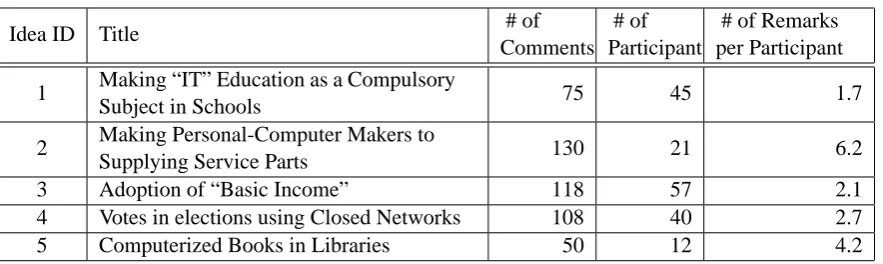
For the 936 ideas that were posted to the Idea Box, we examined 17 ideas with more than 40 comments. Finally we selected five ideas for the evaluation. The numbers of remarks (a main idea and comments), participants, and remarks per par-ticipants are shown in Table 1.
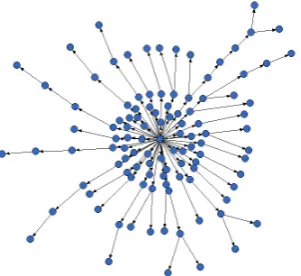
We extracted the reply-to structure information in textual contents. The Idea Box system had a capability to adding a comment to a main topic or the other comment, and the system inserted an identifier in comment’s text. Each identifier started with “#” and the IDs of the previous com-ments followed the identifier, such as “#003” (with #001 referring to the main topic in the thread). An idea or comments may have several comments as replies, so this reply-to structure in a debate is a tree structure whose root node is the main topic. A typical reply-to tree structure is shown in Fig 2.
4.2 Agree/Disagree Classification
To calculate the reaction coefficients, we need to extract the reply-to pairs and classify these pairs into the agree/disagree/neutral classes. To classify these remark pairs we use opinionative and senti-ment expressions. If a reply remark contains an expression of “I agree with you” then it should be classified into the agree class. Another example of expressions of the agree class would be “That’s a good idea!”.
Figure 2: Reply-to Structure of a Debate
agree/disagree expressions. For instance, “I dis-agree with your idea” and “I don’t dis-agree with you” are in the disagree pattern dictionary. At the same time we use a sentiment analysis tool to extract sentiment expressions. The tool we used for sen-timent expression extractions is the same as de-scribed in (Kanayama et al., 2004), which use ma-chine translation techniques to identify sentiment expressions in text. The tool returns sentiment ex-pressions with a sentiment label, favorable or un-favorable.
After identifying opinionative and sentiment expressions in the remarks, scores for the opin-ion classificatopin-ion are calculated. The score of each reply-to pair is the number of agreeing and favor-able expressions minus the number of disagreeing and unfavorable expressions in the reply remark. When the score is positive, the opinion of the pair is identified as agree, and if the score is negative then the opinion of the pair identified as disagree. If the score equals zero, then the opinion is iden-tified as neutral.
To evaluate this opinion classifier, we did an experiment with the METI data, which was man-ually assigned agree/disagree/neutral flags. The answers for these evaluation were created by us for three of the idea threads (Idea IDs #1,#2 and #3). Since most remarks do not have agree or dis-agree expressions, most reply-to pairs are classi-fied into the neutral class. This means that cal-culating precision and recall for the neutral class are not important. For the evaluation of the
clas-Table 2: Accuracy of opinion classification for reply-to pairs
Idea ID Precision Recall
1 0.63 0.25
2 0.62 0.14
3 0.44 0.38
Ave. 0.56 0.26
sifier we calculated precisions and recalls only for agree and disagree classes. The results are shown in Table 2.
4.3 Support/Oppose Classification
Using the numbers of agree/disagree/neutral reply-to pairs, we can calculate the reaction co-efficients for each pair of participants. After cal-culating the reaction coefficients for all of the par-ticipants’ pairs, we can classify each participant into support or oppose sets using the max cut tech-nique. In this subsection, we explain how to eval-uate our proposed method and show experimental results.
4.3.1 Answer Sets for Global Position Classification
To evaluate our method we created answer sets for a global position classifier, consisting of par-ticipant sets with the position labels Support or Oppose. We identified the positions of the par-ticipants’ remarks with contexts, but we assigned the “Unclear” label for some participants since their remarks did not contain enough information to classify their global positions. For showing the validity of the answer sets, two annotators anno-tated three ideas and calculated aκvalue. Theκ value is 0.69 so that this answer set is appropri-ate as an evaluation set. The use of the answer set annotated by a single annotator for the evaluation of support/oppose classification is justified since the agreement rate (theκvalue) is enough for the evaluation.
4.3.2 Evaluation Index for Position Classification
number of participants in the Oppose position. If the answers are grossly one-sided, the general accuracy does not work well, since the system can lead to a high score when it classifies all of the participants into the larger side. To minimize this potential bias, we defined an estimation in-dexaccuracyusing the average of the accuracies for the Support/Oppose sets. The estimation index accuracyis defined as:
accuracy = 1
where Asup and Aopp are the Support and
Op-pose participant sets in the answer set and Ssup
andSopp are the Support and Oppose participant
sets generated by the system, respectively. For accuracy, we ignore “Unclear” users since the system is a two-class classifier.
4.3.3 Experimental Results
In the experiments we use the reaction coeffi-cientsr(i, j)calculated based on the results of the agree/disagree/neutral Classifier, and classify par-ticipants into Support/Oppose position sets using BiqMac. Since we assumed that the main topic of the debate is the first remark of the debate thread, we assume that the set which includes the author of the first remark as the “Support” set and the other set as the “Oppose” set5.
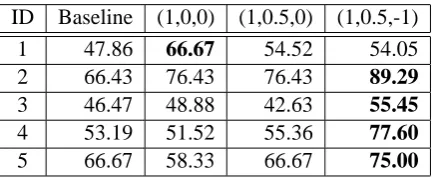
We conducted experiments for (α, β, γ) = (1,0,0),(1,0.5,0),(1,0.5,−1)in Eq. (1) to ex-amine the dependency of the accuracy on the co-efficients r(i, j). We also conducted an experi-ment for(1,1,1), which is regarded as a baseline method described in (Agrawal et al., 2003), since all of the reply actions represent “disagree” opin-ions for the previous remarks with these parame-ter. The experimental results are shown in Table 3.
The ideas other than ID 1 show better accu-racy than the baseline and their accuracies tend to increase in the order of (1,0,0), (1,0.5,0),
(1,0.5,−1). This result shows that the effec-tiveness of distinguishing between “disagree” and “agree” replies. This distinction makes it possible to introduce the constraint in which the user pairs
5For this reason, the values of the accuracies can be lower
than0.5.
Table 3: Accuracy of Support/Oppose position classification
ID Baseline (1,0,0) (1,0.5,0) (1,0.5,-1)
1 47.86 66.67 54.52 54.05
2 66.43 76.43 76.43 89.29
3 46.47 48.88 42.63 55.45
4 53.19 51.52 55.36 77.60
5 66.67 58.33 66.67 75.00
with “disagree” and “neutral” should be classi-fied into opposing positions and user pairs with “agree” should be classified into same position in the Support/Oppose user sets.
At the same time, ID 1 shows lower accuracy for(1,0.5,0),(1,0.5,−1)even though the accu-racy of agree/disagree classifier is good. In idea ID 1, the number of remarks per participant is the lowest in data sets, so the errors of the Agree-ment/Disagreement classifier strongly affect the results of the Support/Oppose classifier.
5 Conclusion and Future Work
We have shown how to classify users in an online debate based on their general positions with re-gards to the main topic by the textual contents of their remarks and the link structure of their replies. The previous work used the assumption that the replies are usually disagreements and based on this assumption used a link-based method to clas-sify the participants. However, in an online debate the replies are also used for clarifying previous remarks and quite often for supporting the previ-ous ones. Our proposed method uses not only the link structure of the replies, but also the textual contents of the local agreement/disagreement po-sitions between the remarks to boost the accuracy of the task of classifying users into the supporting and opposing parties.
agree, disagree, and neutral (with regards to the previous replies) and used these classifier’s result to determine the weight of the corresponding links in the link structure of the reply network. The max cut algorithm is then applied to the network, which results in a classification of the users into supporting or opposing parties (with regards to the main topic of the debate). The experiments indi-cate that the accuracies of the link-based method of (Agrawal et al., 2003) can be significantly in-creased by considering the textual contents of the replies.
There are several directions to extend our method. When an expression of opinion appears in a reply, we have to locate the target of the opin-ion. In the current method the target is deter-mined by the ID of the remark pointed by the re-ply. When the ID is not available, we assume that the reply is with regards to the main topic. How-ever, we also observed that even though a reply was directed to a particular remark, it often also contained opinions about the main topic. Identi-fying such replies can be used to yield higher ac-curacy in the classification task.
Much work remains for ultimate understanding of the participants’ opinions in debate corpus. Un-derstanding the reasons for the position for the main topic is one of the ways to understand their opinions and it may help to decide the next steps for companies or governments which held the de-bate sessions. An integrated system that includes a discussion system and an analysis system show-ing the ratio of positions and the reasons would support such purposes.
Acknowledgments
The authors would like to acknowledge Kenji Hi-ramoto and Manabu Morita, who are responsible for the IdeaBox, for their helpful comments and conversation.
References
Agrawal, Rakesh, Sridhar Rajagopalan, Ramakrish-nan Srikant, and Yirong Xu. 2003. Mining news-groups using networks arising from social behav-ior. In WWW ’03: Proceedings of the 12th
interna-tional conference on World Wide Web, pages 529–
535, New York, NY, USA. ACM.
Dave, Kushal, Martin Wattenberg, and Michael Muller. 2004. Flash forums and forumreader: navigating a new kind of large-scale online discussion. In CSCW
’04: Proceedings of the 2004 ACM conference on Computer supported cooperative work, pages 232–
241, New York, NY, USA. ACM.
Galley, Michel, Kathleen McKeown, Julia Hirschberg, and Elizabeth Shriberg. 2004. Identifying agree-ment and disagreeagree-ment in conversational speech: use of bayesian networks to model pragmatic de-pendencies. In ACL ’04: Proceedings of the 42nd
Annual Meeting on Association for Computational Linguistics, pages 669–676, Morristown, NJ, USA.
Association for Computational Linguistics.
Kanayama, Hiroshi, Tetsuya Nasukawa, and Hideo Watanabe. 2004. Deeper sentiment analysis using machine translation technology. In COLING ’04:
Proceedings of the 20th international conference on Computational Linguistics, page 494, Morristown,
NJ, USA. Association for Computational Linguis-tics.
Millen, David R. and Michael A. Fontaine. 2003. Multi-team facilitation of very large-scale dis-tributed meetings. In ECSCW’03: Proceedings of
the eighth conference on European Conference on Computer Supported Cooperative Work, pages 259–
275, Norwell, MA, USA. Kluwer Academic Pub-lishers.
Murakami, Akiko, Katashi Nagao, and Koichi Takeda. 2001. Discussion Mining: Knowledge discovery from online discussion records. In NLPRS
Work-shop XML and NLP, 2001.
Murakami, Akiko, Tetsuya Nasukawa, Fusashi Naka-mura, Hironori Takeuchi, Risa Nishiyama, Pnina Veisberg, and Hideo Watanabe. 2007. Innovation-Jam: Analysis of online discussion records using text mining technology. In International Workshop
on Intercultual Collaboration 2007 (IWIC2007).
Rendl, Franz, Giovanni Rinaldi, and Angelika Wiegele. 2010. Solving Max-Cut to optimality by intersecting semidefinite and polyhedral relax-ations. Math. Programming, 121(2):307.
Thomas, Matt, Bo Pang, and Lillian Lee. 2006. Get out the vote: Determining support or opposi-tion from congressional floor-debate transcripts. In
Proceedings of the 2006 Conference on Empirical Methods in Natural Language Processing, pages