Dependency-Based Bracketing Transduction Grammar
for Statistical Machine Translation
Jinsong Su, Yang Liu, Haitao Mi, Hongmei Zhao, Yajuan L ¨u, Qun Liu Key Laboratory of Intelligent Information Processing
Institute of Computing Technology Chinese Academy of Sciences
{sujinsong,yliu,htmi,zhaohongmei,lvyajuan,liuqun}@ict.ac.cn
Abstract
In this paper, we propose a novel
dependency-based bracketing transduc-tion grammar for statistical machine
translation, which converts a source sen-tence into a target dependency tree. Dif-ferent from conventional bracketing trans-duction grammar models, we encode tar-get dependency information into our lex-ical rules directly, and then we employ two different maximum entropy models to determine the reordering and combi-nation of partial dependency structures, when we merge two neighboring blocks. By incorporating dependency language model further, large-scale experiments on Chinese-English task show that our sys-tem achieves significant improvements over the baseline system on various test sets even with fewer phrases.
1 Introduction
Bracketing transduction grammar (BTG) (Wu, 1995) is an important subclass of synchronous context free grammar, which employs a special synchronous rewriting mechanism to parse paral-lel sentence of both languages.
Due to the prominent advantages such as the simplicity of grammar and the good coverage of syntactic diversities in different language pairs, BTG has attracted increasing attention in statis-tical machine translation (SMT). In flat reorder-ing model (Wu, 1996; Zens et al., 2004), which assigns constant reordering probabilities depend-ing on the language pairs, BTG constraint proves to be very effective for reducing the search space of phrase reordering. To pursue a better method to predict the order between two neighboring
blocks1, Xiong et al. (2006) present an enhanced BTG with a maximum entropy (ME) based re-ordering model. Along this line, source-side syn-tactic knowledge is introduced into the reorder-ing model to improve BTG-based translation (Se-tiawan et al., 2007; Zhang et al., 2007; Xiong et al., 2008; Zhang and Li, 2009). However, these methods mainly focus on the utilization of source syntactic knowledge, while ignoring the modeling of the target-side syntax that directly influences the translation quality. As a result, how to ob-tain better translation by exploiting target syntac-tic knowledge is somehow neglected. Thus, we argue that it is important to model the target-side syntax in BTG-based translation.
Recently, modeling syntactic information on the target side has progressed significantly. De-pending on the type of output, these models can be divided into two categories: the
constituent-output systems (Galley et al., 2006; Zhang et
al., 2008; Liu et al., 2009) and
dependency-output systems (Eisner, 2003; Lin, 2004; Ding
and Palmer, 2005; Quirk et al., 2005; Shen et al., 2008). Compared with the constituent-output systems, the dependency-output systems provide a simpler platform to capture the target-side syntac-tic information, while also having the best inter-lingual phrasal cohesion properties (Fox, 2002). Typically, Shen et al. (2008) propose a string-to-dependency model, which integrates the target-side well-formed dependency structure into trans-lation rules. With the dependency structure, this system employs a dependency language model (LM) to exploit long distance word relations, and achieves a significant improvement over the hier-archical phrase-based system (Chiang, 2007). So
we think it will be a promising way to integrate the target-side dependency structure into BTG-based translation.
In this paper, we propose a novel dependency-based BTG (DepBTG) for SMT, which represents translation in the form of dependency tree. Ex-tended from BTG, our grammars operate on two neighboring blocks with target dependency struc-ture. We integrate target syntax into bilingual phrases and restrict target phrases to the well-formed structures inspired by (Shen et al., 2008). Then, we adopt two ME models to predict how to reorder and combine partial structures into a target dependency tree, which gives us access to captur-ing the target-side syntactic information. To the best of our knowledge, this is the first effort to combine the translation generation with the mod-eling of target syntactic structure in BTG-based translation.
The remainder of this paper is structured as fol-lows: In Section 2, we give brief introductions to the bases of our research: BTG and dependency tree. In Section 3, we introduce DepBTG in detail. In Section 4, we further illustrate how to create two ME models to predict the reordering and de-pendency combination between two neighboring blocks. Section 5 describes the implementation of our decoder. Section 6 shows our experiments on Chinese-English task. Finally, we end with a summary and future research in Section 7.
2 Background
2.1 BTG
BTG is a special case of synchronous context free grammar. There are three rules utilized in BTG:
A→[A1, A2] (1)
A→ hA1, A2i (2)
A→x/y (3)
where the reordering rules (1) and (2) are used to merge two neighboring blocks A1 and A2 in a straight or inverted order, respectively. The lex-ical rule (3) is used to translate the source phrase xinto the target phrasey.
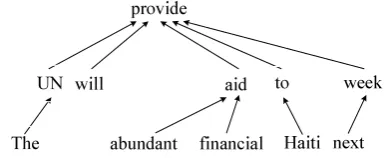
Figure 1: The dependency tree for sentence The
UN will provide abundant financial aid to Haiti next week.
2.2 Dependency Tree
In a given sentence, each word depends on a par-ent word, except for the root word. The depen-dency tree for a given sentence reflects the long distance dependency and grammar relations be-tween words. Figure 1 shows an example of a de-pendency tree, where a black arrow points from a child word to its parent word.
Compared with constituent tree, dependency tree directly models semantic structure of a sen-tence in a simpler form. Thus, it provides a desir-able platform for us to utilize the target-side syn-tactic knowledge.
3 Dependency-based BTG
3.1 Grammars
In this section, we extend the original BTG into DepBTG. The rules of DepBTG, which derive from that of BTG, merge blocks with target de-pendency structure into a larger one. These rules take the following forms:
Ad→[A1d, A2d]CC (4)
Ad→[A1d, A2d]LA (5)
Ad→[A1d, A2d]RA (6)
Ad→ hA1d, A2diCC (7)
Ad→ hA1d, A2diLA (8)
Ad→ hA1d, A2diRA (9)
Ad→x/y (10)
where A1
d and A2d represent two neighboring
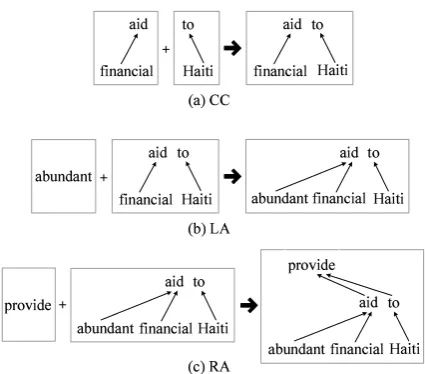
Figure 2: Dependency operations on the neigh-boring dependency structures. CC = coordinate concatenate, LA = left adjoining, and RA = right adjoining.
we merge two neighboring blocks. Rule (10) is applied to generate bilingual phrase (x,y) with target dependency structure learned from train-ing corpus. To disttrain-inguish the rules with differ-ent functions, the rules (4)∼(9) and rule (10) are named as merging rules and lexical rule, respec-tively.
Specifically, we first merge the neighboring blocks in the straight order using rules (4)∼(6) or in the inverted order using rules (7)∼(9). Then, according to different merging rules, we conduct some operations to combine the corresponding de-pendency structures in the target order: coordinate concatenate (CC), left adjoining (LA) and right adjoining (RA).
To clearly illustrate our operations, we show the process of applying three dependency operations to build larger structures in Figure 2. Adopting rule (4), the dependency structures “( ( financial ) aid )”1 and “( to ( Haiti ) )” can be combined into a larger one consisting of two sibling subtrees (see Figure 2(a)). Adopting rule (5), we can adjoin the left dependency structure “( abundant )” to the leftmost sub-root of the right dependency
struc-1
We use the lexicon dependency grammar (Hellwig, 2006) to express the projective dependency tree. Using this grammar, the words in the brackets are defined as the child words depending on the parent word outside the brackets.
ture “( ( financial ) aid ) ( to ( Haiti ) )” (see Figure 2(b)). Adopting rule (6), we can include the right dependency structure “( ( abundant ) ( financial ) aid ) ( to ( Haiti ) )” as a child of the rightmost sub-root of the left dependency structure “( provide )” (see Figure 2(c)). In a similar way, rules (7)∼(9) are applied to deal with two partial structures in the inverted order.
3.2 Well-Formed Dependency Structures
As illustrated in the previous sub section, the rules of DepBTG operate on the blocks with tar-get dependency structure. Following (Shen et al., 2008), we restrict the target phrases to the well-formed dependency structures. The main differ-ence is that we use more relaxed constraints to extract more bilingual phrases with rational struc-ture. Take a sentence S =w1w2...wn for
exam-ple, we denote the parent word ID of wordwiwith
di, and show the definitions of structures as
fol-lows.
Defination 1 A dependency structure di...j is
fixed on head h, where h∈[i, j], if and only if it meets the following conditions
• dh ∈/[i,j]
• ∀k∈[i,j]and k =6 h,dk ∈[i,j] • ∀k∈[i,j], dk =h or dk ∈[i,j]
Defination 2 A dependency structure di...dj is
floating with children C, for a non-empty set
C⊆ {i...j}, if and only if it meets the following
wherecl andcr represent the IDs of the leftmost
.
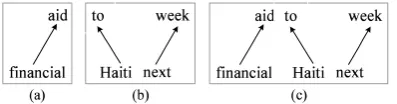
Figure 3: (a) A fixed structure and (b) (c) two floating structures. Note that (c) is ill-formed in (Shen et al., 2008).
structures shown in Figure 3 are all well-formed structures. However, according to the definitions of (Shen et al., 2008), 3(c) is ill-formed because
aid does not include its leftmost child word abun-dant in the structure.
4 ME Models for Merging Rules
4.1 The Models
A simple way to estimate the probabilities of the merging rules is to adopt maximum likelihood es-timation to obtain the conditional probabilities. However, this method is not applicable to merging rules because the dependency structures become larger and larger during decoding, which are very sparse in the corpus.
Inspired by MEBTG translation (Xiong et al., 2006), which considers phrase reordering as a classification problem, we model the reordering and combination of two neighboring dependency structures based on the ME principle. Owing to data sparseness and the complexity of multi-class classification, we establish two ME models rather than an unified ME model: one for the reorder-ing between blocks, called reorderreorder-ing model; the other for the dependency operations on the corre-sponding dependency structures, called operation
model.
Thus, according to the ME scheme, we decom-pose the probabilityΩof each merging rule into
Ω = pθ1(o|A
tures of the ME-based reordering model,
θ1i are the corresponding weights, and o∈ {straight, inverted}. Similarly, the func-tions h2j ∈ {0,1} and the weights θ2j are
trained for the ME-based operation model, and d∈ {CC, LA, RA}.
4.2 Example Extraction
To train the ME models, we extract examples from a string-to-dependency word-aligned corpus during the process of bilingual phrases extraction (Koehn et al., 2005), and then collect various fea-tures for the models.
For the reordering model, we adopt the method of (Xiong et al., 2006) to extract reordering exam-ples. Due to the limit of space, we skip the details of this method.
For the operation model, given an operation training example consisting of two neighboring dependency structures: the left structuredland the
right structuredr, we firstly classify it into
differ-ent categories by the dependency relation between dlanddr:
• ifdl and dr have the same parent, the
cate-gory of the example isCC;
• ifdldepends on the leftmost sub-root of dr,
the category of the example isLA;
• ifdrdepends on the rightmost sub-root ofdl,
the category of the example isRA.
For instance, Figure 4 shows an operation exam-ple with RAoperation, where the sub-root word
week of dr depends on the rightmost sub-root
word provide ofdl.
Then, we collect various features from the fol-lowing nodes: the rightmost sub-root of dl, and
its rightmost child node; the leftmost sub-root of dr, and its leftmost child node. Here, we
specu-late that these nodes may carry useful information for the dependency combination of the two struc-tures, since they locate nicely at the boundary sub-trees ofdlanddr. For simplicity, we refer to these
nodes as the feature nodes of the example. Let’s revisit Figure 4, the feature nodes of the example are marked with dashed ellipses. The rightmost sub-root word ofdl is provide, and its rightmost
child word is to; The leftmost sub-root word ofdr
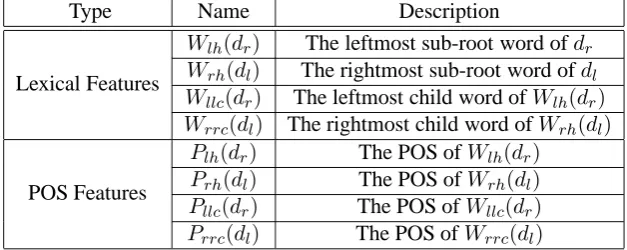
Type Name Description
Lexical Features
Wlh(dr) The leftmost sub-root word ofdr
Wrh(dl) The rightmost sub-root word ofdl
Wllc(dr) The leftmost child word ofWlh(dr)
Wrrc(dl) The rightmost child word ofWrh(dl)
POS Features
Plh(dr) The POS ofWlh(dr)
Prh(dl) The POS ofWrh(dl)
Pllc(dr) The POS ofWllc(dr)
Prrc(dl) The POS ofWrrc(dl)
Table 1: Feature categories in the ME-based operation model.
Type Features and Instances
Unigram Features Wrh(dl)= provide Wrrc(dl)= to Wlh(dr)= week Wllc(dr)= next Prh(dl)=VV Prrc(dl)= TO Plh(dr)= NN Pllc(dr)= ADJ
Bigram Features
Wrh(dl) Wlh(dr)= provide week Wrh(dl) Plh(dr)= provide NN
Prh(dl) Wlh(dr)= VV week Prh(dl) Plh(dr)= VV NN
Wrh(dl) Wllc(dr)= provide next Wrh(dl) Pllc(dr)= provide ADJ
Prh(dl) Wllc(dr)= VV next Prh(dl) Pllc(dr)= VV ADJ
Wrrc(dl) Wlh(dr)= to week Wrrc(dl) Plh(dr)= to NN
Prrc(dl) Wlh(dr)= TO week Prrc(dl) Plh(dr)= TO NN
Table 2: ME operation features and instances of the example shown in Figure 4.
abundant/ADJ
to/TO aid/NN
Haiti/NR
week/NN
next/ADJ financial/ADJ
provide/VV
dA d
B
Figure 4: An example withRAcategory consist-ing of the neighborconsist-ing dependency structures dl
and dr. The dashed ellipses denote the feature
nodes of the example, and each node consists of
one word and its corresponding POS tag.
In addition, to keep the number of operation ex-amples acceptable, we follow (Xiong et al., 2006) to only extract the smallest one from the examples with the same feature nodes in each sentence.
4.3 Features
To capture reordering information, we use the boundary words of bilingual blocks as features, which are proved to be very effective in (Xiong
et al., 2006).
To capture dependency operation information, we design two kinds of features on the feature
nodes: the Lexical features and Parts-of-speech
(POS) features. With the POS features, the op-eration ME model will do exact predicating to the best of its ability, and then can back off to approxi-mately predicating if exact predicating fails. Table 1 shows these feature categories in detail.
Furthermore, we also use some bigram features, since it is generally admitted that the combina-tion of different features can lead to better per-formance than unigram features. To better under-stand our operation features, we continue with the example shown in Figure 4, listing features and instances in Table 2.
5 Implementation Details
5.1 Decoder
score, (4) ME-based reordering model score, (5) Number of phrases, (6) Number of target words, (7) ME-based operation model score, (8) Depen-dency LM scores at word level and POS level separately, and (9) Discount on ill-formed depen-dency structures. Here, the former six features are also used in MEBTG translation.
5.2 Dependency Language Model
Following (Shen et al., 2008), we apply different tri-gram dependency LMs at word level and POS level separately to DepBTG translation.
Given a dependency structure, where wh
is the parent word, wL =wl1...wln and
wR=wr1...wrm are child word sequences
on the left side and right side respectively, the probability of a tri-gram is computed as follows:
P(wL, wR|wh-as-head)
= P(wL|wh-as-head)·P(wR|wh-as-head)
HereP(wL|wh-as-head)can be decomposed into:
P(wL|wh-as-head)
= P(wl1|wh-as-head)·P(wl2|wl1, wh-as-head) ...·P(wln|wln−1, wln−2)
where ‘-as-head’ is used to distinguish the head word from child word in the language model. In like manner,P(wR|wh-as-head)has a similar
cal-culation method.
5.3 Ill-Formed Dependency Structure
To preserve the good coverage of bilingual phrases, we keep some bilingual phrases with the special ill-formed dependency structure. Differ-ent from the well-formed structures, where all the children of the sub-roots are complete, these ill-formed structures are not complete on the chil-dren of the boundary sub-roots, lacking a well-formed sub structure on the boundary. We con-sider them as useful structures with gaps, each of which can be combined with some well-formed structures into a larger well-formed one. To re-duce the search space, we constrain the number of gap to one on each boundary. During decoding, we directly substitute the gap in a structure with another well-formed structure which has the same direction.
CDEFG I
J
E KDIK
K L M
N H
KN J O
GNKNPGK Q KG
H
R H
GSKS J
ID
dT dU
Figure 5: Dependency combination of the ill-formed dependency structure dl with the right
well-formed dependency structure dr. Gdenotes
gap and the dotted line denotes the substitution of the gapGwithdr.
For example, there are two dependency struc-tures in Figure 5:dlis an ill-formed structure with
a right gap, anddr is a well-formed one. Instead
of investigating three operations to combine these structures, we fill the gap ofdl withdr, and then
compute the corresponding score of theRA oper-ation on the sub structures “( to )” and “( ( disaster ) area )” in the ME-based operation model.
6 Experiment
6.1 Setup
The training corpus1 comes from LDC with 1.54M bilingual sentences (41M Chinese words and 48M English words). We run GIZA++ (Och and Ney, 2000) to obtain word alignments with the heuristic method “grow-diag-final-and”. Then we parse the English sentences to generate a string-to-dependency word-aligned corpus using the parser (Huang et al., 2009). From this cor-pus, we extract bilingual phrases with dependency structure. Here, the maximum length of the source phrase is set to 7. For the n-gram LM, we use SRILM Toolkits (Stolcke, 2002) to train a 4-gram LM on the Xinhua portion of the Gigaword cor-pus. For the dependency LM, we train different 3-gram dependency LMs at word level and POS level separately on the English side of the training corpus.
During the process of bilingual phrase extrac-tion, we collect the neighboring blocks without
1
any length limitation to obtain examples for two ME models. For the reordering model, we obtain about22.6M examples with monotone order and
4.8M examples with inverted order. For the op-eration model, we obtain about 5.9M examples with CC operation, 14.8M examples with LA operation, and 9.7M examples with RA opera-tion. After collecting various features from the examples, we use the ME training toolkit devel-oped by Zhang (2004) to train ME models with the following parameters: iteration numberi=200 and Gaussian priorg=1.0.
The 2002 NIST MT Evaluation test set is used as the development set. The 2003 and 2005 NIST MT Evaluation test sets are our test sets. We per-form the MERT training (Och, 2003) to tune the optimal feature weights on the development set. To run the decoder, we prune the phrase table with b= 100, prune the chart withn= 50,α= 0.1. See (Xiong et al., 2006) for the meanings of these pa-rameters. The translation quality is evaluated by case-insensitive BLEU-4 metric (Papineni et al., 2002), as calculated by mteval-v11b.pl.
6.2 Results
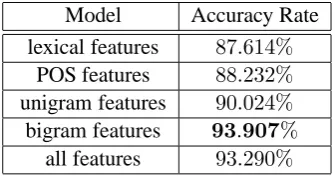
Since (Xiong et al., 2006) has made a deep inves-tigation on the ME-based reordering model, we mainly focus on the study of the ME-based oper-ation model. To explore the utility of the various features in the operation model, we randomly se-lect about 10K examples from all the operation examples as held-out data, and use the rest exam-ples as training data. Then, we train the operation models on different feature sets and investigate the performance of models on the held-out data.
Table 3 shows the accuracy rates of the ME op-eration models using different feature sets. We find that the bigram feature set provides the most persuasive evidences and achieves best perfor-mance than other feature sets.
To investigate the influences of various factors on the system performance, we carried out exper-iments on the NIST Chinese-English task with the following systems:
• MEBTG + all: an MEBTG translation sys-tem, which uses all bilingual phrases. It is our baseline system;
Model Accuracy Rate
lexical features 87.614%
POS features 88.232%
unigram features 90.024%
bigram features 93.907%
all features 93.290%
Table 3: The accuracy rates of the ME-based oper-ation models on the held-out data set using differ-ent feature sets. Unigram features include lexical features and POS features, and bigram features are the combinations of different unigram features.
• MEBTG + filter1: a baseline system, which uses the bilingual phrases consistent to the well-formed dependency structures by (Shen et al., 2008);
• MEBTG + filter2: a baseline system, which uses the bilingual phrases consistent to our well-formed dependency structures;
• MEBTG + filter3: a baseline system, which uses the bilingual phrases consistent to our well-formed dependency structures and the special ill-formed dependency structures;
• DepBTG + unigram features: a DepBTG system which only uses the unigram features in the ME-based operation model;
• DepBTG + bigram features: a DepBTG sys-tem which only uses the bigram features in the ME-based operation model;
• DepBTG + all features: a DepBTG system which uses all features in the ME-based op-eration model;
• DepBTG + unigram features + dep LMs: a DepBTG system with dependency LMs, where only the unigram features are adopted in the ME-based operation model;
• DepBTG + bigram features + dep LMs: a DepBTG system with dependency LMs, where only the bigram features are adopted in the ME-based operation model;
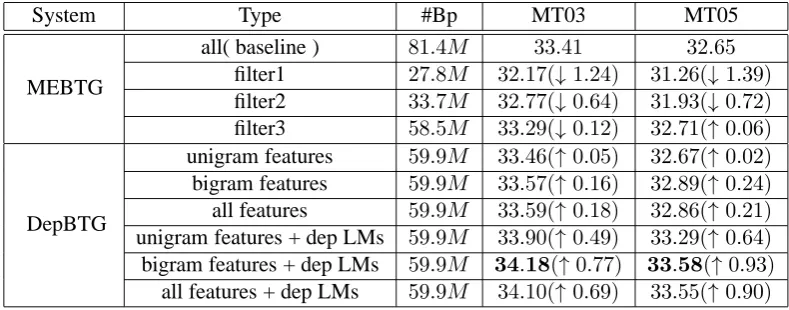
System Type #Bp MT03 MT05
MEBTG
all( baseline ) 81.4M 33.41 32.65
filter1 27.8M 32.17(↓1.24) 31.26(↓1.39)
filter2 33.7M 32.77(↓0.64) 31.93(↓0.72)
filter3 58.5M 33.29(↓0.12) 32.71(↑0.06)
DepBTG
unigram features 59.9M 33.46(↑0.05) 32.67(↑0.02)
bigram features 59.9M 33.57(↑0.16) 32.89(↑0.24)
all features 59.9M 33.59(↑0.18) 32.86(↑0.21)
unigram features + dep LMs 59.9M 33.90(↑0.49) 33.29(↑0.64)
bigram features + dep LMs 59.9M 34.18(↑0.77) 33.58(↑0.93)
all features + dep LMs 59.9M 34.10(↑0.69) 33.55(↑0.90)
Table 4: Experimental results on Chinese-English NIST Task.
Experiment results are summarized in Table 4. Our baseline system extracts 81.4M bilingual phrases and achieves the BLEU scores of 33.41
and 32.65 on two test sets separately. Adopt-ing the constraint of the well-formed structures by (Shen et al., 2008), we extract 27.8M bilingual phrases, which lead to great drops in BLEU score:
1.24 points and1.39 points on two test sets sep-arately(see Row 3). Using the constraint of our well-formed structures, the number of extracted bilingual phrases is33.7M. We observe the simi-lar results that the performance drops 0.64 points and 0.72 points over the baseline system on two test sets, respectively (see Row 4). Furthermore, we add some bilingual phrases with the special ill-formed structure into our phrase table, and the number of the bilingual phrases in use is 58.5M accounting up71.9%of the full phrases. For two test sets, our system achieves the BLEU scores of
33.29and32.71(see Row 5), which are very close to the scores of baseline system. Those experi-mental results demonstrate that phrase coverage has a great effect on the system performance and our definitions of the allowed dependency struc-tures are useful to retain rational bilingual phrases.
Then, by employing the ME-based operation model and two 3-gram dependency LMs, the DepBTG system outperforms the MEBTG system in almost all cases. The experimental results indi-cate that the dependency LMs are more effective than the ME-based operation model for DepBTG system. Especially, using bigram features and de-pendency LMs, the DepBTG system obtains
ab-solute improvements on two test sets:0.77BLEU points on NIST03 test set and0.93BLEU points on NIST05 test set (see Row 10), which are both statistically significant atp < 0.05using the sig-nificance tester developed by Zhang et al. (2004).
7 Conclusion and Future Work
In this paper, we propose a novel dependency-based BTG to directly model the syntactic struc-ture of the translation. Using the bilingual phrases with target dependency structure, our system em-ploys two ME models to generate the transla-tion in line with dependency structure. Based on the target dependency structure, our system filters 26.4% bilingual phrases (from81.4Mto59.9M), captures the target-side syntactic knowledge by dependency language models, and achieves sig-nificant improvements over the baseline system.
There is some work to be done in the future. To better utilize the syntactic information, we will put more effort on the study of the dependency LM with deeper syntactic knowledge. Moreover, we believe that modeling the syntax of both sides is a promising method to further improve BTG-based translation and this will become a study emphasis in our future research. Finally, inspired by (Tu et al., 2010), we will replace 1-best dependency trees with dependency forests to further increase the phrase coverage.
Acknowledgement
60736014 and 60873167, and 863 State Key Project No.2006AA010108. We thank the anony-mous reviewers for their insightful comments. We are also grateful to Zhaopeng Tu, Shu Cai and Xi-anhua Li for their helpful feedback.
References
Chiang, David. 2007. Hierarchical phrase-based translation. Computational Linguistics.
Ding, Yuan and Martha Palmer. 2005. Machine trans-lation using probabilistic synchronous dependency insertion grammars. In Proc. of ACL.
Eisner, Jason. 2003. Learning non-isomorphic tree mappings for machine translation. In Proc. of ACL.
Fox, Heidi J. 2002. Phrasal cohesion and statistical machine translation. In Proc. of EMNLP.
Galley, Michel, Jonathan Graehl, Kevin Knight, Daniel Marcu, Steve DeNeefe, Wei Wang, and Ignacio Thayer. 2006. Scalable inference and training of context-rich syntactic translation models. In Proc.
of ACL.
Hellwig, Peter. 2006. Parsing with dependency gram-mars, volume ii. An International Handbook of Contemporary Research.
Huang, Liang, Wenbin Jiang, and Qun Liu. 2009. Bilingually-constrained (monolingual) shift-reduce parsing. In Proc. of EMNLP.
Koehn, Philipp, Amittai Axelrod, Alexandra Birch Mayne, Chris Callison-Burch, Miles Osborne, and David Talbot. 2005. Statistical phrase-based trans-lation. In Proceedings International Workshop on
Spoken Language Translation.
Lin, Dekang. 2004. A path-based transfer model for machine translation. In Proc. of Coling.
Liu, Yang, Yajuan L¨u, and Qun Liu. 2009. Improving tree-to-tree translation with packed forests. In Proc.
of ACL.
Och, Franz Josef and Hermann Ney. 2000. Improved statistical alignment models. In Proc. of ACL.
Och, Franz Josef. 2003. Minimum error rate training in statistical machine translation. In Proc. of ACL.
Papineni, Kishore, Salim Roukos, Todd Ward, and Wei-Jing Zhu. 2002. Bleu: a method for automatic evaluation of machine translation. In Proc. of ACL.
Quirk, Christopher, Arul Menezes, and Colin Cherry. 2005. Dependency treelet translation: Syntactically informed phrasal smt. In Proc. of ACL.
Setiawan, Hendra, Min-Yen Kan, and Haizhou Li. 2007. Ordering phrases with function words. In
Proc. of ACL.
Shen, Libin, Jinxi Xu, and Ralph Weischedel. 2008. A new string-to-dependency machine translation algo-rithm with a target dependency language model. In
Proc. of ACL.
Stolcke, Andreas. 2002. Srilm - an extensible lan-guage modeling toolkit. In Proc. of ICSLP.
Tu, Zhaopeng, Yang Liu, Young-Sook Hwang, Qun Liu, and Shouxun Lin. 2010. Dependency forest for statistical machine translation. In Proc. of
COL-ING.
Wu, Dekai. 1995. Stochastic inversion transduction grammars, with appliction to segmentation, backet-ing, and alignment of parallel corpora. In Proc. of
IJCAI.
Wu, Dekai. 1996. A polynomial-time algorithm for statistical machine translation. In Proc. of ACL.
Xiong, Deyi, Qun Liu, and Shouxun Lin. 2006. Maxi-mum entropy based phrase reordering model for sta-tistical machine translation. In Proc. of ACL.
Xiong, Deyi, Min Zhang, Aiti Aw, and Haizhou Li. 2008. Linguistically annotated BTG for statistical machine translation. In Proc. of Coling.
Zens, Richard, Hermann Ney, Taro Watanabe, and Ei-ichiro Sumita. 2004. A polynomial-time algorithm for statistical machine translation. In Proc. of
Col-ing.
Zhang, Min and Haizhou Li. 2009. Tree kernel-based svm with structured syntactic knowledgefor btg-based phrase reordering. In Proc. of EMNLP.
Zhang, Ying, Stephan Vogel, and Alex Waibel. 2004. Interpreting bleu/nist scores how much improve-ment do we need to have a better system? In Proc.
of LREC.
Zhang, Dongdong, Mu Li, Chi-Ho Li, and Ming Zhou. 2007. Phrase reordering model integrating syntactic knowledge for smt. In Proc. of EMNLP.
Zhang, Min, Hongfei Jiang, Aiti Aw, Haizhou Li, Chew Lim Tan, and Sheng Li. 2008. A tree sequence alignment-based tree-to-tree translation model. In Proc. of ACL.