Improving Hypernymy Extraction with Distributional Semantic Classes
Alexander Panchenko
1∗, Dmitry Ustalov
2,3∗, Stefano Faralli
3, Simone P. Ponzetto
3, Chris Biemann
1 ∗these authors contributed equally1University of Hamburg, Department of Informatics, Language Technology Group, Germany
2University of Mannheim, School of Business Informatics and Mathematics, Data and Web Science Group, Germany 3Ural Federal University, Institute of Natural Sciences and Mathematics, Russia
{panchenko,biemann}@informatik.uni-hamburg.de {dmitry,stefano,simone}@informatik.uni-mannheim.de
Abstract
In this paper, we show how distributionally-induced semantic classes can be helpful for extracting hypernyms. We present methods for inducing sense-aware semantic classes using distributional semantics and using these induced semantic classes for filtering noisy hypernymy relations. Denoising of hypernyms is performed by labeling each semantic class with its hypernyms. On the one hand, this allows us to filter out wrong extractions using the global structure of distributionally similar senses. On the other hand, we infer missing hypernyms via label propagation to cluster terms. We conduct a large-scale crowdsourcing study showing that processing of automatically extracted hypernyms using our approach improves the quality of the hypernymy extraction in terms of both precision and recall. Furthermore, we show the utility of our method in the domain taxonomy induction task, achieving the state-of-the-art results on a SemEval’16 task on taxonomy induction.
Keywords:semantic classes, distributional semantics, hypernyms, co-hyponyms, word sense induction
1.
Introduction
Hypernyms are useful in various applications, such as ques-tion answering (Zhou et al., 2013), query expansion (Gong et al., 2005), and semantic role labelling (Shi and Mihalcea, 2005) as they can help to overcome sparsity of statistical models. Hypernyms are also the building blocks for learn-ing taxonomies from text (Bordea et al., 2016). Consider the following sentence: “This caf´e serves freshmangosteen
juice”. Here the infrequent word “mangosteen” may be poorly represented or even absent in the vocabulary of a sta-tistical model, yet it can be substituted by lexical items with better representations, which carry close meaning, such as its hypernym “fruit” or one of its close co-hyponyms, e.g. “mango”.
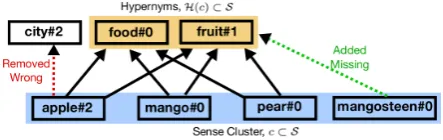
Currently available approaches to hypernymy extraction fo-cus on the acquisition of individual binary hypernymy rela-tions (Hearst, 1992; Snow et al., 2004; Weeds et al., 2014; Shwartz et al., 2016; Glavaˇs and Ponzetto, 2017). Frequen-cies of the extracted relations usually follow a power-law, with a long tail of noisy extractions containing rare words. We propose a method that performs post-processing of such noisy binary hypernyms using distributional semantics, cf. Figure 1. Namely, we use the observation that distribu-tionally related words are often are co-hyponyms (Wand-macher, 2005; Heylen et al., 2008) and operationalize it to perform filtering of noisy relations by finding dense graphs composed of both hypernyms and co-hyponyms.
The contribution of the paper is an unsupervised method for post-processing of noisy hypernymy relations based on clustering of graphs of word senses induced from text. The idea to use distributional semantics to find hypernyms seems natural and has been widely used. However, the ex-isting methods used distributional, yetsense-unawareand
localfeatures. We are the first to useglobal sense-aware distributional structure via the induced semantic classes
[image:1.595.311.533.416.486.2]to improve hypernymy extraction. The implementation of our method and the induced language resources (distribu-tional semantic classes and cleansed hypernymy relations) are available online.1
Figure 1: Our approach performs post-processing of hy-pernymy relations using distributionally induced semantic classes, represented by clusters of induced word senses la-beled with noisy hypernyms. The word postfix, such as#1, is an ID of an induced sense. The wrong hypernyms out-side the cluster labels are removed, while the missing ones not present in the noisy database of hypernyms are added.
2.
Related Work
2.1.
Extraction of Hypernyms
In her pioneering work, Hearst (1992) proposed to extract hypernyms based on lexical-syntactic patterns from text. Snow et al. (2004) learned such patterns automatically based on a set of hyponym-hypernym pairs. Pantel and Pen-nacchiotti (2006) presented another approach for weakly supervised extraction of similar extraction patterns. These approaches use some training pairs of hypernyms to boot-strap the pattern discovery process. For instance, Tjong Kim Sang (2007) used web snippets as a corpus for extrac-tion of hypernyms. More recent approaches exploring the use of distributional word representations for extraction of
TextCorpus
RepresentingSenses
withEgoNetworks
SemanticClasses WordSenseInduction
fromTextCorpus
SenseGraph
Construction
Clusteringof
WordSenes
LabelingSenseClusters
withHypernyms
Induced Word Senses Sense Ego-Networks Global Sense Graph
§3.1 §3.2 §3.3 §3.4
§4
NoisyHypernyms
CleansedHypernyms
§3InductionofSemanticClasses
[image:2.595.80.514.69.188.2]Global Sense Clusters
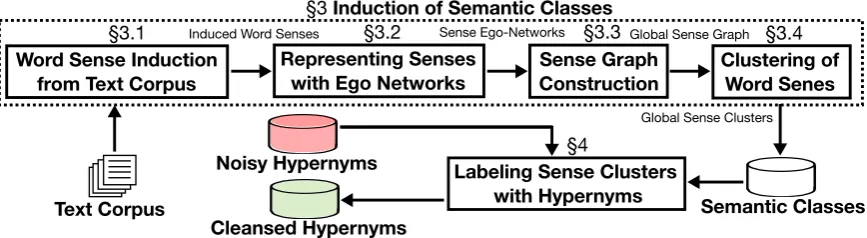
Figure 2: Outline of our approach: sense-aware distributional semantic classes are induced from a text corpus and then used to filter noisy hypernyms database (e.g. extracted by an external method from a text corpus).
hypernyms and co-hyponyms include (Roller et al., 2014; Weeds et al., 2014; Necsulescu et al., 2015; Vylomova et al., 2016). They rely on two distributional vectors to char-acterize a relation between two words, e.g. on the basis of the difference of such vectors or their concatenation. Levy et al. (2015) discovered a tendency to lexical memorization of such approaches, hampering their generalization to other domains.
Fu et al. (2014) relied on an alternative approach where a projection matrix is learned, which transforms a distribu-tional vector of a hyponym to the vector of its hypernym. Ustalov et al. (2017a) improved this method by adding reg-ularizers in the model that take into account negative train-ing samples and the asymmetric nature of the hypernyms. Recent approaches to hypernym extraction focused on learningsupervisedmodels based on a combination of syn-tactic patterns and distributional features (Shwartz et al., 2016). Note that while methods, such as (Mirkin et al., 2006) and (Shwartz et al., 2016) use distributional features for extraction of hypernyms, in contrast to our method, they do not take into account word senses and global distribu-tional structure.
Seitner et al. (2016) performed extraction of hypernyms from the web-scale Common Crawl2text corpus to ensure
high lexical coverage. In our experiments, we use this web-scale database of noisy hypernyms, as the large-web-scale repos-itory of automatically extracted hypernyms to date.
2.2.
Taxonomy and Ontology Learning
Most relevant in the context of automatic construction of lexical resource are methods for building resources from text (Caraballo, 1999; Biemann, 2005; Cimiano, 2006; Bordea et al., 2015; Velardi et al., 2013) as opposed to methods that automatically construct resources from semi-structured data (Auer et al., 2007; Navigli and Ponzetto, 2012) or using crowdsourcing (Biemann, 2013; Braslavski et al., 2016).
Our representation differs from the global hierarchy of words as constructed e.g. by (Berant et al., 2011; Faralli et al., 2016), as we are grouping many lexical items into a labeled sense cluster as opposed to organizing them in deep hierarchies. Kozareva and Hovy (2013) proposed a taxonomy induction method based on extraction of hyper-nyms using the doubly-anchored lexical patterns. Graph
2http://www.commoncrawl.org
algorithms are used to induce a proper tree from the binary relations harvested from text.
2.3.
Induction of Semantic Classes
This line of research starts with (Lin and Pantel, 2001), where sets of similar words are clustered into concepts. While this approach performs a hard clustering and does not label clusters, these drawbacks are addressed in (Pantel and Lin, 2002), where words can belong to several clus-ters, thus representing senses, and in (Pantel and Ravichan-dran, 2004), where authors aggregate hypernyms per clus-ter, which come from Hearst patterns. The main difference to our approach is that we explicitly represent senses both in clusters and in their hypernym labels, which enables us to connect our sense clusters into a global taxonomic struc-ture. Consequently, we are the first to use semantic classes to improve hypernymy extraction.
Ustalov et al. (2017b) proposed a synset induction ap-proach based on global clustering of word senses. The au-thors used the graph constructed of dictionary synonyms, while we use distributionally-induced graphs of senses.
3.
Unsupervised Induction of Distributional
Sense-Aware Semantic Classes
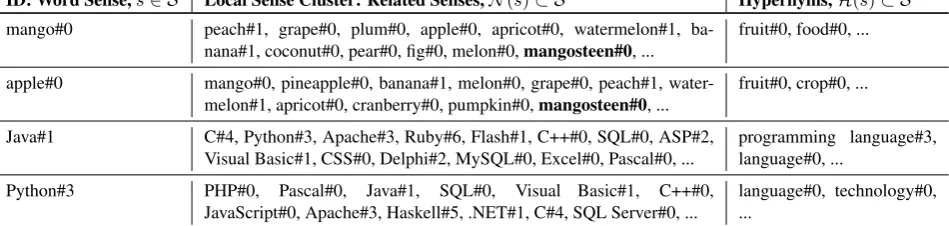
As illustrated in Figure 2, our method induces a sense in-ventory from a text corpus using the method of (Faralli et al., 2016; Biemann et al., 2018), and clusters these senses. Sample word senses from the induced sense inventory are presented in Table 1. The difference of the induced sense inventory from the sense clustering presented in Table 2 is that word senses in the induced resource are specific to a given target word, e.g. words “apple” and “mango” have distinct “fruit” senses, represented by a list of related senses. On the other hand, sense clusters represent a global and not a local clustering of senses, i.e. the “apple” in the “fruit” sense can be a member of only one cluster. This is similar to WordNet, where one sense can only belong to a single synset. Below we describe each step of our method.
3.1.
Word Sense Induction from a Text Corpus
ID: Word Sense,s∈ S Local Sense Cluster: Related Senses,N(s)⊂ S Hypernyms,H(s)⊂ S
mango#0 peach#1, grape#0, plum#0, apple#0, apricot#0, watermelon#1, ba-nana#1, coconut#0, pear#0, fig#0, melon#0,mangosteen#0, ...
fruit#0, food#0, ...
apple#0 mango#0, pineapple#0, banana#1, melon#0, grape#0, peach#1, water-melon#1, apricot#0, cranberry#0, pumpkin#0,mangosteen#0, ...
fruit#0, crop#0, ...
Java#1 C#4, Python#3, Apache#3, Ruby#6, Flash#1, C++#0, SQL#0, ASP#2, Visual Basic#1, CSS#0, Delphi#2, MySQL#0, Excel#0, Pascal#0, ...
programming language#3, language#0, ...
Python#3 PHP#0, Pascal#0, Java#1, SQL#0, Visual Basic#1, C++#0, JavaScript#0, Apache#3, Haskell#5, .NET#1, C#4, SQL Server#0, ...
language#0, technology#0, ...
Table 1: Sample induced sense inventory entries representing “fruits” and “programming language” senses. Each word sensesis represented with a list of related sensesN(s)and the list of hypernymsH(s). The hypernyms can be used as human-interpretable sense labels of the sense clusters. One senses, such as “apple#0”, can appear in multiple entries.
ID Global Sense Cluster: Semantic Class,c⊂ S Hypernyms,H(c)⊂ S
1 peach#1, banana#1, pineapple#0, berry#0, blackberry#0, grapefruit#0, strawberry#0, blue-berry#0, fruit#0, grape#0, melon#0, orange#0, pear#0, plum#0, raspblue-berry#0, water-melon#0, apple#0, apricot#0, waterwater-melon#0, pumpkin#0, berry#0,mangosteen#0, ...
vegetable#0, fruit#0, crop#0, ingredient#0, food#0,·
2 C#4, Basic#2, Haskell#5, Flash#1, Java#1, Pascal#0, Ruby#6, PHP#0, Ada#1, Oracle#3, Python#3, Apache#3, Visual Basic#1, ASP#2, Delphi#2, SQL Server#0, CSS#0, AJAX#0, JavaScript#0, SQL Server#0, Apache#3, Delphi#2, Haskell#5, .NET#1, CSS#0, ...
programming language#3, technology#0, language#0, format#2, app#0
Table 2: Sample of the induced sense clusters representing “fruits” and “programming language” semantic classes. Simi-larly to the induced word senses, the semantic classes are labeled with hypernyms. In contrast to the induced word senses, which represent a local clustering of word senses (related to a given word) semantic classes represent a global sense clus-tering of word senses. One sensec, such as “apple#0”, can appear only in a single cluster.
of related ambiguous terms (Biemann and Riedl, 2013); (2) word sense induction via clustering of ego networks (Wid-dows and Dorow, 2002; Everett and Borgatti, 2005) of re-lated words using the Chinese Whispers graph clustering algorithm (Biemann, 2006); (3) disambiguation of related words and hypernyms. The word sense inventory used in our experiment3was extracted from a 9.3 billion tokens
cor-pus, which is a concatenation of Wikipedia4, ukWac
(Fer-raresi et al., 2008), LCC (Richter et al., 2006) and Giga-word (Graff and Cieri, 2003). Note that analogous graphs of senses can be obtained using word sense embeddings, see (Neelakantan et al., 2014; Bartunov et al., 2016). Sim-ilarly to any other distributional word graph, the induced sense inventory sense network is scale-free, cf. (Steyvers and Tenenbaum, 2005). Our experiments show that a global clustering of this network can lead to a discovery of giant components, which are useless in our context as they rep-resent no semantic class. To overcome this problem, we re-build the sense network as described below.
3.2.
Representing Senses with Ego Networks
To perform a global clustering of senses, we represent each induced sensesby a second-orderego network(Everett and Borgatti, 2005). An ego network is a graph consisting of all related sensesR(s)of the ego sensesreachable via a path of length one or two, defined as:
{sj: (sj ∈ N(s))∨(si∈ N(s)∧sj ∈ N(si))}. (1)
Each edge weightWs(si, sj)between two senses is taken
3The input and output datasets are available for download at
https://doi.org/10.5281/zenodo.1174041
4https://doi.org/10.5281/zenodo.229904
from the induced sense inventory network (Faralli et al., 2016) and is equal to a distributional semantic relatedness score betweensiandsj.
Senses in the induced sense inventory may contain a mix-ture of different senses introducing noise in a global clus-tering: cf. Figure 3, where “Python” in the animal sense is related to both car and snake senses. To minimize the impact of the word sense induction errors, we filter out ego networks with a highly segmented structure. Namely, we cluster each ego network with the Chinese Whispers algo-rithm and discard networks for which the cluster containing the target sensescontains less than 80% nodes of the re-spective network to ensure semantic coherence inside the word groups. Besides, all nodes of a network not appearing in the cluster containing the ego sensesare also discarded.
3.3.
Global Sense Graph Construction
The goal of this step is to merge ego networks of individual senses constructed at the previous step into a global graph. We compute weights of the edges of the global graph by counting the number of co-occurrences of the same edge in different networks:
W(si, sj) =
X
s∈S
Ws(si, sj). (2)
For filtering out noisy edges, we remove all edges with the weight less than a thresholdt. Finally, we apply the func-tionE(w)that re-scales edge weights. We tested identity function (count) and the natural logarithm (log):
W(si, sj) =
(
E(W(si, sj)) ifW(si, sj)≥T,
[image:3.595.60.535.74.187.2]Figure 3: An example of a non-coherent ego network of the automatically induced sensePython#1, representing the “animal” sense. We prune it to remove terms not relevant to the animal sense.
3.4.
Clustering of Word Senses
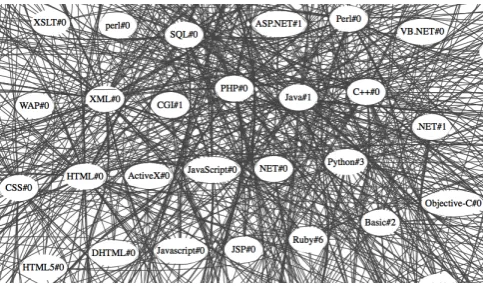
The core of our method is the induction of semantic classes by clustering the global graph of word senses. We use the Chinese Whispers algorithm to make every sense appear only in one clusterc. Results of the algorithm are groups of strongly related word senses that represent different con-cepts (cf. Figure 4). Hypernymy is by definition a relation between nouns. Thus optionally, we remove all single-word senses that do not correspond to nouns using the Pattern library (De Smedt and Daelemans, 2012). This optional mode is configured by the boolean parameterN.
We use two clustering versions in our experiments: the fine-grained model clusters 208,871 induced word senses into 1,870 semantic classes, and thecoarse-grainedmodel that groups 18,028 word senses into 734 semantic classes. To find optimal parameters of our method, we compare the induced labeled sense clusters to lexical semantic knowl-edge from WordNet 3.1 (Fellbaum, 1998) and Babel-Net 3.7 (Navigli and Ponzetto, 2012).
Figure 4: Senses referring to programming languages co-occur in global sense cluster entries, resulting in a densely connected set of co-hyponyms.
4.
Denoising Hypernyms using the Induced
Distributional Semantic Classes
By labeling the induced semantic classes with hypernyms we can thereby remove wrong ones or add those that are missing as illustrated in Figure 1. Each sense cluster is la-beled with the noisy input hypernyms, where the labels are the common hypernyms of the cluster word (cf. Table 2). Hypernyms that label no sense cluster are filtered out. In addition, new hypernyms can be generated as a result of labeling. Additional hypernyms are discovered by propa-gating cluster labels to the rare words without hypernyms, e.g. “mangosteen” in Figure 1. For labeling we used the
tf-idf weighting. Hypernyms that appear in many sensess
are weighted down:
tf-idf(h) =X s∈c
H(s)·log |S|
|h∈ H(s) :∀s∈ S|, (4)
whereP
s∈cH(s)is a sum of weights for all hypernyms
for each senses, per each clusterc.
We label each sense clusterc with its top five hypernyms
H(c). Each hypernym is disambiguated using the method of Faralli et al. (2016). Namely, we calculate the cosine similarity between the context (the current sense cluster) and the induced senses (local clusters of the ambiguous word).
Distributional representations of rare words, such as “man-gosteen” can be less precise than those of frequent words. However, co-occurrence of a hyponym and a hypernym in a single sentence is not required in our approach, while it is the case for the path-based hypernymy extraction methods.
5.
Finding an Optimal Configuration of
Meta Parameters of the Method
The approach consists of several sequential stages, as de-picted in Figure 2, with each stage having a few meta pa-rameters. This study is designed to find promising combi-nations of these meta parameters. In this section, we pro-pose several metrics which aim at finding an optimal con-figuration of all these meta parameters jointly. In particu-lar, to compare different configurations of our approach, we compare the labeled sense clusters to WordNet 3.1 (Fell-baum, 1998) and BabelNet 3.7 (Navigli and Ponzetto, 2012). The assumption is that the optimal model contains lexical semantic knowledge similar to the knowledge in the lexical resources. To implement the evaluation metrics we used the NLTK library (Bird et al., 2009) and the BabelNet Java API.5
5.1.
Metrics Quantifying Goodness of Fit of the
Induced Structures to Lexical Resources
To summarize various aspects of the lexical resource, we propose a score that is maximized if labeled sense clusters are generated directly from a lexical resource:
hpc-score(c) = h-score(c) + 1
p-score(c) + 1·coverage(c). (5)
p-score(c)quantifies the plausibility of the sense clusterc.
[image:4.595.53.295.586.729.2]Min. sense co-occurrences,t
Edge weight,E
Only nouns,N
Hypernym weight,H
Number of clusters
Number of senses
hpc-avg, WordNet
hpc-avg, BabelNet
coarse-gr. 100 log yes tf-idf 734 18 028 0.092 0.304
100 log no tf-idf 763 27 149 0.090 0.303
100 count no tf-idf 765 27 149 0.089 0.302
100 log no tf 784 27 149 0.090 0.300
100 count yes tf 733 18 028 0.092 0.299
100 count no tf 772 27 149 0.089 0.297
100 count yes tf-idf 732 18 028 0.091 0.295
100 log yes tf 726 18 028 0.088 0.293
fine-gr. 0 count no tf-idf 1870 208 871 0.041 0.279
0 count no tf 1877 208 871 0.041 0.278
0 count yes tf 2070 144 336 0.037 0.240
0 count yes tf-idf 2080 144 336 0.038 0.240
0 log yes tf-idf 4709 144 336 0.027 0.138
0 log yes tf 4679 144 336 0.027 0.136
0 log no tf-idf 5960 208 871 0.035 0.127
[image:5.595.53.539.70.278.2]0 log no tf 5905 208 871 0.036 0.126
Table 3: Performance of different configurations of the hypernymy labeled global sense clusters in terms of their similarity to WordNet/BabelNet. The results are sorted by performance on BabelNet dataset, the best values in each section are boldfaced. The two underlined configurations are respectively the bestcoarse-grainedandfine-grainedgrained semantic class models used in all experiments. The coarse grained model contains less semantic classes, but they tend to be more consistent than those of the fine-grained model, which contains more senses and classes.
It reflects the distance of co-hyponyms in a lexical resource:
p-score(c) = 1
|c| |c| X
i=1
i
X
j=1
dist(wi, wj). (6)
The lower thep-score is, the closer the hyponyms are lo-cated in the gold standard resource. For each pair of distinct lemmas(wi, wj)in the cluster of co-hyponymsc, we search
for the minimal shortest path distance (SPD) between the synsets corresponding to each word in the pair, i.e. S(wi)
is the set of synsets having thewilemma andS(wj)is the
similar set with respect to thewjlemma:
dist(wi, wj) = min s0∈S(wi),
s00∈S(w j)
SPD(s0, s00). (7)
h-score(c)quantifies plausibility of the hypernyms H(c)
of a sense cluster c measuring the precision of extracted hypernyms:
h-score(c) =|H(c)∩gold(c)|
|H(c)| . (8)
Thegold(c)is composed of the lowest common hypernyms (LCH) in the lexical resource for each pair of lemmas in the sense clusterc:
gold(c) = [ wi∈c,
wj∈c [
s0∈S(wi),
s00∈S(w j)
{LCH(s0, s00)}. (9)
coverage(c)quantifies how well cluster words are repre-sented in the gold standard resource. Thus, errors in poorly represented clusters are discounted via coverage. Coverage is the fraction of the lemmas appearing both in the clusterc
and in the vocabulary of the resourceV:
coverage(c) =|c∩ V|
|c| . (10)
The total score used to rank various configurations of our approach averageshpc-score scores for all induced sense
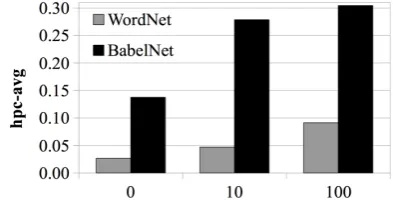
Figure 5: Impact of the min. edge weightt.
clusters:
hpc-avg = 1
|C|
X
c∈C
hpc-score(c). (11)
5.2.
Results
[image:5.595.324.521.365.465.2]much more impact as the sense graphs are noisier.
We selected the best-performed configuration according to BabelNet (hpc-avgof 0.304), which also is the second best configuration according to WordNet (hpc-avg of 0.092). This model is based on the edge threshold t of 100, log-arithmic weights of edges contains only nouns and hyper-nyms ranked according totf-idf. Note also that, the best-unpruned model (t = 0) has BabelNethpc-avg of 0.279, which is only 10% lower than the best model, yet the un-pruned model has an order of magnitude larger vocabulary and a more fine-grained representation (734 vs. 1,870 clus-ters). Thus, if coverage is important, the unpruned model is recommended. In the remainder of this paper, we continue with the first model listed in Table 3 and evaluate it in the following experiments.
6.
Evaluation
To evaluate our approach, we conduct two intrinsic eval-uations and one extrinsic evaluation. The first experiment aims to estimate the fraction of spurious sense clusters, the second one evaluates the quality of the post-processed hy-pernyms. Finally, we evaluate the induced semantic classes in application to the taxonomy induction task.
6.1.
Experiment 1: Plausibility of the Induced
Semantic Classes
Comparison to gold standard resources allows us to gauge the relative performances of various configurations of our method. To measure the absolute quality of the best con-figuration selected in the previous section, we rely on microtask-based crowdsourcing with CrowdFlower6.
6.1.1. Task Design
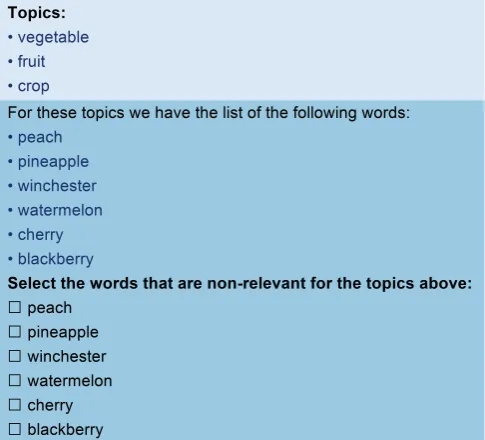
We used two crowdsourcing tasks based on word intruder detection (Chang et al., 2009) to measure how humans per-ceive the extracted lexical-semantic structures. Namely, the tasks are designed to evaluate the quality of the extracted sense clusters and their labels. The input form presented to an annotator is illustrated in Figure 6. A crowdworker is asked to identify words that do not match the context repre-sented by words from a sense cluster or its label. To gener-ate an intruder, following the original design of Chang et al. (2009), we select a random word from a cluster and replace it with a word of similar frequency that does not belong to any cluster (bias here is low as the evaluated model contains 27,149 out of 313,841 induced word senses). In both tasks, the workers have been provided with concise instructions and test questions.
6.1.2. Evaluation Metrics
We compute two metrics on the basis on annotation results: (1)accuracyis the fraction of tasks where annotators cor-rectly identified the intruder, thus the words from the clus-ter are consistent; (2) badnessis the fraction of tasks for which non-intruder words were selected. In this experi-ment, we assume that it is easy to identify the intruder in a correct sense cluster and difficult in a noisy, implausible sense cluster. We computeaccuracyas the fraction of tasks
[image:6.595.306.549.70.290.2]6https://www.crowdflower.com
Figure 6: Layout of the sense cluster evaluation crowd-sourcing task, the entry “winchester” is the intruder.
Accuracy Badness Randolphκ
Sense clusters,c 0.859 0.248 0.739
Hyper. labels,H(c) 0.919 0.208 0.705
Table 4: Plausibility of the sense clusters according to hu-man judgments via an intruder detection experiment for the coarse-grained semantic class model.
where annotators correctly identified the intruder, thus the words from the cluster are consistent.
6.1.3. Results
Table 4 summarizes the results of the intruder detection ex-periment. Overall, 68 annotators provided 2,035 judgments about the quality of sense clusters. Regarding hypernyms, 98 annotators provided 2,245 judgments. The majority of the induced semantic classes and their labels are highly plausible according to human judgments: the accuracy of the sense clusters based on the intruder detection is 0.859 (agreement of 87%), while the accuracy of hypernyms is 0.919 (agreement of 85%). The Randolphκof respectively 0.739 and 0.705 indicates substantial inter-observer agree-ment (Randolph, 2005).
Precision Recall F-score
Original hypernymy relations extracted from the Common Crawl corpus (Seitner et al., 2016) 0.475 0.546 0.508
Enhanced hypernyms with thecoarse-grainedsemantic classes 0.541 0.679 0.602
Table 5: Results of post-processing of a noisy hypernymy database with our approach, evaluated using human judgements.
Figure 7: Layout of the hypernymy annotation task.
too generic even undertf-idfweighting.
6.2.
Experiment 2: Improving Binary
Hypernymy Relations
In this experiment, we test whether our post-processing based on the semantic class improves the quality of hyper-nymy relations (cf. Figure 2).
6.2.1. Generation of Binary Hypernyms.
We evaluated the best coarse-grained model identified in the first experiment (tof 100). Each sense cluster of this model is split into the setHcluster of binary hypernyms,
as illustrated in Figure 1. Overall, we gathered 85,290 hy-pernym relations for 17,058 unique hyponyms. Next, we gathered the set Horig of 75,486 original hypernyms for
exactly the same 17,058 hyponyms. For each word from the sense cluster we looked up top five hypernyms under the best ones when sorting them by extraction frequency from the hypernym relation database of Seitner et al. (2016) as in our model each sense cluster is labeled with five hy-pernyms from the same database. The database of Seitner et al. (2016) is extracted using lexical patterns. Note that any other method for extraction of binary hypernyms can be used at this point, e.g. (Weeds et al., 2014; Roller et al., 2014; Shwartz et al., 2016; Glavaˇs and Ponzetto, 2017). For the comparison, we gathered up to five hypernyms for each word, using (1) the most frequent hypernym relations from (Seitner et al., 2016) vs. (2) the cluster labeling method as described above.
6.2.2. Task Design
We drew a random sample of 4,870 relations using lexical split by hyponyms. All relations fromHclusterandHorig
of one hyponym were included in the sample. These re-lations were subsequently annotated by human judges us-ing crowdsourcus-ing. We asked crowdworkers to provide a binary judgment about the correctness of each hypernymy relation as illustrated in Figure 7.
6.2.3. Results
Overall, 298 annotators completed 4,870 unique tasks each labeled 6.9 times on average, resulting in a total of 33,719 binary human judgments about hypernyms. We obtained a
fairagreement among annotators of 0.548 in terms of the Randolphκ(Meyer et al., 2014). Since CrowdFlower re-ports a confidence for each answer, we selected N = 3
most confident answers per pair and aggregated them using weighted majority voting. The ties were broken pessimisti-cally, i.e. by treating a hypernym as irrelevant. Results for
N ∈ 3,5,6varied less than by 0.002 in terms of F-score. The task received the rating of a 4.4 out of 5.0 according to the annotator’s feedback mechanism.
Table 5 presents results of the experiment. Since each pair received a binary score, we calculated Precision, Recall, and F-measure of two compared methods. Our denoising method improves the quality of the original hypernyms by a large margin both in terms of precision and recall, leading to an overall improvement of 10 F-score points. The im-provements of recall are due to the fact that to label a clus-ter of co-hyponyms it is sufficient to lookup hypernyms for only a fraction of words in the clusters. However, binary re-lations will be generated between all cluster hypernyms and the cluster words potentially generating hypernyms missing in the input database. For instance, a cluster of fruits can contain common entries like “apple” and “mango” which ensure labeling it with the word “fruit”. Rare words in the same cluster, like “mangosteen”, which have no hypernyms in the original resource due to the sparsity of the pattern-based approach, will also obtain the hypernym “fruit” as they are distributionally related to frequent words with re-liable hypernym relations, cf. Figure 1. We also observed this effect frequently with clusters of named entities, like cricket players. Improvements in precision are due to filter-ing of wrong extractions, which are different for different words and thus top hypernyms of a cluster contain only hy-pernyms confirmed by several co-hyponyms.
Finally, note that all previous hypernymy extraction meth-ods output binary relations between undisambiguated words (cf. Section 2.). Therefore, our approach could be used to improve results of other state-of-the-art hypernymy extraction approaches, such as HypeNET (Shwartz et al., 2016).
6.3.
Experiment 3: Improving Domain
Taxonomy Induction
In this section, we show how the labeled semantic classes can be used for induction of domain taxonomies.
6.3.1. SemEval 2016 Task 13
We use the taxonomy extraction evaluation dataset by Bor-dea et al. (2016), featuring gold standard taxonomies for three domains (Food, Science, Environment) and four lan-guages (English, Dutch, French, and Italian) on the basis of existing lexical resources, such as WordNet and Eu-rovoc (Steinberger et al., 2006).7 Participants were sup-posed to build a taxonomy provided a vocabulary of a do-main. Since our other experiments were conducted on En-glish, we used the English part of the task. The evaluation is
System / Domain, Dataset Food, WordNet
Science, WordNet
Food, Combined
Science, Combined
Science, Eurovoc
Environment, Eurovoc
WordNet 1.0000 1.0000 0.5870 0.5760 0.6243 n.a.
Baseline 0.0022 0.0016 0.0019 0.0163 0.0056 0.0000
JUNLP 0.1925 0.0494 0.2608 0.1774 0.1373 0.0814
NUIG-UNLP n.a. 0.0027 n.a. 0.0090 0.1517 0.0007
QASSIT n.a. 0.2255 n.a. 0.5757 0.3893 0.4349
TAXI 0.3260 0.2255 0.2021 0.3634 0.3893 0.2384
USAAR 0.0021 0.0008 0.0000 0.0020 0.0023 0.0007
Semantic Classes (fine-grained) 0.4540 0.4181 0.5147 0.6359 0.5831 0.5600
Semantic Classes (coarse-grained) 0.4774 0.5927 0.5799 0.6539 0.5515 0.6326
Table 6: Comparison of the our taxonomy induction method on the SemEval 2016 Task 13 on Taxonomy Extraction Evaluation (Bordea et al., 2016) for English in terms of cumulative Fowlkes&Mallows measure (F&M).
Domain #Seeds words
#Expand. words
#Clusters, fine-gr.
#Clusters, coarse-gr.
Food 2 834 3 047 29 21
Science 806 1 137 73 35
Environ. 261 909 111 39
Table 7: Summary of the domain-specific sense clusters.
based on the Fowlkes&Mallows Measure (F&M), a cumu-lative measure of the similarity of both taxonomies (Velardi et al., 2013).
6.3.2. Taxonomy Induction using Semantic Classes
Our method for taxonomy induction takes as input a vo-cabulary of the domain and outputs a taxonomy of the do-main. The method consists of three steps: (1) retrieving sense clusters relevant to the target domain; (2) generation of binary relations though a Cartesian product of words in a sense cluster and its labels; (3) attaching disconnected com-ponents to the root (the name of the domain). We retrieve domain-specific senses for each domain of the SemEval datasets by a lexical filtering. First, we build an extended lexicon of each domain on the basis of the seed vocabulary of the domain provided in the SemEval dataset. Namely, for each seed term, we retrieve all semantically similar terms. To filter out noisy expansions, related terms are added to the expanded vocabulary only if there are at leastk= 5 com-mon terms between the seed vocabulary and the list of re-lated terms. Second, we retrieve all sense clusters that con-tain at least one term from the expanded vocabulary among its sense clusters or hypernyms. Table 7 summarizes results of this domain filtering. After, we generate binary hyper-nymy relations by linking every word in the semantic class to each hypernymy label as shown in Figure 1. Finally, we link roots of each disconnected components to the root of the taxonomy, e.g. “food” for the Food domain. Note that this step was used by SemEval participants, e.g. in the TAXI system (Panchenko et al., 2016).
6.3.3. Results
Table 6 presents results of the taxonomy extraction ex-periment. We evaluated two best models of our method: a coarse and a finegrained clusterings featuring respec-tively 734 and 1870 semantic classes identified in Section 5. with different levels of pruning: t ∈ {0,100}. As one
can observe, our model based on the labeled sense clus-ters significantly outperforms the substring-based baseline and all participating system by a large margin on all do-mains. For the “Science (Eurovoc)” and “Food” domains our method yields results comparable to WordNet while re-maining unsupervised and knowledge-free. Besides, for the “Science” domain our method outperforms WordNet, indi-cating on the high quality of the extracted lexical seman-tic knowledge. Overall, the coarse-grained more pruned model yielded better results as compared to fine-grained
un-pruned model for all domains but “Science (Eurovoc)”.
7.
Conclusion
In this paper, we presented an unsupervised method for the induction of sense-aware semantic classes using distri-butional semantics and graph clustering and showed how these can be used for post-processing of noisy hypernymy databases extracted from text. We determined optimal parameters of our approach by a comparison to existing lexical-semantic networks. To evaluate our approach, we performed three experiments. A large-scale crowdsourc-ing study indicated a high plausibility of extracted semantic classes according to human judgment. Besides, we demon-strated that our approach helps to improve precision and re-call of a hypernymy extraction method. Finally, we showed how the proposed semantic classes can be used to improve domain taxonomy induction from text.
While we have demonstrated the utility of our approach for hypernym extraction and taxonomy induction, we believe that the induced semantic classes can be useful in other tasks. For instance, in (Panchenko et al., 2017) these se-mantic classes were used as an inventory for word sense disambiguation to deal with out of vocabulary words.
8.
Acknowledgements
9.
Bibliographical References
Auer, S., Bizer, C., Kobilarov, G., Lehmann, J., Cyga-niak, R., and Ives, Z. (2007). DBpedia: A Nucleus for a Web of Open Data. In Proceedings of the 6th Inter-national Semantic Web Conference, 2nd Asian Semantic Web Conference, ISWC 2007 + ASWC 2007: The Se-mantic Web, pages 722–735. Springer Berlin Heidelberg, Busan, Korea.
Bartunov, S., Kondrashkin, D., Osokin, A., and Vetrov, D. (2016). Breaking sticks and ambiguities with adaptive skip-gram. InProceedings of the International Confer-ence on Artificial IntelligConfer-ence and Statistics (AISTATS), pages 130–138, Cadiz, Spain.
Berant, J., Dagan, I., and Goldberger, J. (2011). Global Learning of Typed Entailment Rules. InProceedings of the 49th Annual Meeting of the Association for Com-putational Linguistics: Human Language Technologies, pages 610–619, Portland, Oregon, USA. Association for Computational Linguistics.
Biemann, C. and Riedl, M. (2013). Text: now in 2D! A framework for lexical expansion with contextual similar-ity.Journal of Language Modelling, 1(1):55–95. Biemann, C., Faralli, S., Panchenko, A., and Ponzetto, S. P.
(2018). A framework for enriching lexical semantic re-sources with distributional semantics. Natural Language Engineering, pages 1–48.
Biemann, C. (2005). Ontology Learning from Text: A Sur-vey of Methods. GLDV-Journal for Computational Lin-guistics and Language Technology, 20(2):75–93. Biemann, C. (2006). Chinese Whispers: An Efficient
Graph Clustering Algorithm and Its Application to Nat-ural Language Processing Problems. InProceedings of the First Workshop on Graph Based Methods for Natural Language Processing, TextGraphs-1, pages 73–80, New York, NY, USA. Association for Computational Linguis-tics.
Biemann, C. (2013). Creating a system for lexical sub-stitutions from scratch using crowdsourcing. Language Resources and Evaluation, 47(1):97–122.
Bird, S., Loper, E., and Klein, E. (2009). Natural Lan-guage Processing with Python. O’Reilly Media Inc. Bordea, G., Buitelaar, P., Faralli, S., and Navigli, R.
(2015). SemEval-2015 Task 17: Taxonomy Extraction Evaluation (TExEval). In Proceedings of the 9th In-ternational Workshop on Semantic Evaluation (SemEval 2015), pages 902–910, Denver, CO, USA, June. Associ-ation for ComputAssoci-ational Linguistics.
Bordea, G., Lefever, E., and Buitelaar, P. (2016). SemEval-2016 task 13: Taxonomy extraction evaluation (texeval-2). InSemEval-2016, pages 1081–1091, San Diego, CA, USA. Association for Computational Linguistics. Braslavski, P., Ustalov, D., Mukhin, M., and Kiselev, Y.
(2016). YARN: Spinning-in-Progress. InProceedings of the 8th Global WordNet Conference, GWC 2016, pages 58–65, Bucharest, Romania. Global WordNet Associa-tion.
Caraballo, S. A. (1999). Automatic construction of a hypernym-labeled noun hierarchy from text. In Pro-ceedings of the 37th Annual Meeting of the Association
for Computational Linguistics, pages 120–126, College Park, MD, USA. Association for Computational Linguis-tics.
Chang, J., Boyd-Graber, J., Gerrish, S., Wang, C., and Blei, D. M. (2009). Reading Tea Leaves: How Humans In-terpret Topic Models. InAdvances in Neural Informa-tion Processing Systems 22, pages 288–296. Curran As-sociates, Inc.
Cimiano, P., (2006). Ontology Learning from Text, pages 19–34. Springer US, Boston, MA, USA.
De Smedt, T. and Daelemans, W. (2012). Pattern for Python. Journal of Machine Learning Research, 13:2031–2035.
Everett, M. and Borgatti, S. P. (2005). Ego network be-tweenness. Social networks, 27(1):31–38.
Faralli, S., Panchenko, A., Biemann, C., and Ponzetto, S. P. (2016). Linked Disambiguated Distributional Semantic Networks. InThe Semantic Web – ISWC 2016: 15th In-ternational Semantic Web Conference, Part II, Lecture Notes in Computer Science, pages 56–64, Kobe, Japan. Springer International Publishing.
Fellbaum, C. (1998). WordNet: An Electronic Database. MIT Press.
Ferraresi, A., Zanchetta, E., Baroni, M., and Bernardini, S. (2008). Introducing and evaluating ukWaC, a very large web-derived corpus of English. InProceedings of the 4th Web as Corpus Workshop (WAC-4): Can we beat Google?, pages 47–54, Marrakech, Morocco. European Language Resources Association (ELRA).
Fu, R., Guo, J., Qin, B., Che, W., Wang, H., and Liu, T. (2014). Learning Semantic Hierarchies via Word Em-beddings. InProceedings of the 52nd Annual Meeting of the Association for Computational Linguistics (Vol-ume 1: Long Papers), pages 1199–1209, Baltimore, MD, USA. Association for Computational Linguistics. Glavaˇs, G. and Ponzetto, S. P. (2017). Dual tensor
model for detecting asymmetric lexico-semantic rela-tions. In Proceedings of the 2017 Conference on Em-pirical Methods in Natural Language Processing, pages 1758–1768, Copenhagen, Denmark, September. Associ-ation for ComputAssoci-ational Linguistics.
Gong, Z., Cheang, C. W., and Leong Hou, U. (2005). Web Query Expansion by WordNet. In Proceedings of the 16th International Conference on Database and Ex-pert Systems Applications - DEXA ’05, pages 166–175, Copenhagen, Denmark. Springer Berlin Heidelberg. Graff, D. and Cieri, C. (2003). English Gigaword corpus.
Linguistic Data Consortium.
Hearst, M. A. (1992). Automatic Acquisition of Hy-ponyms from Large Text Corpora. InProceedings of the 14th Conference on Computational Linguistics - Volume 2, COLING ’92, pages 539–545, Nantes, France. Asso-ciation for Computational Linguistics.
Heylen, K., Peirsman, Y., Geeraerts, D., and Speelman, D. (2008). Modelling Word Similarity: an Evaluation of Automatic Synonymy Extraction Algorithms. In Pro-ceedings of the Sixth International Conference on
3243–3249, Marrakech, Morocco. European Language Resources Association (ELRA).
Kozareva, Z. and Hovy, E. (2013). Tailoring the automated construction of large-scale taxonomies using the web.
Language resources and evaluation, 47(3):859–890. Levy, O., Remus, S., Biemann, C., and Dagan, I. (2015).
Do Supervised Distributional Methods Really Learn Lexical Inference Relations? InProceedings of the 2015 Conference of the North American Chapter of the Associ-ation for ComputAssoci-ational Linguistics: Human Language Technologies, pages 970–976, Denver, CO, USA. Asso-ciation for Computational Linguistics.
Lin, D. and Pantel, P. (2001). Induction of Semantic Classes from Natural Language Text. InProceedings of the Seventh ACM SIGKDD International Conference on Knowledge Discovery and Data Mining, KDD ’01, pages 317–322, San Francisco, CA, USA. ACM.
Meyer, C. M., Mieskes, M., Stab, C., and Gurevych, I. (2014). DKPro Agreement: An Open-Source Java Li-brary for Measuring Inter-Rater Agreement. In Proceed-ings of COLING 2014, the 25th International Conference on Computational Linguistics: System Demonstrations, pages 105–109, Dublin, Ireland. Dublin City University and Association for Computational Linguistics.
Mirkin, S., Dagan, I., and Geffet, M. (2006). Integrat-ing pattern-based and distributional similarity methods for lexical entailment acquisition. InProceedings of the
COLING/ACL 2006 Main Conference Poster Sessions,
pages 579–586, Sydney, Australia. Association for Com-putational Linguistics.
Navigli, R. and Ponzetto, S. P. (2012). BabelNet: The automatic construction, evaluation and application of a wide-coverage multilingual semantic network. Artificial Intelligence, 193:217–250.
Necsulescu, S., Mendes, S., Jurgens, D., Bel, N., and Nav-igli, R. (2015). Reading Between the Lines: Overcom-ing Data Sparsity for Accurate Classification of Lexical Relationships. InProceedings of the Fourth Joint Con-ference on Lexical and Computational Semantics, pages 182–192, Denver, CO, USA. Association for Computa-tional Linguistics.
Neelakantan, A., Shankar, J., Passos, A., and McCallum, A. (2014). Efficient non-parametric estimation of multi-ple embeddings per word in vector space. InConference on Empirical Methods in Natural Language Processing (EMNLP), pages 1059–1069, Doha, Qatar.
Panchenko, A., Faralli, S., Ruppert, E., Remus, S., Naets, H., Fairon, C., Ponzetto, S. P., and Biemann, C. (2016). TAXI at SemEval-2016 Task 13: a Taxonomy Induction Method based on Lexico-Syntactic Patterns, Substrings and Focused Crawling. InProceedings of the 10th Inter-national Workshop on Semantic Evaluation (SemEval-2016), pages 1320–1327, San Diego, California, USA. Association for Computational Linguistics.
Panchenko, A., Marten, F., Ruppert, E., Faralli, S., Ustalov, D., Ponzetto, S. P., and Biemann, C. (2017). Unsu-pervised, knowledge-free, and interpretable word sense disambiguation. In Proceedings of the 2017 Confer-ence on Empirical Methods in Natural Language
Pro-cessing: System Demonstrations, pages 91–96, Copen-hagen, Denmark, September. Association for Computa-tional Linguistics.
Pantel, P. and Lin, D. (2002). Discovering Word Senses from Text. InProceedings of the Eighth ACM SIGKDD International Conference on Knowledge Discovery and Data Mining, KDD ’02, pages 613–619, Edmonton, AB, Canada. ACM.
Pantel, P. and Pennacchiotti, M. (2006). Espresso: Lever-aging Generic Patterns for Automatically Harvesting Se-mantic Relations. In Proceedings of the 21st Inter-national Conference on Computational Linguistics and 44th Annual Meeting of the Association for Computa-tional Linguistics, pages 113–120, Sydney, Australia. Association for Computational Linguistics.
Pantel, P. and Ravichandran, D. (2004). Automatically La-beling Semantic Classes. InProceedings of the Annual Conference of the North American Chapter of the As-sociation for Computational Linguistics (NAACL’2004), pages 321–328, Boston, MA, USA. Association for Computational Linguistics.
Randolph, J. J. (2005). Free-marginal multirater kappa (multirater k [free]): An alternative to fleiss’ fixed-marginal multirater kappa.Online submission.
Richter, M., Quasthoff, U., Hallsteinsd´ottir, E., and Bie-mann, C. (2006). Exploiting the Leipzig Corpora Col-lection. In Proceedings of the Fifth Slovenian and First International Language Technologies Conference (IS-LTC), Ljubljana, Slovenia. European Language Re-sources Association (ELRA).
Roller, S., Erk, K., and Boleda, G. (2014). Inclusive yet Selective: Supervised Distributional Hypernymy Detec-tion. InProceedings of COLING 2014, the 25th Interna-tional Conference on ComputaInterna-tional Linguistics: Tech-nical Papers, pages 1025–1036, Dublin, Ireland. Dublin City University and Association for Computational Lin-guistics.
Seitner, J., Bizer, C., Eckert, K., Faralli, S., Meusel, R., Paulheim, H., and Ponzetto, S. P. (2016). A Large DataBase of Hypernymy Relations Extracted from the Web. In Proceedings of the Tenth International Con-ference on Language Resources and Evaluation, LREC 2016, pages 360–367, Portoroˇz, Slovenia. European Language Resources Association (ELRA).
Shi, L. and Mihalcea, R. (2005). Putting Pieces Together: Combining FrameNet, VerbNet and WordNet for Robust Semantic Parsing. In Proceedings of the 6th Interna-tional Conference on ComputaInterna-tional Linguistics and In-telligent Text Processing, CICLing 2005, pages 100–111, Mexico City, Mexico. Springer Berlin Heidelberg. Shwartz, V., Goldberg, Y., and Dagan, I. (2016).
Im-proving Hypernymy Detection with an Integrated Path-based and Distributional Method. InProceedings of the 54th Annual Meeting of the Association for Computa-tional Linguistics (Volume 1: Long Papers), pages 2389– 2398, Berlin, Germany, August. Association for Compu-tational Linguistics.
InProceedings of the 17th International Conference on Neural Information Processing Systems, NIPS’04, pages 1297–1304, Vancouver, BC, Canada. MIT Press. Steinberger, R., Pouliquen, B., Widiger, A., Ignat, C.,
Er-javec, T., Tufis, D., and Varga, D. (2006). The jrc-acquis: A multilingual aligned parallel corpus with 20+ languages. arXiv preprint cs/0609058.
Steyvers, M. and Tenenbaum, J. B. (2005). The large-scale structure of semantic networks: Statistical analyses and a model of semantic growth.Cognitive science, 29(1):41– 78.
Tjong Kim Sang, E. (2007). Extracting Hypernym Pairs from the Web. InProceedings of the 45th Annual Meet-ing of the Association for Computational LMeet-inguistics Companion Volume Proceedings of the Demo and Poster Sessions, pages 165–168, Prague, Czech Republic. As-sociation for Computational Linguistics.
Ustalov, D., Arefyev, N., Biemann, C., and Panchenko, A. (2017a). Negative sampling improves hypernymy ex-traction based on projection learning. In Proceedings of the 15th Conference of the European Chapter of the Association for Computational Linguistics: Volume 2, Short Papers, pages 543–550, Valencia, Spain. Associ-ation for ComputAssoci-ational Linguistics.
Ustalov, D., Panchenko, A., and Biemann, C. (2017b). Watset: Automatic induction of synsets from a graph of synonyms. InProceedings of the 55th Annual Meeting of the Association for Computational Linguistics (Volume 1: Long Papers), pages 1579–1590, Vancouver, Canada. Association for Computational Linguistics.
Velardi, P., Faralli, S., and Navigli, R. (2013). OntoLearn Reloaded: A Graph-Based Algorithm for Taxonomy In-duction.Computational Linguistics, 39(3):665–707. Vylomova, E., Rimell, L., Cohn, T., and Baldwin, T.
(2016). Take and Took, Gaggle and Goose, Book and Read: Evaluating the Utility of Vector Differences for Lexical Relation Learning. InProceedings of the 54th Annual Meeting of the Association for Computational Linguistics (Volume 1: Long Papers), pages 1671–1682, Berlin, Germany. Association for Computational Lin-guistics.
Wandmacher, T. (2005). How semantic is Latent Semantic Analysis? InProceedings of R ´ECITAL 2005, pages 525– 534, Dourdan, France.
Weeds, J., Clarke, D., Reffin, J., Weir, D. J., and Keller, B. (2014). Learning to distinguish hypernyms and co-hyponyms. In Proceedings of COLING 2014, the 25th International Conference on Computational Linguistics: Technical Papers, pages 2249–2259, Dublin, Ireland. Dublin City University and Association for Computa-tional Linguistics.
Widdows, D. and Dorow, B. (2002). A graph model for unsupervised lexical acquisition. In Proceedings of the 19th international conference on Computational linguistics-Volume 1, pages 1–7. Association for Com-putational Linguistics.
Zhou, G., Liu, Y., Liu, F., Zeng, D., and Zhao, J. (2013). Improving question retrieval in community question an-swering using world knowledge. In Proceedings of the