Universal Dependencies Version 2 for Japanese
Masayuki Asahara
♡†
, Hiroshi Kanayama
♠
, Takaaki Tanaka
♣
Yusuke Miyao
♢
, Sumire Uematsu
♢
, Shinsuke Mori
◦
Yuji Matsumoto
•
, Mai Omura
♡
, Yugo Murawaki
◦
♡National Institute for Japanese Language and Linguistics,♠IBM Research AI ♣NTT Communication Science Labolartories,♢National Institute of Informatics
◦Kyoto University,•Nara Institute of Science and Technology [email protected]†
Abstract
In this paper, we are presenting our work to build Universal Dependencies (UD) resources for Japanese. The UD Japanese resources are built based on automatic conversion from several treebanks. The word delimitation, POS, and syntactic relations of the existing treebanks are ported for the UD annotation scheme. We discuss the issues of the UD scheme found through porting of the Japanese language.
1.
Introduction
The Universal Dependencies (UD) project (McDonald et al., 2013) has defined a consistent, cross-linguistic target and syntactic structure representation format. In this presentation, we will show the work of the UD Japanese team. The UD Japanese team was organised by interested people who are developing their own treebanks or parsers. We developed and maintained several UD guidelines (version 2.0) compatible data for Japanese. Most of the data are made through automatic conversion from the existing treebank. The UD annotation guidelines were updated from version 1 to version 2 in early 2017. The automatic conversion enabled us to adapt the existing annotation based on traditional Japanese grammar conventions for the UD annotation guidelines changes. In this paper, we discuss the current issues of UD Japanese resources until today. These issues come from the difficulty to perform cross-linguistically consistent annotation for the different grammatical system from western European languages. The points at the issues related to the conversions are split into the delimitation (word, phrase and clause), undefined policies of UD guidelines, typological systems for UD, and copyright of Japanese language resources.
2.
UD Japanese Resources
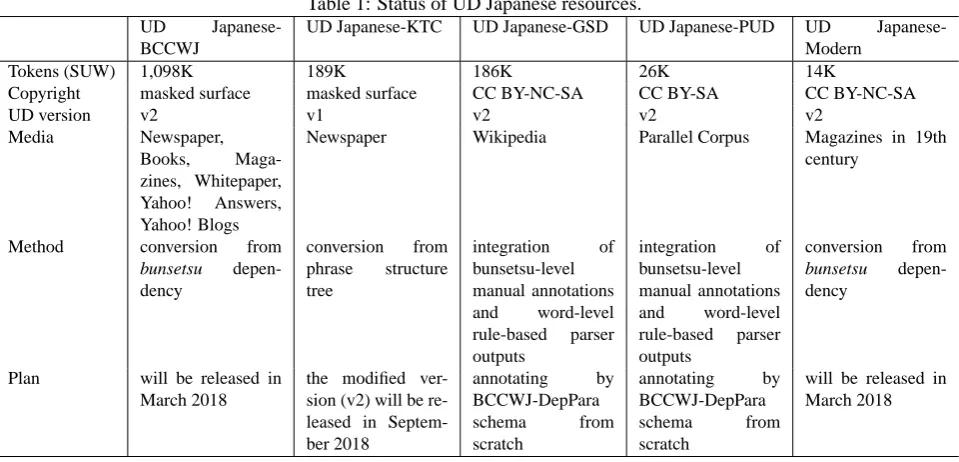
We have the following UD Japanese resources: UD Japanese-BCCWJ, UD Japanese-KTC (Tanaka et al., 2016), UD GSD, UD Japanese-PUD, and UD Japanese-Modern (Omura et al., 2017). Table 1 presents the current status of UD Japanese resources. Below, we describe these resources briefly.
UD Japanese-BCCWJ is UD data based on the ‘Balanced
Corpus of Contemporary Written Japanese’ (hereafter BC-CWJ) (Maekawa et al., 2014). The BCCWJ defines 1 million word-scale core data samples in which the mor-phological information is manually annotated with three layers of word delimitations: Short Unit Word (SUW), Long Unit Word (LUW), and bunsetsu. The BCCWJ has several syntactic annotations. The BCCWJ-DepPara (Asahara and Matsumoto, 2016) is a bunsetsu-based syn-tactic dependency and coordinate structure annotation. The BCCWJ-PAS (Ueda et al., 2015) is a predicate-argument
relation annotation with the NAIST Text Corpus annotation schema (Iida et al., 2007). We maintain conversion rules based on these annotations.
UD Japanese-KTC (Tanaka et al., 2016) is based
on the NTT Japanese Phrase Structure Treebank (Tanaka and Nagata, 2013) which contains the same original text as the Kyoto Text Corpus (KTC) (Kurohashi and Nagao, 2003). KTC is a bunsetsu, namely base phrase, based dependency treebank with its own word delimitation schema and POS tagset. The NTT Japanese Phrase Structure Treebank is a phrase structure-based treebank. The word delimitation and POS are adapted to the UniDic SUW standard. The data is still in version 1.0 schema as of February 2018. We are now modifying UD Japanese KTC from version 1.0 schema to version 2.0.
UD Japanese-GSD (formerly known as UD Japanese)
con-sists of sentences from Wikipedia. The version 2.0 of this annotated corpus was provided for the CoNLL 2017 Shared Task (Zeman et al., 2017). In the release of version 2.0, the sentences have been automatically split into words by IBM’s word segmenter. The segmentation errors were re-moved by adding lexicons specific to the data. In addi-tion, the dependencies are automatically resolved using the bunsetsu-level dependency parser (Kanayama et al., 2000) with the attachment rules for functional words defined in UD Japanese (Tanaka et al., 2016). Complex sentences with parenthesis were removed to avoid parsing errors. In the version 2.1 released in November 2017, manual annota-tions were merged with the semi-automatic annotaannota-tions to reduce remaining errors.
UD Japanese-PUD was created in the same manner as UD
Japanese-GSD, with the goal of maintaining consistency with UD Japanese-GSD. Since it is a parallel corpus with other languages, no sentences were removed from the cor-pus, including the ones containing parenthesis.
UD Japanese-Modern (Omura et al., 2017) is a small
an-Table 1: Status of UD Japanese resources.
UD Japanese-BCCWJ
UD Japanese-KTC UD Japanese-GSD UD Japanese-PUD UD Japanese-Modern
Tokens (SUW) 1,098K 189K 186K 26K 14K
Copyright masked surface masked surface CC BY-NC-SA CC BY-SA CC BY-NC-SA
UD version v2 v1 v2 v2 v2
Newspaper Wikipedia Parallel Corpus Magazines in 19th century
Plan will be released in March 2018
will be released in March 2018
notated predicate-argument relations based on the NAIST Text Corpus annotation schema. We utilised the conver-sion script used for UD Japanese-BCCWJ, because the two corpora share the same annotation schema. There are two characteristic syntactic structures in modern Japanese. One is inversion in Sino-Japanese literary styles. The other is predicative adnominals.
3.
Issues
3.1.
Overview
The first issue is word delimiters. Japanese has no overt word delimitation. We have to define what is the syntactic word in UD for such languages. The same issue can be found in the discrimination between phrases and clauses. Because obligatory cases in Japanese can be omitted, the definition of adjective and adverbial clauses is vague which requires some clarification for the UD syntactic relations. The second issue is undefined policies in the UD guidelines. The design of POS can be split into two principles: one is lexicon-based morphology level; the other is the usage-based syntax level. The design of syntactic relations also has several levels. One level is that the relations are defined only by the surface form. Another level is that the relations are defined by the contextual words. The UD guidelines are not entirely clear as to define which levels are appropriate for the designs of POS and syntactic relations.
The third issue is the guidelines related to linguistic typol-ogy. The UD guidelines are biased toward subject promi-nent languages such as English. However, Japanese is one of topic prominent languages. For example, in the topic prominent languages, whereas the expletive label expl
cannot appeared, a label for the topic marker is needed. Though Japanese is a strictly head-final language, the UD guidelines define head-initial construction for coordinate structures. We hope to introduce the head directionality pa-rameter for UD guidelines.
The last issue is the copyright of the original texts for Japanese language resources.
3.2.
Word Delimitation
Word delimitation is a critical issue for building UD annota-tion, because Japanese is written without word boundaries. UD guidelines specify that the basic units of annotation are
syntactic words.
We tend to define morphemic units which are smaller than the word unit in order to maintain unit uniformity. There-fore, when we define the morpheme unit as the Universal Dependency word unit, we must annotate the compound word construction, as defined in the morphological layer of Japanese linguistics. Although the smaller word unit can be produced with high precision, this is not suitable for Japanese syntactic dependency annotation. In Japanese NLP, bunsetsu (base phrase) tends to be used as a syntactic dependency annotation unit. The morphology level includ-ing multi-word expressions is encapsulated within a bun-setsu. Therefore we can concentrate on the annotation of purely syntactic phenomena.
We must define the syntactic words for UD annotation for Japanese. We used the BCCWJ morpheme annotation stan-dard, which is based on UniDic word boundary definition. The definition contains three layers: SUW, LUW, and
bun-setsu. SUW can be produced by the morphological analyser
MeCab.1 with UniDic2LUW and bunsetsu can be produced by the pre-trained chunker Comainu.3
NINJAL4 defined five sorts of word unit definitions by
operationalism. The most fine-grained unit is NINJAL Minimum Unit Word. SUW (Short Unit Word: ) is constructively defined by the NINJAL Minimum Unit Word ( ). MUW (Middle Unit Word: ) is a basic unit where a sound may change at the begin-ning or the ending of a word and/or an accent may change (Uchimoto and Den, 2008). The Middle Unit Word defines voiced compound (“rendaku”) (van de Weijer et al., 2005).
1
taku910.github.io/mecab/
2unidic.ninjal.ac.jp/ 3osdn.net/projects/comainu/ 4
Short Unit Word (SUW)
PROPN PUNCT PROPN NOUN ADP VERB AUX PUNCT VERB NOUN ADP NOUN ADP VERB
China Beijing univ. -IOBJ study return after -IOBJ twins -OBJ birth abroad to Japan
root
name
punct
name case iobj
aux
punct
advcl
compound
iobj
case
obj
case
Long Unit Word (LUW)
PROPN ADP VERB PUNCT NOUN ADP NOUN ADP VERB
Peking Univ. -IOBJ study after return -IOBJ twins -OBJ birth in China abroad to Japan
root
iobj
case punct
advcl
iobj
case
obj
case
bunsetsu
PROPN VERB NOUN NOUN VERB
Peking Univ. in China study abroad after return to Japan twins birth
-IOBJ -IOBJ -OBJ
root
iobj
advcl
iobj
obj
She studied in Peking University, and delivered twins when she returned to Japan.
Figure 1: Word delimitation standards in Japanese.
The ‘named entity’ and ‘compound word construction’ re-lated labels (in the black ground) which show up SUW dis-appear in the LUW (Long Unit Word: ) layer. In the most coarse-grained level, bunsetsu, case marker and aux-iliary verbs that show up in LUW disappear. Currently, all UD Japanese resources (in versions 1 and 2) are based on SUW word delimitations. Figure 1 shows the SUW, LUW and bunsetsu examples. The group of words in a squircle defines a bunsetsu chunk.
UD schema defines that the basic units of annota-tion are syntactic words, though a renowned typologist failed to identify words consistently across languages (Haspelmath, 2011). However, SUW is not suitable for syntactic dependency annotations. We need to define syn-tactic word delimitation for UD Japanese. Structuralists (Hattori, 1960; Miyaoka, 2015) discuss Japanese syntactic word definition. A blog5 also discusses the plausible unit
for UD Japanese resources. These discussions are not based on any language resources.
5www.cjvlang.com/Spicks/udjapanese.html
3.3.
POS
In Japanese NLP, we have several POS tagsets used in IPADIC, JUMAN, and UniDic. IPADIC and its POS tagset have not been maintained for 10 years. The JUMAN POS tagset is based on the Masuoka-Takubo POS tagset (Masuoka and Takubo, 1992). UniDic has a two layered POS tagset for SUW and LUW delimitations. The two layered UniDic POS tagset is split in to two categories: lexicon-based ( ) and usage-based ( ). The lexicon-based approach involves all possible categories for one word as labels. For example, the label ‘
princi-NOUN ADP NOUN ADP VERB
morning -IOBJ school -IOBJ go TEMP GOAL
root
case case
iobj
iobj
GOAL
TEMPORAL
Figure 2: Double indirect object markers.
NOUN ADP ADJ
Taro -TOPIC strict
root
case
nsubj
Figure 3: Topic marker.
ples with this respect. We used usage-based POS tags from UniDic based on lexicon/corpora/morphological analysers to align the Universal POS tags.
3.4.
Japanese case marker and syntactic
relations
A phrase-based treebank includes syntactic relation infor-mation for UD. However, a bunsetsu dependency-based treebank does not include the syntactic relation informa-tion. Our policy is to produce UD syntactic relations from the surface forms of bunsetsu dependency-based depen-dency structures.
We assigned the labelnsubjto nominal phrases with the case marker ‘ ’ (ga), the label objto nominal phrases with the case marker ‘ ’ (o), and the labeliobjto nomi-nal phrases with the case marker ‘ ’ (ni), respectively. Though the indirect object marker ‘ ’ (surface case) is given the labeliobj, it can appear in more than one phrase with different deep cases for one predicate. The example in Figure 2 shows two indirect objects with the deep cases of TEMPORAL and GOAL presented below the sentences. If the UD guideline define deep case based labels for the syntactic relations, we need to assign the labeloblto the TEMPORAL case. It is difficult to determine deep cases. Though the information to discriminate iobj from obl
is available in BCCWJ-PAS or compatible annotation, it is not reproducible for other language resouces.
Japanese obligatory cases for predicates do not necessar-ily appear overtly in Japanese sentences. If ‘ ’ does not overtly appear in the clause, the labelnsubjis assigned to a nominal phrase with a topic marker ‘ ’ (wa). Figure 3 shows an example ofnsubjindicated by the topic marker. The topic marker ‘ ’ and subject marker ‘ ’ can appear for the same predicate. Figure 4 shows such a double
sub-NOUN ADP NOUN ADP ADJ
elephant -TOPIC nose -SUBJ long
root
case case
dislocated
nsubj
Figure 4: Double subject sentence.
NOUN ADP ADP NOUN ADP ADJ
Taro -IOBJ -TOPIC problem -SUBJ easy
root
case case
case
iobj
nsubj
Figure 5: Indirect object marker with topic marker.
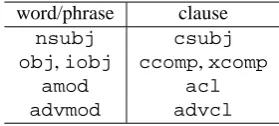
Table 2: The UD dependency labels between word/phrase and clause.
word/phrase clause
nsubj csubj
obj,iobj ccomp,xcomp
amod acl
advmod advcl
ject sentence. The UD guidelines specify that the example needs the labeldislocated.
The topic marker ‘ ’ can immediately follow an indirect object marker ‘ ’ as in Figure 5.
The labels for the topic marker are instable because of the design of UD syntactic labels. The design of UD syntactic labels are biased to subject-prominent languages. We argue for a new label for the topic marker for the topic-prominent languages such as Japanese, Korean, Chinese and Indone-sian.
3.5.
Clause
The UD dependency labels are designed to split between word/phrase and clause (Table 2). The difference tween clause and word/phrase is vague in Japanese, be-cause obligatory cases, including subject, do not necessar-ily overtly appear in the sentences.
We define the dependency labelcsubjonly for the clause with a particle ( ) ‘ ’ (no) with UD POSSCONJ in UD Japanese resources (Figure 6).
We define the dependency labelccomponly for the clause with a case particle ‘ ’ (to) with UD POS ADP in UD Japanese resources (Figure 7).
NOUN ADP VERB AUX SCONJ ADP ADJ AUX
Taro -SUBJ get angry PASSIVE -TOPIC unpleasant COPULA
root
case nsubj
aux mark
case
csubj
aux
Figure 6: Clausal subjectcsubj.
ADJ AUX ADP VERB
beautiful COPULA -QUOTE think
root
aux case
ccomp
Figure 7: Clausal complementccomp.
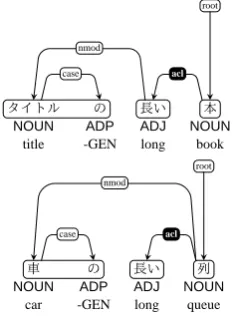
NOUN ADP ADJ NOUN
title -GEN long book
case nmod
acl
root
NOUN ADP ADJ NOUN
car -GEN long queue
case nmod
acl
root
Figure 8: Adjective clauseacl.
In the case of adjectives, attributive and predicative usages are not exclusive. There are two examples of attributive usages given in Figure 8. Whereas the latter example does not have an overt sense subject, the former has an overt sense subject and can also indicate predicative usage. The absence of an overt sense subject does not mean that the adjective is not used in the predicate. Therefore, we regard both adjectives as clauses, and we assignacl. The same goes foradvclin which there are adverbial forms (
) of adjectives.
Furthermore, acl has an ambiguity with appos. The UD guidelines (v2) define the label (acl) for an adjec-tive clause with a predicate-argument relation (
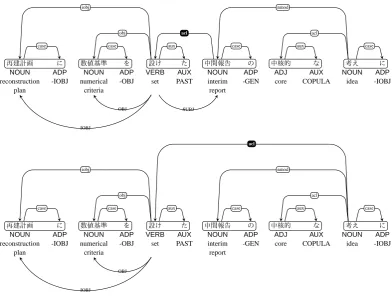
) between the modifier and head (nominal phrase). The Japanese language has a similar clause – an apposi-tional clause ( ) without predicate-argument relations between the modifier and head. The difference between the adjective clause and appositional clause is not clearly defined in Japanese, since the case for predi-cates including adjectives tends to be omitted. Figure 9 shows some ambiguous examples. The arcs below the
sentences indicate predicate-argument relations compatible with BCCWJ-PAS annotation. One interpretation (in the upper example) is that (interrim report) can be the subject of the (set) as an adjective clause. The other interpretation (in the lower example) is that
(idea) cannot be the subject of the (set) as an ap-position clause. However, both interpretations are assigned
aclin the UD annotation. Note that the labelapposis assigned not for clause but for word/phrase.
3.6.
Coordinate Structure
The Japanese language is a strictly head-final language with a bunsetsu-based dependency structure. However, UD guidelines define head-initial relations for coordinate struc-tures, where in the attachment of conjuctions or punctua-tion is to the right-side constituent in the coordinate struc-tures. Figure 10 shows simple coordinate structure exam-ples. The grouping of the words indicates the bunsetsu. The word-based UD dependency relations intersect the bunsetsu boundaries.
Figure 11 shows a coordinate structure with three con-stituents. The root of the dependency tree is the leftmost constituent in the coordinate structure.
Figure 12 shows an example of non-constituent coordina-tion. The upper example is the coordination of ‘
’ and ‘ ’. The
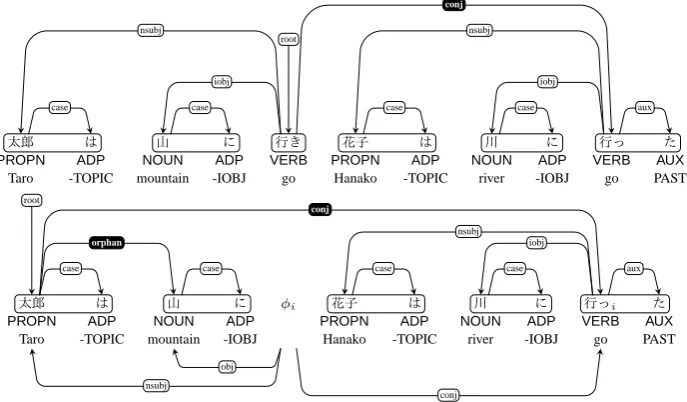
root node is the rightmost word in the leftmost coordinate chunk. The lower example has an ellipsis of ‘ ’ be-fore the numeral. The dependency relations of the omitted node are reduced and attached to the daughter node ‘ ’. Figure 13 shows another example of non-constituent coor-dination. The upper example is the coordination of ‘
’ and ‘ ’. The root node is the rightmost word in the leftmost coordinate chunk. The lower example is the ellipsis of the ‘ ’ part, which is the root node in the upper example. The dependency relations of the omitted node that include the root are reduced and at-tached to the daughter node ‘ ’. We assigned the label
orphanbetween ‘ ’ (SUBJ) and ‘ ’ (IOBJ).
These peculiar tree constructions are caused by the initial definition of coordinate structures for a strictly head-final language.
3.7.
Copyright
NOUN ADP NOUN ADP VERB AUX NOUN ADP ADJ AUX NOUN ADP
reconstruction -IOBJ numerical -OBJ set PAST interim -GEN core COPULA idea -IOBJ
plan criteria report
case
iobj
case obj
aux
acl
SUBJ OBJ
IOBJ
case
nmod
aux acl
case
NOUN ADP NOUN ADP VERB AUX NOUN ADP ADJ AUX NOUN ADP
reconstruction -IOBJ numerical -OBJ set PAST interim -GEN core COPULA idea -IOBJ
plan criteria report
case
iobj
case obj
aux
acl
OBJ
IOBJ
case
nmod
aux acl
case
Figure 9: Ambiguous example of adjective clause (acl) (LUW delimitation).
ADJ NOUN CCONJ NOUN
cute dog and cat
acl
conj
cc
root
Figure 10: Simple coordinate structures.
of BCCWJ.6
UD Japanese-KTC is the first UD annotation schema data for Japanese. The data is based on Mainichi Newspaper in 1995. Though the annotation is available under the Cre-ative Commons License (CC BY-SA), users are required to purchase the original text data CD-ROM.7
UD Japanese-GSD and UD Japanese-PUD data are based on open data. The original text is also under Creative Com-mons License (CC BY-NC-SA for UD Japanese-GSD and CC BY-SA for UD Japanese-PUD).
UD Japanese-Modern is based on CHJ. The copyright of the original text has already expired. We will provide the data under open license.
A newswire company asked us to provide a million scale newspaper texts for the UD Japanese project. We will
anno-6
pj.ninjal.ac.jp/corpus_center/bccwj/ en/dvd-index.html
7
www.nichigai.co.jp/sales/mainichi/ mainichi-series.html
tate BCCWJ-like morphological information and bunsetsu-based syntactic structures for the data. The data will pub-lished on the Linguistic Data Consortium by the newswire company.
4.
Conclusion
This paper presented our work to build UD compatible lan-guage resources for Japanese. We discussed the issues of using the UD annotation scheme on Japanese language. We are still working on conversion rules around word delimita-tion, clause definitions and coordinate structure.
Table 1 presents the plans to develop UD Japanese re-sources.
UD Japanese-KTC is based on the UD schema of version
1.0. The data is derived by conversion rules based on phrase structure trees. We are adapting the conversion rules to the version 2.0 schema. The newer version will be released on September 2018.
UD Japanese-GSD and UD Japanese-PUD are not based
on UniDic word boundaries (SUW/LUW). We are annotat-ing the word boundaries of SUW and LUW with morpho-logical information in UniDic definition. The next step is to annotate bunsetsu-based dependency structures based on BCCWJ-DepPara schema.
UD Japanese-BCCWJ and UD Japanese-Modern are
de-velopped based on version 2.0 schema. These two data will be released in March 2018.
5.
Acknowledgements
NOUN ADP VERB PUNCT VERB PUNCT VERB AUX AUX
machine -OBJ design produce sell do PAST
root
case
obj conj
punct conj
punct
aux aux
root
Figure 11: Coordinate structure with three constituents.
PROPN ADP NOUN ADP NUM VERB PROPN ADP NOUN ADP NUM VERB AUX
Hanako -TOPIC apple -OBJ two buy Taro -TOPIC orange -OBJ three buy PAST
case case
nummod obj nsubj
case
advcl
case nsubj
obj
nummod
aux root
i ϕi
PROPN ADP NOUN ADP NUM VERB PROPN ADP NUM VERB AUX
Hanako -TOPIC apple -OBJ two buy Taro -TOPIC three buy PAST
case case
nummod obj nsubj
case
advcl
nsubj
obj
nummod
obj
aux root
Figure 12: Nominal phrase ellipsis in the non-constituent conjunct coordination.
PROPN ADP NOUN ADP VERB PROPN ADP NOUN ADP VERB AUX
Taro -TOPIC mountain -IOBJ go Hanako -TOPIC river -IOBJ go PAST
case case
nsubj
iobj
case case
nsubj
iobj
aux
conj
root
ϕi i
PROPN ADP NOUN ADP PROPN ADP NOUN ADP VERB AUX
Taro -TOPIC mountain -IOBJ Hanako -TOPIC river -IOBJ go PAST
case case
nsubj obj
orphan
case case
nsubj iobj
aux
conj
conj
root
Figure 13: Predicate ellipsis in the non-constituent conjunct coordination.
Center for Corpus Development, NINJAL.
6.
Bibliographical References
Cor-pus of Contemporary Written Japanese’. In
Proceed-ings of the 12th Workshop on Asian Langauge Resources (ALR12), pages 49–58.
Haspelmath, M. (2011). The indeterminacy of word seg-mentation and the nature of morphology and syntax.
Fo-lia Linguistica, 45(1):31–80.
Hattori, S., (1960). Gengogaku no hoho, chapter Fuzokugo to Fuzokukeishiki, pages 461–491. Iwanami Shoten. (in Japanese).
Iida, R., Komachi, M., Inui, K., and Matsumoto, Y. (2007). Annotating a Japanese Text Corpus with Predicate-argument and Coreference Relations. In LAW ’07:
Pro-ceedings of the Linguistic Annotation Workshop.
Kanayama, H., Torisawa, K., Mitsuishi, Y., and Tsujii, J. (2000). A hybrid Japanese parser with hand-crafted grammar and statistics. In Proceedings of the 18th
In-ternational Conference on Computational Linguistics,
pages 411–417.
Kurohashi, S. and Nagao, M., (2003). Building a Japanese
Parsed Corpus – while Improving the Parsing System,
chapter 14, pages 249–260. Kluwer Academic Publish-ers.
Maekawa, K., Yamazaki, M., Ogiso, T., Maruyama, T., Ogura, H., Kashino, W., Koiso, H., Yamaguchi, M., Tanaka, M., and Den, Y. (2014). Balanced Corpus of Contemporary Written Japanese. Language Resources
and Evaluation, 48:345–371.
Masuoka, T. and Takubo, Y. (1992). Kiso Nihongo Bunpou
– Kaitei Ban. Kuroshio Publisher.
McDonald, R., Nivre, J., Quirmbach-Brundage, Y., Gold-berg, Y., Das, D., K.Ganchev, Hall, K., Petrov, S., Zhang, H., T¨ackstr¨om, O., Bedini, C., Castell´o, N. B., and Lee, J. (2013). Universal dependency annotation for multilin-gual parsing. In Proceedings of the 51st Annual Meeting
of the Association for Computational Linguistics, pages
92–97.
Miyaoka, O. (2015). Go to wa Nani ka Saiko
(Reconsider-ing What is the “Word”?). Sanseido. (in Japanese).
Ogiso, T., Kondo, A., Mabuchi, Y., and Hattori, N. (2017). Construction of the “Corpus of Historical Japanese: Meiji-Taisho Series I - Magazines”. In Proceedings of
Digital Humanities 2017.
Omura, M., Takahashi, Y., and Asahara, M. (2017). Uni-versal Dependency for Modern Japanese. In
Proceed-ings of the 7th Conference of Japanese Association for Digital Humanities (JADH2017).
Tanaka, T. and Nagata, M. (2013). Constructing a Practical Constituent Parser from a Japanese Treebank with Func-tion Labels. In Proceedings of the Fourth Workshop on
Statistical Parsing of Morphologically Rich Language,
pages 108–118.
Tanaka, T., Miyao, Y., Asahara, M., Uematsu, S., Kanayama, H., Mori, S., and Matsumoto, Y. (2016). Universal Dependencies for Japanese. In Proceedings of
LREC 2016.
Uchimoto, K. and Den, Y. (2008). Word-level dependency-structure annotation to corpus of sponta-neous japanese and its application. In Proceedings of
LREC 2008.
Ueda, Y., Iida, R., Asahara, M., Matsumoto, Y., and Toku-naga, T. (2015). A Predicate-Argument and Coref-erence Relation Annotation on the ‘Balanced Corpus of Contemporary Written Japanese’, gendai nihongo
kakikotoba kinkou koopasu ni taisuru jutugo koukouzou kyosanshou kankei annoteeshon (in Japanese). In 8th Corpus Japanese Linguistics Workshop, pages 205–214.
van de Weijer, J., Nanjo, K., and Nishihara, T. (2005).
Voicing in Japanese. Studies in Generative Grammar.
Walter De Gruyter Inc.
Zeman, D., Popel, M., Straka, M., Hajiˇc, J., Nivre, J., Gin-ter, F., Luotolahti, J., Pyysalo, S., Petrov, S., Potthast, M., Tyers, F., Badmaeva, E., G¨okırmak, M., Nedoluzhko, A., Cinkov´a, S., Hajiˇc jr., J., Hlav´aˇcov´a, J., Kettnerov´a, V., Ureˇsov´a, Z., Kanerva, J., Ojala, S., Missil¨a, A., Manning, C., Schuster, S., Reddy, S., Taji, D., Habash, N., Leung, H., de Marneffe, M.-C., Sanguinetti, M., Simi, M., Kanayama, H., de Paiva, V., Droganova, K., Mart´ınez Alonso, H., Uszkoreit, H., Macketanz, V., Bur-chardt, A., Harris, K., Marheinecke, K., Rehm, G., Kayadelen, T., Attia, M., Elkahky, A., Yu, Z., Pitler, E., Lertpradit, S., Mandl, M., Kirchner, J., Fernandez Al-calde, H., Strnadova, J., Banerjee, E., Manurung, R., Stella, A., Shimada, A., Kwak, S., Mendonc¸a, G., Lando, T., Nitisaroj, R., and Li, J. (2017). CoNLL 2017 Shared Task: Multilingual Parsing from Raw Text to Univer-sal Dependencies. In Proceedings of the CoNLL 2017
Shared Task: Multilingual Parsing from Raw Text to Universal Dependencies. Association for Computational