V.N. B~l~OOZ~l~OV - A. A. POLIKARI'OV
A MECHANISM OF THE ANALYTICITY DEVELOPMENT IN A LANGUAGE, ELEMENTS OF THE THEORY AND THE
COMPUTER~ EXPERIMENT
1. From the point of view of the general cybernetic theory we consider language to be a device, which regulates the information streams in social systems. 1 On this basis it is possible to come to the conclusion of bilateral dependency of the language organization level (the level of its complexity) on (1) complexity value of the language mechanism input information stream, and (2) complexity value o f the output in- formation stream which is to be produced by the language mecha- nism.~
The relation between mentioned values the following formula:
L--- S ,
may be represented by
where L is complexity (volume) of the language (in the elementary language units); 8 S is complexity (volume) of the input information stream (in elementary sense units, which are supposed to be encoded); k is complexity (volume) of the output information stream (in elemen- tary sign units, in which sense units are coded).
In the given paper we consider certain moments o f dependency of general level o f human language complexity on some values o f the
1 The analysis o f systems, in which communication processes are carried out and in which the necessity in communicative regulators arises, is made in our papers. It should be noted that our analysis is based on the ontological model of the communicative pro- cess, which is represented in the series o f papers on systems linguistics by G. P. Melni- kov, published in 1967-1972 (G. P. M~L'NmOV, 1967, 1969, 1970, 1972 a).
2 It follows from the fundamental cybernetic law of the necessary variety (W. tk. ASHBY, 1958), which determines the functioning of any regulator. A more detailed ana- lysis of the given dependency is made in the paper of A. A. P o L n ~ v o v (in press).
output information stream; internal typological reconstructions of language, wherein the change of its complexity is expressed, and some fundamental reasons of the changing in the values of the output infor- mation stream optimum redundancy are also treated.
As is going to be shown below, the changing in the values of that parameter depends on some specific processes in the social systems of communication. That is why the main problem of the given paper refers to the sphere of socio-linguistic problematics and constitutes a fragment of the more complex socio-linguistic model, which is being worked out at present.
2. Factors that lead to the changes in the parameter of language complexity are, in our opinion, connected with increasing or decreas- ing of specific "noise level" in language communication channels. Such "noise" appears, for instance, in the case of long-time and intense language contacts, when the community includes different language bearing communicants amalgamated. If the income of foreign- language communicants is weak and occurs from time to time, the lan- guage contact does not effect considerably the communication situa- tion (the foreign incomers accept gradually the common (original) language). But in the case of stable income of such communicants into the communicative system, and for that reason of stable low average value of language message comprehension in the community, the communicative system has to change the values of its parameters in order to increase the e~ciency of communication. One of the results of such a process is the reorganisation of language, its transition to the more simple organisation, which is described in the terms of linguistic typology as analyticisation.
The interrelation between the phenomenon of language contacts and language analyticisation was already indicated more than once (L. T~SNI~.m~, 1939; U. Wr.INR~CH, 1953; U. W~m~ICH, 1972; G. C~ARDT, 1950, V. Ju. I~OSnNZW~.IG, 1972) but the mechanism and tran- sitional stages of the development of the process remains undiscovered up to the present time. The communicative and intralanguage mecha- nisms of analyticity developing in language become to our mind, ap- parent, if we consider the following hypothetical model.
A MECHANISM OF THE ANALITICITY DEVELOPMENT IN A LANGUAGE 2 5
importance of achieving mutual comprehension the interlocutors na- turally try to make their speech explicit to each other. This is achieved by the increase of volume, complexity of messages, which as regards the preceding form of organisation of sign messages, can be defined as the increase of message redundancy. After a certain period of time the repeated attempts of the interlocutors to establish comlnunication result in discovering by the communicants a certain part of the common language vocabulary as the most accessible for the typical interlocutor under given circumstances, i.e. they result in the narrowing of the vocabulary in comparison with the vocabulary of the language at the previous stage. It turns out that the most suitable and productive part of the vocabulary is, as a rule, that part in which the most general, most universal, most frequently used words are concentrated. This very part of the vocabulary allows, in a general way, to "hint " each phenomenon of reality. Besides, mastering of the language system begins only with this most frequently used, most universal part, even at the lowest stage of one's /earning the language.
to economize the communicants' long-time memory and to exploit their efforts when encoding the communicative intentions, to a greater extent.
Thus we may assume that the synthetic type of language organi- sation is preferable because of communicative causes. This preference arises from the fact that the circumstances accompanying this lan- guage type allow the fixing in the language system of many of the most successful means of denotating objects of reality. Analytical type of language organisation, on the contrary, makes the average language speaker fix in the language only a certain minimum of language experiences, it makes him improvise the actual formation of the mes- sage. This, apparently, does not promote the precision, optimality in denoting objects.
4. We undertook a mathematical check-up of the connection be- tween the starting point of the process of analyticity increase (i.e. the fact of decrease of the level (probability) of comprehension of the sign messages generated with the help of the language) and one of the ter- minal moments of the process (the increase of the optimum redun- dancy level of messages built on the basis of the preserved part of the vocabulary).
For the calculation, the following model of communication was designed. A speaker must " c o n v e y " to a listener the sense, which can be "transferred" in the most favourable, so-called "noiseless" case, with the help of the utterance containing N signs. The average proba- bility of comprehending the signs (with definite "interferences" pre- sent) is P. From the whole number of signs, which to some extent make a " h i n t " to the sense, the speaker chooses m items (m >1 N), and then he produces the utterance, consisting of the signs chosen before, to the listener. Judging by the reaction of the listener, he makes a conclusion on the result of the experiment, whether the sense was caught or not. The sense of the utterance is considered to be understood if the number of signs, clear for the listener, exceeds N. Then the act of communica- tion appears to be accomplished. If the sense of the utterance has not been caught, the speaker repeats the random choice of m signs from the same set, and build new utterances until the listener comes to understand the sense of the utterance at last. In this process the previous utte- rances are considered to have neither effect on the comprehension of further "transforms" nor on the new choice of the signs.
A MECHANISM OF THE ANALITICITY DEVELOPMENT IN A LANGUAGE 27
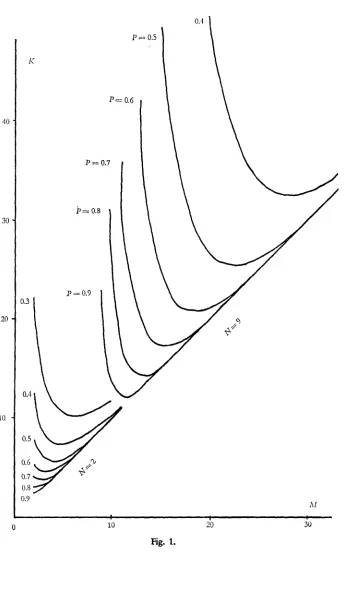
communication can be evaluated by the expected number of signs (K), produced in all the utterances taken together. If the average probability of every sign to be understood is P, then the probability of comprehen- sion of at least N signs of the whole number (m) is P, nN = ~ C,~P~(1-P) ml.
The average number of utterances, given in order to reach comprehen- sion, is
oo
i ~ l
Then the expected duration of the communication is
This value was calculated with the help of the computer for dif- ferent magnitudes of m, N, P. The typical diagrams of dependency K - m for different P is represented in Fig. 1.
The optimum utterance redtmdancy minimizing the expected time of reaching comprehension appears to exist at any volume of in- formation, which is to be transferred, and at any probability of compre- hension of the signs transferred. The diagram showing the depen-
m - N
dency of the optimum redundancy Aopt = rain ~ oll P is repre- sented in Fig. 2.
The data given above show that, for the communicational situation characterized by the partial comprehension of signs, the more re- dundancy the message contains the more is the probability of mis- comprehension. The speaker's intuitional search for the optimum strategy of communication, leading to the rise of sign saturation of utterances, evokes other phenomena, characterising the development of analytic features in language; the higher the degree of these, the lower is the level of comprehension.
To sum up, we must emphasise, that oll the basis of the model giv- en above a more complicated model might be constructed. The phe- nomenon of communicants' adaptation to each other in the course of the attempts to "transfer" the sense information must be taken into consideration in further research.
40
30
20
10
0.9
P = 0 . 7
P = 0.8
P=0.5
P~-0.6
0.4
P = 0.9
+9
÷?
10
Fig. 1.
M
! I,
[image:6.612.170.516.81.675.2]A MECHANISM OF THE ANALITIClTY DEVELOPMENT IN A LANGUAGE 29
Aopt
N----2 N > 4
i .: # I , ~ , !
0 02 0.4 0.6 0.8
~ g . 2.
P
!
1.0
tacts between different languages representatives, the lower the average level of comprehension in that communicative system), etc. Further, the definite qualitative types of languages 4 can apparently be evaluated by means of the definite quantitative index. 5 The efficient shift of the quantitative index during language evolution, breaking the definite ranges boundaries, seems to define the transition of language into another qualitative type. The quantitative characteristics of languages can be calculated theoretically and empirically checked up by numeral cha- racterisation of communicative situations (percentage of nonprinci- ple language representatives, the divergency degree of contacting lan- guages, etc.) in which the language is formed. As a result, the matrix of language types can be associated with the matrix of communica- tive situation types.
To put it briefly, the given perspectives are those of creating a complex-structured sociolinguistic model with many parameters re- flecting the data of modern qualitative and quantitative linguistic ty- pology as well as quantitative and qualitative sociological typology. One may expect that the successive detection, the quantification of the values of linguistic and sociological parameters, the revealing of their relationships will result in building up the explanatory sociolin- guistics theory. This theory can find out the correlation between the given states of a language and the given states of society employing it. This theory is very likely to predict with a high degree of certainty the future development of languages and the human language in gene- ral with a view of perspectives of humanity's social development. It is possible, having a carefully worked out theory (that is, knowing prin- ciple correlations between language and society), to simulate with the help of a computer the evolution of the given language as the function of the facts given by the history of the people employing this language, of the communicative system history, in which the language is formed,
Turn to one of the most full, in our opinion, classifications of language types, represented in the paper of G. P. M~L'~rmov (1972 b).
R.EFEP, ENCES
W. IL. ASHBY, An introduaion to cyber- netics, London 3rd imp., 1958. V. N. BELOOZEROV, O fonologi[eskich
edinicach v kanalach massovoj kommu- nikacii, in Semiotika sredstv massovoj kommunikacii, Materialy simpoziuma 18-20 ijunja 1973 g., MGU.
S. M. DaNCO~, H. QUASTL~, The Infor- mation Content and Error Rate of Living Things, in Information Theory in Biology,
Urbana 1953.
G. P. M~t'NIKOV, Sistemnaja lingvistika i ee otno~enle k strukturnoj, in Problemy jazykoznanija, Moskva 1967.
G. P. M~Z'NIKOV, Sistemnyj analis gelo- vdeskich jazykov v svjazi s problemoj modelirovanija jazykovych processov i postroenija universal'nych mMinnych jazykov, Ot~ety LASUP, S MGPI ira. V. I. LENINA, Sektor ob~ej teorii sistem, za 1968 i 1969 gg., Moskva. G. P. M~'NIKOV, Rdevaja dejatel'nost'pri bilingvizme, in IV seminar Fo vopro- sam teorii i praktiki perevoda nau~noj i techni[eskoj literatury, 2-4 nojabra
1970, Tezisy dokladov, Moskwa-Tbi- lisi 1970.
G. P. M~'NmOV, Sistemnyj podchod v lin- gvistike, in <~ Sistemnye issledovanija ~,
E{egodnik 1972, Moskva 1972(a).
G. P. MBL'NIKOV, Determinantnaja klassi- fikacija jazykov i jazyki bantu, in <~Africana. Africanskij etnografi~eskij sbornik,>, IX, Leningrad 1972 (b).
A. A. POUKARPOV, K objasneniju oso- bennostej sintaksisa jazyka nauki kak jazyka massovoj kommunikacii, in Se- mioti[eskie problemy jazykov nauki, ter- minologii i informatiki, Materialy sim- poziuma, t. 2, MGU, 1971.
A. A. POUKARPOV, O meste sistemy masso- voj kommunikacii /MK/ v tipoIogii kom- munikativnych sistem, in Semiotika sredstv massovoj kommunikacii, Mate- rialy simpoziuma 18-20 ijunja 1973 g., MGU.
V. Ju. R.osrNzw~m, Jazykovye kontakty,
Leningrad 1972.
G. ~UCI-IARDT, Izbrannye stat'ji po jazy- koznaniju, Moskva 1950.
L. T~SNmRE, Phonologie et melange des langues, in ~, Travaux du Cercle linguis- tique de Prague,~, VIII (1939).
U. W~mlu~ICH. Languages in Contact,
New York 1953.