Compilation of Corpora for the Study of
the Information Structure–Prosody Interface
M´onica Dom´ınguez
1, Alicia Burga
1, Mireia Farr ´us
1, Leo Wanner
2,1University Pompeu Fabra1, Catalan Institute for Research and Advanced Studies (ICREA)2 C. Roc Boronat, 138
Barcelona, Spain
{monica.dominguez, alicia.burga, mireia.farrus, leo.wanner}@upf.edu
Abstract
Theoretical studies on the Information Structure–prosody interface argue that the content packaged in terms of theme and rheme correlates with the intonation of the corresponding sentence. However, there are few empirical studies that support this argument and even fewer resources that promote reproducibility and scalability of experiments. In this paper, we introduce a methodology for the compilation of annotated corpora to study the correspondence between Information Structure and prosody. The application of this methodology is exemplified on a corpus of read speech in English annotated with hierarchical thematicity and automatically extracted prosodic parameters.
Keywords:prosody, information structure, theme, rheme, thematicity, language resource, annotated corpora
1.
Introduction
The interest in the Information Structure–prosody corre-spondence applied to natural language speech generation lies in the derivation of prosody that is communicatively oriented and, therefore, more expressive. Knowing the linguistic mechanisms involved in human communication is pertinent to the achievement of multifaceted speech technologies that can carry out more complex tasks linked to conversational settings. The so-called Information Structure–prosody interface stands out as a solid ground for starting to build up such a communicative model in the computational field. However, empirical approaches to the Information Structure–prosody interface are scarce, studies on a corpus of more than two speakers are uncommon and the availability of corpora is, so to say, exceptional.
It is usually one aspect of Information Structure that is studied: thematicity. Thematicity defines how content is packaged in terms of “what is being talked about”, i.e., the ‘theme’ and “what is being said”, i.e., the ‘rheme’. Most of the approaches draw upon a binary flat thematic division and established a one-to-one correspondence between theme–rheme and rising–falling intonation patterns respec-tively; see, e.g., (Steedman, 2000; Haji-Abdolhosseini and M¨uller, 2003; B¨uring, 2003).
A different view on thematicity is that advocated by I. Mel’ˇcuk in the context of the MTT (Mel’ˇcuk, 2001). Compared to the traditional theme–rheme dichotomy, thematicity in the MTT introduces two key features that enhance the scope of the theme–rheme span division, namely: (i) the notion of specifier, which sets up the context of the sentence, and (ii) the fact that thematicity is defined over propositions, rather than over sentences. This second feature implies that thematicity is per se
hierarchical: if a proposition is embedded, its thematicity will be embedded as well. Previous studies proved that hierarchical thematicity corresponds to a wider range of
intonation patterns, and is, therefore, a more adequate representation than binary approaches, especially for long syntactically complex sentences; see, e.g., (Dom´ınguez et al., 2016a).
In this paper we present a methodology for the com-pilation of a corpus for research on the Information Structure–prosody interface from an empirical perspective. This methodology is based on the formal description of information (or communicative) structure by Mel’ˇcuk (2001), which has been already used for the annotation of hierarchical thematicity of written text in (Bohnet et al., 2013); and an automatic annotation of prosody based on a modular pipeline for extraction of acoustic parameters (Dom´ınguez et al., 2016c). An example application is introduced and demonstrated in the online platformPraat on the Web (Dom´ınguez et al., 2016b). Classification experiments on a corpus of read speech in English are carried out to validate our approach.
The rest of the paper is structured as follows. The next section presents the motivation and background of this work. The methodology proposed for the compilation of a corpus to study the Information Structure correspondence is described in Section 3. A sample application of a small corpus of read speech in American English is introduced in Section 4. Then, the validation of our approach is presented in Section 5. Finally, conclusions are drawn in Section 6.
2.
Motivation and Background
for example, show that characteristic intonation patterns that make a distinction between theme and rheme spans contribute to a better understanding of the message.
The relationship between Information Structure and intona-tion had been discussed even before theTones andBreaks
Index (ToBI) (Silverman et al., 1992) was agreed upon as a convention to represent intonation cues. (Beckman and Pierrehumbert, 1986) suggest that the characteristic bitonals for theme and rheme are rising (L*+H) and falling (H+L*), respectively. (Steedman, 2000) proposes a question–answer setting for the identification of theme and rheme and builds upon Beckman’s assumption to hypothesize on complete intonation patterns for theme (L*+H LH%) and rheme (H* LL%).
Some attempts have been made on exploring additional as-pects of prosody, apart from ToBI contours, in connection with Information Structure. These studies are, as a rule, restricted to one prosodic element in isolation; see, e.g. (Calhoun, 2010) on rhythm (or, rather, ‘metrical structure’, as the author defines it); (Xu, 1999) on F0 alignment and (F´ery, 2013) on prominence and phrasing.
With respect to empirical studies, the intonation of thematicity1 is studied in German using one speaker
(Baumann, 2012). (F´ery and K¨ugler, 2008) study the process of tonal scaling on a corpus of German consisting of eighteen speakers and 2,277 sentences of the same syntactic structure with a varying number of constituents, word order and theme–rheme structure.
All of these studies coincide in that: (i) they analyze only one aspect of prosody, mostly intonation (the variation of F0); and (ii) their representation of binary thematicity is not formalized as required in computational linguistics.
3.
Methodology
This paper envisages the compilation of corpora to study the Information Structure–prosody interface from a methodological perspective based on the formal represen-tations of hierarchical thematicity as described by Mel’ˇcuk (2001) and the annotation guidelines established in (Bohnet et al., 2013). The proposed methodology aims to facilitate the following goals:
• to compile large amounts of data from different regis-ters and languages;
• to analyze the hierarchical thematicity–prosody corre-spondence in human speech using corpus-driven ap-proaches;
• to explore a parametric representation of prosodic ele-ments in its relationship to Information Structure.
1A number of other studies refer to thematicity with the term
‘givenness’; see, e.g., (Schwarzschild, 1999), and thus talk about ‘given’ and ‘new’ information (Chafe and Li, 1976; Clark and Haviland, 1977; Brown, 1983).
Such a methodology addresses two main research issues in this field: (i) the lack of empirical analysis of the IS–prosody correspondence; and (ii) testing of theories on the IS–prosody interface in corpus-based computational models. In order to address these two issues we propose a processing pipeline implemented in the online platform based on Praat (Boersma and Weenink, 2017): Praat on the Web(Dom´ınguez et al., 2016b).2This platform takes as
the basic annotation file, aTextGrid,3as in standard Praat,
and allows scripting of subroutines on both audio and text input using a modular approach, which is not possible in standard Praat.
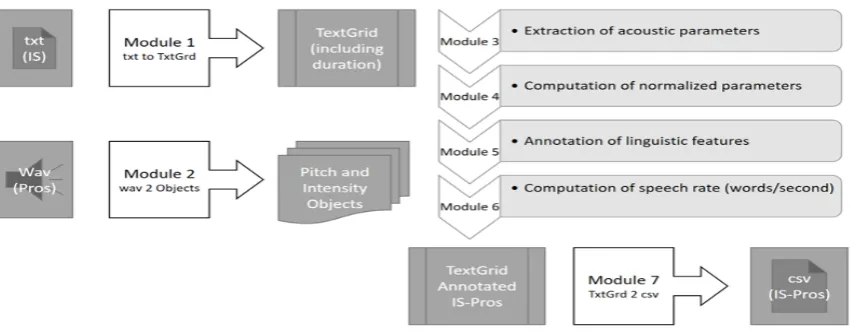
Figure 1 sketches the pipeline for compilation of corpora to study the IS–prosody interface. The following input is required: (i) a speech (wav) file containing the prosodic information (‘Pros’) and; (ii) the corresponding text (txt) file annotated with thematicity (‘IS’) following the guide-lines established in (Bohnet et al., 2013). In module 1, the text is converted to TextGrid format adapting the original annotation to a specific organization into tiers based on the description of thematicity proposed by (Mel’ˇcuk, 2001), as will be detailed in Section 3.1.. Module 2 generates using Praat in-built functions two objects that are needed to extract prosodic information from speech: the pitch and intensity objects. Then, the annotation of prosodic and linguistic features is executed from modules 3 to 6 resulting in an annotated TextGrid with prosodic and thematicity features. Finally, the pipeline outputs a comma separated values (csv) file that can be fed to the validation stage to be analyzed by a statistics package or used as input for classification algorithms.
3.1.
Annotation of Hierarchical Thematicity
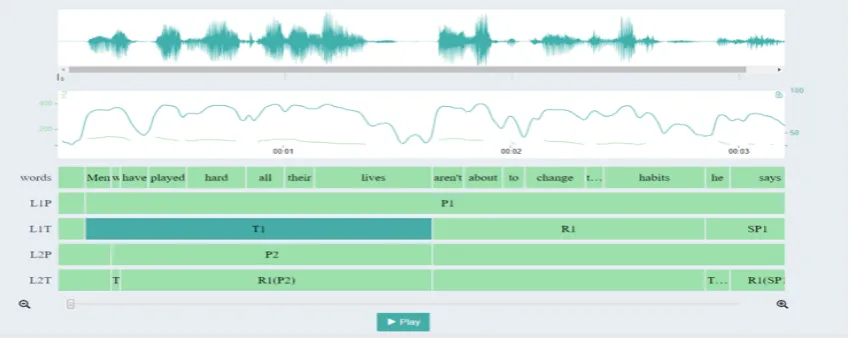
The fact that thematicity, in Mel’ˇcuk’s view, is defined over propositions rather than sentences implies that thematicity is per se hierarchical, allows embeddedness and, thus, involves different levels of thematicity. For instance, a theme (T1) can be embedded in another theme or rheme (R1) span. Figure 2 shows the levels of embeddedness in example (1), where T1(P2), for instance, is a level 2 theme that belongs to a level 2 proposition (P2) that is embedded in the main T1 span. As more than one thematicity span may exist within the same proposition, abbreviations include a number (e.g., ‘SP1’) that indicates the number of occurrences at each level (e.g., ‘SP2’ would be the second specifier in a specific thematicity level).
Guidelines for annotation of hierarchical thematicity were defined and tested in (Bohnet et al., 2013) for the study and annotation of communicative structure in written text. In order to deal with spoken material, an adaptation of these guidelines must be carried out mostly in terms of format to fit in the requirements of the TextGrid format.
2
http://kristina.taln.upf.edu/praatweb/
3
Figure 1: Processing pipeline for IS-Prosody corpus compilation.
(1) [Men {[who]T1(P2) [have played hard all their lives]R1(P2)}P2]T1 [aren’t about to change their habits]R1 , [[he]T1(SP1) [says]R1(SP1)]SP1.
Example (1) shows a sentence annotated with thematicity following the guidelines established in (Bohnet et al., 2013). In this annotation, the main proposition (P1) is often not required for annotation, as it is assumed to be marked by the full stop signalling the end of the sentence. However, P1 is required in the TextGrid format, as it is the segment used for further computation of relative prosodic parameters, as will be introduced in the next section. Therefore, the proposed annotation includes two tiers for each level of representation: one for propositions (e.g., L1P) and one for thematicity labels (e.g., L1T).4
Figure 2 presents the annotation of example (1) using the visualization tool available in Praat on the Web.
Within the processing pipeline, module 5 annotates linguis-tic features related to the communicative structure of the text, namely, the number of words in each span, the num-ber of embedded spans it contains and the string of labels associated to that interval at the L1P level.
3.1.1. Annotation of Prosody
Automatic extraction and computation of acoustic param-eters is carried out using the extension of Praat for feature annotation and the automatic prosody tagger presented in (Dom´ınguez et al., 2016b; Dom´ınguez et al., 2016c).
Table 1 shows the complete list of absolute and relative acoustic parameters (grouped by the three acoustic el-ements: F0, intensity, and rhythm), and abbreviations (within brackets) used in this paper.
Absolute values are extracted using different pre-determined functions available in Praat. Normalized values relative to the whole sample are computed for each segment
4The numbers of the levels are correlative indicating the order
in the hierarchy: first (1), second (2), third (3), etc.
Table 1: Prosodic parameters.
Absolute Parameter Relative Parameter
mean F0 (F0)
z-score F0 (z F0) standard deviation F0 (std.F0)
minimum F0 (min.F0)
maximum F0 (max.F0) time point of max.F0 (maxF0.t)
mean intensity (int)
z-score int (z int) standard deviation intensity (std.int)
minimum intensity (min.int) time point of min.Int (minInt.t) maximum intensity (max.int)
duration (dur) z-score dur (z dur)
speech rate in words/sec (sr.w) z-score sr (z sr) speech rate in syllables/sec (sr.s)
of analysis, usually a thematicity span (it may be another segment, e.g., a word). Normalized values for mean abso-lute values of F0, intensity and speech rate are computed using the ‘z-score’ normalization. Parameters referring to a time point are computed extracting the point of maximum F0 and minimum intensity respectively and calculating the relative time position in the span with a minmax score. Minmax normalization is computed following the equation 1:
minmax.t= x.t−min.t
max.t−min.t (1)
where:
x.t = point in time where a peak or valley is located within an interval (e.g., word),
min.t = starting point in time of the corresponding in-terval, and
Figure 2: Example of Hierarchical Thematicity visualization.
In the minmax normalization, the minimum value is the starting time of the interval, which is mapped to 0, and the maximum value is the ending time of the interval, which is mapped to 1. So, the entire range of time points is mapped to the range 0 to 1. This gives us an idea of the relative time location of the peak within a time segment (in this case a word). In other words, the computed minmax score provides information on the location of the F0 peak (‘maxF0.t’) and intensity valley (‘minint.t’). Thus, if an F0 peak is located within the first half of the time span, it will have a score between 0 and 0.5, and if an intensity valley is located within the second half of the span, the score will be between 0.5 and 1.
4.
Example of Application
A selection of 109 isolated sentences from the Penn Treebank (Charniak and al., 2000) (section of the Wall Street Journal) was made from the annotated material used in (Bohnet et al., 2013). The corpus contains not only simple sentences, but also coordination, subordination and the combination of both. This varied syntactic composition is related to the representativeness of communicative structure in terms of: number of thematicity levels (up to three in the corpus); position of spans within the sentence and with respect to each other; and continuity or lack of continuity of spans (in particular, rheme spans can be discontinuous). The corpus has an average of fifteen words per sentence with a minimum of three words and a maximum of thirty. This selection of sentences was recorded in a professional studio by twelve native speakers of American English.
There is a balanced six-to-six distribution of male and female speakers. Participants are assigned an anonymous identifier with the format: speaker (abbreviated as ‘spk’) – number (a correlative natural number) – gender (‘f ’ for female or ‘m’ for male), resulting in, e.g., ‘spk1f’.
Two datasets are created extracting acoustic parameters from different segments (see Table 2). Acoustic data from all twelve speakers is included in the sentence and thematicity span dataset (abbreviated as SSD and TSD,
Table 2: Datasets derived from the corpus of read speech.
Acronym Dataset Name Speakers Attributes Instances Classes
SSD Sentence Span Dataset 12 11 1,308 17
TSD Thematicity Span Dataset 12 14 6,036 31
respectively). The main difference between these two datasets is that in SSD the segments are sentences and the classes to be predicted account for the L1 thematicity of each sentence, whereas in TSD the segments are thematic-ity spans with their corresponding labels assigned to them.
5.
Validation Experiments
Classification experiments are carried out using the Weka 3.8 Workbench (Hall et al., 2009). A bagging classi-fier with RepTree is using as classiclassi-fier with a 10-fold cross-validation configuration. We set out to demonstrate the hypothesis that prosodic parameters are related to thematicity labels at the level of two different partitions: the sentence as a whole and each thematicity span. The objective of these experiments is to observe in isolation prosodic parameters and hierarchical thematicity in order to get a closer insight on their relationship. In these exper-iments, the correspondence of prosody and thematicity is put to test assuming a bidirectional relation between them, but acknowledging that both of them are dependent upon other linguistic phenomena.
5.1.
Prediction of Labels within Thematicity
Span
to the bagging classifier. Table 3 shows average precision (P), recall (R) and F-measure (F) results for the bagging classifier (Bag) and baseline (BL).
Table 3: Absolute improvement classification results.
Precision Recall F-Measure
BL Bag AbsImp BL Bag AbsImp BL Bag AbsImp
TSD 0.05 0.71 0.66 0.22 0.71 0.49 0.08 0.70 0.62
SSD 0.29 0.73 0.44 0.54 0.75 0.21 0.38 0.74 0.36
5.2.
Prediction of labels in each sentence
A second experiment is carried out at the sentence level. For each sentence span, acoustic parameters are extracted to predict the thematicity label sequence at L1 using the SSD (a total of seventeen distinct labels are to be predicted). A simple rule classifier (ZeroR), based on a majority vote, is used as baseline. Classification with ZeroR shows a low precision (P=0.29) and F-measure (F=0.38) while recall is 0.54. Then, a bagging classifier is used and results show a considerable increase in all measures with an average absolute improvement over the baseline of P=+0.44 R=+0.19 and F=+0.36. Table 3 reports precision, recall and F-measure results from this classification.
6.
Conclusions and Future Work
The contributions of this approach for the compilation of corpora to study the Information Structure–prosody interface are the following: (i) it is automatized to adapt to format requirements; (ii) it assumes a formal represen-tation of thematicity to annotate text instead of thead hoc
perspective taken by traditional approaches; and (iii) it proposes the automatic extraction of prosodic cues related to three prosodic elements.
Resources for the automatic conversion oftxthierarchical thematicity to TextGrid format and from TextGrid format tocsv format as well asarff files and pitch and intensity objects derived from the audio files used in the example application are made available in the authors’ repository.5 The material from the example application described in this paper (despite its modest size) is the first annotated resource to study the correspondence in English between prosody and hierarchical thematicity as described by Mel’ˇcuk (2001). Moreover, preliminary experiments (Dom´ınguez et al., 2014; Dom´ınguez et al., 2016a) already proved the adequateness of tripartite hierarchical thematic-ity over traditional binary approaches and its applicabilthematic-ity to prosody enrichment in speech synthesis applications (Dom´ınguez et al., 2017).
5
This material as well as the code of each module is avail-able under a Creative Commons GNU v.3 License in the following repository: https://github.com/TalnUPF/compilationISpros/
An automatic approach for the annotation of hierarchical thematicity based on syntactic dependencies is currently being looked into. This advance combined with the present methodology will foster empirically-grounded models to study the Information Structure–prosody interface and to allow the integration of communicatively-oriented approaches to speech technologies.
7.
Acknowledgements
8.
Bibliographical References
Baumann, S. (2012). The Intonation of Givenness. Ev-idence from German. Max Niemeyer Verlag, Berlin, Boston.
Beckman, M. E. and Pierrehumbert, J. (1986). Intonational Structure in Japanese and English. Phonology Yearbook, 3:255–310.
Bock, J. K., Mazzella, J. R., and Bock, K. (1983). Into-national marking of given and new information: Some consequences for comprehension.Memory & Cognition, 11(1):64–76.
Boersma, P. and Weenink, D. (2017). Praat: do-ing phonetics by computer [Computer program], http://www.praat.org/, version 6.0.14.
Bohnet, B., Burga, A., and Wanner, L. (2013). Towards the annotation of penn treebank with information struc-ture. InProceedings of the Sixth International Joint Con-ference on Natural Language Processing, pages 1250– 1256, Nagoya, Japan.
Brown, G. (1983). Prosodic structure and the given/new distinction. In A. Cutler et al., editors,Prosody: Models and Measurements, pages 67–77. Springer, Berlin, Hei-delberg.
B¨uring, D. (2003). On d-trees, beans, and b-accents. Lin-guistics & Philosophy, 26(5):511–545.
Calhoun, S. (2010). The centrality of metrical structure in signalling information structure: A probabilistic per-spective. Language, 1(86):1–42.
Chafe, W. L. and Li, C. N. (1976). Givenness, contrastive-ness, definitecontrastive-ness, subjects, topics, and point of view in subject and topic. Subject and Topic, pages 25–55. Charniak, E. and al., E. (2000). BLLIP 1987-89 WSJ
Cor-pus Release 1 LDC2000T43. Linguistic Data Consor-tium, Philadelphia.
Clark, H. H. and Haviland, S. E. (1977). Comprehension and the given-new contract. Discourse production and comprehension. Discourse processes: Advances in re-search and theory, 1:1–40.
Dom´ınguez, M., Farr´us, M., Burga, A., and Wanner, L. (2014). Towards Automatic Extraction of Prosodic Pat-terns for Speech Synthesis. InProceedings of the 7th In-ternational Conference on Speech Prosody, pages 1105– 1109, Dublin, Ireland.
Dom´ınguez, M., Farr´us, M., Burga, A., and Wanner, L. (2016a). Using hierarchical information structure for prosody prediction in content-to-speech applications. In Proceedings of the 8th International Conference on Speech Prosody, pages 1019–1023, Boston, USA. Dom´ınguez, M., Farr´us, M., and Wanner, L. (2016b). An
Automatic Prosody Tagger for Spontaneous Speech. In
Proceedings of COLING 2016, the 26th International Conference on Computational Linguistics, pages 377– 387, Osaka, Japan.
Dom´ınguez, M., Latorre, I., Farr´us, M., Codina, J., and Wanner, L. (2016c). Praat on the Web: An Upgrade of Praat for Semi-Automatic Speech Annotation. In Pro-ceedings of COLING 2016, the 26th International Con-ference on Computational Linguistics: System Demon-strations, pages 218–222, Osaka, Japan.
Dom´ınguez, M., Farr´us, M., and Wanner, L. (2017). A Thematicity-based Prosody Enrichment Tool for CTS. InAccepted to show and tell demonstrations at INTER-SPEECH17, Stockholm, Sweden.
F´ery, C. and K¨ugler, F. (2008). Pitch accent scaling on given, new and focused constituents in German.Journal of Phonetics, 36(4):680–703.
F´ery, C. (2013). Focus as prosodic alignment. Natural Language & Linguistic Theory, 31(3):683–734.
Fowler, C. A. and Housum, J. (1987). Talkers’ signaling of ”new” and ”old” words in speech and listeners’ percep-tion and use of the distincpercep-tion. Journal of Memory and Language, 26(5):489–504.
Haji-Abdolhosseini, M. and M¨uller, S. (2003). Constraint-Based Approach to Information Structure and Prosody Correspondence. In Proceedings of the 10th Interna-tional Conference on Head-Driven Phrase Structure Grammar, pages 143–162. CSLI Publications.
Hall, M., Frank, E., Holmes, G., Pfahringer, B., Reute-mann, P., and Witten, I. H. (2009). The WEKA Data Mining Software: An Update. SIGKDD Explorations, 11(1).
Mel’ˇcuk, I. A. (2001). Communicative Organization in Natural Language: The semantic-communicative struc-ture of sentences. Benjamins, Amsterdam, Philadephia. Meurers, D., Ziai, R., Ott, N., and Kopp, J. (2011).
Eval-uating Answers to Reading Comprehension Questions in Context: Results for German and the Role of Infor-mation Structure. InProceedings of the TextInfer 2011 Workshop on Textual Entailment, TIWTE ’11, pages 1– 9, Stroudsburg, PA, USA. Association for Computational Linguistics.
Schwarzschild, R. (1999). Givenness, avoidf and other constraints on the placement of accent. Natural Lan-guage Semantics, 7(1):141–177.
Silverman, K., Beckman, M., Pitrelli, J., Ostendorf, M., Wightman, C., Price, P., Pierrehumbert, J., and Hirschberg, J. (1992). TOBI: A Standard for Labeling English Prosody. In 2nd International Conference on Spoken Language Processing (ICSLP 92), pages 867– 870, Banff, Canada, October.
Steedman, M. (2000). Information structure and the syntax-phonology interface. Linguistic inquiry, 31(4):649–689, Fall.
van Donselaar, W. and Lentz, J. (1994). The function of sentence accents and given/new information in speech processing: different strategies for normal-hearing and hearing-impaired listeners? Language and Speech, 37(4):375–391.
Vanrell, M., Mascar´o, I., Torres-Tamarit, F., and Prieto, P. (2013). Intonation as an Encoder of Speaker Cer-tainty: Information and Confirmation Yes-No Questions in Catalan.Language and Speech, 56(2):163–190. Xu, Y. (1999). Effects of tone and focus on the