16
CHILD (Chivalrous Humanitarian Ideological Loiter
Device)
Udhay Shankar. P
1, Vinodh Kumar
2. E, V.Vidhya
3DIYA EDULABS PVT LTDChennai-1071, PSG College of Tech2 Peelamedu Coimbatore – 641004, Asst. Professor3
SSSS Jain College for women, Dept of Computer Applications, Email: [email protected], [email protected] Gesture, Strain, IR Remote and DTMF has been developed. Haptic Arm and Tray for user's assistance. Obstacle and wall avoiding is enabled. Emergency stop and emergency correspondence are active.
It is human nature to strive to be independent, but we do have the tendency of developing a low self-esteem and feel bad to have to depend on others. Globally, the count multiple-utility bestowing 'smart' mechatronic wheel chair/ bike, thus the goal is the optimization of cost and performance.
1.1Technical Background
The previous models include, optical fiber curvature sensors [2], joystick [3], MEMS accelerometer [4],eye ball movement [5]brain wave (Electro Encephalogram) [6]based wheel chair. Considering the MEMS accelerometer, optical fiber curvature sensors and eye ball movement based wheelchair it is evident that the freedom of the user is curtailed. For example, if the
accelerometer is attached to the hand or the neck, the person cannot do as he wishes, because he will unintentionally navigate to some direction. Also, the cost is comparatively high. Considering the of navigation and does not require continuous user interaction and is
17
ensuring that it is affordable. User assistance is maximized and user interference is minimized,
hence the optimization is focused
upon. Coming to the mechanical design, the bikes available for differently-abled are actually after- market fitted with two extra wheels. It generally costs an extra Rs.5000 to fit these wheels on to the bikes. But these bikes come with added disadvantages. Firstly, adding two extra wheels reduces the mileage. Secondly, these wheels add to extra un-sprungmass. The suspension needs to be modified to take into account the extra un-sprung mass. This is normally ignored, which leads to a rough ride for the user. So, the users tend to suffer from frequent back pains and body pains. Moreover, they face difficulty in parking the vehicle as there is no provision to reverse it. Hence, based on the comparative analysis CHILD stands unique and highly beneficial both in terms and the software architecture is explained diagrammatically. Following this is the detailed explanation of hardware and software in a modular basis. Post explanation of the electronic modules, the mechanical aspects of the project are focused upon. The design considerations and the overall outcome of the outcome of project is
combination (Gesture Based) or in special cases by usage of movable strain gauges(Strain Based), which are to be placed in locations as specified by the user based on his comfort(Current consideration is operation using feet). DTMF based control by those authorized when the physically challenged person is within visual range. IR Remote based control to ensure that the attendant is close to the wheel chair. GSM is tailored to ensure correspondence in case of emergency and when the RFID is passed over the reader. LCD based interaction with the user to intimate the detection of emergency stop criterion, so that the user is not confused. RFID based authentication and Password initialization are achieved for the purpose of security in the event of occurrence of un- anticipated situations. Additional the system level block diagram as shown in Figure The special mobility vehicle which incorporates key features like Hub motors, Regenerative shock absorbers, Solar panel and Torque vectoring system . These features coupled with a ergonomic frame design, adjustable seats and independent suspension makes this vehicle more safer, economical and comfortable than any other bike available in the market today. The solar panels, regenerative shock absorbers and regenerative braking makes this vehicle more eco-friendly than a conventional electric vehicle. These renewable technologies effectively increase the range efficiency of the vehicle.
3.
HARDWARE AND SOFTWARE IMPLEMENTATION3.1Navigation mode selection
18
Figure 2: System level block diagram of
CHILD
Figure 3: CHILD pin configuration
through the modes, there will be no effect because the Remote and Mobile modes are protected by password and touch and strain have zero as inputs unless triggered. The motors are driven using the driver IC
L293DNE. The real time model has the voltage regulated from IC 7805.
3.2 Remote based navigation and RFID Authentication
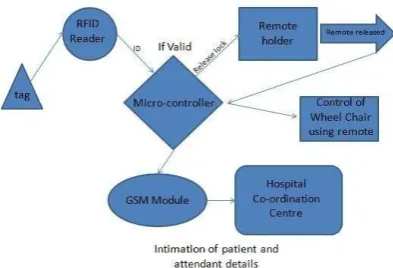
Figure 4: RFID authentication and Remote based navigation
The IR reader in the micro-controller recognizes the frequency corresponding to each button we toggle in the remote. The IR remote sends a series of pulse trains, which are received using the TSOP and counted using loops. Hence, the number is recognized. To each key, assigning of tasks is done.
19
remote remains locked in the holder. Once, an valid is used, the remote holder is unlocked and the remote is accessible. When, the holder unlocks, a message is sent and the centre will be intimated
of the wheel chair number that operates on the remote based navigation. Serial communication is done through Max232N. Hence, security and ease of use are achieved
3.3. DTMF (Mobile) based navigation
The first step would involve the decoding of the frequency generated as and when the keypad is used. This involves the use of the IC CS9370DGP, which is a DTMF to decimal decoder. There on it gives output in BCD. By using the left shifting operation, the decimal number is decoded. To exercise control over the wheel chair, the user will have to enter the password. Only if the password matches, the navigation is done.
DTMF can aid two types of control. Primarily by the person with the disability, the sixteen key based control can help control the direction of motion. Secondarily in conditions wherein a person from long distance would prefer to control the motion of the wheel chair, this is most likely to happen when distance of travel is restricted to the vision span of the person controlling.
3.4 Gesture and Strain based control
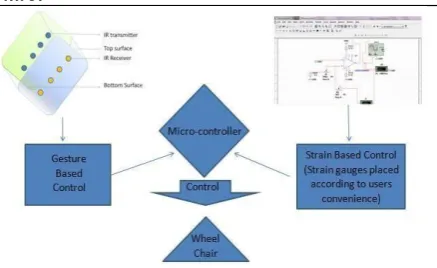
Figure 6: Gesture and Strain based control.
IR proximity based gesture recognition is developed. The signal received by the photodiode is weak and hence it is amplified using the IC LM358P.The amplified signal is fed to the controller. The control segment is basically cubical in shape, but the front surfaceis left open to provide entry to the fingers. The IR LEDs photodiodes are placed consecutively on the top surface. Hence, when the person makes the choice of the direction he wants to move in, logic 1 is the output of the photodiode. Hence, the direction to be taken corresponds to the gestures. Therefore, the IR based control works out to be cheap and efficient replica of a touchpad. Considering the
20
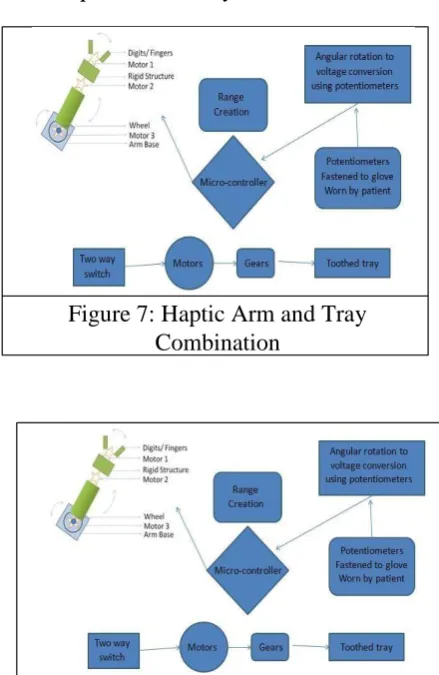
3.5Haptic Arm and Tray combinationThe haptic arm is controlled using a three motor combination, thus allowing it to move along six axes. The picking of goods is enabled by two metallic structures which act as fingers. The persons elbow, wrist and two fingers are strapped. The rotation of the elbow is bequeathed with the potential to take a 360 degree turn. The wrist can induce a 180 degree motion. The movement of the elbow and the wrist contribute to reach the object. The action performed by the user is detected through the potentiometers. Since the movement of these joints is angular, the movement causes the rotation of the variable arm of the potentiometer, hence producing a change in voltage. This change is made use of to produce the corresponding rotation. The picking up of the object is facilitated by gripping using the fingers. A two way switch is used to move the tray in and out.Hence, this serves a very essential tool adding to the rider‟s ease. Edge and Wall avoider circuitry: colliding on a wall, though the rider directs the CHILD in a
haphazard manner. Also since it is obstacle based, it will also prevent chances of colliding with other people. Whenever the obstacle is detected, the stop loop is executed. In a stipulated time from then on, the wheel chair continues to the direction as chosen by the user. So, after a pause for a stipulated time, it then gets back. There is toggle switch to turn on/ off the safety measure, since if the place is over-crowded the CHILD will consider people to be obstacles and so will not move. Thus, the basic circuitry will enable the CHILD from preventing the occurrence of collisions. To ensure that the user has knowledge of what is happening, LCD interface is made to intimate the user of the criterion being executed.
Colliding on a wall, though the rider directs the CHILD in a haphazard manner. Also since it is obstacle based, it will also prevent chances of colliding with other people. Whenever the obstacle is detected, the stop loop is executed. In a stipulated time from then on, the wheel chair continues to the direction as chosen by the user. So, after a pause for a stipulated time, it then gets back. There is toggle switch to turn on/ off the safety measure, since if the place is over-crowded the CHILD will consider people to be obstacles and so will not move. Thus, the basic circuitry will enable the CHILD from preventing the occurrence of collisions.
To ensure that the user has knowledge of what is happening, LCD interface is made to intimate the user of the criterion being executed.
3.7 Emergency Stop Criterion
Figure 7: Haptic Arm and Tray
Combination
21
irrespective of the mode of navigation, he can simply lean forward. Then on, once he rests back he will continue along his chosen direction. This is again a sort of gesture control.3.8 Emergency Correspondence
The purpose of the edge and wall avoider would be to prevent the wheel-chair from toppling over at an edge or TL082CNis used for building the comparator. The input to the negative terminal is message is sent mentioning the wheel chair number and that it is an emergency. Hence, the measures are taken suitably.
4. RESULT
With regard to CHILD, the results include software testing and visualization through hardware implementation. As of the software testing, the results are as expected and the code has been included in the Appendix B of the report.
It is evident from the results that the development of a market ready CHILD will be highly beneficial. To ensure that the cost benefit is maintained, each CHILD can be custom made, i.e. the user can choose the modules he wants to make use at the time of purchase, making it becomes all the more user specific and cheaper.
Figure 11: Completed prototype
5. CONCLUSION
The development of the prototype with the proposed modules has been achieved. The future scope of the project includes addition of a GPS module, thereby the exact location can be added every time a message is sent. Also, addition of a rotating camera and online publishing of the footage will ensure that DTMF based control can be made use of from any part of the world to navigate to the destination. An added advantage would be that, if emergency correspondence is made, looking at the person will be made possible. Hence, the prototype has promising utility and benefits with scope for future work.
REFERENCES
[1]
Statistics of people dependent on
Wheelchair and the reason for the
same: http://codi. buffalo. edu/graph _based/.demographic
s/.statistics.htm
, last
accessed on June 6th, 2012.
[2]
Kyoobin Lee, Dong-Soo Kwon,
“Wearable Master Device Using Optical
Fiber Curvature Sensors for the
Conference
, July 2012 Page(s): 702 - 707.
22
Accelerometer Based Nonspecific-User
Hand Gesture Recognition",
Sensors
Journal, IEEE,
Volume: 12, Issue: 5, May
2012 Page(s):
1166 - 1173.
[5]
D.H. Yoo, Y.J. Lee, G.W. Chu, J.H.
Kim, D.H. Kim, M.J.Chung, "Assitive
Robot Control by an Eye- mouse System
for the Disabled",
Proceedings of
World Automatic Congress
, Hawaii,
USA, June 2000.
[6]