
MULTI-TAPE TWO-LEVEL MORPHOLOGY:
A Case Study in Semitic Non-linear Morphology
G e o r g e A n t o n K i r a z *
COMPUTER LABORATO1;:Y, UNIVEIlSITY OF CAMP, RIDCI,; (St John's Colh!ge)
E-mail. George. Kiraz~cl. cam. ac. uk
A p r i l 22, 199d
Abstract
This I)aper presents an implemented multi-tal)e two- level model capable of describing Semitie non-linear morphology. T h e computational fl'arnework behind the ettrrcnt work is motivated by [Kay 1987]; the fimnal- ism presented here is an extension to the formalism re- ported by [Puhnan art(1 Hepl)le. 1993]. The objectives of the current work are: to stay as close as possible, in spirit, to standard two-level morl)hology, to stay close to the linguistic description of Semitic stems, and to present a model which can be used with ease by the Semitist. The. Imper illustrates that if finite-state transducers (FSTs) in a standard two-level morphology model are replaced with multi-tape attxiliary versions ( A F S T s ) , one can account for Semitic root-andq)attern morphology using high level notation.
1
I N T R O D U C T I O NThis paper aims at presenting a computational mor- phology model which can handle the non-linear
phenomenon of Semitic morphology. The ap-
proach presented here builds on two-level mori)hology [Koskennienfi 1983], extending it to achieve the desired objective. Tit('. contril)ution of this l)almr tnay ])e Slllll- marised as follows:
With regards to the two-level model, we extend this model by allowing it to have multiI)le tapes on the lex- ical level and retaining the one tape on the surface level; hence, 'multi-tape two-level morphology'. Feasi- ble pairs in the standard two-level model become 'fea- sible tuple pairs' in our multi-tape model.
W i t h regards to the formalism, we have. chosen a twodevel formalism and extended it to be al)le to write multi-tape two-level grammars which involve non-linear operations. To achieve this, we made all lexieal expressions n-tuple regular expressions. In ad- dition, we introduced the notion of 'ellipsis', which in-
* S u p p o r t e d by a Benefitctor S t u d e n t s h i p f r o m SI+ J o l m ' s Col- lege. q~llis r e s e a r c h was d o n e tllld(!r the SUlmrvision <ff I)r Steph(!n G. P u l m a n w h o m I t h a n k fro' g u i d a n c e , s u p p o r t and feedback. q ' h a n k s to 13r ,Iohn C a r r o l l for editm'ial c o m m e n t s , A r t u r o 'lh'u- jillo for useful ' c h a t s ' ;rod T a n y a Bow(h!n for Prolog tips,
dicates the (optional) omission from left-context lexical e×I)ressions of tui)les; this accounts for spr(~a(ling.
Two-level implementations either work directly on rules or compile rules into FSTs. For the latte.r cats(:, we propose, an au×iliary finite-state transduce.r into which multi-tape two-level rules can be co)replied. Tit(.' ma- chine scans %Ulfle imirs ' instead of pairs of symbols.
'Fhe outline of the paper is as follows: Sect;ion 2 in- troduces the root-and-pattern nature of Semitic r o o f phology. Section 3 provides a review of the previous prol)osals iBr han(lling Semitie morphology. Section 4 t)resents our proposal, extending two-level morphology anti l)roposing a formalism which is adequate, for writ- ing non-linear grammars using high level notation. Sex> tion 5 al)i)lies our model on the Arabic verb. Section 6 I)resents an auxiliary automaton into which multi-tape two-level rules can/)e compiled. Finally, section 7 giw;s eonchtding r e m a r k s .
2 1~10 ( ) T - A N D - P A T T I , ; I ) ~ N M O R P I t O L - O G Y
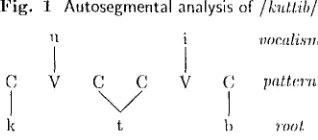
Non-linear r o o t - a n d - p a t t e r n morphology is best il+ lustrated in Semitic. A Setnitic stem (:onsists of a r o o t and a v o w e l t n e l o d y , ;u'rattged according to a c a n o n - ic.al i)atte.rn. For examph~, Arahic/Iv'uttib/ 'caused t.o write' is composed front the root murphenm {ktb} 'no- tion of wril.inp;' and the vowel melody morpheme {ui} 'pertlwt lmssive'; the two are arr:mged act:ording to the pattern morpheme {CVCCVC} 'causative'.
Table ] (next page) gives the Arabic perfeetive vet- hal forms (from [McCarthy 1981]). l
"l~d)le 1 Active
Arabic Verbal Stems Passive
1 l~at ab kutib
2 l~tttab k u t t i b 3 k a a t a b k m l t i b 4 p a k t a b puktib 5 t a k a t t a b t u k u t t i b 6 talmatal) t u k u u t i b 7 nb~tat) n k u t i b 8 k t a t a b k t u t i b 9 k t a b a b
10 staktat) s t u k t i b
Active 11 k t a a b a b 1.2 ktawtal) 13 ktawwal)
14 ktmdml)
15 k t a n b a y Q 1 daltraj Q2 t a d a h r a j
Q3 (lllalll'at,j
Q4 d h a r j a j
Passive
duhrij tuduhrij dhunrij dlmrjij
Moving horizontally across the table, one notices a ,:hang° i,, vowel
melo(ly (a,:tive
(a}, > s s i v e {ui}); ev- e r y t h i n g else r e m a i n s invariant. Moving vertically, at(:hatlg~e in eailonical p a t t e r n ()CC/II'S~ e.verythillg else re- mains inwtriant.
[Ilarris 1941] suggested t h a t Semitic. stem mor- phemes are classified into: r o o t n m r l ) h e . m e s c(msist- ing of e()nSollatlts att(l p a t t e r n m o r p h e m e s consist- ing of vowels a n d affixes. Morphemes which fall old: of the d o m a i n of the root-an(l-l)attern system, such as particles a n d preposil,ions, are. (:lassitied as belonging to a t h i r d (:lass consisting of successions of consonants and vowels. T h e analysis of
/kuttib/
i)roduces: the root {ktb} ' n o t i o n of writing' and the p a t t e r n {_.u_:i } 'causative - perfect passive' (wh(!re _ indicates a cons()- n a n ( slot, a n d : indicates gemination).[ M c C a r t h y 1981] provided a deel)er analysis rai- der the fl:amework of autoseglnental 1)honology [Goldsmith 1976]. IIere, m o r p h e m e s are elassiIied into:
r o o t m o r p h e m e s CO[lSiStillt~ of COIIS()llalltS, v o ( ' a l i s m
n l o r l ) h e n m s consisting of vowels, and p a t t e r n m o r - p h e m e s wlfieh are. CV-skelet:{. 2 Each sits on a sepa- rate tier in the alttosegmental model, and they m'e (:o- o r d i n a t e d with association liims according to 0m I)rinei - pies of a u t o s e g m e n t a l phonology; when universal l)rin - (:il)les fail, language specific rules al)l)ly. '12he analysis
o f / k u t t i b / p r o d u c e s three inori)hemes , linked as illus-
t r a t e d below.
Fig. 1 Autosegmental analysis o f / k u t t i b /
n
i
voealism
L
I
C
V
C
C
V
C
patter'a
I
">/
I
k t l) ~'ool,
Similarly, one can describe nonfinals such as
/kitaab/
'l)ook',/kutub/
'books',/kaatib/
'writer',/kitaaba/
' w r i t i n g ' and/katiiba/
'squadron' etc.2The analysis of Arabic here is I)ased tm CV theory [McCarthy 1981]. Morale [Mc('arthy an,I Prince l!)90a] and at- fixational [McCarthy 1992] analyses will be di;;(:ussed in a future work.
3 @ O M I ) U T A T I O N A L M O D E L S
In the past decade, two-level morl)hology, i n t r o d u c e d t)y [I(oskenniemi 1983], has I)ecomc ubiquitous, i n sec- tion 3.1, we shall take a l)rM' look at two-level morl)hol- ogy. Section 3.2 gives a brief review of the previous pro- posals for dealing with Semitic non-linear mori)hology. Section 3.3 looks at the development of the [ormalism which we have chosen for our proposal.
3 . 1 T w o - L e v e l M o r p h o l o g y
q'his approach de[ines two levels of strings in recogni- tion and synthesis: lexical and surface, the former is a represent.ation of lexic;d strings; the l a t t e r is a represen- i.;ttir)n of Slit(ace sl,rillgs. A lltlai)l)ing seheltle 1)etweell the t, wo levels is described by rules wlfieh are compiled into I;'STs; the seI. of I;'STs rml in parallel. One c.ase of ~.wo-level rules l.;tkes the following form:
, : b
:> c : d _ _ _ c : fi.e. lexicai a eorresl)Oll(lS (;0 surface b wh(!ll
l)i'eeeeded
by lexical c corresponding; to surface d and followed by h!xical e corresponding to sllrfat;e f. T h e olmrai, or is oIle o1' follr l;yI)es: =~ for a ¢;otltext restriel;iolt ruh!, <= for it NIII'[';WO (',oercioIl rllle, ¢5 for & eolllposite rule (i.(',. a c.ol,q)osit.ion o[ > and <:=), and /¢= ['or a n exclusion rule. lh!re is an example from [Ill(chic 1992]:F i g . 2 T w o - l e v e l description of
moved
[
-m
o ~v
e - F
e
d
lexical
m o v 0 0 e d
T h e process can He deseriHed l)y the rules:
x : x - > ... (l)
I : l ) _ > ... ( 2 )
( : : 0 : > v : v .... - t : 0 ( 3 )
liule I is t.he d e f a u l t rule., where a lexi(:;d charac. ter al)l)ears oil the mlrfat:e. ]~.llle 2 is the I ) o m l ( l a r y r u l e , where l;he lexieal morph(mm b o u n d a r y symbol is deleted on the surface (i.e. surfaces as '0'). l{ule 3 sl:at.es the deletion of lexical [e] in {re(we} in the. con- t;ext shown.
[image:2.612.85.292.76.198.2] [image:2.612.105.264.529.599.2]3 . 2 P r e v i o u s P r o p o s a l s
Working within s t a n d a r d two-level morphology, [ K a t a j a a n d Koskenniemi 1988] went a r o u n d the prob- lem. Nominal forms, such as / k i t a a b / 'book', were en- tered in t h e lexicon. Vert)al forms were derived by a 'lexicon c o m p o n e n t ' . A verb, such as /nkutib/ (form 7), has the lexical entries
n E1 u El i El
where E l is the a l p h a b e t of the root and E~ the al- p h a b e t of the vocalism/affixes. Tim lexicon c o m p o v e n t takes the intersection of these two expressions and pro- d u c e s / n k u t i b / . N o w / n k u t i b / i s fed on the lcxical tape of a s t a n d a r d two-level system wtfich takes care of con- ditional p h o n e t i c d m n g e s (assimilation, deletion, etc.) and produces/'einkutib/, a A similar approach was used by [Lavie et al. 1988] for IIehrew using a 'pre-h!xical compiler'.
[Kay 1987] proposed a finite-state aplnoacl~ using fimr tapes for root, CV-skeleton, vowel melody and surface, each h a v i n g an indel)endent head, i.e. the ma- chine can scan from one lexical t a p e w i t h o u t moving the h e a d on o t h e r lexieal tapes. T h e absence of mo- tion is indicated by ad hoc n o t a t i o n coded in the lexical strings.
[Beesley 1991], working on Arabic, impleme,ited a two-level system with 'detours', where, according to [Sproat 1992, p. 163-64], detouring involves nmltiple dictionaries b e i n g open at a time, one for roots and one for t e m p l a t e s w i t h vowels pre-compiled (as in iIarris' description).
O t h e r non two-level models were proposed (there is no place here for a review of ttmse works): [Kornai 1991] proposed a model for autosegmental l/honology using FSTs, where non-linear autoseg- m e n t a l r e p r e s e n t a t i o n s are coded as linear strings. [llird and Ellison 1992] proposed a model llased on one-level phonology using FSA to model representa- tions and rules. [Wiel)e 1992] pr(llmsed I,l(Jdellii,g au- tosegmental phonology using multi-tal/e FSTs, where mitosegmental r e p r e s e n t a t i o n s m'e coded in arrays.
[ P u h n a n a n d Hepi)le 1993] prol)osed a formalism for bidirectional segmental phonological processing, and i)roposed using it for Arabic. T h e next subsection presents the develoi)ment of this formalism.
3 . 3 P r e v i o u s F o r m a l i s m s
[Black e t al. 1987] pointed out ttmt previous two-level rules (cf. ,~a.1) affect one c h a r a c t e r at a time and pro- posed a formalism wtfich maps tletween (equal ram> bered) sequences of surface and lexical characters of the form,
SURF ~ LEX
a l n i d a l consonant clusters, CC, take a prosthetic /Pi/.
A lexical s t r i n g maps l;o a sllrfaee sLring iff they can be p a r t i t i o n e d into pairs of lexical-sm'fi~ce, sub- sequences, wtmre each pair is licenced I)y a rule. [l].uessink 1989] added explicit contexts a n d allowed unequal sequences. [ P u h n a n and IIepple 19931 (level- oiled the l'ormalism further, allowing feature-based rep- resentations interpreted via unification.
The developed formalism is llased on the existence of only two levels of rel)resentation: sm'face and lexical. Two types of rules are provided:
L S C - SuI~," - I1.SC --> L L C - LF:x - B.LC LSC - Sm~v - R S C c> L L C - LEX - R L C where
L S C = h.'ft surfiu:e context ~ IJll I,' --- S l l r f a c e f o r t n I/.SC - riKht ranface context L L C = h'l't le.xical context LI,:x = lexical form I{LC = right lexical conte.xt
The special symbol * indicates an e m p t y context, which is always satisfied. T h e o p e r a t o r ~ states t h a t lw, x 'tttay sur[itc.e, a s StJIIF ill t h e g i v e n c o n t e x t , w h i l e t h e operator ¢5 adds the condition t h a t when LEx appears in the given context, then the surface description must satisfy S1HII.'. 'Phe later caters for obligatory rules.
The advantage of this Rn'malism over others is t h a t it allows inter alia m a p p i n g s between lexical and surface strings of uneqmd lengths/!
Rules 1- 3 can be expressed in this formalism as follows: a
• - X - * => * - X - * (,l)
• - - * ~ * - + - *
(5)
• - - * <~ v - e - + (6)
P u l m a n and llepi)le proposed using the formalism for Arabic in the following manner: surface /k'utti5/ call be expressed with the r/lle:
• -- C t ' t t . U 2 C 2 i C : l -- * -> -}- -- CIC2Ca -- + WIH!I'I! (',,, l'l!pl'l!S('llts I.]1(! 7ztlI r a d i c a l o[' d i e r o o t . T h e y conclude t h a t their representation is closer I,o the lin- guist,ic mmlysis of lIarris tlmn McCarthy. 'l~lte only disadvantaZ(~ is t h a t lexi(:al (Jements, so. lint.tern and vocalism, al)llem in rules resultin/_, ~ in one rule per tentlllate-vocldism.
4 A M U L T I - q _ ' A P l , ; T w o - L E v E L A P - I ) l l O A C I I
Now we l)resent our prolm~ed model. Se(:tion 4.1 de- fines a multi-tap(, two-level model. Section 4.2 ex- pands the formalism presented in section 3.3 making it a m u l t i - t a p e two-level formalism.
4This allows two-level i~rallllll~l,y.tl Lo handle C,V, lIior0,1c &lid infixrd,ional im~tlyses which we shMI present in a future work.
4 . 1 A
M u l t i - T a p e T w o - L e v e l M o d e l
T h i s work follows [Kay 1987] in using I;hree I, apes l))l" the lexical level: p a t t e r n t a p e (PT), r o o t t a l ) e (liT) a n d v o e a l l s m t a p e (VT), and <m<: sm'face, t a p e (ST). Ill syntliesis, the lexical tapes are in read mode and the surface l;aI)e is in write mode; in recognil;ion, the op- posite s t a t e of affairs holds. One of the lexieal tapes is called the p r h n a r y l e x i e a l t a p e (PILF) through wtfieh all lexical morphentes which fall out of the do-
nlain of rool;-and-pattern morl>hology are passed (e.g.
pretixes, sutlixes, I~artic:les, prepositi<ms). Since char: acters in P'.I' correspond to those on ST, P'F was chosen as PLT.
T h e r e is linguisti<: SUl)pnrt for n lexical l.apes maI)l)ing to <)ne surface tape. As described })y [ M c C a r t h y 1986], when a word is uttered, it is pro- nounced in a linear s t r i n g of segmmits (eorrespondinf,;
to the linear ST in this model), i.e. the m u l t i - t i e r rep-
r e s e n t a t i o l l is linearised. M c C a r t h y ealls this p r o c e s s t i e r e o n l l a t i o n .
4 . 2 A M u l t i - T a p e T w o - L e v e l
Fornml-
i s m
The l ' u l n u u l - I h ; p l ) l e / l h m s s i n k / l l l a e k ct aL fornialisnl
is a d o p t e d here with l;wo extensions. The first exten- sion is t h a t all expressions in the lexical side of (.he rules (i.e. L L C , LBX and R L C ) are n-tuple regular expressions of t h e form:
(;1~1) ;i;2) • • , ) "lT~'t)
If a regular expression ignores all tapes lint Pl;I?, the parentheses can 1)e ignored; hence, (x) is the sanlt! ;ts :.): where x is on PIfF. llaving n-tuI)le lexical exI)r(!ssions and 1-tuple surface expression corresponds to having n-tapes on the lexieal level and one ()it the surface.
T h e second extension is giving LI,C the ability to contain e l l i p s i s , ... , which indicates the (ol)tional) omission li'om L L C of tvples, provided t h a t the t.uples to tlt(: left o f . . . are the first to apl>ear Oil {;h(! ]ell. of l,[~X. For examf)le , (;It(: LI,C (:xl)ression
(<0 " "
(~')
matcltes al), axtl), axlx2t), axlx.2...1), where xi 7 / (at. In s t a n d a r d two-lew~l morphology we talk of feasilfle p a i r s . Ilere we talk of f e a s i b l e t u l i l e p a i r s el the f o r l r l
(.",, :"':,..., :':,,)
: (:'DFor example, ll.ule 8 (see. I)elow) gives rise 1.o four fea- sible tul)le l)airs (C/, X, ):(X), 1 < i 5-4 4. T h e set of feasible tuple pairs is d e t e r m i n e d the same way as the set of feasible pairs in standard two-level gramniars.
N o w t h a t we have presented otir prol)osal , we are
ready to aplily it, to t h e Aral)ic d a t a of '1'ahh! I.
5 A N A I , Y S I S O F 'I?IIE A R A B I C V E I t . B
~ection 5. l presents l;he default and I)oundary rules for
Arabic. in the twoqevel fortnalisni. ,qec.I;ion 5.2 gives rules which handle vocalised-, non-voealised-, and l)ar- lially voealised tex(;s. I,'inally, we shall see the use of
ellipsis to m:connt for gelllingd;ion and spreading in sec- t i o n 5.3.
5.1
D e f i m l tand
B o u n d a r y I { u l e s
The default and b o u n d a r y rules for Arabic in the mull,i- I.ape fornlalisnl are: G
* - X - - * -> * - X - - * (7)
* - X - - * =~ * --- ( ( , < , X , ) - - *
* - X - *
-> * - - ( V , , A ' ) - *
V <
{,,,,'.~
} (9)* - * - > * - - t . . . . ~ ( 1 0 )
* - -* :> * - ( - t , - I , + ) - - * (1t)
Rule 7 is equiwdent to Rule 1. l l u l e 8 states t h a t any
(} on t.he pal,l*q'n i.al)e and X on l;he r o o t tal)e w i t h lie I,ralisitioll (lti I;he. vocalisni tape c.orrespolld (,o X (ill the
Sllrfac(! tape. Rule 9 sl, al;es t h a t ally V oil the l)attern
l;al)e and X {)n vocalisltl tal m w i t h I1o t r a n s i t i o n on I;]ie root tape ('.orresl)ond to X on tile. sln'face tape. Rule 10 is the b o m M a r y rule for morl)henw.s which lie out of the
doniain of rool,-andqml.1;ern niorphology. Rule 11 is I,he
})OllIiditry rille for sl,enis.
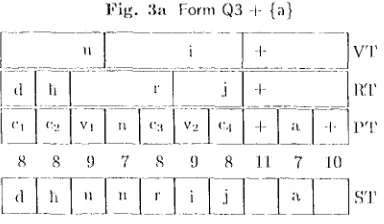
llere is the derivation of Idri,,,,,',.ij,d (r<),-,n Q3)f=,>tn
the three morphemes {e,c.2v,nc:,v2c4}, 7 {<ilt,'i) and { u i } , and the sutlix {at} ' 3 M pers(m' which falls oul, of l,he dOillahl e l rllol,-alld-.liat;tern Inort)holo/ry all(i>
hence, I, akes its place on PI'I'.
F i g . 3 a Form Q 3 -i- { a }
u " i I- V T
...
J ...
],
...
8 8 9 7 ,g 9 8 1 I 7 10
T h e numl)ers between Srl ' and the lexical tapes indicate l:he rules which sanction the moves.
We find l,hat default and l)oundary rules represent :t
wide range of Seniti,it stenls.
6Varialih!s are indicated by Ilplier-i':ase leti,ers and {t|,OllliC (!]-
(!lll(!llI,s Iiy lllwi!r ('itSl!-If!lJAws,
[image:4.612.303.495.483.595.2]5 . 2 V o c a l i s a t i o n
Orthographically, Semitic texts appear in three forms: e o n s o n a n t a l t e x t s do not incorporate any w~wels but
mattes lectionis ~, e.g. ktb f o r / k a t a b / (forln 1, active), / k u t i b / ( f o r m 1, passive) a n d / k u t u b / ' b o o k s ' , but kaatb f o r / k a a t a b / ( f o r m 3, active) a n d / k a a t i b / ' w r i t e r ' ; par- t i a l l y v o e a l l s e d t e x t s incorporate some vowels to clarify ambiguity, e.g. kufl> for /kutib/ (form 1, pas- sive) to distinguish it fi'om /katab/ (form 1, active); and v o e a l l s e d t e x t s incorporate flfll vocalisation, e.g. st&tab (form 10, active).
This phenomenon is taken care of by the following r u l e s :
* - - * a ( x 0 - ( v ) - ( x = , )
X I , X2 -¢ vowel (12)
, - - , ~ ( I ' , , x , , ) - ( p , , x ) - ( i ~ , x ~ , )
P (~ { v l , v 2 } , X = vowel,
1",,1~ E {cl,c2,ea,c4},
XI, X2 = radical (13)
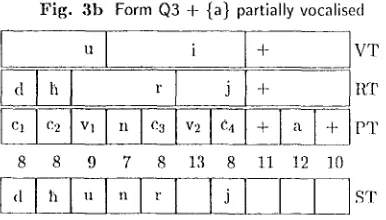
R.ule 12 allows the omission of non-stmn vowels (i.e.. prefixes and suffixes). Rule 13 allows the omission of stern vowels. Note t h a t the lexical contexts, LI,C and R L C , ensure that mattes lectionis are not omitted in the surface. Here is form Q3 with partial vocalisation on the surface.
F i g . 3b Form Q3 -I- {a} partially vocalised
~ u i + VT
8 8 9 7 8 13 8 11 12 10
E,, I', I" 1" I'I
I VT-I T
One additional rule is required t<> allow the omis- sion of vowels which experience spreading (see Rule 17 below).
5 . 3 G e m i n a t i o n a n d S p r e a d i n g
The only two phonological <:hanges ill the Arabic sl.em are gemination and spreading, e.g. /tukuttib/ (form 5) fi'om the morphemes {tvlct vl c~c~v2<:a }, {ktb} and {ui}. The gemination of the second radical [t] and the spreading of the first vowel [u] can be expressed by Rule 14 and Rule 15, respectively:
* - X - * ~ (e.2,X, ) - o 2 - , (14)
* - - X - - * ~ ( 1 1 1 , , X ) . . . . V I -- * (15)
8'Mothers of readlng', these are consonantal h!tters which play the role of vowels, all{[ are represented ill t.he p3.ttel'll l/iol'|)helill~ by VV (e.g. /aa/, /uu/, /ii/). Mattes lectionis cannot be omit- ted fi'om the orthographic string.
Note. the use of ellipsis to indicate, t;hat there are el- emenl;s separal;ing tile two [u]s. Form 5 is illustrated below (without boundary symbols).
F i g . 4 Form 5
- - q i V T
7 9 8 ;I 5 8 14 9 8
In fact, gemination can be considered as a case <>f spreading; llnle 14 lmcomes,
• - x - , -~ ( < , , x , ) . . . . ~ , ~ - , ( | 6 )
This allows fin/tuk'ul, l, ib/(form 5 ) a n d / l , : t a w t a b / ( f o r m
\,Ve also need to allow a vowel which originally sur- faces hy spreading t:o be onfil.ted in the Slll'face ill llll- vocalised words. This ix accomplished l)y l;he. [bllowing rule:
('U[, , X ) . . - ( P l , X l , ) - v I
- ( [ ~ , X 2 , )
X = vowel,P1,1~ C { el, <,, c:~, c4 },
X t , X ) = radical ( I 7 )
Not:e thai, the segments in SIJItF iIl the above rules do not appear in LI.;X, rather in L[,C. This means [;hat, if rllles are to })e eoml>ile<l ill{;() alltolllata, the alll;Omata }lave t;o rcmember i;he segments from LLC. 9 This leads us on thinking about what sorl; of allI;Olllal;a are needed to describe a mull,i-tape two-level grammar.
6 C, O M P l I , A T I O N I N T O A U T O M A T A
We define the following antomat, ou iul;o which rules can he cmnpiled:
A m u l t L t a p e f - r e g i s t e r a u x i l i a r y f i n i t e - s t a t e a u t o m a t o n (AFSA) with n-tapes consists of: n read tapes and heads, a linite state control, and a read- write storage tape of length g, where f < w, and w is the length of the inlml; strings (of. A P D A in [I]opcrofl. and Ulhmm 1979]). The auLomal;on is illus- trated iu Fig. 5 (next page). I°
In cme mow~, depending on the state of the finite control, along with the symbols scanned by the input aml storage heads, the AFSA may do any (n' all of the following:
'qlf the h'aph!mental, ion works dh'e(%ly on ru[es~ this can he achieved by unification.
[image:5.612.337.502.115.225.2] [image:5.612.102.295.378.488.2]F i g . 5 input tapes
A F S T
... F
II
7_Jt172
storage • clumgc ~ s t a t e ;• mow~ its ~t i n p u t h e a d s i n d e p e n d e n t l y c,n,:~ l)osil.iou to t h e right;
• p r i n t a s y m b o l o n t h e coil s c a n n e d by the sLot'age h e a d and (optionally) move that; head ont, l)osition to t h e r i g h t or loft.
M o r e fern, ally iLI/ A F S A is a se.xtui)lo of tim fOl'lli
( Q , ) ; , F, 6, q0, F'), whore:
• Q is a finite sot; of states; • E is t h e m a c h i n e ' s a l p h a b e t ; • it' C )] is t h e s t o r a g e a l p h a h o t ;
• ~$ is t h e t r a n s i t i o n f u n c t i o n , a m a p from Q × a x F t,o
Q x I' x { L , / { } , where o" is ( a l , ..., o,,) and a i C Y;; • qll El Q is t.h,', initial sl.~tl.e;
• 1,' C Q is the. sot of final st;ares.
T h e transil;ion f u n c t i o n a(l,, ~, r) -= (q, ,,., .,) iff t.he ma- chine emt m o v e from s t a t e p to s t a t e q wlfile s(:antfin Z t h e n - t u p l o cr f r o m t h e i n p u t t a p e s a n d r from the cur- r e n t s t o r a g e cell, a n d u p o n ente.ring s t a t e q, writes t h e s y m b o l w onto the. c l l r r e n t sl, or;Lg(1 cell ;m(I moves the s t o r a g e h e a d a c c o r d i n g to m E { L, l~}.
A m u l t i - t : a p e ,t?-reglstm' a u x i l i a r y f i n i t e - s t a t e t r a n s d u c m ' ( A F S T ) wit;ll n i n l m t t a p e s and k o u t l n t t t a p e s is ml A F S A w i t h (t+ + k)-tapos. A F S T s lw.httvo like A F S A s , b u t s c a n t.uple pairs.
N o t e t h a t a n A F S T w i t h n = k -= I a n d ~? =: 0 is e q u i v a l e n t to a. F S T .
T h e rules are comIfiled into A F S T s in t h e s a m e lines of s t a n d m ' d two-level m o r p h o l o g y . We shall ttso. a spe- cial ease of A F S T s : W e h y p o t h o s i s e t h a t , in lilms w i t h tie.r confl:+A:ion, for all tnortJtcJogical processes, k = l
(i.o. on('. surface t a p e ) ; further, wo .:msmno l,hat, m > less one proves otherwise, all m o r p h o l o g i c a l processes require t h a t f < 1 (hence, we shall ignore m in a).
l,'or Semitic, n = 3 . T h e A F S T for R u b 15 is illus- Ix;tted bolc~w.
F i g . 6 AFST for Rule 15
Def, 0 ; 0
( v 1 , 0 , X ) : X , 0 ; X
( v l , 0 , X ) : X , ( v l , 0 , 0 ) : X , X ; 0
I)cf, 0 ; 0
(13acktracking) [
j
(Road)l)c{', 0 ; 0
(vl ,O,O):X, X ;(I (Re.acO
T r a n s i t i o n s m;u'ked with l)ef (for default) take phu'.o wh(!n a is a ft!:mibh! i.uI)le pair, oLhor dm, n l.hoso ex- plicidy shown. T h e onq)t.y st.rhlg is rot)resented I)y 0. T h e transil.ions are:
• @so, l ) c f , 0) = (so, 0) allows s t r i n g s n o t r e l a t e d to l.his r u b to be accepted;
• @ s 0 , 0 , , O , X ) : X,O) -. ( s l , X ) e n t e r s t h e rule writ.inp; X in t.he storage coil;
• ,S(.~,,(',,,,O,X) : X , 0 ) = (.~t,X) a t , d
,S(s.,, ('vl, 0, X ) : X,(]) = (st, X ) e n s u r e . b a d d a ' a c k - ing;
• ~(,'1, D e f , O) = (sl, O) t'Oln'Osents ellipsis;
• (S(sl, ( v 1 , 0 , 0 ) : X, X ) == ( . , ' 2 , 0 ) r e t r i e v e s t h e ('otx- t~mt.s of the s t o r a g e cell;
• ,S(.~.,, (',.,,, 0, 0) : .V, .V) =: (<,, {I) ;dl,,ws ,:,,,,s,,,:,,Uv,,
,,,.di,,r; op,.'at.i,)ns, e.g.
[aa] i n / ~ . t . . , ~ . t , /(form
6).
• ¢$(s'e,De:f,0) = (.st,0) allows noll-(:OllSectttive r e a d i n g o p e r a t i o n s , e.g. t h e t h r e e [a]s in /I.akat-
t.b/
(form ~).'7 C O N ( ' , L U , q I O N
T h i s lmpor has shown t h a t a. m u l d - t:apo I;wo-lovol ap- p r o a c h using t:he P u h n a n - I [eplflO/ILuessinl¢/Bhtcl~ et al. formalism with the. e x t e n s i o n s m e n t i o n e d is c a p a b l e of do.scribing the whole r a n g e of A r a b i c stems.
[image:6.612.82.284.77.285.2] [image:6.612.306.502.136.313.2]using finite s t o r a g e (especially w i t h g _< 1 a n d a small finite set of I') does n o t give t h e m a c h i n e e x t r a l)ower. T h e r e a s o n for u s i n g s t o r a g e is to m i n i m i s e t h e m u n h e r of m a c h i n e s a n d s t a t e s .
W i t h r e g a r d s to t h e i m p l e m e n t a t i o n , first we imple- m e n t e d a s m a l l s y s t e m in o r d e r to t e s t t h e usage of A F S T s in o u r m o d e l . O n c e this was estat)lished, we m a d e a s e c o n d i m p l e m e n t a t i o n b a s e d on t h e work of [ P u l m a n a n d H e p p l e 1993]. T h i s i m l ) l e m e n t a t i o n dif- fers fi'om t h e i r s as follows: Lexical e x p r e s s i o n s are n- tuples, i.e. i m p l e m e n t e d as lists-of-lists instead of lists- of-characters. A facility to check ellipsis in rules was a d d e d . T h e lexicon c o n s i s t s o f multii)le trees, one tree p e r t a p e . Finally, a m o r p h o s y n t a c t i c pro:set was a d d e d . Wc c o n c l u d e this p a p e r by looking at t h e possil)ility of using our m o d e l for toiml h m g u a g e s .
7.1
B e y o n d S e m i t i c
T h i s a p p r o a c h m a y be c a p a b l e of des(:rit)ing o t h e r t y p e s of n o n - l i n e a r m o r p h o l o g y , t h o u g h we have n o t yet looked at a w h o l e range,
of
e x a m p l e s . T h e following m a y form a t h e o r e t i c a l f r a n m w o r k for a n u m b e r of n o n - l i n e a r phe- n o m e n a .C o n s i d e r s u i ) r a s e g m e n t a l m o r p h o l o g y in t o n a l lan- guages. T e n s e in Ngbal~% a l a n g u a g e of Zaire, is in- d i c a t e d l)y t o n e , e.g. {kpolo} ' r e t u r n ' gives I k p a t , ) /
( L o w ) , / k p S l s / ( M i d ) , / k p b l 6 / ( L o w - I l i g h ) , a n d / k p 6 1 S / (Iiigh) [Nida 1949]. T h i s can be e x p r e s s e d with t h e s t e m nlorpheme. {lq)olo} on one t a p e a n d t h e t o n a l m o r p h e m e s {L}, {M}, {LH} a n d {tI} on a s e c o n d t a p e w i t h t h e lbllowing rules:
* - C - * => * - C - * (18)
* - V - * :~ * - - V - * (:19)
* - T - - * ~:;, (V, ) - ( , T ) - * (20)
w h e r e C is a c o n s o n a n t , V is a vowel a n d T is a tonal s e g m e n t ( t h e s e rules are for t h e al)ove d a t a only). T h e t r a n s i t i o n s for
/kpald/are
s h o w n below:F i g . 7
{kpolo)
-I-{LII}
~ _ V P V ~
-_
1 1 0 ~ St.era18 18 19 20 18 19 2(1
For all o t h e r cases one needs to a d d a rule for s p r e a d i n g t h e t o n a l m o r p h e m e .
7.2
F u t u r e W o r k
C m r e n t l y , we are looking a t d e s c r i h i n g tl,e Semitic s t e m using m o r a k : [ M c C a r t h y a n d P r i n c e 1990a] a n d affixational [ M c C a r t h y 1992] analyses of Semitic sLems. A n o t h e r a r e a of i n t e r e s t is to look at t h e formal prop- erties of t h e f o r m a l i s m a n d of t h e A F S M .
R e f e r e n c e s
[Beesley 1991] I(. Beesley. 'Computer Analysis of Aral)ic Mor- phology.' 11. Comrie and M. l"id (eds.) l'erspectives on Arabic Linguistics IlL
[]~ird ~l.l~ld ]~][]~()[l 1992] S. ]~hd and T. l']llison. One Level Phonvlogy. Edinburgh research Papers in Cognitive Sci- ence, No. EU('CS/RP~51 (updated version 1993).
[Black et al. 1987] A. Black, G. Ritchie, S. Puhnan, G. ]hlssel. 'Formalisms fbr Morphographernlc Description.' 1,2ACL-
3.
[(:oidsmith
1976]
J. (',oMsmith. Autosegmental Iqwnology, l)oc- t()r;t] dissertaLion, MIT, Published later ,'us Autosegmen- tal and Metrical l'honology (Ox[ord 1(.)90.)[llarris 1941) Z. llm'ris. 'Linguistic Structmre of Hebrew.' ,liner-
nag of the American Oriental 5'oclety: 61.
[llopcroft and UIhmm 1979] .l. l]ol)croft and J. Ulhnan. Int~v- duclion to Automata Theory, Languages, and Compu- tation. (Addlson-WeMey).
[Kataja and Koskemdemi 1988] I,. Kataja and K. Kosken- niemi. 'Finite State 1)escril)l.ion of Semitic Morphnlc)gy.'
[image:7.612.126.272.503.589.2]COLIN('-S&
[Kay 1987] M. Kay. ~Nonconcatenative Finite-St;tte Morph[fl- ol',y.' A C L Prvceedings, 3rd I?u~vpean Meeting.
[Kornai 1991] A. Kornai. l;'ormal PhonMogy. Ph.D. thesis, Stan- tk)rd University.
[Koskemdemi 1983] K. Koske,miemi. Two Level Morphology.
l'h.I), thesis, University of llelsinki.
[Lavie et al. 1988] A. Lavie, A. Itai, U. Ormm. 'On the Appli- cability of Two Level Morphology to the ln[lection of llebrew Verbs.' /'roceedin9 s of A L L C IIL
[McCarthy 1981] .1. J. McCart;hy. 'A Prosodic Theory of Non- con(:;tteruttive Morphoh)gy.' L112.
[McCarthy 1986] .1..l. McCarthy. 'OCP effects: gmnination
and
antigemination' LI 17.[McCarthy
~tnd
Print:e 199(ht] J. ,I. McCarthy and A..q. Prince. 'Prosodi(: lvlorphoh)gy and Ten-ll)latic Morphology,' In M. Eid and ,I. McCarthy (eds.) Perspectives on Arabic Linguistics II.[Mc(.~;u'thy 1992] .I..I. Mc(~au'thy. 'T(!ml)l;d.e Form in l)roso(lic Mm'l)hohq,,y.' (1.. al)l)ear in th(! Im)C(!edings [)[" tim For- Imtl l,inguisl.ics Society
oi'
Mid-AmericaIII.
[NMa 1949] I'L Ni([a. Morphology: 'l'he I)eseriptivc Analysis of Words. (Ihfiwwsity ~d' Michigan Press.)
[Puhn;ut and llepl)le 1993] .q. I)ulman and M. lIeI)ph~. 'A featm'e-based form;flisnl for
two-level
phonology: ,"t de- scriI)tion and hnplemtmtation.' (;ompuler Speech and],a~tguage 7.
[l/itchle t992] (l. lilt.chic, q,;ulgmtges (](![ltwltl, e(] [;,y Tw(>lmvel Mnrphologlcal lhlles.' UL 18.
[ILuessink 1989] 11. II.uessink. 'Two I,evel l'~ormalism. ' Utrecht g o r k i n 9 /tapers in NLP, No. 5.
[Sl)roal. 1992] 1{. Sproat. Morphology and Compuhdion, ((];ml- bridge, Mass.: MITt

![Fig. 7 {kpolo) [Mc(.~;u'thy 1992] .I..I. Mc(~au'thy. 'T(!ml)l;d.e Form in l)roso(lic -I- {LII} Mm'l)hohq,,y.' (1.](https://thumb-us.123doks.com/thumbv2/123dok_us/792146.1092558/7.612.126.272.503.589/fig-kpolo-mc-form-roso-lic-lii-hohq.webp)