A HYBRID APPROACH TO THE AUTOMATIC PLANNING
OF TEXTUAL STRUCTURES
Gang Zhu and Nigel Shadbolt
A.I. Group, Psychology l)epartment, Nottingham University, Nottingham, U.K.
1. Introduction
Over the last decade, the research goals in natural language generation have shi fred fi'om the gen- eration of isolated sentences to the production of coher- ent multi-sentence paragraphs. Two major aspects of the generation process have been focused on: deciding 'what to say' (the strategic level) and deciding 'how to say it' (the tactical level).
In 1985, McKeown designed one of the first systems to produce paragraphs using so-called sche- mata to describe conventional text structures in terms of patterns. Schemata are used to determine the content and order of the clauses in paragraphs (McKeown, 1985). However, these structures have a major limita- tion (Moore and Paris, 1988): schemata do not contain a description of tim intentional and rhetorical role that each part of the paragraph plays with respect to the whole paragraph.
In 1988, H o w first employed RST (Pdmtorical Structure Theory) relations, which state the relation- ships between individual elements of a text, to control the construction of texts (How, 1988). In developing this RST-based method, Ho W has discovered that RST relations are a powerful tool for planning pa,'agraphs. They support reasoning about the intentions of writers and readers in a very natural way. Planning with rhe- torical relations affords more flexibility than schcnmta. This method of planning paragraphs builds a tree struc- ture that represents the internal organisation and rhe- torical dependencies between clauses in a text. P, nt there is a cost: it is more difficult to assemble an RST paragraph tree from a set of independent relations than it is to instantiate and traverse a schema (Hovy, 1991 ). In 1992, Hovy et. al. described a new text planner (Ho W e t . al., 1992) that identifies the distinct types of knowledge necessary to generate coherent discourse in a text generation system. These knowl- edge resources are integrated under a planning process that draws from appropriate resources whatever knowledge is needed to construct a text. Though Itovy et. al. do not claim to have identified all the knowledge sources required to produce coherent discourse, their planner sets a trend for applying multi-knowledge resources for more complete and flexible phmning of text.
So far, planning techniques have developed from the direct application of schemata toward the wider implementation of multi-knowledge resources and diverse l)hmning architectures (McKeown, 1985; Paris, 1987; H o w , 1988; Moore, 1989; McKeown et al., 1990; Suthers, 1991; Hovy et. al., 1992). When these planning mechanisms are implemented in a working system, efficiency is still an important factor in developing a workable model. One of the problems in generation is that of designing a phmning architec- ture that can achieve a good balance between the efficiency of the schema-based approach and the lqex- ibility o1' the RST-based one. This paper presents such a hybrid architecture.
2. A llybrid Approach
Both schema-based and RST-based planning pa,'adigms have advantages and disadvantages. A hybrid of the two approaches that preserves their best aspects - - the efficiency of tile schema-based para- digm and the flexibility of the RST-based one - - would clearly be usefnl. What are the possibilities for such a hybrid approach?
Though the two paradigms seem very differ- ent, tile fact is that a close relationship exists between them. Schemata are nothing other than stereotypically occurring collections of phms, whereas the plans and their plan elements are simply the elementary building blocks of schemata (Mann, 1987). Schcrnata can be viewed as the result of a process where the plans for all of the steps in the process have been compiled into a single structu re (Moore and Swartout, 1991 ). Schemata can be used for plmming relatively invariant aspects of text content and structure. RST-based plans can cope with less predicable and more volatile. Both planning paradigms can be inlplementcd if they are properly represenled and manipulated in a hybrid architecture. Two features are of importance in this hybrid appro'~ch: (t) different planning mechanisms are re- quired to deal with different textual phenomena and (2) explicit use of multi-knowledge resources indis- pensable to these n~echanisms.
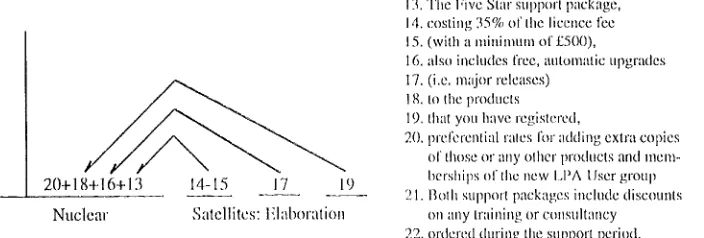
20+18+16+13 14-15 17 19
Nuclear Satellilcs: l{labc.ration
13. The Five Sttu" stipport package, 14. costing 35% of Ihe licorice fee
15. (with a iliiliinltiln of J2500), 16. also hlcltldeS free, aUtOlllalic tlpgrades 17. (i.e. Ill;Ijor releases)
I 8. to the products 19. thai you have registered,
20. prel\~rential rales for adding extra copies of those or <'lily ol]ler products and Illel/l- Imrships of the new I+l>A User gl'ou I) 21. I~ olh stt ppott packages include d iscou n ts
on m~y training or ctmsultancy 22+ ordered during the support periud.
Fig. 1: A sample RST "uialysis
pendent and domain-independent knowledge resources will consist of intentional and rhetorical operators with associated hierarchical networks.
In the hybrid planning rnechanisni advocated here, top-down hierarchical expansion is used as tile basic planning meclmriism. It retrieves as ll/tlch i.t'or- mation as possible from relewmt knowledge rcsources. In general it does t h i s in a donmin-dcpendent-to- domain-independent order. This order rel+lecls the idea that an efl'icient planuing mechanism should seek to exploit, whenever possible, stereotypical domain- dependent knowledge resources. This top-down plan- ning mechanism is combined with other heuristic meehanistns such as atl atlgmetlted transitiot/network traversal, constructive critics and focus modul0s. This approach makes use of different knowledge rcsOill+eOs and planriing mechanisms and is capable of handling a n u m b e r of different textual pbenomeria.
3. A P r o t o t y p e
A prototype lias been designed to delllOll- strate tiffs hybrid approach to die problem of phlnning textual structures. W e will first describe how the text data were collected and analysed. Based on this data, we will then discuss the kuowledge resources lhat were identified as important as well as how they are ,'epresented. lqnally we indicnte how the i+lulmitlg mechanisnis are iml:,lenu:nted.
3.1. T e s t l ) a t a
The test data are a selection of l:inglish sah:s letters. These letters are rehltively formalised, in that some paragral)hs are fixed while others are more wtried as to whether they appear mid where they appear. The letters were written for a restricted read- ership on a specific subject " " i namely, certain comptt+ tot" software products.
The textual analysis has bcen carried out according to RST, although several modifications have had to be made. An exatnple o1' part of a RST analysis is given hi Fig. 1.
Although RST provides a framework for de- scribing rhetorical relations ali]Ollg parts of a text, it lacks ;ill explicit representation of the coummnicative intentions undcrlyhlg the generation of cohol+Oilt IiltlltisententiaI text. In order to COllstrtlct a hybridised processor for various knowledge bases and plannhig ilioclialliSlils, we callnot implelnellt RST dh'ectly with its rhctoric'al rotations, but llave to develop additional hlcntional rol;itions. RST has to be supplenlonted with a richer hltoulional context.
3.2. l(nowledt4e I~,esources
"Fo plan otlr s;tles letters, we need to develop distinctive domain-dcl)endent and domain-independ- ent knowledge reseurces and thoh" associated proeosshlg nlcchanisms in a plaunhlg system.
l:{;lcll lesourcc represeuts both domaiu+de- pendeltt hlfornr, ttion :.uM donlahl-hldepondout hlfor- tllaliOll, tlierarchical l/etworks describe relationsliil+s
LII/1OII,~ r, the (:OlltOllts o f otlr k n o w l e d g e resources.
In this section, we present tim main knowl-
ed~o i'ost)tll'CCS that we have st) far Meniifiod, namely: intentional operators, rlietorical operators, and ilet- works over theln.
3.2.1. l n t e n t i o n : d O p e r a t o r s
h+llClltiOl1~tl ol)(21"~Itt)l+S ~+ll+e Ol'g~Illlscd ;+trOLllld tim intentions of the writer, and tlmir decornpositions are used to select t'elevant rhetorical operators or approl-Jrhite speech acts as defirted by Allen (1987). An hlentioruil operator is represented using the for- real theory o f t'ational interaction developed by Coben, 1,cvesque, and Perraut (1985). Each operator has a goal, prerequisites, consh'airlts, subgoals, and a type. The goal will be brought abotlt by a,i application ot'the Ol~JCrtltor. The stlbgo:.llS mtlst be achieved for stibse- quent application el'the operator. The prerequisites are conditions which must be. salisfied, and coustr;ihlts
are Colld it ions which Call be i g n o r e d if there is rio o t h e r
[image:2.612.104.456.85.204.2]domain-independent. The criteria for the division be- tween the domain-dependeut and the domain-inde- pendent operators is based on the stereotypic patterns of our analysed texts. For example, Fig. 2 represents a domain-dependent intentional operator, Pe,'suade. In our system, this operator may be instantiated as an attempt by an agent X to persuade a client Y to take an Action such as buying the agent's Products. This is achieved by making the client aware of the products and increasing his desire to take the action of buying the product. The prerequisites indicate that both the agent X and the client Y mutually believe that Informa- tion is about Products, the agent believes hfformation, and the client does not know it. These prerequisites nmst be satisfied within the existing knowledge re- sources before the intentional operator can be applied. The constraints, in this case that the client Y is not competent to fulfil Action, need to be satisfied at this stage of processing. When the constraints happened not to be satisfied within the existing knowledge resources, the constraints are then set as a new subgoal for later expansion.
GOAL: persuade(X, Y, Action) PREREQUISITES:
bmb(X, Y, is(Information, Products))
bel(X, hfformation), not(know(Y, hfformation)) CONSTRAINTS: not(competent(Y, Action))
SUBGOALS: bmb(X, Y, and(bel(Y, l~roducts), increase_desire(Y, Action))
TYPE: domain-independent
Fig. 2: An intentional operator: Persuade
3.2.2. Rhetorical Operators
Rhetorical operators are associated with in- tentional operators. This association reflects the fact that there are certain rhetorical means of achieving particular intentional goals. P, hetorical operators con- sist of seven components: Prerequisites, Constraints, Effects, Nuclear, Satellite, Order and Type. As wflh our intentional operators the prerequisites must always be satisfied. Constraints may be ignored but if they are processed they have the same potentkd as constraints in intentional operators -- they may become new goals for the system. Rhetorical operators as expected to have clear effects on intended recipients. Our rhetorical operators also possess the important constituents of a nuclear and satellite. They concern how the goals expressed in the calling intentional operators are to be achieved-- the actions to be carried out. There are two types of rhetorical o p e r a t o r s - - domain-dependent and domain-independent:
Domain-independent rhetorical operators are general rhetorical operators applicable across a wide
range of types of texts. There are about thirty of them described to date (Mann and Thompson 1987). Plan- ning with these operators affords more flexibility than schemata, because individual operators typi- cally control less of a paragraph than schemata do;
Domain-dependent rhetorical operators are derived fi'om our RST analysis of our task-oriented data. l-laving analysed our sales letters we have klentified those rhetorical operators that seem par- ticular to such computer product sales texts. Often they arc rather schematic in that one can expect certain material to be expressed in particnlar ways at certain parts in the text.
3.2.3. Intentional and Rhetorical Networks The intentional network is a hierarchical structure that embodies a preferred control structure for the use o f on r in ten t io nal operators. The intent ion al network can be used for giving possible development of conmmnicative goal(s) with heuristic ordering for an efl'icient schema-based approach.
The rhetorical network is derived fi'om several main sources: the relations defined in RST (Mann and Thompson 1989), which were extended in Hovy's taxonomization ol' relations (Hovy et. al. 1992), and others as determined by our sldes-letter domain. This ,hetorical network operates together with the other knowledge resources, by posting the hierarchical patterns of intentional operator(s), selecting relewmt speech act(s), or specifying aspects of g,'ammatical realisation.
3.3. l ' l a n n i n g Mecllanisnls
A text phnumr, in the form of a heuristic planning process adopted from the layered architec- ture JAM (Carletta 1992) and a top-down hierarchi- cal expansion system based on NOAH (Sacerdoti 1977), has been ilnl~lcmentcd to phm cohel'ent para- graphs which achieve a goal. The goal is configured with initial stales designed to affect a reader in a specified way.
InlOU{ ~/o.r [ Intlial.~jc, a,(bmb(agec,t, client, ¢onvincecl(dietd, intonnation(lpa ctelt~ba~)))~ ] (k)aI ill all intentional operator
~ cite r,t, inlllaLgoal(...)) -~ Ti/~nd~tLf~; tmtiue
lil~n dle e~ LP~] stla si'le: ~ Constraint a~ a subgc, al y~ Decomposition
1
F
l r
l
- ' - - " ~ _ ~ { cleric opcr to'
[bmb(agent, client, and(bel(Client,information),increase dedre))] r - - ~ - - - 7 [ Preser'tati°nalsequenee I
- ~ j
bmb(egent client and(exped(a£1ent aelion) e0e,-,t(elie,'lt, achon)))] ~ ~ ~ . _ "- . . . ~ " - - ' " ... ' ... ' - ' ~ ' ~ ~ / { 1-21
,. , , _
I
I
/
bmb(agent client and(present believe)) . . . . ~ 3,1-38 Nucleus Nucleus
1-33 j Nucleus Salellit e 1-25
Satellite ~ ~
1-33 1-21
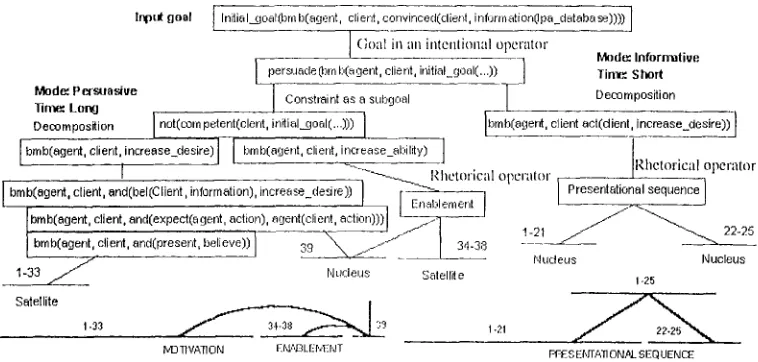
[image:4.612.105.484.94.275.2]IVD ]]VA]]ON El&43 L Ef...EI..J T FVESEI,KA'IIONf, LSEQUENCE Fig. 3: A simplified tol>-Icvcl planning process for |we alternative lextua[ structures These heu,'istics prefer structures with less subgoals
remaining or lower c o s t estimates in the knowledge hierarchical networks. We call these critic processes heuristic ordering mechanisms.
For example, Fig. 3 shows a simplified top- level planning process for two alternative textual struc- tures. The initial goal is that the writer or agent wishes to convince the client about in formation concerning on LPA database products. The two alternative structures of Fig. 3 represent two different plans that our system can generate so as to achieve the initial goal. The two plans vary in terms of whether the text is lengthy and persuasive, else short and informative. The persuasive, lengthy setting results in an olmrator being selected to increase the client's desire to buy tile products. But a constraint oftheoriginal persuade operato,'is expanded. The operator attempts to increase the client's ability to take advantage of his strengthened desire to buy the products. This will result in text tlmt attempts to produce
a means of cnablement to increase the ability to satisfy the desire. Motivation and Enablemcnt are used to produce a partial textual structure on the left side of Fig.3. Otherwise, when an Infornmtive mode and a Short time setting are required, the system selects an intentional operator with a rhetorical operator to fulfil its initial goal as shown on the right side of Fig. 3. This is a simplificd presentation of informing material about the prodttcts.
The output for the hybrid phmner is a single structure tree, with speech acts associated with each of the terminal nodes. The termiual nodes specify propo- sitions discharging those speech acts. This inlbr,nation is chosen st) that, with minor supplementation, it is sufficient to specify sentences to be generated by a functional grallllllar (see Fig. 4)
During the process of developing the hybrid phuining protolype, we have found that it possesses the following adwlniage. I leuristic strategies can be imple-
lnlbml(Volitional Result)
~lntentional /Volitional Result operators
/ 2 Inform(Elaboration) I
!
I
/
/ ..--. El Ibo ition
Rhetorical 3 hfform(l~labc, r;llion) o p o r a [ o r s "4"" x x ]
i "~F,]aboration
4 5
:2. [I IIlI bml)(agcnt,clienl,and(agent is pleased, present(agent,agent is
plcascd)))l, * I,PA is pleased
3. [ [ [ [l',In b(agcnl,clicnt,and(anncmlmc(agcrd,wir@.:,w series),
bcl(clicnt,window_scrics))) I,
* [O allllOtlllCe ils lies,,, ~,Villdn,,vs series,
4. [l[[bmb(agent,client,and(inform ol)jecl(agcnt,lnachin¢ 386 / 486),hal(client,machine 386 / 486)))1,
* a rnnge of software tools for 386 :rod 486 machines 5.
[I;inb(agcnl,clierd,ai~d(in/iwrn_attribute(agcnl,windows_3 in cnhancedj'n~le), bcl(clicrd,windows 3 in enhanccd_mc, dc)))]llllllll,
* running 'Windows 3.0 in Enh'lnced Mode.
[image:4.612.95.491.540.688.2]mented within a non-linear hierarchical planning pro- cedure and multi-knowledge resources can be em- ployed selectively at each level of abstraction. Its top- down hierarchical expansion process provides an ef- ficient non-linear planning mechanism. Its heuristic strategy flexibly chooses not to expend all of the effort needed to employ various resources unless it is abso- lutely necessary.
4. Conclusion
This paper has presented a hybrid approach to the planning of textual structm'es. It is based on the idea that a variety of explicit knowledge resources and planning mechanisms are needed for an efficient but flexible text planner. By describing a hybrid planning prototype, it identifies various knowledge resources required in the domain of business letters. It suggests associated planning techniques for manipulating in- tentional and rhetorical information. Since tile re- search is still in progress, this paper cannot claim to have identified all the necessary knowledge resources and requisite planning mechanisms. Consequently, certain problems, such as how to evaluate wnious planning critics in detail, remain unsolved. The next stage of the research is to capture richer knowledge in the domain and further develop tile critic modules and their controlling mechanisms. Nevertheless we feel that the system as it stands represents a linguistically motivated and coherent computational architecture for the generation of text. The generated text is, moreover, rhetorically compelling given the intention'fl goals of the originator.
References
Allen, J. 1987. Natural Language Understanding, The Benjamin/Cummings Publishing Company, Inc.. Carletta, J. 1992. Risk-taking and Recovery in Task-OH- ented Dialogue, PhD thesis, University of Edintmrgh Cohen, P. R. and Levesque, H. 1985. Speech "lets and nationality, hz Proceedings of tile 23rd Annual Meeting of the Association for Computational Linguistics.
Hovy, E. H. 1988. Planning coherent multisententinl text. hi Proceedings of the twenty-sixth Annual Meeting o['lhe Association for Computational I.inguistics, State Univer- sity of New York, Buffalo, New York.
Ho W, E. H. 1990. Unsolved issues in paragraph phuming. hi R. Dale, C. Mollish and M. Zock Eds., Current Research in Natural Language Generation. Academic Press Lim- ited, London.
Hovy, E.H. 1991. Approach to tile planning of coherent text. ht C.L. Paris, W.R. Swartout and W.C. Mann Eds., Natural Language Generation in Artificial Intelligence and Computational Linguistics. Kluwer Academic Pub- lishers, USA.
Hovy, E., Lavld, J., Maier, E., Mittal, V. and Paris, C. 1992. Employing knowledge resources in a new text planner archi- tecture. In R. Dale, F,. llovy, D. Rosner and O. Stock Eds., Aspects of Autmnated Natural Language Generation.
Springer-Verlag Berlin Heidelberg.
Mann, W.C. 1987. Text Generation: the Problem of Text Smlcture. Technical Report No. RS-87-181, ugc/in[brma- lion Science Institute, Marina Del Rey, CA.
Mann, W. C., Matthiessen, C. and Thompson, S. A. 1989. P, hetoricaI Structure Theory for text analysis, USC/lnforma- lion Sciences Institute, Technical Report ISI/RR-89-242. McKeown, K. R. 1985. Text Generation : Using Discourse StJwtegies and Focus Constraintx to Generate Natur_al Lzm- guage Text. Cambridge University Press, Cambridge, Eng- land.
McKeown, K. R; Elhadad, M.; Fukmnoto, Y.; Lira, J.; Immbardi, C.; Robin, J. and Smaadja, F. 1990. Natural language generation in COMET. In R. Dale; c. Mellish and M. Zock Eds., Current Research in Natural Ixmguage Gen- eration. Academic Press Limited, London
Moore, J. I). 1989. A reactive approach to explanation in expert ancl advice giving systems. PhD. dissertation, Univer- sity of California, Los Angeles, CA.
IVloore, J .D. and Paris, C.I_ 1988. Constructing coherent text using rhetorical relations. In Proceedings of tile National Conference oil Artificial Intelligence, Moston, MA. Saeerdoti, E, D. 1977. A Structure Ibr Plans and Behaviours. New York: North l lolland,