An Object Oriented Approach to Content Planning for
Text Generation
U r s u l a W o l z l Columbia University Department of Computer Science
New York, New York 10027 (212) 854 - 8124 email: [email protected]
Abstract
I'his paper describes GENIE, an object-oriented architecture that generates text with the intent of extending user expertise in interactive environments. Such environments present three interesting goals. First, to
provide information within the task at hand. Second to both respond to a user's task related question and simultaneously extend their knowledge. Third, to do this in a manner that is concise, clear and cohesive. Instead of generating text based solely on either discourse goals, intentions, or the domain, we found a need to combine techniques from each. We have developed an object oriented architecture in which the concepts about which we talk (domain entities), the goals that may be accomplished with them (intentions), end the rhetorical acts through which we express them (discourse goals) are represented as objects with localized knowledge end methods. This paper describes how current text planning methods were insufficient for our needs, and presents our object-oriented method as an alternative.
1. Introduction
A practical problem for text generation is how to produce good advice for users of interactive environments. In such settings users attempt to accomplish tasks by combining the set of available commands in a potentially infinite number of ways. In this setting, the text generation problem amounts to describing and justifying a plan of action to the user, or describing trade-offs between alternative plans, for example when suggesting a better way to do a task. In developing GENIE [Wolz et al. 90, Wolz 90a, Wolz 90b], an advice giving system for accomplishing tasks using Berkeley Unix Mail, we discovered that current approaches to content planning were insufficient for our needs in two ways. First, to
1Supported in part by ONR grant N00014-82-K-0256, by NSF grant IST-84-51438, a grant from DARPA, and a grant from Siemens Researreh and
Technology Laboratories.
produce the kind of informative responses we found in naturally occurring settings, we needed to carefully partition how textual, domain, and intentional knowledge influence the generation process. Second, in defining textual structure, we found that both schemas [McKeown 85] and simple plan operators [Hovy 88, Moore & Paris 89] could not model the general structures we required without introducing far too many special case operators. Instead we found we could eliminate special case operators by using a two stage process of liberal, minimally constrained planning, followed by pruning in which speech acts c o n t e n d for inclusion in the text.
Both partitioning and our two stage planning process fall naturally within an object oriented paradigm. Objects of our three types, namely domain, intentional and textual, have "knowledge" of how they participate in developing a response to a question. This allows domain knowledge to play more of a role in structuring response content than in other systems. More importantly, as this paper will show, all three can have localized knowledge of how they
interact with other objects which reduces the need for special cases.
The next section will elaborate on the practical problem of advice giving in open-ended settings, define our goals for text generation in such settings, and justify why our goals are appropriate. Section 3 shows why schema and plan operators are insufficient. Our object-oriented approach is described in section 4, with an emphasis on text structuring. Section 5 reports on the status of GENIE, and section 6 presents our conclusions.
2. Background
answering in such an environment requires that a text generator not only respond to the specific question asked, but also attempt to add a little extra information in order to enrich the user's knowledge. The domain we consider is Berkeley Unix Mail, chosen because it is a microcosm of Unix, providing extremely rich and sophisticated functionality with a frustratingly hard to learn interface. The domain also allows us to focus on extending system expertise rather than domain problem solving since the activities, sending, receiving and managing messages, do not require high level thinking skills.
Interactive environments can be characterized as computational tools that allow users to accomplish tasks. Examples range from desk top aides such as word processors, message systems and spread sheets, to cad/cam systems and multi-purpose programming environments. Typically a core set of functionality can be combined and manipulated to construct solutions to domain specific problems. A user approaches such an environment with a domain specific or computational goal, and constructs a plan to satisfy that goal with the functional mechanisms available in the environment.
In such open-ended settings no two users will approach the system with the same background or needs. Consequently the degree of difficulty of functionality is more dependent upon the particular experience of a user, than on broad categories of functional difficulty or user expertise [Chin 88]. Users tend to develop their own highly personal repertory of commands. For example, an "expert" user who has extensive experience reading messages, and a "novice", one who has almost no experience reading messages, may both need to be introduced to a method for storing mail in files. The level of expertise of the first user is less significant than whether his or her particular expertise contributes to how much more easily the new method can be communicated. Therefore a particular goal may be satisfied by more than one plan, where the criteria for which plan is "best" is dependent upon the context of the task at hand. This context can be viewed as a model of the user, and it is the primary influence on the choice of content and the structure in which that content appears as text. It consists of:
• The discourse context w The type of question the user is asking, and the specificity of the question. For example, is the user asking for a plan, for an explanation for why a plan failed, or for a better plan than the one he or she is currently using 2.
• The situational context - - The "physical
2A more accurate label might be the "question context," however eventually this structure should represent the dialogue between the user and GENIE over time. We keep the more grand label to remind ourselves
of this.
situation" the user is in, that is, the state of the environment and the user's position in it. This includes background knowledge about domain entities such as what some one's email (electronic mail) address is.
• B e l i e f s a b o u t t h e U s e r ' s T a s k E x p e r t i s e w
The computational goals GENIE believes the user knows about and the plans the user has for satisfying them.
Finally, since a user's primary goal is to complete the task, and only secondarily to get new information, he or she would prefer a succinct, informative answer. However the answer should also be sufficiently grounded, that is, it should contain advanced organizers [Gagne & Briggs 79] that explicitly articulate any of its goals, assumptions, and decisions in choosing a course of domain action that are not obvious to the user.
An example scenario might help illustrate these points. Consider the user model defined at the top of Figure 2-1. The user asks the question, "how do I send a message", which implies a question intent to receive a plan for the goal "send a message." The discourse context contains the question intent "given a goal give me a plan", and the expectation that such a plan exists, and that GENIE will provide it to the user. The statement of the goal further indicates that the user is asking about sending a single message, in contrast to "sending mail" where the quantity of messages is ambiguous. The goal statement does not however does not say anything about who the recipient might be. The details of the goal statement can have a profound effect on how GENIE selects content, and chooses to present it. Physically, the user is in the Unix shell, and has no new mail. In the past the user has never initiated the sending of a message, but has only sent messages in reply to messages s/he has received. Finally, as background, in Berekely Unix mail, one cannot "get into" the mail environment with the command "mail" unless one has new mail. The text GENIE produces as a result of this scenario appears in the lower part of the figure.
Sentences 1 - 3 are produced as a result of responding to the user by introducing a plan for sending mail. Sentence 1 is an advanced organizer, which makes sure GENIE is answering the question the user asks. Note that if GENIE had true dialogue capabilities, it might pose this as a question. Only ff the user responded in the affirmative would it proceed with the remainder of the text as is. Sentences 4 and 5 are enrichment, elucidating why the user's usual plan won't work. Note too, how discourse goals are merged. For example, sentence 3 is both an example and a definition of syntax.
Text generation for interactive environments therefore requires addressing the following goals:
Input:
Discourse: How can I send a message to message? Situation: User is in Unix, with no new mail.
Kathy is a user with email address "kathy." User knowledge of domain tasks:
User has never sent a message from Unix shell, but has only initiated sending from "read mode" afar reading new mail.
Output:
(1) I assume you are in unix, your recipient is an individual, and the address is a local address. (2) You must supply the email address of the individual. (3)For example, to send mail to Kathy, type
mail kathy
since kathy is her email address.
(4) You usual method is to read your mail, then use the mail command inside the mail environment. (5) Since you do not have any new mail, your usual method will not work.
F i g u r e 2-1: A n example scenario
users' task (their computational goal) and the methods ((plans) that may be used to accomplish them. Do this within the current context of the task at hand.
2. Respond informatively, but also attempt to provide enriching material.
3. Provide advanced organizers, but do it in a manner that is concise, clear and cohesive.
Taken together these goals suggest that a large amount of information must be presented in as short a text as possible. Evidence from three informal studies indicates that natural occurring texts satisfy these goal. First a set of textual materials, including manuals, tutorials, texts and canned text on-line resources were studied. Tutorials and on-line resources tended to focus on responding directly to the problem of how to do tasks. Reference manuals, text books and especially "advanced user" manuals focused on enrichment. In all, 20 passages covering information about Unix, Lisp, Pascal, Logo and a number of word processors were analyzed. These texts have strongly influenced our approach to content selection and structuring. In particular, we found that four types of strategies occurred through which information about the relationship between domain plans and goals was given:
• Introducing: Presenting plans that the user has not encountered before.
• Reminding: Briefly describing plans to which the user has been exposed, but may have forgotten.
• Clarifying Distinctions: Explaining
distinctions and options about plans.
• Elucidating Misconceptions: Clearing up misunderstandings that have developed about plans to which the user has been exposed.
These strategies had a consistent general structure that included sub-strategies such as summarizing or elaborating on a plan that had their own linguistic structure. See [Wolz et al. 90] for a thorough discussion of these strategies. The "Introduce" strategy will be discussed extensively in the following sections.
The second analysis looked at 30 unix related question answering sessions in which the correspondence occurred through electronic mail. We found that the responses still fell within the four strategies. The respondent made an attempt to respond informatively, and in 8 cases explicitly included contextual information that acted as an advanced organizer, or that might not have been obvious to the questioner. In 7 cases the respondent included information that was not merely in response to the question, but that could extend the questioner's expertise. Most importantly however, we found instances where sub-strategies, and sometimes the four basic strategies themselves, were combined to produce very concise utterances. We also noticed that sub-strategies were absent when their contents was not critical, or when it was obvious from the question. The last of these points have led us to the goal of conciseness.
A third study of human-to-human tutoring in a computer lab also corroborated the strategies, the incidence of enriching behavior, the use of advanced organizers. However, verbal responses tended to be significantly more long winded, exhibiting more o f a stream of consciousness than the mail messages. Since GENIE produces interactive text, our goal is to most closely match the mail message behavior, and aim for conciseness.
3. L i m i t a t i o n o f C u r r e n t A p p r o a c h e s
GENIE was developed as a result of the design goals enumerated above, namely to answer a question within the task at hand, satisfy the dual discourse goals of responding and enriching, and do this clearly and concisely. These goals presented some special problems for capturing textual structure, and for defining choice points for refining that structure into natural language clauses and vocabulary.
hand, GENIE needed to make choice point decisions based on intentional [Appelt 85, Moore & Paris 89], domain and textual [McKeown 85, Paris 87] knowledge. Previous work on text generation has tended to put the emphasis on one of the three, incorporating the other two implicitly.
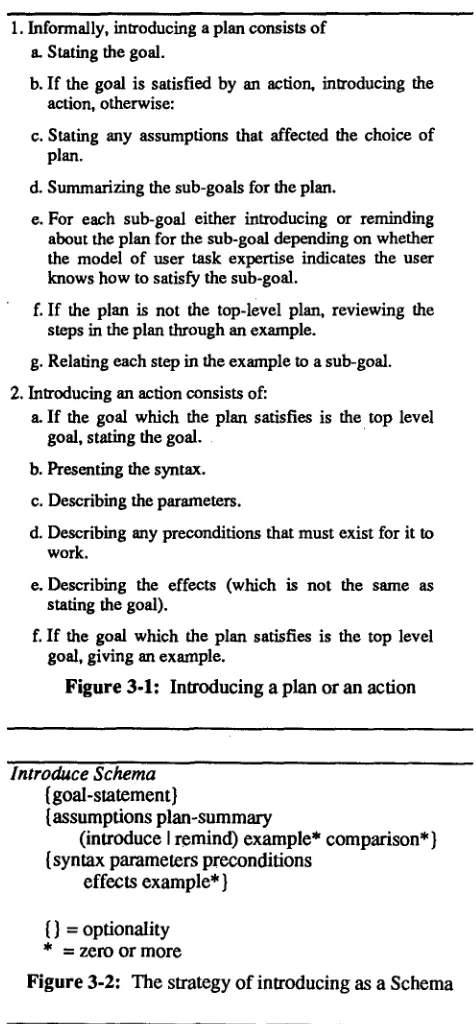
The problem can be best illustrated by looking at the informal description of the strategy of "introducing" presented in Figure 3-1. The structure of this strategy was derived from principles of instructional design [Gagne & Briggs 79] and on the analysis of text. The informal definition contains both structure, in the form of how to expand an introduction into sub-structures such as "summarize", and under what circumstances to do so, for example whether the goal is satisfied by an action or another plan, or whether the user knows or does not know the subgoal. This strategy assumes a recursive definition of a goal, where the goal can be satisfied by an action or indirectly by a plan that itself consists of a set of subgoals. This definition of a goal follows that used in STRIPS [Fikes and Nilsson 71] where the term goal refers to a state difference. It is to be distinguished from the goal state, or end state which is sometimes referred to as "the goal."
Casting this informal description as a formal schema looses the explicit information about what circumstances motivate expansion into particular sub-structures. For example, the schema definition presented in Figure 3-2 does not contain choice point knowledge.
Conversely, casting the description as a set of plan operators looses the explicit structure in the informal description. The structure emerges only during planning. Researchers in text generation using plan operators (Appelt85,Hovy88, Moore-paris89) have adapted the hierarchical definition of a plan operator developed by Sacerdoti [Sacerdoti 77] A discussion of the merits and disadvantages of the subtle differences between definitions is not appropriate here. Instead, we must focus here on the components of plan operators that are critical to representing choice points and sub-structure, namely a constraint/action-body pair. Constraints or preconditions define choice points, while the body of the operator defines actions that are taken if the constraints are met. Figure 3-3 shows informal definitions of some of the operators that would be required to model the sub- structures that appear in Figure 3-1.
Plan operators introduce an even more insidious problem. Note that both Introduce-plan and Introduce-action contain the operator "state-goal" in their bodies. Other high-level strategies such as Remind Plan or Elucidate Misconception also include this sub-structure. Recall that GENIE will initiate two strategies, one in response and one to enrich. For example, to produce the text in Figure 2-1 GENIE chose to respond by introducing a new plan to the user, and enrich, by elucidating why the user's usual plan won't work in the current situation. The fundamental
1. Informally, introducing a plan consists of a. Stating the goal.
b. If the goal is satisfied by an action, introducing the action, otherwise:
c. Stating any assumptions that affected the choice of plan.
d. Summarizing the sub-goals for the plan.
e. For each sub-goal either introducing or reminding about the plan for the sub-goal depending on whether the model of user task expertise indicates the user knows how to satisfy the sub-goal.
f. If the plan is not the top-level plan, reviewing the steps in the plan through an example.
g. Relating each step in the example to a sub-goal. 2. Introducing an action consists of:
a. If the goal which the plan satisfies is the top level goal, stating the goal.
b. Presenting the syntax. c. Describing the parameters.
d. Describing any preconditions that must exist for it to work.
e. Describing the effects (which is not the same as stating the goal).
[image:4.596.307.545.53.565.2]f. If the goal which the plan satisfies is the top level goal, giving an example.
Figure
3-1: Introducing a plan or an actionIntroduce Schema {goal-statement}
{assumptions plan-summary
(introduce I remind) example* comparison*} {syntax parameters preconditions
effects example* }
{ } = optionality * = zero or more
Figure 3-2: The strategy of introducing as a Schema
introduce-plan
constraints: goal is satisfied by plan action-body: state-goal
state-assumptions summarize-plan expand-plan plan-example relate-steps
introduce-action
constraints: goal is satisfied by action action-body: state-goal
state-syntax state-preconditions state-parameters action-example
Figure 3-3: Possible plan operators for introducing
don't show how this kind of open-ended recursion is handled. Examples tend to only show how a top level discourse goal is elaborated through a refinement process. When runaway recursion might occur, computational tricks such as limiting the number of levels of deepening is suggested. This is not sufficient for GENIE'S purposes.
For example consider a domain goal G that is satisfied by plan P, that expands into subgoals, that are satisfied by plans that themselves expand until a set of actions is reached. Clearly one can't limit the expansion since the actions are a critical component of the text. If one blindly follows the informal description of introducing the top level plan P, then all of the subgoals and sub-plans will be included recursively. Merely stating the top level goal and plan, and the resulting actions would seem to be a natural intuitive solution. But this would require different operators for "high" level strategies, than for those further down the structure. This thwarts the elegant nature of independent, generalized structures such as schema's and plan operators. To further aggravate the situation, consider that many of those actions may have the same preconditions. Again, if one blindly follows a generalized "introduce action" operator, then for all those actions that include precondition P, a speech act stating P will be included. One would prefer that P be stated at most once.
Avoiding this problem through "special case" operators is insufficient. For example, consider two plan operators that handle when to state the goal.
1. If introducing in response, include a statement of the goal unless it is explicitly mentioned in the question. 2. If introducing as enrichment, do the same thing
except if you already mentioned the goal in response, don't mention it again.
The second operator is dependent upon the result of the
first one, and although superficially they seem to be independent entities, they are not. Now a third special case is introduced when "elucidating a misconception", because here too, there are circumstances in which the goal should be stated. All three operators know about each other implicitly through their constraints. Because plan operators based on Sacerdoti's hierarchical model assume a set of abstraction spaces, "high level" operators always precede lower-level ones, and the higher ones consequently have an implicit influence on the subordinate ones.
A final problem with implementing the informal structure of Figure 3-1 as plan operators is that a significant amount of domain specific knowledge is embedded in the operators, The operators in Figure 3-3 illustrate this point. The "state-..." operators are essentially "inform" speech acts, but they imply that a specific sort of domain object is to be the subject of the informing. Although text plan operators are supposed to be textual in nature, it is far too easy to implicitly embed domain knowledge in them. This compounds the complexity in developing constraints because textual, domain, and intentional knowledge can be haphazardly intertwined. A similar problem occurs in creating the tests on schemas, since the test may be described by an arbitrary lisp expression. In developing GENIE, we found ourselves mired in layers of operators that contained such complex inter-related constraints. This suggested a different sort of architecture that would allow us to deal with the complexity of inter-related, but distinct influences, and at the same time model both structure and choice of structure in one formalism.
4. An Object-Oriented Architecture for
Content Planning
Given the problems described in the previous section, we will focus here on the aspects of GENIE'S object-oriented architecture that address the problems of text structuring and content choice. The over-all architecture is described in [Wolz 90a]. In particular, this section will illustrate how special case operators are avoided by cleanly dividing the structuring process into two stages. First, rhetorical strategies are refined with minimal constraints to the point of rhetorical acts. Second, the rhetorical acts
4.1. O b j e c t Classes f o r Content Planning
GENIE employs three overlapping classes of objects; domain objects, intentional objects and discourse objects. Domain Objects classify domain entities, including both the commands such as "mail" or "copy" that the user invokes, and the entities manipulated by commands such as flies, messages and users. Intentional Objects allow GENIE tO construct and analyze plans, and include computational goals, plans to satisfy them, and actions (which contain commands as a subclass). Discourse Objects include rhetorical strategies, rhetorical plans, rhetorical acts, syntactic structures and vocabulary. Note that these classes are not mutually exclusive. For example, a goal such as "wanting to send mail" is both an intentional and domain object since it is a domain specific goal.
Each object class has explicit relationships to other classes. For example the class "goal" contains an attribute "who-satisfies-me", whose value can point to either a plan or an action. A plan in turn is an object class that is related to a rhetorical strategy "talk-about." The strategy in turn knows under what circumstances the object about which it talks (the plan) should be introduced, reminded about, clarified or elucidated, that is, it is related to these other rhetorical strategies. Finally, rhetorical strategies may be instantiated either by rhetorical plans, that recurse to other strategies, or by rhetorical acts such as "stating" that can be manifested as English texL
4.2. Constructing Domain Objects for Inclusion in the Text
Recall that GENIE answers questions about how to do tasks. In other words, it provides descriptions of the relationships between goals, plans, actions and the effects of actions in the domain. Providing an answer involves understanding the user's question in a situational context by instantiating a set of domain objects, generating the set of objects (domain goals, plans, actions, effects) that are expected in reply, and selecting the discourse objects that talk about those objects.
For example, consider the question from Figure 2-1: "How do I send a message?" As a result of parsing this sentence, the discourse context will include an instantiation of the very specific goal "send-mail." The discourse context will also include the question intent that the user expects to be told the best plan for the goal in the current context. A specialized plan class knows how to construct an instantiation of such a plan, calling it b e s t - p l a n . It creates a relationship between the instantiation of the "send-mail" goal, and b e s t - p l a n and relates b e s t - p l a n to an instantiation of an abstract plan for satisfying that goal. It also instantiates discriminator objects that capture the assumptions and decisions that were made in constructing the abstract
plan. Like other objects that might be included in the final text, these discriminator objects, which are domain dependent, have rhetorical strategies that can talk about them. b e s t - p l a n is then refined, by instantiating the subgoals of its abstract plan until the process bottoms out as actions.
Figure 4-1 shows some of the itentional objects that are instantiated for b e s t - p l a n . Describing the actual process here would take us too far afield. Note that the discriminators include which part of the user model affected the choice. Decisions that are based on the discourse and situational context are "stronger" than those that are based on the model of user task knowledge. The former are deduced from facts, the latter, like default heuristics for object types, are deduced from weaker beliefs. The strength of the deduction will affect how the decision is described in the text.
BEST-PLAN (plan)
subgoals: ENTER-SEND-MODE-I, CHOOSE-RECIPIENTS-I
ENTER-SEND-MODE- 1 (goal) discriminator: UNIX-READ-I who-satisfies-me: B-SUB-I
B-SUB-I (plan)
subgoals: SEND-FROM-UNIX- 1
SEND-FROM-UNIX-1 (goal)
who-satisfies-me: SEND-FROM-UNIX-ACTION- 1
CHOOSE-RECIPIENTS-I (goal) discriminator: GROUP-SINGLEd
who-satisfies-me: B-SUB-2
B-SUB-2 (plan)
subgoals: CHOOSE-SINGLEd
CHOOSE-SINGLE-I (goa D B-SUB-3 (plan)
discriminator: LOCAL-REMOTE-I subgoals: CHOOSE-LOCAL-1
who-satisfies-me: B-SUB-3
CHOOSE-LOCAL-I
who-satisfies-me: CONSTRUCT-LOCAL-ADDRESS-ACTION- 1
UNIX-READ-I (discriminator) choice-from: SITUATION
GROUP-SINGLEd (discriminator) choice-from: USER-TASK-MODEL
LOCAL-REMOTE-1 (discriminator) choice-from: USER-TASK-MODEL
Figure 4-1: Set of Objects to be Included in Response
importantly, the best-plan and user-plan are
annotated as to whether each is valid in the current situation, and if so, whether they are the same plan. The information is critical to how each will be "talked about." In the scenario of Figure 2-1 the u s e r - p l a n will not work because it requires that new mail exist, which is not the case in the scenario. Once the relationship between the goal, b e s t - p l a n and u s e r - p l a n have been established, text structuring can begin.
4.3. Structuring Content: Instantiating
Rhetorical Strategies
Structuring content consists of selecting two rhetorical strategies, one for responding, and one for enriching, and instantiating a rhetorical plan for each strategy. The selection is based on the nature of the question intent, the domain plans that have been constructed, whether those domain plans satisfy the goal, and whether they are identical. The selection rules were compiled from our design goals, and result in one plan being described in response and possibly a second being described as enrichment. The plans for the two strategies are then reeursively expanded until the process bottoms out as a set of rhetorical acts.
Structuring begins when the domain plans such as
best-plan and user-plan are sent messages to "talk-about" themselves 3. In the example scenario,
best-plan decides that it should be "introduced in response to the question" because it is not identical to user-plan. Had the plans been identical, b e s t - p l a n would have chosen to be reminded instead. u s e r - p l a n decides that it should be "elucidated as enrichment" because it doesn't work in the current context.
The strategies map to rhetorical plans that are a sequences of message passing instructions with simple control structures, such as interating on a list, and binary branching. A rhetorical plan is refined by sending those messages to other rhetorical strategies or to rhetorical acts that cannot not be further refined. The method for expanding the rhetorical plan is dependent upon the object type of the entity to be talked about. Classes of objects may use the same rhetorical strategy through inheritance, however, when appropriate two classes may require the same strategy, but have their own private rhetorical plans for those strategies. For example, given the informal descriptions of introducing a plan or an action in Figure 3-1, it is clear that the text structure of introducing these two kinds of things is dissimilar. The rhetorical strategy associated with introducing a plan is formally described as:
3In other scenarios, other kinds of plans might be constructed, s e e
[Wolz 90a] for details.
(rh-plan introduce plan ((state-it goal-I-satisfy)
(ITERATE choice ON
choices-made
WITH (describe-decisions choice)(ITERATE subgoal ON subgoals WITH (summarize subgoal))
(ITERATE subgoal ON subgoals WITH (IF (subgoal in-user-model)
(remind who-satisfies-me) (introduce who-satisfies-me)))))
This plan says, to introduce a plan, state the goal it satisfies. For each choice made to construct it, describe the reason for the choice. For each subgoal, summarize the subgoal, then for each subgoal, if the subgoal is known by the user, remind the user about how it can be satisfied, otherwise, introduce how it can be satisfied. A particular object, like a domain plan, has a set of attributes or slots that link it to other objects. For example, a plan has a "goal-l-satisfy" slot that relates it to the goal it satisfies, and the goal in turn has a "who- satisfies-me" slot that points to the plan. The statement "(state-it goal-I-satisfy)" says to send a "state-it" message to the object related to me by my "goal-l-satisfy" attribute. When this message is sent, a rhetorical object of class "state-it" is instantiated that links the calling rhetorical object with the called object, creating ties between them and the domain objects.
Of particular significance is the fact that rhetorical plan are minimally constrained. For example, the plan for introducing a domain plan has no constraints on when to include the statement of the domain goal, so this plan can be used both to describe the b e s t - p l a n , or one of its sub-plans, or the u s e r - p l a n without complex constraints. More importantly, this rhetorical plan does not need to keep track of which operators are appropriate for different kinds of objects. For example, when expanding its subgoals, it merely sends a message to the object related to the subgoal by the "who-satisfies-me" slot. The object, either a plan or an action, upon receiving the message instantiates its localized rhetorical plan for reminding or introducing. This process continues until a set of rhetorical acts is constructed.
4.4. Contending for Inclusion: Communication
Between Rhetorical Acts
given to the surface generator. Note that these 6 acts are only 1/5 of the rhetorical acts that are produced in this example.
STATE-IT-GOAL- 1 ::
domain-object[goal] :send-mall-I
STATE-IT-STRONG-DISCRIMINATOR- l :: domain-object[discriminator] :unix-read- 1 STATE-IT-GOAL-2 ::
domain-object[goal] :choose-recipients- 1 STATE-IT-WEAK--DISCRIMINATOR- 1 ::
domain-object[discriminator] :group-single-1 STATE-IT-GOAL-3 ::
domain-object[goal] :send-individual- 1 STATE-1T-WEAK-DISCR/MINATOR-2 ::
domain-object[discriminator] :local-remote- 1
You want to send mail. I know you are in Unix. You want to specify a recipient. I assume your recipient is an individual. You want to specify a single recipient. I assume the address is a local address.
Figure 4-2: Text Produced Before Content Filtering
some distance may find themselves next to each other, or even merged, if the acts between them are excluded. Once processing is complete, the remaining objects apply knowledge for constructing clause level structures which are then passed to the surface generator.
Figure 4-3 shows how the 6 acts from Figure 4-2 contend to be included, and are eventually merged to produce the first sentence in Figure 2-1. The first act of stating the main goal can be excluded because it is in the discourse, and is probably obvious to the user. The second and third statements of goals may be excluded because they are part of a goal-plan-goal chain, that is, they supply unnecessary detail about the relationship between the top level goal and the actions. The result of these deletions makes the two "weak" discriminator statements adjacent, at which point they can be merged. This newly merged object can then be merged with the "strong" discriminator that follows it. In general, when weak assertions out number strong ones, the weak assertions can subsume the strong assertions, if the significance of the strong assertion isn't important. For example, it is acceptable to say "I assume X and Y" even if you "know X" provided the distinction between knowing X and assuming X is not critical to the response.
The contention stage reviews this list and specifically includes, excludes, merges or keeps separate acts within this list. For example information derived from either the situational context, such as the mode the user is in, should be included because it may not be obvious to the user. Information derived from the discourse context, such as an explicit reference to the goal may be excluded as obvious because it was referred to in the question. In the process of both reminding and clarifying, the same preconditions may be introduced twice. These can be merged into one utterance. However, if a component of an utterance is critical, such as a failed precondition when elucidating a misconception, then it should be kept separate.
The rhetorical acts contain the methods for determining how they can be filtered. This includes specific rules for when they may be excluded, when they must be included, what other objects they may or must be merged with and which one is dominant, and when they are to be kept separate. Contention for inclusion in the text begins when the set of rhetorical acts is sent messages to "execute" themselves. Each examines its methods for how it may be merged etc. Processing continues until all objects return successfully. Some objects will have been excluded and some will have instantiated new "merged" objects, subordinating themselves to the merged object. Restructuring occurs during merges and excludes. A merge may move an act up or down depending on whether the dominant act comes before or after the submissive one. Two acts which are initially separated by
Excluded[
STATE-IT-GOAL-1 because IN-DISCOURSE-CONTEXT Excluded!
STATE-IT-GOAL-2 because IN-GOAL-PLAN-GOAL-PATH Excluded[
STATE-IT-GOAL-3 because IN-GOAL-PLAN-GOAL-PATH
Merged!
STATE-IT-WEAK-DISCRIMINATOR-2 and STATE-IT-WEAK-DISCRIMINATOR- 1 into CONJOINED-WEAK-DISCRIMINATOR- 1 because SAME-TYPE
Merged!
CONJOINED-WEAK-DISCRIMINATOR- 1 and STATE-IT-STRONG-DISCRIMINATOR- 1 into CONJOINED-WEAK-DISCRIMINATOR-2 because WEAK dominates STRONG
I assume you are in unix, your recipient is an individual, and the address is a local address.
Figure 4-3: Application of Filtering Methods
5. Status
[Finin 83] Finin, T. Providing help and advice in task oriented system. Proceedings of the Eighth International Joint Conference on Artificial Intelligence, Karlsruhe, West Germany, 1983, pp. 176-178.
[Gagne & Briggs 79] Gagne, R. M. and L. J. Briggs
Principles of Instructional Design. Holt Rinehart and Winston, New York, 1979.
[Halliday 85] Halliday, M.A.K. An Introduction to Functional Grammar. Arnold, London, 1985.
[Hovy 88] Hovy E.H. Two types of planning in language generation. Proceedings of 26th Meeting of ACL, Association for Computational Linguistics, 1988.
[Kay 79] Kay, M. Functional Grammar. Proceedings of the 5th meeting of the Berkeley Linguistics Society, 1979.
[MeKeown 85] McKeown, K.R. Text Generation: Using Discourse Strategies and Focus Constraints to Generate Natural Language Text. Studies in Natural Language Processing. Cambridge University Press, Cambridge, England, 1985.
[Moore & Paris 89] Moore, J.D. and C.L. Paris.
Planning text for advisory dialogues. Proceedings of 27th • Meeting of ACL, Association for Computational
Linguistics, 1989, pp. 203 - 211.
[Paris 87] Paris, C.L. The Use of Explicit User Models in Text Generation: Tailoring to a User's Level of Expertise. Ph.D. Thesis, Columbia University, 1987.
[Sacerdoti 77] Sacerdoti, E. A Structure for Plans and Behavior. American Elsevier North-Holland, New York,
1977.
[Smith and Carando 86] Smith, R.G and P.J. Carando. Structured Object Programming In Strobe.
Schlumberger-DoU Research, Ridgefield, CT, 1986.
[Wolz 90a] Wolz, U. Extending User Expertise in Interactive Environments. Ph.D. Thesis, Columbia University, 1990. Forthcoming.
[Woh 90b] Wolz, U. The impact of user modeling on text generation in task-centered settings. Second International Conference on User Modeling, Honolulu, Hawaii, 1990.
[Woiz et al. 90] Woh, U., K.R. McKeown and G. E. Kaiser. "Automated tutoring in interactive environments: A task centered approach."