E v e n t C o r e f e r e n c e for I n f o r m a t i o n E x t r a c t i o n
K e v i n H u m p h r e y s a n d R o b e r t G a i z a u s k a s a n d S a l i h a A z z a mD e p a r t m e n t o f C o m p u t e r S c i e n c e T h e U n i v e r s i t y o f Sheffield R e g e n t C o u r t , 211 P o r t o b e l l o S t r e e t
Sheffield S1 4 D P U K
{K. Humphreys, R. Gaizauskas, S. Azzam}@dcs. shef. ac. uk
A b s t r a c t
We propose a general approach for per- forming event coreference and for con- structing complex event representations, such as those required for information ex- traction tasks. Our approach is based on a representation which allows a tight coup- ling between world or conceptual model- ling and discourse modelling. The rep- resentation and the coreference mechanism are fully implemented within the LaSIE information extraction system where the mechanism is used for both object (noun phrase) and event coreference resolution. Indirect evaluation of the approach shows small, but significant benefit, for informa- tion extraction tasks.
1 I n t r o d u c t i o n
Much recent work on anaphora has concen- trated on coreference between objects referred to by noun phrases or pronouns (see, e.g., Botley and McEnery (1997)). But coreference in- volving events, expressed via verbs or nominalised verb forms, is also common, and can play an import- ant role in practical applications of natural language processing (NLP) systems.
One application area of increasing interest is information extraction (IE) (see, e.g., Cowie and Lehnert (1996)). Information extraction systems attempt to fill predefined template structures with information extracted from short natural language texts, such as newswire articles. The prototypical IE tasks are those specified in the Message Under- standing Conference (MUC) evaluations (DARPA, 1995; Grishman and Sundheim, 1996). In these ex- ercises the main template filling task centres around a 'scenario' which is defined in terms of a key event type and various roles pertaining to it. Examples
of scenarios used in previous MUCs include joint venture announcements, microprocessor product an- nouncements, terrorist attacks, labour negotiations, and management succession events. In order not to spuriously overgenerate event instances and to prop- erly acquire all available role information, it is cru- cial that multiple references to the same event be correctly identified and merged. While these con- cerns are of central importance to IE systems, they are clearly of significance for any NLP system, and more broadly for any computational model of nat- ural language.
A few concrete examples will make the issues clearer 1. A management succession event (as used in MUC-6) may involve the two separate events of a corporate position being vacated by one person and then filled by another. For an event to be considered reportable for the IE task, the post, the company and at least one person (either incoming or outgo- ing) must all be identifiable in the text.
The first thing to note here is that while manage- ment succession events are sometimes reported as single, simple events, as in
(1) Mr. Jones succeeds M. James Bird, 50, as pres- ident off Wholistic Therapy.
more frequently multiple aspects or sub-events of a single succession event are identified in separ- ate clauses by separate verb phrases or nominalised forms:
(2) Daniel Wood was named president and chief ex- ecutive officer off E F C Records Group, a unit off London's Spear E F C PLC. He succeeds Charles Paulson, who was recently made chairman and chief executive officer off E F C Records Group North America.
(3) The sell-o# followed the resignation late Monday o] Freddie Heller, the president o/ Renard Broadcasting Co. Yesterday, Renard named Susan B. Kempham, chairman o/ Renard Inc. 's television production arm, to suc- ceed him.
Both of these pairs of sentences refer to a single management succession event (though the second sentence in 2 also identifies a further one). Such event/sub-event relations are similar to the famil- iar part-whole or related-object anaphora exempli- fied in sentences such as The airplane crashed a~ter the wings/ell off or When John entered the kitchen the stove was on (Allen, 1987).
T h e second thing to note is the variety of surface forms used to refer to events. Events are referred to by verb phrases in main clauses (1 above), and in re- lative clauses (second sentence in 2) or subordinate clauses. T h e y may be referred to through nominal- ised forms (resignation in 3 above) or through infin- itival forms in control sentences (second sentence in 3). When there are multiple references to the same event, antecedent and anaphor appear to be able to adopt all combinations of these forms 2.
This paper discusses an approach to hand- ling event coreference as implemented in the LaSIE information extraction system (Gaiza- uskas et al., 1995; Gaizauskas and Humphreys, 1997b). Within this system, event coreference is handled as a natural extension to object core- ference, outlined here and described in detail in Gaizauskas and Humphreys (1997a). Both mechan- isms are handled within a general approach to dis- course and world modelling.
In the next section we give a brief overview of the LaSIE system. Section 3 describes in more detail the approach to world and discourse modelling within LaSIE and Section 4 details our coreference proced- ure. In Section 5 we discuss a particular example in detail and show how our approach enables us to correctly corefer multiple event references. Section 6 presents results of an approach to evaluating the the approach and Section 7 concludes the paper with some general discussion.
2 L a S I E O v e r v i e w
T h e Large Scale Information Extraction system (LaSIE) has been designed as a general purpose IE research system, initially geared towards, but not 2While no extended study has been carried out, it appears that in newswire texts nominalised forms are less likely to appear in the first reference to an event, and more likely to appear in subsequent references.
solely restricted to, carrying out the tasks specified in MUC-6: named entity recognition, coreference resolution, template element filling, and scenario template filling tasks (see DARPA (1995) for further details of the task descriptions). In addition, the system can generate a brief natural language sum- m a r y of any scenario it has detected in a text. All these tasks are carried out by building a single rich discourse model of the text from which the various results are read off. T h e system is a pipelined archi- tecture which processes a text one sentence at a time and consists of three principal processing stages: lex- ical preprocessing, parsing plus semantic interpreta- tion, and discourse interpretation. T h e overall con- tributions of these stages may be briefly described as follows (see Gaizauskas et al. (1995) for further details):
l e x i c a l p r e p r o c e s s i n g reads and tokenises the raw input text, tags the tokens with parts-of- speech, performs morphological analysis, per- forms phrasal matching against lists of p r o p e r names;
p a r s i n g a n d s e m a n t i c i n t e r p r e t a t i o n
builds lexical and phrasal chart edges in a feature-based formalism then does two pass chart parsing, pass one with a special n a m e d en- t i t y grammar, pass two with a general grammar, and, after selecting a 'best parse', constructs a predicate-argument representation of the cur- rent sentence;
d i s c o u r s e i n t e r p r e t a t i o n adds the information from the predicate-argument representation to a hierarchically structured semantic net which encodes the system's world model, adds addi- tional information presupposed by the input, performs coreference resolution between new and existing instances in the world model, and adds any information consequent upon the new input.
2.1 M U C - 6 C o r e f e r e n c e P e r f o r m a n c e
here is a m e a s u r e of how m a n y correct (i.e. manually a n n o t a t e d ) coreferences the system actually found, and precision is a measure of how m a n y coreferences the s y s t e m proposed were actually correct. For ex- ample, suppose there are 100 real coreference rela- tions in a corpus and a system proposes 75, of which 50 are correct. T h e n its recall is 50/100 or 50% and its precision is 50/75 or 66.7%.
T h e MUC-6 definition of the coreference task in- cluded several forms of NP coreference, not only pro- nominal relations. However, it did not include event coreference, which can be measured only indirectly via the information extraction task results, a topic to which we return in Section 6.
3
D i s c o u r s e Interpretation
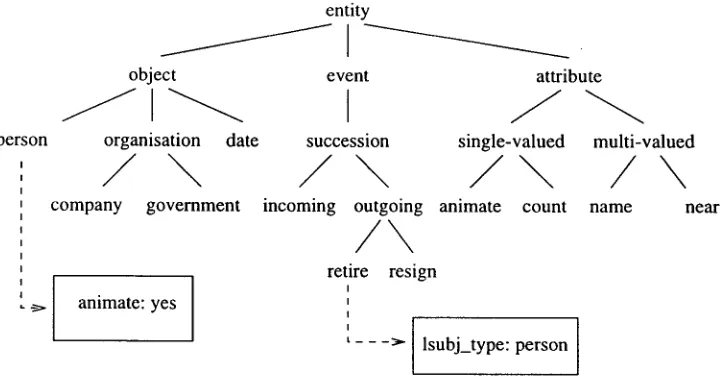
T h e L a S I E s y s t e m ' s 'world' or domain of interest is modelled by an inheritance-based semantic graph, using the XI knowledge representation language (Gaizauskas, 1995). In the graph classes of objects, events, and a t t r i b u t e s a p p e a r as nodes; each node m a y have associated with it an attribute-value struc- ture and these structures are inherited down the graph. T h e higher levels of the graph, or ontology, for the m a n a g e m e n t succession task have the struc- ture shown in Figure 1. Two simple attribute-value structures are also shown in the graph, connected by dashed lines to the nodes with which t h e y are associated.
Attribute-value structures are just sets of a t t r i b u t e : v a l u e pairs where the value for an a t t r i b u t e m a y either be static, as in the pair a n i m a t e : y e s , which is associated with the p e r s o n node, or dynamic, where the value is dependent on various conditions, the evaluation of which makes reference to other information in the model. Cer- tain special a t t r i b u t e types, p r e s u p p o s i t i o n and c o n s e q u e n c e , m a y also return values which are used at specific points to modify the current state of the model.
As a discourse is processed, discourse entities (ob- jects and events introduced by the text) are added as new nodes in the graph beneath their parent class and have associated with t h e m an a t t r i b u t e - v a l u e s t r u c t u r e containing b o t h inherited and discourse- supplied attributes. This process m a y involve hypo- thesising new implicit entities if they are not avail- able explicitly in the text, or have not been dis- covered by the parser, but are required role play- ers for a given event type. Knowledge a b o u t re- quired roles is represented via attributes in the world model. For example, in Figure 1 we see t h a t a r e t i r e event requires a logical subject of t y p e
p e r s o n and an entity of this t y p e will be hypothes- ised if it is not available from the text.
4
Coreference R e s o l u t i o n
After each sentence in a text is added to the 'world model', gradually forming a discourse-specific model, a coreference procedure is applied to a t t e m p t to resolve, or merge, each of t h e newly added in- stances with instances currently in the discourse model. Coreference resolution is p e r f o r m e d by com- paring instances from several candidate sets, each of which is a set of pairs of instances where one element is an instance from the current input sentence and the other an instance occurring earlier in the text, which m a y be coreferential. T h e algorithm proceeds as follows for each instance pair being considered:
1. Ensure semantic t y p e consistency
To determine semantic consistency requires es- tablishing a p a t h in t h e semantic g r a p h between the semantic types of the two instances. If a p a t h can be found a semantic similarity score is calculated using t h e inverse of the length of the p a t h (measured in nodes) between the two types.
For event instances, a p a t h is valid if b o t h event types are d o m i n a t e d by a task-specific top node, i.e. b o t h types m u s t be potential sub-events of an event required by the current I E template. For example, 'hire' a n d ' r e t i r e ' are b o t h sub- events of the 'succession' event in the ontology sketched above.
For instances of the object class, a p a t h is valid if the two types s t a n d in a dominance relation, i.e. the types are ordered in the ontology. For example, ' c o m p a n y ' is a sub-class of 'organisa- tion' so these t y p e are ordered (and have a se- mantic similarity score of 0.5).
If no valid p a t h can be found the a t t e m p t to resolve the two instances is abandoned.
. Ensure a t t r i b u t e consistency
Certain a t t r i b u t e s , e.g. a n i m a t e a n d t i m e , are specified in the ontology as taking a single fixed value for any p a r t i c u l a r instance. If two in- stances being c o m p a r e d have a c o m m o n attrib- ute of this type, the values m u s t be identical or the a t t e m p t e d resolution is abandoned.
person
entity
object event
organisation date succession single-valued
/ \
/ \
/ \
company government incoming outgoing animate count
/ \
retire resign
animate: yes I
I
attribute
multi-valued
/ \
name near
lsubj_type: person
Figure 1: U p p e r ontology for the m a n a g e m e n t succession t a s k
Constraints on the various event types are de- tailed in the following section.
. Calculate a similarity score
T h e semantic similarity score is s u m m e d with an a t t r i b u t e similarity score to give an overall score for the current pair of instances. T h e at- t r i b u t e similarity score is established by finding the ratio of the n u m b e r of shared multi-valued a t t r i b u t e s with compatible values, against the total n u m b e r of the instances' attributes.
After each pair m a candidate set has either been assigned a similarity score or has been rejected on grounds of inconsistency, the highest scoring pair (if any score at all) are merged in the discourse model. If several pairs have equal similarity scores then the pair with the closest realisations in the t e x t will be merged. T h e merging of instances involves the re- moval of the least specific instance (i.e. the highest in the ontology) and the addition of all its attributes to the other instance.
4.1 E v e n t C o r e f e r e n c e
T h e constraints on events as used in Step 2 of the general coreference algorithm above can be associ- ated with a n y event node in the ontology, and will then be inherited by all instances of all sub-event types. T h e constraints currently used can be cat- egorised in the following way:
1. General task-independent constraints are as- sociated with the top-level e v e n t node. For example two event instances are defined as
distinct (i.e. not coreferential) if t h e y have incompatible times. At present this simply means t h a t two events with different tenses can- not be resolved, b u t clearly a m o r e detailed model of event times is required, particularly as Crowe (1996) shows how t e m p o r a l phrases are consistently useful in distinguishing a n d recog- nising events 3.
2. General task-specific constraints are, for the m a n a g e m e n t succession task, associated with the s u c c e s s i o n _ e v e n t node. For example, the constraint t h a t two instances m u s t be distinct if they involve different organisations or different m a n a g e m e n t positions.
3. More specific constraints are represented at lower and possibly verb-specific nodes. For ex- ample, an i n c o m i n g _ e v e n t (e.g. hire, p r o m o t e ) is distinct from a c h a n g e o v e r _ e v e n t (e.g. re- place, succeed) if the f o r m e r ' s logical object is distinct from the l a t t e r ' s logical subject. T h e d e t e r m i n a t i o n of distinct or c o m p a t i b l e event roles requires the application of the coreference mechanism to instances of the object class (the role players in the event). T h e s a m e algorithm is used but the inherited constraints will be those associ- ated with the o b j e c t nodes in the ontology. For ex-
[image:4.596.127.489.81.272.2]ample, indefinite noun phrases cannot be anaphors, pronouns should be resolved within the current para- graph, definite noun phrases within the last two paragraphs, etc. Full details and an evaluation of the coreference constraints on object instances can be found in Gaizauskas and Humphreys (1997a).
The constraints above are similar to those used in the FASTUS IE system (Appelt et al., 1995) and by Sown (1984), where the merging takes place between template structures, considering special conditions for the unification of variables in template slots. However, the general approach here has more in common with Whittemore and Macpherson (1991) or Zarri (1992), where event merging is carried out within the underlying knowledge representation.
5 A W o r k e d E x a m p l e
This section describes the operation of the general coreference mechanism for the example (3) presen- ted in the introduction, concentrating on the effect of the various constraints on event instances. We reproduce the two sentences in (3) here:
(3a) The sell-off followed the resignation late Monday of Freddie Heller, the president of Renard Broadcasting Co.
(3b) Yesterday, Renard named Susan B. Kempham, chairman of Renard Inc. % television production arm, to succeed him to succeed him.
The full semantic representation of these sentences as produced by the parser/semantic interpreter for input to the discourse interpreter is:
Sentence 3a
s e l l - o f f ( e 2 ) , n u m b e r ( e 2 , s i n g ) , d e t ( e 2 , t h e ) , f o l l o w ( e l ) , t i m e ( e l , p a s t ) ,
l s u b j ( e l , e 2 ) , l o b j ( e l , e 3 ) , r e s i g n a t i o n ( e 3 ) , n u m b e r ( e 3 , s i n g ) ,
d e t ( e 3 , t h e ) ,
d a t e ( e 5 ) , name(e5,'Monday'),
p e r s o n ( e T ) , n a m e ( e T , ' F r e d d i e H e l l e r ' ) , t i t l e ( e S , p r e s i d e n t ) ,
company(el0),
n a m e ( e l 0 , ' R e n a r d B r o a d c a s t i n g C o . ' )
Sentence 3b
y e s t e r d a y ( e l l ) , n u m b e r ( e l l , s i n g ) , n a m e ( e 1 3 , ' R e n a r d ' ) ,
name(el2), t i m e ( e l 2 , p a s t ) , l s u b j ( e 1 2 , e 1 3 ) ,
p e r s o n ( e l 5 ) , n a m e ( e l 5 , ' S u s a n B . Kempham'), a p p o s e d ( e l 5 , e l 6 ) ,
title(elG,chairman),
arm(el8), number(el8,sing), qual (el8, el9) ,
production(el9), number(el9, sing), qual(el9,e20), of(el9,e21), television (e20) , (~,
company(e21), name(e21,'Renard Inc.'), succeed(el4) , time(el4,present),
isubj(el4,el5), lobj(e14,e22), pronoun (e22 ,him)
The nominalisation of the verb resign in (3a) leads to the presupposition of an outgoing_even% which in turn leads to hypothesised objects for a related person, post and organisation (these presuppositions are stored as attributes of the outgoing_event in the world model). The coreference mechanism will then be applied to these objects and, in this case, will be able to resolve all three within the same sen- tence. The r e s i g n event therefore forms a complete succession event for the management succession IE task.
Both verbs in (3b), the incoming_event name and the changeover_event succeed, will cause the introduction of succession event instances into the discourse model, each of which will cause the hy- pothesis of a related person, post and organisation. Attributes of the name event will add additional con- straints to its hypothesised objects, including the specification that the organisation should be a po- tential subject of the verb, the person a potential logical object, and the post a potential complement. Objects with the required features will be found by the coreference mechanism for the organisation and person, but not the post. The succeed event will also cause the hypothesis of an additional person, with the constraints that one must be incoming, and a potential logical subject of the verb, and the other outgoing, and a potential logical object. The succeed event's hypothesised organisation and post will be resolved with the same objects as the r e s i g n event from the previous sentence.
The general constraints on coreferential succession events are therefore satisfied for the succeed and r e s i g n events, and the restrictions on the more spe- cific subclasses must then be considered. The rel- evant restriction here is that a changeover_event must share its logical object with the logical subject of an outgoing_event. This will require the applic- ation of the coreference mechanism for objects to resolve the pronoun him. A correct resolution with Freddie Heller will then allow the two events to be resolved.
Succession Events Overall
Recall Precision Recall , Precision I Combined
No Event Corer 66% 72% 42% 59% 48.88%
With Events Coref 65% 77% 42% ~ 60% ] 49.40%
Table 1: Upper Ontology.for the management succession task
with the logical object of an incoming_event. In this case the infinitive form of the succeed verb will have no explicit logical subject, but one will be hypo- thesised and resolved with the best antecedent of the required type ( p e r s o n ) , here Susan B. Kempham. T h e two events can therefore be merged, to result in the representation of a single succession event with Freddie Heller outgoing and Susan B. Kempham in- coming.
6 E v a l u a t i o n
We have not been able to carry out direct evaluation of our approach to event coreference. To do so would require manually annotating coreferential events in a corpus of significant size, and we have not had the resources to do so. However, we have a t t e m p t e d to gain some indirect measure of the successfulness of the approach by toggling event coreference on and off and observing the effect on the ability of the sys- tem to fill MUC-6 management succession templates correctly. T h e hypothesis here is t h a t effective event coreference will lead to higher scores in the template filling task for at least two reasons. First, role play- ers in events (which become slot fillers in the scored templates, e.g. persons and organisations) should become available due to event coreference. Second, spurious succession events should be eliminated due to proper event coreference.
T h e MUC-6 management succession scenario task involved filling an object-oriented template consisting of five objects, each with associated slots (twenty slots in total). T h e top level ob- ject was a t e m p l a t e object and contained one or more s u c c e s s i o n _ e v e n t objects which in t u r n contained an o r g a n i z a t i o n object and one or more in_and_out objects, themselves containing o r g a n i z a t i o n and p e r s o n objects (a precise defin- ition of the template and the task can be found in DARPA (1995)).
Table 1 shows the gross results of running the sys- tem against the 100 articles in the MUC-6 scenario task test corpus. Our system is easily reconfigured to run with or without attempting event corefer- ence. T h e two rows in the table show the effects without and with event coreference. T h e 'Overall'
column show the effects on the overall scenario tem- plate filling task, i.e., on recall and precision scores for all objects and slots in the templates. T h e 'Suc- cession Events' column shows the effect just for the s u c c e s s i o n _ e v e n t objects in the templates, and is therefore a more direct measure of template filling performance where we might expect event corefer- ence to have an effect.
As can be seen from the table, the effect over- all is not particularly significant. However, the ef- fect on succession events alone is more substan- tial, with precision going up five percentage points and recall dropping only one, when event corefer- ence is switched on. Closer examination revealed that the event coreference mechanism successfully avoided the proposal of 11 spurious succession events in the evaluation corpus, which included 196 possible events.
We stress t h a t this is a crude measure of our event coreference algorithm - really just an indica- tion of its utility in the information extraction task. However, even as such, it shows t h a t the algorithm is performing correctly, on balance, and that event coreference is worth addressing in an IE system.
7 C o n c l u s i o n
Event coreference is more complex t h a n object core- ference because of the requirement t h a t objects filling particular event roles in two possibly corefer- ential events must themselves be coreferential. Core- ferring events is therefore logically secondary to core- ferring objects 4.
[image:6.596.149.474.76.128.2]mechanism will operate within a more general rep- resentation. Our approach can be compared to that of Whittemore and Macpherson (1991) who discuss incremental building of event representations within a modified form of DRT (Kamp, 1981). However, the representation used here is preferred because it allows a tighter coupling between world or concep- tual modelling and discourse modelling.
The representation and the coreference mechan- ism are fully implemented within the LaSIE in- formation extraction system and are currently be- ing extended to make use of a richer model of event times, the importance of which is demonstrated in Crowe (1996). The mechanism described here is used in the LaSIE system for both object and event coreference, treating the different types simply as in- stances subject to differing constraints, where con- straints can be easily represented at any level of gen- erality. Our evaluation, while far from exhaustive, shows that addressing event coreference can clearly result in real benefits for IE systems.
8 A c k n o w l e d g e m e n t s
We thank the UK EPSRC (Grant: GR/K25267) and the European Commission Telematics Programme (ECRAN and AVENTINUS projects) for funding which has made the development of VIE/LaSIE and GATE possible.
R e f e r e n c e s
Allen, J. 1987. Natural Language Understanding.
Benjamin/Cummings, Menlo Park, CA, 1st edi- tion.
Appelt, D., J. Hobbs, J. Bear, D. Israel, M. Kameyama, A. Kehler, D. Martin, K. Myers, and M. Tyson. 1995. SRI International FAS- TUS system: MUC-6 Test Results and Analysis. In Proceedings of the Sixth Message Understand- ing Conference (MUC-6), pages 237-248. Morgan Kaufmann.
Botley, S. and T. McEnery, editors. 1997. Dis- course Anaphora and Anaphor Resolution. Uni- versity College London Press, London. In press. Cowie, J. and W. Lehnert. 1996. Information Ex-
traction. Communications o/the ACM, 39(1):80- 91.
Crowe, J. 1996. Constraint Based Event Recog- nition for Information Extraction. Ph.D. thesis, University of Edinburgh.
DARPA. 1995. Proceedings o/ the Sixth Mes- sage Understanding Conference (MUC-6). Mor- gan Kaufmann.
Gaizauskas, R. 1995. XI: A Knowledge Representa- tion Language Based on Cross-Classification and Inheritance. Technical Report CS-95-24, Depart- ment of Computer Science, University of Sheffield. Gaizauskas, R. and K. Humphreys. 1997a. Quant- ative Evaluation of Coreference Algorithms in an Information Extraction System. In S. Botley and T. McEnery, editors, Discourse Anaphora and Anaphor Resolution. University College London Press. In press.
Gaizauskas, R. and K. Humphreys. 1997b. Us- ing a Semantic Network for Information Extrac- tion. Journal of Natural Language Engineering.
In press.
Gaizauskas, R., T. Wakao, K Humphreys, H. Cun- ningham, and Y. Wilks. 1995. Description of the LaSIE System as Used for MUC-6. In Proceedings of the Sixth Message Understanding Conference (MUC-6). Morgan Kaufmann.
Grishman, R. and B. Sundheim. 1996. Message Understanding Conference - 6: A Brief History. In
Proceedings of the 16th International Conference on Computational Linguistics, Copenhagen, June. Kamp, H. 1981. A Theory of Truth and Semantic Representation. In Formal Methods in The Study o/ Language. J. Groenendijk, Jannsen, T, and Stokhof, M.
Sowa, J.F. 1984. Conceptual Structures : Inform- ation Processing in Mind and Machine. Reading (MA): Addison-Wesley.
Whittemore, S and M. Macpherson. 1991. Event- building through Role-Filling and Anaphora Res- olution. In Proceedings of the 29th meeting of the Asssociation for Computational Linguistics,
Berkeley, CA.
Zarri, G.P. 1992. Semantic Modeling of the Content of (Normative) Natural Language Documents. In
Proceedings of the specialized conference on Nat- ural Language Processing and its applications,