An Object-Oriented Linguistic Engineering Environment using
LFG (Lexical Functionnal Grammar) and CG (Conceptual
Graphs)
J ~ r 6 m e V a p i l l o n , X a v i e r B r i f f a u l t , G d r a r d S a b a h , K a r i m C h i b o u t L a n g u a g e a n d C o g n i t i o n G r o u p
L I M S I - C N R S
B.P. 133, 91403 Orsay Cedex, FRANCE
vap/xavier/gs/chibout ©rl ims i. fr
Abstract
In order to help computational linguists, we have conceived and developed a lin- guistic software engineering environment, whose goal is to set up reusable and evo- lutive toolkits for natural language pro- cessing. This environment is based on a set of natural language processing compo- nents, at the morphologic, syntactic and semantic levels. These components are generic and evolutive, and can be used separately or with specific problem solv- ing units in global strategies built for man- machine communication (according to the general model developed in the Language and Cognition group: Caramel). All these tools are complemented with graphic in- terfaces, allowing users outside the field of Computer Science to use them very eas- ily. In this paper, we will present first the syntactic analysis, based on a chart parser that uses a LFG grammar for French, and the semantic analysis, based on conceptual graphs. Then we will show how these two analyses collaborate to produce semantic representations and sentences. Before con- cluding, we will show how these modules are used through a distributed architecture based on CORBA (distributed Smalltalk) implementing the CARAMEL multi-agent architecture.
1 Introduction
1.1 G e n e r a l i t i e sNatural language processing is nowadays strongly related to Cognitive Science, since linguistics, psy- chology and computer science have to collaborate to produce systems that are useful for man-machine communication. This collaboration has allowed for- malisms that are both theoretically well-founded and implementable to emerge. In this paradigm, we have conceived and developed a linguistic software engi-
neering environment, whose goal is to set up reusable and evolutive toolkits for natural language process- ing (including collecting linguistic data, analysing them and producing useful data for computer pro- cesses). Based on a large number of graphical, very intuitive, interfaces, this environment has two main goals:
* to provide tools usable by users outside the field of Computer Science (e.g., computational lin- guists) for them to be able to easily collect data and test their linguistic hypotheses
* to allow computer scientists to exploit these data in computer programs
Remark: in the text, some figures describe the structure of our tools; we have used Booch's conven- tions (Booch, 1994) about object oriented analysis and conception. They are summarized here:
I name I class
operations
cent ains/uses
1,2...N
relation cardinality
inherits
Figure 1: symboles used in the figures
1.2 E x t e n s i o n s t o L F G f o r m a l i s m
Four types of equations are defined in classical LFG (Bresnan and Kaplan, 1981):
1. unifying structures (symholised by " - " ) , 2. constrained unification of structures, only true
if a feature is present in both structures, but m a y not be added (symbol "=c"),
[image:1.612.370.515.448.535.2]We have defined three non-standard types of equa- tions used in our parser:
1. obligatory difference between two values (sym- bol " # " ) ,
2. disjunction of obligatory differences (a sequence of obligatory differences separated by the sym- bol "1") (this can also be viewed as the negation of a conjonction of obligatory presences) 3. prioritary union, copy into a F-Structure the
attributes of the other t h a t are not present in the first one, nor inconsistent with it.
A m o n g other existing systems (e.g., A. An- drew's system , Charon, T h e "Konstanz LFG Workbench" and Xerox "LFG Workbench"; see h t t p : / / c l w w w . e s s e x . a c . u k / L F G for more details on these systems), only the last one is a complete en- v i r o n m e n t for editing g r a m m a r s and lexicons. Our system adds to this feature an open architecture and m a n y interfaces t h a t make it very easy to use.
2
T h e L F G E n v i r o n m e n t
2.1 F o u n d a t i o n : a L F G p a r s e r
According to the principles of lexical functional g r a m m a r s , the process of parsing a sentence is de- composed into the construction of a constituent parts structure (c-structure) upon which a func- tional structure is inserted. C- structure construc- tion is based on a chart parser, t h a t allows the sys- t e m to represent syntactic ambiguities (Kay, 1967), (Winograd, 1983). In order to be used within a LFG parser, a classical chart has to be complemented with a new concept: completed arcs (which repre- sent a whole syntactic structure) have to be differ- enciated between completed arcs linked with a cor- rect F-Structure, and those which are linked to an F- Structure t h a t cannot be unified or t h a t does not respect well-formedness principles.
2.2 V i s u a l i s i n g t h e Chart
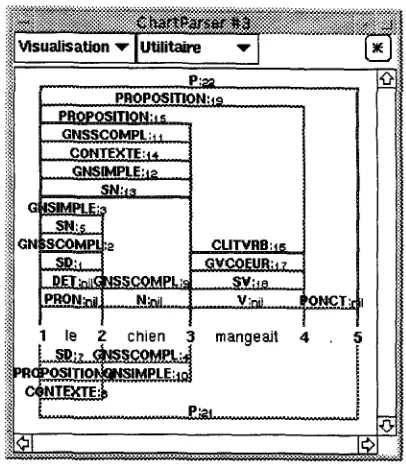
In the C h a r t interface, words are separated by nodes, n u m b e r e d from 1 to numberOfWords + 1. Each arc is represented by a three segment polygon (larger arcs are above the narrower, for readibility reason).
Active arcs are grey and positioned under the words. C o m p l e t e d arcs with uncorrect F-Structures are red and also placed under the words. C o m - pleted arcs with correct F-Structures are blue and above the words. Lastly, completed arcs with F- Structures t h a t d o n ' t respect well formedness prin- ciples are grey and above the words. T h e user can select the kind of arc he is interested in. By clicking on an arc with the left button, the arc and all its daughters become green, thus showing the syntac- tic hierarchy. By clicking with the middle button, a
iii suaJ saU°n
vl°.,~
.
® !
PlIOPOSITiON:t~,
GNSSCOMPL',I_t . . . . ]
CONTEXTE :t 4 '
... _GNSIMPLE:t2 SN:I~/
ii I -
G; ;SCOMPm__.__....~1:2~ 1 ) : ~ ,,, GVCO!IUR;~ 7
P__L~_ :nilC N$$COMPL;s SV:te
iii ,PI).O r,I :L-dl. N k ' d . . . . V :flit 'ONCT '..m I i
me Z chien 3 mangeait 4 $
Figure 2: T h e C h a r t Interface
menu appears within which one can choose to e x a m - ine the applied rule or the F-Structures (see below for the corresponding interface).
2.3 V i s t t a l i s i n g F - S t r u c t u r e s
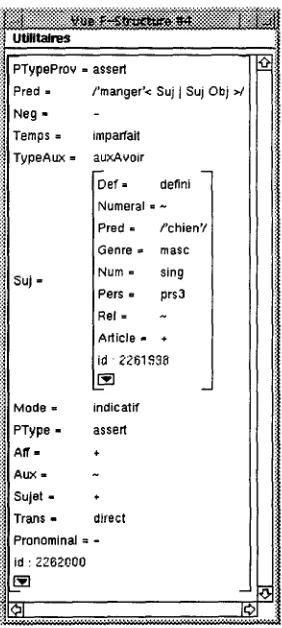
As shown in Figures 3 and 4, F-Structures are repre- sented by attribute-value pairs (a value m a y itself be a F- Structure). In addition to such a graphical rep- resentation, a linear representation (more suitable for storing d a t a on files or printing t h e m ) has been developed and it is possible to switch from one to the other. This allows us to keep track of previous results and to use t h e m for testing the evolution of the system.
2.4 L e x i c o n and l e x i c o n m a n a g e m e n t
Since L F G is a "lexical" g r a m m a r , it is i m p o r t a n t to have powerful and easy to use lexicon m a n a g e - m e n t tools. To be as flexible as possible, we have choosen to use several lexica at the s a m e t i m e in the same analyser. T h e lexicon m a n a g e r contains a list of lexica ordered by access priority. For each word analysed, the list is searched, and the first analysis encountered is returned.
T w o kinds of lexica are currently used; this kind of structuration is quite flexible:
• if the user uses a big lexicon, but wants to re- define a few items for his own needs, he j u s t has to define a new small lexicon containing the modified items, and to give it a high priority. • if the user has a big lexicon with a slow ac-
cess, the access can be optimised by p u t t i n g the
mm
u
m
n
n
m
[]
N
m
n
mm
m
[]
m
[image:2.612.311.514.66.300.2]U l J l i t a i r e s
P T y p e P r o v =
P r e d =
N e g =
T e m p s =
T y p e A u x =
$uj =
Mode =
PType = A f t =
A U X =
S u j e t - *
T r a n s = direct
P r o n o m i n a l = -
id : 2 . 2 6 2 0 0 0
I
assert
/ ' m a n g e r ' < S u j [ S u j O h ) >/
i m p a r f a i t
au;,C, v o i r
D e f = d e f i n i
N u m e r a l = ~
P r e d = / ' c h i e n ' /
G e n r e = m a s c
N u m = s i n g
P e r s = p r s 3
R e l = ~
A r t i c l e - +
id ' 2 2 6 1 ,¢,38
i n d i c a t i f
a s s e r t
÷
Figure 3: graphical representation of a F-Structure
words frequently used in a direct access lexicon stored in memory.
Our lexicon currently contains 7000 verbs, all the closed classes words (e.g., prepositions, articles, con- junctions), 12000 nouns and a b o u t 2500 adjectives. To mitigate the consequences of some lacks of this lexicon, a set of subcategorisation frames is indepen- dently associated with the lexicon (3000 frames).
T h e user m a y also define a direct access lexicon, whose equations are written in a formalism close to the s t a n d a r d L F G formalism. Dedicated interfaces have been developped for editing these lexica, with syntactic and coherence checking.
E x a m p l e of an entry of a canonical form:
@chien={ 'chien canonique' C A T - - N;
T Pred = chien}
E x a m p l e of an entry of an inflected form:
# c h i e n n e s = { "chien fern plur' "chiennes f-flechie" T N u m = plur;
T Genre = f e m ;
@chien-~'chien canonique'}
All these lexica conform to the specification de- fined by an a b s t r a c t lexicon class. It is possible, and
U U l i t a l r ~
PTypeProv = a s s e r t
P r e d = / ' m a n g e r ' < S u j I S u l O b j > / N e g - -
T e m p s = imparfait
T y p e A u x = a u x A v o i r
M o d e = indicatif
PType = a s s e r t A f t = +
A U × = ~
$ u j e t = + T r a n s = direct
P r o n o m i n a l = -
S u j = F S : [
Def = deflni
N u m e r a l = ~ P r e d = / ' c h i e n ' /
Genre = m a s c N u m = sing
P e r s = prs3
Rel = ~
A r t i c l e = ÷
}
• l I¢
Figure 4: textual representation of a F-Structure
very easy, to add new kinds of lexica, provided they conform to this specification.
2.5 T r a c k i n g f a i l u r e c a u s e s
A specific feature ( " E r r o r ") allows the system to keep a value t h a t makes explicit the reason why the unifying process has failed. Possible situations are listed below:
1. Unifying failure. T h e values of a given feature are different between the two F-Structures to be unified. T h e generated F-Structure contains the feature Error , whose value is an associa- tion of the two uncompatible values. E x a m p l e :
N u m = sing --+ plur.
2. A feature present in an equation has non value in either of the two F-Structures to be unified. Example: with the equation
'~ Suj N u m = ~ N u m " and two F-Structures without the N u m feature, the generated F- Structure contains "Num -- n i l - + nil" .
3. While making a constrained unification (e.g.,
J, N u m =c sing ) a feature does not exist. We obtain: N u m = sing --* nil.
4. An obligatory feature is absent.Example: N u m -- obligatoire.
[image:3.612.129.270.74.388.2] [image:3.612.378.511.74.317.2]the case when a F-Structure contains this fea- ture. Example: Num=sing-+ "tilde".
6. A feature has a forbidden w~lue. Example: Num= "tilde" sing.
7. When a disjunction of constraints is the rea- son of the failure, the block itself is set as the value of the "Error" feature in the resulting F- Structure.
These errors can be recovered through the interface (errors are highlighted in the representation), which allows the user to track t h e m easily. Moreover, these well defined categories make it easy to find the real cause of the error and to correct the g r a m m a r and the lexicon.
2.6 S t r u c t u r e o f t h e r u l e s
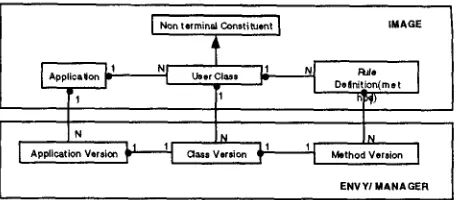
Smalltalk80 specific features (mainly the notions of "image" and incremental compilation) have been heavily exploited in the definition of the internal structure of the g r a m m a r rules. Basically a rule is defined as the rewriting of a given constituent (left p a r t of the rule), equations being linked to the right constituents. Each non terminal constituent of the g r a m m a r is then defined as a Smalltalk class, whose instance m e t h o d s are the rules whose left p a r t is this constituent (e.g., NP is a class, NP --* ProperNoun and NP --~ Det Adj* Noun are instance methods of this class).
T h e Smalltalk compiler has been redefined on these classes so t h a t it handles L F G syntax. There- fore, all the s t a n d a r d tools for editing, searching, replacing (Browsers) m a y be used in a very natural way. A specific interface m a y also be used to consult the rules and to define sets rules to be used in the parser.
A great interest of such a configuration is to allow the user to define his own (sub-)set or rules by defin- ing sub-classes of a category when he wants to define different rules for this category (since a m e t h o d with a given n a m e cannot have two different definitions). O n t h e u s e o f t h e E n v y / M a n a g e r s o u r c e c o d e m a n a g e r t o m a i n t a i n t h e s y n t a c t i c r u l e s b a s e . E n v y / M a n a g e r is a source code m a n a g e r for t e a m p r o g r a m m i n g in Smalltalk, proposed by OTI. It is based on a client-server architecture in which the source code is stored in a c o m m o n database ac- cessible by all the developpers. Envy stores all the successive versions of classes and methods, and pro- vides tools for m a n a g i n g the history. Applications are defined as sets of classes, methods, and exten- sions of classes, t h a t can be independently edited and versioned. Very fine grained ownership and ac- cess rights can be defined on the software compo- nents. T h e structuration of our syntactic rules base enables us to benefit directly of these functionali- ties, and hence to be able to m a n a g e versions, access rights, comparisons of versions (Figure 5)... on all our linguistic data.
I Non termin~d Constituent I iMAGE
I User CItes r I DellN~on(m e t
I Application Versi(x~ ~ CI~a Version ~ Method Version
ENV Y/MANA GER
Figure 5: Structuring the set of rules
C o n t e n t o f t h e r u l e s . T h e current g r a m m a r contains a b o u t 250 rules t h a t covers m o s t of the classical syntactic structures of French simple sen- tences. T h e y have been tested on d a t a coming from the T S N L P european project. In addition to these simple sentences, difficult problems are also han- dled: clitics, complex determiners, completives, var- ious forms of questions, extraction and non limited dependancies, coordinations, comparatives. Some extensions are currently under development, includ- ing negation, s u p p o r t verbs, circonstant subordinate phrases and ellipses.
3
Conceptual graphs
Conceptual graphs (Sowa, 1984) f o r m the basis of the semantic and encyclopedic representations used in our system. Conceptual graphs are bipartite graphs composed of concepts and relations. A con- ceptual graph database is generally composed of the following subparts:
• a lattice of concepts and relation types
• a set of canonical graphs, associated with con- cepts and relation types, used for e x a m p l e to express the selectionnal restrictions on the ar- guments of semantic relations.
• a set of definitions, associated with concepts and relation types, used to define the m e a n i n g of concepts.
• a set of schemas and prototypes.
• a set of operations, such as join, contraction, expansion, projection...
• a database containing the description of a situ- ation in t e r m s of conceptual graphs.
T h e framework we describe here aims at m a n a g i n g all this information in a coherent m a n n e r , and at facilitating the association with the linguistic pro- cesses described above.
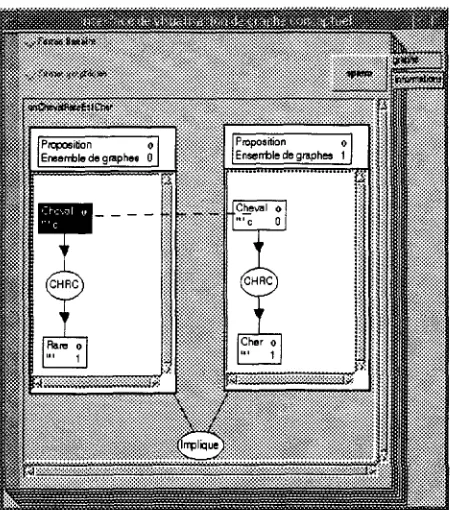
[image:4.612.304.534.77.177.2]Figure 6: Graphical representation of "a cheap horse is scarce" (with second order concepts)
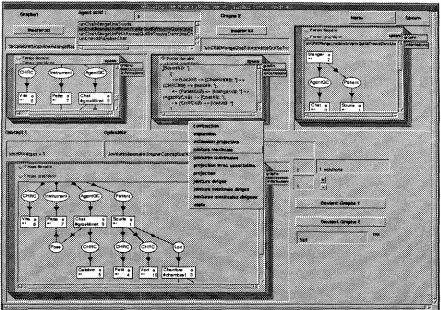
The lattice, and the different items of informa- tion associated with concepts and relations types, can be visualized, modified, searched and saved us- ing graphical or textual representations (Figure 10). An "individual referents inspector" allows to in- spect the cross-references between references, con- cepts and graphs.
4 A n a l y s i n g a s e n t e n c e
The processus of analysis from sentence to seman- tic representation can be separated into three sub- processes. After the sentence has been segmented, we obtain the lexical items in LFG-compliant form via the lexieal manager. After parsing, we obtain some edges with their respective F-Structures. (Del- monte, 1990) has developed a parser which uses basic entries with mixed morphological, functionnal and semantic informations. The rules use different level information. We propose to map the semantic struc- ture on the syntactic one in a manner that avoids too many interdependencies. We use a intermedi- ate structure (named "syntax-semantic table") that expresses the mapping between the value of a LFG Pred and a concept, as well as connected concepts and relations. Semantic data in the lexical knowl- edge base are defined by using conceptual graphs, as shown in the paragraph 4.1 below about some verb examples. Selectional restrictions defined with canonical graphs are then used to filter the graphs, when more than one is obtained at this level.
4.1 S e m a n t i c v e r b c l a s s i f i c a t i o n i n t h e l e x i c a l k n o w l e d g e b a s e
The lexical knowledge base is based on a hierarchical representation of French verbs. We have developped a systematic and comprehensive representation of verbs in a hierarchical structure, data coming from the French dictionary "Robert". Our method relies on classification method proposed by (Talmy, 1985) and (Miller, Fellbaum and Gross, 1989), (Miller and Fellbaum, 1991). We chose a description with a structure composed of a basic action (the first of the most general uperclasses, e.g. stroll and run can be associated with walk as a basic action, andwalk, ride, pass point atmoving, which is a step further in generality) associated with thematic roles that spec- ify it (i.e., object, mean, manner, goal, and method). The basic actions are in turn defined with the same structure, based on a more general basic action.
The hierarchy of verbs depends on the thematic relations associated with them. A verb V1 is the hyperonym (respectively a hyponym) of a verb V2 (which is noted VI~-V2, respectively VI-<V2) if they share a common basic action and if, in the thematic relations structure associated with it, we have:
* absence (for the hyperonym) or presence (for the hyponym) of a particular thematic relation: e.g. for the pair divide /cut ; to cut is to divide using a sharp instrument, thus divide ~- cut
• presence of a generic value thematic relation vs. a specific value (example cut (object is
generic:solid object ~- behead (object is ahead))
For every verb:
• the semantic description pointed out is coded in the lexical knowledge base as a definitional graph.
t y p e c u t ( * x ) is [divide:
*x]-
(obj)
[Object:
(car) --* [solid]
[image:5.612.89.314.72.327.2](method) --+ [traverse]--~ (Object: ~'y) (mean) -+ [Instrument]--* (car) --+
[shar,].
• a canonical graph makes explicit the selectional restrictions
C a n o n i c a l g r a p h f o r c u t is (Agent) -~ [Animate]
(Obj) ---+ [Object: *y]--~ (car) ---+ [solid].
4.2 A n e x a m p l e
Below, we give an example for the sentence "Un av- ocat vole une pomme" (a lawyer steals an apple), where "avocaf' is ambiguous and refers to a lawyer or to an avocado. A semantic representation of this sentence is derived from its non-ambiguous F- Structure.
Figure 7: Conceptual graph operation manager, showing the result of a join between two graphs, and the liste of available operations.
' a v o c a t ' --. (Lawyer Avocado) ' p o m m e ' ---* (Apple).
' v o l e r ( d e r o b e r ) ' --* (Steal(Agent ~ I Suj; Ob- jet --* 1" Obj)),
Explanations: the first item between quotes is the Pred value, followed by a list of types of con- cepts (or types of relations) and their mapping def- inition structure in the F-Structure. ~ represents the local F-Structure. T represents the F-Structure t h a t contains the local F-Structure. For example, Agent --* ~ Suj means that a concept of Type "Steal" is connected to a concept that can be found in the F- Structure of the feature "Suj" in the local F- Struc- ture. From these data, the following graphs (Figure 8) are obtained.
The "Deft feature of the F-structure gives us in- formation about the referents of concepts. For ex- ample, the F- Structure for 'apple' contains "Def = indefini", which implies the use of a generic referent for the concept (corresponds to a n apple, indicated
by a star in Figure 8). Then, since canonical graphs express selectional restrictions, they are used to fil- ter the results through the join operation. For ex-
2) Avocado'.* Agent SteaJ Object Apple:'
Figure 8: Graphs from the sentence "Un avocat vole une pomme"
ample, "Steal" needs an animated agent (Figure 9), therefore graphs with the "Avocado" concept can be removed from the selection.
Figure 9: Canonical Graph for "Steal"
These principles are the bases of the system cur- rently available, but we are working on improve- ments and extensions. We want to address the issue of adjunct processing, prepositional comple-
[image:6.612.72.513.73.383.2] [image:6.612.305.522.447.498.2]Figure 10: Lattice visualizer, showing (bottom right) the canonical graphs of "d~concerter" (to disconcert), the "graph origin" inspector (top right), and the menu of operations (bottom left)
ments (with problem of second order concepts), etc.
5 C o n c l u d i n g r e m a r k s : S h a r i n g t h e t o o l s o n a n e t w o r k w i t h C O R B A
The different tools described in this paper are cur- rently being extended to be CORBA-compatible. CORBA (Common Object Request Broker Archi- tecture) (Ben-Natan, 1995), has been defined by the OMG as an interoperability norm for heteroge- neous languages (Smalltalk, C + + , JAVA) and plat- forms (UNIX, Macintosh, PC). CORBA defines a common interface definition language (IDL), as well as a set of services (naming service, security, con- currency management...). CORBA objects can be distributed worldwide (for example using Internet) using an ORB (Object Request Broker). Various tools implement this CORBA norm. We have used Distributed Smalltalk (Pare Place Digitalk) to real- ize the distributed implementation of an analyser. With this system, users can currently make an anal- ysis, see the results of this analysis, the F-structures, see the syntactic rules base... With this kind of architecture, systems necessiting a large amount of
ressources can be distributed amongst workstations on a network and/or be used by clients having few ressources. Moreover these ressources can be phys- ically located in any place of a network, allowing thus to distribute the responsibility of their man- agement and maintenance to different persons. With the communication possibilities offered by Internet, it makes it possible to coordinate the cooperative efforts of several teams in the world around a sin- gle, coherent, though distributed system. We are continuing our work toward the implementation of a complete distributed multi-agent system, following the CARAMEL architecture (Sabah and Briffault, 1993), (Sabah, 1995), (Sabah, 1997).
R e f e r e n c e s
Ben-Natan, R. 1995, CORBA, a Guide to the Com- mon Object Request Brocker. McGraw-Hill.
Booch G. 1994, Analyse et conception orientees objets , Addison-Wesley, Reading Mass.
[image:7.612.105.542.70.381.2]matical representation, The mental representation
of grammatical relations, MIT Press, Cambridge,
Mass.
Delmonte R. 1990, Semantic Parsing with LFG and Conceptual Representations, Computers and the Humanities, Kluwer Academic Publishers, 24 , p. 461-488.
Kaplan R.M. and J.T. Maxwell ].994, Grammar Writer's Workbench, Xerox Corporation, Version 2.0.
Kay Martin 1967, Experiments with a powerful parser, Proceedings 2nd COLIN(], , p. 10. Kay Martin 1979, Functional grammars, Proceed-
ings 5th. annual meeting of the Berkeley linguistic society, Berkeley, p. 142- 158.
Miller A. G., C. Fellbaum and D. Gross 1989, WORDNET a Lexical Database Organised on Psycholinguistic Principles, Proceedings IJCAI, First International Lexical Acquisition Workshop, Detroit.
Miller G. A. and C. Fellbaum 1991, Semantic net- works of English, Cognition, 41 , p. 197-229. Pitrat Jacques 1983, R~alisation d'un analyseur-
g@n@rateur lexicographique g@n~ral, rapport de recherche GR22, Institut de programmation, Paris VI, 79/2.
Sabah G@rard 1995, Natural Language Understand- ing and Consciousness, Proceedings AISB - work- shop on "Reaching for Mind", Sheffield.
Sabah G~rard 1997, The fundamental role of pragmatics in Natural Language Understanding and its implications for modular, cognitively mo- tivated architectures, Studies in Computational Pragmatics: Abduction, Belief, and Context, Uni- versity College Press, to appear, London.
Sabah G@rard and Xavier Briffault 1993, Caramel: a Step towards Reflexion in Natural Language Un- derstanding systems, Proceedings IEEE Interna- tional Conference on Tools with Artificial Intelli- gence, Boston, p. 258-265.
Sowa John 1984, Conceptual structures: informa-
tion processing in mind and machine , Addison
Wesley, Reading Mass.
Talmy L. 1985, Lexicalisation patterns: Semantic structure in lexical forms, Language typology and
syntactic description, 3 , Cambridge University
Press, New York, p. 57-149.
Winograd Terry 1983, Language as a cognitive pro-
cess, Volume I syntax, Addison Wesley, Reading