CATEGORIAL SEMANTICS FOR
LFG
M a r y D a l r y m p l e X e r o x P A R C Palo Alto, C A 94304 USA d a l r y m p l e @ p a r c . x e r o x . c o m
1 I n t r o d u c t i o n
A categorial semantics for Lexical-khmctional G r a m m a r provides a m e a n s for semantic inter- pretation of sentences of n a t u r a l language t h a t is appropriately constrained b o t h syntactically and semantically. The f-structure of LFG provides a cross-lingnistically uniform format for represent- ing syntactic information; constraining a deriva- tion with respect to the f-structure rather t h a n a phrase structure tree allows reference to rel- evant functional syntactic information without requiring construction of a phrase structure tree whose form is (often dubiously) motivated on se- mantic grounds. Additionally, a categorial se- mantics constrains semantic derivations appro- priately, obviating the need for an appeal to well- formedness conditions on the resulting semantic representation.
2 P r e v i o u s W o r k
Most semantic analyses appeal to syntactic con- straints on semantic derivations. In particular, m a n y analyses assume that such syntactic con- straints are statable in terms of phrase structure tree configurations (Montague, 1974). However, it is well-known that a variety of phrase struc- ture configurations can express the same syn- tactic predicate-argunlent relations within and across languages (Kaplan and Bresnan, 1982); thus, syntactic constraints on semantic deriva- tions are better expressed at a level at which the relevant syntactic information is expressed more uniformly. Such a level is the
f-structure
of LFG. Halvorsen (1983) first provided a theory of semantic interpretation for LFG in which se- mantic interpretation rules are related to the f-structure. His s y s t e m involves an intermedi- ate level of representation, the ' s e m a n t i c struc- ture', which is represented as a directed graph {like the f-structure). Translation rules m a p fromf-structures to semantic structures, and these structures are then interpreted (or translated into a formula of intensional logic).
The approach to be presented here also re- lies on f-structure configurations to provide syn- tactic constraints on categorial semantic deriva- tions. However, an intermediate level of se- mantic representation such as Halvorsen's se- mantic structure is not introduced. In the cat- egoriai semantic framework developed by Fer- nando Pereira (Pereira, 1990; Pereira and Pol- lack, 1991; Pereira, 1991), syntactic structures are directly associated with interpretations (or their types), and syntactic configurations license the combination of these interpretations in a se- mantic derivation. On this approach, 'logical forms' are not viewed as manipulable syntactic objects; instead, a logical formula is simply a graphical representation of a meaning that is lex- ically provided or that is the outcome of a seman- tically justified derivation. In this, the approach differs from other recent approaches to seman- tic interpretation in LFG (Halvorsen and Kap- lan, 1988), in which the interpretation of an f- structure is represented as a directed graph, and semantic derivation proceeds principally by uni- fication of semantic representations. As a con- sequence, these approaches require constraints on semantic derivations to be stated as well- formedness conditions on semantic representa- tions, contrary to the commonly-held goal of dis- pensabihty of logical form.
To illustrate a categorial semantic analysis within LFG, I will provide a small fragment of syntactic and semantic rules of English; the frag- m e n t contains rules for quantified noun phrases, nominal modification, and clauses headed by transitive and intransitive verbs. Many of these rules are modifications and extensions of rules originally described in Pereira (1990), t h o u g h Pereira's system appeals to phrase structure configurations rather t h a n f-structures to con-
s t r a i n s e m a n t i c derivations; in p a r t i c u l a r , the rules P e r e i r a provides for quantifiers a n d rela- tive clauses have direct c o u n t e r p a r t s in the set of rules to be described below.
3 S e n t e n c e I n t e r p r e t a t i o n
A sentence such as (1) has the i n t e r p r e t a t i o n g i v e n in (2): 1
(1) J o h n crashed.
(2) crash (john)
T h i s i n t e r p r e t a t i o n is the o u t c o m e of a deriva- t i o n according to a set of rules to be described below. Some of the rules m u s t b e licensed by p a r t i c u l a r f-structure configurations, while some are u n r e s t r i c t e d in t h e i r a p p h c a h i h t y . E x a m p l e 1 h a s the following h s t r u c t u r e :
(3) [PRED ,crash (SUBJ) , 1 [SkrBJ [PRED 'John']]
A n n o t a t e d p h r a s e s t r u c t u r e rules h k e the follow- ing are assumed: 2
S ---, NP V P
(T suBJ)=~
1-
V P - ~ V (NP)
T = ~ (T o B ~ ) = l
N o t i c e t h a t these p h r a s e s t r u c t u r e rules encode only s y n t a c t i c information. No s e m a n t i c infor- m a t i o n or c o n s t r a i n t s are required.
T h e lexical entries involved in the d e r i v a t i o n of sentence (1) are:
John N P ( I P R E D ) = ' J o h n '
I~
=[OP/]
crashed V (T PILED)= ' c r a s h ( s u B J } ' (, TENSE) = PAST
(T
PRED)a : [O [- Ax.crash(z)]T h e n o t a t i o n f~, s t a n d s for the i n t e r p r e t a t i o n of a n f-structure f , often referred to as t h e se- m a n t i c projection of f ( K a p l a n , 1987; H a l v o r s e n a n d K a p l a n , 1988). The i n t e r p r e t a t i o n for a n y f - s t r u c t u r e f is a sequent:
1I will ignore tense and aspect in the representation of sentence meanings.
2See Bresnan (1982) for an explication of the relation between c-structure and f-structure and the notation com- monly used to represent that relation.
(4)
G : [ o ~ - M ]
The sequent '[a ~ M ] ' is a p a i r c o n s i s t i n g of a set of assumptions a, s o m e w h a t analogous t o a ' q u a n t i f i e r store' ( C o o p e r , 1983), a n d a ma- t r i x t e r m M in w h i c h free v a r i a b l e s i n t r o d u c e d by the a s s t u t l p t i o n s in a m a y occur (Pereira, 1990; P e r e i r a , 1991; D a l r y m p l e et al., 1991). In the following, I will s p e a k of such expressions as i n t r o d u c i n g t h e m e a n i n g M u n d e r the assump- tions in a.
I a s s u m e a fixed o r d e r of a p p l i c a t i o n of t h e m e a n i n g of a verb to its s e m a n t i c a r g u m e n t s , w i t h the o r d e r d e t e r m i n e d by t h e s y n t a x ( t h o u g h this a s s m n p t i o n is n o t c r u c i a l to t h e a n a l y s i s ) . A r g u m e n t s are a p p l i e d i n the following order: s
(1) O b l i q u e s
(2) o,~2
(3) osJ
(4)
sunJThe PILED of t h e f - s t r u c t u r e of a n a c t i v e verb such as own will, t h e n , be a s s o c i a t e d via the a m a p p i n g w i t h the following i n t e r p r e t a t i o n :
(5) Ay.Ax.own(x,y)
Notice t h a t the verb is r e q u i r e d to c o m b i n e w i t h the o b j e c t first, a n d t h e n the s u b j e c t , in accor- dance w i t h the a r g u m e n t o r d e r i n g g i v e n above. ]:'or a p a s s i v e verb, t h e o r d e r i n g will be reversed. For the p a s s i v e verb (be) owned, t h e order will be:
(6)
x~.~v.ow,t(~,v)
Here, the verb c o m b i n e s first w i t h the o b l i q u e by-phrase, t h e n w i t h t h e s u b j e c t .
T h e rule for i n t e r p r e t i n g art f - s t r u c t u r e for a clause h e a d e d by a n i n t r a n s i t i v e verb is: 4
(7) C l a u s e w i t h i n t r a n s i t i v e verb:
3This order of application was also proposed by Dowry (1982), and is reminiscent of the obliqueness or- dering for arguments in HPSG (Pollard and Sag, 1987).
4This rule should apply when f has a PRED and a sUB J, but no other governable grammatical functions; it should not apply if the verb is transitive and there is a slJl~J and an oB3, although f is unifiable with tile f-structure of a transitive verb as well as an intransitive one. There are several ways of ensuring the needed result: the valence of tire verb can be reflected in its semantic type; f-structures can be typed, with this rule applying only to intransitive f-structures (Zajac and Emele, 1990); or the PROD and its arguments can be separately specified, with the argu- marts of the PRED specified as a list which can be mntched
against, as in recent work by John Maxwell, Ron Kaplan, and others.
" L s o s ~ s J Pa = [JR ~- mp] -~
S~, = [as ~-
ms]
f,, = [ap U a s ~- m v (ms)]
The derivation of the m e a n i n g f~ of an f- structure f with a PRED and SUBJ proceeds by applying the m e a n i n g of the PILED to the mean- ing of the suBJ. The associated a s s u m p t i o n set is the union of the a s s m n p t i o n s from the PRED and the SUna. The f-structure for sentence 1 hcenses the following derivation and provides the ex- pected m e a n i n g (under a null a s s u m p t i o n set):
(8)
['p RED f2:,craah (SUBJ) , J
ks..,
'John']]
Lexically specified meanings: (f~)~ = [0 ~- A x . c r a s h (~}] (fa),~ -- [0 ~- j]
By rule 7:
(fl)~ = [0 U 0 l- A x . e r a s h ( x ) ( j ) ] = [0 }- c r a s h ( j ) ]
4 Q u a n t i f i c a t i o n
Sentence 9 contains a quantified n o u n phrase and has the m e a n i n g represented in (10):
(9) Every car crashed.
(10) e v e r y ( A y . c a r ( y ) , Az.craMz(x))
This sentence has the f-structure shown in (11), constructed on the basis of the lexical entries be- low:
(11)
[Pa~D'c~ash
<sv.J) ']
SPEC LPRED
'every'
L LPRgD 'car' J J
every D E T (T PREP) = 'every'
T ~ =
[0 ~- every]
car
N
(T PRZ.)= 'car'
(T P~ZD)~ = [0 ~ ay.ear(y)]
The type of the quantifier every is the familiar generalized quantifier type (e -+ t) ~ (e ~ t) ---* t: quantifiers are functions from properties to prop- erties, yielding a t r u t h value. The following schematic rule is necessary to interpret quanti- fied noun phrases:
(12) Quantified noun phrase, preliminary ver- sion (handles unmodified nominals only):
f
[svzc S ] ]
: [PriED P ]
S~ = [as ~- ms] I
P , = lap F- m e ]f ~ - [a s [5 ap , quant ( m s , x, rap) ~- 2]
The notation 'a, A' represents the set a plus the singleton A. By this rule, a quant a s s u m p t i o n is added to the assumption set for the noun phrase. The quant assmnption acts like an element in a Cooper store, keeping together the information associated with the quantified noun phrase, m s in the quant asstmlption is the m e a n i n g of the specifier (here, every); z is the variable intro- duced by the quantifier as the meaning of the quantified norm phrase; and m p is the meaning of the PRED, which will form the first argument of the generalized quantifier every when quan- tifier discharge takes place. The derivation of the meaning of sentence 9 according to the rnles given thus far proceeds as follows:
fl : SPEC f4 : PROD 'every ~ SUBJ f3 : L PREp f5 :'car'
Lexically specified meanings: ( f 2 L = [0 W A~.crash (z/]
By rule 12, 'Quantified noun phrase': (In), = [{quant (every, z, A y . c a r ( y ) ) } W z] By rule 7, 'Clause with intransitive verb':
( k L
-[ { q ~ a n t
(,~ery,,, ~y.ear(y))} ~ cry*h(,)]
According to these rules, the meaning for f- structure fl is a meaning under an a s s u m p t i o n about the variable x. The meaning of fl with- out assumptions is obtained by discharging the (sole) quantifier assumption in the a s s u m p t i o n set. The quantifier discharge rule relates a se- quent and a syntactic licensing environment to a new sequent:
(14) Quantifier discharge:
disch(f, [a, quaut (ms, x, mR) ~- S C O P E :t]) = [a ~ ms" (rap, Ax.SCO P E)]
Conditions on f: none
By this discharge rule, the quant assumption is removed from the assumption set, the variable x introduced by the quantifier assmnption is ab- stracted out of the scope S C O P E (required to be of type t), and the quantifier is applied to its scope. The syntactic licensing environment is the f-structure f. in this rule, f is lmeonstrained; there are no conditions on f. This means that the quantifier discharge rule has art unrestricted syntactic licensing condition. A quantifier may scope over any syntactic constituent, as long as it is of the correct semantic type. 5
To interpret sentence 9, diseh can now be applied to the sequent (fl)~ associated with the f-structure ]1:
disch ( £ , [{quant(every, ~, )~y.car(y))} b crash(z:)]) = [0 ]- every (Xy.car (y), Xx.crash(x))]
The result is the meaning of fl with all assump- tions discharged. I will assume that what is gen- erally referred to as the 'meaning' of an utterance is the meazfing obtained when all assumptions have been discharged.
In general, assumptions may be discharged after any application of a functor to an argument, as long as the syntactic enviromnent for assump- tion discharge has been met. Thus, a predicate apply can be defined:
(15) apply(f, [a~ ~ Fun], [aA ~ Arg])
d9
discharge(I, [aF UaA '- Fun (Avg)])apply operates on sequents in a syntactic licens- ing environment f. discharge(f, S) is the re- sult of applying any number of discharge (disch) rules licensed by the syntactic configuration f to S. (Note that apply is not a function, since the result of apply depends on the Immber and the choice of assumptions to be discharged.) By this function application rule for sequents, then, the meaning of the fimctor is applied to the mean- ing of the argunlent; the union of the functor assumptions and the argmnent assumptions is taken; and some number of discharge rules may be applied. This definition of apply will be used
~Here [ will not discuss conditions on preferred scopes for quantifiers (such as the tendency for the quantifier each to outscope other quantifiers, or for quantifiers to scope inside the clause in which they appear).
ACTES DE COLING-92, NANTES, 23-28 ho~r 1992 2 1 5
in the tbllowing to apply predicates to their ar- guments and to permit subsequent assumption discharge.
Given this new definition of apply, interpre- tation rule 7 for clauses headed by intransitive verbs can be restated:
(16) Clause with intransitive verb:
The interpretation for an f-structure f, repre- senting an umnodified clause with an intransitive verb, is obtained by applying the pREI) P to the SuBJ S in the syntactic heensing enviroltment f. In general, f~, will constitute an assignment of f to a sequent that satisfies the constraints given by the lexical entries and the rules of interpreta- tion.
It should be noted that rule 16 is incomplete in providing interpretations only for sentences not involving adverbial modification; an analy- sis of adverbials, though straightforward in this framework, will not be provided here.
5 N o m i n a l m o d i f i c a t i o n
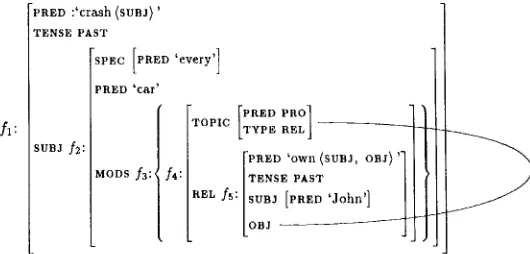
Rule 12 for tile interpretation of quantified norm plLrases is incomplete, since it apphes only to un- modified nominals. Consider sentence (17), its f- structure, displayed in Figure 1, and its meaning, (18):
(17) Every car that John owned crashed.
(18)
~ery (~.ea~ (~) A ow,~
(j,
~), ~y.cra~h
(y))
These lexical entries are necessary:
that CMP ([ PRED) : PRO
(T TYPE) = REL
owned V (~ PRED):-'own(SUBJ, OnJ)'
(l 'rENSF~) " PAST
(1 P~ED). = [0 ~- @.a~.own(~,y)l
Syntactically, a relative clause contains a fronted constituent (a TOPIC; see Bresnan and Mchombo (1987)) which is related to a gapped position in tim sentence. This fronted constituent contains a relative pronoun or that. Tile relative pro- noun nlay be deeply embedded in the fronted
constituent, as in the ease of pied piping. Se- mantically, the interpretation of a relative clause is the property obtained when the position filled by the relative pronoun is abstracted out. For example, here are some relative clauses with a rough representation of their memfings: (19) a. (the m a n ) that I saw: Az.saw(1,~)
b. (the m a n ) whose brother's ear I drove: A~.drove( I, z ' s brother's car)
I assume that relative pronouns such as that or whose introduce a variable under a tel a s s u m p t i o n which is abstracted out in the course of the derivation. The interpreta- tion of a relative clause is obtained by a rule allowing the discharge of the rel as- s u m p t i o n associated with the relative pro- noun (and possibly other a s s u m p t i o n s as well):
[image:5.432.229.383.427.481.2](20) Relative clause interpretation:
[TOPIC TOP]
f : [REL R J ~ "f~ = discharge(f,R~)
The tel discharge rule applies only under syntac- tically licensed conditions:
(21) Relative clause a s s u m p t i o n discharge: disch( f , [aREL, tel(x) ~ R E L :t]) =
[aRE L ~- A z . R E L l Conditions:
[TOPIC TOP]
f : [REL R ]
( / T O P I C G F * ) = r e l p : [PREDTypE aELJPRO]
,elp~
= [,el(x) ~ x : e}The relative pronoun m u s t appear in the fronted TOPIC constituent. This is indicated in the second condition by the regular expression TOPIC OF*; this expression involves functional uncertainty (Kaplan and Maxwell, 1988) and re- quires t h a t the relative pronoun relp m u s t ap- pear at the end of a p a t h t h a t is a m e m b e r of the language described by the regular expres- tmn. Here, the p a t h expression does not con- strain where the relative pronoun m a y be found within the fronted constituent (OF* is a sequence of zero or more g r a m m a t i c a l functions); a more complete syntactic analysis of relative clauses would constrain the p a t h appropriately. The re- sult of the application of rule 21 is that the vari- able introduced by the relative pronoun is ab- stracted out.
The value of the MOPS attribute is a set off- structures, interpreted according to the following r ule:
(22) The semantic value of a set off-structures is the set of corresponding sequents. If F is a set of f-structures:
F ~ - - { f ~ r f c F}
The rule for the interpretation of quantified noun phrases with nominal modification is given in Figure 2. According to this rule, the derivation of the meaning of a quantified noun phrase proceeds by introducing a variable (x in Figure 2) under a quant assumption, consisting of the meaning of the specifier of the noun phrase, the variable, and the quantifier restriction ILEST.
Recall the definition of apply given in 15:
(23) apply(f, jaR ~- Fun], [aA F- Arg]) d~=y discharge(f, [aF U aA ~- Fun (Arg)})
This definition will now be extended so apply can take a set ofsequents as its argument. The result is a set of sequents:
(24) apply (f, Set, Arg) dff
{s [ Fun E Set A s = apply (f, Fun, Arg)}
The function conj is defined as the conjunction of a set of sequents; the matrices of the sequents are conjoined and the union of the assumptions is taken:
(25) conj (S) de=/[ U a F- A M] IaP-M]eS [a~-M]ES
nEST, then, is the conjunction of the result of applying the PRED meaning and the m e a n i n g of each of the modifiers in MOPS to the variable z.
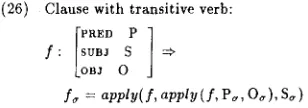
Finally, a rule for the interpretation of a clause containing a transitive verb is also needed:
(26) Clause with transitive verb:
?°:l
f : SUBJ OBJ O
f~ = apply(f, apply(f, P~, O~), S~)
The interpretation of sentence 17 can now be derived; the derivation is sketched in Figure 3.
/1 :
-PRED :'crash (sun,l)' TENSE PAST
SUBJ f2:
"SPEC [PRED'every'] PRED 'car'
[ [TOPIC [ PRE: PRLO ]
!
/
I I
MODS
f3:]/4: /
/,E,,sE ,'AST
I I
([
L
t°'J
]JJ
,1
/
Figure 1: F-structure for Every car that John owned crashed.
[S~E~ S 1
/
f: / P'E° P/
J
LMODS
M]
S~, = [as k ms][anEST ~- m n s s r ] = couj (apply(f, M~ U {P~}, [O ~- z]))
f ~ = [a S 13 aREST , quant ( m s , y, .'~x.mREST) ~- y]
Figure 2: Quantified noun phrase interpretation rule
By rule 26 for clauses with transitive verbs and the lexical entries given:
A~
= [{tel(x)} ~ own(j,~)]By rule 20 for relative clauses, allowing the application of rule 21 for tile discharge of relative pronoun assumptions:
f4~ = [O I- Ax.own(j, x)]
By rule 22 for interpreting sets of f-structures: h ~ = {[0 k Ax.own(j,x)]}
By the rule for quantified noun phrases given in Figure 2 and the lexical entries tbr every and car:
h . = [{q~ant(everv, y, ~ . e a r ( ~ ) A
own(j,
~))}
~ Yl By rule 16 for clauses with intransitive verbs:f ~ = [{q~,ant(every, y, ~x.car(x) A own(j, x)} ~ crash(y)] By quantifier discharge rule 14:
A . = [0 ~ every (~z.ear(z) A own(j, x), Av.era~h(y))]
Figure 3: Derivation of the interpretation of Every car that John owned crashed.
[image:6.432.104.369.46.173.2]6 C o n c l u s i o n
T h e s m a l l f r a g m e n t of English presented above is easily extensible to handle other semantic phe- n o m e n a , such as sentential modification. Con- s t r a i n i n g semantic derivations with respect to f- s t r u c t u r e s is preferable to the standard approach of using phrase structure trees, since f-structures need n o t be specifically tailored to solving the in- t e r p r e t a t i o n problem, but are motivated on inde- pendent grounds. The categorial semantics rules presented above provide an interpretation for f- structures directly, without the need for con- structing an intermediate level of 'logical form'.
7 A c k n o w l e d g e m e n t s
For invaluable assistance, I a m very grateful to Feruando Pereira and Stuart Shieber. Many t h a n k s are also due to John Lamping and Vijay Saraswat for their help and encouragement, and to J o a n Bresnan, Ken Kahn, Ron Kaplan, Lauri K a r t t u n e n , Chris Manning, John Maxwell, and Annie Zaenen for helpful comments and discus- sion.
R e f e r e n c e s
Joan Bresnan and Sam A. Mchombo. 1987. Topic, pronoun, and agreement in Chiche~'a. Language, 63(4):741-782.
J o a n Bresnan, editor. 1982. The Mental Rep- resentation of Grammatical Relations. The MIT Press, Cambridge, MA.
Robin Cooper. t983. Quantification and Syntac- tic Theory, volume 21 of Synthese Language Library. D. Reidel, Dordrecht.
Mary Dalrymple, Stuart M. 8hieber, and Fer- n a n d o C. N. Pereira. 1991. Ellipsis and higher-order unification. Linguistics and Philosophy, 14(4):399-452.
David R. Dowty. 1982. G r a m m a t i c a l relations and Montague G r a m m a r . In Pauline Jacob- son and Geoffrey K. Pullum, editors, The Na. tune of Syntactic Representation, pages 79- 130. Reidel, Dordrecht.
Per-Kristian ttalvorsen and Ronald M. Kaplan. 1988. Projections and semantic description in Lexical-Functional G r a m m a r . In Proceed- ings of the International Conference on Fifth
Generation Computer Systems, pages 1116- 1122, Tokyo, Japan. Institute for New Gen- eration Systems.
Per-Kristian Haivorsen. 1983. Semantics for Lexical-Functional G r a m m a r . Linguistic In- quiry, 14(4):567-615.
Ronald M. Kaplan and Joan Bresnam 1982. Lexical-Functional G r a m m a r : A formal sys- t e m for g r a m m a t i c a l representation. In J o a n Bresnan, editor, The Mental Representation of Grammatical Relations, pages 173-281. The MIT Press, Cambridge, MA.
Ronald M. Kaplan and John T. Maxwell. 1988. An algorithm for functional uncertainty. In Proceedings of COLING-88, volume 1, pages 297-302, Budapest.
Ronald M. Kaplan. 1987. Three seductions of computational psycholinguistics. In Pe- ter Whitelock, Harold Somers, Paul Bennett, Rod Johnson, and Mary McGee Wood, edi- tors, Linguistic Theory and Computer Appli- cations, pages 149-188. Academic Press, Lon- don.
Richard Montague. 1974. Formal Philosophy. Yale University Press, New Haven. Richard Thomason, editor.
Fernando C. N. Pereira and M a r t h a E. Pollack. 1991. Incremental interpretation. Artificial Intelligence, 50:37-82.
Fernando C. N. Pereira. 1990. Categorial seman- tics and scoping. Computational Linguistics, 16(1):1-10.
Fernando C. N. Pereira. 1991. Deductive inter- pretation. In ESPRIT Symposium on Natu- ral Language and Speech. Brussels, Novem- ber 1991.
Carl Pollard and Ivan A. Sag. 1987. Information-Based Syntaz and Semantics, volume 1. CSLI/University of Chicago Press, Stanford University. CSLI Lecture Notes, Number 13.
ROmi Zajac and Martin Emele. 1990. Typed unification grasnmars. In Proceedings of COLING-90, vohtme 3, pages 293-298, Helsinki.