146
Interpretable Rationale Augmented Charge Prediction System
1Xin Jiang∗,1Hai Ye∗,2Zhunchen Luo∗,1Wenhan Chao†,1Wenjia Ma
1School of Computer Science and Engineering, Beihang University
2Information Research Center of Military Science, PLA Academy of Military Science
1,2Beijing, China
1{xinjiang, yehai, chaowenhan, mawenjia}@buaa.edu.cn 2[email protected]
Abstract
This paper proposes a neural based system to solve the essential interpretability problem exist-ing in text classification, especially in charge prediction task. First, we use a deep reinforcement learning method to extract rationales which mean short, readable and decisive snippets from input text. Then a rationale augmented classification model is proposed to elevate the prediction accu-racy. Naturally, the extracted rationales serve as the introspection explanation for the prediction result of the model, enhancing the transparency of the model. Experimental results demonstrate that our system is able to extract readable rationales in a high consistency with manual annotation and is comparable with the attention model in prediction accuracy.
1 Introduction
Given a case’s fact description, charge prediction aims to determine appropriate charge for the criminal suspect mentioned. Existing works generally treat charge prediction as a text classification problem, and have made a series of progress(Liu et al., 2004; Liu and Hsieh, 2006; Lin et al., 2012; Luo et al., 2017). However, in the field of justice, every decision may be a matter of life and death. It is necessary for judges and lawyers to understand the principles of the decisions, since people cannot completely trust the machine-generated judgement results without any interpretation provided.
Interpretability which means the ability of AI systems to explain their predictions, has attracted more and more attention. Hendricks et al. (2016) divide the concept of interpretation into introspection ex-planationwhich explains how a model determines its final output and justification explanationwhich produces sentences detailing how the evidence is compatible with the system output.
Works have been proposed to enhance the interpretability of AI&Law. From the justification aspect, Ye et al. (2018) consider court views as the explanation for the pre-decided charges. They use a charge-conditioned Seq2Seq model to generate court views based on criminal cases’ fact descriptions and the given charge labels. From the introspection aspect, Luo et al. (2017) propose to select supportive law articles and use the articles to enhance the charge prediction accuracy. The supportive law articles is treated as a kind of support for the predicted charge.
In this work, focusing on the introspection explanation of charge prediction, we learn to jointly extract rationales and make charge prediction. The task is not trivial: (1) The granularity of rationales is difficult to grasp – sentence level rationales are not concrete enough while word level rationales lose readability. (2) Corpus with rationale annotation is hard to obtain. (3) Methods of improving the prediction accuracy while having high interpretability are very essential, but have not been well studied. In order to overcome the difficulties above, we propose a hybrid neural framework to (1) extract readable and charge-decisive rationales in the form of key fact snippets from input fact description with the only supervision of charge labels, and (2) elevate charge prediction accuracy by a rationale augmentation mechanism.
* indicates equal contribution.
†Corresponding author.
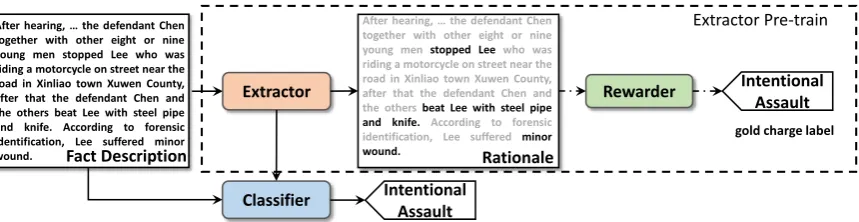
After hearing, … the defendant Chen together with other eight or nine young men stopped Lee who was riding a motorcycle on street near the road in Xinliao town Xuwen County, after that the defendant Chen and the others beat Lee with steel pipe and knife. According to forensic identification, Lee suffered minor wound. Fact Description
Extractor
Rationale After hearing, … the defendant Chen together with other eight or nine young men stopped Lee who was riding a motorcycle on street near the road in Xinliao town Xuwen County, after that the defendant Chen and the othersbeat Lee with steel pipe and knife. According to forensic identification, Lee suffered minor wound. Classifier Intentional Assault Rewarder Extractor Pre-train Intentional Assault
[image:2.595.80.510.62.173.2]gold charge label
Figure 1: Architecture of Interpretable Rationale Augmented Charge Prediction System
2 Interpretable Rationale Augmented Charge Prediction System
In this section, we will first use mathematical language to define our task and then introduce the proposed Interpretable Rationale Augmented Charge Prediction System. We define the input fact description as word sequencex= [x1, x2, . . . , xn], and the gold charge labelyas a non-negative integer. Givenx, we
aim to extract rationalesr ={xi|zi = 1, xi ∈x}wherezi ∈ {0,1}, and predict the charge based onx
augmented byr. Figure 1 shows the overview of our system. The system takes the fact description in a case as input and outputs the predicted charge as well as the rationales. The rationales play an important role in the predicting process, so they can be seen as an explanation of the charge prediction. The system consists of two main components: ExtractorandClassifier. We train these two components successively.
For the Extractor training phase, we apply a deep reinforcement method learning to extract ra-tionales with the only supervision of charge labels. For the Classifiertraining phase, we freeze the parameters ofExtractor, and the importance of each word is used to make a weighted sum over the RNN hidden states of all words. Then the weighted sum is used to make charge prediction.
2.1 Phrase-level Rationale Extraction
Considering the snippet-like rationales should be more integral in semantics, we propose to represent fact descriptions with phrases (as opposed to words). We split the fact description into phrases with a maximum length of 6. The phrase-level factxpis denoted as[xp1, x2p, . . . , xpm]. xpi represents the i-th
phrase in the fact description.xpi’s representation is defined as the average word embedding in the phrase.
……
…
Bi-directional RNN Layer Selection Layer
Embedding Layer
𝑧1
𝑝𝑧1 𝑝𝑧2 𝑝𝑧3 𝑝𝑧𝑚
𝑧2 𝑧3 𝑧𝑚
…
…
Sampling Layer …
… … RNN Layer(s) Embedding Layer … x1 𝑝 x2 𝑝 x3 𝑝 x 𝑚𝑝 Extractor Rewarder x2 𝑝 x3 𝑝 x 𝑚 𝑝 x1 𝑝 Reward Charge Label … …
[image:2.595.76.292.513.680.2]Figure 2: Architecture for Extractor Training
Figure 2 demonstrates the architecture for Ex-tractor training. We introduce a latent variable z (z ∈ {0,1}m) to define the extraction of phrases.
zt = 1represents the t-th word is chosen as an
ra-tionale phrase. The final goal of rara-tionale extraction is to learn a distributionp(z|xp)over the phrase
se-quence. At timet,p(zt)is calculated as follows:
p(zt|xp, z<t) =sigmoid(We[
− →
ht;
←−
ht;zt−1] +be)
− →
ht =
− →
f(xpt,−−→ht−1) ;
←−
ht=
←−
f(xpt,←−−ht+1)
where−→f and←−f are Bi-RNN functions which read the input sequence forward and backward. Here we choose Bi-directional Gated Recurrent Units (Bi-GRU) as the recurrent units. ztis sampled
accord-ing to the probability p(zt). To model the
distribu-tion better, at time t, the information from current GRU outputs and the states ofz<t are jointly considered to predict the label ofxpt. The extracted
ratio-nales arer = {xpi|zi = 1, xpi ∈ xp}. The learning of rationale extraction needs a reward function to
distribu-tion over charge labelsy˜and then provide the reward. The final embedding ofr is the concatenation of the last states of the two layers.y˜is calculated asy˜=sigmoid(Wrer+br).
To control the quantity of rationales, we introduce a novel penalty overzasΦ(z) =|kzk −η|where
ηis a constant to controlk z karoundηin case ofk z kbeing too small or too large. We setη as7in this work. We define the loss function asLθ(r, y) =ky˜−yk2
2 +λΦ(z). We use the gradient calculation
in Lei et al. (2016). Sampling technique (Williams, 1992) is used to approximate the gradient.
2.2 Rationale Augmented Charge Prediction
We move to train Classifierutilizing the rationale information generated by Extractor. After the previous training,Extractoralready has the ability to estimate the probabilities of the phrases being rationales. Though the phrase-level representation elevates the rationales’ semantic integrality, it causes information loss in the averaging process.
In order to better utilize the information and make charge prediction more accurate, we adop-t a RNN model wiadop-th a raadop-tionale augmenadop-t mechanism. Given the fact description word sequence
x= [x1, x2, . . . , xn], the hidden state at timetin thel-th layer is defined as follow:
h(tl) =
(
f(h(tl−1), ht(−l)1) l >0
f(xt, h
(0)
t−1) l=0
wheref is a unidirectional RNN function. The representation of fact description in layerlderived from the weighted sum of all the hidden states in layerl. Here,p(z)is treated as the importance distribution on input fact description. And the weightsatare calculated by a softmax layer based onp(zt|x), which
is provided by the pre-trainedExtractor. More precisely:
e(docl) =
n
X
1 ath(tl)
at=
exp(p(zt|x))
Pn
t=1exp(p(zt|x))
The final representation of a fact description is defined as the concatenation of the representation in each RNN layer: edoc = [e
(0)
doc;e
(1)
doc;· · · ;e
(L−1)
doc ]. Through an activation layer, edoc generates the final
distributiony˜on the charges:y˜=sigmoid(Wcedoc+bc). The loss function is defined as: Lθ(x, y) =k
˜ y−yk2
2.
3 Experiments
3.1 Data Preparation
We construct the dataset from China Judgements Online1. 80k, 10k and 10k documents are randomly selected as training, validation and test set respectively. We extract the fact description and charge labels using regular expressions. We set up a length threshold of 256. Fact description longer than that will be stripped. We use HanLP2 to tokenize the Chinese texts. We use CoreNLP (Manning et al., 2014) to parse the syntax tree, and words in a subtree with a max length of 6 make up a phrase. There are 2.8 words in each phrase on average. We also use<name>,<num>and<date>to replace the names, numbers and dates in the corpus. Following Luo et al. (2017), we choose the same charge set involving 50 most common charges and leave the other charges as negative data. To evaluate the rationale extraction performance, we randomly select 1000 documents and ask three legal professionals to annotate the sentences mentioning illegal behaviors. Sentences chosen by at least two professionals are considered as gold rationale sentences. Kappa (Cohen, 1960) between the annotators is 0.773, proving the high consistency of the annotation.
1
http://wenshu.court.gov.cn/
MODEL COMPARISON OFRATIONALEEXTRACTIONPERFORMANCE
Bi-GRUatt
. . .在狩猎过程中,PP因地滑摔跤,导致其所持鸟铳击发走火,将走在前面的PP打伤致死. . .
. . . In the process of hunting, PP fell down due to the slippery ground , leading to the shotgun fire, killing PP who was walking in front . . .
OURS− . . .在狩猎过程中,PP因地滑摔跤,导致其所持鸟铳击发走火,将走在前面的PP打伤致死. . .
. . . In the process of hunting, PP fell down due to the slippery ground , leading to the shotgun fire, killing PP who was walking in front . . .
OURS . . .在狩猎过程中,PP因地滑摔跤,导致其所持鸟铳击发走火,将走在前面的PP打伤致死. . .
. . . In the process of hunting, PP fell down due to the slippery ground , leading to the shotgun fire, killing PP who was walking in front . . .
MOREDEMONSTRATION OFOURSYSTEM
CASE 1 [Of f icial Embezzlement]charge
. . . PP利用其担任[公司业务员的职务便利]key point,从公司仓库提走多部手机,后将手机卖掉,货款挥霍。. . .
. . . Using his [position as a company salesman]key point, PP took phones from the company’s warehouse, sold the phones, and squandered the money. . . CASE 2 [Larceny]charge
. . . PP1[趁PP2家中无人 之机]key point,进入到PP2家卧室内伺机盗窃。被PP2回家后发现,PP1翻墙逃跑. . .
. . . [When PP2was not at home ]key point, PP1went to PP2’s bedroom to steal. When PP2came home, PP1fled the wall and ran. . . CASE 3 [N egligently Causing F ire]charge
. . .在焚烧耕地上的杂草时,[不慎]key point引发山林火灾。案发后,PP积极救火,主动向上级说明失火情况. . .
. . . When burning weeds on land, PP [inadvertently]key pointignited the mountain fire. PP actively doused the fire and reported the fire situation . . . CASE 4 [Arson]charge
. . . PP1因生意竞争 与PP2产生积怨。PP1酒后[萌生放火 烧PP2手机店的念头]key point,进入PP2的店内将纸箱点燃. . .
. . . PP1hates PP2for business competition. After drinking, PP1[wanted to burn PP2’s shop]key point. PP1entered the shop and lighted the carton. . . CASE 5 [N egligent Homicide]charge
. . . PP1驾驶货车在倒车 过程中,[因疏忽大意]key point将负责指挥倒车的PP2挤伤,后PP2抢救 无效死亡. . .
. . . When reserving the truck, PP1[inadvertently]key pointinjured PP2, who was in charge of commanding PP1. PP2died later. . . . CASE 6 [Intentional Homicide]charge
. . . PP1从家中携带匕首出门寻找PP2[进行报复]key point,将PP2捅倒后,在颈部来回割,致PP2当场死亡. . .
[image:4.595.106.512.386.472.2]. . . PP1took the dagger and looked for PP2[for revenge]key point. He stabbed PP2and cut the neck back and forth, causing PP2to die on the spot. . .
Table 1: Examples of extracted rationales. The highlighted words are rationales extracted by models. Different colors are used to align Chinese original text and corresponding English translation. The cores which can directly influence the charges are artificially marked as “key point”.
MODEL
CHARGEPREDICTION RATIONALEEXTRACTION
MICRO MACRO MACRO
ACC
P R F P R F P R F
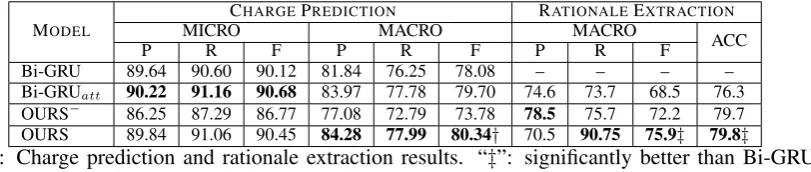
Bi-GRU 89.64 90.60 90.12 81.84 76.25 78.08 – – – –
Bi-GRUatt 90.22 91.16 90.68 83.97 77.78 79.70 74.6 73.7 68.5 76.3
OURS− 86.25 87.29 86.77 77.08 72.79 73.78 78.5 75.7 72.2 79.7 OURS 89.84 91.06 90.45 84.28 77.99 80.34† 70.5 90.75 75.9‡ 79.8‡
Table 2: Charge prediction and rationale extraction results. “‡”: significantly better than Bi-GRUatt
(p<0.01). “†”: better than Bi-GRUatt(p<0.05).
3.2 Baselines
We choose three types of baselines: Bi-GRU, Bi-GRUattand OURS−. Bi-GRU reads the input sequence
forward and backward. The final fact representation used for charge prediction is the average of the hidden states. Bi-GRUattis the base Bi-GRU model with an attention mechanism followed. We adopt
similar attention calculation in Yang et al. (2016). OURS−consists ofExtractorand theRewarder
used for training. That is, only the extracted rationales are used to make charge prediction. Additionally, it discards the concept of phrase. It can be seen as a modified version of Lei et al. (2016): simpler structure inp(z|x)modeling, but almost the same classification performance.
3.3 Experimental Results and Case Study
Rationale Extraction We choose 20 most heavily weighted words in each document as extracted ra-tionale words (almost equal to the rara-tionale word count extracted by OURS). The result in Table 2 proves that our model significantly outperforms the attention model on rationale extraction. Table 1 presents the models’ performance on rationale extraction. The first three same sentences are selected from a case with a charge ofnegligent homicidewhich is suitable for people causing one’s death due to negligence. Only our model notices the fact that the shotgun fire was due to the slippery fall, which is a key point distinguishing the case fromintentional homicide.
the fact “his position as a company salesman” which is the key point of distinguishingOfficial Embezzle-menfromLarceny. For the remaining cases, our system also seizes a series of key details such as “When PP2was not at home”, “inadvertently”, and “for revenge”, and correctly predicts the charges.
Charge Prediction We evaluate charge prediction performance using precision, recall and F1, in both micro and macro level. As shown in Table 2, Bi-GRU proves to be a strong baseline and the effect of attention mechanisms is obvious. Interestingly, though Bi-GRUatt ranks first on all micro metrics, our
model has better performance on macro metrics. This proves our method’s competitive ability on subtle differences capturing, especially when making decision among infrequent but confusing charges. The huge gap between OURS−and OURS on charge prediction proves that our two-step rationale augmented base strategy fully utilizes the information contained in non-rationale text.
4 Conclusion
We propose a neural based system to jointly extract readable rationales and elevate charge prediction accuracy by a rationale augment mechanism. Sufficient experiments demonstrate that our model outper-forms the attention based model on rationale capturing while having comparable classification accuracy.
Acknowledgements
We would like to appreciate the comments from anonymous reviewers and the data annotation from the the legal professionals. This work is supported by National Key Research and Development Pro-gram of China (Grant No. 2017YFB1402400) and National Natural Science Foundation of China (No. 61602490).
References
Jacob Cohen. 1960. A coefficient of agreement for nominal scales. Educational and psychological measurement, 20(1):37–46.
Lisa Anne Hendricks, Zeynep Akata, Marcus Rohrbach, Jeff Donahue, Bernt Schiele, and Trevor Darrell. 2016. Generating visual explanations. InECCV (4), volume 9908 ofLecture Notes in Computer Science, pages 3–19. Springer.
Tao Lei, Regina Barzilay, and Tommi S. Jaakkola. 2016. Rationalizing neural predictions. InProceedings of the 2016 Conference on Empirical Methods in Natural Language Processing, EMNLP 2016, Austin, Texas, USA, November 1-4, 2016, pages 107–117.
Wan-Chen Lin, Tsung-Ting Kuo, Tung-Jia Chang, Chueh-An Yen, Chao-Ju Chen, and Shou-de Lin. 2012. Ex-ploiting machine learning models for chinese legal documents labeling, case classification, and sentencing pre-diction. volume 17.
Chao-Lin Liu and Chwen-Dar Hsieh. 2006. Exploring phrase-based classification of judicial documents for criminal charges in chinese. InISMIS, volume 4203 of Lecture Notes in Computer Science, pages 681–690. Springer.
Chao-Lin Liu, Cheng-Tsung Chang, and Jim-How Ho. 2004. Case instance generation and refinement for case-based criminal summary judgments in chinese.J. Inf. Sci. Eng., 20(4):783–800.
Bingfeng Luo, Yansong Feng, Jianbo Xu, Xiang Zhang, and Dongyan Zhao. 2017. Learning to predict charges for criminal cases with legal basis. InProceedings of the 2017 Conference on Empirical Methods in Natural Language Processing, EMNLP 2017, Copenhagen, Denmark, September 9-11, 2017, pages 2727–2736.
Christopher D. Manning, Mihai Surdeanu, John Bauer, Jenny Rose Finkel, Steven Bethard, and David McClosky. 2014. The stanford corenlp natural language processing toolkit. InACL (System Demonstrations), pages 55–60. The Association for Computer Linguistics.
Zichao Yang, Diyi Yang, Chris Dyer, Xiaodong He, Alexander J. Smola, and Eduard H. Hovy. 2016. Hierar-chical attention networks for document classification. InHLT-NAACL, pages 1480–1489. The Association for Computational Linguistics.