22
Abstract: -With the advanced technology, the world is getting automated. Automatic systems are being favored over manual systems, as they are energy efficient and to minimize the need for tedious manual labour. With agriculture, being the primary economic sector of India, it is essential to automate it in order to increase efficiency. A typical farm requires a lot of labour. Automation can proficiently moderate the amount of manual labour, and make farming easier and faster, leading to more agricultural growth. Numerous aspects of the farm are automated. The concept of automation is extended to agricultural farms. This paper is focused on analysis of farming, four features are included, moisture sensor which senses the soil humidity and automatically waters the field, light dependent resistor, which completes the light necessity whenever needed, obstacle detection used to enhance the security of the farm, fan system for maintaining temperature. As these featured devices will work whenever required, such system conserves energy effectively. Although, there are some issues that need this paper and efficient methods to be resolved are discussed in “Farm Automation” is proposed using the analysis of the various farming problems.
Index Terms: - farm security, embedded control system, and smart farm.
1. INTRODUCTION
We live in a world wherever everything is controlled and operated automatically, however there are still many vital sectors in our country wherever automation has not been adopted or not been place to a full-fledged use, maybe as a result of many reasons one such reason is value. One such field is that of agriculture. Agriculture has been one amongst the first occupations of man since early civilizations and even nowadays manual interventions in farming are inevitable.
It involves visual scrutiny of the plant growth, manual irrigation of plants, turning ON and OFF the temperature controllers. It’s time overwhelming, prone to human error and therefore less correct and unreliable. This set-up is machine-driven and is analogous to manual set-up in most respects however it reduces the labour concerned in terms of the set-up. It works on a feedback system that helps and it to retort the external stimuli expeditiously. Though this set-up overcomes the issues caused thanks to human errors and it's not utterly machine-driven.
This paper, addresses all the approaches in Farm Automation, features are provided for the betterment of agricultural field. Nowadays, there is wastage of light energy. So prohibiting the wastage of light energy this LDR sensor feature is being used. As the obstacle is detected, the system will automatically get activated and provides a kind of indication for the savage of farm crops. Also as the water level is being judged by the controller, the water pump gets activated and supply water as per the requirement.
From this we are making combination of four features in one system.
2. LITERATURE REVIEW
After the analysis within the agricultural field, researchers found that the yield of agriculture goes on decreasing day by day. Use of technology within the field of agriculture plays
vital role in increasing the assembly moreover as in reducing the additional man power efforts.
The sensible farm has used agriculture automation system rather than ancient agriculture. Ancient agricultural ways utilized by the native folk’s area unit extremely property, though the all-embracing value isn't low-cost. Our analysis goal is to produce future property resolution for automation of agriculture. Moreover, irrigation system mistreatment wireless detector network has put in these sensors, with the aim for collection the surroundings information and dominant the irrigation system via sensible phone. [1]
Electronic equipment’s are concentrated on automating the irrigation system for financial aid of Indian agricultural system. These techniques are helpful for watching the soil wetness condition of the farm likewise reaches a selected level, the system takes acceptable steps to manage or perhaps stop the water flow. The circuit additionally monitors the water within the water supply in order that if the water level becomes terribly low, it switches off the motor to forestall injury to the motor thanks to recitation. [2]
Technological advancements within the arena of agriculture can ascertain to extend the competency of bound farming activities. The essential physical and chemical parameters of the soil measured, the desired amount of manure, compost, and water is splashed on the crops employing a good irrigator, that is mounted on a movable overhead crane system. The detailed modeling and control strategies of a smart irrigator and smart farming system are demonstrated. [3]
23
tremendously when the technology of automatic vehicleguidance is put into practical use. [4]
In recent years, the aging of agricultural workers has progressed rapidly, successor problem is becoming more serious. Under this more circumstances are coming out also new farmers that will be beginner to agriculture. Also, the establishment of farming technology has become a major management challenge for new farmers. In this study, we focused on the fact that to compensate for the water management is a part of the management challenges of the new farmers (establishment of farming technology), to build a soil moisture measurement system due to moisture sensor. [5]
Currently, many garden centers use a timer-controlled sprinkler system to water their plants. This has a disadvantage in that the timer system has no means of measuring the moisture level of the soil, which may lead to over-watering of certain plants. The microcontroller acted as the control system, controlling the motorized valves and reading signals from two simple moisture sensing circuits. The testing of the system proved that plants can be watered based on the moisture level of the soil. It also shows that the soil probes are needed to be much more reliable in order for the system to be successful. [6]
Presents an experimental system that allows the study and testing of two proximity sensors and their use in an application. An application of inductive and capacitive proximity sensors is implemented using a programmable logic controller. The programmable logic controller performs the monitoring of sensors' outputs and controls the object movement sense. [7]
To monitor the environment inside greenhouse different parameters have been considered such as light, temperature, humidity, soil moisture etc. using different sensors like temperature and humidity Sensor, LDR, grove-moisture sensor etc. which will be interfaced with microcontroller. It is a closed loop system that will execute control action to adjust temperature, humidity, light intensity and soil moisture if any unwanted errors (high/low) occur. [8]
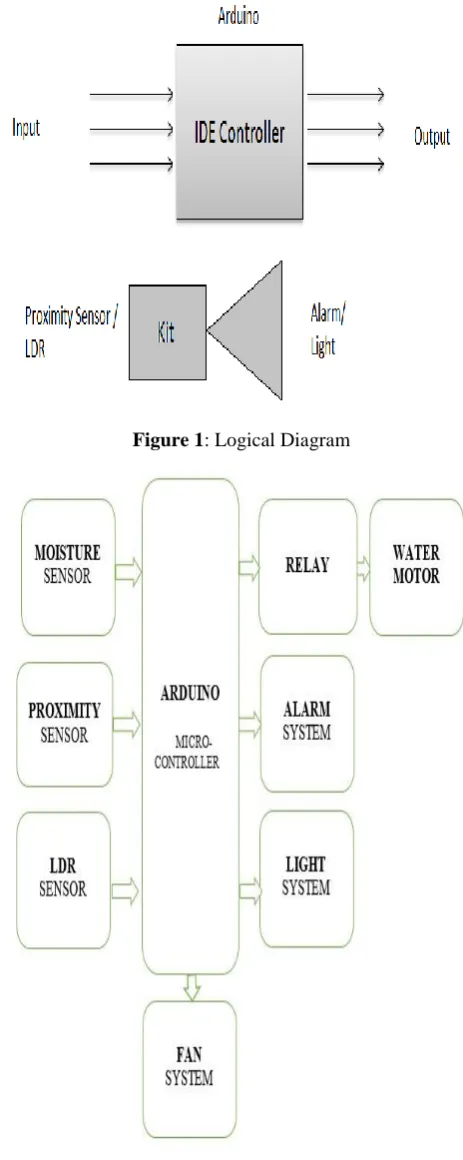
3. PROPOSED BLOCK DIAGRAM
Figure 1: Logical Diagram
Figure 2: Block Diagram
3.1 Components Description
3.1.1 Arduino
24
and package, that square measure authorized beneath thewildebeest Lesser General Public License (LGPL) or the wildebeest General Public License (GPL).
Arduino board styles use a spread of microprocessors and controllers. The boards are equipped with sets of digital and analog input/output (I/O) pins which will be interfaced to numerous enlargement boards (shields) and alternative circuits.
Figure 3: Arduino Uno ATmega328P kit
3.1.2 Light Dependent Resistor – LDR
A light dependent resistor also known as a LDR, photo resistor, photoconductor or photocell, is a resistor whose resistance increases or decreases depending on the amount of light intensity. LDRs (Light Dependent Resistors) are a very useful tool in a light/dark circuits. A LDRs can have a variety of functions. For example, it can be used to turn on a light when the LDR is in darkness or to turn off a light when the LDR is in light. It can also work the other way around so when the LDR is in light it turns on the circuit and when it’s in darkness the resistance increase and disrupts the circuit.
Figure 4: Circuit Symbol of LDR 3.1.3 Moisture Sensor
This sensing element won’t take a look at the wet of soil, once the soil has water shortage, the module output is at high level, and else the output is at low level. By exploitation this sensing element one will automatically water the plants. One face of the probe is directly connected to Vcc and alternative probe terminal goes to the bottom of BC547 semiconductor unit. A potentiometer is connected to the bottom of the semiconductor unit to regulate the sensitivity of the sensing element. Module triple output mode, digital output is straightforward, analog output a lot of correct, serial output with actual readings.
Figure 5: Moisture Sensor
3.1.4 Proximity Sensor
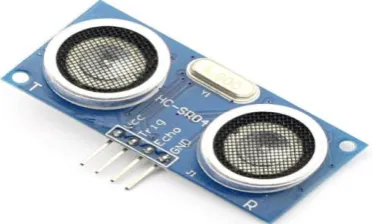
A proximity detector could be able to find the presence of close objects with none physical contact. A proximity detector typically emits a magnetism field or a beam of electromagnetic wave (infrared for instance), and appears for changes within the field or come back signal. The article being detected is commonly said because the proximity sensor's target. Completely different proximity detector targets demand of different sensors. as an example, an electrical phenomenon proximity detector or photoelectrical detector may be appropriate for a plastic target, an inductive proximity detector perpetually needs a metal target.
The maximum distance that this detector will find is outlined "nominal range". Some sensors have changes of the nominal vary or means that to report a graduated detection distance. Some grasp these processes as "Thermo-sensation".
Figure 6: Proximity Sensor 3.1.5 Relay Module
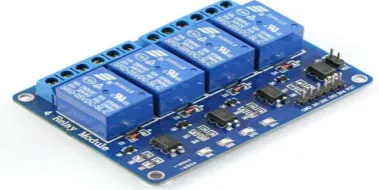
A relay is associate electrically operated switch. Several relays use associate magnet to automatically operate a switch, however different operative principles are used, like solid-state relays. Relays area unit used wherever it's necessary to regulate a circuit by a separate low-power signal, or wherever many circuits should be controlled by one signal.
25
Figure 7: Relay Module
4. SOFTWARE DESCRIPTION
4.1 Arduino Software (IDE 1.8.4)
The Arduino integrated development environment (IDE) could be a cross-platform app. written in Java, and comes from the IDE for the process programing language and also the wiring comes. A program or code written for Arduino is named a "sketch". The Arduino IDE uses the antelope tool chain and AVR Lib to compile programs, and uses avr-dude to transfer programs to the board. The ASCII text file Arduino computer code (IDE) makes it simple to write down code and transfer it to the board. It runs on Windows, Mac OS X, and Linux. The setting is written in Java and supported process and different ASCII text file computer code. This computer code is often used with any Arduino board. Arduino is associate degree ASCII text file prototyping platform supported easy-to-use hardware and computer code.
In “Farm Automation”, the moisture sensor is fixed in soil to see moisture content in the crops. Based on the moisture, water pump providing water to crop. The LDR sensor emits the light rays of the sun and the light bulb which is fixed inside the control room to get light. Proximity sensor are fixed on the boundaries to detect the animals which are entering in the farm. There is also a system of alarm called “Buzzer/Loudspeaker” which emits the roar of lion fixed in the farm. Fan system is fixed inside the control room and in green shade as per requirement of the farmer to maintain the temperature and save the electricity.
6. OUTCOMES AND POSSIBLE RESULT
After fixing of “Farm Automation” system, we will get outputs in terms of Light, Alarm, Water System, and Fan. For getting the Light the LDR which will be fixed on system at night it will get turned on and at morning it gets turned off. Alarm system can be on whenever any animal is entering in to the farm. It is useful to keep the animal away from farm. Whenever the moisture level is low the water system gets on and if there is already presence of
water or the level is as accepted then motor will off. Fan system will on and off to maintain the temperature and save electricity.
7. ADVANTAGES
Low cost and high efficiency.
Easily monitored.
Use in agricultural field.
Requires less energy due to automation.
Minimum human efforts.
8. CONCLUSION
Using this system, one can save manpower, water to improve production and ultimately increase profit.
The automated farm automation system is feasible and cost effective for optimizing water resources for agricultural production. done without manual. Using this system, valves and relay board can be controlled remotely which opens the opportunities to control the water flow as well as the electrical flow. This system can have a more improvised version as the world is moving toward technology. Few further modifications can be done to this project to make it more and more beneficial for future:
Rather than providing each platform with water supply, we can modify it to have water content only to the highest platform or a step and then allowing that highest platform to supply water to the rest of the platforms.
In further innovation the platforms which we are using can be movable or rotating in order to provide each platform adequate amount of sunlight and other nutrients.
We can also think of fixing led lights, light emitters which works as sunlight for crops.
Mirror can be fixed on the outer sides of the building in order to reflect sunlight from all directions to the required area.
This system can be further enhanced by connecting the whole system to the android device.
26
[2] https://www.scribd.com/document/156333059/Real-time-Automization-of-Irrigation-System-for- Social-Modernization-of-Indian-Agricultural-System-Ieee-2011.
[3] NattapolKaewmard, SaiyanSaiyod, "Sensor data collection and irrigation control on vegetable crop using smart phone and wireless sensor networks for smart farm", IEEE Conference on Wireless sensors (ICWiSE), pp. 106-112, 2014.
[4] K. Katayama, K. Machida, "Automatic Implement Tilt Control for Kubota Agricultural Tractors", International Congress on Transportation Electronics, 1984.
[5] Seneviratne, Soniaet al., "Investigating soil moisture-climate interactions in a changing climate: A review", Earth-Science Reviews, vol. 3, pp. 125-161, 2010.
[6] K. Hunter, "Guidelines for Watering Indoor Plants", Colorado State University Extension, 2010.
[7] M. N. Frota, L. Finkelstein, "Education in metrology and instrumentation from the engineering perspective", Journal of Engineering Education, vol. 25, no. 1, pp. 49-65, June 2006. [8] N. Dinesh Kumar, S. Pramod, C. H. Sraboni,