Assessing the correlation between contextual patterns and
biological entity tagging.
M.KRALLINGER, M.PADR ´ON, C.BLASCHKE, A.VALENCIA
Protein Design Group,
National Center of Biotechnology (CNB-CSIC), Cantoblanco,
E-28049 Madrid,
martink, mpadron, blaschke, [email protected]
Abstract
The tagging of biological entities, and in partic-ular gene and protein names, is an essential step in the analysis of textual information in Molec-ular Biology and Biomedicine. The problem is harder than was originally thought because of the highly dynamic nature of the research area, in which new genes and their functions are con-stantly being discovered, and because of the lack of commonly accepted standards. An impres-sive collection of techniques has been used to detect protein and gene names in the last four-five years, ranging from typical NLP to purely bioinformatics approaches. We explore here the relationship between protein/gene names and expressions used to characterize protein/gene function. These expressions are captured in a collection of patterns derived from an original set of manually derived expressions, extended to cover lexical variants and filtered with known cases of association patterns/ names. Apply-ing these patterns to a large collection of cu-rated sentences, we found a significant number of patterns with a very strong tendency to ap-pear only in sentences in which a protein/gene name is simultaneously present. This approach is part of a larger effort to incorporate contex-tual information so as to make biological infor-mation less ambiguous.
1 Introduction
Molecular Biology and biomedical research cov-ers a broad variety of research topics, connected to the function of genes and proteins. The infor-mation on the experimental characterization of essential functional aspects of these genes and proteins is manually extracted from primary sci-entific publications by field-specific databases. This process requires highly specialist person-nel, and is costly and time-consuming. Indeed, only a small number of genes and proteins have been annotated with information directly re-lated to experiments, whereas in the immense
majority of cases the annotations are trans-ferred from other similar entries. The anno-tations provided by the databases are a valu-able source for large-scale analysis, but are in-evitably incomplete at the level of detailed func-tion and experimental results.
It is in the context of fast-growing biblio-graphic information (over 12 million references are collected in the PubMed database, with an average of 500,000 new references added every year) and annotation of the function of genes and proteins that Text Mining and Information Extraction systems become important tools for biological research (Blaschke and Valencia, 2001).
Since the first papers were published in this field in the late 90’s, it has become clear that the detection of gene and protein names (gene tagging) is a key first step towards Text Mining systems becoming really useful.
The detection of names is particularly com-plex in the domain of Molecular Biology, for a number of reasons:
(1) Sociological, since names are perceived as associated with the recognition of the groups that first discovered them.
(2) As biologists tend not to adopt available naming standards, often the disease related to a gene disorder has the same name as the gene itself (homonyms). This can be only be addressed using context based sense disam-biguation procedures.
are mixed with the various levels of knowledge for different members of the protein families. (6) The field itself is still evolving, and the catalogue of genes even for the genomes already sequenced, such as the Human one, is still incomplete.
Our own assessment of the evolution of gene names shows that names evolve over time into a complex system with scale-free behavior, with the presence of a few very oft-quoted names (attractors) and many very seldom quoted ones. The system itself is in a critical state and the fate of current names is unpredictable (Hoffmann and Valencia, 2003).
A significant number of applications have been developed to identify gene names and sym-bols in the biomedical literature (see (Tanabe and Wilbur, 2002; Yu et al., 2002; Proux et al., 1998; Krauthammer et al., 2000) for four dif-ferent methodological approaches). In order to assess the performance of different approaches the BioCreative challenge was carried out. The recent BioCreative challenge showed that gene and protein names can be detected by several techniques, with a significant success that can be as high as 80% for the best-performing sys-tems (Blaschke et al. in preparation; and special issue of BMC Bioinformatics on the BioCreative challenge cup, in preparation). However, detec-tion of the remaining 20% of names is really im-portant for many operations. Therefore, there is significant room for improvement, and a clear need for new approaches able to use alternative sources of information.
We explore here a new avenue for the detec-tion of gene and protein names by using con-textual information, since in many cases gene tagging requires knowledge of context (context-based approach for disambiguation). We pre-viously explored relevant information by cre-ating context-based sentence sliding windows for entity-relation extraction (Krallinger and Padron, 2004).
We propose here to detect those sentences de-scribing the function of genes and proteins in the literature that are good candidates for con-taining unambiguous information about corre-sponding gene and protein names.
To detect these sentences, we relied on the identification of typical expressions (patterns) associated with the description of protein func-tion in the literature. Context informafunc-tion in the form of heuristically extracted sentence
pat-terns, known as frames, proved useful in the past for deriving protein interactions automat-ically (Blaschke et al., 1999; Blaschke and Va-lencia, 2001) from protein co-occurrences.
The approach proposed here is based on the extension of heuristically derived trigger words (Riloff, 1993; Agichtein and Gravano, 2000) and the filtering of patterns using previously gene-indexed sentences. The extraction patterns ob-tained were then ranked, using a validation set of gene-indexed sentences and sentences lacking the gene symbols. Precision-ranked extraction patterns and indexing of sentences using those patterns allowed ranking of these sentences ac-cording to whether they contained relevant in-formation for protein indexing and annotation.
2 Methods
In the case of complex domains, such as Molec-ular Biology and Biomedicine, a prohibitively large training set is generally required in order to mine scientific literature. Often inter-domain portable methods do not perform well enough. Nevertheless, within relevant sentences contain-ing protein or gene names, commonly used pat-terns often describe or define relevant aspects of those entities.
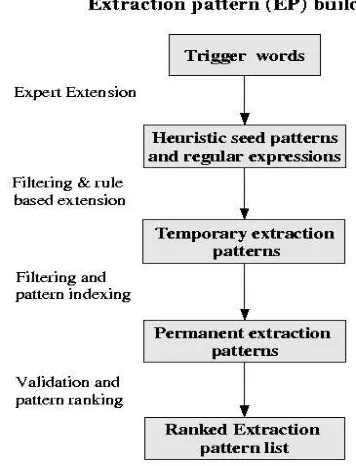
Figure 1: Flow chart of the main steps for constructing the extraction pattern set.
sev-eral processing and filtering steps, resulted in a ranked list of protein-specific extraction pat-terns (see Figure 1).
2.1 Set of trigger words
First, a domain expert manually analyzed gene-indexed sentences to extract key words that could trigger potential extraction patterns. The expert used heuristics based on background knowledge of the domain. These trigger words (Riloff, 1993; Agichtein and Gravano, 2000) constituted frequent word types which, in the context of other word types (often prepositions or articles), displayed a strong association with the given gene or protein entity. Trigger words thus made up a sort of concept node1 by
scan-ning through gene-indexed sentences. Most of these trigger words were in fact verbal phrases (e.g. transitive verbs), which were often encoun-tered in sentences defining or describing relevant features of genes and gene products. There-fore, only trigger words which helped describe or define relevant aspects of the protein were ex-tracted. These trigger words are also useful for computerized annotation of extraction of pro-teins. Among the trigger words were 507 verbs, 127 adjectives and 265 nouns.
2.2 Heuristic trigger word extension The trigger words were then extended and com-bined by the domain expert using context-based heuristics to extract a seed set of ini-tial extraction patterns and a set of regular extraction expressions. An example (1) of the heuristic trigger words used was ’encod-ing’. Among the resulting expert-derived ex-traction patterns were: ’, encoding a’, ’, encod-ing the’, ’encodencod-ing a’,’encodencod-ing the’,”encodencod-ing a<PROT>’,’gene , encoding’and’protein, en-coding’. Here<PROT>represents a previously gene tagged word type.
2.3 Automatic extension of seed extraction patterns
To extend the set of extraction patterns and to expand the regular expressions to obtain defined patterns, a rule-based system was used. Among the extension rules for these seed patterns were preposition substitutions, comma addition be-fore verbs, article insertion bebe-fore certain nouns and pattern fusions. Some of the patterns gen-erated were revised manually and
inconsisten-1Concept nodes are essentially case frames which are
triggered through a lexical item and its corresponding linguistic context (Riloff, 1993)
cies were removed. Examples of the extraction patterns based on the seed patterns provided in example (1) were’the gene encoding the’ , ’, a gene encoding’, ’, a gene encoding the’,’, gene encoding a’,’, the gene encoding’,’, the gene en-coding a’,’the gene enen-coding the’. Some of the extensions did not correspond to natural lan-guage and some were too long. Thus, in a sec-ond step, those patterns not encountered in free text, namely the initial set of gene-indexed sen-tences, were removed.
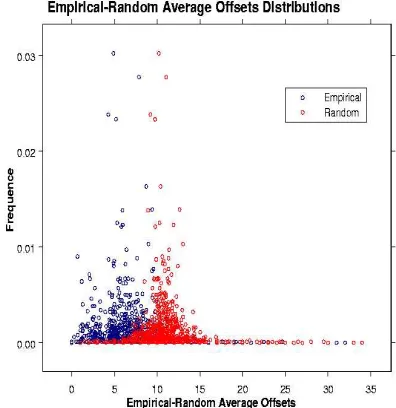
Figure 2: Emprirical and random distribution of the pattern to gene name average offsets.
2.4 Temporary extraction pattern filtering.
The extended set of extraction patterns had to be analyzed as to whether they really corre-sponded to patterns encountered in sentences in which gene and protein names or symbols were found. Therefore we tagged, using exact pattern matching, the temporary set of extrac-tion patterns to a set of previously gene-indexed sentences.
These sentences contained gene symbols of the yeast S. cerevisiae provided by the SGD database. A total of 36,543 sentences were gen-erated with the use of a refined gene tagger. In general, as yeast genes are easier to tag and on the whole do not correspond to common En-glish word types, they became a high-quality gene-indexed data set for further analysis using offset statistics.
dis-carded. To determine whether those matched patterns had a distance association to the gene names, we calculated the empirical average off-set of each pattern. The distances used for the offset calculation were measured in word tokens. Thus average empirical offset ¯de was
calcu-lated by
¯ de =
Pn
i=1di
n (1)
where n is the number of occurrences of the given pattern in the gene indexed sentences and di is the observed offset.
Taking into account the sentence length, the individual pattern length and the gene posi-tion within the pattern matching sentences also a random offset was calculated for each pat-tern occurrence and the average random offset for each pattern, ¯dr was calculated (see
Fig-ure 2). In order to determine whether the aver-age empirical distance of the patterns were sig-nificantly different from the corresponding rdom offsets, the distributions were further an-alyzed. A chi-square test was applied to verify that both, the empirical and the random offset distributions were normally distributed. Then we used the Kullback-Leibler divergence to mea-sure how different the two probability distribu-tions were :
D(pkq) =X
i
pilog2(pi/qi) (2)
where p corresponds to the normal distribution of the empirical average offset and q to the nor-mal distribution of the random average offset. In our case the distributions showed a large KL divergence. This means that ¯de is significantly
smaller when compared to ¯dr(i.e. the patterns
are closer to the gene names).
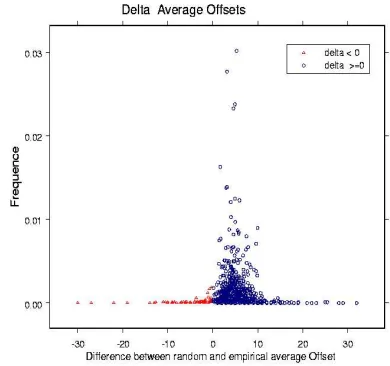
To be able to use the average offset differ-ences of the patterns as a filtering criterion we calculated the distribution of the differences δi
between ¯dr and the corresponding ¯de (see
Fig-ure 3). Only patterns with δi > 0 passed the
selection filter.
2.5 Permanent extraction pattern ranking.
After the filtering of the temporary extrac-tion patterns using gene/protein indexed sen-tences, it was important to determine the preci-sion of the extraction patterns for gene-indexed sentences, compared with sentences without mentions of genes. Therefore, two validation sets were constructed: one containing a set of
Figure 3: Difference between the average random and average empirical offset. The extraction patterns which did not pass the filtering step (difference > 0 are dis-played in red. The remaining pattern set (blue) consti-tuted the permanent pattern set which was used for the f-score ranking.
Data set Total
Initial trigger words 899 Seed heuristic patterns 472,427 Extended heuristic patterns 525,408 Filtered heuristic patterns 53,185 Temporary patterns 769 Permanent patterns 655 Gene indexed sentences 36,543 Validation sentences (+)) 45,119 Validation sentences (-) 45,119
Table 1: Overview of the used dataset of pat-terns and sentences.
gene indexed sentences using gene names con-tained in the SwissProt database, and the other consisting of the remaining sentences, without those symbols. The sets were used to calculate recall and precision:
R= TP
TP+FN (3)
P= TP
TP+FP (4)
The corresponding f-score is given by
F−score= 1 αP1 + (1−α)
1 P
(5)
recall, here α = 0.5, were both precision and recall had the same weight. Regarding the ob-tained f-score or the precision we could rank the permanent extraction patterns.
Figure 4: F-score plot for the extraction patterns in the validation set: f-score for each pattern (numbered)
3 Results
The total number of initial patterns was 472,427, the extended version included more than 525,408 patterns and the reduced filtered final set included 655 patterns. Even though these patterns clearly do not include all pos-sible mentions of functions in texts, it is also clear that they provide a good statistical base (32,641 sentences detected in a corpus of 36,543 sentences) for screening the sentences to search for protein names.
To assess the relationship between patterns and names, we compared the frequency of the patterns in two sets of sentences, one containing and one not containing gene names. A highly relevant number of patterns appears more fre-quently in sentences containing names (324 of the 518 patterns). A subset of these, 202, ap-pears only in sentences where a gene or protein name is present. This subset is an ideal candi-date for enhancing the discriminative power of gene/protein detection systems.
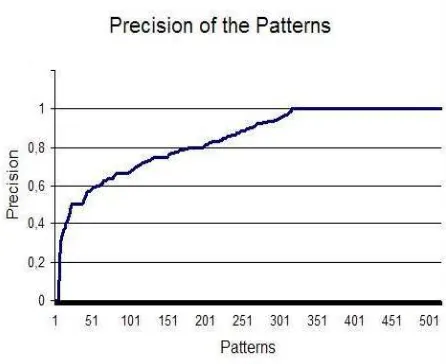
The permanent extraction patterns displayed in general a very high precision (see Figure 5), but the recall for an individual pattern was relatively low. Nevertheless, most of the pat-terns were matched to the validation sentences (79.08%) and 13,799 sentences of the gene in-dexed validation set had at least one pattern.
There were a total of 59.82% of high precision patterns, i.e. with a precision greater then 0.8, of which 64.86% had a precision of 1. Thus the patterns are in general very specific for gene containing sentences.
Figure 5: Precision plot for the extraction patterns in the validation set: PRECISION for each pattern (num-bered)
Patterns P R F-score
protein is required 1 5.73E-05 1.15E-04
was localized on 1 5.73E-05 1.15E-04
gene is essential for 1 1.15E-04 2.29E-04
located in the 0.93 3.26E-03 6.51E-03
Table 2: Sample of high precision patterns.
In table 2 some of the top scoring precision patterns can be seen. Most of them contained a verb as trigger word, in contrast to the lower scoring precision patterns (table 3), which often corresponded to patterns were the trigger word corresponded to a noun.
Patterns P R F-score
the human 0.544 0.015 0.029
, acts as 0.5 5.72E-05 0.0001 is associated with 0.494 0.005 0.010
role for 0.463 0.003 0.006
Table 3: Sample of low precision patterns.
be-low 2.5. Therefore, the use of offset calculation as a filtering step to extract co-occurrences of gene-indexed sentences is seen as promising. For sample sentences of true pattern-matching cases, see:
(a)Although generally involved with detoxi-fication, overexpression of one family mem-ber, cytochrome P450 1B1 (CYP1B1), has been associated with human epithelial tumors [PMID:12813131]
(b) For example, we have identified a novel gene called mta1 (rat) or MTA1 (human) that appears to be involved in mammary cell motility and growth regulation [PMID:9891220]
(c)PEX13protein has an SH3 docking site that binds to the PTS-1 receptor [PMID:11405337]
(d) We have previously reported the identifica-tion of human PEX13, the gene encoding the docking factor for the PTS1 receptor, or PEX5 protein[PMID:9878256]
The above examples show correctly identi-fied gene containing sentences using extraction patterns. The extraction patterns are un-derlined, while the relevant gene symbols are displayed in bold.
After detailed analysis of the positive matched patterns, we found that certain pat-terns were more suited to annotating functional implications of disease-related features of genes or proteins (see example a). Other patterns were more suited to extracting descriptions of the participation of proteins in distinct biolog-ical processes (example b). In addition, func-tional descriptions and protein-protein interac-tion informainterac-tion, useful for deriving funcinterac-tional annotation data and protein definitions, were associated with certain patterns (see c and d).
4 Conclusions
We have described here a new approach for the identification of sentences containing informa-tion relating to gene and protein names in bio-logical literature. Our proposal is based on the detection of sentences that contain information relating to protein (or gene) function as an in-dicator of the presence of protein/gene names.
To identify these sentences, we used a pattern-based approach that encapsulates the
characteristic ways in which function is de-scribed in text. To generate the set of pat-terns describing functions, we started with an initial set of manually derived patterns, which was extended to cover a number of lexical varia-tions. This larger set was filtered by matching of the patterns using previously gene-indexed sen-tences. The trigger word extension idea is based on the proposal by (Riloff, 1993; Agichtein and Gravano, 2000). Among the extraction patterns with high precision, a significant number con-tained verbs as trigger words. This corroborates previous studies that used verbs to extract bio-logical interactions (Hatzivassiloglou and Weng, 2002; Sekimizu et al., 1998).
We plan to analyze further the patterns used in the study in order to explore the differen-tial behavior of verb-containing patterns and noun-containing patterns for protein annota-tion extracannota-tions. The use of verbs to trigger extraction patterns for biological interactions have already been explored (Hatzivassiloglou and Weng, 2002; Sekimizu et al., 1998), but their use for protein indexing and annotation extraction was not previously studied in detail. The overall performance of extraction patterns for interactions and for annotation extraction seems to be similar.
Most of the extraction patterns used showed no dependency on the organism that was the source of the genes, with the exceptions of the patterns containing the trigger words human, yeast, mammalian and mouse. Therefore, the majority of the extraction patterns could be used for extraction of genes from a broad range of organisms, and especially aid in disambigua-tion of fly genes. As the extracdisambigua-tion patterns can be applied without prior gene indexing, they could be used to enhance compound gene-name indexing, to extract rare typographical variants of existing gene names (not deposited in anno-tation databases) or even to mine the literature to discover new genes not yet described in cur-rent annotation databases.
The main focus in extraction patterns was pre-cision, which was attained through a pipeline of filtering steps. The use of a larger set of ini-tial trigger words might further increase recall in some cases.
between proteins and their functions. In the recent BioCreative challenge, it was clear that our system could be substantially improved by enhancing its name recognition capacity. This could be done by incorporating the frames as additional context information into the previ-ously developed subset strategy (Krallinger and Padron, 2004).
Finally, we also plan to compare extraction pat-terns with automatically derived n-grams from previously gene-indexed sentences, in order to find which features are best suited for itera-tive bootstrapping to create new extraction pat-terns.
5 Acknowledgements
This research was sponsored by DOC, doctoral scholarship of the Austrian Academy of Sciences and the ORIEL (IST-2001-32688) and TEM-BLOR (QLRT-2001-00015) projects. We are grateful to R. Hoffmann for providing the fil-tering set of gene-indexed sentences.
References
E. Agichtein and L. Gravano. 2000. Snowball: Extracting relations from large plain-text col-lections. Proc. 5th ACM International Con-ference on Digital Libraries., pages 85–94. C. Blaschke and A. Valencia. 2001. The
poten-tial use of SUISEKI as a protein interaction discovery tool. Genome Inform Ser Work-shop Genome Inform., 12:123–134.
C. Blaschke, A. Andrade, M, C. Ouzounis, and A. Valencia. 1999. Automatic extrac-tion of biological informaextrac-tion from scientific text: protein-protein interactions. Proc Int Conf Intell Syst Mol Biol., pages 60–67. V. Hatzivassiloglou and W. Weng. 2002.
Learn-ing anchor verbs for biological interaction patterns from published text articles. Int J Med Inf., 67:19–32.
R. Hoffmann and A. Valencia. 2003. Life cycles of successful genes. Trends Genet, 19:79–81. M. Krallinger and M. Padron. 2004. Prediction
of GO annotation by combining entity spe-cific sentence sliding window profiles. Proc. BioCreative Challenge Evaluation Workshop 2004.
M. Krauthammer, A. Rzhetsky, P. Morozov, and C. Friedman. 2000. Using BLAST for identifying gene and protein names in journal articles. Gene, 259:245–252.
D. Proux, F. Rechenmann, L. Julliard, V.V. Pil-let, and B. Jacq. 1998. Detecting Gene
Sym-bols and Names in Biological Texts: A First Step toward Pertinent Information Extrac-tion. Genome Inform Ser Workshop Genome Inform, 9:72–80.
E. Riloff. 1993. Automatically Constructing a Dictionary for Information Extraction Tasks. Proceedings of the Eleventh National Confer-ence on Artificial IntelligConfer-ence., pages 811– 816.
T. Sekimizu, H.S. Park, and J. Tsujii. 1998. Identifying the Interaction between Genes and Gene Products Based on Frequently Seen Verbs in Medline Abstracts. Genome Inform Ser Workshop Genome Inform., 9:62–71. L. Tanabe and W.J. Wilbur. 2002. Tagging
gene and protein names in biomedical text. Bioinformatics, 18:1124–1132.