Tag-Enhanced Tree-Structured Neural Networks for Implicit Discourse
Relation Classification
Yizhong Wang1 Sujian Li1,2 Jingfeng Yang1 Xu Sun1 Houfeng Wang1,2 1Key Laboratory of Computational Linguistics, Peking University, MOE, China
2Collaborative Innovation Center for Language Ability, Xuzhou, Jiangsu, China
{yizhong, lisujian, yjfllpyym, xusun, wanghf}@pku.edu.cn
Abstract
Identifying implicit discourse relations tween text spans is a challenging task be-cause it requires understanding the mean-ing of the text. To tackle this task, re-cent studies have tried several deep learn-ing methods but few of them exploited the syntactic information. In this work, we explore the idea of incorporating syntac-tic parse tree into neural networks. Specif-ically, we employ the Tree-LSTM model and Tree-GRU model, which are based on the tree structure, to encode the argu-ments in a relation. Moreover, we fur-ther leverage the constituent tags to con-trol the semantic composition process in these tree-structured neural networks. Ex-perimental results show that our method achieves state-of-the-art performance on PDTB corpus.
1 Introduction
It is widely agreed that text units such as clauses or sentences are usually not isolated. Instead, they correlate with each other to form coherent and meaningful discourse together. To analyze how text is organized, discourse parsing has gained much attention from both the linguistic (Weiss and Wodak, 2007; Tannen, 2012) and computational (Marcu,1997;Soricut and Marcu,2003) commu-nities, but the current performance is far from sat-isfactory. The most challenging part is to identify the discourse relations between text spans, espe-cially when the discourse connectives (e.g., “be-cause” and “but”) are not explicitly shown in the text. Due to the absence of such evident linguistic clues, trying to model and understand the mean-ing of the text becomes the key point in identifymean-ing such implicit relations.
economic performance future
NP
JJ NN
JJ NP measure
VB VP
(a)
(b)
to expand likely
VP
TO VB JJ
ADJP is
VBZ S
the economy DET NN
NN VP
(Expansion.Restatement.Specification, wsj_0233) Arg2: A figure above 50 indicates the economy is likely to expand
Arg1: The index is intended to measure future economic performance
Figure 1: An example of two sentences
with their discourse relation as
Expan-sion.Restatement.Specification. Subfigure (a) and (b) are partial parse trees of the two important phrases with yellow background.
Previous studies in this field treat the task of recognizing implicit discourse relations as a clas-sification problem and various techniques in se-mantic modeling have been adopted to encode the arguments in each relation, ranging from tradi-tional feature-based models (Lin et al.,2009;Pitler et al.,2009) to the currently prevailing deep learn-ing methods (Ji and Eisenstein,2014;Liu and Li,
2016;Qin et al., 2017). Despite of the superior ability of the deep learning models, the syntactic
information, which proves to be helpful for iden-tifying discourse relations in many early studies (Subba and Di Eugenio,2009;Lin et al.,2009), is seldom employed by recent work. Therefore we are curious to explore whether such missing syn-tactic information can be leveraged in deep learn-ing methods to further improve the semantic mod-eling for implicit discourse relation classification. Tree-structured neural networks, which recur-sively compose the representation of smaller text units into larger text spans along the syntactic parse tree, can tactfully combine syntatic tree structure with neural network models and recently achieve great success in several semantic mod-eling tasks (Eriguchi et al., 2016; Kokkinos and Potamianos,2017;Chen et al.,2017). One useful property of these models is that the representation of phrases can be naturally captured while com-puting the representations from bottom up. Taking Figure1for an example, those highlighted phrases could provide important signals for classifying the discourse relation. Therefore, we will employ two latest tree-structuerd models, i.e. the Tree-LSTM model (Tai et al., 2015; Zhu et al., 2015) and
the Tree-GRU model (Kokkinos and Potamianos,
2017), in our work. Hopefully, these models can learn to preserve or highlight such helpful phrasal information while encoding the arguments.
Another important syntactic signal comes from the constituent tags on the tree nodes (e.g., NP, VP, ADJP). Those tags, derived from the production rules, describe the generative process of text and therefore could indicate which part is more impor-tant in each constituent. For example, consider-ing a node tagged with NP, its child node tagged with DT is usually neglectable. Thus we pro-pose to incorporate this tag information into the tree-structured neural networks, where those con-stituent tags can be used to control the semantic compostion process.
Therefore, in this paper, we will approach the discourse relation classification task with two tree-structured neural networks proposed recently (Tree-LSTM and Tree-GRU ). To our knowledge, this is the first time these models are applied to dis-course relation classification. Moreover, we fur-ther enhance these models by leveraging the con-stituent tags to compute the gates in these models. Experiments on PDTB 2.0 (Prasad et al., 2008) show that the models we propose can achieve state-of-the-art results.
2 Related Work
2.1 Implicit Discourse Relation Classication
Discourse relation identification is an important but difficult sub-component of discourse analysis. One fundamental step forward recently is the re-lease of the large-scale Penn Discourse TreeBank (PDTB) (Prasad et al.,2008), which annotates dis-course relations with their two textual arguments over the 1 million word Wall Street Journal corpus. The discourse relations in PDTB are broadly cat-egorized as either “Explicit” or “Implicit” accord-ing to whether there are connectives in the original text that can indicate the sense of the relations. In the absence of explicit connectives, identifying the sense of the relations has proved to be much more difficult (Park and Cardie, 2012; Rutherford and Xue, 2014) since the inferring is solely based on the arguments.
Prior work usually tackles this task of implicit discourse relation identification as a classification problem with the classes defined in PDTB cor-pus. Early attempts use traditional various feature-based methods and the work inspiring us most is
Lin et al.(2009), in which they show that the syn-tactic parse structure can provide useful signals for discourse relation classification. More specif-ically they employ the production rules with con-stituent tags (e.g., SBJ) as features and get com-petitive performance. Recently, with the popular-ity of deep learning methods, many cutting-edge models are also applied to our task of implicit dis-course relation classification. Qin et al. (2016) tries to model the sentences with Convolutional Neural Networks. Liu and Li(2016) encodes the text with Long Short Term Memory model and employ multi-level attention mechanism to cap-ture important signals.Qin et al.(2017) proposes a framework based on adversarial network to incor-porate the connective information. To be noted,
Ji and Eisenstein (2014) adopts Recursive Neu-ral Network to exploit the representation of sen-tences and entities, which is the first yet simple tree-structured neural network applied in this task.
2.2 Tree-Structured Neural Networks
compositional nature of text, tree-structured neu-ral network models show superior ability in a vari-ety of semantic modeling tasks, such as sentiment classification (Kokkinos and Potamianos, 2017), natural language inference (Chen et al.,2017) and machine translation (Eriguchi et al.,2016).
The earliest and simplest tree-structure neural network is the Recursive Neural Network pro-posed by Socher et al. (2011), in which a global matrix is learned to linearly combine the con-tituent vectors. This work is further extended by replacing the global matrix with a global ten-sor to form the Recursive Neural Tenten-sor Network (Socher et al.,2013). Based on them, Qian et al.
(2015) first proposes to incorporate tag informa-tion, which is very similar as our idea described in Section 3.2, by either choosing a composition function according to the tag of a phrase (Tag-Guided RNN/RNTN) or combining the tag em-beddings with word emem-beddings (Tag-Embedded RNN/RNTN). Our method of incorporating tag information improves from theirs and somewhat combines these two methods by using the tag em-bedding to dynamically determine the composi-tion funccomposi-tion via the gates in LSTM or GRU.
One fatal weakness of vanilla RNN/RNTN is the well-known gradient exploding or vanishing problem due to the multiple computation steps in the vertical direction. ThereforeTai et al.(2015) andZhu et al.(2015) propose to import the Long Short Term Memory into tree structured neural networks and design a novel network architecture called Tree-LSTM. The adoption of the memory cell enables the Tree-LSTM model to preserve in-formation even though the tree becomes very high.
Similar to Tree-LSTM,Kokkinos and Potamianos
(2017) introduces the so-called Tree-GRU
net-work, which replace the LSTM unit with Gated Recurrent Unit (GRU). With less parameters to train, Tree-GRU achieves better performance on the sentiment analysis task. In this work, we will experiment with these Tree-LSTM and Tree-GRU models for the semantic modeling in implicit rela-tion classificarela-tion.
3 Our Method
This section details the models we use for implicit discourse relation classification. Given two textual arguments without explicit connectives, our task is to classify the discourse relation between them. It can be viewed as two parts: 1) modeling the
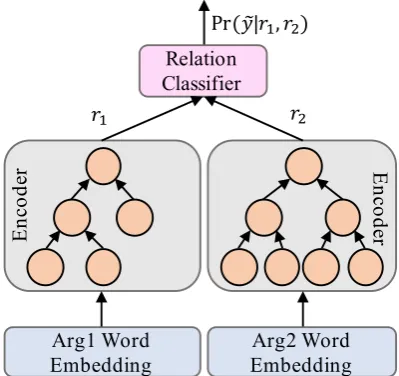
se-mantics of the two arguments; 2) classifying the relations based on the semantics. Our main contri-bution concentrates on the semantic modeling part with two types of tree-structured neural networks described in Section 3.1 and we further illustrate how to leverage the constituent tags to enhance these two models in Section 3.2. In Section 3.3, we will shortly introduce the relation classifier and the training procedure of our model. The architec-ture of our system is illustrated in Figure2.
Arg1 Word Embedding
Arg2 Word Embedding Relation
Classifier
𝑟" 𝑟#
Pr (𝑦)|𝑟", 𝑟#)
En
co
de
r En
co
de
r
Figure 2: Architecture of our discourse relation classification model. Layers with the same color share the same parameters.
3.1 Modeling the Arguments with Tree-Structured Neural Networks
In a typical tree-structured neural network, given a parse tree of the text, the semantic representations of smaller text units are recursively composed to compute the representation of larger text spans and finally compute the representation for the whole text (e.g., sentence). In this work, we will con-struct our models based on the constituency parse tree, as is shown in Figure 1. Following previ-ous convention (Eriguchi et al.,2016;Zhao et al.,
2017), we convert the general parse tree, where the branching factor may be arbitrary, into a bi-nary tree so that we only need to consider the left and right children at each step. Then the following Tree-LSTM and Tree-GRU models can be used to obtain a vector representation of each argument.
step to take the word at current step and previous output as its input, update its memory cell and out-put a new hidden vector. In the Tree-LSTM model, a similar LSTM unit is applied to each node in the tree in a bottom-up manner. Since each internal node in the binary parse tree has two children, the Tree-LSTM unit has to consider information from two preceding nodes, as opposed to the single pre-ceding node in the sequential LSTM model. Each Tree-LSTM unit (indexed byj) contains an input gate ij, a forget gatefj 1 and an output gate oj.
The computation equations at node j are as
fol-lows:
ij =σ
(
W(i)x
j+U(i)[hLj, hRj ]) (1)
fj =σ(W(f)xj+U(f)[hLj, hRj ]) (2)
oj =σ
(
W(o)xj +U(o)[hLj, hRj]) (3)
uj = tanh
(
W(u)x
j +U(u)[hLj, hRj
])
(4)
cj =ij⊙uj+fj ⊙cLj +fj ⊙cRj (5)
hj =oj⊙tanh (cj) (6)
where xj is the embedded word input at current
node j, σ denotes the logistic sigmoid function
and ⊙denotes element-wise multiplication. hL
j, hR
j are the output hidden vectors of the left and
right children, and cL
j, cRj are the memory cell
states from them, respectively. To save space, we leave out all the bias terms in affine transforma-tions and the same is true for other affine transfor-mations in this paper.
Intuitively,ujcan be regarded as a summary of the inputs at current node, which is then filtered by ij. The memory from left and right children
are forgotten byfj and then we compose them to-gether with the new inputs to form the the new memory cj. At last, part of the information in
memorycj is exposed byojto generate the output vectorhjfor current step. Another thing to note is that only leaf nodes in the constituency tree have words as its input, soxj is set to a zero vector in
other cases.
Tree-GRU Model. Similar to Tree-LSTM, the Tree-GRU model extends the sequential GRU model to tree structures. The only difference be-tween Tree-GRU and Tree-LSTM is how they
1The original Binary Tree-LSTM in (Tai et al.,2015) con-tains separate forget gates for different child nodes but we find single forget gate performs better in our task.
modulate the flow of information inside the unit. Specifically, Tree-GRU unit removes the separate memory cell and only uses two gates to simu-late the reset and update procedure in informa-tion gathering. The computainforma-tion equainforma-tions in each Tree-GRU unit are the following:
rj =σ(W(r)xj+U(r)[hLj, hRj ]) (7)
zj =σ
(
W(z)x
j+U(z)[hLj, hRj]) (8)
˜
hj = tanh(W(h)xj+U(h)[hLj ⊙rj, hRj ⊙rj])
(9)
hj =zj⊙˜hj+ (1−zj)⊙(hLj +hRj
)
(10)
whererjis the reset gate andzjis the update gate.
The reset gate allows the network to forget pre-vious computed representations, while the update gate decides the degree of update to the hidden state. There is no memory cell in Tree-GRU, with onlyhL
j andhRj as the hidden states from the left
and right children.
3.2 Controlling the Semantic Composition with Constituent Tags
The constituent tag in a parse tree describes the grammatical role of its corresponding constituent in the context. Bies et al. (1995) defines several types of constituent tags, including clause-level tags (e.g., SBAR, SINV, SQ), phrase-level tags (e.g., NP, VP, PP) and word-level tags (e.g., NN, VP, JJ). These constituent tags greatly interleave with the semantics and in some ways can provide determinant signals for the importance of a stituent. For example, for most of the time, con-stituents with PP (prepositional phrase) tag are less important than those with VP (verb phrase) tag. Therefore we argue that these tags are worth con-sidering when we compose the semantics in the tree-structured neural networks.
One way to leverage such tags is using tag-specific composition functions but that would lead to large number of parameters and some tags are very sparse so it’s very hard to train their corre-sponding parameters sufficiently. To solve this problem, we propose to use tag embeddings and dynamically control the composition process via the gates in our model.
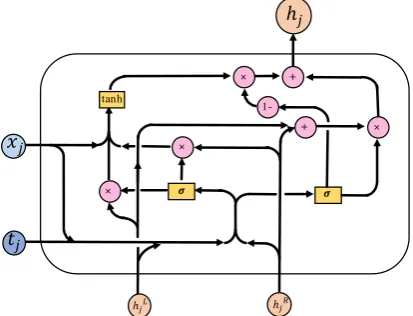
to a new representation. Furthermore, these gates are computed dynamically according to the inputs at a certain step. Therefore, it’s natural to incor-porate the tag embeddings in the computation of these gates. Based on this idea, we propose the Tag-Enhanced Tree-LSTM model, where the in-put, forget and output gates in each unit are calcu-lated as follows:
ij =σ
(
W(i)xj+M(i)tj+U(i)[hLj, hRj ])
(11)
fj =σ
(
W(f)x
j+M(f)tj+U(f)[hLj, hRj
])
(12)
oj =σ(W(o)xj +M(o)tj +U(o)[hLj, hRj])
(13) Similarly, we can have the Tag-Enhanced Tree-GRU model with new reset and update gates:
rj =σ(W(r)xj+M(r)tj+U(r)[hLj, hRj])
(14)
zj =σ
(
W(z)xj+M(z)tj+U(z)[hLj, hRj])
(15) where tj is the embedding of the tag at current
node (indexed byj).
3.3 Relation Classification and Training
In our work, the two arguments are encoded with the same network in order to reduce the number of parameters. After that we get a vector representa-tion for each argument, which can be denoted asr1
for argument 1 andr2 for argument 2. Supposing
that there are totallynrelation types, the predicted probability distributionyˆ∈Rnis calculated as:
ˆ
y=softmax(W(ˆy)[r
1, r2] +b(ˆy)
)
(16)
To train our model, the training objective J is dened as the cross-entropy loss with L2 regular-ization:
E(ˆy, y) =−∑n
j=1
yj×log ˆyj (17)
J(θ) = N1 ∑N
k=1
E(ˆy, y) +λ2∥θ∥2 (18)
tanh
tanh 𝝈
𝝈
𝝈 ×
×
× ×
+
ℎ𝑗𝐿 ℎ𝑗𝑅 𝑐𝑗𝐿 𝑐𝑗𝑅
ℎ𝑗 𝑐𝑗
𝑥𝑗
𝑡𝑗
Figure 3: Flow of Information in Tag-Enhanced Tree-LSTM unit.
𝝈
+
ℎ𝑗
×
𝑡𝑗
×
1-ℎ𝑗𝐿
𝝈 ×
𝑥𝑗
tanh
+
ℎ𝑗𝑅
×
Figure 4: Flow of Information in Tag-Enhanced Tree-GRU unit.
whereyˆis the predicted probability distribution,y
is the one-hot representation of the gold label and
N is the number of training samples.
4 Experiments 4.1 Experiment Setup
Tem-Models Level-1 Classification Level-2 ClassificationDev Test Dev Test
Bi-LSTM 55.10 56.88 35.02 42.44
Bi-GRU 55.21 57.01 35.34 42.46
Tree-LSTM 56.04 58.89 35.76 43.02
Tree-GRU 55.36 58.98 36.09 43.78
Tag-Enhanced Tree-LSTM 56.97 59.85 35.92 45.21
Tag-Enhanced Tree-GRU 56.63 59.75 36.93 44.55
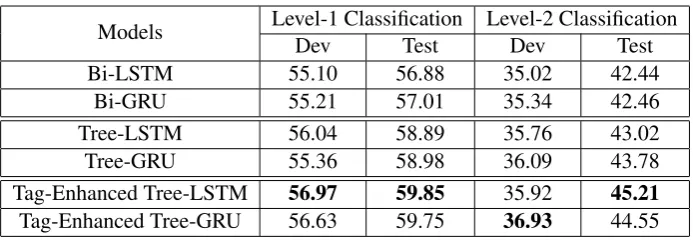
Table 1: The accuracy score of multi-class classification
poral, Contingency, Comparison andExpansion. Then for each class, it is further divided into dif-ferent types, which is supposed to provide finer pragmatic distinctions. This totally yields 16 rela-tion types at the second level. At last, a third level of subtypes is defined for some types according to the semantic contribution of each argument.
Preprocesssing. Following the common setup
convention (Rutherford and Xue, 2014; Ji and
Eisenstein, 2014;Liu and Li, 2016), we split the dataset into training set (Sections 2-20), develop-ment set (Sections 0-1), and test set (Section 21-22). For preprocessing, we employ the Stanford CoreNLP toolkit (Manning et al., 2014) to lem-matize all the words and get the constituency parse tree for each sentence. Then we convert the parse tree into binary with right branching and we re-move the internal nodes that have only one child so that our binary tree-structured models can be applied. Small portion of the arguments in PDTB are composed of multiple sentences. In such cases, we add a new “Root” node and link the original root nodes of those sentences to this shared “Root” before converting the tree into binary.
Multi-Class Classification There are mainly two ways to set up the classification tasks in pre-vious work. Early studies (Pitler et al., 2009;
Park and Cardie,2012) train and evaluate separate “one-versus-all” classifiers for each discourse re-lation since the classes are extremely imbalanced in PDTB. However, recent work put more empha-sis on the multi-class classification, where the goal is to identify a discourse relation from all possible choices. According toRutherford and Xue(2014), the multi-class classification setting is more natu-ral and realistic. Moreover, the multi-class clas-sifier can directly serve as one building block of a complete discourse parser (Qin et al., 2017). Therefore, in this work, we will focus on the
multi-class multi-classification task. Moreover, we will ex-periment on the classification of both the Level-1 classes and the Level-2 types, so that we can compare with most of previous systems and thor-oughly analyze the performance of our method.
It should be noted that roughly 2% of the im-plicit relation instances are annotated with more
than one types. Following Ji and Eisenstein
(2014), we treat these different types as multiple instances while training our model. During test-ing, if the classifier hits either of the annotated types, we consider it to be correct. We also fol-low previous studies (Lin et al.,2009;Ji and Eisen-stein,2014) to remove the instances of 5 very rare relation types in the second level. Therefore we have totally 11 types to classify for Level-2 classi-fication and 4 classes for Level-1 classiclassi-fication.
4.2 Model Settings
We tune the hyper-parameters of our Tag-Enhanced Tree-LSTM model based on the devel-opment set and other models share the same set of parameters. The best-validated hyper-parameters, including the size of the word embed-dingsω, the size of the tag embeddingsτ, the di-mension of the Tree-LSTM or Tree-GRU hidden stated, the learning rateη, the weight of L2 regu-larization termλand the batch sizebare shown in Table2.
ω τ d η λ b
50 50 250 0.01 0.0001 10
Table 2: Hyper-parameters of our model
We adopt the AdaGrad optimizer (Duchi et al.,
2011) for training our model and we validate the performance every epoch. It takes around 5 hours (5 epochs) for the Tag-Enhanced Tree-LSTM and 4 hours (6 epochs) for the Tag-Enhanced Tree-GRU model to converge to the best performance, using one INTEL(R) Core(TM) I7 3.4GHz CPU and one NVIDIA GeForce GTX 1080 GPU.
4.3 Results
The evaluation results of our models on both the Level-1 classification and the Level-2 classifica-tion are reported in Table 1. Accuracy score is used to measure the overall performance and we present our performance on both the development set and the test set. In addition to the four tree-structured neural networks described in Section
3, we also implement two baseline models: the
bi-directional LSTM model and the bi-directional GRU model. The hyper-parameters of these two models are tuned separately from other models. Due to the space limitation, we don’t present the details here. Comparison of these sequential mod-els with the tree-structured modmod-els are expected to show the effects of tree structures.
From Table1, we can see that the sequential Bi-LSTM model and Bi-GRU model perform worst for our task, which confirms our hypothesis that the tree-structured neural networks can really cap-ture some important signals that are missing in the sequential models.
Furthermore, if we add the tag information to tree-structured models, both the Tag-Enhanced LSTM model and the Tag-Enhanced Tree-GRU model provide conspicuous improvement (around 1%) compared with the no-tag version. This demonstrates the usefulness of those con-stituent tags and the effectiveness of our method to incorporate this important feature. Especially, since both the Tree-LSTM model and Tree-GRU model rely on the gating machanism to control the flow of information, this double confirms that the tag information can help with the computation of such gates and therefore can be leveraged to con-trol the semantic composition process.
Another discovery from our results is that the GRU models performs similarly as its correspond-ing variant of LSTM model. This conforms to previous empirical observation in sequential mod-els that LSTM and GRU have comparable capabil-ity (Chung et al.,2014). However, the Tree-GRU
Systems Accuracy
Zhang et al.(2015) 55.39
Rutherford and Xue(2014) 55.50
Rutherford and Xue(2015) 57.10
Liu et al.(2016) 57.27
Liu and Li(2016) 57.57
Ji et al.(2016) 59.50
Tag-Enhanced Tree-LSTM 59.85
Tag-Enhanced Tree-GRU 59.75
Table 3: Accuracy (%) for Level-1 multi-class classification on the test set, compared with other state-of-the-art systems.
Systems Accuracy
Lin et al.(2009) 40.66
Ji and Eisenstein(2014) 44.59
Qin et al.(2016) 45.04
Qin et al.(2017) 46.23
Tag-Enhanced Tree-LSTM 45.21
Tag-Enhanced Tree-GRU 44.55
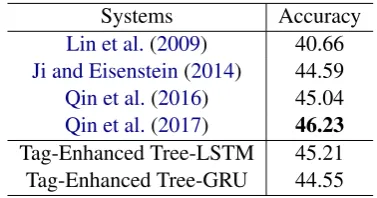
Table 4: Accuracy (%) for Level-2 multi-class classification on the test set, compared with other state-of-the-art systems.
model have less parameters to train which could alleviate the problem of overfitting and also cost less training time.
4.4 Comparison with Other Systems
For a comprehensive study, we compare our mod-els with other state-of-the-art systems. The sys-tems that conduct Level-1 classification are re-ported in Table3, including:
• Zhang et al. (2015) proposes to use convo-lutional neural networks to encode the argu-ments.
• Rutherford and Xue(2014) manually extracts features to represent the arguments and use a maximum entropy classifier for classifi-cation. Rutherford and Xue (2015) further exploits discourse connectives to enrich the training data.
• Liu et al.(2016) employs a multi-task frame-work that can leverage other discourse-related data to help with the training of dis-course relation classifier.
mechanism to model the interaction between the two arguments.
• Ji et al.(2016) treats the discourse relation as latent variable and proposes to model them jointly with the sequences of words using a latent variable recurrent neural network ar-chitecture.
And in Table 4, we present the following sys-tems, which focus on Level-2 classification:
• Lin et al. (2009) uses traditional feature-based model to classify relations. Especially, constituent and dependency parse trees are exploited.
• Ji and Eisenstein(2014) models both the se-mantics of argument and the meaning of en-tity mention with two recursive neural net-works, which are then combined to classify relations.
• Qin et al.(2016) utilize convolutional neural network for argument modeling and a collab-orative gated neural network to model their interaction.
• Qin et al.(2017) proposes to incorporate the connective information via a novel pipelined adversarial framework.
The comparison with these latest work shows that our system achieves currently best perfor-mance for the Level-1 classification and ranks sec-ond for the Level-2. With the state-of-the-art per-formance on both levels, we can verify the effec-tiveness of our method.
4.5 Qualitative Analysis
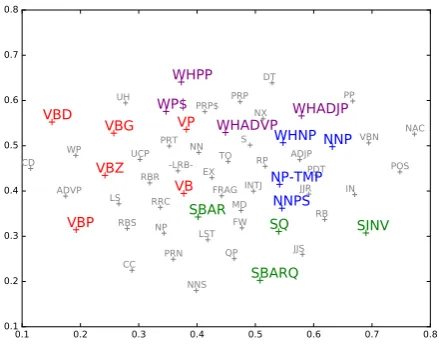
To get a deeper insight into the proposed tag-enhanced models, we project the constituent tag embeddings learned in our Tag-Enhanced Tree-LSTM model into two dimensions using the t-SNE method (Maaten and Hinton,2008) and normalize the values in each dimension. The projected em-beddings are visualized in Figure 5and we high-light some representative tags that may share some kind of commonality in their functions.
According to the definition inBies et al.(1995), the tags with red color are all verb-related, while those with blue color describes noun-related syn-tax. Despite of some noisy points, we can see that they are roughly separated into two groups.
0.1 0.2 0.3 0.4 0.5 0.6 0.7 0.8
Figure 5: t-SNE Visualization (Maaten and
Hin-ton,2008) of the constituent tag embeddings
In addition, the purple tags correspond to words or phrase that are wh-related (e.g., what, when, where, which) and we can see they are distributed similarly. Moreover, the green tags are, which are located in the right-bottom corner, all describe the clause-level constituents.
Therefore, from this visualization, we can con-clude that the tag embeddings we learned are somewhat meaningful and really capture some functionalities of these tags. Since these em-beddings are used to compute the gates and the gates further determine the flow of information, we argue that these tags can indeed help to con-trol the semantic composition process in our tree-structured networks.
5 Conclusion
Acknowledgments
We thank all the anonymous reviewers for their in-sightful comments on this paper. This work was partially supported by National Natural Science Foundation of China (61572049 and 61333018). The correspondence author of this paper is Sujian Li.
References
Ann Bies, Mark Ferguson, Karen Katz, Robert Mac-Intyre, Victoria Tredinnick, Grace Kim, Mary Ann Marcinkiewicz, and Britta Schasberger. 1995. Bracketing guidelines for treebank ii style penn tree-bank project. University of Pennsylvania, 97:100.
Qian Chen, Xiaodan Zhu, Zhen-Hua Ling, Si Wei, Hui Jiang, and Diana Inkpen. 2017. Enhanced lstm for natural language inference. InProc. ACL.
Junyoung Chung, C¸aglar G¨ulc¸ehre, KyungHyun Cho, and Yoshua Bengio. 2014. Empirical evaluation of gated recurrent neural networks on sequence model-ing. CoRR, abs/1412.3555.
John Duchi, Elad Hazan, and Yoram Singer. 2011. Adaptive subgradient methods for online learning and stochastic optimization. Journal of Machine Learning Research, 12(Jul):2121–2159.
Akiko Eriguchi, Kazuma Hashimoto, and Yoshi-masa Tsuruoka. 2016. Tree-to-sequence atten-tional neural machine translation. arXiv preprint arXiv:1603.06075.
Yangfeng Ji and Jacob Eisenstein. 2014. One vec-tor is not enough: Entity-augmented distributional semantics for discourse relations. arXiv preprint arXiv:1411.6699.
Yangfeng Ji, Gholamreza Haffari, and Jacob Eisen-stein. 2016. A latent variable recurrent neural net-work for discourse relation language models. arXiv preprint arXiv:1603.01913.
Filippos Kokkinos and Alexandros Potamianos. 2017. Structural attention neural networks for improved sentiment analysis. arXiv preprint arXiv:1701.01811.
Ziheng Lin, Min-Yen Kan, and Hwee Tou Ng. 2009. Recognizing implicit discourse relations in the penn discourse treebank. InProceedings of the 2009 Con-ference on Empirical Methods in Natural Language Processing: Volume 1-Volume 1, pages 343–351. Association for Computational Linguistics.
Yang Liu and Sujian Li. 2016. Recognizing implicit discourse relations via repeated reading: Neural net-works with multi-level attention. arXiv preprint arXiv:1609.06380.
Yang Liu, Sujian Li, Xiaodong Zhang, and Zhifang Sui. 2016. Implicit discourse relation classification via multi-task neural networks. In AAAI, pages 2750– 2756.
Laurens van der Maaten and Geoffrey Hinton. 2008. Visualizing data using t-sne. Journal of Machine Learning Research, 9(Nov):2579–2605.
Christopher D. Manning, Mihai Surdeanu, John Bauer, Jenny Finkel, Steven J. Bethard, and David Mc-Closky. 2014. The stanford corenlp natural lan-guage processing toolkit. InAssociation for Compu-tational Linguistics (ACL) System Demonstrations, pages 55–60.
Daniel Marcu. 1997. The rhetorical parsing of natu-ral language texts. InProceedings of the 35th An-nual Meeting of the Association for Computational Linguistics and Eighth Conference of the European Chapter of the Association for Computational Lin-guistics, pages 96–103. Association for Computa-tional Linguistics.
Joonsuk Park and Claire Cardie. 2012. Improving im-plicit discourse relation recognition through feature set optimization. In Proceedings of the SIGDIAL 2012 Conference, The 13th Annual Meeting of the Special Interest Group on Discourse and Dialogue, pages 108–112.
Jeffrey Pennington, Richard Socher, and Christo-pher D. Manning. 2014. Glove: Global vectors for word representation. InEmpirical Methods in Nat-ural Language Processing (EMNLP), pages 1532– 1543.
Emily Pitler, Annie Louis, and Ani Nenkova. 2009. Automatic sense prediction for implicit discourse re-lations in text. InProceedings of the Joint Confer-ence of the 47th Annual Meeting of the ACL and the 4th International Joint Conference on Natural Lan-guage Processing of the AFNLP: Volume 2-Volume 2, pages 683–691. Association for Computational Linguistics.
Rashmi Prasad, Nikhil Dinesh, Alan Lee, Eleni Milt-sakaki, Livio Robaldo, Aravind K. Joshi, and Bon-nie L. Webber. 2008. The penn discourse treebank 2.0. In Proceedings of the International Confer-ence on Language Resources and Evaluation, LREC 2008, 26 May - 1 June 2008, Marrakech, Morocco.
Qiao Qian, Bo Tian, Minlie Huang, Yang Liu, Xuan Zhu, and Xiaoyan Zhu. 2015. Learning tag embed-dings and tag-specific composition functions in re-cursive neural network. In ACL (1), pages 1365– 1374.
Lianhui Qin, Zhisong Zhang, Hai Zhao, Zhiting Hu, and Eric P Xing. 2017. Adversarial connective-exploiting networks for implicit discourse relation classification. arXiv preprint arXiv:1704.00217. Attapol Rutherford and Nianwen Xue. 2014.
Discover-ing implicit discourse relations through brown clus-ter pair representation and coreference patclus-terns. In Proceedings of the 14th Conference of the European Chapter of the Association for Computational Lin-guistics, 2014, pages 645–654.
Attapol Rutherford and Nianwen Xue. 2015. Improv-ing the inference of implicit discourse relations via classifying explicit discourse connectives. In The 2015 Conference of the North American Chapter of the Association for Computational Linguistics: Hu-man Language Technologies, pages 799–808. Richard Socher, Cliff C Lin, Chris Manning, and
An-drew Y Ng. 2011. Parsing natural scenes and natu-ral language with recursive neunatu-ral networks. In Pro-ceedings of the 28th international conference on ma-chine learning (ICML-11), pages 129–136.
Richard Socher, Alex Perelygin, Jean Y Wu, Jason Chuang, Christopher D Manning, Andrew Y Ng, Christopher Potts, et al. 2013. Recursive deep models for semantic compositionality over a senti-ment treebank. InProceedings of the conference on empirical methods in natural language processing (EMNLP), volume 1631, page 1642.
Radu Soricut and Daniel Marcu. 2003. Sentence level discourse parsing using syntactic and lexical infor-mation. In Proceedings of the 2003 Conference of the North American Chapter of the Association for Computational Linguistics on Human Language Technology-Volume 1, pages 149–156. Association for Computational Linguistics.
Rajen Subba and Barbara Di Eugenio. 2009. An effec-tive discourse parser that uses rich linguistic infor-mation. InProceedings of Human Language Tech-nologies: The 2009 Annual Conference of the North American Chapter of the Association for Computa-tional Linguistics, pages 566–574. Association for Computational Linguistics.
Kai Sheng Tai, Richard Socher, and Christopher D Manning. 2015. Improved semantic representations from tree-structured long short-term memory net-works. arXiv preprint arXiv:1503.00075.
Deborah Tannen. 2012. Discourse analysis–what speakers do in conversation. Linguistic Society of America.
Gilbert Weiss and Ruth Wodak. 2007. Critical dis-course analysis. Springer.
Biao Zhang, Jinsong Su, Deyi Xiong, Yaojie Lu, Hong Duan, and Junfeng Yao. 2015. Shallow convolu-tional neural network for implicit discourse relation recognition. InProceedings of the 2015 Conference on Empirical Methods in Natural Language Pro-cessing, pages 2230–2235.
Kai Zhao, Liang Huang, and Mingbo Ma. 2017. Tex-tual entailment with structured attentions and com-position. CoRR, abs/1701.01126.