Learning Efficient Information Extraction on Heterogeneous Texts
Henning Wachsmuth University of Paderborn, s-lab
Paderborn, Germany [email protected]
Benno Stein
Bauhaus-Universit¨at Weimar Weimar, Germany [email protected]
Gregor Engels
University of Paderborn, s-lab Paderborn, Germany
Abstract
From an efficiency viewpoint, information extraction means to filter the relevant por-tions of natural language texts as fast as possible. Given an extraction task, differ-ent pipelines of algorithms can be devised that provide the same precision and recall but that vary in their run-time due to dif-ferent pipeline schedules. While recent re-search investigated how to determine the run-time optimal schedule for a collection or a stream of texts, this paper goes one step beyond: we analyze the run-times of efficient schedulesas a function of the
het-erogeneityof the texts and we show how
this heterogeneity is characterized from a data perspective. For extraction tasks on heterogeneous big data, we present a self-supervised online adaptation approach that learns to predict the optimal schedule de-pending on the input text. Our evaluation suggests that the approach will significant-ly improve efficiency on collections and streams of texts of high heterogeneity.
1 Introduction
Information extraction analyzes natural language text in order to find relevant information about en-tities and the events they participate in. An extrac-tion task often requires to fill event templates with considerable numbers of slots. Such a task implies several analysis steps, e.g. certain types of entity and relation extraction, and it is therefore typically tackled with a pipelineΠ=hA, πi, whereAis a set of extraction algorithms andπ a schedule that prescribes the order of algorithm application. The information sought for is anchored in text units of a certain size, e.g. in a sentence or paragraph.
In times of big data, the run-time efficiency of information extraction receives much attention in research and industry (Chiticariu et al., 2010).
Among others, a growing need for business intelli-gence can be regarded as the driving force behind. This trend is equally observed by consulting com-panies who see evolving markets for predictive an-alytics (Harper, 2011), by global software players who exploit big data for decision making (White, 2011), and by researchers who seek to annotate ta-bles at web scale (Limaye et al., 2010).
Generally, a pipeline Π = hA, πi can be sped up by parallelization (Agichtein, 2005), if given enough resources, or by using faster but less ef-fective algorithms (Al-Rfou’ and Skiena, 2012). In addition, information extraction can always be approached as a filtering task as discussed in detail in (Wachsmuth et al., 2013b): By filling a template slot, each algorithm inAimplicitly classifies cer-tain units of an input text as relevant. Only these units need to be filtered for the next algorithm inπ. As a result, a smart scheduleπ will often signif-icantly improve the overall extraction efficiency. If the input requirements of all algorithms in A are met withinπ, the effectiveness ofΠ(in terms of both precision and recall) will be maintained, since the output ofΠexactly lies in the filtered text units (Wachsmuth and Stein, 2012).1
When given a big data filtering task, the desig-ner of a pipeline faces two challenges: (1) How to determine the most efficient schedule for a set of extraction algorithms and a collection or a stream of texts? (2) How to maintain efficiency under het-erogeneous text characteristics? With regard to the former challenge we resort to existing research (cf. Section 2). The latter becomes an issue where in-put texts are not fully known or come from differ-ent sources as in the web. Moreover, streams of texts can undergo substantial changes in the
distri-1
The simplest filtering task is to extract a relation between two entity types, such as<ORG>was founded in<TIME>. E.g., the sentence“Google was established by two Stanford students.” needs not to be filtered for relation extraction, as it contains no time entity. The schedule of the two implied entity recognition steps will affect the extraction efficiency.
bution of relevant information. We argue that such kinds of uncertainty and lack of a-priori knowl-edge cannot be tackled offline, but they require to learn and to adapt to the characteristics of input texts to avoid a noticeable efficiency loss.
1.1 Contributions and Outline
In this paper, we analyze to what extent the hetero-geneity of natural language texts in the distribution of relevant information affects the efficiency of an information extraction pipeline. For a high hetero-geneity, we propose an adaptation of the pipeline’s schedule, which we address with online learning. Our learning algorithm maps basic linguistic char-acteristics of a text to run-times of pipelines and chooses the pipeline with the lowest predicted run-time. The algorithm learns self-supervised and it is language-independent. To measure the impact of heterogeneity, we evaluate the algorithm on pre-cisely constructed text corpora of different hetero-geneity. Our contributions are three-fold:
1. We develop a self-supervised online adapta-tion algorithm that learns the efficiency of in-formation extraction pipelines (Section 3).
2. We quantify the heterogeneity of natural lan-guage texts with regard to the distribution of relevant information (Section 4).
3. We evaluate the need for online adaptation in efficient information extraction as a function of the heterogeneity of input texts (Section 5).
2 Related Work
One line of research on extraction efficiency refers
todeclarative information extraction(Shen et al.,
2007). In particular, Krishnamurthy et al. (2009) created SYSTEMT to address the needs of enter-prise extraction applications. SYSTEMT involves optimization strategies such as the ordering and in-tegration of analysis steps (Reiss et al., 2008), but it is restricted to rule-based extraction.
In (Wachsmuth et al., 2011a), we introduced a method that optimizes the schedule of an arbitrary set of extraction algorithms. This method captures much optimization potential and it can be auto-mated using techniques from artificial intelligence (Wachsmuth et al., 2013a). Unlike the approach in this paper, however, the method does not handle variances in the characteristics of input texts.
Our approach applies to all extraction tasks with dependencies between the relevant types of infor-mation. We target at template filling, which
con-sists in relating a number of entities to events of predefined types (Cunningham, 2006). Recent re-search, e.g. (Jean-Louis et al., 2011), and major evaluation tracks, e.g. (Kim et al., 2011), show the ongoing importance of template filling.
We consider extraction pipelines that perform filtering, which have a long tradition (Cowie and Lehnert, 1996). Sarawagi (2008) sees the efficient filtering of relevant portions of input texts as a main challenge. In the pipelines we focus on, each algorithm takes on one analysis (Grishman, 1997). Other approaches such asjoint information extrac-tion (Choi et al., 2006) can be effective, but they are not suitable when efficiency is important.
van Noord (2009) trades parsing efficiency for parsing effectiveness by learning a heuristic filter-ing of useful parses. In contrast, we develop a self-supervised online learning algorithm to achieve ef-ficient extraction without reducing effectiveness. While our approach works with every predefined relation and event type, arbitrary binary relations are found in self-supervisedopen information
ex-traction(Fader et al., 2011). Self-supervised
lear-ning aims to fully overcome manual text labeling, mostly for learning language like McClosky et al. (2010). To our knowledge, we are the first to apply it for predicting extraction efficiency.
3 Learning Efficient Extraction
The run-time efficiency of an information extrac-tion pipeline depends on the distribuextrac-tion of rele-vant information in its input texts (Wachsmuth and Stein, 2012). For situations where this distribution varies, we now present an approach that chooses a pipeline schedule depending on the text at hand. To maintain precision and recall, we consider only schedules that fulfill the input requirements of all algorithms employed in a pipeline.
3.1 Splitting the Pipeline
Most extraction tasks require some analyses (e.g. tokenization) to be performed on the whole input texts, as they are needed for most or all subsequent analyses. We exploit this notion in that we use the results of the first algorithms in a pipeline to pre-dict the best schedule of the remaining algorithms. To this end, we split a pipeline into a fixed first part and a variable second part. We call the first part the
prefix pipeline, denoted asΠpre, and each second
partΠ1, . . . ,Πkamain pipeline.
6.1. Predict run-time of main pipeline ∏1
6.k. Predict run-time of main pipeline ∏k
... 7. Execute ∏* with
lowest prediction of main pipeline 8. Get run-time∏* 9. Update model ofmain pipeline ∏* 4.k. Get run-time
of main pipeline ∏k 3.k. Execute
main pipeline ∏k of main pipeline 5.k.Update model∏k
... ... ...
3.1. Execute main pipeline ∏1
4.1. Get run-time of main pipeline ∏1
5.1.Update model of main pipeline ∏1
2. Compute feature values 1. Execute prefix
pipeline ∏pre
[training phase]
[update phase]
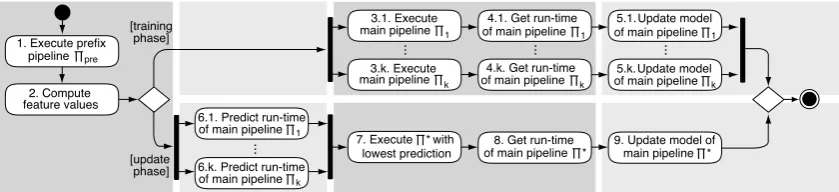
Figure 1: Illustration of the online adaptation algorithm with a prefix pipelineΠpreandkmain pipelines Π1, . . . ,Πkfor one input text, which either goes through the training phase or through the update phase.
Due to the algorithms’ input constraints, how-ever,kis normally much lower in practice. Also, there might be ways to restrict the set of candidate schedules to a reasonable selection, which is itself a non-trivial problem that is beyond the scope of this paper. In the following, we simply assume thatk≤m!main pipelines are given.
3.2 Self-Supervised Learning of Run-times
For a collection or a stream of textsD, our goal is to determine the most efficient main pipeline for each text inD. We approach this goal as an on-line regression problem by learning to predict the run-time per text unitt(Πi)of each main pipeline Πi ∈ {Π1, . . . ,Πk}. Based on the results ofΠpre, we represent each textD∈Das a feature vector (x1, ..., xp) in order to create a regression model
for each t(Πi). Concretely, we map the feature valuesx(1D), ..., x(pD)forDto a predicted run-time ˜
t(Πi). Then,Dis processed by the main pipeline Π∗with the lowest prediction.
In this manner, learning can be approached self-supervised, as all training data is generated auto-matically: the feature values and the observed run-timet(Π∗)ofΠ∗onDserve as a new training in-stance, and the prediction error is given by the dif-ference betweent(Π˜ ∗)andt(Π∗). Still, an explicit training set that is processed by all main pipelines helps to create initial regression models.
3.3 The Online Adaptation Algorithm
Let a prefix pipelineΠpre, a set of main pipelines Π1, . . . ,Πk, and a collection or a stream of textsD
be given. ThenD is split into two partsDT and
DUto serve the following two phases of theonline adaptation algorithm:
1. Training.On each textD∈DT, executeΠpre
and eachΠi∈ {Π1, . . . ,Πk}. Update the re-gression model of eachΠi wrt. the results of Πpreand the run-timet(Πi)ofΠionD.
2. Update.On each textD∈DU, executeΠpre
and predict˜t(Πi)for allΠi∈ {Π1, . . . ,Πk}.
Execute theΠ∗with the lowest prediction and update its regression model wrt. the results of Πpreand the run-timet(Π∗)ofΠ∗ onD.
Figure 1 illustrates the online adaptation algorithm on one single text. An intuitive extension is to it-eratively schedule each extraction algorithm sepa-rately. This would allow us to use detailed knowl-edge in later predictions. Since the first predic-tions are most decisive, however, we do not con-sider the iterative scenario here for simplicity.
3.4 Baselines and the Gold Standard
One way to evaluate our approach is to compare it to each pipeline(Πpre,Πi),Πi∈ {Π1, . . . ,Πk}. In practice, relying on such a fixed pipeline involves the danger of choosing a slow one. Hence, we also consider two baseline approaches below:
1. Random baseline. For each textD ∈ DU,
choose a main pipeline (pseudo-) randomly.
2. Optimal baseline. For each text D ∈ DU,
choose the main pipeline that has achieved the best overall run-time onDT.
The optimal baseline serves as a strong competitor on homogeneous collections and streams of texts, where it will often find the run-time optimal fixed pipeline. In contrast, the random baseline appears rather weak, but it will never fail completely.
Besides, we compute the gold standardbelow, i.e., an oracle that knows the fastest main pipeline for each text beforehand. The gold standard de-fines the upper ceiling for a set of main pipelines, thereby quantifying the general optimization po-tential. In that, it helps to evaluate whether online adaptation is suitable for the input texts at hand.
4 The Heterogeneity of Texts
where input texts are heterogeneous in content or style, as is typical for the results of an exploratory web search. From an extraction perspective, the heterogeneity of a collection or a stream of textsD can be regarded as the extent to which the texts inDvary in the distribution of instances of the rel-evantinformation types C1, . . . , Cm, i.e., the en-tity, relation, and event types to be extracted.
As motivated in Section 1, text units need to be analyzed only if they may contain instances of all relevant information types. Hence, a pipeline’s efficiency depends on the density ρi(D) of each typeCi in the input texts inD. Here, the density corresponds to the fraction of text units inDthat contain an instance ofCi. The density ρi(D) of Ci in a single textD∈D can be defined accord-ingly. Now, differences in the run-time per text unit of a pipeline mainly result from varying den-sitiesρi(D). In this regard, the heterogeneity ofD can be quantified by measuring the variance of all densities in the texts inD. The outlined consider-ations give rise to the following measure:
Averaged Deviation LetC= {C1, . . . , Cm}be
the set of relevant information types for an extrac-tion task, and letσi(D) be the standard deviation of the densityρi(D)ofCi ∈Cin a collection or a stream of textsD. Then, the averaged deviation ofCinDis
σ(C|D) = 1 m ·
m
X
i=1
σi(D).
We compute exact valuesσ(C|D)in Section 5 to measure the impact of heterogeneity. In general, the averaged deviation can also be estimated on a sample of texts. For illustration, Table 1 lists the deviations for the three most common named en-tity types in the German part of theCoNLL’03 cor-pus(Tjong Kim Sang and De Meulder, 2003), in
theRevenue corpus(Wachsmuth et al., 2010), in a
sample of the German Wikipedia (the first 10,000 articles according to internal page ID), and in the
LFA-11 smartphone corpus, which is a web crawl
of blog posts (Wachsmuth and Bujna, 2011). Here, we recognized entities usingStanford NER(Finkel et al., 2005; Faruqui and Pad´o, 2010).
Different from other sampling-based efficiency estimations, cf. (Wang et al., 2011), the averaged deviation doesnotmeasure the typical characteris-tics of input texts, but it quantifies how much these characteristics vary. By that, it helps pipeline de-signers to decide whether an online adaptation of pipeline schedules is needed to ensure efficient
ex-Information typeCi σi(Dco) σi(Drv) σi(Dwk) σi(Dbp)
Person entities 18.4% 11.1% 15.9% 16.6% Organization entities 18.1% 16.0% 14.1% 23.4% Location entities 16.6% 10.9% 16.0% 15.3% Averaged deviation 17.7% 12.7% 15.3% 18.4%
Table 1: The standard deviationσiof the density of three entity types in the CoNLL’03 corpus Dco,
the Revenue corpusDrv, a sample of 10,000
Wiki-pedia articlesDwk, and a crawl of blog postsDbp.
The bottom line shows their averaged deviations.
traction. However, its current form leaves unclear how to compare deviations across tasks. In future work, a solution will be to normalize the averaged deviation—either with respect to a reference cor-pus or with respect to the given task, e.g. to a situ-ation where all schedules perform equally well.
4.1 Text Corpora of Different Heterogeneity
For a careful evaluation of online adapation, we need input texts that refer to different levels of het-erogeneity while being appropriate for analyzing a single and sufficiently complex filtering task at the same time. Most corpora for extraction tasks are too small to create reasonable subsets of different heterogeneity likeDcoandDrv. As an alternative,
a web crawl such asDbptypically yields high
het-erogeneity, but it tends to include a large fraction of task-irrelevant texts. This conceals which effi-ciency differences are due to scheduling and, thus, is not suitable for controlled experiments.
To address this difficulty, we also use precisely constructed text corpora below, which consist of both original texts from existing corpora and artifi-cially modified versions of these texts. Concretely, we modified a text by randomly duplicating one of its sentences, ensuring that each text in a corpus comprises a unique set of sentences while being grammatically valid. Thereby, we limit the online adaptation algorithm to a certain degree in learn-ing llearn-inguistic features from the texts, but we gain that we can measure the benefit of online adapta-tion as a funcadapta-tion of the averaged deviaadapta-tion.
5 Evaluation
5.1 Experimental Set-up
We consider the filtering task to extract financial forecast statements with resolvable time informa-tion and a monetary value for an organizainforma-tion. An example for such a statement is“Apple’s annual
revenues could hit$400 billion by 2015”.
Accord-ingly, we have a setCof five relevant information types: time entities, money entities, organization entities, financial statements, and forecast events.
Algorithms Table 2 outlines the eight algorithms
that we used in all experiments. We employed the
UIMA tokenizer2to generate tokens and sentences,
and theTreeTaggerfor part-of-speech tagging and chunking (Schmid, 1995). As in (Wachsmuth et al., 2011a), we relied on regexes for money and time recognition, while we applied support vector machinesSDandFDfor event detection. Organi-zation names were extracted with the CRF-based
Stanford NER(cf. Section 4). Finally, we
imple-mented a rule-based time normalizerTN.
While, in general, our approach works for each kind of extraction algorithm, all algorithms in Ta-ble 2 perform only in-sentence extraction.
Pipelines As stated in Section 3, we split all pipe-lines into two parts. The prefix pipeline consists of the two algorithms used for preprocessing only: Πpre =(UT,TT). For the reasons given below, we evaluated the followingk=3main pipelines:
Π1 =(TR,FD,MR,SD,TN,OR)
Π2 =(TR,MR,FD,TN,OR,SD)
Π3 =(MR,TR,FD,OR,SD,TN)
Only 108 of the6!= 720possible main pipelines fulfill all dependencies listed in Table 2. Based on the method from (Wachsmuth et al., 2011a), we found that main pipelines starting with TR, MR, andFD(which are significantly faster thanOR,SD, andTN) dominate others. We selectedΠ1,Π2, and
Π3, as they target at very different distributions of
relevant information. Whilek= 3appears small, it allows for a concise evaluation and suffices to discuss the impact of online adaptation. Still, we evaluate all 108 main pipelines in Section 5.4.
Features For generality, we restricted our view
to simple features that neither require a preced-ing run over the trainpreced-ing set nor exploit knowledge about the employed algorithms: (1)Lexical statis-tics, namely, the average and maximum number of characters in a token and of tokens in a sentence as
2UIMA tokenizer, http://uima.apache.org/sandbox.html.
AlgorithmA t(A) depends on
UT UIMA tokenizer 0.06 ms –
TT TreeTagger 0.59 ms UT
TR Time recognition 0.36 ms UT MR Money recognition 0.64 ms UT
OR Organization recognition 2.52 ms UT,TT SD Financial statement detection 3.95 ms UT,TR,MR FD Forecast event detection 0.29 ms UT,TT,TR TN Time normalization 0.95 ms UT,TR
Table 2: Each evaluated algorithmAwith its esti-mated average run-time per sentencet(A)and the algorithmAdepends on.
well as the length of the text, (2) the average
run-timesper sentence of each algorithm inΠpre, and
(3) the frequencies of allpart-of-speech tags. In the feature evaluation in Section 5.4, we also have two further types that capture general charac-teristics of entities: (4) The frequency of each uni-gram and biuni-gram of allchunk tagsand (5) the fre-quencies ofregex matchesof a regex for arbitrary numbers and of a regex for upper-case words.3
Learning Algorithm For run-time prediction, we
appliedStochastic Gradient Descent (SGD) from
Weka 3.7.5(Hall et al., 2009). After some
prelim-inary tests, we set the learning rate of SGD to 0.01 for all experiments. Accordingly, we always used 10−5for regularization and we always let SGD it-erate 10 epochs over the training texts.
Datasets We constructed four partly artificial
cor-poraD0, . . . ,D3 as motivated in Section 4.1. In
case ofD0, we randomly mixed 1500 texts of the
German CoNLL’03 corpus and the Revenue cor-pus (cf. Section 4).4 ForD1, we took the 300 texts
fromD0 with the highest differences in the
den-sity of relevant information. We created modified versions of these texts in order to obtain a corpus size of 1500. D2 andD3 were built analogously
for the 200 and 100 highest-difference texts, re-spectively. Table 3 lists all averaged deviations for the text unit “sentence”. Where not stated other-wise, we used the first 500 texts of each corpus for training and the remaining 1000 for testing.
Efficiency The efficiency of all pipelines on each
text was measured as therun-time in milliseconds
per sentence, averaged over 10 runs. All run-times
and their standard deviations were saved. For de-terminism, we loaded these run-times during
eval-3
We experimented with further regexes, but their impact was low. Therefore, we do not report on them in this paper.
Information typeCi σi(D0) σi(D1) σi(D2) σi(D3)
Time entities 19.1% 22.5% 24.6% 25.9% Money entities 19.8% 19.1% 20.4% 22.3% Organization entities 19.3% 21.6% 22.4% 25.0% Financial statements 7.1% 7.8% 8.9% 10.6% Forecast events 3.8% 5.9% 6.7% 8.5% Averaged deviation 13.8% 15.4% 16.6% 18.5%
Table 3: The standard deviationσi(D)of the den-sity of each relevant information typesCi∈Cfor each corpusD∈ {D0, . . . ,D3}as well as the
av-eraged deviationσ(C|D)ofCin eachD.
uation instead of executing pipelines.5 In case of the online adaptation algorithm, we also computed
the mean run-time prediction error and the
clas-sification error, i.e., the fraction of texts the best main pipeline was not found for.
Effectiveness We omit to evaluate effectiveness
here for lack of relevance: Our experiment setting, which is similar to (Wachsmuth et al., 2011a), yields no trade-off between efficiency and effec-tiveness, since we only consider schedules that ful-fill all dependencies in Table 2. Thus, all pipelines always achieve the same precision and recall.
System and Software All experiments were
con-ducted on a2 GHz Intel Core 2 Duo MacBookwith 4 GB memory. The Java source code and the pre-computed run-time files used in the evaluation can be accessed at http://www.arguana.com.
5.2 The Impact of Heterogeneity
We ran the online adaptation algorithm and the baselines from Section 3 on the test set of each of the corporaD0, . . . ,D3. Both the algorithm and
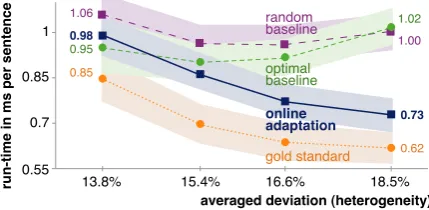
the optimal baseline were trained on the respective training sets. Figure 2 illustrates the run-times of the main pipelines for each approach as a function of the averaged deviation and compares them to the gold standard. The shown confidence intervals result from the run-times’ standard deviationsσ, which ranged between 0.029ms and 0.043ms.
On the least heterogeneous corpusD0 with an
averaged deviation of 13.8%, the online adaptation algorithm achieved an average run-time of 0.98ms per sentence, which is faster than the random base-line but slower than the optimal basebase-line at a low confidence level. Forσ(C|D1)= 15.4%, the on-line adaptation algorithm succeeded with 0.87ms per sentence as opposed to 0.9ms of the optimal baseline. This gap gets significantly larger
un-5Section 5.4 shows the effects of errors of measurement.
0.55 0.7 0.85 1
13.8% 15.4% 16.6% 18.5%
run-time in ms per sentence
averaged deviation (heterogeneity) optimal
baseline
gold standard 1.06
1.00
0.95
1.02
0.98
0.73 0.85
0.62 online
adaptation random baseline
Figure 2: The average run-times of the main pipe-lines of both baseline approaches, the online adap-tation algorithm, and the gold standard as a func-tion of the averaged deviafunc-tion. The background areas denote the 95% confidence intervals (±2σ).
der higher averaged deviation. At 18.5%, both baselines are clearly outperformed, taking 37% and 40% more time on average, respectively.6
One reason for the weak result of online adap-tation onD0lies in the low optimization potential
for that corpus: the main pipeline of the optimal baseline took only 12% more time on average than the gold standard (0.95ms vs. 0.85ms), which im-plies very small differences in the main pipelines’ run-times. This does not only render online adap-tation hard but also unnecessary. Conversely, Fig-ure 3 shows an optimization potential of over 50% forD3. A reasonable hypothesis is therefore that
online adaptation succeeds only on collections and streams of texts of high heterogeneity as indicated by large differences in the pipelines’ run-times.
5.3 Run-time and Error Analysis
Figure 3 details the run-times of the three fixed pipelines, the online adaptation algorithm, and the gold standard onD0andD3. The small black
in-dicators denote the standard deviations.
In total, the fixed pipelines are 16% to 25% slo-wer than the online adaptation algorithm on D3.
The algorithm’s run-time mainly breaks down into 0.51ms of the prefix pipeline and 0.73ms of the main pipelines, while the time for feature com-putations (0.03ms) and regression (0.01ms) is al-most negligible. A similar situation is observed for D0. Here, online adaptation is worse only than
(Πpre,Π1), which did best on 598 of the 1000 test
texts. (Πpre,Π2) and(Πpre,Π3) had the lowest
run-time on 229 and 216 texts, respectively.7
6On the training set ofD3, the optimal baseline did not find the fastest main pipeline. This might be coincidence, but is, of course, more likely under higher heterogeneity.
run-time in ms
adaptation prefix pipeline main pipeline features regression0.73 1.27
0.65 0.51
Figure 3: Average run-times of the fixed pipelines and online adaptation on the test sets ofD0andD3.
The online adaptation algorithm did not succeed on D0, since its mean run-time prediction error
of 0.45ms was almost half as high as the average run-times to be predicted, which is too inaccurate under the small differences in the pipelines’ run-times. As a result, for only 39% of the input texts, the best pipeline was chosen (i.e., a classification error of 0.61). However, the impact onD3 does
not emanate from a low mean prediction error (that was in fact 0.24ms higher), but the classification error was reduced to0.45. Consequently, the main reason lies in larger differences in the pipelines’ run-times, which supports our hypothesis.
An insightful linguistic phenomenon is that the prefix pipeline Πpre took significantly more time per sentence on D0 than on D3. Since the
run-times of both algorithms in Πpre scale linearly with the number of input tokens, the average sen-tence length ofD0 must exceed that ofD3. The
reason is that shorter sentences tend to contain less relevant information. Hence, many sentences can be discarded after a few analysis steps, which in-creases the need for input-dependent scheduling.
5.4 Parameter Analysis
To give further evidence for the hypothesis from Section 5.2 and to test the applicability of online adaptation, we evaluated some major parameters:
Impact of Features For each of the five feature
types in isolation, we trained a regression model onD0and analyzed its impact. Thelexical statis-ticsachieved the lowest classification error (0.41), followed by therun-times(0.53). In terms of run-time prediction, the regex matches (0.46ms) and
the part-of-speech tags(0.48ms) performed best,
whereas thechunk tagsfailed both in classification (0.57) and prediction (0.58ms).8 We used feature types 1–3 in all other experiments, since
comput-8
The low correlation of the prediction and classification error seems counterintuitive, but it indicates the limitations of these measures: E.g, a small prediction error can still be prob-lematic if run-times differ only slightly, while a high classifi-cation error may have few negative effects in this case. If both errors are small, however, this normally implies success.
0.25 0.35 0.45 0.55 0.65
1000 5000 10,000 15,000
prediction error in ms
input text 0.56
0.48
0.37 0.40
mean (0.43)
Figure 4: The mean run-time prediction error for the pipelines chosen by the online adaptation algo-rithm on 15,000 modified versions of the texts in D0for training size 1. The values of the two
inter-polated learning curves denote the mean of 1000 and 100 consecutive predictions, respectively.
ing them took only 0.05ms per sentence on aver-age. In contrast, theregex matchesneeded 0.16ms alone, which exceeds the difference between the optimal baseline and the gold standard onD0(cf.
Section 5.2) and, thus, renders the regex matches useless in the given setting.
Theregex matchesemphasize the obvious need
for a scheduling mechanism that avoids spending more time than can be saved later on. At the same time, such a mechanism should capture character-istics of a text that reliably model its complexity, which the evaluated features did not fully achieve.
Impact of Training Size We evaluated the
on-line adaptation algorithm onD0for nine training
sizes between 1 and 5000. As the training set of D0 is limited, we created modified versions of its
texts where needed (cf. Section 4.1). Online adap-tation always did better than the random baseline but not than the optimal baseline except for train-ing size 1. In case of 1000 or more traintrain-ing texts, the algorithm mimicked the optimal baseline, i.e., it choseΠ1for about 90% of the texts.
Online Learning For training size 1, we ran the
online adaptation algorithm on 15,000 modified versions of the texts in D0. Figure 4 shows two
0 0.4 0.8 1.2 1.6 run-time in ms per sentence
0.65 0.98
a)loaded
0.51 0.73
a)loaded
0.68 1.02
b)measured
prefix pipeline main pipeline features regression
0.53 0.77
b)measured
D0
D3
Figure 5: The average run-times and standard de-viations of the online adaptation algorithm onD0
andD3when run-times are a) loaded from a
pre-computed file or b) measured during execution.
first 5000 texts to an area around 0.4ms where it stays most of the time afterwards, though the light curve discovers many outliers. Still, online learn-ing apparently seems to work well.
Overall Optimization Potential To measure the
overall optimization potential of scheduling, we made an experiment with all k = 108 correct main pipelines onD0 (cf. Section 5.1).9 The
re-sulting average run-times of the fixed main pipe-lines span from 0.79ms per sentence in case of Πbest = (TR,FD,MR,OR,TN,SD) to 3.27ms of Πworst = (OR,TR,TN,MR,SD,FD). This shows that the efficiency loss of choosing a wrong sched-ule can be very high. The online adaptation algo-rithm achieved 0.86ms with a mean run-time pre-diction error of 0.37ms. Altogether, 21 of the 108 schedules were used on the 1000 test texts, and the best schedule was chosen for 30% of the texts.
Real Execution As mentioned, we loaded all
run-times from a precomputed file, which is not pos-sible in case of real execution. In Figure 5, we compare the results of loading run-times to the run-times measured during the execution of the online adaptation algorithm. The measured val-ues mainly differ in terms of larger standard devi-ations, i.e., 0.16ms onD0and 0.12ms onD3. This
seems to have a fairly negative effect on the main pipelines’ run-times. However, the measured pre-fix pipeline run-times also exceed the saved ones, which suggests that the effect is due to a higher system load only. In any case, the measured run-time onD3indicates that the online adaptation
al-gorithm applies for practical applications.
Conclusion
In this paper, we analyze the efficiency of informa-tion extracinforma-tion pipelines as a funcinforma-tion of the
het-9Notice that the training time increases linear tok, so a highkimplies a high training overhead. For space reasons, we omit to report on training time here at all. However, train-ing time will always be amortized in large-scale scenarios.
erogeneity of their input texts. In particular, we quantify heterogeneity with regard to the distribu-tion of relevant informadistribu-tion and we provide a self-supervised online adaptation algorithm that learns which pipeline schedule to choose for what input text in order to optimize efficiency while maintain-ing precision and recall. On this basis, we investi-gate the need for pipelines that adapt to their input within time-critical extraction tasks.
Our experiments suggest that the benefit of on-line adaptation is significant on heterogeneous col-lections and streams of texts: The online adapta-tion algorithm achieves gains of about 30% over the most efficient fixed schedule, which we see as important in times of big data. Conversely, when relevant information is uniformly distributed, find-ing an efficient fixed schedule appears sufficient, as approached in (Wachsmuth et al., 2013a).
A setting still to be evaluated refers to streams of input texts whose characteristics change slowly over time. Also, other extraction tasks may yield more insights. In order to decide how to approach a task at hand, a better understanding of the pro-cessing complexity of collections and streams of texts is required, to which our research contributes substantial building blocks.
In general, our self-supervised learning concept can be transferred to each natural language proces-sing task that meets two basic conditions: (1) The task can be approached in different manners where each approach performs best for certain situations or inputs. (2) The performance of each approach can be measured or it is clear by definition.
Acknowledgments
This work was partly funded by the German Fed-eral Ministry of Education and Research (BMBF) under contract number 01IS11016A.
References
Eugene Agichtein. 2005. Scaling Information Extrac-tion to Large Document CollecExtrac-tions. Bulletin of the IEEE Computer Society TCDE, 28:3–10.
Rami Al-Rfou’ and Steven Skiena 2012. SpeedRead: A Fast Named Entity Recognition Pipeline. InProc. of the 24th COLING, pages 51–66.
Yejin Choi, Eric Breck, and Claire Cardie. 2006. Joint Extraction of Entities and Relations for Opinion Recognition. In Proc. of the 2006 EMNLP, pages 431–439.
Hamish Cunningham. 2006. Information Extraction, Automatic. Encyclopedia of Language & Linguis-tics, 4:665–677.
Jim Cowie and Wendy Lehnert. 1996. Information Ex-traction. Communications of the ACM, 39(1):80–91.
Anthony Fader, Stephen Soderland, and Oren Etzioni. 2011. Identifying Relations for Open Information Extraction. In Proc. of the 2011 EMNLP, pages 1535–1545.
Jenny R. Finkel, Trond Grenager, and Christopher D. Manning. 2005. Incorporating Non-local Informa-tion into InformaInforma-tion ExtracInforma-tion Systems by Gibbs Sampling. InProc. of the 43nd Annual Meeting of the ACL, pages 363–370.
Manaal Faruqui and Sebastian Pad´o. 2010. Training and Evaluating a German Named Entity Recognizer with Semantic Generalization. In Proc. of KON-VENS 2010, pages 129–133.
Ralph Grishman. 1997. Information Extraction: Tech-niques and Challenges, In International Summer School on Information Extraction: A Multidisci-plinary Approach to an Emerging Information Tech-nology, pages 10–27.
Mark Hall, Eibe Frank, Geoffrey Holmes, Bernhard Pfahringer, Peter Reutemann, and Ian H. Witten. 2009. The WEKA Data Mining Software: An Up-date.SIGKDD Explorations, 11(1):10–18.
Fern Harper. 2011. Predictive Analytics: The Hurwitz Victory Index Report, Hurwitz & Associates.
Ludovic Jean-Louis, Romaric Besanc¸on, and Olivier Ferret. Text Segmentation and Graph-based Method for Template Filling in Information Extraction. In Proc. of the 5th IJCNLP, pages 723–731, 2011.
Jin-D. Kim, Sampo Pyysalo, Tomoko Ohta, Robert Bossy, and Jun’ichi Tsujii. 2011. Overview of BioNLP Shared Task 2011. InProc. of the BioNLP 2011 Workshop Companion Volume for Shared Task, pages 1–6.
Rajasekar Krishnamurthy, Yunyao Li, Sriram Ragha-van, Frederick R. Reiss, Shivakumar Vaithyanathan, and Huaiyu Zhu. 2009. SystemT: A System for Declarative Information Extraction. In SIGMOD Records, 37(4):7–13.
Girija Limaye, Sunita Sarawagi, Soumen Chakrabarti. 2010. Annotating and Searching Web Tables using Entities, Types and Relationships. In Proc. of the VLDB Endowment, 3(1):1338–1347.
Christopher D. Manning and Hinrich Sch¨utze. 1999. Foundations of Statistical Natural Language Pro-cessing, MIT Press, Cambridge, MA, USA.
David McClosky, Eugene Charniak, and Mark John-son. 2010. Automatic Domain Adaptation for Pars-ing. InProc. of the HLT/NAACL, pages 28–36.
Gertjan van Noord. 2009. Learning Efficient Parsing. InProc. of the 12th EACL, pages 817–825.
Frederick R. Reiss, Sriram Raghavan, Rajasekar Krishnamurthy, Huaiyu Zhu, and Shivakumar Vaithyanathan. 2008. An Algebraic Approach to Rule-Based Information Extraction. InProc. of the 2008 IEEE 24th ICDE, pages 933–942.
Sunita Sarawagi. 2008. Information Extraction. Foun-dations and Trends in Databases, 1(3):261–377.
Helmut Schmid. 1995. Improvements in Part-of-Speech Tagging with an Application to German. In Proc. of the ACL SIGDAT-Workshop, pages 47–50.
Warren Shen, AnHai Doan, Jeffrey F. Naughton, and Raghu Ramakrishnan. 2007. Declarative Informa-tion ExtracInforma-tion using Datalog with Embedded Ex-traction Predicates. In Proc. of the 33rd VLDB, pages 1033–1044.
Erik F. Tjong Kim Sang and Fien De Meulder. 2003. Introduction to the CoNLL-2003 Shared Task: Language-independent Named Entity Recog-nition InProc. of the 7th CoNLL, pages 142–147.
Henning Wachsmuth, Peter Prettenhofer, and Benno Stein. 2010. Efficient Statement Identification for Automatic Market Forecasting. InProc. of the 23rd COLING, pages 1128–1136.
Henning Wachsmuth, Benno Stein, and Gregor Engels. 2011. Constructing Efficient Information Extraction Pipelines. InProc. of the 20th ACM CIKM, pages 2237–2240.
Henning Wachsmuth and Kathrin Bujna. 2011. Back to the Roots of Genres: Text Classification by Lan-guage Function. InProc. of the 5th IJCNLP, pages 632–640.
Henning Wachsmuth and Benno Stein. 2012. Optimal Scheduling of Information Extraction Algorithms. InProc. of the 24th COLING: Posters, pages 1281– 1290.
Henning Wachsmuth, Mirko Rose, and Gregor Engels. 2013. Automatic Pipeline Construction for Real-Time Annotation. In Proc. of the 14th CICLing, pages 38–49.
Henning Wachsmuth, Benno Stein, and Gregor Engels. 2013. Information Extraction as a Filtering Task. To appear inProc. of the 22th ACM CIKM.
Daisy Z. Wang, Long Wei, Yunyao Li, Frederick R. Reiss, and Shivakumar Vaithyanathan. 2011. Selec-tivity Estimation for Extraction Operators over Text Data. InProc. of the 2011 IEEE 27th ICDE, pages 685–696.