Boosting Neural Machine Translation
Dakun Zhang and Jungi Kim and Josep Crego and Jean Senellart
[email protected] SYSTRAN / 5 rue Feydeau, 75002 Paris, France
Abstract
Training efficiency is one of the main problems for Neural Machine Translation (NMT). Deep networks need for very large data as well as many training iterations to achieve state-of-the-art performance. This results in very high computation cost, s-lowing down research and industrialisa-tion. In this paper, we propose to alleviate this problem with several training meth-ods based on data boosting and bootstrap with no modifications to the neural net-work. It imitates the learning process of humans, which typically spend more time when learning “difficult” concepts than easier ones. We experiment on an English-French translation task showing accuracy improvements of up to1.63BLEU while saving20%of training time.
1 Introduction
With the rapid development of research on Neu-ral Machine Translation (NMT), translation quali-ty has been improved significantly compared with traditional statistical based method (Bahdanau et al.,2014; Cho et al., 2015;Zhou et al., 2016; Sennrich et al.,2015). However, training efficien-cy is one of the main challenges for both academi-a academi-and industry. A huge academi-amount of tracademi-aining dacademi-atacademi-a is still necessary to make the translation accept-able (Koehn and Knowles, 2017). Though new techniques have recently been proposed (Vaswani et al., 2017; Gehring et al., 2017), fully trained NMT models still need for long training period-s (period-sometimeperiod-s by weekperiod-s) even uperiod-sing cutting-edge hardware.
NMT system directly models the mappings be-tween source sentencexn
1 = (x1, ..., xn)and tar-get sentence ym
1 = (y1, ..., ym), with n and m
words respectively (Sutskever et al.,2014). Usu-ally, such system is based on an encoder-decoder-attention framework, in which the source sentence is fed into an encoder word by word to form a fixed length representation vector, with a forward sequence of hidden states(−→h1, ...,−h→n)and a back-ward sequence (←h−1, ...,←h−n). With the attention mechanism (Bahdanau et al., 2014), a decoder is used to decide which part of the source sentence to pay attention to and predict corresponding word representation at timettogether with history pre-dictions before time t. Then, a softmax is used to restore the word representation to natural target words. During the training process, the parameter
Θis optimized:
p(ym
1 |xn1; Θ) =Qmt=1p(yt|y<t, xn1; Θ) The amount of parameters which is proportional to the network size and the size of training corpora both decide the cost of training for NMT systems. In order to achieve an acceptable performance on systems, deep networks (up to 8 layers) and more iterations (10-18 epochs) are necessary with a cer-tain amount of data (Wu et al.,2016;Crego et al., 2016). Since several weeks are needed to gener-ate results, it is difficult to experiment with sever-al different meta-parameters, hence slowing down innovation.
While Wu et al.(2016) proposes a brute-force approach with massive data and model parallelis-m as a way to accelerate training, in this paper, we focus on a different approach based on ranking training sentence pairs by “difficulty”. We aim at boosting the optimisation problem through target-ing difficult traintarget-ing instances rather than spendtarget-ing time on easier ones.
Every several epochs, we re-select 80% of the data from the corpus with the highest perplexi-ty (ppl.) to use for training. There is no ex-tra calculation cost since we get these ppl. loss
from the previous epoch. Finally, we achieve a 1.63 BLEU points improvement while saving 20% training cost at the same time, which is quite a sta-ble improvement compared with our baseline sys-tem on English-French translations.
2 Related Work
Training efficiency has been a main concern by many researchers in the field of NMT. Data par-allelism and model parpar-allelism are two commonly used techniques to improve the speed of training (Wu et al.,2016). As a result, multiple GPUs or T-PUs1are needed which requires additional
replica-tion and combinareplica-tion costs. Data parallelism does not reduce the actual cost of computation, it only saves time by using additional computational pow-er.
Chen et al. (2016b) proposed a modified RN-N structure with a full output layer to facilitate the training when using a large amount of data. Kalchbrenner et al.(2016) proposed ByteNet with two networks to encode the source and decode the target at the same time. Gehring et al.(2017) use convolutional neural networks to build the sys-tem with a nature of parallelization.Kuchaiev and Ginsburg(2017) focus on how to reduce the com-putational cost through patitioning or factorizing LSTM matrix. To compare, our method does not modify the network itself and can be used in any NMT framework.
Other methods focus on how to reduce the pa-rameters trained by the model (See et al., 2016). They show that with a pruning technique, 40-60% of the parameters can be pruned out. Similar meth-ods are proposed to reduce the hidden units with knowledge distillation (Crego et al., 2016; Kim and Rush, 2016). They re-train a smaller student model using text translated from teacher models. They report a 70% reduction on the number of pa-rameters and a 30% increase in decoding speed. Hubara et al.(2016) proposed to reduce the preci-sion of model parameters during training and net-work activations, which can also bring benefits to training efficiency.
To the best of our knowledge the closest idea to our work is instance weighting (Jiang and Zhai, 2007), which is often used for domain adaptation. They add instance dependent weights to the loss function to help improving the performance. As a comparison, we focus on using “difficult”
in-1Google’s Tensor Processing Unit (Wu et al.,2016).
stances in training rather than spending training time on easier ones. We improve the accuracy while simultaneously reducing the cost of training.
3 Training Policies
To train a NMT system, we first design a neu-ral network with some fixed meta-parameters (e.g. number of neurons, LSTM layers, etc.). Then, we feed the network with training instances (in a way of mini-batch) (Ioffe and Szegedy,2015) until all instances of a training set are consumed. The op-eration is repeated until the model converges. Pa-rameters of the network turn to an optimum status and as a consequence, the system reaches best per-formance.
[image:2.595.314.522.443.574.2]During this process, there is no distinction be-tween training instances. That is, all the instances are regarded as equal and used to train the NMT model equally. However, some instances are rela-tively easy for the model to learn (e.g. shorter or frequently used sentences). To use them repeated-ly results in a waste of time. Moreover, to avoid overfitting and to help convergence, training in-stances are often randomly shuffled before used to train a model, hence, introducing un-certainty to the final status of the system.
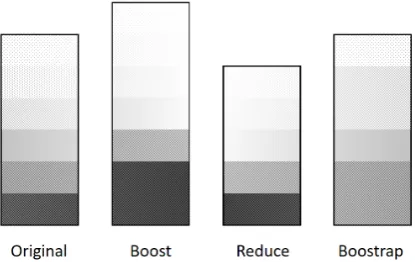
Figure 1: Training data selection. Levels of grey are used to indicate perplexity ranges. Dark-er/lighter indicate higher/lower perplexity.
initially sorted based on their translation perplexi-ties (Original) to be finally duplicated (Boost), re-duced (Reduce), or just re-sampled (Bootstrap). Such adjustment is applied during each training e-poch, thus results in different cost and accuracy.
To be specific, at each training epoch we extend the training set with sentence pairs that the trans-lation model finds “difficult” to translate (Boost). We approximate this procedure by choosing sen-tences with a high perplexity score. In Figure1, the block with higher perplexity sentences (dark-er) is repeated in the Boosting set when compared to the Original set. The process has no addition-al computationaddition-al cost since perplexity is addition-already computed in a previous iteration.
To put it further, we may focus on “difficult” sentences by removing “easy” ones from the train-ing set (Reduce). In Figure1, the block with low-er plow-erplexity sentences (lightlow-er) is missing in the Reduction set when compared to the Original set.
Finally, we randomly sample 100% of the sen-tences from the corpus as a comparison to the baseline system (Bootstrap). In Figure1, some blocks of the Original set appear repeated in the Bootstrap set while some others are missing, due to a random re-sampling.
4 Experiments
In this section we report on the experiments con-ducted to evaluate the suitability of the proposed methods. We begin with details of the NMT sys-tem parameters as well as the corpora employed.
4.1 System Description
We build our NMT system based on an open-source projectOpenNMT2. We use a bidirectional
RNN encoder with4LSTM layers with each con-taining1,000nodes. Word embeddings are sized of500cells and we set the dropout probability to
0.3. Batch size is set to64. The maximum length of both source and target sentences is set to 80
and we limit the vocabulary size to50Kwords for both source and target languages.
The default optimiser is SGD with starting learning rate 1.0. We start to decay the learning rate from epoch 10, or when we find a perplex-ity increasing compared with the previous epoch on a validation set. Evaluation is performed on a held-out testset with BLEU score (Papineni et al., 2002).
2http://opennmt.net
4.2 Corpora
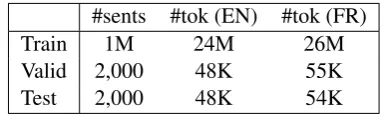
We used an in-house generic corpus built as mix from several client data consisting of French-English sentences pairs. We split the corpus into three sets: training, validation and a held-out test set. Table1shows statistics of the data used in our experiments.
#sents #tok (EN) #tok (FR)
Train 1M 24M 26M
[image:3.595.322.516.173.230.2]Valid 2,000 48K 55K Test 2,000 48K 54K Table 1: Statistics of the data used in our experi-ments. M stands for millions and K for thousands.
4.3 Results
We train four systems corresponding to the differ-ent training policies considered in this paper fol-lowing the system configuration detailed in Sec-tion4.1. During each training epoch:
• defaultuses the entire original data.
• boostextends 10% the original data with the most difficult sentence pairs (following per-plexity).
• reduce keeps 80% the most difficult in-stances of the previous epochs, discarding the remaining 20%. Note that the procedure restarts using the entire training set every 3 epochs. That is it uses 100%, 80%, 64%, 100%, 80%, 64%, ... of the training data.
• bootstrapre-samples 100% the training set. Hence allowing for repeated and missing sen-tences of the original training set.
All systems are trained up to 18 epochs3.
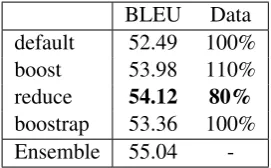
E-valuation results are shown in Figure2and Table 2. Each result is averaged from two systems ini-tialised with different random seeds to alleviate the influence of randomisation.
As it can be seen, boost outperforms the de-fault method by+1.49(BLEU) at the cost of using
10%of additional training data. However, the sys-tem converges faster than any other syssys-tem as best performance is achieved at epoch14, while others need to achieve the best after epoch16.
3For some experiments, we continue to train until 22
2 4 6 8 10 12 14 16 18 36
38 40 42 44 46 48 50 52 54
Epoch
BLEU
default boost 10%
[image:4.595.76.280.58.223.2]reduce 20% restart every 3 epochs bootstrap 100% for each epoch
Figure 2: Effect of data boosting during training for English-French translation.
The reduce system finally obtains the high-est accuracy scores, outperforming the default method by +1.63 (BLEU). In addition to accu-racy, the system performing the reduce method needed only 80% less data than the default. It shows that this policy is promising.
Considering boostrap, the score steadily im-proves. Though not so significantly, it outperform-s aloutperform-so the default method by+0.87 (BLEU) with better stability. Finally, we ensemble the 4 best systems (epoch 18) generated by each method, getting an additional+0.92BLEU improvement.
BLEU Data default 52.49 100% boost 53.98 110% reduce 54.12 80%
boostrap 53.36 100% Ensemble 55.04
-Table 2: BLEU score, and data size conditions for different training policies.
4.3.1 Perplexity Normalisation
In this work we use perplexity as the measure for translation “difficulty”, computed over each train-ing batch. We disttrain-inguish instances between “dif-ficult” ones and “easy” ones in order to save time during system training. Since perplexity will al-ways increase when the sentences are long, a nor-malisation method is typically needed. We test several normalisation strategies:
• by batch size (number of training instances) • by (target) sentence length
• without normalisation (longer sentences were always assigned a higher perplexity)
Experimental results show no significant perfor-mance differences for any of the strategies. An ex-planation for such behaviour may be found on the fact that long sentences are also difficult transla-tions. Thus, the selected subsets (by any normali-sation strategy) are very similar.
4.4 Analysis
We propose a simple data manipulation technique to help improving efficiency and performance of NMT models during training. The idea imitates the human learning process. Typically, humans need to spend more time to learn “difficult” con-cepts and less time for easier ones . As a conse-quence, we force the NMT system to spend more time on more “difficult” instances, while “skip-ping” easier examples at the same time. Thus, We emulate a human spending additional energy on learning complex concepts.
We inspect the selected “difficult” examples ac-cording to perplexity. We find that almost all such examples containing complex structures, thus be-ing difficult to be translated. To force the system to pay much attention on them can adjust it towards “mastering” more information for these sentences. An interesting conclusion is that, we can train the NMT system with 80% of the most complex sentences. That is to say, when training exam-ples with smaller perplexity are removed and those with larger ones are emphasised, the system per-forms better in terms of accuracy and efficiency.
Further experiments need to be conducted for a detailed insight of the methods presented. Like measuring the impact of using several ratios of training data boosted/reduced. As well as studying the impact of the methods on different language pairs and data size conditions.
5 Conclusions
[image:4.595.116.252.459.543.2]scores and by reducing the size of the corpus by 20%, translation performance improved by 1.63.
The method we proposed focuses on training process only. There is no restriction for the neural network structure. It can be used in any data paral-lelism framework and then distributed onto multi-GPUs. Also, corpus pre-processing like tokeniza-tion (e.g. using sub-word unit (Sennrich et al., 2015)) and other techniques like guided training (Shen et al.,2016;Chen et al.,2016a) can be freely added based on the method we proposed. In the future, we plan to investigate more on the influ-ence of training data especially in the later phase of training.
Acknowledgments
We thank the anonymous reviewers for their in-sightful comments.
References
Dzmitry Bahdanau, Kyunghyun Cho, and Yoshua Ben-gio. 2014. Neural machine translation by jointly learning to align and translate. arXiv preprint arX-iv:1409.0473.
Wenhu Chen, Evgeny Matusov, Shahram Khadivi, and Jan-Thorsten Peter. 2016a. Guided alignment train-ing for topic-aware neural machine translation. arX-iv preprint arXarX-iv:1607.01628.
Xie Chen, Xunying Liu, Yongqiang Wang, Mark JF Gales, and Philip C Woodland. 2016b. Efficien-t Efficien-training and evaluaEfficien-tion of recurrenEfficien-t neural neEfficien-t- net-work language models for automatic speech recog-nition. IEEE/ACM Transactions on Audio, Speech, and Language Processing, 24(11):2146–2157. S´ebastien Jean Kyunghyun Cho, Roland Memisevic,
and Yoshua Bengio. 2015. On using very large tar-get vocabulary for neural machine translation. Josep Maria Crego, Jungi Kim, Guillaume Klein,
Anabel Rebollo, Kathy Yang, Jean Senellart, E-gor Akhanov, Patrice Brunelle, Aurelien Coquard, Yongchao Deng, Satoshi Enoue, Chiyo Geiss, Joshua Johanson, Ardas Khalsa, Raoum Khiari, Byeongil Ko, Catherine Kobus, Jean Lorieux, Leid-iana Martins, Dang-Chuan Nguyen, Alexandra Pri-ori, Thomas Riccardi, Natalia Segal, Christophe Ser-van, Cyril Tiquet, Bo Wang, Jin Yang, Dakun Zhang, Jing Zhou, and Peter Zoldan. 2016. Systran’s pure neural machine translation systems. CoRR, ab-s/1610.05540.
Jonas Gehring, Michael Auli, David Grangier, Denis Yarats, and Yann N Dauphin. 2017. Convolutional sequence to sequence learning. arXiv preprint arX-iv:1705.03122.
Itay Hubara, Matthieu Courbariaux, Daniel Soudry, Ran El-Yaniv, and Yoshua Bengio. 2016. Quantized neural networks: Training neural networks with low precision weights and activations. arXiv preprint arXiv:1609.07061.
Sergey Ioffe and Christian Szegedy. 2015. Batch nor-malization: Accelerating deep network training by reducing internal covariate shift. In Proceedings of the 32nd International Conference on Machine Learning, volume 37 of Proceedings of Machine Learning Research, pages 448–456, Lille, France. PMLR.
Jing Jiang and ChengXiang Zhai. 2007. Instance weighting for domain adaptation in nlp. In ACL, volume 7, pages 264–271.
Nal Kalchbrenner, Lasse Espeholt, Karen Simonyan, Aaron van den Oord, Alex Graves, and Koray Kavukcuoglu. 2016. Neural machine translation in linear time. arXiv preprint arXiv:1610.10099.
Yoon Kim and Alexander M Rush. 2016. Sequence-level knowledge distillation. arXiv preprint arX-iv:1606.07947.
Philipp Koehn and Rebecca Knowles. 2017. Six challenges for neural machine translation. arXiv preprint arXiv:1706.03872.
Oleksii Kuchaiev and Boris Ginsburg. 2017. Factor-ization tricks for lstm networks.arXiv preprint arX-iv:1703.10722.
Kishore Papineni, Salim Roukos, Todd Ward, and Wei-Jing Zhu. 2002. Bleu: a method for automatic e-valuation of machine translation. InProceedings of the 40th annual meeting on association for compu-tational linguistics, pages 311–318. Association for Computational Linguistics.
Abigail See, Minh-Thang Luong, and Christopher D Manning. 2016. Compression of neural machine translation models via pruning. arXiv preprint arX-iv:1606.09274.
Rico Sennrich, Barry Haddow, and Alexandra Birch. 2015. Neural machine translation of rare words with subword units. arXiv preprint arXiv:1508.07909.
Shiqi Shen, Yong Cheng, Zhongjun He, Wei He, Hua Wu, Maosong Sun, and Yang Liu. 2016. Minimum risk training for neural machine translation. In Pro-ceedings of the 54th Annual Meeting of the Associa-tion for ComputaAssocia-tional Linguistics (Volume 1: Long Papers), pages 1683–1692, Berlin, Germany. Asso-ciation for Computational Linguistics.
Ashish Vaswani, Noam Shazeer, Niki Parmar, Jakob Uszkoreit, Llion Jones, Aidan N. Gomez, Lukasz Kaiser, and Illia Polosukhin. 2017. Attention is all you need.
Yonghui Wu, Mike Schuster, Zhifeng Chen, Quoc V Le, Mohammad Norouzi, Wolfgang Macherey, Maxim Krikun, Yuan Cao, Qin Gao, Klaus Macherey, et al. 2016. Google’s neural machine translation system: Bridging the gap between hu-man and machine translation. arXiv preprint arX-iv:1609.08144.