A Computational Study on Word Meanings and Their Distributed
Representations via Polymodal Embedding
Joohee Park∗ Korea Advanced Institute of Science and Technology [email protected]
Sung-hyon Myaeng Korea Advanced Institute of Science and Technology
Abstract
A distributed representation has become a popular approach to capturing a word meaning. Besides its success and practical value, however, questions arise about the relationships between a true word meaning and its distributed representation. In this paper, we examine such a relationship via polymodal embedding approach inspired by the theory that humans tend to use di-verse sources in developing a word mean-ing. The result suggests that the existing embeddings lack in capturing certain as-pects of word meanings which can be sig-nificantly improved by the polymodal ap-proach. Also, we show distinct character-istics of different types of words (e.g. con-creteness) via computational studies. Fi-nally, we show our proposed embedding method outperforms the baselines in the word similarity measure tasks and the hy-pernym prediction tasks.
1 Introduction
Word representations based on the distributional hypothesis ofHarris(1954) have become a domi-nant approach including word2vec (Mikolov et al., 2013) and GloVe (Pennington et al.,2014), which show remarkable performances in a wide spec-trum of natural language processing. However, a question arises about a relationship between a true word meaning and its distributed tion. While the context-driven word representa-tions seem to be able to capture word-to-word re-lations, for example, men is towomen as kingis toqueen, it still remains unclear what aspects of
∗Currently at Search Solutions Inc., Seongnam, 13561,
Korea
word meaning they capture and miss. For exam-ple, a word, coffee, can be understood from mul-tiple perspectives. It may be associated with a ce-ramic cup filled with dark brown liquid from the perceptual perspective or an emotion such as hap-piness or tranquility. It may provoke other related concepts like bagel or awakening. We raise the question of how well the current distributed repre-sentation captures such aspects of word meanings. In order to help answering this question, we pro-pose a polymodal word representation based on the theory that humans tend to use diverse sources in developing a word meaning. In particular, we construct six modules for polymodality including linear context, syntactic context, visual percep-tion, cognipercep-tion, emopercep-tion, and sentiments based on the human cognitive model proposed byMaruish and Moses(2013). They are combined to build a single word representation.
We conduct a series of experiments to examine the relationships between word meanings and their distributed representations and compare the re-sults with other representations such as word2vec, GloVe, and meta-embedding (Yin and Sch¨utze, 2015). We attempt to understand how well the model capture the diverse aspects of word mean-ings via two experiments: the property norms analysis and the sentiment polarity analysis. The result suggests that the existing embedding meth-ods lack in capturing visual properties and senti-ment polarities and show that they can be much improved by adopting polymodal approaches.
Finally, we examine distinct characteristics of different types of words via computational studies, focusing along the dimension of concept concrete-ness and similarity. We find that the importance of a certain module (e.g. visual perception or lexical relations) varies depending on the word properties. Our study provides some computational evidence for the heterogeneous nature of word meanings,
which has been extensively studied in the field of psycholinguistics. We briefly introduce it in the following subsection.
2 Related Work 2.1 Theoretical works
Word meanings are thought to have diverse as-pects. Steels (2008) address that languages are inherently built upon our cognitive system to ful-fill the purpose of communication between mu-tually unobservable internal representations. So many psycholinguistic theories have attempted to understand the diverse nature of word mean-ings by human minds. Barsalou (1999) claims that many human modalities such as concep-tual/perceptual systems cooperate with each other in a complex way and influence word meanings, while Pulverm¨uller (1999) argues that concepts are grounded in complex simulations of physical and introspective events, activating the frontal re-gion of the brain that coordinates the multimodal information. Studies on semantic priming (Plaut and Booth, 2000) also supports them that words can be similar to each other in various ways to foster the priming effect. The experiments in this paper are designed to provide some computational evidence on such studies on the multifaceted na-ture of word meanings.
2.2 Multimodal approaches
From a computational point of view, there exist a number of bimodal approaches that extend the semantic representation to include perceptual in-formation or understandings of the world around us. Bruni et al. (2014) and Kiros et al. (2014a) propose a way to augment text-based word em-beddings using public image datasets whileRoller and Im Walde(2013) integrate visual features into LDA models. A recent study on Image caption generation (Xu et al., 2015) suggests an inter-esting way to align word embeddings and im-age features. Moreover, Kiros et al. (2014b) jointly trains the image abstraction network and sentence abstraction network altogether, making the visual features naturally combined into word embeddings. Similar attempts have been made not only for visual perception but also auditory (Kiela and Clark,2015) and olfactory (Kiela et al., 2015) perception. On the other hand,Henriksson (2015) demonstrates that semantic space ensemble models created by exploiting various corpora are
able to outperform any single constituent model. Yin and Sch¨utze(2015) propose meta-Embedding that ensembles multiple semantic spaces trained by different methods with different tasks such as word2vec, GloVe, HLBL (Luong et al., 2013) and C&W (Collobert and Weston,2008). Above works succeed to improve word embedding qual-ity by extending the semantic representation, but it still remains unclear how those improvements are related to the word meanings.
3 Polymodal word embedding
To embrace the multifaceted nature of word mean-ings, we propose a polymodal word embedding. More specifically, we take into account percep-tion, sentiment, emopercep-tion, and cognition (lexical re-lation) derived from diverse sources, in addition to linear context and syntactic context obtained from the corpus. Note that the termpolymodalis used to distinguish it from bimodal(Kiela, 2017). In bimodal approach, a single cognitive modality is used whereas more than one modalities are used in polymodal.
3.1 Modules
We describe each of the modules in detail.
Linear context refers to linear embed-dings (Mikolov et al., 2013) comprising 300-dimensional vectors trained over 100 billion words from the Google News dataset using skip-gram and negative sampling.
Syntactic contexttakes a similar skip-gram ap-proach as in linear context but defines the context window differently using a dependency parsing result (Levy and Goldberg,2014). While the lin-ear skip-gram defines the contexts of a target word wasw−k, w−k+1, ..., wk−1, wk wherekis a size of the window, syntactic context defines them as
(m1, lbl1),(m2, lbl2), ...,(mk, lblk),(m−1, lbl−1) wheremis the modifiers of wordwandlblis the type of dependency relation.
We harness both types of contexts to take into ac-count functional and syntactic similarities.
Cognition (Lexical relation) encompasses all the relations between words, which are captured in the form of a lexicon or ontology in a cog-nitive system. In this paper, we mainly focus on synonym, hypernym and hyponym relations in WordNet (Miller, 1995) which contains 149k words and 935k relations between them. We train lexical-relation-specific word embedding us-ing retro-fittus-ing (Faruqui et al.,2015).
Specifically, letV = {w1, ..., wn}be a vocab-ulary andΩbe an ontology that encodes semantic relations between words in V. Ω can be repre-sented as a set of edges of undirected graph where
(wi, wj)∈Ωifwiandwjholds semantic relation-ship of interest. The matrixQˆ is the collection of the vector representation ofqiˆ ∈Rdfor each word wi ∈ V wheredis the length of pre-trained word vectors. In this experiment, we use GloVe as such vectors. The objective of learning is to train the matrixQ = (q1, ..., qn)so as to make qi close to its counterpartqˆi and also to its adjacent vertices inΩ. Thus the objective function to be minimized can be written as
Ψ(Q) =
whereαi andβij are hyperparameters. This pro-cedure of training transforms the manifold of se-mantic space to make words in relations located more closer in Euclidean distance.
Perceptionis a vital component for human cog-nition and has a significant influence on word meanings. In this paper, we only consider visual perception. We jointly train the embeddings of im-ages and sentences together into the multi-modal vector space to build vision-specific word embed-dings (Kiros et al.,2014b).
In particular, letT be the training dataset where one image Ii is associated with a correspond-ing caption sentence Si, i.e., (Ii, Si) ∈ T. An embedding of image Ii, xi ∈ Rd, can be ob-tained through convolutional neural networks, in this case, 19-layer OxfordNet (Simonyan and Zis-serman, 2014), where dis the size of the dimen-sion of multimodal space. Similarly, an embed-ding of sentence Si, xs ∈ Rd, can be composed through one of the sentence modeling networks, in this case, LSTM (Hochreiter and Schmidhuber, 1997). These two image and sentence modeling
networks are jointly trained together to minimize the pairwise ranking loss function
L=X
to place correct samples closer while separating negative samples farther in the joint space. αis a hyperparameter andxˆsandxˆiare incorrect image and sentence pair obtained through negative sam-pling. We use MS COCO dataset (Lin et al.,2014) to train the network which contains 300k images and 5 captions per image. Final perception em-beddings of dimension 1024 are sampled from the joint space regarding one word as a sentence.
Sentiment, either positive or negative, is de-termined for words that have sentiment orienta-tions depending on their inherent meanings, us-ages, backgrounds etc. To capture the sentiment polarity of words (positive and negative), we use SentiWordNet3.0 (Baccianella et al.,2010), a lex-ical resource that automatlex-ically annotates the de-gree of positivity, negativity, and neutrality of En-glish words. It is a one-dimensional value and if a word has multiple senses, we take the dif-ference between the maximum positivity and the minimum negativity.
Emotion are considered by using NRC Emo-tion Lexicon (Mohammad and Turney, 2013) to reflect the emotional characteristics of words. It contains 15k words that are annotated with 10 emotion categories: anger, anticipation, disgust, fear, joy, sadness, surprise, trust, negative and pos-itive. We built 10-dimensional one-hot emotion vectors based on this dataset.
Note that some embedding sets may not cover every word in our set of test vocabulary. In that case, out-of-vocabulary (OOV) words are initial-ized to zero for the missing modules. All embed-dings are L2-normalized.
3.2 Ensemble methods
their work, we examine two matrix factorization techniques, SVD and non-negative matrix factor-ization (NMF). In addition, we explore an unsu-pervised ensemble method via autoencoder (AE) networks. The details of these methods are illus-trated below. Hyperparameters such as dimension dare selected to obtain the highest Spearmans cor-relation score in the RG-65 dataset (Rubenstein and Goodenough, 1965), which is used as a de-velopment set to minimize the interference on the test set. Note that before applying SVD, NMF, and AE, embeddings from different modules are con-catenated with weights.
Concatenation (CONC)is used as the first step for ensembling multiple vectors of different di-mensions. That is, let S be a set of n seman-tic spaces and si be a single vector space in S. eid ∈ si is a representation of wordwdin the se-mantic spacesi ∈S. Then the resulting concate-nated embeddingedof wordwdis
ed=α1ed1⊕...⊕αiedi⊕...⊕αnedn
where ⊕ is the concatenation operator and P
iαi= 1. RG-65 is used as a development set to tune the weightsαiof particular embeddingedi.
Singular Value Decomposition (SVD) is a generalization of eigenvalue decomposition to any m×nmatrix where it is reported to be effective in signal processing (Sahidullah and Kinnunen, 2016). LetV be the set ofmwords andkis the di-mension of word embeddingeifor wordwi ∈V. The dictionary matrixM is am×kmatrix where each row vectormiofM is an embedding vector ofei of wordwi. Then this matrixM is decom-posed intoM =UΣVT whereU andV arem×m andn×nreal unitary matrices respectively, and
Σis am×nnon-negative real rectangular diago-nal matrix. uidis the firstddimension of i-th row vectoruiofU and we use it as a representation of wordwi.dis 230 for SVD. The size of vocabulary mis 20150.
Non-negative matrix factorization (NMF)
has been reported to be effective method in various research areas including bioinformatics (Taslaman and Nilsson, 2012), signal denoising (Schmidt et al., 2007), and topic modeling (Arora et al., 2013). Two non-negative matrix W and H are optimized to approximate the dictionary matrix MT ≈ W H by minimizing the frobenius norm
||MT −W H||F whereW, H ≥ 0. NMF has an inherent property of clustering the column vectors
of the target matrix. To make MT non-negative, we normalize the values of each embedding into the [0,1]. Let sid be the firstddimension of i-th column vectorsiofW. Then we usesidas a rep-resentation of wordwi.dis200for NMF.
Autoencoder (AE)is a neural network used for unsupervised learning of efficient coding for data compression or dimensionality reduction (Hinton and Sejnowski, 1986). Previous work suggests that an autoencoder may be able to learn relation-ships between the modules and result in higher-level embeddings (Silberer and Lapata, 2014). Our autoencoder consists of simple feedforward network. We trained two matrices Wenc of size k×d and Wdec of size d×k to learn efficient coding of word representation wherek is the di-mension of original word embedding anddis the dimension of compressed representation. Param-eters are optimized to minimize cosine proximity loss:
L=X
x∈T
1− x˜·x ||x˜|| · ||x||
where x is a k-dimensional word embedding, T is a training data set of size 20150 words, x˜ =
f(Wdecf(Wencx+benc) +bdec)andf is a ReLU non-linear activation function. We setd= 900.
4 Experiments
We introduce the experiments taken to examine how well the representations embed word mean-ings incorporating distinct properties. First, we apply our proposed embedding method to a word similarity measure task and a hypernym prediction task to measure its overall quality. Then we con-ducted a series of experiments for analyzing the characteristics of word meanings.
4.1 Word Similarity Measure and Hypernym Prediction
Meta-embedding(1toN) (Yin and Sch¨utze,2015). The result is shown on table1.
Baseline SL WS MEN
Word2Vec .442 .698 .782
GLoVe .453 .754 .816
MetaEmb .464 .745 .816
Polymodal (CONC) .533 .622 .778
Polymodal (SVD) .580 .775 .838 Polymodal (AE) .507 .599 .751
Polymodal (NMF) .414 .509 .589
Avg. Human .780 .791 .840
Table 1: Spearman’s correlation score on SimLex-999 (SL), WordSim-353 (WS), and MEN datasets. “Avg. Human” score is an inter-agreement between human annotators.
Our proposed method clearly outperforms the baselines in all the datasets, with near-human performance in WordSim-353 and MEN. Among the ensemble methods, SVD gave the best result showing its strong capability of combining infor-mation from different modules for this task.
We also conducted a hypernym prediction ex-periment using HyperLex dataset (Vuli´c et al., 2016) to analyze the quality of proposed embed-ding from a different perspective. Given a pair of two words, the task is to predict the degree of the first word being a type of the second word, for example “To what degree is chemistry a type of
science?”. We build a 2-layer feedforward net-work of dimensions 1000 and 500 respectively with a ReLU activation function to predict the hy-pernyms. Then the network is trained to predict the degree of hypernymity of the scale from 0.0 to 10.0 to minimize categorial cross-entropy loss using AdaGrad optimizer on the training set. The final evaluation metrics are obtained by calculat-ing Spearman’s correlation between the predicted degrees and the test set.
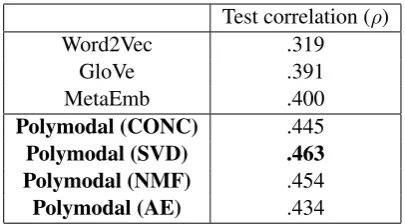
As in Table 2, the proposed method shows the highest correlation to the test set among all the cases including the baselines. Among the ensem-ble method, SVD again shows the highest perfor-mance. For the hypernym prediction, NMF gives a slightly better result than the simple weighted concatenation.
4.2 Property Norms Analysis
While the corpus-driven word representations such as Word2vec and GLoVe have been shown to
Test correlation (ρ)
Word2Vec .319
GloVe .391
MetaEmb .400
Polymodal (CONC) .445
Polymodal (SVD) .463 Polymodal (NMF) .454
Polymodal (AE) .434
Table 2: Spearman’s correlation score of Hyper-Lex test dataset and predictions. The proposed method shows the highest correlation with the test dataset.
embed some word-to-word relations such asmen
is towomenaskingis toqueen, but it is still un-certain that they are also able to capture the prop-erties like has four legs or is delicious. To see how well the models capture such properties of words, we perform the property norms analy-sis. We utilize the CSLB concept property norms dataset (Devereux et al., 2014) which annotates the normalized feature labels to the set of con-cepts. This dataset provides the normalized fea-tures of five categories: visual perceptual, other perceptual, taxonomic, encyclopedic, and func-tional. Cis the set of all concepts andF is the set of all normalized features in CSLB dataset where
|C|= 638and|F|= 5929. Forf ∈Fandc∈C, c ∈ Cf if and only ifc has the feature f where Cf ⊂C. The valid feature setFv is a subset ofF such thatf ∈Fvonly if there exist more than three concepts that havef, or equivalently, |Cf| > 3. Then the|Fv|= 1053.
To examine how well each representation cap-tures the normalized featurefi ∈Fv, we calculate the cosine similarity betweenR(c)forc∈Cfiand
R(Cfi)whereR(·) is a mapping from concept to
its distributed representation andCfi is a centroid
of all concepts inCfi or
Cfi = 1
|Cfi|
X
c∈Cfi R(c)
In other words,Cfi is a centroid of concepts that
share the featurefi. We define thefeature density as the cosine similarity between the concept and the centroid. That is,
feature density(c, f) =R(c)·Cf
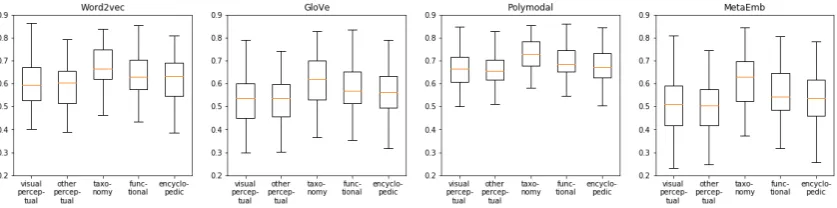
Figure 1: The feature density of different types of embedding on CSLB Concept Property Norms dataset.
Word2Vec GloVe MetaEmb Proposed
All features .308 .262 .283 .343
Visual Perceptual .204 .162 .188 .241
Other Perceptual .122 .143 .148 .148
Taxonomic .271 .236 .244 .263
Encyclopedic .138 .129 .145 .136
Functional .314 .288 .280 .310
Table 3: Spearman’s correlation between the CSLB normalized feature representation and the target distributed representation.
the same features will also be distributionally sim-ilar (Erk,2016).
In Figure1that summarizes the result, the pro-posed embedding method shows higher averages and lower deviations of feature densities across all the categories. It shows that our proposed embed-ding method is more capable of capturing normal-ized features than the baselines.
To further cement the observations, we cal-culate Spearman’s correlation of word similarity measures between the normalized feature repre-sentation and the target distributed reprerepre-sentation. The normalized feature representation of a con-cept is constructed as an one-hot vector which as-signs 1 if the concept has the feature and 0 oth-erwise, and then L2-normalized to have length 1. Then we calculate the correlations of similarity measures by the feature categories. The results are shown in Table3. While the proposed embed-ding method shows the highest correlation to the case of using all normalized features, it also shows a noticeable improvement in the visual perceptual category.
4.3 Positive vs Negative
One of the critical weakness of context-based word representation is that it cannot differ-entiate the sentiment polarity correctly. So we examine the ratio of neighbors that have same/opposite/neutral sentiment polarities with a
Figure 2: The ratio of 10 nearest neighbors that have same/opposite/neutral sentiment polarities of 15010 words.
target word among 15010 words and see how this problem can be mitigated. Figure2illustrates the result. The three context-based approaches show roughly 20% of incorrect sentiment differentia-tion. This can be benefited greatly from the sen-timent module of the proposed approach as this is-sue is almost perfectly resolved by simply attach-ing sentiment values to the embeddattach-ing. The result might be straightforward but this can improve the quality of embedding greatly.
4.4 Concrete vs Abstract
two groups for different degrees of concept creteness. This corresponds to 500 pairs of con-crete words vs. 499 pairs of abstract words. Then we examine the relative importance of the differ-ent modules to each group via an ablation test. The result is reported in Table4.
Modules All Concrete Abstract
L (linear) .442 .462 .449
T (syntactic) .446 .439 .459
C (cognition) .464 .451 .456
P (perception) .157 .355 .010
S (sentiment) .221 -.100 .293
E (emotion) .376 .350 .385
All-but-L .527O .464O .538O
All-but-T .524O .478O .501O
All-but-C .514O .466O .492O
All-but-P .531O .476O .570N
All-but-S .503O .491N .484O
All-but-E .526O .488N .540O
All .533 .483 .545
Table 4: Ablation tests for different word groups in Simlex-999. The metric is Spearman’s cor-relation. Embeddings here are ensembled via weighted concatenation.
Interesting properties are revealed through the ablation test. By comparing the results between the different word groups, we can observe that the importance of a certain word aspect varies depend-ing on the word characteristics. While concrete words profit from perception embeddings, the sen-timent and emotion aspects are somewhat disturb-ing. We can observe an opposite result for abstract words. This result is quite intuitive since we can easily imagine the perceptual image from a con-crete concept but not from an abstract one like
love.
For a deeper analysis, we further investigate the role of each module in different word groups. For instance, since concrete concepts are perception-revealing, they would benefit from a strong em-phasis on the perception embedding. On the other hand, emotion-revealing word groups such as ab-stract concepts would be opposite. Noting that the different types of words may have different sen-sitivity toward the modules, we adjusted the rel-ative weights for a particular aspect of interest to be from 0.1 to 3.5 while maintaining others to 1.0. Then we observed the changes of the performance in word similarity task. The result is shown in
Fig-ure3.
Figure 3: The result of sensitivity analysis. The weight of aspect-of-interest is adjusted while oth-ers are fixed to 1. These graphs reveal the distinct profiles of different word groups. Gradual pat-terns of emotion and perception are opposite for the concrete and abstract word groups.
The result of sensitivity analysis supports the idea that different word groups are influenced by each module with varying degrees. The x-axis refers to the relative weight of a particular as-pect while setting the others to 1.0. The y-axis indicates the changes of Spearman’s correlation score ρ on Simlex-999. The results in Figure 3 illustrate the different preferences among different word groups, which show the distinct nature be-tween the two groups. In particular, the gradual patterns revealed by increasing relative weights of perception and emotion are contrary to concrete and abstract words. Increasing the weight of per-ception is beneficial for concrete word groups but detrimental to abstract word groups. However an exactly reverse pattern can be observed for the emotion. Increasing the weight of emotion is ad-vantageous for abstract words but adverse for con-crete words.
4.5 Similarity vs Relatedness
The “similarity” between two words is more strict term than the “relatedness”. While the relatedness measures how much the two words are related to each other in some senses, the similarity measures how much the two words can be regarded as “sim-ilar” than just simply related. For example, con-sider the three word pairs: (bread, butter), (bread, toast), and (bread, stale). All of them can be re-garded as “related” but only the (bread, toast) pairs can be regarded as “similar” because the other two words (butter and stale) are related but not similar to the “bread”.
WordSim-353 capture this difference of similarity and relat-edness. While the scores of WordSim-353 focus on the relatedness, those of the Simlex-999 de-liberately try to distinguish between them. For example, a word pair (cloth, closet) is scored 8.00 in WordSim-353 dataset whereas 1.96 in the SimLex-999 dataset. To capture the difference between relatedness and similarity and see what modules contributes most to capture the similarity or the relatedness, we conduct a sensitivity analy-sis on WordSim-353 and SimLex-999 dataset.
Figure 4: The result of sensitivity analysis on word similarity and word relatedness. While con-text information is important to the relatedness, sentiment polarity and lexical relations are impor-tant to the similarity.
Figure 4 shows the result of sensitivity anal-ysis. In the SimLex-999 dataset which focuses on the word similarity, the cognition (lexical re-lation) and the sentiment modules turned out to be important. On the other hand, in the WordSim-353 dataset which focuses on the word related-ness, both linear context and syntactic context are turned out to be critical. This difference can be in-terpreted that the word properties extracted from the contexts are of the word relatedness, and in or-der to differentiate the similarity from the related-ness, additional properties such as lexical relations and sentiment polarities need to be introduced.
5 Conclusion
In this paper, we raise a question if the current dis-tributed word representations sufficiently capture different aspects of word meanings. To address the question, we proposed a novel method for com-posing word embeddings, inspired by a human cognitive model. We compared our proposed em-bedding to the current state-of-the-art distributed word embedding methods such as Word2Vec, GloVe, and Meta-embedding from the perspective
of capturing diverse aspects of word meanings. Our proposed embedding performs better in the word similarity and hypernym prediction tasks than the baselines. We further conducted a series of experiments to study how well the word mean-ings are reflected by the representations and ana-lyze the relationships between the modules and the word properties. From the property norms analy-sis, our findings show that the proposed method can capture the visual properties of words better than the baselines. Also, harnessing sentiment val-ues helps the embedding greatly to resolve the sen-timent polarity issue which is a limitation of cur-rent context-driven approaches. Based on the ex-perimental results, we can conclude that some as-pects of word meanings are not captured enough from the corpus and we can further improve the word embedding by referring to additional data re-lated to a human mind model.
Finally, using our proposed method we show the different characteristics of concrete and ab-stract word groups and the difference between the concept relatedness and the concept similar-ity. We observe that emotional information is more important than the perceptual information for the abstract words whereas the opposite result is observed for the concrete words. Also, we see that the context-driven embeddings mostly capture the word relatedness and therefore lexical relation and sentiment polarities would be beneficial when considering the word similarity.
In conclusion, we concentrate on analyzing the relationships between the diverse aspects of word meanings and their distributed representations and propose a way to improve them by harnessing ad-ditional information based on the human cognitive model. Since our proposed method largely relies on the labeled extra data, this work has a limita-tion in terms of the scalability. For future research, we need to explore unsupervised ways of introduc-ing perceptual properties and lexical relationships of words and annotating their sentiment and emo-tional properties. It will make our method more scalable.
Acknowledgements
Deep-Symbolic Hybrid Learning and Construction of Language Resources)
References
Eneko Agirre, Enrique Alfonseca, Keith Hall, Jana Kravalova, Marius Pas¸ca, and Aitor Soroa. A study on similarity and relatedness using distributional and WordNet-based approaches. InProceedings of Human Language Technologies: The 2009 Annual Conference of the North American Chapter of the Association for Computational Linguistics, pages 19–27. Association for Computational Linguistics, 2009.
Sanjeev Arora, Rong Ge, Yonatan Halpern, David M Mimno, Ankur Moitra, David Sontag, Yichen Wu, and Michael Zhu. A practical algorithm for topic modeling with provable guarantees. In ICML (2), pages 280–288, 2013.
Stefano Baccianella, Andrea Esuli, and Fabrizio Sebas-tiani. Sentiwordnet 3.0: An enhanced lexical re-source for sentiment analysis and opinion mining. InLREC, volume 10, pages 2200–2204, 2010. LW Barsalou. Perceptual symbol system. Behavioral
and Brain Science, 22(4):577–609, 1999.
Elia Bruni, Nam-Khanh Tran, and Marco Baroni. Mul-timodal distributional semantics. J. Artif. Intell. Res.(JAIR), 49(1-47), 2014.
Ronan Collobert and Jason Weston. A unified archi-tecture for natural language processing: Deep neural networks with multitask learning. InProceedings of the 25th international conference on Machine learn-ing, pages 160–167. ACM, 2008.
Barry J Devereux, Lorraine K Tyler, Jeroen Geertzen, and Billi Randall. The centre for speech, language and the brain (CSLB) concept property norms. Be-havior research methods, 46(4):1119, 2014. Katrin Erk. What do you know about an alligator when
you know the company it keeps? Semantics and Pragmatics, 9:17–1, 2016.
Manaal Faruqui and Chris Dyer. Non-distributional word vector representations. arXiv preprint arXiv:1506.05230, 2015.
Manaal Faruqui, Jesse Dodge, Sujay K. Jauhar, Chris Dyer, Eduard Hovy, and Noah A. Smith. Retrofitting word vectors to semantic lexicons. In
Proceedings of NAACL, 2015.
Zellig S Harris. Distributional structure. Word, 10(2-3):146–162, 1954.
Aron Henriksson. Ensembles of semantic spaces: On combining models of distributional semantics with applications in healthcare. PhD thesis, Department of Computer and Systems Sciences, Stockholm Uni-versity, 2015.
Felix Hill, Roi Reichart, and Anna Korhonen. Simlex-999: Evaluating semantic models with (genuine) similarity estimation. Computational Linguistics, 2016.
Geoffrey E Hinton and Terrence J Sejnowski. Learn-ing and releamLearn-ing in Boltzmann machines. Parallel Distrilmted Processing, 1, 1986.
Sepp Hochreiter and J¨urgen Schmidhuber. Long short-term memory. Neural computation, 9(8):1735– 1780, 1997.
Douwe Kiela. Deep embodiment: grounding seman-tics in perceptual modalities. Technical report, Uni-versity of Cambridge, Computer Laboratory, 2017. Douwe Kiela and Stephen Clark. Multi- and
cross-modal semantics beyond vision: Grounding in au-ditory perception. In Proceedings of the 2015 Conference on Empirical Methods in Natural Lan-guage Processing, pages 2461–2470, Lisbon, Portu-gal, September 2015. Association for Computational Linguistics.
Douwe Kiela, Luana Bulat, and Stephen Clark. Grounding semantics in olfactory perception. In
ACL (2), pages 231–236, 2015.
Ryan Kiros, Ruslan Salakhutdinov, and Richard S Zemel. Multimodal neural language models. In
Icml, volume 14, pages 595–603, 2014a.
Ryan Kiros, Ruslan Salakhutdinov, and Richard S Zemel. Unifying visual-semantic embeddings with multimodal neural language models. arXiv preprint arXiv:1411.2539, 2014b.
Omer Levy and Yoav Goldberg. Dependency-based word embeddings. InACL 2014, 2014.
Tsung-Yi Lin, Michael Maire, Serge Belongie, James Hays, Pietro Perona, Deva Ramanan, Piotr Doll´ar, and C Lawrence Zitnick. Microsoft COCO: Com-mon objects in context. InEuropean Conference on Computer Vision, pages 740–755. Springer, 2014. Thang Luong, Richard Socher, and Christopher D
Manning. Better word representations with recur-sive neural networks for morphology. In CoNLL, pages 104–113, 2013.
Mark E Maruish and James A Moses. Clinical neu-ropsychology: Theoretical foundations for practi-tioners. Psychology Press, 2013.
Tomas Mikolov, Ilya Sutskever, Kai Chen, Greg S Cor-rado, and Jeff Dean. Distributed representations of words and phrases and their compositionality. In
Advances in neural information processing systems, pages 3111–3119, 2013.
Saif M Mohammad and Peter D Turney. Crowdsourc-ing a word–emotion association lexicon. Computa-tional Intelligence, 29(3):436–465, 2013.
Jeffrey Pennington, Richard Socher, and Christopher D Manning. Glove: Global vectors for word represen-tation. In EMNLP, volume 14, pages 1532–1543, 2014.
David C Plaut and James R Booth. Individual and de-velopmental differences in semantic priming: Em-pirical and computational support for a single-mechanism account of lexical processing. Psycho-logical review, 107(4):786, 2000.
Friedemann Pulverm¨uller. Words in the brain’s lan-guage. Behavioral and brain sciences, 22(02):253– 279, 1999.
Stephen Roller and Sabine Schulte Im Walde. A multi-modal LDA model integrating textual, cognitive and visual modalities. InProceedings of the 2013 Con-ference on Empirical Methods in Natural Language Processing, pages 1146–1157, 2013.
Herbert Rubenstein and John B Goodenough. Contex-tual correlates of synonymy. Communications of the ACM, 8(10):627–633, 1965.
Md Sahidullah and Tomi Kinnunen. Local spectral variability features for speaker verification. Digital Signal Processing, 50:1–11, 2016.
Mikkel N Schmidt, Jan Larsen, and Fu-Tien Hsiao. Wind noise reduction using non-negative sparse coding. In Machine Learning for Signal Process-ing, 2007 IEEE Workshop on, pages 431–436. IEEE, 2007.
Carina Silberer and Mirella Lapata. Learning grounded meaning representations with autoencoders. InACL (1), pages 721–732, 2014.
Karen Simonyan and Andrew Zisserman. Very deep convolutional networks for large-scale image recog-nition.arXiv preprint arXiv:1409.1556, 2014. Luc Steels. The symbol grounding problem has been
solved. so whats next. Symbols and embodiment: Debates on meaning and cognition, pages 223–244, 2008.
Leo Taslaman and Bj¨orn Nilsson. A framework for regularized non-negative matrix factorization, with application to the analysis of gene expression data.
PloS one, 7(11):e46331, 2012.
Ivan Vuli´c, Daniela Gerz, Douwe Kiela, Felix Hill, and Anna Korhonen. Hyperlex: A large-scale evalua-tion of graded lexical entailment. arXiv preprint arXiv:1608.02117, 2016.
Kelvin Xu, Jimmy Ba, Ryan Kiros, Kyunghyun Cho, Aaron C Courville, Ruslan Salakhutdinov, Richard S Zemel, and Yoshua Bengio. Show, attend and tell: Neural image caption generation with visual atten-tion. InICML, volume 14, pages 77–81, 2015.
Wenpeng Yin and Hinrich Sch¨utze. Learning meta-embeddings by using ensembles of embedding sets.