238
Network and Application Performance in Cloud
Computing With Low Resource Utilization across
Multiple Cloud Platforms
Punashri Patil1, Poonam Jadhav2, Amrapali Chavan3 Department of Computer Engineering, AISSMS,IoIT,PUNE
Email:[email protected],[email protected],[email protected]
Abstract-Now a days, Cloud Computing (CC) has been most useful methodology over the web. Virtualization in
cloud computing is responsible to use by many cloud vendors in their infrastructure. In our paper we studied, how to achieve high availability using Docker Container. This can be achieved with virtualization technology. We studied cloud infrastructure management with minimum resources & by using private DNS server which is connected with all the containers in multi-cloud environment with improvement of network server. In this paper emphasis is given on cloud infrastructure management in multi-cloud platform. The networking issues are rectified with the help of Docker framework with the help of private DNS which acts as network server for each cloud environment. YCSB tool is used for testing the performance of cloud infrastructure.
Index Terms-Virtualization, Live Migration, MongoDB, Cloud Infrastructure Management, Docker container, YCSB
1. INTRODUCTION
For deployment of cloud environment Docker container is used in virtual cloud network. For drifting organization cloud computing is a viable technology in the computing. d Cloud computing makes the provision of using the utilities as per requirement from anywhere along with usage of parallel computing in the virtualized surroundings [8]. Cloud computing environment has software as offerings (SaaS), Platform as a services (PaaS) and Infrastructure as services (IaaS). Sources such storage, topologies, server space are provided in both physical and virtualized pattern to make cloud computing success. Virtualization is most important in cloudcomputing. The research aims that deploying cloud infrastructure using Docker container and eliminates networking problems faced by it .The IPs are allocated by the Docker from IP pool and if Container A is Shut down then new container will get the IP addresses of A container.It is necessary to find out new ways to achieve high availability and get rid of network issues in Docker Container.A novel solution for the above problem is given by our researchwith the help of creation of private DNS container and amalgamation of all the containers to the DNS.
Second section includes all the related work to our research including Docker container and Linux container in addition to cloud infrastructure management ideology.
The third section discussion is regarding our proposed architecture which includes connection of private DNS server to containers with specifications.
Next is the implementation part where the description of our system is stated with the creation of private DNS server & deployment through MongoDb.At the end results of our system are shown.
2. RELATED WORK
This part explains points regarding Docker Container and virtualization.
2.1. Introduction to cloud computation and concept of Virtualization
Computing ability has the power to enhance performance of IT industry and provides handsome software services [3]. Cloud computation includes cloud services: cloud software as a service (SaaS), cloud platform as a service (PaaS), and cloud infrastructure as a service (IaaS) [26]. Virtualization is part & parcel of cloud computing and information centers. Paravirtualization provides solution for Memory Management Unit (MMU) and I/O [14].
2.2. Linux Container (LXC) and Docker Container
239 cloud computing and Docker approach is used for the
same. dot Cloud is renowned service PaaS supporting a variety of cloud computing applications. Images can be created as per requirement on requirement using Dockerfile [25].Different tools for implementation of Virtual Machines include KVM, Xen hypervisors and Docker container along with the testing tools like Hackbench benchmarking for testing & evaluation to nullify Docker overhead [32]. Docker container is helpful to extend Quality and operations of Linux container (LXC) using core kernel layer and API[5].
2.3. Cloud Infrastructure Management
In learning cloud infrastructure system Yan et al., says that IaaS is well defined cloud computing platform [37]. IaaS has problems in heterogeneous cloud environment which is provided a solution called Monsoon which satisfies cloud requirement of organizations.
2.4 High availability and Live Migration
Yu and Huan states that live migration using Docker container is lightweight and used for VMs [38]. It also figures out that Docker container minimizes time required for live migration [35]. It introduced technology called live snapshot for cluster-based computing which provides high availability to VMs[2]. It tells solution using virtual machine where live migration from one physical device to other is done without performance degradation.
3. Design and Specification
3.1 Design
In IT industries Docker container is the expanding technology. The main focus of
Our system analyzing execution of deployment of cloud platform in one & more cloud vendors by restoring execution of private DNS inside containers. Openstack, AWS, Digital Ocean are the different Cloud vendors used in the research work to check & test their performances by deploying the cloud infrastructure
3.2 Software Requirement:
3.2.1 MongoDB Sharding Cluster:
MongoDB is database management system (DBMS) that focuses on using document-oriented database model supporting various forms of data which is open source. The MongoDB architecture is comprised of collections and documents. MongoDB supports
GridFs, auto-sharding, store files of any size without any error to the stack. Document is important part of MongoDB which makes request from client, routing it to matching server &merging the result to client side.
3.2.2 MongoDB clustered Architecture:
Sharding is the process used to store data across numerous machines.It is helpful to achieve the growing data demands. It is collection of variety of data from variety of machines and not replication. The process of sharding is responsible for evenly distributing data across multiple physical partition called as shards. Sharding allows horizontal scaling of data stored in multiple shards. Concept of sharding in MongoDB address hardware limitation of a single server [28].
3.2.3 Shards:
Shards consist of subsets of data used for shared cluster and is also called single mongod. Each and everysharad will be having one or more server that uses mongodb process to store data.
3.2.4 Config Server:
The purpose of config server is to store the metadata for shardedcluster. It is used to maintain the distributed lock in MongoDB. It is used by the query router wherein metadata is used to target operation to specific shard.
3.2.5 Router Server:
The alternate name for this fundamental is query router used for routing the processes and coordinating with complete process working in sharding cluster architecture
3.3 DNS Server:
The DNS Server plays an important role in our research where it will be used as main source component for networking containers among different cloud vendors or different networks.
3.3.1 DNS Zone
A DNS zone is any specific part of the domain name space in the Domain Name System (DNS) for which regulatory duty has been designated to a single manager. The tree network structure in DNS is divided into small networks called as zones. A zone starts at a domain and extended in downward direction in the tree to the leaf nodes or to the top-level of sub domains where other zones start.
3.3.2 BIND DNS:
240 and the various files associated for setting up our own
Linux DNS BIND server.
3.4 YCSB (Yahoo cloud serving benchmark)
YCSB is a tool for quantifying systems. Usage of YCSB can be done either by cloning git repository or download latest version from the source YCSB is used for comparison of performance with respect to other clod platform databases. YCSB has key feature of extensibility for implementation. YCSB is used for generation of data and operations which create the workload which is written in java language. Workload property & runtime property are the two concepts present in YCSB. Workload Property defines the workload irrespective of the given database and runtime properties point given instance.
3.5 NEW RELIC
Many Organizations make use of New relic tool which is real time application performance monitoring tool. Through use of new relic tool organizations get information about web user experience which is the main reason for organization success. This tool helps organizations to examine CPU utilization, memory utilization, it also helps to remove the obstacles which lowers the performance of application. The new Relic tool is used for checking CPU & memory consumption ofMongDB cluster. This tool helps the
organizations to transfer the data from one server to another in case the load is increased in order to avoid the bottleneck and improve cluster performance [7].
4. IMPLEMENTATION
This section focuses on deployment of multi-vendor cloud infrastructure with the help of Docker containers. The first part tells about deployment of existing infrastructure through weave networking plug-in and its related issues. The second part shows our proposed system being deployed using creation of DNS inside Docker. Following is the prerequisite for completion of setup.
1. Bind9 DNS Server 2. Docker Containers
3. Virtual Private Servers from Different cloud vendors like Digital Ocean, OpenStac and Amazon Web Services
4. Weave docker networking plug-in(required for deployment of existing infrastructure)
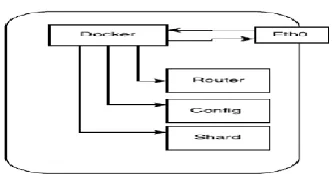
241 It shows the execution of container technology in host
server. Execution of Docker takes place on host and the docker bridge container are created on top level. Docker bridge provides IPs to contain++ers. Docker
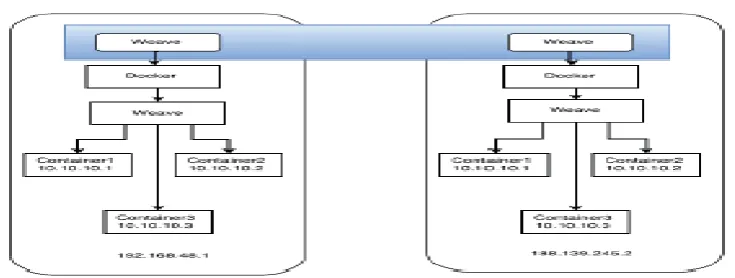
bridge has pre-defined IP subnet that is 17217.0.0/16 which is for the internal communication. The communication is not possible for two host having docker containers for the reason thatIps are not static &private for config servers. The Figure4.1 below show no communication between the containers. To get rid of networking problem weave docker plug-in is used for communication purpose between containers established at different networks. All servers need to be configured before infrastructure deployment. The existing infrastructure does not support addition of new server.
The Figure 4.2 tells weave creates tunnel for communication purpose. In case if we have to add server, weave router throws an error that it is unable to establish connection for new server.
4.2 Building an infrastructure using DNS.
In our research due to security reasons we are not using public DNS server such as Amazon DNS,Google DNS rather create private DNS in Docker container.The setup is described below:
1. In each server create DNS containers.
2. Add DNS Server as nodes after creation of containers.
3. Deployment of Infrastructure
4.2.1 Configuring DNS Server.
Collection of records of Primary DNS server known as zones. Specifying forward and reverse zone process is done after configuration of master DNS.
4.3 Creation Addition of container to the server.
[image:4.595.309.475.190.293.2]Creation of container and addition to DNS server zone is possible after configuration of DNS only. Docker file is used for creation of Docker container with the help of handful commands. The Docker file is shown below:
Figure 4.1: Servers With Docker Containers.
[image:4.595.107.475.345.484.2]242 Figure 4.3: Zones configuration structure with DNS
Server
4.4Infrastructure Deployment:
Infrastructure Deployment of MongoDB cluster across different cloud vendors with the domain name configuration. The deployed architecture is shown below which provides high availability and by using public or private clouds new resources can be added .
5.Evaluation
5.1Performance Calculation of Cloud
Infrastructure deployment between single server model & 2 Server Model
[image:5.595.173.488.149.327.2]Figure 4.4: Connection of DNS to MongoDB Containers
[image:5.595.333.488.382.539.2] [image:5.595.88.271.397.527.2] [image:5.595.334.501.627.714.2]243 Table 5.1: Comparison of MongoDB in single server
& two server
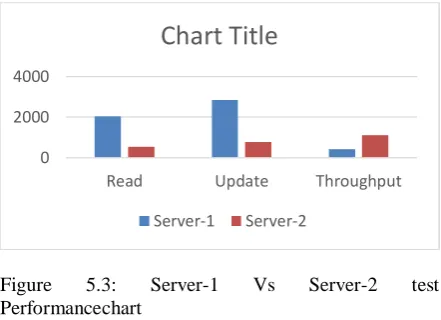
[image:6.595.303.543.136.324.2] [image:6.595.72.293.276.436.2]As Shown in the Table 5.1 with respect to 5.1 , By executing the system 5 times we examined read, update & throughput along with the latency time taken in microseconds.
Figure 5.3: Server-1 Vs Server-2 test Performancechart
Our Architecture gives benefits like low cost of resource, less resource utilization and all the resources are used without making any servers idle. Our architecture thus enhances all three operations.
[image:6.595.309.530.520.690.2]5.2 Testing Performance in Multiple Cloud Platforms
Table 5.2: Testing Performance in Multiple Cloud Platforms
In this we have testing results of 3 different clod platforms like AWS, OpenStack, Digital oceanFrom the comparison we understand that read & update operation in digital ocean is better with respect to other platforms. In digital Ocean the SSD Hard drive is used which improves the performance along with better services in minimum cost. We have used YCSB tool for the performance testing operation.
Figure 5.4: Performance of Different Cloud Infrastructure Platformchart.
5.3 Resource Utilization:
Here in this part we do the analysis of the resource consumption done by our prototype and weave. New Relic an online monitoring tool is used for the analysis of CPU and memory utilization.
5.4CPU utilization:
In this Part evaluation of CPU utilization is performed using new relic monitoring tool which shows that DNS server does not consume any resource of the host whereas weave consumes resource of the host.
Table 5.3: CPU Utilization Rate
Figure: 5.5 CPU utilization rate chart
5.3.2 Memory utilization:
The memory utilization of the DNS Server is less in comparison with wave because DNS Server Utilizes
0 2000 4000
Read Update Throughput
Chart Title
Server-1 Server-2
0 200 400 600 800 1000 1200 1400 1600
AWS
Digital Ocean
Openstack
0.00% 0.50% 1.00% 1.50% 2.00%
DNS Weave
Docker
Host
Read 2029 531
Update 2847 774
Throughput 431 1116
AWS
Digital
Ocean Openstack
Read 1015 968 1463
Update 493 630 539
Throughput 607 785 645
Docker Host
DNS 1.83% 0.00%
[image:6.595.68.300.550.615.2]244 virtualized resources whereas weave utilizes physical
as well as virtual.
Table 5.4: Memory Utilization Rate
Figure: 5.6 Memory Utilization chart
Conclusion:
For multiple cloud environment ,the Hypervisor based virtualization is not the match. The hardware demand and resource allocation methods vary in Docker based cloud infrastructure. The research highlights difficulties encountered by Docker networking at the time of cloud infrastructure deployment also the solution is provided by generation of private DNS server for each one of the cloud platform along with containers attached to one another with the help of private DNS.We perform the deployment process of MongoDB clustered architecture in single server as well as our proposed model, on comparison we concluded that our proposed infrastructure has enhanced the read and update operation. The deployment of proposed infrastructure in multiple cloud model indicates that the performance is better when the infrastructure is deployed in Digital Ocean
(A.1)
REFERENCES
[1] Ahmad, N., Kanwal, A. and Shibli, M. A. (2013), Survey on secure live virtual machine (vm) migrationin cloud, in `Information Assurance (NCIA), 2013 2nd National Conference on', IEEE, pp. 101{106.
[2] Anala, M., Kashyap, M. and Shobha, G. (2013), Application performance analysis during live migrationof virtual machines, in `Advance Computing Conference (IACC), 2013 IEEE 3rd International',IEEE, pp. 366{372.
[3] Armbrust, M., Fox, A., Gri_th, R., Joseph, A. D., Katz, R., Konwinski, A., Lee, G., Patterson, D.,Rabkin, A., Stoica, I. et al. (2010), `A view of cloud computing', Communications of the ACM53(4), 50{58.
[4] Bacis, E., Mutti, S., Capelli, S. and Paraboschi, S. (2015), Dockerpolicymodules: mandatory access control for docker containers, in Communications and Network Security (CNS), 2015 IEEE Confer- ence on', IEEE, pp. 749{750.
[5] Bernstein, D. (2014), `Containers and cloud: From lxc to docker to kubernetes', IEEE Cloud Computing(3), 81{84.
[6] Boettiger, C. (2015), `An introduction to docker for reproducible research', ACM SIGOPS OperatingSystems Review 49(1), 71{79.
[7] Burson-Marsteller and Starch, R. (2016), Application Performancde Monitoring APM for LAB, Tech-nical report, New Relic Organisation. [8] Buyya, R., Yeo, C. S., Venugopal, S., Broberg, J.
and Brandic, I. (2009), `Cloud computing and emerging it platforms: Vision, hype, and reality for delivering computing as the 5th utility', FutureGeneration computer systems 25(6), 599{616.
[9] Casoni, M., Grazia, C. A. and Patriciello, N. (2013), On the performance of linux container with
netmap/vale for networks virtualization, in `Networks (ICON), 2013 19th IEEE International Conference on', IEEE, pp. 1{6.
[10]Chandramouli, R. and Rose, S. (2005), An integrity veri_cation scheme for dns zone _le based onsecurity impact analysis, in `21st Annual Computer Security Applications Conference (ACSAC'05)',pp. 10 pp.{321.
[11].Cooper, B. F., Silberstein, A., Tam, E., Ramakrishnan, R. and Sears, R. (2010), Benchmarking cloudserving systems with ycsb, in `Proceedings of the 1st ACM symposium on Cloud computing', ACM,pp. 143{154.
[12]Deb, S., Srinivasan, A. and Pavan, S. K. (2008), An improved dns server selection algorithm for
0 10 20 30 40 50
Weave DNS
Host
Docker
Host(MB) Docker(MB)
DNS 44 28
245 fasterlookups, in `Communication Systems
Software and Middleware and Workshops, 2008. COMSWARE2008. 3rd International Conference on', pp. 288{295.
[13]Dhungana, R. D., Mohammad, A., Sharma, A. and Schoen, I. (2013), Identity management frame-
work for cloud networking infrastructure, in `Innovations in Information Technology (IIT), 2013 9thInternational Conference on', IEEE, pp. 13{17.
[14]Dong, Y., Yang, X., Li, J., Liao, G., Tian, K. and Guan, H. (2012), `High performance network virtualization with sr-iov', Journal of Parallel and Distributed Computing 72(11), 1471{1480. [15]Dong, Y., Zhang, X., Dai, J. and Guan, H. (2014),
`Hyvi: A hybrid virtualization solution balancing performance and manageability', Parallel and Distributed Systems, IEEE Transactions on25(9), 2332{2341.
[16]Dua, R., Raja, A. R. and Kakadia, D. (2014), Virtualization vs containerization to support paas, in`Cloud Engineering (IC2E), 2014 IEEE International Conference on', IEEE, pp. 610{614. [17]Dusia, A., Yang, Y. and Taufer, M. (2015),
Network quality of service in docker containers, in `ClusterComputing (CLUSTER), 2015 IEEE International Conference on', IEEE, pp. 527{528. [18]Fakhfakh, M., Cherkaoui, O., Bedhiaf, I. L. and
Frikha, M. (2009), High availability in ims virtualizednetwork, in `Communications and Networking, 2009. ComNet 2009. First International Conferenceon', IEEE, pp. 1{6. [19]Felter, W., Ferreira, A., Rajamony, R. and Rubio,
J. (2015), An updated performance comparison of virtual machines and linux containers, in `Performance Analysis of Systems and Software (ISPASS),2015 IEEE International Symposium On', IEEE, pp. 171{172.
[20].Ismail, B. I., MostajeranGoortani, E., Ab Karim, M. B., Ming Tat, W., Setapa, S., Luke, J. Y. and Hong Hoe, O. (2015), Evaluation of docker as edge computing platform, in `Open Systems (ICOS),2015 IEEE Confernece on', IEEE, pp. 130{135.
[21]Jalalzai, M. H., Shahid, W. B. and Iqbal, M. M. W. (2015), Dns security challenges and best practices
to deploy secure dns with digital signatures, in `2015 12th International Bhurban Conference on Applied Sciences and Technology (IBCAST)', pp. 280{285.
[22]Jin, X.,Wang, H.,Wang, J., Cheng, S. and Li, J. (2013), A partners assisted virtual machine live storagemigration for intensive disk i/o workloads, in `High Performance Computing and Communications &2013 IEEE International Conference on Embedded and Ubiquitous Computing (HPCC EUC), 2013IEEE 10th International Conference on', IEEE, pp. 693{1698.
[23]Lei, S., Zishan, D. and Jindi, G. (2010), Research on key management infrastructure in cloud computingenvironment, in `Grid and cooperative Computing (GCC), 2010 9th International Conference on',IEEE, pp. 404{407.
[24]Liu, C. and Albitz, P. (2006), DNS and Bind, " O'Reilly Media, Inc.".
[25]Liu, D. and Zhao, L. (2014), The research and implementation of cloud computing platform basedon docker, in `Wavelet Active Media Technology and Information Processing (ICCWAMTIP), 201411th International Computer Conference on', IEEE, pp. 475{478. [26]Liu, F., Tong, J., Mao, J., Bohn, R., Messina, J.,
Badger, L. and Leaf, D. (2011), `Nist cloud computingreference architecture', NIST special publication 500, 292.
[27].Liu, X. X., Qiu, J. and Zhang, J. M. (2014), High availability benchmarking for cloud management infrastructure, in `Service Sciences (ICSS), 2014 International Conference on', IEEE, pp. 163{168. [28]Liu, Y., Wang, Y. and Jin, Y. (2012), Research on
the improvement of mongodb auto-sharding in cloud environment, in `Computer Science Education (ICCSE), 2012 7th International Conferenceon', pp. 851{854.
[29]Marquezan, C. C., Bruneo, D., Longo, F., Wessling, F., Metzger, A. and Pulia_to, A. (2014), 3-d cloud
246 [30]Mattetti, M., Shulman-Peleg, A., Allouche, Y.,
Corradi, A., Dolev, S. and Foschini, L. (2015), Securingthe infrastructure and the workloads of linux containers, in `Communications and Network Security(CNS), 2015 IEEE Conference on', IEEE, pp. 559{567.
[31]Patnaik, D., Bijlani, A. and Singh, V. K. (2010), Towards high-availability for ip telephony using virtualmachines, in `Internet Multimedia Services Architecture and Application (IMSAA), 2010 IEEE 4thInternational Conference on', IEEE, pp. 1{6.
[32]Raho, M., Spyridakis, A., Paolino, M. and Raho, D. (2015), Kvm, xen and docker: A performance analysis for arm based nfv and cloud computing, in `Information, Electronic and Electrical Engineering(AIEEE), 2015 IEEE 3rd Workshop on Advances in', IEEE, pp. 1{8.
[33]Rey, J., Cogorno, M., Nesmachnow, S. and Ste_enel, L. A. (2015), E_cient prototyping of fault tolerant map-reduce applications with docker-hadoop, in `Cloud Engineering (IC2E), 2015 IEEE International Conference on', IEEE, pp. 369{376.
[34]Satam, P., Alipour, H., Al-Nashif, Y. and Hariri, S. (2015), Dns-ids: Securing dns in the cloud era, in
`Cloud and Autonomic Computing (ICCAC), 2015 International Conference on', pp. 296{301. [35]Sun, R., Yang, J. and He, Z. (2013), An approach
to minimizing downtime induced by taking livesnapshot of virtual cluster, in `Cloud and Service Computing (CSC), 2013 International Conferenceon', IEEE, pp. 63{68.
[36]To, M. A., Cano, M. and Biba, P. (2015), Dockemu{a network emulation tool, in `Advanced InformationNetworking and Applications Workshops (WAINA), 2015 IEEE 29th International Conference on',IEEE, pp. 593{598.
[37]Yan, S., Lee, B. S., Zhao, G., Ma, D. and Mohamed, P. (2011), Infrastructure management of hybridcloud for enterprise users, in `Systems and Virtualization Management (SVM), 2011 5th InternationalDMTF Academic Alliance Workshop on', IEEE, pp. 1{6.