An Empirical Analysis of Constructing Non.restrictive N P
Modifiers to Express Semantic Relations
H u a C h e n g a n d C h r i s M e l l i s h
D i v i s i o n o f I n f o r m a t i c s , U n i v e r s i t y o f E d i n b u r g h 80 S o u t h B r i d g e , E d i n b u r g h E H 1 1 H N , U K
huac, c h r i s m @ dai. ed. ac. u k
A b s t r a c t
It is not a rare phenomenon for h u m a n written text to use non-restrictive NP modifiers to express es- sential pieces of information or support the situa- tion presented in the main proposition containing the NP, for example, "Private Eye, which couldn't afford the libel payment, had been threatened with closure." (from Wall Street Journal) Yet no previ- ous research in NLG investigates this in detail. This paper describes corpus analysis and a psycholinguis- tic experiment regarding the acceptability of using non-restrictive NP modifiers to express semantic re- lations that might normally be signalled by 'because' and 'then'. The experiment tests several relevant factors and enables us to accept or reject a number of hypotheses. The results are incorporated into an NLG system based on a Genetic Algorithm.
1 I n t r o d u c t i o n
To produce natural language text, an NLG system must be able to choose a m o n g possible paraphrases one t h a t satisfies the highest n u m b e r of constraints in a certain context. P a r a p h r a s e s can use various constructions, for example, using nominalisation in- stead of a clause for event representation. We are particularly interested in the use of non-restrictive (NR) modifiers within a referring expression to ex- press certain semantic relationQ other than object- attribute elaboration (in the sense defined in (Mann and Thompson, 1987)), for instance, causal rela- tions, which are normally expressed by separate clauses connected by cue phrases (Knott, 1996) such as 'because '.
"A non-restrictive c o m p o n e n t gives additional in- formation to a head t h a t has already been viewed as unique or as a m e m b e r of a class that has been independently identified,-mud therefoee is not' essml; tial for the identification of the head" (Quirk et al., 1985). This definition can be extended to account for modifiers of not only definite referring expres- sions, but also definite and indefinite NPs of var-
ious types. In this paper, an N R modifier refers to any NP modifying component t h a t is not essen- tial for identifying the object denoted by the head, including all modifiers of an NP t h a t does not in- tend to identify (e.g. indefinite referring expressions a n d predicative phrases) (Kronfeld, 1990). Our dis- cussion focuses on definite referring expressions in- cluding p r o p e r - n a m e s because of the dominance of such examples in our corpus. However, we would expect no difficulty in applying our observation to other types of NPs.
T h e semantic roles of N R modifiers, in particular N R clauses, are mentioned in m a n y g r a m m a r and linguistics books. Quirk et al. (1985) point out t h a t an N R clause in a referring expression is usually neu- tral in its semantic role (i.e. it provides descriptive information a b o u t its head), b u t sometimes it can contribute to the semantics of the main clause in a variety of ways. T h e y summarise three types of semantic relations t h a t can be expressed by an NR clause (examples are given in Figure 1):
® Causal, where the situation in the main clause is caused by t h a t in the NR clause, e.g. (la). ® Temporal, where the two clauses form a time
sequence, e.g. (lb).
® Circumstantial, where the N R clause sets a tem- poral or spatial framework for interpreting the main clause, e.g. (lc).
Halliday (1985) mentions t h a t a subordinate clause can elaborate a part of its primary clause through restating, clarifying, refining or adding a de- scriptive a t t r i b u t e or comment (see (2) of Figure 1). Halliday's notion of elaboration is much more gen- eral than t h a t in other coherence theories like R S T ( M a i m " a n d T h o m p s o n ; t987), a n d :the r d a t i o n ex- pressed in (2) would not be t r e a t e d as elaboration in most NLG systems.
Similar p h e n o m e n a were observed from the MUSE corpus 2, a corpus of museum exhibit labels, which
l kVe are concerned with s e m a n t i c ( i n f o r m a t i o n a l ) relations in this paper• A r g u m e n t a t i v e {intentional) relations are be- yond t h e scope of this paper.
(1)
a. b. C.He sent ahead the se,yeant, w h o w a s the m o s t e x p e r i e n c e d s c o u t in t h e c o m p a n y . In 1960 he came to ,London4 .:wh.are. :he :haa~lived • e v e r ~in~ze.
The boy, w h o h a d h i s s a t c h e l t r a i l i n g b e h i n d h i m , ran past.
(2) Inflation, w h i c h w a s n e c e s s a r y f o r t h e s y s t e m , became also "lethal.
(3) In spite of his F r e n c h name, Martin Carlin was born in Germany and emigrated to Paris to become an ebeniste.
Figure 1: -Examples for N R modifiers .contributing. to t h e semantics of the m a i n clauses
• _ . . . • ~ ' . , . ... _ - -
describe museum objects on display. For example, in (3) of Figure 1, the modifier French is not for identifying the name, but for establishing a conces- sion relation between the main proposition and the subordinate phrase to increase the reader's positive regard for where Martin Carlin was born.
For the convenience of discussion, we define some terminology to be used throughout the paper:
An NR construction/sentence : a sentence that has a main clause and a subordinate NR modifier attached to one of its NPs (e.g. (4b) of Fig- ure 2).
A hypotactic construction/sentence : a sentence that has a main clause and a dependent clause, connected by a cue phrase. This is a common way of expressing semantic relations such as causality (e.g. (4a) of Figure 2). In this syn- tactic category, we single out a subclass of sen- tences according to one possible semantic con- nection between the two clauses. It is defined below.
An elaboration realisation : a type of hypotactic construction where one clause elaborates the se- mantics of the other. We take cue phrases "as for" or "what is more" to signal elaboration re- lations 3 .
Previous research in NLG mainly focuses on us- ing NR constructions to realise elaboration relations but not other semantic relations (e.g. (Scott and de Souza, 1990) and (Hovy, 1993)). The NR modi- tier usually adds a descriptive a t t r i b u t e to the object denoted by the head.
The linguistic research suggests for an NLG sys- tem the possibility to express certain semantic rela-
cue phrases in most cases, and therefore could avoid using cues too heavily., This could be a better re- alisation under certain circumstances. Secondly, an N R construction enables a wider range of relations (especially those that are preferred to be expressed implicitly) to be selected for text structuring because the corresponding syntactic option is available.
To understand how to enable an NLG system to generate such modifiers, we are faced with two ques- tions, which are not answered by linguistic research:
1. Can this type of modifier be identified by human subjects, i.e. can humans tell the difference be- tween different NP modifier uses?
2. Under what circumstances can an NR construc- tion be used in substitution of a hypotactic con- struction without changing the meaning dra- matically and how close are the meanings con- veyed by the two representations?
An NLG system must come up with some solu- tions, simple or complex, to these two questions in order to choose among paraphrases. In this paper, we use cue phrases ms a signal of semantic relations rather t h a n try to identify the relations directly. We describe systematically controlled experiments aimed at finding out the factors related to the gen- eration of this type of modifier in referring expres- sions. The result is intended to be reliable enough to be used by NLG systems in generating descriptive text.
2 C o r p u s a n n o t a t i o n
To a n s w e r the first question, we a n n o t a t e d the M U S E corpus, from which we have observed three types of modifier uses in an NP:
tions through NR constructions, which is important . . . . Firstly,. pro~i.ding .properties £o .uniquely identify in two aspects. Firstly, a n NR construction gives--.--the objects or concepts denoted b y t h e - N P . W i t h - a more concise alternative realisation for a relation,
where the relation is expressed implicitly rather than explicitly and usually more subtly. It does not need
3\Ve acknowledge t h a t these cue p h r a s e s are controversial in their s e m a n t i c i n t e r p r e t a t i o n s , b u t not u s i n g cue p h r a s e s would be even more a m b i g u o u s . Besides, o u r e x p e r i m e n t does not heavily depend on these cue phrases.
(4) a. b.
(5) a.
b.
Private Eye had been threatened with closure because it couldn't afford the libel payment. Private ~Ege;-',which. couldn~t~.a~o.rd.thevlibel. :paymen.t,.,: had:~been~threa~ned'with" closure.
But P & G contends the new Cheer is a unique formula t h a t also offers an ingredient that prevents colors from fading. And retailers are expected to embrace the product, because it will take up less shelf space.
A n d retailers are expected to embrace the product, w h i c h will take u p less s h e l f space.
Figure 2: Examples for inferrability
in other types of genericreferences, e.g. indefini:tes; also belong here.
This t y p e subsumes the modifiers normally con- sidered by the referring expression generation mod- ule of an NLG system for uniquely identifying the referents (e.g. (Dale, 1992)).
Secondly, having no effect in constraining a unique or unambiguous concept out of the NP which is ei- ther already unique or not required to have a unique interpretation, but being i m p o r t a n t to the situation presented in the main proposition containing the NP. This type includes the modifiers described in the previous section and m a n y modifiers in indefinite predicatives, e.g. t h a t in (6b).
Thirdly, providing additional details a b o u t the referents of the NP, which functions the same way as the NP without these modifiers, e.g. those in (6c). T h e effect of such modifiers is usually local to the heads they describe rather than to the main propositions as a whole, which is the main difference between this and the second type of modifier.
This t y p e subsumes the modifiers normally gen- erated by an aggregation module, in particular one using embedding (e.g. (Shaw and McKeown, 1997), (Cheng, 1998)).
(6) a. the decoration o n this cabinet; the best l o o k i n g food I e v e r s a w
b. This is a m i g h t y e m p t y country.
c. the w i d e gilt b r o n z e straps on the cof- fer fronts and sides; He lived in a f i v e - r o o m apartment in the F a u b o u r g S a i n t - A n t o i n e .
To find out whether the above distinctions make sense to h u m a n subjects, we designed an annotation scheme for modifiers in NPs, describing which ele- ments of an NP should be marked as a modifier and how to m a r k the features for a modifier. A p a r t from o t h e r features, e a c h modifier should be a n n o / a t e c l with a p r a g m a t i c function feature ( P R A G M ) , which specifies why a modifier is used it: an NP. The pos- sible values for this feature are unique, int and attr, corresponding to the three types of modifier uses de- scribed above (we will use the value names to refer to the different types of modifier in the rest of this paper). X.XlL was used as the markup language.
We' had -two t r a i n e d annotators m a r k t h e N P modifiers in the MUSE corpus according to their understanding of the scheme. T h e agreement be- tween t h e m on the P R A G M feature by means of the K a p p a statistic (Caxletta, 1996) is .734, which means t h a t the distinctions we are trying to make can be identified by human subjects to some extent. T h e main ambiguity exists between int and attr modi- fiers. T h e r e seems to be a gradual difference between them and where to draw the line is a bit arbitrary.
In the MUSE corpus a n n o t a t e d so far, 19% of 1078 modifiers in all types of NPs axe identified as int. So this is not a trivial phenomenon.
3 A n e x p e r i m e n t
We reduced the size of the problem of when to use an NR construction by focusing on two relations: a causal relation signalled by 'because' and a t e m p o r a l relation signalled by 'then'. The reason for choosing these relations is that the possibilities of expressing t h e m t h r o u g h NR constructions have already been shown by linguists. The two cue phrases are typical for the corresponding relations and can often substi- tute other cue phrases for the same relations. In the rest of this paper, we will still use the t e r m causal or t e m p o r a l relation, but what we actually mean is the specific relation signalled by 'because' or 'then'.
3.1 I n d e p e n d e n t v a r i a b l e s a n d h y p o t h e s e s From the generation point of view, our question is: given two facts and the semantic relation between them, w h a t extra input do we need for making real- isation decisions?
We collected examples of 'because' sentences from the M U S E corpus, and Wall .Street Journal source data, and transfered t h e m to NR sentences by hand. C o m p a r i n g the two constructions, we found some ~, .An~eresting..vaxiation.:. _Eor .example,:compaxing the sentences in Figure 2, we found intuitively t h a t the meanings of (4a) and (4b) are much closer t h a n those of (5a) and (5b). In other words, (4b) can be used in substitution of (4a), whereas (5b) cannot, so easily
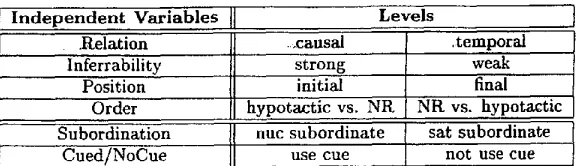
I n d e p e n d e n t V a r i a b l e s I] L e v e l s
.Relation ...causal , temporal Inferrability strong weak
Position initial final Order hypotactic vs. NR NR vs. hypotactic Subordination I nuc subordinate sat subordinate
Cued/NoCue I use cue not use cue
Table 1: Independent variables and their values
substitute (5a). A simiiar pa~ttern can be foun(i in a number of other collected sentences.
We claim that it is the degree ofinferrability of the relation between the semantics expressed through the two clauses that makes the difference. We define the inferrability of a causal/temporal relation as:
Given two separate ]acts, the likeli- hood of human subjects inferring from their world knowledge that a causal/temporal connection between the ]acts might plausi- bly exist.
In examples (4) and (5), the fact that Private Eye cannot afford the libel payment is very likely to di- rectly cause the closure threaten, whereas a prod- uct occupying less space is not usually a cause of it being accepted by retailers according to common sense. Therefore, the two realisations in (4) can be used in substitution of one another whereas those in (5) cannot.
In]errability is dynamic and user dependent. Given two facts, people with different background knowledge can infer the relation between them with different ease. If a relation is easily recognisable according to general world knowledge, we say that the inferrability of the relation is globally strong, in which case a hypotactic and an NR construction can express the relation almost equally well (if not considering rhetorical effect). Context can also con- tribute to the inferrability of a relation. A relation not easily recognisable from world knowledge may be identified by a reader with ease as the discourse proceeds. In this case, we say that the inferrabil- ity of the relation is locally strong, where the two constructions can express the relation equally well only in a certain context. In this paper, we mainly consider the global aspect of a relation and we will describe how we decided the value of inferrability in the next section.
In Table 1, we summarise the factors (indepen- dent variables) that might play a role in the close- ness judgement between the semantics of a hypotac- tie construction and an NR construction. The levels are possible values of these factors. Besides Rela- tion and In]errability. Position gives the location of the NP that contains the NR modifier. It can be the
first (initial) or the last (final) phrase in a sentenceS;
Order gives the order of presentation; a hypotactic sentence to be compared with an NR sentence or vice versa, which is used to balance the influence of cue
phrases on human judgement; Subordination speci-
fies whether the nucleus or the satellite is realised
as an NR clause6; and Cued/NoCue means using a
cue phrase in the NR clause or not, which is only applicable to the temporal relation, for example,
(7) The health-care services announced the spinoff plan last January, w h i c h was t h e n r e v i s e d
in May.
Based on our observation of human written sen- tences, we have the following hypotheses:
H y p o t h e s i s ! For both causal and temporal rela- tions, the inferrability of the relation between the se- mantics of two ]acts contributes significantly to the semantic similarities between a hypotactic construc- tion and an N R construction.
In other words, if the in]errability of the relation between the two facts is strong, the semantic rela- tion can be expressed similarly through an NR con- struction, otherwise, the similarity is significantly re- duced.
H y p o t h e s i s 2 For the causal relation, the satellite subordination bears significantly higher similarity m meaning to the hypotactic construction than the nu- cleus subordination does.
For example, (4b) would be preferred to "Private Eye, which had been threatened with closure, couldn't afford the libel payment."
H y p o t h e s i s 3 For the temporal relation, both the position of subordination and the use of an appro- priate cue phrase in the NR clause make a signifi- cant difference to the semantic similarities between • a hypotactic a n d an NR construction. -
This hypothesis prefers Example (7) to the reali- sation that does not have 'then'.
5|n our implementation, we restrict ourselves to sentences with two NPs.
aWe assume that in the causal relation, the clause bearing
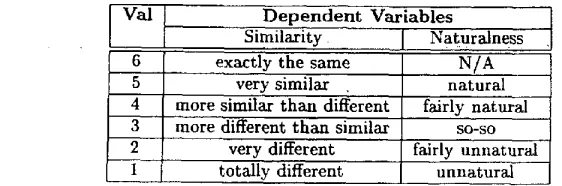
[image:4.596.181.472.63.146.2]D e p e n d e n t Variables
Naturalness
Similarity.
exactly the same _~ very similar
more similar than di~erent
N/A
natural
fairly natural
more different than similar so-so very different fairly unnatural totally different unnatural
Table 2: Dependent variables and their values
3.2 T h e d e s i g n o f t h e e x p e r i m e n t
To assess a semantic similarity, which is thought to be influenced by the independent variables, we use h u m a n subjects to judge the following two depen- dent variables:
Naturalness : how fluent a sentence is on its own. Similarity : how similar the meanings of two sen-
tences are without considering their natural- ness.
T h e scales of the variables are selected such that all values on the scale have natural verbal descrip- tions t h a t could be g r a s p e d easily by our subjects (see Table 2). Similar rating methods have been described in (Jordan et al., 1993) to c o m p a r e the o u t p u t of a machine translation system with t h a t of expert humans.
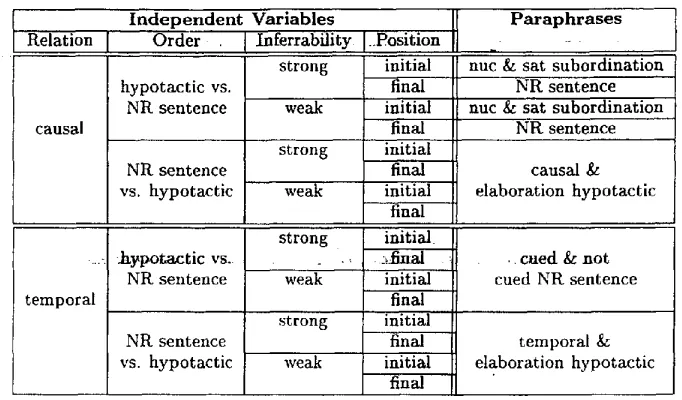
Since we want to m e a s u r e different groups of similarity judgement based on different in]errabil- ity, order or position levels, a between-groups de- sign (Hatch and L a z a r a t o n , 1991) seems to be most appropriate. T h e design we used is illustrated in Table 3, where all possible combinations of the in- dependent variables are listed. In the table, para- phrases gives the types of alternative sentences each original sentence has. T h e y should be scored by hu- m a n subjects for their similarities to the original sen- tences and their naturalness.
We used a method similar to random selection to create a stratified r a n d o m sample. T h e sample should contain 12 hypotactic sentences and 12 NR sentences: two for each combination of the causal re- lation and one for each combination of the temporal relation. These numbers were used to obtain as big a sample as possible which could still be judged by h u m a n subjects in a relatively short period of time (say less than 30 minutes).
Using cue phrases as- the indicators o f ' t h e se ... mantic relations between clauses, we collected all the sentences containing 'because' or 'then' from the Wall Street Journal source data. and went through each of t h e m to pick out those that actually signal the desired relations and can potentially have NR- realisations, i.e. where there is a coreference relation between the two NPs in the two clauses. Sentences
containing N R clauses signalled by ', which' or ', who ':~were~=coUected similarly<,<From: these~:seritcnces, we randomly selected one by category. If it realised an unused factor combination, it was kept in the sample. This process was r e p e a t e d until we collected the right n u m b e r of test items which instantiated all combinations of properties in Table 3.
We asked two subjects to m a r k the 24 selected items with regard to their inferrability on a five- point scale: 5 for very likely, 4 for quite likely, 3 for possibly, 2 for .even less possibly and 1 for un- known.-We~took values of 4 a n d 5 as Strong a h d " t h e others as weak. The subjects a n d an author agreed on 19 items, and the a u t h o r ' s version was used for the experiment.
For the test items, we manually produced the cor- responding paraphrases, which were then put into a questionnaire for human assessment of the two de- pendent variables for each paraphrase.
3 . 3 R e s u l t s
We had ten native English speakers evaluating tile similarity and naturalness on the sample.
3.3.1 S i m i l a r i t y
Since the similarity d a t a is ordinal data and departs significantly from a theoretical normal distribution according to One-Sample Komogorov-Smirnov Test, we chose Mann Whitney U, which is a test for com- paring two groups on the basis of their ranks above and below the median. T h e result is summarised in Table 4, with statistically significant items in bold- face (taking the conventional .05 p level). The Z scores tell how m a n y s t a n d a r d deviations above or below the mean an observation might be. Means gives the means of the similarity scores with respect to the values of the independent variables in Table 1. For the causal relation, there is a significant dif- ference between the means of similarities of the two groups of different inferrabilities (P<.0005). So we have high confidence to accept p a r t of Hypothesis 1. i.e. the strong inferrability of the causal relation be- tween the semantics of two facts makes the semantic similarities between a h y p o t a c t i c construction and an NR construction significantly higher than the weak case does. In the strong case, tile mean of similarity is 4.59, wilich is ,close to very similar.
[image:5.596.57.338.57.150.2]I n d e p e n d e n t Variables I Relation [ O r d e r I inferrabflity I.Position
causal
temporal
strong initial
hypotactic vs. final
NR sentence weak initial
final strong initial
NR sentence final
vs. hypotactic weak initial final strong initial ~ypot, actic vs . . . 5finAl
NR sentence weak initial
final strong initial
NR sentence final
vs. hypotactic weak initial
final
P a r a p h r a s e s
nuc & sat subordination
NR sentence
nuc & sat subordination
NR sentence
causal & elaboration hypotactic
• cued & not
cued NR sentence
temporal &
elaboration hypotactic
Table 3: A between-groups
R e l a t i o n D e p e n d V a r [ Factors
causal (160 cases)
temporal (80 cases)
Similarity
Similarity (cued)
design
M e a n s Z 2-tailed P
Inferrability 4.59/3.70 -4.1015 <.0005
Order 4.46/3.83 -2.6400 .0083
Position 4.11/4.18 -.2136 .8308 Inferrability 4.88/5.00 -.1022 .9086 Order 5.08/4.80 -1.1756 .2398 Position 4.80/5.08 -2.0649 I .0389
Table 4: T h e output of Mann
For the temporal relation,
position
is the only sig- nificant factor (P=.0389). So p a r t of Hypothesis 3 is confirmed, that is, the final position subordination makes an NR paraphrase significantly more similar to the corresponding hypotactic construction than the initial position does.We do not have enough evidence to accept the claim t h a t the inferrability of the temporal relation contributes significantly to the similarity judgement (as in Hypothesis 1). However, when we calculated the similarity mean for the alternative sentences us- ing cue phrases, strong or weak in inferrability, we got 4.94
(very similar).
Comparing this with that of the strong causal case using the Mann Whitney U test, we get a significance level of 0.0294. This means that we have strong confidence to believe that the similarity mean for the temporal relation if using a cue phrase is significantly . higher. -than, that for t h e strong causal relation. Therefore, the temporal re- lation can always be realised by an NR construction as long as an appropriate cue phrase is used in the NR clause.The assumption of normality is also not met by the subset of the d a t a related to Hypothesis 2 and 3 (i.e. the similarity scores for nucleus/satellite subor-
W h i t n e y U on the similarity d a t a
dination paraphrases and cued/nocue paraphrases). We used the Wilcoxon Matched-Pairs Signed-Ranks Test because we were comparing pairs of para- phrases. The result is given in Table 5. We accept the hypothesis that the similarity means of nucleus and satellite subordination are significantly different in the initial position (Hypothesis 2). This confirms the linguistic observation t h a t information of greater i m p o r t a n c e should be presented in a main position rather than a subordinate position. We can also ac- cept the hypothesis that for the temporal relation, using cue phrases in NR clauses can significantly im- prove the similarity score of the NR construction (Hypothesis 3).
3.3.2 N a t u r a l n e s s
~,¥e -used the Mann W h i t n e y U test on
naturalness
with regards to
order, inferrability
andposition,
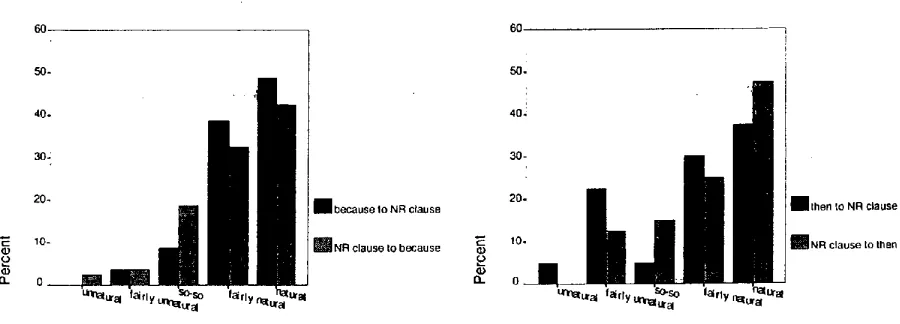
and found no significant connection. Figure 3 shows the distribution of naturalness assessment of the para- phrases for the causal and temporal relation respec- tively. The m a j o r i t y of the NR constructions arenatural
orfairly natural,
which suggests that they [image:6.596.153.494.62.262.2]causal temporal
D..
Paired V a r i a b l e s ~
Means
] Z value ] 2-tail Sig ]
ua7evaa
-3.o2 .oo3Relation [
Table 5: T h e output of the Wilcoxon Matched-Pairs Signed-Ranks Test
• b e c a u s e to NR clause
~ N R clause to because
60
50-
¢) O
0.. 60-
50-
• t h e e to NR clause
~ N R clause to then
Figure 3: The naturalness of the causal paraphrases (left) and the temporal paraphrases (right)
3.3.3 S u m m a r y
We briefly summarise the heuristics drawn from the experiment for expressing the causal a n d t e m p o r a l relations with an NR construction. This is an ac- ceptable realisation in the following circumstances:
e the causal relation holds between two facts and the inferrability of the relation is strong, in which case satellite subordination should be used; or
® the temporal relation holds between two facts, in which case a final position subordination and an a p p r o p r i a t e cue phrase, like 'then', should be used in the NR clause.
We also found that an N R construction can ex- press the c a u s a l / t e m p o r a l relation and the object- a t t r i b u t e elaboration relation at the same time, ir- respective of the inferrability of the relation. Gen- erally speaking, a semantic relation expressed by an NR construction sounds weaker than a hypotactic realisation with a cue phrase. Therefore, if a rela- tion is to be emphasised, N R constructions should not be used.
4 I m p l e m e n t i n g t h e r e s u l t s i n a O A - b a s e d t e x t p l a n n e r
int-modifiers have a mixed character, i.e. like attr-
modifiers they are not essential for identifying the referents, but like unique-modifiers they are not op- tional. Because of their role in supporting the se-
mantics of the main propositions, the selection of
int-modifiers should be a p a r t of the text planning process, where a text s t r u c t u r e is constructed to ful- fill the overall goals for producing the text. How- ever, c o m p a r e d with unique-modifiers, int-modifiers
are less essential for an NP and they can only be added if there are available syntactic slots.
Since embedding deals with attr-modifiers at both a content selection and an a b s t r a c t realisation level, it could coordinate the addition of int-modifiers. Therefore, the text planner could consult the embed- ding module as to whether a p r o p e r t y can be realised as an NP modifier, under the constraints from the NP t y p e and the unique-modifiers t h a t are already there. In other words, the text planner chooses facts to satisfy certain goals and the embedding process decides if the facts can be realised as NP modifiers in an a b s t r a c t sense.
[image:7.596.117.567.141.303.2]We extended the text planner by adding a GA op- erator called embedding mutation, .which ~andomly selects two items mentioning a common entity from a sequence and assumes an embedding on them. Em- beddings are evaluated together with the other prop- erties an RST tree has. In this way, embedding is performed during text planning. The ultimate score of a tree is the sum of positive and negative scores for all the good and bad properties it bears. Since good embeddings are scored higher, they are kept in the sequences for producing,better offspring and. are very likely to be included in t h e final output.
We incorporated the results from the experiment into the GA planner by using them as preferences for evaluating RST trees. We treated inferrability
as an input to the system. If a good embedding can be formed from two facts connected by an RST re- lation (i.e. either of the two cases in Section 3.3.3 is satisfied and the required syntactic slot is free), the embedding is scored higher than the hypotactic realisation. However, this emphasis on embedding might not be appropriate. In a real application en- vironment, other communicative intentions should be incorporated to balance the scoring for differ- ent realisations. And generally, inferrability has to be implemented based on limited domain-dependent knowledge and user configuration.
5 C o n c l u s i o n a n d f u t u r e w o r k
This paper investigates the use of NR modifiers in referring expressions to express certain semantic re- lations. This is a commonly used strategy by human authors, which has not been explored by an NLG system before. Our experiment shows that when the conditions for inferrability etc. are satisfied, certain relations can be expressed through an NR construc- tion as well as a normally used hypotactic construc- tion with little difference in semantics. This facili- tates for an NLG system a way of expressing these semantic relations more concisely and subtly which could not be achieved by other means.
Our experiment is restricted in many ways. One possible extension is to use more cue phrases to cover a wider range of cases for each semantic relation. In reality, the application domain should decide which relations need to be tested.
R e f e r e n c e s
Jean Carletta. 1996. Assessing agreement on classi- fication tasks: the kappa statistic,. Computational Linguistics, 22(2):249-254.
Hua Cheng. 1998. Embedding new information into referring expressions. In Proceedings of COLING- A CL '98, pages 1478-1480, Montreal, Canada. Robert Dale. 1992. Generating Referring Expres-
sions: Constructing Descriptions in a Domain of Objects and Processes. The MIT Press.
M.A.K. Halliday. 1985. An Introduction to Func- tianal- Grammar. Edward..,&rnold (.PUblishers) Ltd., London, UK.
Evelyn Hatch and Anne Lazaraton. 1991. The Re- search Manual: Design and Statistics for Applied Linguistics. Newbury House Publishers.
Eduard Hovy. 1993. Automated discourse genera- tion using discourse structure relations. Artificial Intelligence 63, Special Issue on Natural Language Processing, 1.
: ~Pamela: Jordan,:~:~Bonnie: Dorr, _and John Benoit. ... 1993: A first-pass approach for evaluating ma- chine translation systems. Machine Translation,
8(1-2):49-58.
Alistair Knott. 1996. A Data-Driven Methodol- ogy for Motivating a Set of..Coherence Relations.
Ph.D. thesis, Department of Artificial Intelligence, University of Edinburgh, Edinburgh.
Amichai Kronfeld. 1990. Reference and Compu- tation. Studies in Natural Language Processing. Cambridge University Press.
Sebastian Loebner. 1987. Definites. Journal of Se- mantics, 4:279-306.
William Mann and Sandra Thompson. 1987. Rhetorical structure theory: A theory of text or- ganization. Technical Report ISI/RR-87-190, In- formation Sciences Institute, University of South- ern California.
Chris Mellish, Alistair Knott, Jon Oberlander, and Mick O'Donnell. 1998. Experiments using stochastic search for text planning. In Proceed- ings of the 9th International Workshop on Natural Language Generation, Ontario, Canada.
Massimo Poesio. 2000. Annotating a corpus to de- velop and evaluate discourse entity realization al- gorithms: Issues and preliminary results. In Pro-
ceedings of LREC, Athens, May.
Randolph Quirk, Sidney Greenbaum, Geoffrey Leech, and Jan Svartvik. 1985. A Grammar of Contemporary English. Longman Group Ltd. Donia Scott and Clarisse Sieckenius de Souza. 1990.
Getting the message across in rst-based text gen- eration. In R. Dale, C. Mellish, and M. Zock, edi- tors, Current Research in Natural Language Gen- eration, pages 47-73. Academic Press.
James Shaw and Kathleen McKeown. 1997. An ar- chitecture for aggregation in text generation. In